HASMUKH GOSWAMI COLLEGE
OF ENGINEERING
PRESENTATION ON
FLOOD
Subject: Disaster
Management
Subject Code: 2150003
Class : Mech-A (5th Sem.)
Guided by: Prof. Paresh Patel
GROUP MEMBERS:
1.Koshti Shubham (130240119043)
2.Makwana Maulik (130240119047)
1.Mehta Hitechhu (130240119054)
2.Moghariya Ghanshyam (130240119060)
TOPICS:
• Introduction to FLOOD
• Hazardous by FLOOD
• Disaster Management for FLOOD in
India
• Future directions & STRATEGIES
INTRODUCTION
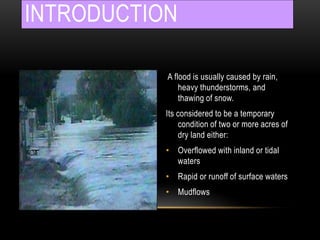
A flood is usually caused by rain,
heavy thunderstorms, and
thawing of snow.
Its considered to be a temporary
condition of two or more acres of
dry land either:
• Overflowed with inland or tidal
waters
• Rapid or runoff of surface waters
• Mudflows
HOW DOES FLOODING
START AND END?
The shore or land by or surrounding a body of water erodes
and this erosion causes waves currents that result in a
flood.
Flood disasters have been increased because of the
expansion of settlements and growth in floodplains.
Floods could be slow or fast but usually occur over a matter
of days.
After the water eventually goes down or dries up. On coastal
floods, low tides and high tides makes a change in
heights.
WHY DOES IT OCCUR??
A flood is too much water in the wrong place.
Sometimes a flood occurs from :
• Sewer (drain) backup
• Collapse of land along the shore of a lake or another
body of water. This results in waves or currents during
a flood
HAZARDOUS BY FLOOD
• Effects on the Environment:
It also makes a mess of the environment. The soil becomes poor
because the oxygen is limited due to so much water. The pH in soil
decreases, rate decomposition of organic matter in flooded soil tends
only to be half that unflooded soil
Trees are effected as well. It effects the height, age, vigor, roots, and
species.
During the growing season flooding is very harmful especially to woody
plants compared a flood in a dormant season.
Floods could carry chemicals from agricultural fields, sewage,etc. and
can’t handle large bodies of water.
Crops die because they can’t survive because of the conditions.
DEATHS DURING FLOODS
Floods often result in death, especially along river banks
and low-lying areas.
Floods kill more Americans than any other natural
disaster each year. You may be surprised but only 6
inches of fast moving water can sweep a person off
their feet and cars will float of move in only two feet of
water.
HERE ARE THE SOME PICTURES SHOWS
HAZARDOUS:
DISASTER MANAGEMENT IN
INDIA
GEOGRAPHICAL 328
FLOOD PRONE 40 12%
PROTECTABLE 32 80%
PROTECTED 16.4 45%
FLOOD AFFECTED
• AVERAGE 7.7
• MAXIMUM 17.5 (1978)
• MINIMUM 1.5 (1965)
FLOOD PRONE AREA - 40 M.Ha.
OTHER
STATES
43.9%
UTTAR PRADESH
21.90%
BIHAR
12.71%
ASSAM
9.40%
WEST BENGAL
7.91% ORISSA
4.18%
FLOOD DAMAGE IN INDIA DURING
1953-2000
52.4
57.23
102.73
53.63
23.37
43.97
86.2
63.17
31.37
94.89
36.61
66.61
7.14
88.43
155.43
211.1
404.43
287.83
632.48
158.19
569
569.02
471.64
888.69
1201.85
1454.76
614.2
840.5
1196.5
1644.88
2491.61
1905.56
4059.27
3748.53
2569.72
4630.32405.33
1708.92
1488.33
3344.53
2536.79
1794.59
3702.31
2952.78
2831.18
5845.982107.86
1415.88
1953
1955
1957
1959
1961
1963
1965
1967
1969
1971
1973
1975
1977
1979
1981
1983
1985
1987
1989
1991
1993
1995
1997
1999
RUPEESINCRORE
YEAR
 INDISCRIMINATE ENCROACHMENT
 INCREASING ECONOMIC AND DEVELOPMENTAL ACTIVITIES
IN FLOOD PLAINS
 LACK OF REGULATIONS
 INADEQUATE DRAINAGE SYSTEM
 INADEQUATE MAINTENANCE
 LACK OF DISASTER PREPAREDNESS
INCREASED VULNERABILITY
CAUSES
• FLOODS CAN NOT BE ABSOLUTELY
CONTROLLED
• FLOODS CAN ONLY BE MANAGED TO
REDUCE FLOOD LOSSES
FLOOD MANAGEMENT
APPROACH
• MODIFY THE FLOODS
• MODIFY THE SUSCEPTIBILITY TO FLOOD
DAMAGE
• MODIFY THE LOSS BURDEN
• BEAR THE LOSS
FLOOD MANAGEMENT
STRATEGIES
FLOOD MANAGEMENT
ORGANISATIONS:
• STATE FLOOD CONTROL DEPARTMENTS
• CENTRAL WATER COMMISSION
• GANGA FLOOD CONTROL COMMISSION
• BRAHMAPUTRA BOARD
• MHA - NDM DIVISION
• STRUCTURAL : PHYSICAL WORKS FOR
MEASURES MODIFYING FLOOD MAGNITUDE
( TO KEEP FLOODS AWAY FROM
PEOPLE )
• NON-STRUCTURAL : PLANNED ACTIVITY TO MODIFY
MEASURES SUSCEPTIBILITY TO FLOOD DAMAGE
( TO KEEP PEOPLE AWAY FROM
FLOODS )
FLOOD MANAGEMENT MEASURES
• DAMS & RESERVOIRS
• EMBANKMENT
• CHANNEL IMPROVEMENT
• RIVER DIVERSION
• INTER BASIN TRANSFER
• ANTI EROSION WORKS
FLOOD MANAGEMENT
STRUCTURAL MEASURES
• FLOOD FORECASTING & WARNING
• FLOOD PLAIN ZONING
• FLOOD FIGHTING
• FLOOD PROOFING
• FLOOD INSURANCE
• RELIEF & REHABILITATION
NON STRUCTURAL MEASURES
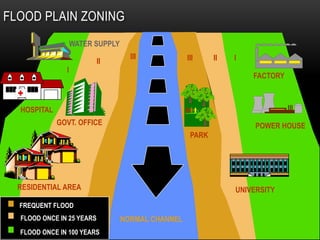
FLOOD PLAIN ZONING
WATER SUPPLY
FACTORY
POWER HOUSE
UNIVERSITYRESIDENTIAL AREA
GOVT. OFFICE
HOSPITAL
NORMAL CHANNEL
PARK
FREQUENT FLOOD
FLOOD ONCE IN 25 YEARS
FLOOD ONCE IN 100 YEARS
III IIII III I
I
FLOOD PLAIN ZONING
PROHIBITIVERESTRICTIVEWARNING WARNINGRESTRICTIVE
I II III II I
RIVER CHANNEL
FLOOD FORECASTING
BEGINNING
• STARTED BY CENTRAL WATER COMMISSION
• YEAR 1958
• RIVER YAMUNA
• FORECASTING STATION DELHI RAILWAY BRIDGE
INDIA
FLOOD FORECASTING AND WARNING
 DATA COLLECTION
 DATA TRANSMISSION
 DATA ANALYSIS & FORECAST FORMULATION
 DISSEMINATION OF FORECAST
STEPS
FLOOD FORECASTING
• HYDROLOGICAL
RIVER WATER LEVEL
RIVER DISCHARGE
• HYDROMETEOROLGICAL
RAINFALL
OTHER RECIPITATION
eg. SNOW, HAIL ETC.
DATA COLLECTION
FLOOD FORECASTING
• WIRELESS
• TELEPHONE
• FAX
DATA TRANSMISSION
 SATELLITE
 TELEGRAPH
 TELEX
FLOOD FORECASTING
DISSEMINATION
FORECAST
CIVIL AUTHORITY
OTHER AGENCIES
PRESS, A I R
DOORDARSHAN
OTHER USERS
LOCAL REPRESENTATIVES
FLOOD FORECASTING AND WARNING
PRESENT SYSTEM - SCHEMATIC DIAGRAM
WEATHER FORECASTS
RIVER STAGE &
DISCHARGE AT
BASE STATION
RIVER STAGE &
DISCHARGE AT
FORECASTING STATIONS RAINFALL
F.M. O. OF I.M.DFLOOD FORECASTING
CENTRES & CONTROL ROOMS
FORMULATION OF
FORECAST
C.E., S.E.
STATE GOVT.
CONTROL ROOM
PRESS RADIO
P & T
POLICE FLOOD COMMITTEE
CIVIL AUTHORITIES
ENGG. AUTHORITIES
DEFENCE
RAILWAYS
INDUSTRIES
F.M.O OF I.M.D
REGIONAL OFFICES
OF I.M.D.
REGIONAL OFFICES
OF I.M.D.
DOORDARSHAN
CWC HQ MINISTRY OF WR
NEW DIRECTIONS FOR DISASTER MANAGEMENT
IN INDIA
• The National Disaster Management Authority (NDMA) has
been set up as the apex body for Disaster Management in
India, with the Prime Minister as its Chairman.
• Disaster Management Authorities will be set up at the
State and District Levels to be headed by the Chief
Ministers and Collectors/Zilla Parishad Chairmen
respectively.
FLOOD MANAGEMENT
SCOPE
• Use of Remote Sensing and GIS
• Research and Development
• Weather / Rainfall Forecasting
• FF Modelling
• Capacity Building
• International Cooperation
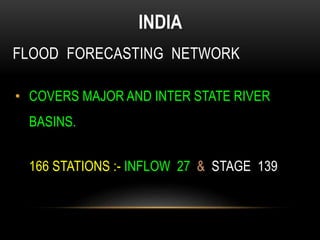
FLOOD FORECASTING NETWORK
• COVERS MAJOR AND INTER STATE RIVER
BASINS.
166 STATIONS :- INFLOW 27 & STAGE 139
INDIA
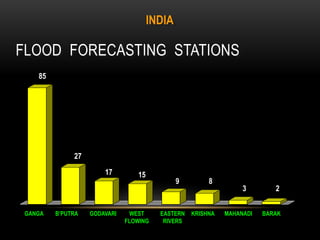
FLOOD FORECASTING STATIONS
INDIA
GANGA B’PUTRA WEST
FLOWING
GODAVARI EASTERN
RIVERS
KRISHNA MAHANADI BARAK
85
27
17 15
9 8
3 2
FLOOD FORECASTING STATIONS
INDIA
35
32
23
1415
11 11
6
4 3 2 12
4
2
MANAGEMENT ACTIVITIES
Pre flood
During
flood
Post flood
FUTURE STRATEGIES:
• Focused Approach
• Basin Wise Action Plan
• Flood Plain Zoning
• Role of Central Government
• Funding of Planned Flood Management Works
• Adequacy of Flood Cushion in Reservoirs
CONTINUE….
• Encourage and consolidate knowledge networks
• Mobilise and train disaster volunteers for more effective
preparedness, mitigation and response (NSS, NCC, Scouts
and Guides, NYK, Civil Defence, Home guards)
• Increased capacity building leads to faster vulnerability
reduction.
• Learn from best practices in disaster preparedness,
mitigation and disaster response
Disaster management  flood

Disaster management flood

  • 1.
  • 2.
    PRESENTATION ON FLOOD Subject: Disaster Management SubjectCode: 2150003 Class : Mech-A (5th Sem.) Guided by: Prof. Paresh Patel
  • 3.
    GROUP MEMBERS: 1.Koshti Shubham(130240119043) 2.Makwana Maulik (130240119047) 1.Mehta Hitechhu (130240119054) 2.Moghariya Ghanshyam (130240119060)
  • 4.
    TOPICS: • Introduction toFLOOD • Hazardous by FLOOD • Disaster Management for FLOOD in India • Future directions & STRATEGIES
  • 5.
    INTRODUCTION A flood isusually caused by rain, heavy thunderstorms, and thawing of snow. Its considered to be a temporary condition of two or more acres of dry land either: • Overflowed with inland or tidal waters • Rapid or runoff of surface waters • Mudflows
  • 6.
    HOW DOES FLOODING STARTAND END? The shore or land by or surrounding a body of water erodes and this erosion causes waves currents that result in a flood. Flood disasters have been increased because of the expansion of settlements and growth in floodplains. Floods could be slow or fast but usually occur over a matter of days. After the water eventually goes down or dries up. On coastal floods, low tides and high tides makes a change in heights.
  • 7.
    WHY DOES ITOCCUR?? A flood is too much water in the wrong place. Sometimes a flood occurs from : • Sewer (drain) backup • Collapse of land along the shore of a lake or another body of water. This results in waves or currents during a flood
  • 8.
    HAZARDOUS BY FLOOD •Effects on the Environment: It also makes a mess of the environment. The soil becomes poor because the oxygen is limited due to so much water. The pH in soil decreases, rate decomposition of organic matter in flooded soil tends only to be half that unflooded soil Trees are effected as well. It effects the height, age, vigor, roots, and species. During the growing season flooding is very harmful especially to woody plants compared a flood in a dormant season. Floods could carry chemicals from agricultural fields, sewage,etc. and can’t handle large bodies of water. Crops die because they can’t survive because of the conditions.
  • 9.
    DEATHS DURING FLOODS Floodsoften result in death, especially along river banks and low-lying areas. Floods kill more Americans than any other natural disaster each year. You may be surprised but only 6 inches of fast moving water can sweep a person off their feet and cars will float of move in only two feet of water.
  • 10.
    HERE ARE THESOME PICTURES SHOWS HAZARDOUS:
  • 12.
    DISASTER MANAGEMENT IN INDIA GEOGRAPHICAL328 FLOOD PRONE 40 12% PROTECTABLE 32 80% PROTECTED 16.4 45% FLOOD AFFECTED • AVERAGE 7.7 • MAXIMUM 17.5 (1978) • MINIMUM 1.5 (1965)
  • 13.
    FLOOD PRONE AREA- 40 M.Ha. OTHER STATES 43.9% UTTAR PRADESH 21.90% BIHAR 12.71% ASSAM 9.40% WEST BENGAL 7.91% ORISSA 4.18%
  • 14.
    FLOOD DAMAGE ININDIA DURING 1953-2000 52.4 57.23 102.73 53.63 23.37 43.97 86.2 63.17 31.37 94.89 36.61 66.61 7.14 88.43 155.43 211.1 404.43 287.83 632.48 158.19 569 569.02 471.64 888.69 1201.85 1454.76 614.2 840.5 1196.5 1644.88 2491.61 1905.56 4059.27 3748.53 2569.72 4630.32405.33 1708.92 1488.33 3344.53 2536.79 1794.59 3702.31 2952.78 2831.18 5845.982107.86 1415.88 1953 1955 1957 1959 1961 1963 1965 1967 1969 1971 1973 1975 1977 1979 1981 1983 1985 1987 1989 1991 1993 1995 1997 1999 RUPEESINCRORE YEAR
  • 15.
     INDISCRIMINATE ENCROACHMENT INCREASING ECONOMIC AND DEVELOPMENTAL ACTIVITIES IN FLOOD PLAINS  LACK OF REGULATIONS  INADEQUATE DRAINAGE SYSTEM  INADEQUATE MAINTENANCE  LACK OF DISASTER PREPAREDNESS INCREASED VULNERABILITY CAUSES
  • 16.
    • FLOODS CANNOT BE ABSOLUTELY CONTROLLED • FLOODS CAN ONLY BE MANAGED TO REDUCE FLOOD LOSSES FLOOD MANAGEMENT APPROACH
  • 17.
    • MODIFY THEFLOODS • MODIFY THE SUSCEPTIBILITY TO FLOOD DAMAGE • MODIFY THE LOSS BURDEN • BEAR THE LOSS FLOOD MANAGEMENT STRATEGIES
  • 18.
    FLOOD MANAGEMENT ORGANISATIONS: • STATEFLOOD CONTROL DEPARTMENTS • CENTRAL WATER COMMISSION • GANGA FLOOD CONTROL COMMISSION • BRAHMAPUTRA BOARD • MHA - NDM DIVISION
  • 19.
    • STRUCTURAL :PHYSICAL WORKS FOR MEASURES MODIFYING FLOOD MAGNITUDE ( TO KEEP FLOODS AWAY FROM PEOPLE ) • NON-STRUCTURAL : PLANNED ACTIVITY TO MODIFY MEASURES SUSCEPTIBILITY TO FLOOD DAMAGE ( TO KEEP PEOPLE AWAY FROM FLOODS ) FLOOD MANAGEMENT MEASURES
  • 20.
    • DAMS &RESERVOIRS • EMBANKMENT • CHANNEL IMPROVEMENT • RIVER DIVERSION • INTER BASIN TRANSFER • ANTI EROSION WORKS FLOOD MANAGEMENT STRUCTURAL MEASURES
  • 21.
    • FLOOD FORECASTING& WARNING • FLOOD PLAIN ZONING • FLOOD FIGHTING • FLOOD PROOFING • FLOOD INSURANCE • RELIEF & REHABILITATION NON STRUCTURAL MEASURES
  • 22.
    FLOOD PLAIN ZONING WATERSUPPLY FACTORY POWER HOUSE UNIVERSITYRESIDENTIAL AREA GOVT. OFFICE HOSPITAL NORMAL CHANNEL PARK FREQUENT FLOOD FLOOD ONCE IN 25 YEARS FLOOD ONCE IN 100 YEARS III IIII III I I
  • 23.
    FLOOD PLAIN ZONING PROHIBITIVERESTRICTIVEWARNINGWARNINGRESTRICTIVE I II III II I RIVER CHANNEL
  • 24.
    FLOOD FORECASTING BEGINNING • STARTEDBY CENTRAL WATER COMMISSION • YEAR 1958 • RIVER YAMUNA • FORECASTING STATION DELHI RAILWAY BRIDGE INDIA
  • 25.
    FLOOD FORECASTING ANDWARNING  DATA COLLECTION  DATA TRANSMISSION  DATA ANALYSIS & FORECAST FORMULATION  DISSEMINATION OF FORECAST STEPS
  • 26.
    FLOOD FORECASTING • HYDROLOGICAL RIVERWATER LEVEL RIVER DISCHARGE • HYDROMETEOROLGICAL RAINFALL OTHER RECIPITATION eg. SNOW, HAIL ETC. DATA COLLECTION
  • 27.
    FLOOD FORECASTING • WIRELESS •TELEPHONE • FAX DATA TRANSMISSION  SATELLITE  TELEGRAPH  TELEX
  • 28.
    FLOOD FORECASTING DISSEMINATION FORECAST CIVIL AUTHORITY OTHERAGENCIES PRESS, A I R DOORDARSHAN OTHER USERS LOCAL REPRESENTATIVES
  • 29.
    FLOOD FORECASTING ANDWARNING PRESENT SYSTEM - SCHEMATIC DIAGRAM WEATHER FORECASTS RIVER STAGE & DISCHARGE AT BASE STATION RIVER STAGE & DISCHARGE AT FORECASTING STATIONS RAINFALL F.M. O. OF I.M.DFLOOD FORECASTING CENTRES & CONTROL ROOMS FORMULATION OF FORECAST C.E., S.E. STATE GOVT. CONTROL ROOM PRESS RADIO P & T POLICE FLOOD COMMITTEE CIVIL AUTHORITIES ENGG. AUTHORITIES DEFENCE RAILWAYS INDUSTRIES F.M.O OF I.M.D REGIONAL OFFICES OF I.M.D. REGIONAL OFFICES OF I.M.D. DOORDARSHAN CWC HQ MINISTRY OF WR
  • 30.
    NEW DIRECTIONS FORDISASTER MANAGEMENT IN INDIA • The National Disaster Management Authority (NDMA) has been set up as the apex body for Disaster Management in India, with the Prime Minister as its Chairman. • Disaster Management Authorities will be set up at the State and District Levels to be headed by the Chief Ministers and Collectors/Zilla Parishad Chairmen respectively.
  • 31.
    FLOOD MANAGEMENT SCOPE • Useof Remote Sensing and GIS • Research and Development • Weather / Rainfall Forecasting • FF Modelling • Capacity Building • International Cooperation
  • 32.
    FLOOD FORECASTING NETWORK •COVERS MAJOR AND INTER STATE RIVER BASINS. 166 STATIONS :- INFLOW 27 & STAGE 139 INDIA
  • 33.
    FLOOD FORECASTING STATIONS INDIA GANGAB’PUTRA WEST FLOWING GODAVARI EASTERN RIVERS KRISHNA MAHANADI BARAK 85 27 17 15 9 8 3 2
  • 34.
  • 35.
  • 36.
    FUTURE STRATEGIES: • FocusedApproach • Basin Wise Action Plan • Flood Plain Zoning • Role of Central Government • Funding of Planned Flood Management Works • Adequacy of Flood Cushion in Reservoirs
  • 37.
    CONTINUE…. • Encourage andconsolidate knowledge networks • Mobilise and train disaster volunteers for more effective preparedness, mitigation and response (NSS, NCC, Scouts and Guides, NYK, Civil Defence, Home guards) • Increased capacity building leads to faster vulnerability reduction. • Learn from best practices in disaster preparedness, mitigation and disaster response