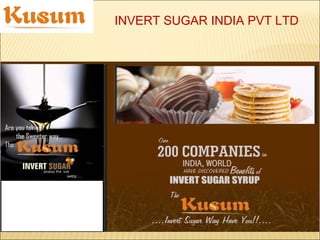
INVERT SUGAR INDIA PVT LTD
 Invert Sugar India Pvt. Ltd. was established in the year 1997. 
 The first plant for producing Invert Sugar Syrup with the state of
art Combined Cycle Technology , developed in-house, was
established in Malanpur Industrial Area, Gwalior & commercial
production started in the year 2001. Madhya Pradesh being
centrally located ; facilities timely deliveries to our Esteemed
Customers having multi location manufacturing facilities in
various States and need just in time supplies of important Raw
Materials such as Invert Sugar .
ISIL has its manufacturing and R&D facilities at Malanpur
Industrial Area, Gwalior (Madhya Pradesh).
ISIL holds In-house Research & Development Status with
Dept. of Scientific and Industrial Research, Ministry of
Science & Technology, New Delhi.
ISIL also holds Tripartite Agreement with National Research
Development Corporation and Bhabha Atomic Research
Centre for the Technology Transfer of Invert Sugar Syrup.
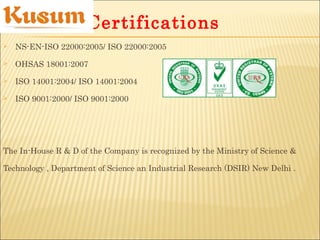
 NS-EN-ISO 22000:2005/ ISO 22000:2005
 OHSAS 18001:2007
 ISO 14001:2004/ ISO 14001:2004
 ISO 9001:2000/ ISO 9001:2000
The In-House R & D of the Company is recognized by the Ministry of Science &
Technology , Department of Science an Industrial Research (DSIR) New Delhi .
Certifications
 INVERT SUGAR SYRUP
 CARAMEL COLOR
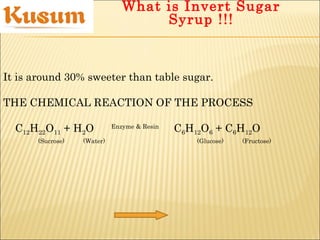
It is around 30% sweeter than table sugar.
THE CHEMICAL REACTION OF THE PROCESS
C12H22O11 + H2O Enzyme & Resin
C6H12O6 + C6H12O
(Sucrose) (Water) (Glucose) (Fructose)
What is Invert Sugar
Syrup !!!
Properties
of
Invert Sugar
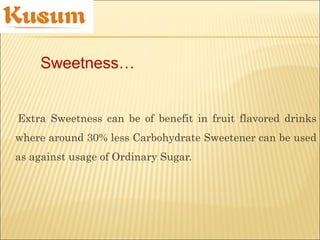
Extra Sweetness can be of benefit in fruit flavored drinks
where around 30% less Carbohydrate Sweetener can be used
as against usage of Ordinary Sugar.
Sweetness…
INVERT SUGAR is used to slow down and minimize the
Crystallization (the major problem area faced by food & beverage
industry), thereby extending the shelf life of the products.

Crystallization Control
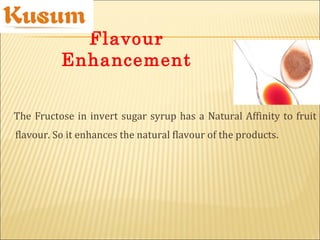
The Fructose in invert sugar syrup has a Natural Affinity to fruit
flavour. So it enhances the natural flavour of the products.
Flavour
Enhancement
Freezing Point
Reduction
A low freezing point is important in beverages (alcoholic or non
alcoholic). The affinity for water of Invert Sugar prevents the
formation of large ice crystals in the final product .
INVERT SUGAR has a lower water activity than that of sucrose, and
so can be used to give a greater preservative effect and hence
increased shelf life by retaining the high quality of the product .
Preservative Effect
 Beverage & Distillery Industry
 Bakery & General Industries
 Tobacco Industries
 Honey Industries
 Pharmaceutical Industries
 Food Processing Industries
 Ice Creams
 Herbal Cosmetics
Application of Invert Sugar in
Various Industries
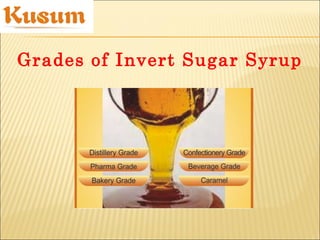
Grades of Invert Sugar Syrup
Sweetening power
Ready-to-use
Easy handling/mixing
Easy automation
Safe and stable microbiology
High concentration
No dust
Easy weight control
Benefits of Invert Sugar
1. Increases productivity
2. Decreases water treatment process :for sugar syrup use
3. Eliminates sugar syrup making process line
4. Decreases operational cost:
5. Enhances natural flavour
6. Decreases flavour consumption
7. Value addition to your product
8. Lots more to be experienced……..
Invert Sugar Syrup: Commercial
Benefits
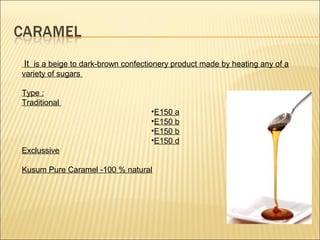
It is a beige to dark-brown confectionery product made by heating any of a
variety of sugars
Type :
Traditional
•E150 a
•E150 b
•E150 b
•E150 d
Exclussive
Kusum Pure Caramel -100 % natural
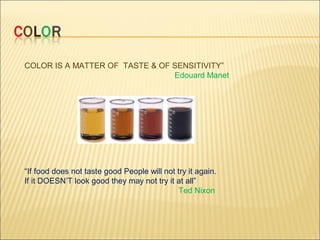
COLOR IS A MATTER OF TASTE & OF SENSITIVITY”
Edouard Manet
“If food does not taste good People will not try it again.
If it DOESN’T look good they may not try it at all”
Ted Nixon
Color Hue & Strength Versatility… from the deepest browns to delicate yellows,
for an excellent alternative to FD&C colors.
Applications Versatility… in every segment of the food industry. It is an
exceptionally stable coloring agent, tolerant of a wide range of physical and
chemical environments.
Handling Versatility…Kusum Caramel Color is easy to handle and store, and
features exceptional microbiological stability.
Economic Versatility… even with all of its functional advantages, kusum
Caramel Color remains cost effective coloring alternatives.
Labeling Versatility… declared simply as "Caramel Color", it's a label-friendly
coloring choice with proven consumer acceptability.
`
 Coloring targets
 How to match it
 Stability
 Storage conditions
 Shelf-life requirements
 Process conditions
 pH
 Ingredients inter-reactions
 Color compatibility
 Color-ingredient compatibility
 Consumer acceptability
 Natural / Real?
 Artificial
 Source:
 Reaction products of carbohydrates during heating
 Usually ammonium and sulfate are added
 Negatively charged
 Positively charged
 We supply ammonium- and sulfur-free caramel, the “REAL”
caramel
 Stability
 Light: very stable
 Heat: very stable
 Acid: use acid stable type
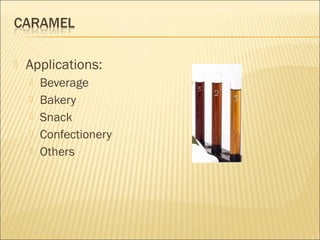
 Applications:
 Beverage
 Bakery
 Snack
 Confectionery
 Others
 Caramel color-Redefined……..
 Caramel Color is a dark brown liquid material derived from controlled heat
treatment of fine grade crystal sugar with or without some additive reagent.
It is defined and regulated as a food color additive. Internationally the
FAO/WHO Joint Expert Committee on Food Additives (JECFA) has divided
Caramel Color into four classes depending on the food grade reactants used
in its manufacturing:
 E150 a - Class I is Plain Caramel Color
 E150 b - Class II is Caustic Sulfite Process Caramel Color
 E150 c - Class III is Ammonia Process Caramel Color
 E150 d - Class IV is Sulfite Ammonia Process Caramel Color
 Class I - Plain /burnt /Caramelized
sugar syrup ( kusum Gold Caramel)
 Class I –Caustic /spirit Caramel
(kusum Caustic Caramel)
 A unique natural manufacturing process is used in creating an ingredient
that has the clean taste as well as color that is ideal for food products.
Since colour is a critical component of any food product
 Kusum Gold Caramel does not have any of the off-notes and side effects
Kusum Gold Caramel is a stable ingredient and perfectly suited for a variety
of food and beverage applications; in other words, any product where taste
as well as color is of the utmost importance. Consumers will enjoy a mouth
watering product - natural color ,flavor , without the negative side effects
associated with some artificial food color substitutes. Kusum gold
caramel is best suited for Bakery and Confectionary Industry .
  
 - This Caramel is produced by a carefully
controlled heat treatment of food finest quality
of crystal sugar in the presence of sulphite
compounds. No ammonium compounds are
used. It carries a negative ionic charge. This
Grade caramel is used in Whiskies,
Brandies, Tea, Distillery Industries.
 Class III Caramel colour is manufactured by the
carefully controlled heat treatment of finest
quality of crystal sugar in the presence of
ammonium compounds and, with or without
acids, alkalies or salts. No sulphite compounds
are used. It is a positive ionic charge caramel
colour and largely used in beer, malted
foods, soy sauce, dairy products and
protein Drinks.
 Caramel colour is the most widely used
colorant in the soft drink industry. Because of
the low pH of most
 carbonated beverages, E150d (Class IV)
caramel colours are required for their acid
stability.
 In addition to providing excellent reddish to brown hues,
caramel colour can enhance soft drinks foaming
 characteristics, mouth feel, and flavour. Typical examples are
colas, root beers, ginger ales, etc.
 In beverage concentrates, caramel colour has an emulsifying
effect with the flavour oil. Caramel colour also
 functions as an emulsifying agent and helps eliminate the
formation of certain types of flocculation.Caramel colour’s light
protective quality also assists in preventing oxidation of the
flavouring components in bottled beverages.
 However, double strength caramel colour also
offers greater cost efficiency, which has
contributed to its rapid acceptance. It is best to
evaluate the specific application to determine
the appropriate caramel colour.
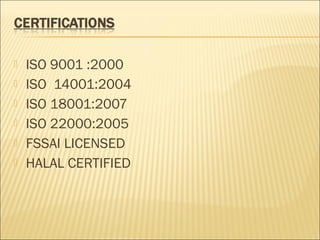
 ISO 9001 :2000
 ISO 14001:2004
 ISO 18001:2007
 ISO 22000:2005
 FSSAI LICENSED
 HALAL CERTIFIED
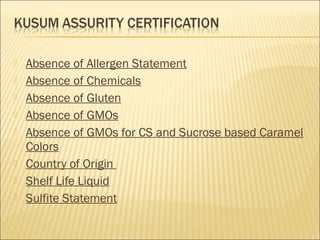
 Absence of Allergen Statement
 Absence of Chemicals
 Absence of Gluten
 Absence of GMOs
 Absence of GMOs for CS and Sucrose based Caramel
Colors
 Country of Origin
 Shelf Life Liquid
 Sulfite Statement
 We do the jobs for you at no extra charge:
 Stabilization of your product
 Selection of right items
 Custom formulation to fit your requirements
Let us take care of your research work!
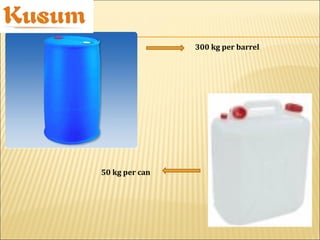
300 kg per barrel
50 kg per can
Slideshar ppt uploaded

Slideshar ppt uploaded

  • 1.
  • 2.
     Invert SugarIndia Pvt. Ltd. was established in the year 1997.   The first plant for producing Invert Sugar Syrup with the state of art Combined Cycle Technology , developed in-house, was established in Malanpur Industrial Area, Gwalior & commercial production started in the year 2001. Madhya Pradesh being centrally located ; facilities timely deliveries to our Esteemed Customers having multi location manufacturing facilities in various States and need just in time supplies of important Raw Materials such as Invert Sugar .
  • 3.
    ISIL has itsmanufacturing and R&D facilities at Malanpur Industrial Area, Gwalior (Madhya Pradesh). ISIL holds In-house Research & Development Status with Dept. of Scientific and Industrial Research, Ministry of Science & Technology, New Delhi. ISIL also holds Tripartite Agreement with National Research Development Corporation and Bhabha Atomic Research Centre for the Technology Transfer of Invert Sugar Syrup.
  • 4.
     NS-EN-ISO 22000:2005/ISO 22000:2005  OHSAS 18001:2007  ISO 14001:2004/ ISO 14001:2004  ISO 9001:2000/ ISO 9001:2000 The In-House R & D of the Company is recognized by the Ministry of Science & Technology , Department of Science an Industrial Research (DSIR) New Delhi . Certifications
  • 5.
     INVERT SUGARSYRUP  CARAMEL COLOR
  • 6.
    It is around30% sweeter than table sugar. THE CHEMICAL REACTION OF THE PROCESS C12H22O11 + H2O Enzyme & Resin C6H12O6 + C6H12O (Sucrose) (Water) (Glucose) (Fructose) What is Invert Sugar Syrup !!!
  • 7.
  • 8.
    Extra Sweetness canbe of benefit in fruit flavored drinks where around 30% less Carbohydrate Sweetener can be used as against usage of Ordinary Sugar. Sweetness…
  • 9.
    INVERT SUGAR isused to slow down and minimize the Crystallization (the major problem area faced by food & beverage industry), thereby extending the shelf life of the products. Crystallization Control
  • 10.
    The Fructose ininvert sugar syrup has a Natural Affinity to fruit flavour. So it enhances the natural flavour of the products. Flavour Enhancement
  • 11.
    Freezing Point Reduction A lowfreezing point is important in beverages (alcoholic or non alcoholic). The affinity for water of Invert Sugar prevents the formation of large ice crystals in the final product .
  • 12.
    INVERT SUGAR hasa lower water activity than that of sucrose, and so can be used to give a greater preservative effect and hence increased shelf life by retaining the high quality of the product . Preservative Effect
  • 13.
     Beverage &Distillery Industry  Bakery & General Industries  Tobacco Industries  Honey Industries  Pharmaceutical Industries  Food Processing Industries  Ice Creams  Herbal Cosmetics Application of Invert Sugar in Various Industries
  • 14.
    Grades of InvertSugar Syrup
  • 15.
    Sweetening power Ready-to-use Easy handling/mixing Easyautomation Safe and stable microbiology High concentration No dust Easy weight control Benefits of Invert Sugar
  • 16.
    1. Increases productivity 2.Decreases water treatment process :for sugar syrup use 3. Eliminates sugar syrup making process line 4. Decreases operational cost: 5. Enhances natural flavour 6. Decreases flavour consumption 7. Value addition to your product 8. Lots more to be experienced…….. Invert Sugar Syrup: Commercial Benefits
  • 17.
    It is abeige to dark-brown confectionery product made by heating any of a variety of sugars Type : Traditional •E150 a •E150 b •E150 b •E150 d Exclussive Kusum Pure Caramel -100 % natural
  • 18.
    COLOR IS AMATTER OF TASTE & OF SENSITIVITY” Edouard Manet “If food does not taste good People will not try it again. If it DOESN’T look good they may not try it at all” Ted Nixon
  • 19.
    Color Hue &Strength Versatility… from the deepest browns to delicate yellows, for an excellent alternative to FD&C colors. Applications Versatility… in every segment of the food industry. It is an exceptionally stable coloring agent, tolerant of a wide range of physical and chemical environments. Handling Versatility…Kusum Caramel Color is easy to handle and store, and features exceptional microbiological stability. Economic Versatility… even with all of its functional advantages, kusum Caramel Color remains cost effective coloring alternatives. Labeling Versatility… declared simply as "Caramel Color", it's a label-friendly coloring choice with proven consumer acceptability. `
  • 20.
     Coloring targets How to match it  Stability  Storage conditions  Shelf-life requirements  Process conditions  pH  Ingredients inter-reactions  Color compatibility  Color-ingredient compatibility
  • 21.
     Consumer acceptability Natural / Real?  Artificial
  • 22.
     Source:  Reactionproducts of carbohydrates during heating  Usually ammonium and sulfate are added  Negatively charged  Positively charged  We supply ammonium- and sulfur-free caramel, the “REAL” caramel
  • 23.
     Stability  Light:very stable  Heat: very stable  Acid: use acid stable type
  • 24.
     Applications:  Beverage Bakery  Snack  Confectionery  Others
  • 25.
     Caramel color-Redefined…….. Caramel Color is a dark brown liquid material derived from controlled heat treatment of fine grade crystal sugar with or without some additive reagent. It is defined and regulated as a food color additive. Internationally the FAO/WHO Joint Expert Committee on Food Additives (JECFA) has divided Caramel Color into four classes depending on the food grade reactants used in its manufacturing:  E150 a - Class I is Plain Caramel Color  E150 b - Class II is Caustic Sulfite Process Caramel Color  E150 c - Class III is Ammonia Process Caramel Color  E150 d - Class IV is Sulfite Ammonia Process Caramel Color
  • 26.
     Class I- Plain /burnt /Caramelized sugar syrup ( kusum Gold Caramel)  Class I –Caustic /spirit Caramel (kusum Caustic Caramel)
  • 27.
     A uniquenatural manufacturing process is used in creating an ingredient that has the clean taste as well as color that is ideal for food products. Since colour is a critical component of any food product  Kusum Gold Caramel does not have any of the off-notes and side effects Kusum Gold Caramel is a stable ingredient and perfectly suited for a variety of food and beverage applications; in other words, any product where taste as well as color is of the utmost importance. Consumers will enjoy a mouth watering product - natural color ,flavor , without the negative side effects associated with some artificial food color substitutes. Kusum gold caramel is best suited for Bakery and Confectionary Industry .
  • 28.
        -This Caramel is produced by a carefully controlled heat treatment of food finest quality of crystal sugar in the presence of sulphite compounds. No ammonium compounds are used. It carries a negative ionic charge. This Grade caramel is used in Whiskies, Brandies, Tea, Distillery Industries.
  • 29.
     Class IIICaramel colour is manufactured by the carefully controlled heat treatment of finest quality of crystal sugar in the presence of ammonium compounds and, with or without acids, alkalies or salts. No sulphite compounds are used. It is a positive ionic charge caramel colour and largely used in beer, malted foods, soy sauce, dairy products and protein Drinks.
  • 30.
     Caramel colouris the most widely used colorant in the soft drink industry. Because of the low pH of most  carbonated beverages, E150d (Class IV) caramel colours are required for their acid stability.
  • 31.
     In additionto providing excellent reddish to brown hues, caramel colour can enhance soft drinks foaming  characteristics, mouth feel, and flavour. Typical examples are colas, root beers, ginger ales, etc.  In beverage concentrates, caramel colour has an emulsifying effect with the flavour oil. Caramel colour also  functions as an emulsifying agent and helps eliminate the formation of certain types of flocculation.Caramel colour’s light protective quality also assists in preventing oxidation of the flavouring components in bottled beverages.
  • 32.
     However, doublestrength caramel colour also offers greater cost efficiency, which has contributed to its rapid acceptance. It is best to evaluate the specific application to determine the appropriate caramel colour.
  • 33.
     ISO 9001:2000  ISO 14001:2004  ISO 18001:2007  ISO 22000:2005  FSSAI LICENSED  HALAL CERTIFIED
  • 34.
     Absence ofAllergen Statement  Absence of Chemicals  Absence of Gluten  Absence of GMOs  Absence of GMOs for CS and Sucrose based Caramel Colors  Country of Origin  Shelf Life Liquid  Sulfite Statement
  • 35.
     We dothe jobs for you at no extra charge:  Stabilization of your product  Selection of right items  Custom formulation to fit your requirements Let us take care of your research work!
  • 36.
    300 kg perbarrel 50 kg per can