Biochemistry
• Study of chemical composition and
reactions occurring in living matter
• Inorganic Compounds
• Do not contain carbon
• Exceptions - CO2, CO, bicarbonates
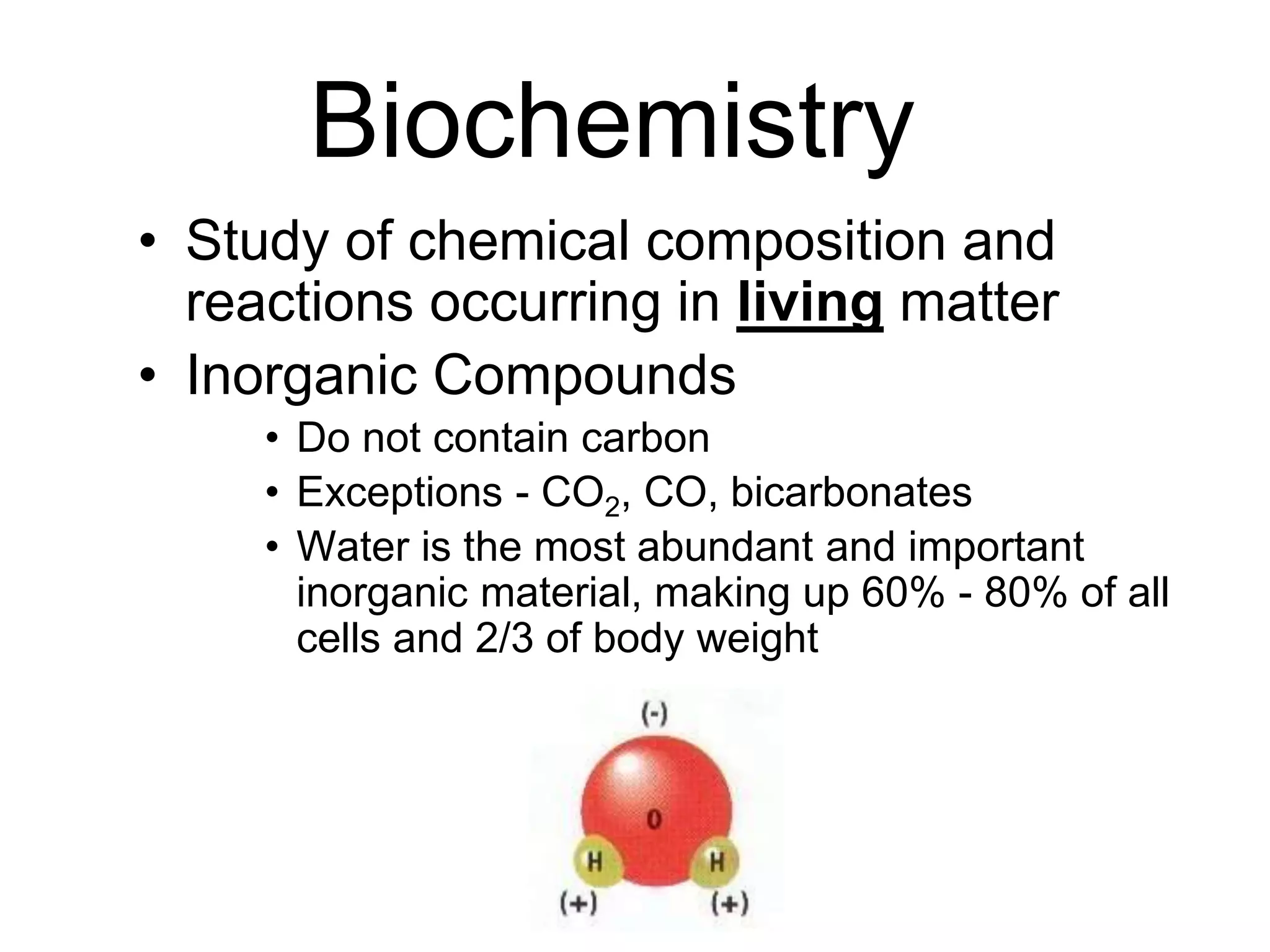
• Water is the most abundant and important
inorganic material, making up 60% - 80% of all
cells and 2/3 of body weight
Organic Compounds
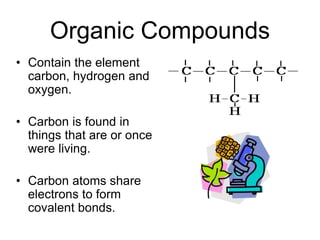
• Contain the element
carbon, hydrogen and
oxygen.
• Carbon is found in
things that are or once
were living.
• Carbon atoms share
electrons to form
covalent bonds.
Organic Compounds
• Organic compounds are composed of
hundreds to thousands of individual
molecules.
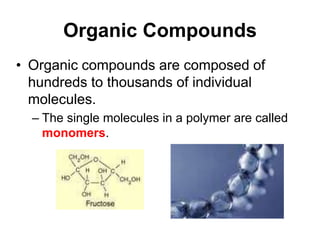
– The single molecules in a polymer are called
monomers.
Organic Compounds
• The long molecules formed by repeating
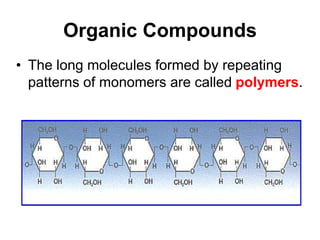
patterns of monomers are called polymers.
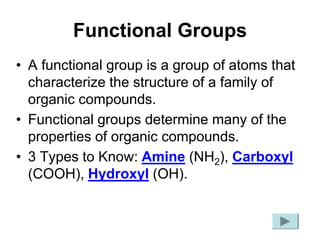
Functional Groups
• A functional group is a group of atoms that
characterize the structure of a family of
organic compounds.
• Functional groups determine many of the
properties of organic compounds.
• 3 Types to Know: Amine (NH2), Carboxyl
(COOH), Hydroxyl (OH).
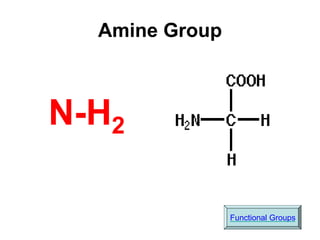
Amine Group
N-H2
Functional Groups
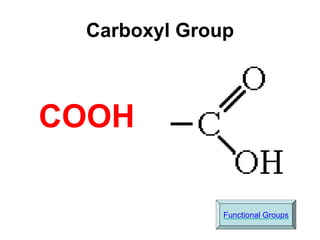
Carboxyl Group
COOH
Functional Groups
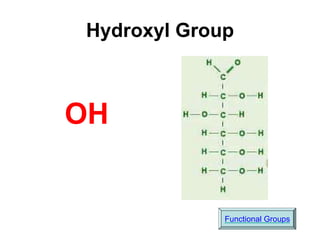
Hydroxyl Group
OH
Functional Groups
Macromolecules
• 4 Types of Organic Compounds or
macromolecules: carbohydrates, lipids,
proteins, and nucleic acids.
– Essential to maintaining life processes: cell
function, storage, energy, homeostasis and
genetic information.
Carbohydrates
• Make up sugars and
starches
• Contain a hydroxyl
(OH) group
• Contain atoms of
carbon, hydrogen, and
oxygen.
• The ratio of the atoms
is 1 C : 2 H : 1 O
• Provide energy to the
cells.
• Dissolve in water
(hydrophilic)
Types of Carbohydrates
• Carbohydrates are classified according
to size.
• One sugar is a monosaccharide (monomer).
• Two sugars make a disaccharide.
• Many sugar molecules linked together form
a polysaccharide (polymer).
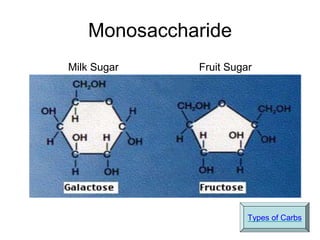
Monosaccharide
Milk Sugar Fruit Sugar
Types of Carbs
Disaccharide
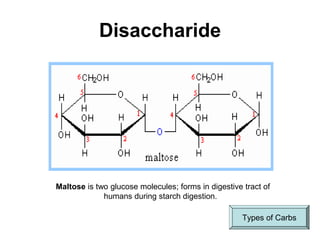
Maltose is two glucose molecules; forms in digestive tract of
humans during starch digestion.
Types of Carbs
Polysaccharide
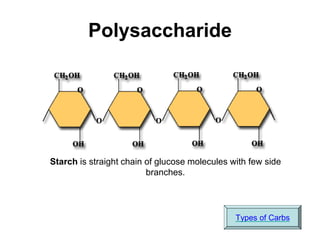
Starch is straight chain of glucose molecules with few side
branches.
Types of Carbs
Lipids
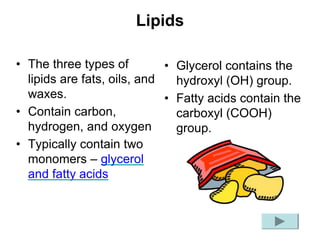
• The three types of
lipids are fats, oils, and
waxes.
• Contain carbon,
hydrogen, and oxygen
• Typically contain two
monomers – glycerol
and fatty acids
• Glycerol contains the
hydroxyl (OH) group.
• Fatty acids contain the
carboxyl (COOH)
group.
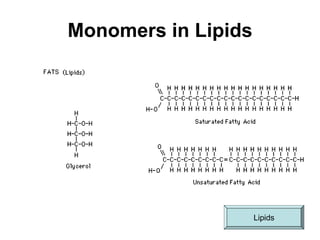
Monomers in Lipids
Lipids
Functions of Lipids
• Lipids store energy
for later use by the
body.
• Lipids also serve as
padding and
protection for the
body.
• Lipids do not
dissolve in water
(hydrophobic), but
may contain parts
that can dissolve in
water.
• The H : O ratio is
higher in lipids than
it is in
carbohydrates.
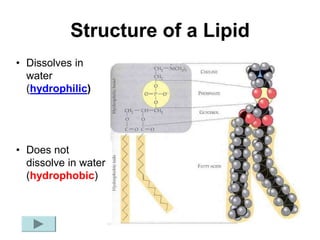
Structure of a Lipid
• Dissolves in
water
(hydrophilic)
• Does not
dissolve in water
(hydrophobic)
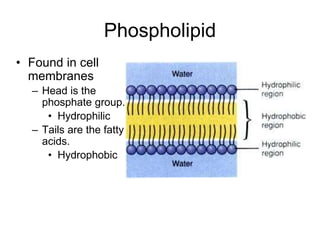
Phospholipid
• Found in cell
membranes
– Head is the
phosphate group.
• Hydrophilic
– Tails are the fatty
acids.
• Hydrophobic
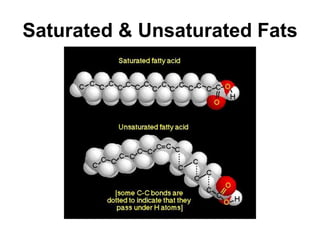
Fatty Acids
• Long chains of carbon atoms with attached
hydrogen atoms (hydrocarbons)
• Saturated fats contain only single bonds
between the carbon atoms.
• Unsaturated fats contain one or more
double or triple bonds between the carbon
atoms.
Saturated & Unsaturated Fats
Proteins
• Proteins are the building materials for the
body.
– Hair, skin, muscles, and organs are made
mostly of proteins.
• Composed of carbon, hydrogen, nitrogen,
and oxygen
• Contain amine (NH2) and carboxyl (COOH)
groups
Function of Proteins
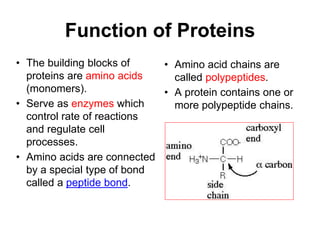
• The building blocks of
proteins are amino acids
(monomers).
• Serve as enzymes which
control rate of reactions
and regulate cell
processes.
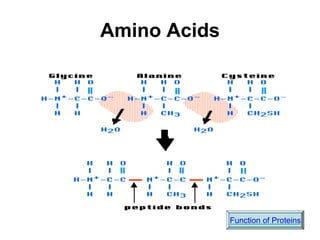
• Amino acids are connected
by a special type of bond
called a peptide bond.
• Amino acid chains are
called polypeptides.
• A protein contains one or
more polypeptide chains.
Amino Acids
Function of Proteins
Types of Proteins
• There are two types of proteins – fibrous
and globular.
• Fibrous protein (found in skin, tendons,
bones, and muscles) does not dissolve
in water (hydrophobic).
• Globular protein (found in enzymes,
some hormones, and hemoglobin) can
dissolve in water (hydrophilic).
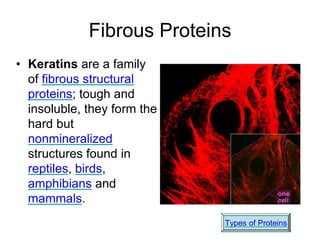
Fibrous Proteins
• Keratins are a family
of fibrous structural
proteins; tough and
insoluble, they form the
hard but
nonmineralized
structures found in
reptiles, birds,
amphibians and
mammals.
Types of Proteins
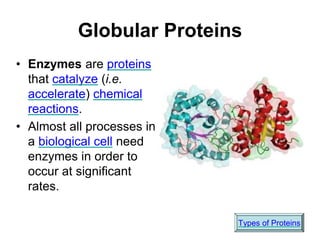
Globular Proteins
• Enzymes are proteins
that catalyze (i.e.
accelerate) chemical
reactions.
• Almost all processes in
a biological cell need
enzymes in order to
occur at significant
rates.
Types of Proteins

Structure of organic compounds ppt

  • 1.
    Biochemistry • Study ofchemical composition and reactions occurring in living matter • Inorganic Compounds • Do not contain carbon • Exceptions - CO2, CO, bicarbonates • Water is the most abundant and important inorganic material, making up 60% - 80% of all cells and 2/3 of body weight
  • 2.
    Organic Compounds • Containthe element carbon, hydrogen and oxygen. • Carbon is found in things that are or once were living. • Carbon atoms share electrons to form covalent bonds.
  • 3.
    Organic Compounds • Organiccompounds are composed of hundreds to thousands of individual molecules. – The single molecules in a polymer are called monomers.
  • 4.
    Organic Compounds • Thelong molecules formed by repeating patterns of monomers are called polymers.
  • 5.
    Functional Groups • Afunctional group is a group of atoms that characterize the structure of a family of organic compounds. • Functional groups determine many of the properties of organic compounds. • 3 Types to Know: Amine (NH2), Carboxyl (COOH), Hydroxyl (OH).
  • 6.
  • 7.
  • 8.
  • 9.
    Macromolecules • 4 Typesof Organic Compounds or macromolecules: carbohydrates, lipids, proteins, and nucleic acids. – Essential to maintaining life processes: cell function, storage, energy, homeostasis and genetic information.
  • 10.
    Carbohydrates • Make upsugars and starches • Contain a hydroxyl (OH) group • Contain atoms of carbon, hydrogen, and oxygen. • The ratio of the atoms is 1 C : 2 H : 1 O • Provide energy to the cells. • Dissolve in water (hydrophilic)
  • 11.
    Types of Carbohydrates •Carbohydrates are classified according to size. • One sugar is a monosaccharide (monomer). • Two sugars make a disaccharide. • Many sugar molecules linked together form a polysaccharide (polymer).
  • 12.
    Monosaccharide Milk Sugar FruitSugar Types of Carbs
  • 13.
    Disaccharide Maltose is twoglucose molecules; forms in digestive tract of humans during starch digestion. Types of Carbs
  • 14.
    Polysaccharide Starch is straightchain of glucose molecules with few side branches. Types of Carbs
  • 15.
    Lipids • The threetypes of lipids are fats, oils, and waxes. • Contain carbon, hydrogen, and oxygen • Typically contain two monomers – glycerol and fatty acids • Glycerol contains the hydroxyl (OH) group. • Fatty acids contain the carboxyl (COOH) group.
  • 16.
  • 17.
    Functions of Lipids •Lipids store energy for later use by the body. • Lipids also serve as padding and protection for the body. • Lipids do not dissolve in water (hydrophobic), but may contain parts that can dissolve in water. • The H : O ratio is higher in lipids than it is in carbohydrates.
  • 18.
    Structure of aLipid • Dissolves in water (hydrophilic) • Does not dissolve in water (hydrophobic)
  • 19.
    Phospholipid • Found incell membranes – Head is the phosphate group. • Hydrophilic – Tails are the fatty acids. • Hydrophobic
  • 20.
    Fatty Acids • Longchains of carbon atoms with attached hydrogen atoms (hydrocarbons) • Saturated fats contain only single bonds between the carbon atoms. • Unsaturated fats contain one or more double or triple bonds between the carbon atoms.
  • 21.
  • 22.
    Proteins • Proteins arethe building materials for the body. – Hair, skin, muscles, and organs are made mostly of proteins. • Composed of carbon, hydrogen, nitrogen, and oxygen • Contain amine (NH2) and carboxyl (COOH) groups
  • 23.
    Function of Proteins •The building blocks of proteins are amino acids (monomers). • Serve as enzymes which control rate of reactions and regulate cell processes. • Amino acids are connected by a special type of bond called a peptide bond. • Amino acid chains are called polypeptides. • A protein contains one or more polypeptide chains.
  • 24.
  • 25.
    Types of Proteins •There are two types of proteins – fibrous and globular. • Fibrous protein (found in skin, tendons, bones, and muscles) does not dissolve in water (hydrophobic). • Globular protein (found in enzymes, some hormones, and hemoglobin) can dissolve in water (hydrophilic).
  • 26.
    Fibrous Proteins • Keratinsare a family of fibrous structural proteins; tough and insoluble, they form the hard but nonmineralized structures found in reptiles, birds, amphibians and mammals. Types of Proteins
  • 27.
    Globular Proteins • Enzymesare proteins that catalyze (i.e. accelerate) chemical reactions. • Almost all processes in a biological cell need enzymes in order to occur at significant rates. Types of Proteins

Editor's Notes

  • #2 Identify the important facts regarding inorganic molecules.
  • #3 Have students differentiate between organic and inorganic compounds.
  • #4 The images at the bottom are examples of monomers. Explain to the students that fructose is a simple sugar. The string of beads are also an example of monomers. As the beads are all the same in the string.
  • #5 Compare the structure of the monomers to the polymers. Use the InterWrite tablet to identify the bonds for students.
  • #6 Use the interactive links to show the diagrams of each functional group.
  • #7 Use InterWrite tablet to a place circle around the functional group.
  • #8 Identify the double bonds, in the carboxyl group.
  • #9 Circle the hydroxyl group in the sugar molecule. Use the InterWrite tablets.
  • #10 Students are to list all of the reasons why macromolecules are essential to life on their Cornell note sheet. Please allow time for this.
  • #11 Emphasize the importance of carbohydrates to living things.
  • #13 Use image to discuss the structure of the two simple sugars and their molecular formula C6H12O6. Use the InterWrite tablet to circle the functional group.
  • #14 Differentiate between the simple sugars and the complex sugar. Again, emphasize the structure and molecular formula C12H22O11. Use the InterWrite tablets to circle the functional group.
  • #15 Identify the structure of the polysaccharide. Highlight for students how the long chains of monomers form this polymer. Also, use the InterWrite tablets to circle the functional group.
  • #16 Emphasize the three types of lipids. Click link for glycerol and fatty acids to show a diagram of the two structures. Use InterWrite tablets to circle the functional group.
  • #17 Discuss the differences between the glycerol and the fatty acids chain.
  • #18 Identify the functions of the lipids. Make sure students have the same information on their Cornell note sheet.
  • #19 Use this slide to discuss the hydrophilic and hydrophobic ends of the lipid molecule. The link will also take you to an image of the phospholipid bilayer.
  • #20 Explain to the students how the phosholipid bilayer works.
  • #21 Differentiate between saturated and unsaturated fats.
  • #22 Explain the structure.
  • #23 Identify the functions of proteins.
  • #24 Additional functions for review. Use the link to an example of three different types of amino acids and a peptide bond.
  • #25 Identify the three amino acids. Explain how they come together to form the peptide bond.
  • #26 This slide is optional. Use if you would like your students to have this additional information regarding proteins. It is also linked to examples of each type of protein.
  • #27 Optional
  • #28 Optional