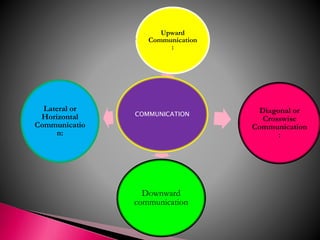
COMMUNICATION
Upward
Communication
:
Diagonal or
Crosswise
Communication
:
Downward
communication
Lateral or
Horizontal
Communicatio
n:
 Traditionally, the emphasis in business
organizations has been on downward
communication. This is because of the
hierarchical nature of organizations where all
communication basically and naturally flows
from top to bottom. It is the communication that
comes from superiors and flows down to the
subordinates.
 Downward communication can be written as
well as oral. The oral communication is mostly
through information channels. The written
downward communication takes the form of
orders, circulars, policy statements, memos and
procedural documents.
 a CEO (Chief Executive Officer) or a General
Manager issuing instructions or sending letters to
various departmental heads.
 Objectives:
 1. To give specific directions about a job
 2. To explain procedures
 3. To apprise subordinates of their performance
 4. To explain the significance of a job given to a
subordinate with respect to the organization’s goals
 As the term suggests, this channel of communication
pushes information upwards. It starts from the people
at the lowest level of an organisation and reaches the
top. An open-door policy, social gatherings, reports,
direct correspondence, counseling, etc. are some
common methods of upward communication.
 Managers have now recognized the importance of this
channel of organizational communication. Until now, it
was felt that the right to communicate had been vested
only in the top management.
 (a) Periodical meetings:
 These are regular meetings with the staff and subordinates
conducted to invite suggestions, opinions or other ideas.
 (b) Written Representations:
 An example of upward communication is a written
representation given by employees to their superiors as regards
what they feel about the work environment and suggestions
regarding improvement.
 (c) Informal Gatherings:
 (d) Suggestion Schemes:
 The employees are encouraged to give suggestions on the
practices and the systems being followed in the organisation. For
this purpose, a suggestion box may be kept.
 (i) Feedback:
 This channel provides the management with the necessary feedback. On
the basis of the feedback, the management can ascertain whether the
subordinates have understood a given set of directions properly.
 (ii) Outlet for held-up Emotions:
 The employees get an opportunity to vent their problems and grievances
when they communicate with the management.
 (iii) Positive Suggestions:
 Quite often, this channel brings forward some very useful suggestions from
the employees, which can be implemented for the organization’s benefit.
 (iv) Harmony:
 Upward communication creates a congenial atmosphere and brings the
management and the employees closer to each other. It creates a positive
psychological factor as employees feel involved.
 This kind of communication takes place between departments or
people on the same level in an organizational structure. It is one of
the most frequently used channels of communication.
 Face-to-face discussions, telephonic talks, periodical meetings,
memos, etc. are the ways of carrying out this type of
communication. It is very important for the smooth functioning of
every organisation as it promotes understanding and coordination
between various departments. Embarrassing situations can arise
when there is a lack of proper horizontal communication.
 For example, the production and the marketing departments must
interact with each other because marketing tactics and production
planning go hand-in-hand.
 (i) To create a friendly atmosphere in an
organisation
 (ii) To cut across departmental barriers
 (iii) To ensure quick feedback
 Diagonal or crosswise communication envisages a
horizontal flow of information as well as interaction
across different levels of an organization’s hierarchy.
Communication flows across different levels in an
organisation among people who may not have direct
reporting relationships. Diagonal communication is
used to speed up the flow of information.
 It makes effective efforts for achieving organizational
goals. A great deal of communication does not follow
the organizational hierarchy, but cuts across well-drawn
lines. Channels of such communication are general
notices, informal meetings, formal conferences, lunch
hour meetings, etc.
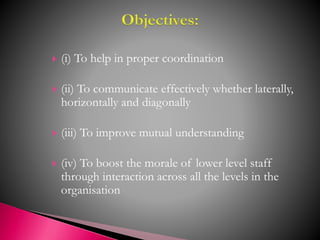
 (i) To help in proper coordination
 (ii) To communicate effectively whether laterally,
horizontally and diagonally
 (iii) To improve mutual understanding
 (iv) To boost the morale of lower level staff
through interaction across all the levels in the
organisation
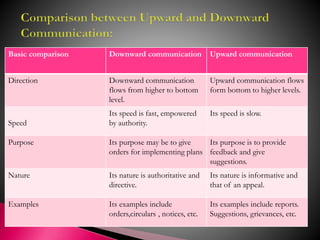
Basic comparison Downward communication Upward communication
Direction Downward communication
flows from higher to bottom
level.
Upward communication flows
form bottom to higher levels.
Speed
Its speed is fast, empowered
by authority.
Its speed is slow.
Purpose Its purpose may be to give
orders for implementing plans
Its purpose is to provide
feedback and give
suggestions.
Nature Its nature is authoritative and
directive.
Its nature is informative and
that of an appeal.
Examples Its examples include
orders,circulars , notices, etc.
Its examples include reports.
Suggestions, grievances, etc.
Directions of Communications

Directions of Communications

  • 2.
  • 3.
     Traditionally, theemphasis in business organizations has been on downward communication. This is because of the hierarchical nature of organizations where all communication basically and naturally flows from top to bottom. It is the communication that comes from superiors and flows down to the subordinates.
  • 4.
     Downward communicationcan be written as well as oral. The oral communication is mostly through information channels. The written downward communication takes the form of orders, circulars, policy statements, memos and procedural documents.
  • 5.
     a CEO(Chief Executive Officer) or a General Manager issuing instructions or sending letters to various departmental heads.  Objectives:  1. To give specific directions about a job  2. To explain procedures  3. To apprise subordinates of their performance  4. To explain the significance of a job given to a subordinate with respect to the organization’s goals
  • 6.
     As theterm suggests, this channel of communication pushes information upwards. It starts from the people at the lowest level of an organisation and reaches the top. An open-door policy, social gatherings, reports, direct correspondence, counseling, etc. are some common methods of upward communication.  Managers have now recognized the importance of this channel of organizational communication. Until now, it was felt that the right to communicate had been vested only in the top management.
  • 7.
     (a) Periodicalmeetings:  These are regular meetings with the staff and subordinates conducted to invite suggestions, opinions or other ideas.  (b) Written Representations:  An example of upward communication is a written representation given by employees to their superiors as regards what they feel about the work environment and suggestions regarding improvement.  (c) Informal Gatherings:  (d) Suggestion Schemes:  The employees are encouraged to give suggestions on the practices and the systems being followed in the organisation. For this purpose, a suggestion box may be kept.
  • 8.
     (i) Feedback: This channel provides the management with the necessary feedback. On the basis of the feedback, the management can ascertain whether the subordinates have understood a given set of directions properly.  (ii) Outlet for held-up Emotions:  The employees get an opportunity to vent their problems and grievances when they communicate with the management.  (iii) Positive Suggestions:  Quite often, this channel brings forward some very useful suggestions from the employees, which can be implemented for the organization’s benefit.  (iv) Harmony:  Upward communication creates a congenial atmosphere and brings the management and the employees closer to each other. It creates a positive psychological factor as employees feel involved.
  • 9.
     This kindof communication takes place between departments or people on the same level in an organizational structure. It is one of the most frequently used channels of communication.  Face-to-face discussions, telephonic talks, periodical meetings, memos, etc. are the ways of carrying out this type of communication. It is very important for the smooth functioning of every organisation as it promotes understanding and coordination between various departments. Embarrassing situations can arise when there is a lack of proper horizontal communication.  For example, the production and the marketing departments must interact with each other because marketing tactics and production planning go hand-in-hand.
  • 10.
     (i) Tocreate a friendly atmosphere in an organisation  (ii) To cut across departmental barriers  (iii) To ensure quick feedback
  • 11.
     Diagonal orcrosswise communication envisages a horizontal flow of information as well as interaction across different levels of an organization’s hierarchy. Communication flows across different levels in an organisation among people who may not have direct reporting relationships. Diagonal communication is used to speed up the flow of information.  It makes effective efforts for achieving organizational goals. A great deal of communication does not follow the organizational hierarchy, but cuts across well-drawn lines. Channels of such communication are general notices, informal meetings, formal conferences, lunch hour meetings, etc.
  • 12.
     (i) Tohelp in proper coordination  (ii) To communicate effectively whether laterally, horizontally and diagonally  (iii) To improve mutual understanding  (iv) To boost the morale of lower level staff through interaction across all the levels in the organisation
  • 13.
    Basic comparison Downwardcommunication Upward communication Direction Downward communication flows from higher to bottom level. Upward communication flows form bottom to higher levels. Speed Its speed is fast, empowered by authority. Its speed is slow. Purpose Its purpose may be to give orders for implementing plans Its purpose is to provide feedback and give suggestions. Nature Its nature is authoritative and directive. Its nature is informative and that of an appeal. Examples Its examples include orders,circulars , notices, etc. Its examples include reports. Suggestions, grievances, etc.