
Organizational Communication
 “Organizational communication is the process by
which activities of an organization are collected and
coordinated to reach the goals of both individuals and
the organization”
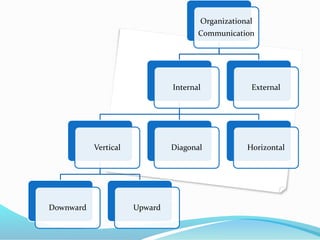
Organizational
Communication
Internal
Vertical
Downward Upward
Diagonal Horizontal
External
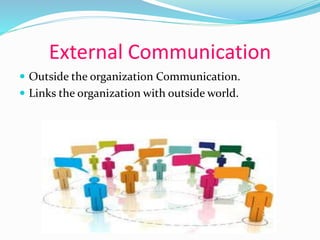
External Communication
 Outside the organization Communication.
 Links the organization with outside world.
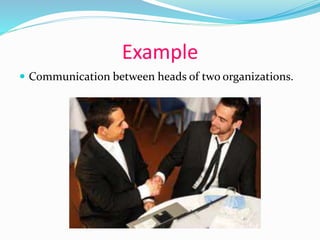
Example
 Communication between heads of two organizations.
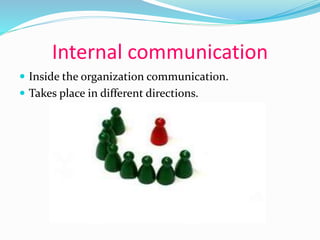
Internal communication
 Inside the organization communication.
 Takes place in different directions.
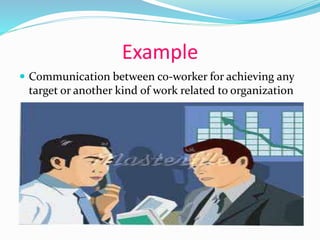
Example
 Communication between co-worker for achieving any
target or another kind of work related to organization
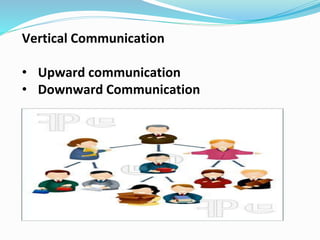
Vertical Communication
• Upward communication
• Downward Communication
Vertical Communication
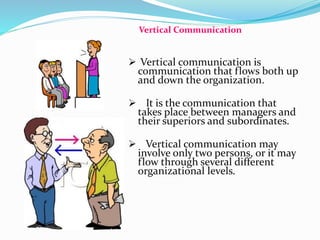
 Vertical communication is
communication that flows both up
and down the organization.
 It is the communication that
takes place between managers and
their superiors and subordinates.
 Vertical communication may
involve only two persons, or it may
flow through several different
organizational levels.
Downward Communication
. It occurs when information flows
down the hierarchy from
high level to low level.
Example: When your boss shares information with you, it’s
downward communication, because your boss, as your supervisor,
is communicating with you as an employee or subordinate.
Diagonal Communication
Diagonal Communication takes place at different
levels in the hierarchy.
It occurs both ways, that is, from the upper level to low
level and vice versa.
The path is mixture of vertical and horizontal
movement.
In large communications various departments need
communication support from each other.
Diagonal communication aims at discussing such
matters as certain to the execution of the plans and
policies of an organization to meet its business
objectives.
For example
 an accounting department manager may communicate
with a marketing department regional manager to
increase the efficiency of a particular decision-making
process. Employees often supplement diagonal
communication with vertical communication to
ensure superiors and subordinates are kept in the loop.
Horizontal Communication
Takes place between individuals of equal
hierarchical rank and is more informal
than either downward or upward
communication
The marketing manager can
communicate with production
manager at the same level without
any difficulty.
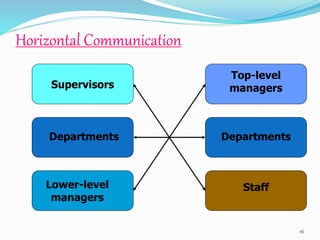
Horizontal Communication
16
Supervisors
Staff
Departments
Top-level
managers
Lower-level
managers
Departments
Importance and advantages of communication in an
organization
 Help individuals to understand and pursue organizational
objectives.
 Cover every management function.
 Organizational culture depends on communications.
 Improve both organizational and individual performance
 Better the communication better the performance
17IIPM SS 11-13 i(A2)
Communicationnetwork 131129101547-phpapp02

Communicationnetwork 131129101547-phpapp02