BUSINESS COMMUNICATION- BARRIERS TO
BUSINESS COMMUNICATION
Dr.MU.Nithyashree
Guest Lecturer
PG Department of Economics
NKR Government Arts College for
Women
Namakkal – 637 001
mnithya.eco@gmail.com
M.A., Economics
BUSINESS COMMUNICATION
UNIT – I
BARRIERS TO BUSINESS COMMUNICATION
2
PG Department of Economics, NKR Govt. Arts College for
Women, Namakkal
Barriersto
Communication
• Barriers or obstacles to communication may
cause break-down, distortions and inaccurate
rumours. The blocks to easy and effective
flow of communication are occurring due to
number of reasons.
3
PG Department of Economics, NKR Govt. Arts College for
Women, Namakkal
Barriers to Business Communication
4
PG Department of Economics, NKR Govt. Arts College for
Women, Namakkal
Barriers to
Business
Communication
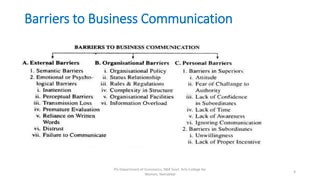
 External Barriers
 Organisational Barriers
 Personal Barriers
5
PG Department of Economics, NKR Govt. Arts College for
Women, Namakkal
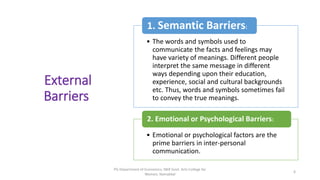
External
Barriers
• The words and symbols used to
communicate the facts and feelings may
have variety of meanings. Different people
interpret the same message in different
ways depending upon their education,
experience, social and cultural backgrounds
etc. Thus, words and symbols sometimes fail
to convey the true meanings.
1. Semantic Barriers:
• Emotional or psychological factors are the
prime barriers in inter-personal
communication.
2. Emotional or Psychological Barriers:
6
PG Department of Economics, NKR Govt. Arts College for
Women, Namakkal
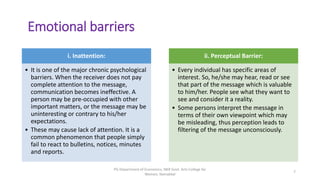
Emotional barriers
i. Inattention:
• It is one of the major chronic psychological
barriers. When the receiver does not pay
complete attention to the message,
communication becomes ineffective. A
person may be pre-occupied with other
important matters, or the message may be
uninteresting or contrary to his/her
expectations.
• These may cause lack of attention. It is a
common phenomenon that people simply
fail to react to bulletins, notices, minutes
and reports.
ii. Perceptual Barrier:
• Every individual has specific areas of
interest. So, he/she may hear, read or see
that part of the message which is valuable
to him/her. People see what they want to
see and consider it a reality.
• Some persons interpret the message in
terms of their own viewpoint which may
be misleading, thus perception leads to
filtering of the message unconsciously.
7
PG Department of Economics, NKR Govt. Arts College for
Women, Namakkal
Emotional
barriers
Cont…
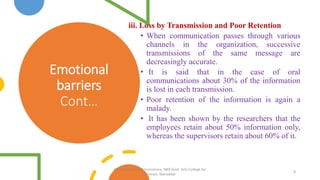
iii. Loss by Transmission and Poor Retention
• When communication passes through various
channels in the organization, successive
transmissions of the same message are
decreasingly accurate.
• It is said that in the case of oral
communications about 30% of the information
is lost in each transmission.
• Poor retention of the information is again a
malady.
• It has been shown by the researchers that the
employees retain about 50% information only,
whereas the supervisors retain about 60% of it.
8
PG Department of Economics, NKR Govt. Arts College for
Women, Namakkal
Emotional barriers Cont…
• Communication is hampered when the receiver evaluates the message before getting the
complete information.
On several occasions, the managers start evaluating the information before reaching proper
understanding.
Decision is taken before knowing the full facts. Such a premature evaluation tends to inhibit the
free flow of information and understanding and distorts the communication.
iv. Premature Evaluation:
• Written words are no substitute for sound face-to-face relationships.
A written communication might fail to explain the purpose of order, procedure or directive.
Written communication often tells what is to be done, but not why it should be done, and lacks
the persuasive quality.
• Moreover, a written communication may be above the comprehension level of the reader and
failure to ascertain the response to communication is also there. Hence, written media must be
considered as supplementary to productive face-to-face relationships.
v. Undue Reliance on the Written Words
9
PG Department of Economics, NKR Govt. Arts College for
Women, Namakkal
Emotional barriers Cont …
… …
vi. Distrust of Communicator
It arises out of all ill-considered judgments or
illogical decisions by the communicator.
Repeated experience of this kind gradually
conditions the receiver to delay action or act
unenthusiastically, thus, making the
communication unsuccessful, though
apparently it is complete.
vii. Failure to Communicate
It is quite an accepted fact that the managers
often fail to transmit the needed messages.
This might be because of laziness on the part
of the communicator or his/her false
assumption that everybody knows it.
10
PG Department of Economics, NKR Govt. Arts College for
Women, Namakkal
Organisational Barriers
i. Organisational Policy
• The general organisational policy regarding communication acts as an overall guideline to
everyone in the organisation regarding how he is normally expected to behave in this matter.
• The policy might be in the form of explicit declaration in writing, or it has to be interpreted from
the behaviour of organisation members, particularly people at the top.
• If this policy is not supportive to the flow of communication in different directions,
communication flow would not be smooth and adequate.
ii. Status Relationship
• In the formal organisation structure, superior-subordinate relationship may cause obstacle to free
and frequent communications, more particularly in upward direction.
• A manager may not communicate to subordinates his/her weaknesses. The subordinates do not feel
free to talk to the superiors.
• They pass on only what the superiors would like to hear and hold back unpleasant facts.
• They may communicate to their superiors only those things which they expect would be
appreciated by the latter.
• When a subordinate does not have trust in his superior, communication becomes less effective.
11
PG Department of Economics, NKR Govt. Arts College for
Women, Namakkal
Organisational Barriers Cont … …
iii. Organisational Rules and Regulations:
• Organisational rules and regulations affect the
flow of communication by prescribing the
subject-matter to be communicated and also the
channel for such communication.
• The rules may restrict the flow of certain
messages and may leave many important ones.
• On the other hand, communication through
proper channel in a specified way prescribed by
these rules delays it and works against the
willingness of the persons to convey the
message.
• This barrier is strongly operative in Indian public
sector enterprises where observance of rules and
regulations is rigid.
12
PG Department of Economics, NKR Govt. Arts College for
Women, Namakkal
Organisational Barriers Cont … …
• In an organisation, where there are a number of managerial levels, the number of filtering
points is many. As a result, the process of communication gets delayed and the chances of
communication getting distorted increase.
• The more complex the organisation structure is, the more difficult it becomes to ensure that
correct information is passed on to the right person at the right time through the right
medium.
iv. Complexity in Organisation Structure:
• Organisational facilities provided for smooth, adequate, clear and timely flow of
communication may take a number of forms such as meetings, conferences, complaint box,
suggestion box, social and cultural gathering, etc.
• If these are not properly emphasised, generally people fail to make effective communication.
v. Organisational Facilities:
13
PG Department of Economics, NKR Govt. Arts College for
Women, Namakkal
Organisational Barriers Cont … …
Information Overload
The managers are overloaded with information from various sources.
They may not always be able to regulate the flow of information.
As a result, the effectiveness of communication is reduced.
They may ignore or misinterpret some of the messages.
Time pressures may also create communication problem.
14
PG Department of Economics, NKR Govt. Arts College for
Women, Namakkal
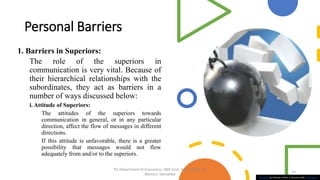
Personal Barriers
1. Barriers in Superiors:
The role of the superiors in
communication is very vital. Because of
their hierarchical relationships with the
subordinates, they act as barriers in a
number of ways discussed below:
i. Attitude of Superiors:
The attitudes of the superiors towards
communication in general, or in any particular
direction, affect the flow of messages in different
directions.
If this attitude is unfavorable, there is a greater
possibility that messages would not flow
adequately from and/or to the superiors.
This Photo by Unknown Author is licensed under CC BY-SA-NC
15
PG Department of Economics, NKR Govt. Arts College for
Women, Namakkal
Personal Barriers Cont … … …
ii. Fear of Challenge to Authority
A person in the organisation always tries to get a higher position
and prestige. As such, the managers generally try to withhold the
information coming down the line or going up—as frequent
passing of information may disclose their weakness.
iii. Lack of Confidence in Subordinates:
The superiors generally perceive (correct or otherwise) that their
subordinates are less competent and less capable, they are not able
to advise their superiors or they may not have some information to
convey.
16
PG Department of Economics, NKR Govt. Arts College for
Women, Namakkal
Personal Barriers Cont … … …
iv. Lack of Time:
• The superiors feel—whether correct or
otherwise—that they are over-burdened with the
work and they have little time to talk to their
subordinates.
v. Lack of Awareness:
• Sometimes the superiors may lack the awareness
about the usefulness and significance of
communication in different directions in general
or particular subject-matter. In such a case,
communication How is blocked.
vi. Ignoring Communication
• Sometimes the superiors —consciously and deli-
berately ignore the communication from their
subordinates to maintain their importance. This
works against the willingness of the subordinates
to communicate.
17
PG Department of Economics, NKR Govt. Arts College for
Women, Namakkal
Vertical communication in either direction can
take place only when the subordinates also
actively participate in this process. There are
various factors in the subordinates that
adversely affect such active participation on
their part.
Barriers in Subordinates
18
PG Department of Economics, NKR Govt. Arts College for
Women, Namakkal
Barriers in Subordinates -Cont…
i. Unwillingness to Communicate
• Sometimes, the subordinates do not communicate upwards
certain information because they are not willing to do so.
• If a subordinate feels that he/she is likely to be adversely
affected by supplying a particular information to his superior,
he/she would not be willing to supply it.
• Information going up is utilised for control purposes and the
subordinates would not be willing to give any information to
their superiors about any unfavorable happening.
• If there is any compulsion to communicate, they would do the
same after modifying the information in such a way so as to
protect their own interest.
19
PG Department of Economics, NKR Govt. Arts College for
Women, Namakkal
Barriers in Subordinates -Cont…
ii. Lack of Proper Incentive:
Lack of motivation to
communicate also refrains the
subordinates from
communicating upwards. If a
novel suggestion by a
subordinate does not evoke any
attention from the superiors,
he/she would not convey it.
20
PG Department of Economics, NKR Govt. Arts College for
Women, Namakkal
THANK YOU
21
PG Department of Economics, NKR Govt. Arts College for
Women, Namakkal
NSM

Barriers to Business Communication

  • 1.
    BUSINESS COMMUNICATION- BARRIERSTO BUSINESS COMMUNICATION Dr.MU.Nithyashree Guest Lecturer PG Department of Economics NKR Government Arts College for Women Namakkal – 637 001 mnithya.eco@gmail.com
  • 2.
    M.A., Economics BUSINESS COMMUNICATION UNIT– I BARRIERS TO BUSINESS COMMUNICATION 2 PG Department of Economics, NKR Govt. Arts College for Women, Namakkal
  • 3.
    Barriersto Communication • Barriers orobstacles to communication may cause break-down, distortions and inaccurate rumours. The blocks to easy and effective flow of communication are occurring due to number of reasons. 3 PG Department of Economics, NKR Govt. Arts College for Women, Namakkal
  • 4.
    Barriers to BusinessCommunication 4 PG Department of Economics, NKR Govt. Arts College for Women, Namakkal
  • 5.
    Barriers to Business Communication  ExternalBarriers  Organisational Barriers  Personal Barriers 5 PG Department of Economics, NKR Govt. Arts College for Women, Namakkal
  • 6.
    External Barriers • The wordsand symbols used to communicate the facts and feelings may have variety of meanings. Different people interpret the same message in different ways depending upon their education, experience, social and cultural backgrounds etc. Thus, words and symbols sometimes fail to convey the true meanings. 1. Semantic Barriers: • Emotional or psychological factors are the prime barriers in inter-personal communication. 2. Emotional or Psychological Barriers: 6 PG Department of Economics, NKR Govt. Arts College for Women, Namakkal
  • 7.
    Emotional barriers i. Inattention: •It is one of the major chronic psychological barriers. When the receiver does not pay complete attention to the message, communication becomes ineffective. A person may be pre-occupied with other important matters, or the message may be uninteresting or contrary to his/her expectations. • These may cause lack of attention. It is a common phenomenon that people simply fail to react to bulletins, notices, minutes and reports. ii. Perceptual Barrier: • Every individual has specific areas of interest. So, he/she may hear, read or see that part of the message which is valuable to him/her. People see what they want to see and consider it a reality. • Some persons interpret the message in terms of their own viewpoint which may be misleading, thus perception leads to filtering of the message unconsciously. 7 PG Department of Economics, NKR Govt. Arts College for Women, Namakkal
  • 8.
    Emotional barriers Cont… iii. Loss byTransmission and Poor Retention • When communication passes through various channels in the organization, successive transmissions of the same message are decreasingly accurate. • It is said that in the case of oral communications about 30% of the information is lost in each transmission. • Poor retention of the information is again a malady. • It has been shown by the researchers that the employees retain about 50% information only, whereas the supervisors retain about 60% of it. 8 PG Department of Economics, NKR Govt. Arts College for Women, Namakkal
  • 9.
    Emotional barriers Cont… •Communication is hampered when the receiver evaluates the message before getting the complete information. On several occasions, the managers start evaluating the information before reaching proper understanding. Decision is taken before knowing the full facts. Such a premature evaluation tends to inhibit the free flow of information and understanding and distorts the communication. iv. Premature Evaluation: • Written words are no substitute for sound face-to-face relationships. A written communication might fail to explain the purpose of order, procedure or directive. Written communication often tells what is to be done, but not why it should be done, and lacks the persuasive quality. • Moreover, a written communication may be above the comprehension level of the reader and failure to ascertain the response to communication is also there. Hence, written media must be considered as supplementary to productive face-to-face relationships. v. Undue Reliance on the Written Words 9 PG Department of Economics, NKR Govt. Arts College for Women, Namakkal
  • 10.
    Emotional barriers Cont… … … vi. Distrust of Communicator It arises out of all ill-considered judgments or illogical decisions by the communicator. Repeated experience of this kind gradually conditions the receiver to delay action or act unenthusiastically, thus, making the communication unsuccessful, though apparently it is complete. vii. Failure to Communicate It is quite an accepted fact that the managers often fail to transmit the needed messages. This might be because of laziness on the part of the communicator or his/her false assumption that everybody knows it. 10 PG Department of Economics, NKR Govt. Arts College for Women, Namakkal
  • 11.
    Organisational Barriers i. OrganisationalPolicy • The general organisational policy regarding communication acts as an overall guideline to everyone in the organisation regarding how he is normally expected to behave in this matter. • The policy might be in the form of explicit declaration in writing, or it has to be interpreted from the behaviour of organisation members, particularly people at the top. • If this policy is not supportive to the flow of communication in different directions, communication flow would not be smooth and adequate. ii. Status Relationship • In the formal organisation structure, superior-subordinate relationship may cause obstacle to free and frequent communications, more particularly in upward direction. • A manager may not communicate to subordinates his/her weaknesses. The subordinates do not feel free to talk to the superiors. • They pass on only what the superiors would like to hear and hold back unpleasant facts. • They may communicate to their superiors only those things which they expect would be appreciated by the latter. • When a subordinate does not have trust in his superior, communication becomes less effective. 11 PG Department of Economics, NKR Govt. Arts College for Women, Namakkal
  • 12.
    Organisational Barriers Cont… … iii. Organisational Rules and Regulations: • Organisational rules and regulations affect the flow of communication by prescribing the subject-matter to be communicated and also the channel for such communication. • The rules may restrict the flow of certain messages and may leave many important ones. • On the other hand, communication through proper channel in a specified way prescribed by these rules delays it and works against the willingness of the persons to convey the message. • This barrier is strongly operative in Indian public sector enterprises where observance of rules and regulations is rigid. 12 PG Department of Economics, NKR Govt. Arts College for Women, Namakkal
  • 13.
    Organisational Barriers Cont… … • In an organisation, where there are a number of managerial levels, the number of filtering points is many. As a result, the process of communication gets delayed and the chances of communication getting distorted increase. • The more complex the organisation structure is, the more difficult it becomes to ensure that correct information is passed on to the right person at the right time through the right medium. iv. Complexity in Organisation Structure: • Organisational facilities provided for smooth, adequate, clear and timely flow of communication may take a number of forms such as meetings, conferences, complaint box, suggestion box, social and cultural gathering, etc. • If these are not properly emphasised, generally people fail to make effective communication. v. Organisational Facilities: 13 PG Department of Economics, NKR Govt. Arts College for Women, Namakkal
  • 14.
    Organisational Barriers Cont… … Information Overload The managers are overloaded with information from various sources. They may not always be able to regulate the flow of information. As a result, the effectiveness of communication is reduced. They may ignore or misinterpret some of the messages. Time pressures may also create communication problem. 14 PG Department of Economics, NKR Govt. Arts College for Women, Namakkal
  • 15.
    Personal Barriers 1. Barriersin Superiors: The role of the superiors in communication is very vital. Because of their hierarchical relationships with the subordinates, they act as barriers in a number of ways discussed below: i. Attitude of Superiors: The attitudes of the superiors towards communication in general, or in any particular direction, affect the flow of messages in different directions. If this attitude is unfavorable, there is a greater possibility that messages would not flow adequately from and/or to the superiors. This Photo by Unknown Author is licensed under CC BY-SA-NC 15 PG Department of Economics, NKR Govt. Arts College for Women, Namakkal
  • 16.
    Personal Barriers Cont… … … ii. Fear of Challenge to Authority A person in the organisation always tries to get a higher position and prestige. As such, the managers generally try to withhold the information coming down the line or going up—as frequent passing of information may disclose their weakness. iii. Lack of Confidence in Subordinates: The superiors generally perceive (correct or otherwise) that their subordinates are less competent and less capable, they are not able to advise their superiors or they may not have some information to convey. 16 PG Department of Economics, NKR Govt. Arts College for Women, Namakkal
  • 17.
    Personal Barriers Cont… … … iv. Lack of Time: • The superiors feel—whether correct or otherwise—that they are over-burdened with the work and they have little time to talk to their subordinates. v. Lack of Awareness: • Sometimes the superiors may lack the awareness about the usefulness and significance of communication in different directions in general or particular subject-matter. In such a case, communication How is blocked. vi. Ignoring Communication • Sometimes the superiors —consciously and deli- berately ignore the communication from their subordinates to maintain their importance. This works against the willingness of the subordinates to communicate. 17 PG Department of Economics, NKR Govt. Arts College for Women, Namakkal
  • 18.
    Vertical communication ineither direction can take place only when the subordinates also actively participate in this process. There are various factors in the subordinates that adversely affect such active participation on their part. Barriers in Subordinates 18 PG Department of Economics, NKR Govt. Arts College for Women, Namakkal
  • 19.
    Barriers in Subordinates-Cont… i. Unwillingness to Communicate • Sometimes, the subordinates do not communicate upwards certain information because they are not willing to do so. • If a subordinate feels that he/she is likely to be adversely affected by supplying a particular information to his superior, he/she would not be willing to supply it. • Information going up is utilised for control purposes and the subordinates would not be willing to give any information to their superiors about any unfavorable happening. • If there is any compulsion to communicate, they would do the same after modifying the information in such a way so as to protect their own interest. 19 PG Department of Economics, NKR Govt. Arts College for Women, Namakkal
  • 20.
    Barriers in Subordinates-Cont… ii. Lack of Proper Incentive: Lack of motivation to communicate also refrains the subordinates from communicating upwards. If a novel suggestion by a subordinate does not evoke any attention from the superiors, he/she would not convey it. 20 PG Department of Economics, NKR Govt. Arts College for Women, Namakkal
  • 21.
    THANK YOU 21 PG Departmentof Economics, NKR Govt. Arts College for Women, Namakkal NSM