Ecology and Ecosystem
Unit-2.1
Sub: Environmental Science
Ecology and Ecosystems
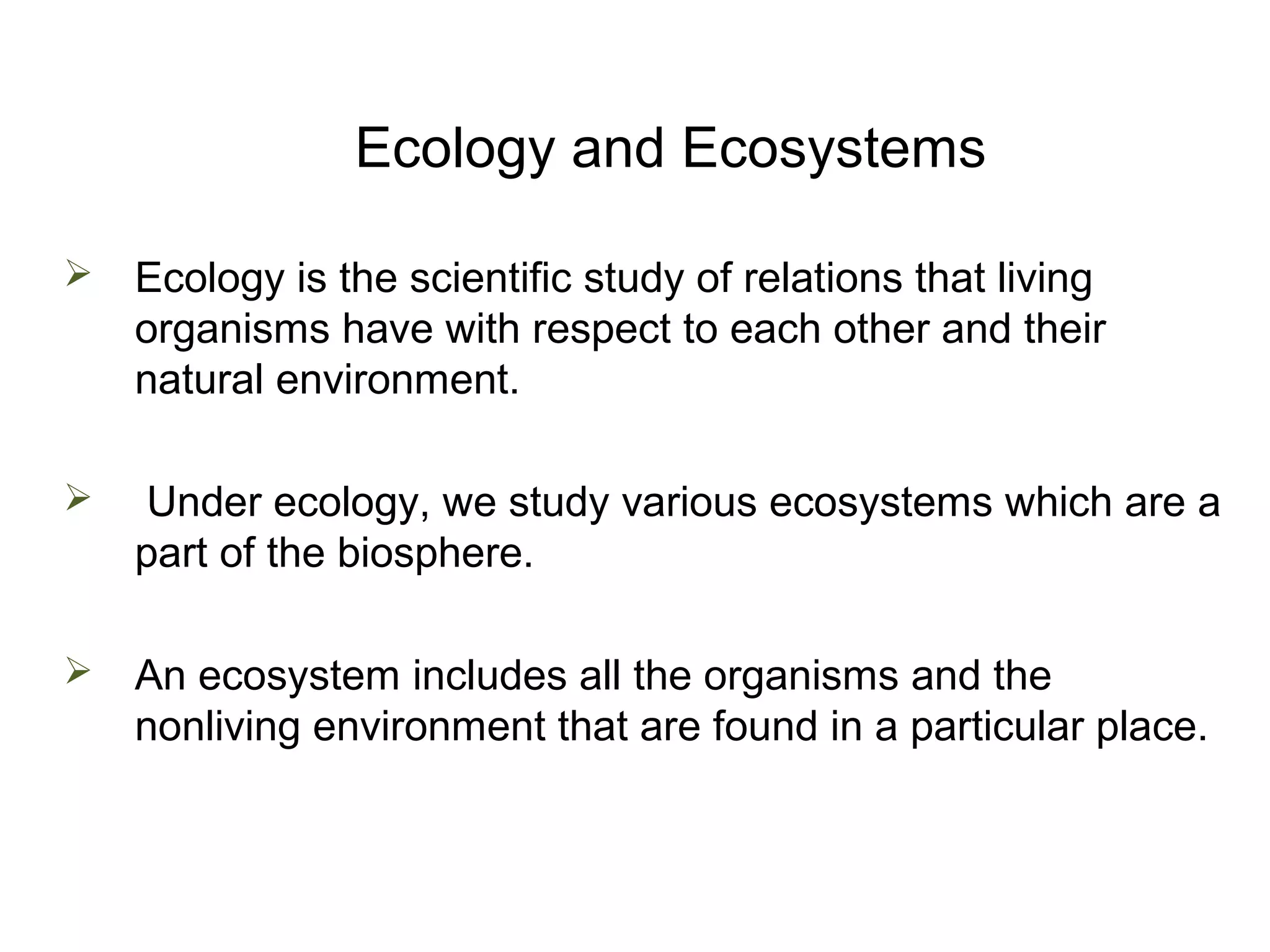
 Ecology is the scientific study of relations that living
organisms have with respect to each other and their
natural environment.
 Under ecology, we study various ecosystems which are a
part of the biosphere.
 An ecosystem includes all the organisms and the
nonliving environment that are found in a particular place.
Ecological Succession
1
Ecological Succession
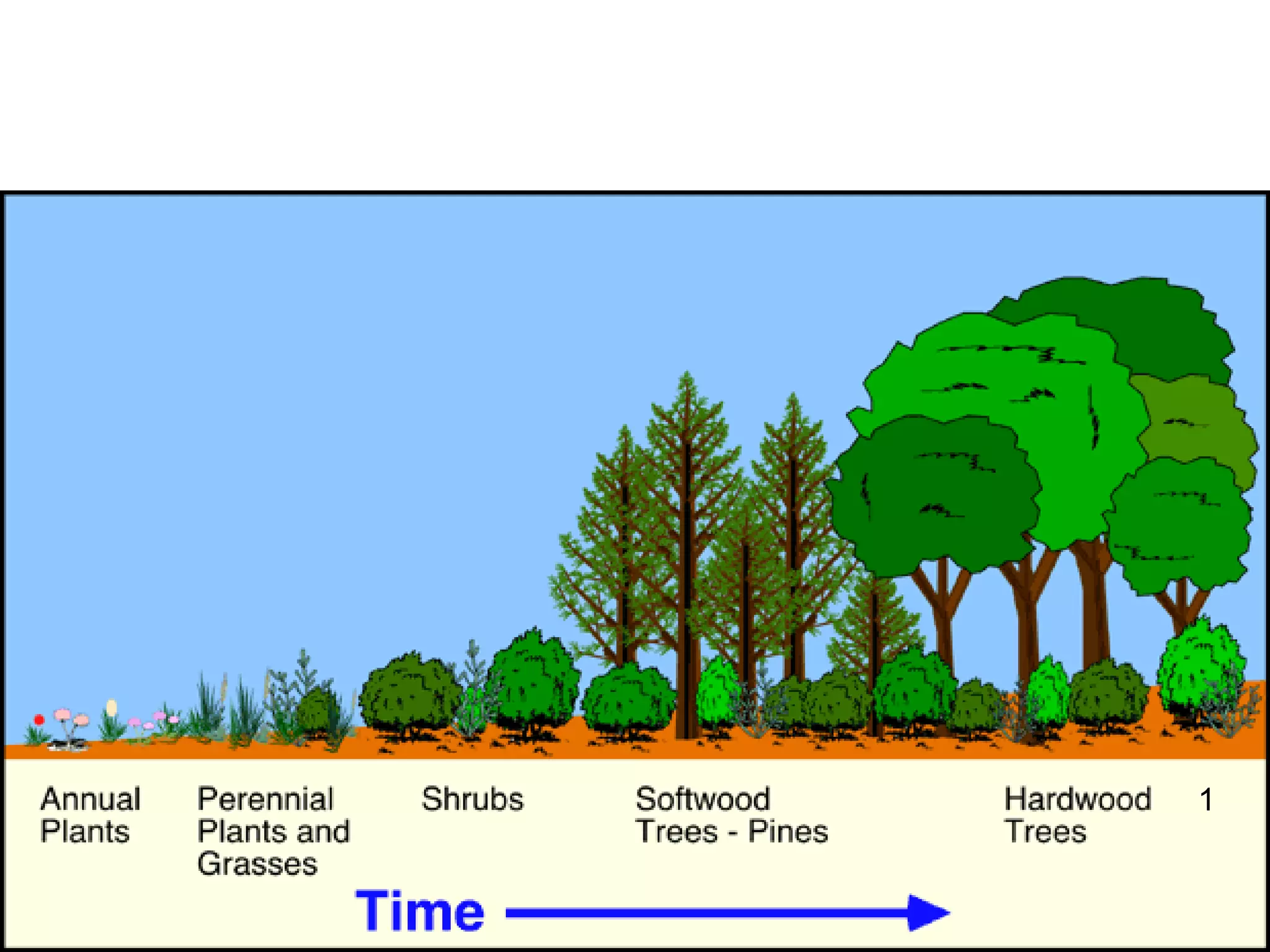
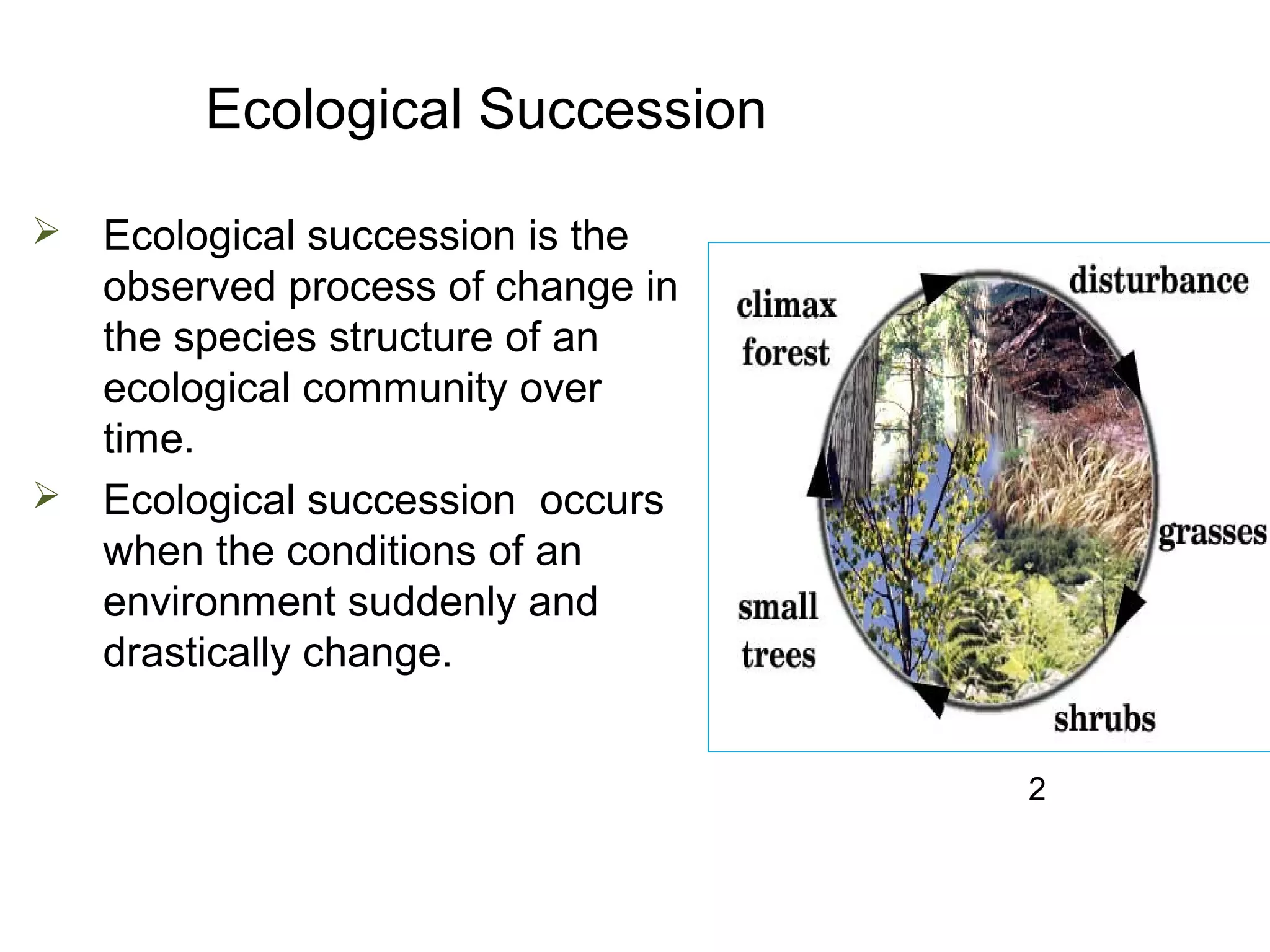
 Ecological succession is the
observed process of change in
the species structure of an
ecological community over
time.
 Ecological succession occurs
when the conditions of an
environment suddenly and
drastically change.
2
Trophic Levels
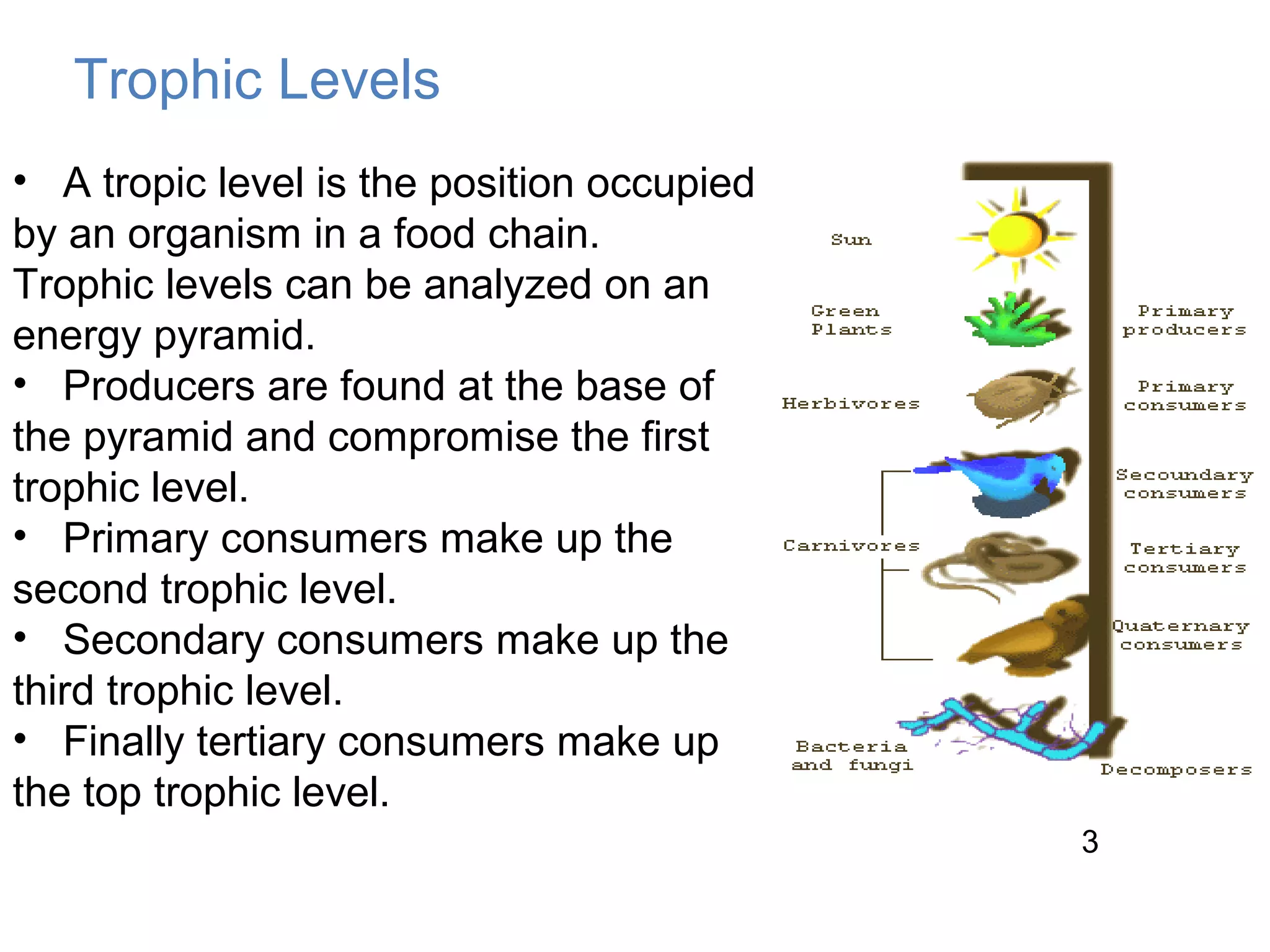
• A tropic level is the position occupied
by an organism in a food chain.
Trophic levels can be analyzed on an
energy pyramid.
• Producers are found at the base of
the pyramid and compromise the first
trophic level.
• Primary consumers make up the
second trophic level.
• Secondary consumers make up the
third trophic level.
• Finally tertiary consumers make up
the top trophic level.
3
Food Chain
 A food chain shows the feeding relationship between
different living things in a particular habitat.
 Food chains show how energy is passed from the sun
to producers, from producers to consumers, and from
consumers to decomposers.
 In any ecosystem, many food chains overlap. When
this happens, the food chain forms a food web.
Grazing Food Chain
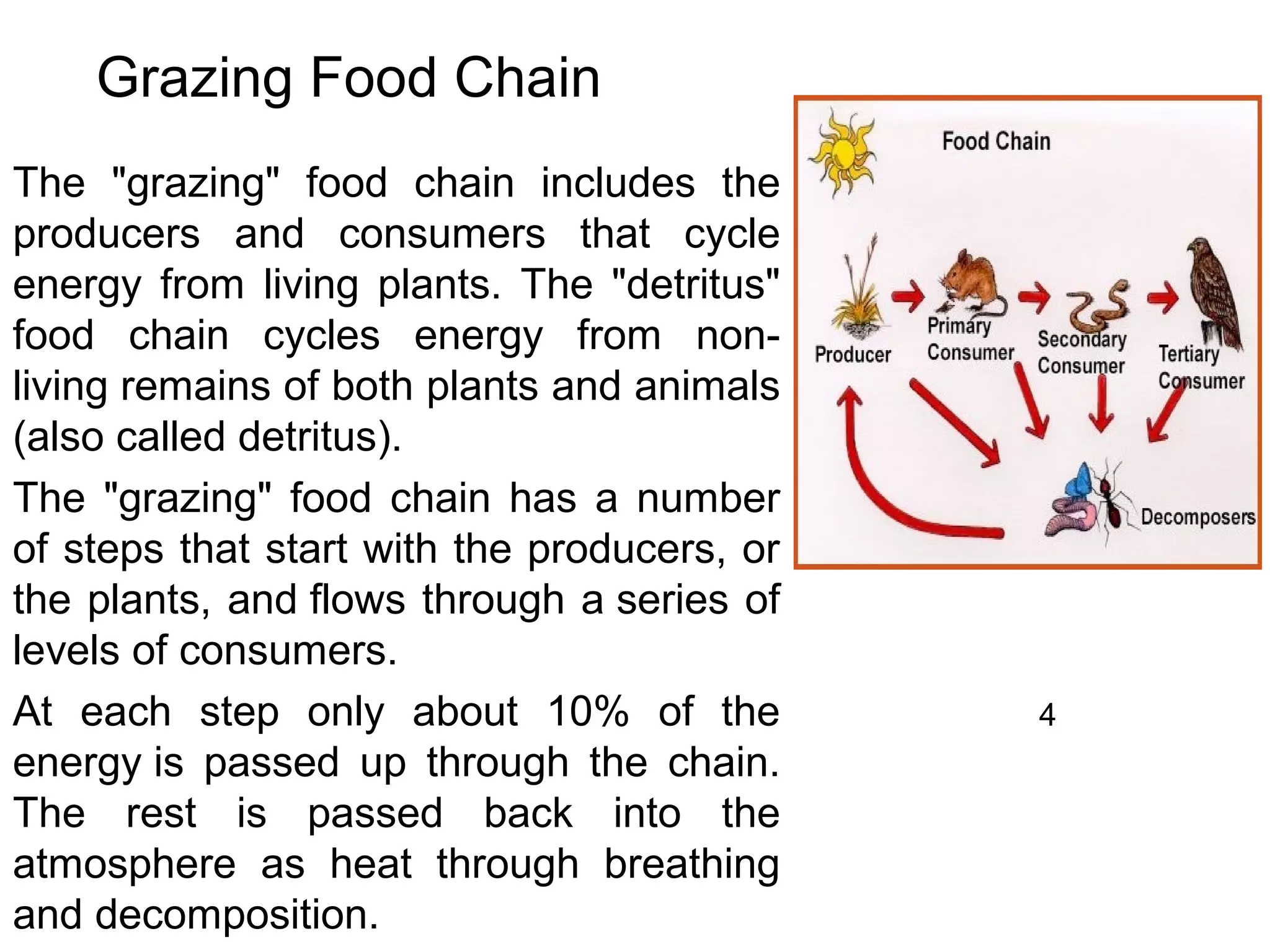
The "grazing" food chain includes the
producers and consumers that cycle
energy from living plants. The "detritus"
food chain cycles energy from non-
living remains of both plants and animals
(also called detritus).
The "grazing" food chain has a number
of steps that start with the producers, or
the plants, and flows through a series of
levels of consumers.
At each step only about 10% of the
energy is passed up through the chain.
The rest is passed back into the
atmosphere as heat through breathing
and decomposition.
4
In the first step plants convert the sun’s energy to chemical
energy through a process called photosynthesis. The
chemical energy is stored both as food and as structural
elements in the plant.
The next step involves the primary consumers, animals that
eat only plants.
At step three are the secondary consumers, also called
predators; these animals eat primary consumers.
At step four are the tertiary consumers that eat secondary
consumers, and sometimes primary consumers as well
Detritus food chain
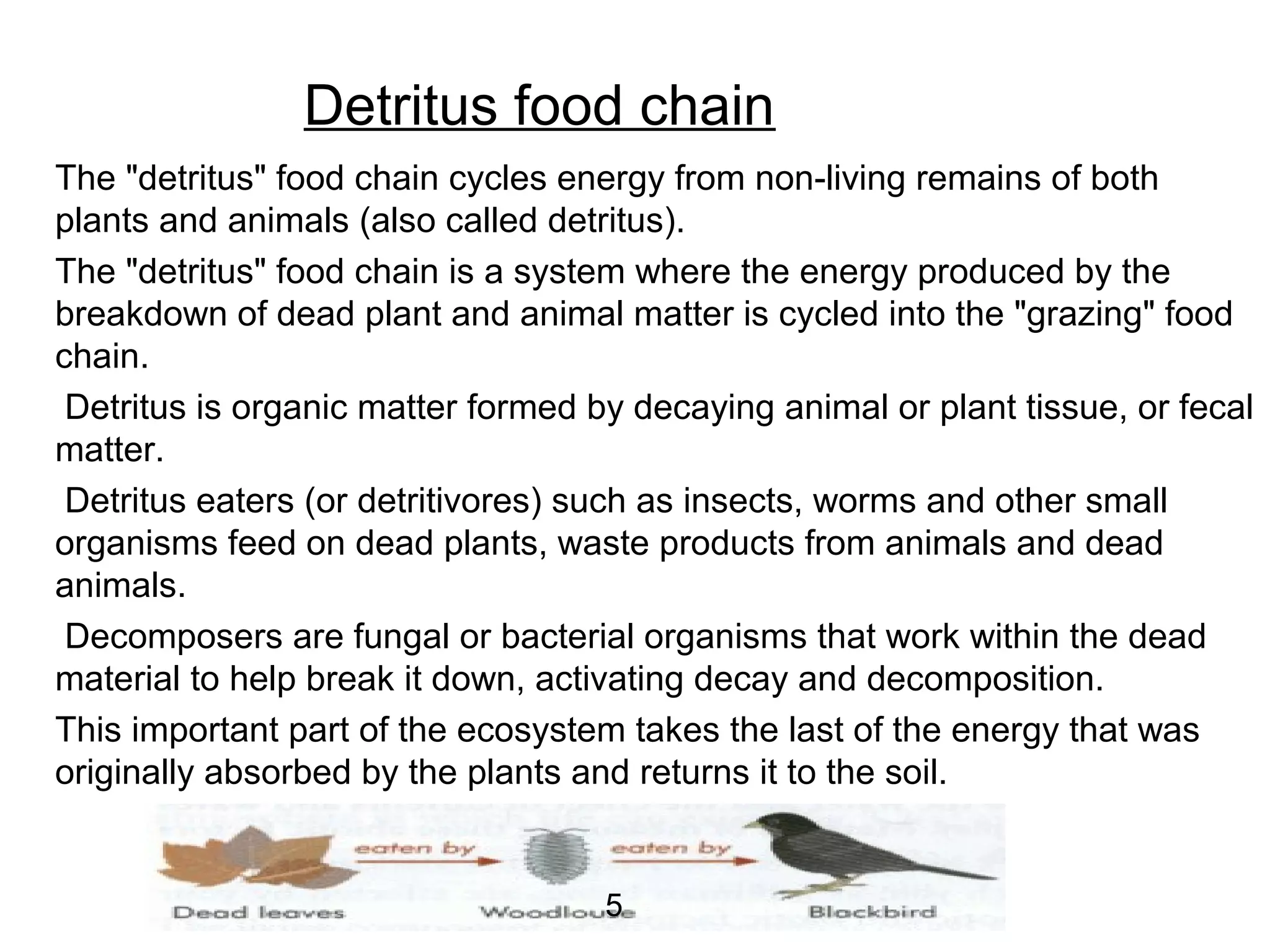
The "detritus" food chain cycles energy from non-living remains of both
plants and animals (also called detritus).
The "detritus" food chain is a system where the energy produced by the
breakdown of dead plant and animal matter is cycled into the "grazing" food
chain.
Detritus is organic matter formed by decaying animal or plant tissue, or fecal
matter.
Detritus eaters (or detritivores) such as insects, worms and other small
organisms feed on dead plants, waste products from animals and dead
animals.
Decomposers are fungal or bacterial organisms that work within the dead
material to help break it down, activating decay and decomposition.
This important part of the ecosystem takes the last of the energy that was
originally absorbed by the plants and returns it to the soil.
5
Characteristics of Detritus Food Chain
a)Primary source of energy is dead organic matter called
'detritus' which are fallen leaves, plant parts or dead animal
bodies.
b) Primary consumers are 'detritivores' including protozoans,
bacteria, fungi, etc which feed upon the detritus saprophytically.
c) Detritivores are in turn eaten by secondary consumers such as
insect larvae, nematodes, etc.
d) Detritus food chains are generally shorter than grazing food
chains
e) In nature, detritus food chains are vital as the dead organic
matter of grazing food chain is acted upon by the detritivores to
recycle the inorganic elements into the ecosystem.
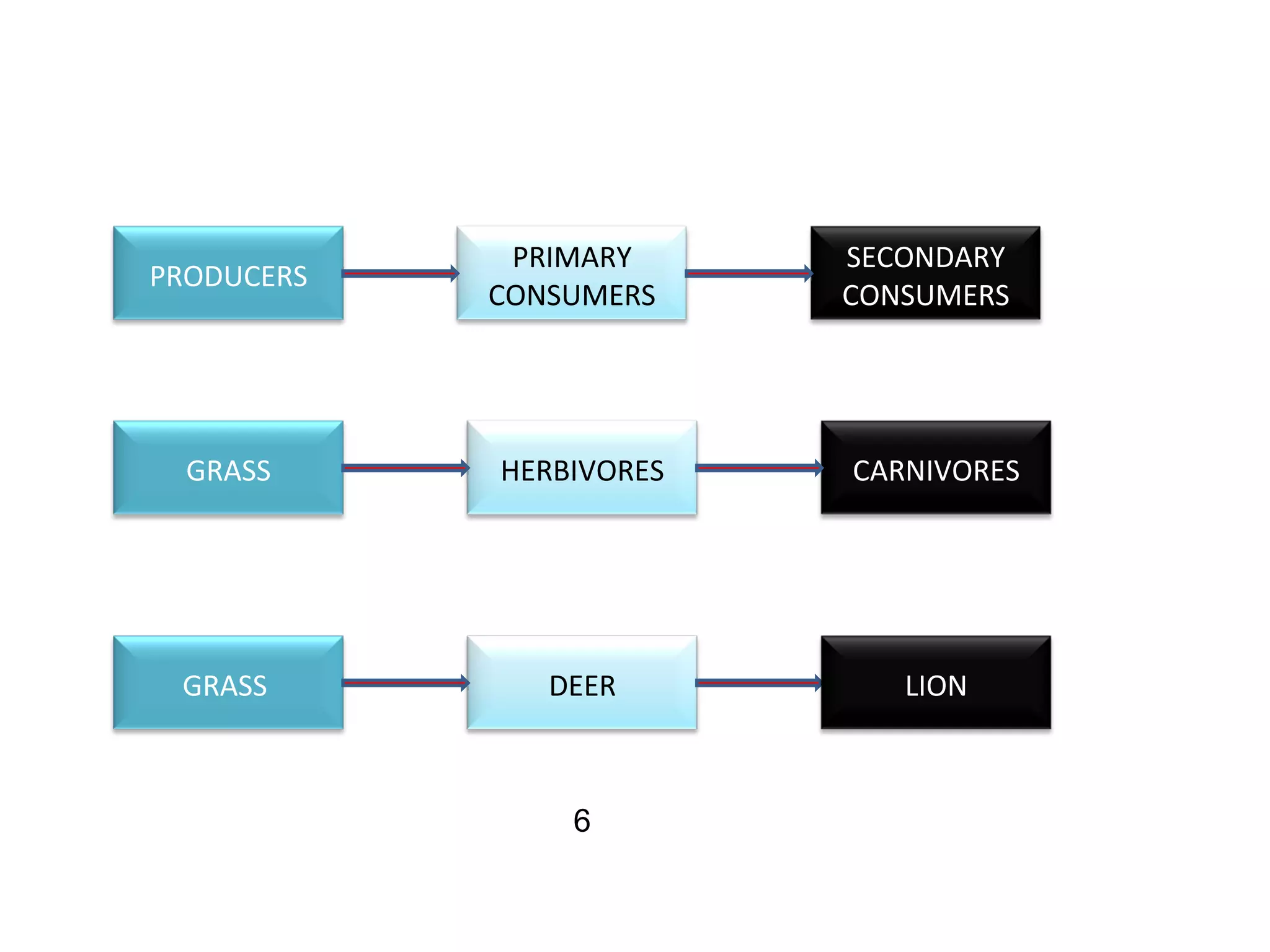
PRODUCERS
GRASS
GRASS
PRIMARY
CONSUMERS
SECONDARY
CONSUMERS
CARNIVORES
DEER
HERBIVORES
LION
6
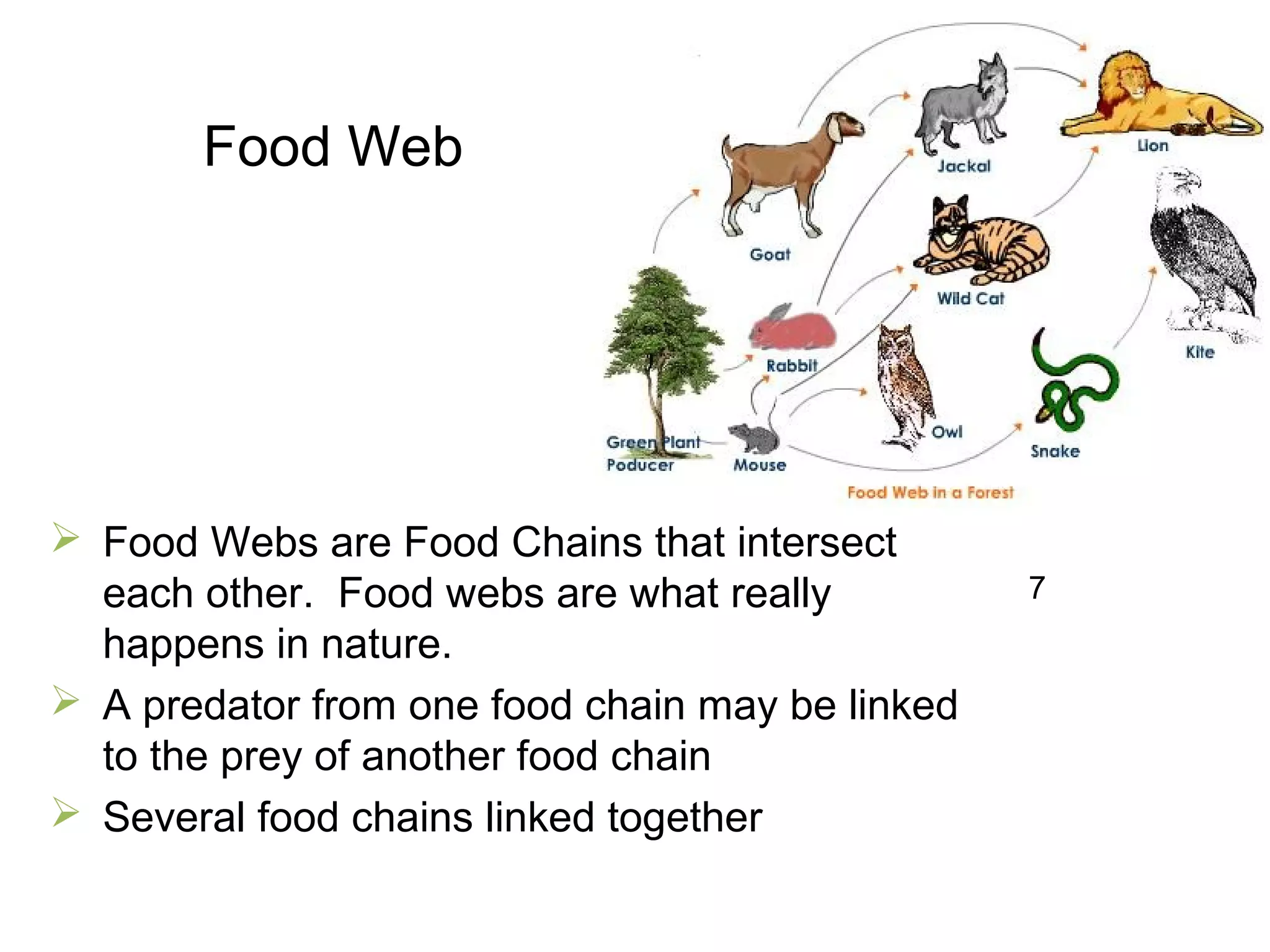
Food Web
 Food Webs are Food Chains that intersect
each other. Food webs are what really
happens in nature.
 A predator from one food chain may be linked
to the prey of another food chain
 Several food chains linked together
7
Ecological pyramids
An ecological pyramid is a graphical
representation designed to show…….
 the number of organisms,
 energy relationships, and
 biomass of an ecosystem.
They are also called Eltonian pyramids after
Charles Elton, who developed the concept of
ecological pyramids.
Charles Elton (1927) developed the concept of
ecological pyramids who noted that "…the
animals at the base of a food chain are
relatively abundant while those at the end are
relatively few in number…"
8
Producer organisms (usually green plants) form the base of
the pyramid, With succeeding levels above representing the
different trophic levels (respective position of the organisms
within ecological food chains).
Succeeding levels in the pyramid represent the dependence
of the organisms at a given level on the organisms at lower
level.
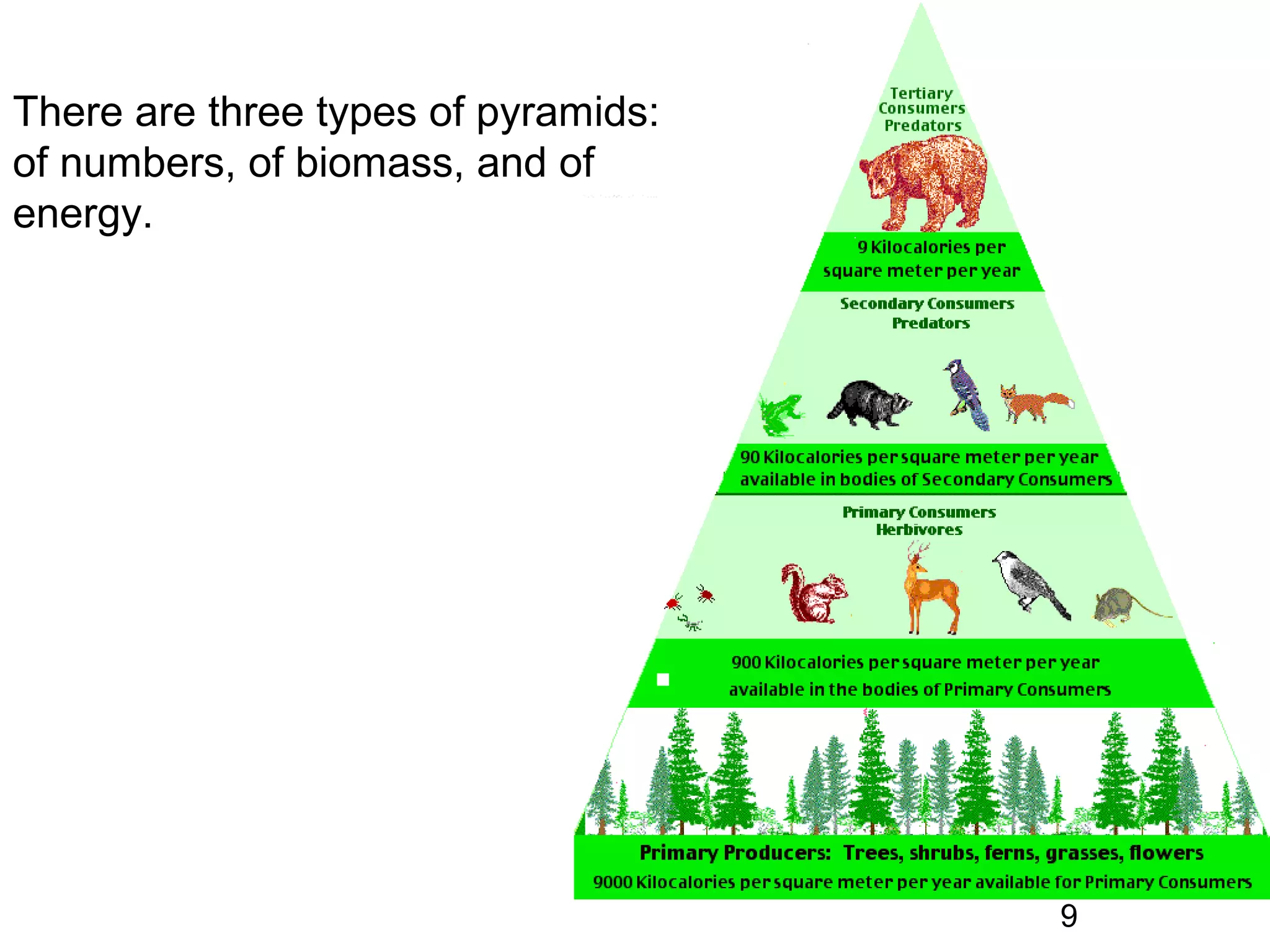
There are three types of pyramids:
of numbers, of biomass, and of
energy.
9
Pyramid of Biomass
 Biomass is (is the mass of living biological organisms in
a given area or ecosystem at a given time) renewable
organic (living) material.
 A pyramid of biomass is a representation of the amount
of energy contained in biomass, at different trophic
levels for a particular time.
 It is measured in grams per meter2, or calories per
meter2. This demonstrates the amount of matter lost
between trophic levels.
 Each level is dependent on its lower level for energy,
hence the lower level determines how much energy will
be available to the upper level. Also, energy is lost in
transfer so the amount of energy is less higher up the
pyramid.
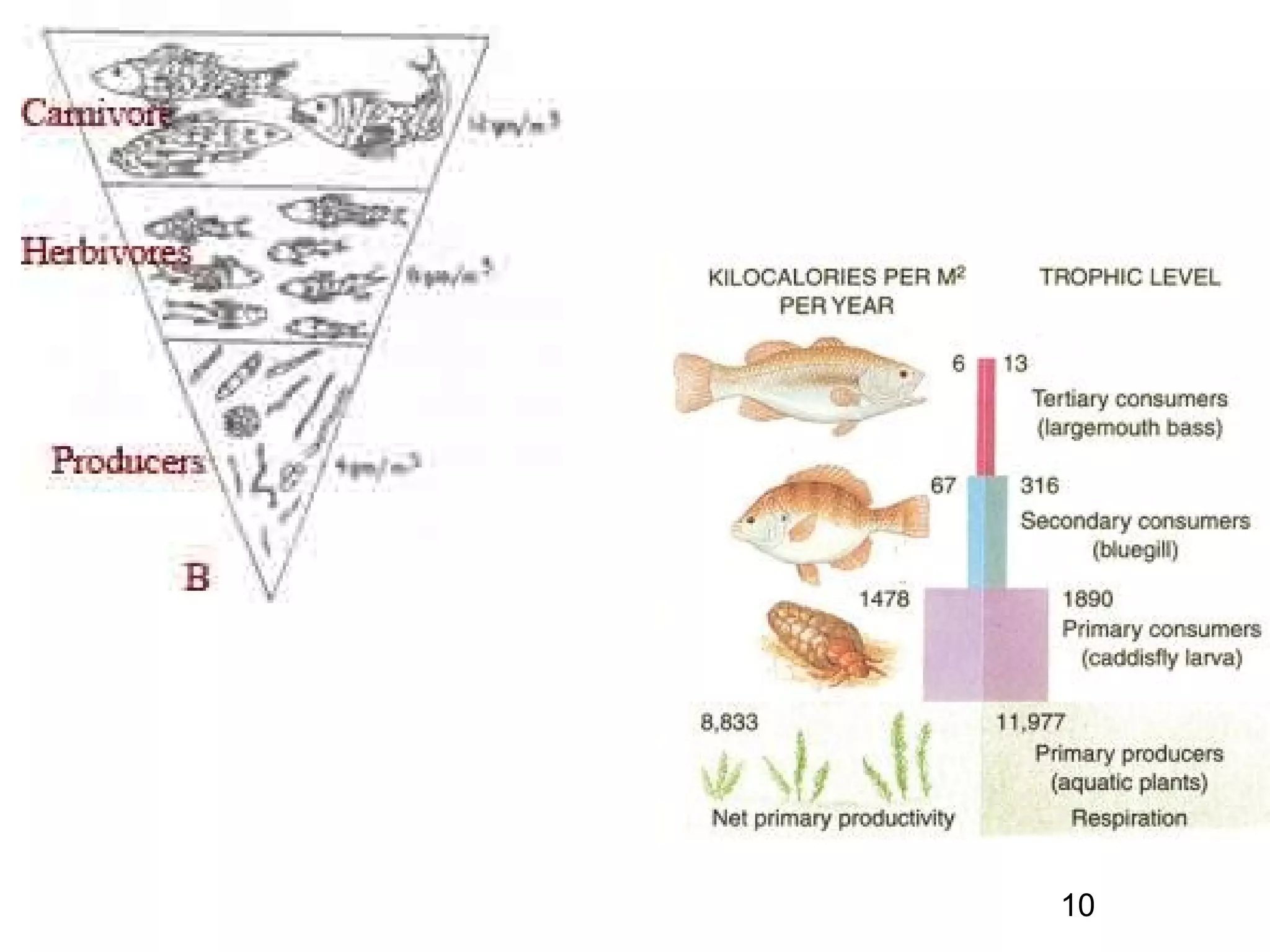
 There are two types of biomass pyramids: upright and
inverted.
 An upright pyramid is one where the combined weight of
producers is larger than the combined weight of
consumers. An example is a forest ecosystem.
 An inverted pyramid is one where the combined weight of
producers is smaller than the combined weight of
consumers. An example is an aquatic ecosystem.
10
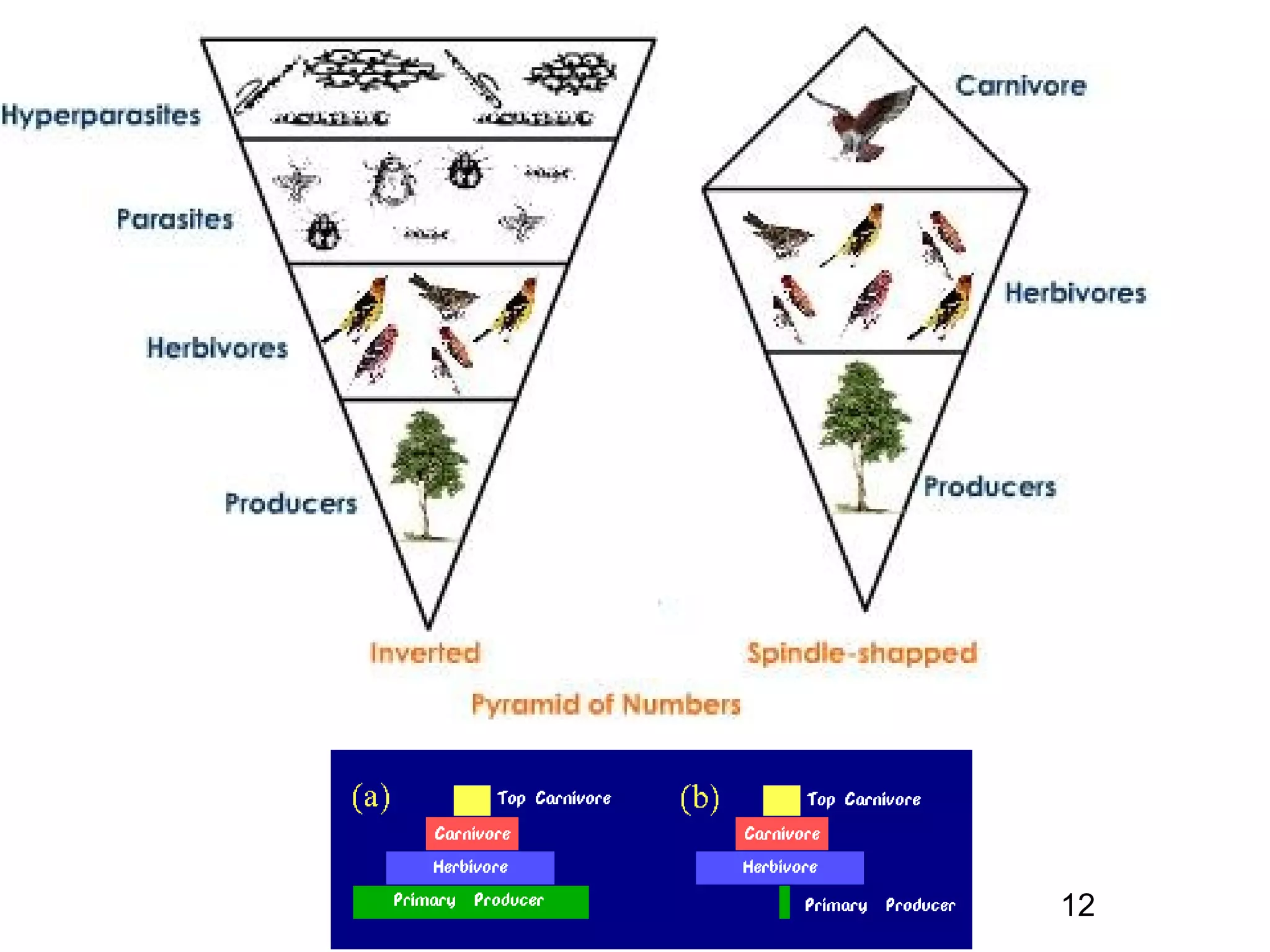
Pyramid of Numbers
 The pyramid of numbers represents the number of organisms in each
trophic level. This pyramid consists of a plot of relationships between the
number herbivores (primary consumers), first level carnivore (secondary
consumers), second level carnivore (tertiary consumers) and so forth. This
shape varies from ecosystem to ecosystem because the number of
organisms at each level is variable
 Upright, partly upright and inverted are the three types of pyramids of
numbers.
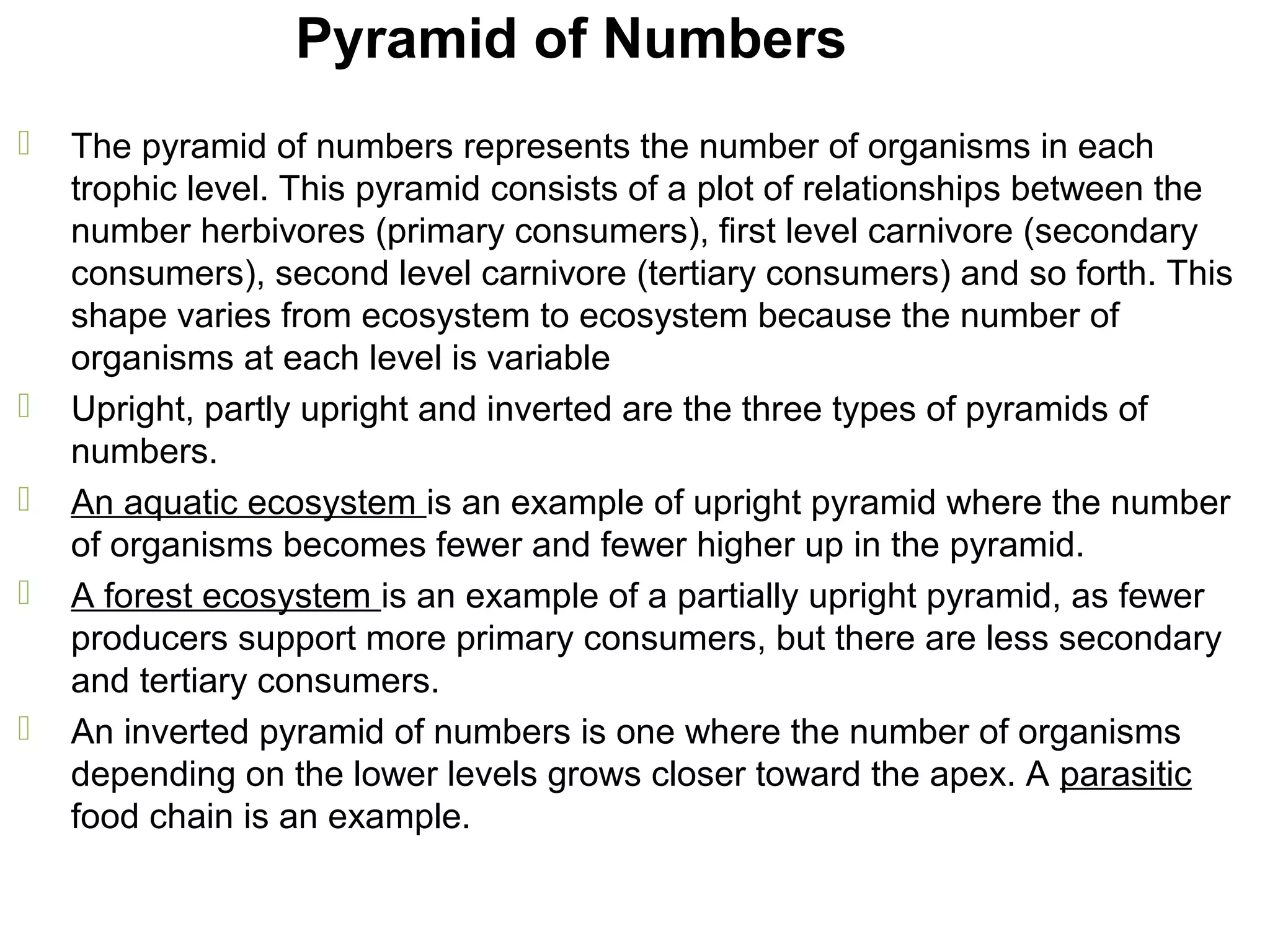
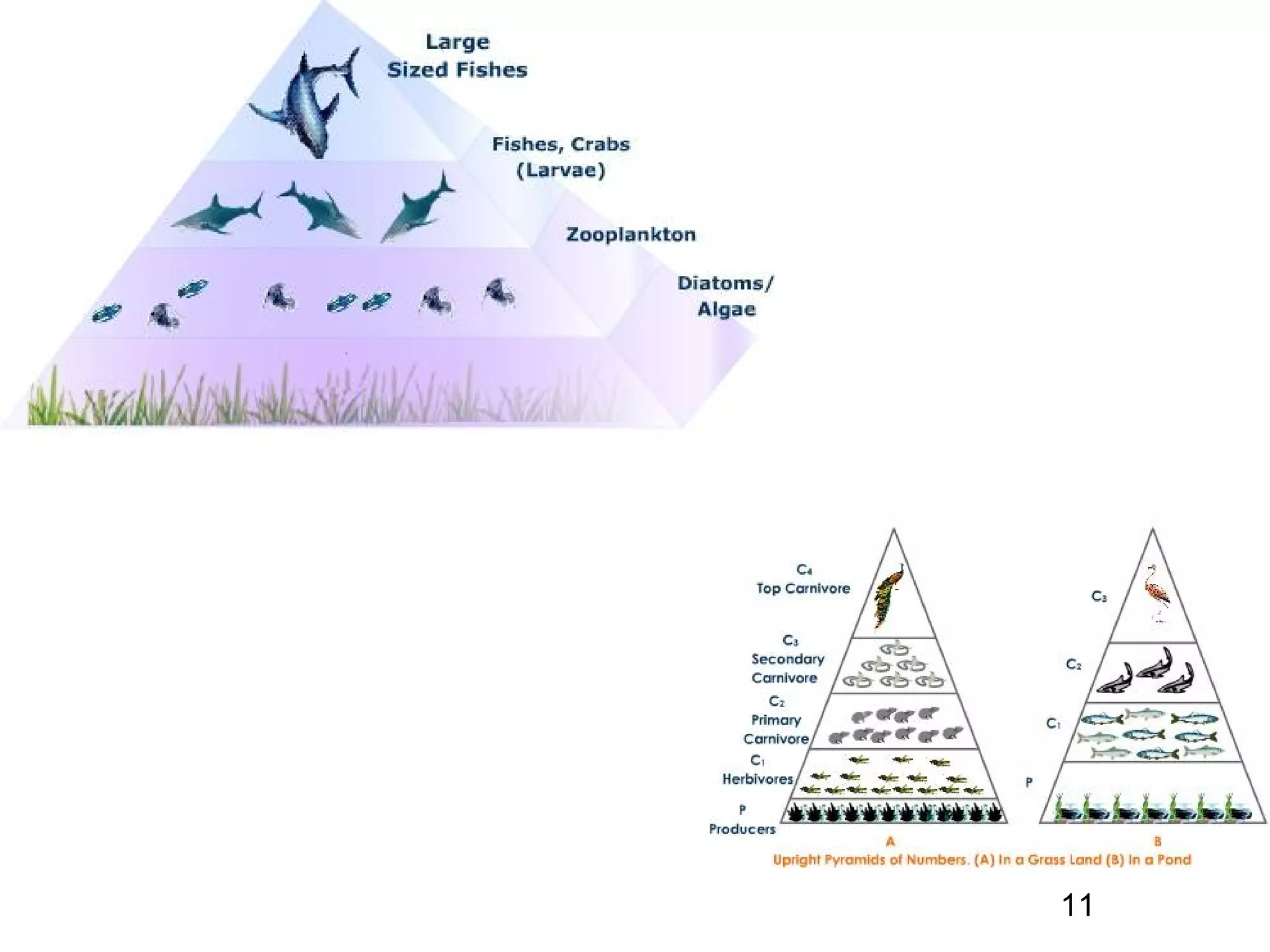
 An aquatic ecosystem is an example of upright pyramid where the number
of organisms becomes fewer and fewer higher up in the pyramid.
 A forest ecosystem is an example of a partially upright pyramid, as fewer
producers support more primary consumers, but there are less secondary
and tertiary consumers.
 An inverted pyramid of numbers is one where the number of organisms
depending on the lower levels grows closer toward the apex. A parasitic
food chain is an example.
11
12
Pyramid of Energy
The pyramid of energy represents the total amount of
energy consumed by each trophic level. An energy pyramid
is always upright as the total amount of energy available for
utilization in the layers above is less than the energy
available in the lower levels. This happens because during
energy transfer from lower to higher levels, some energy is
always lost.
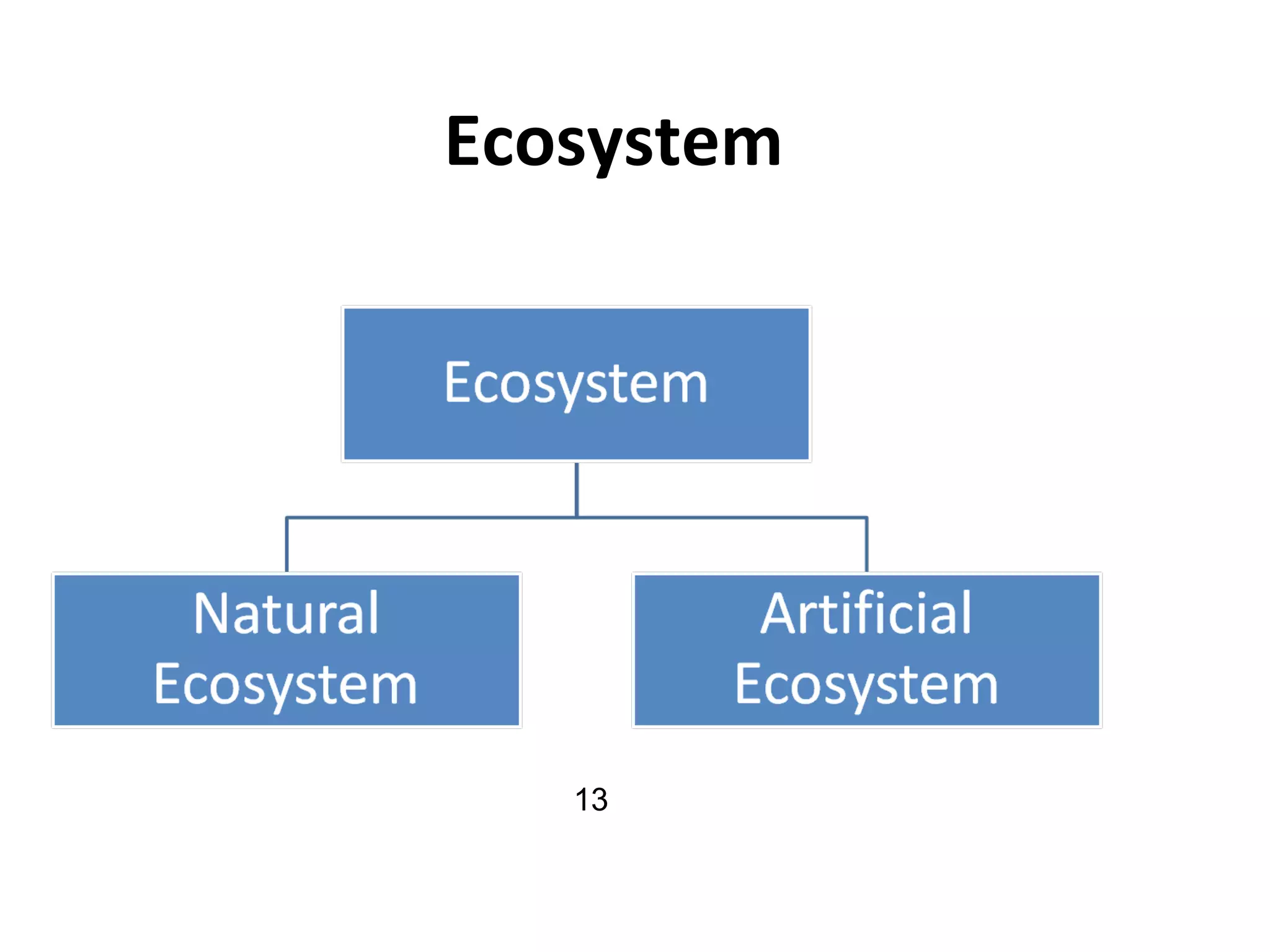
Ecosystem
13
Functions of Natural Ecosystem
Air pollution are tapped by leaves of tree and convert into
harmless compounds
Waste water gets filtrated through the natural soil and
make drinkable
Types Of Ecosystems
 Forest Ecosystem
 Grassland Ecosystem
 Desert Ecosystem
 Aquatic Ecosystem
 Estuarine Ecosystem
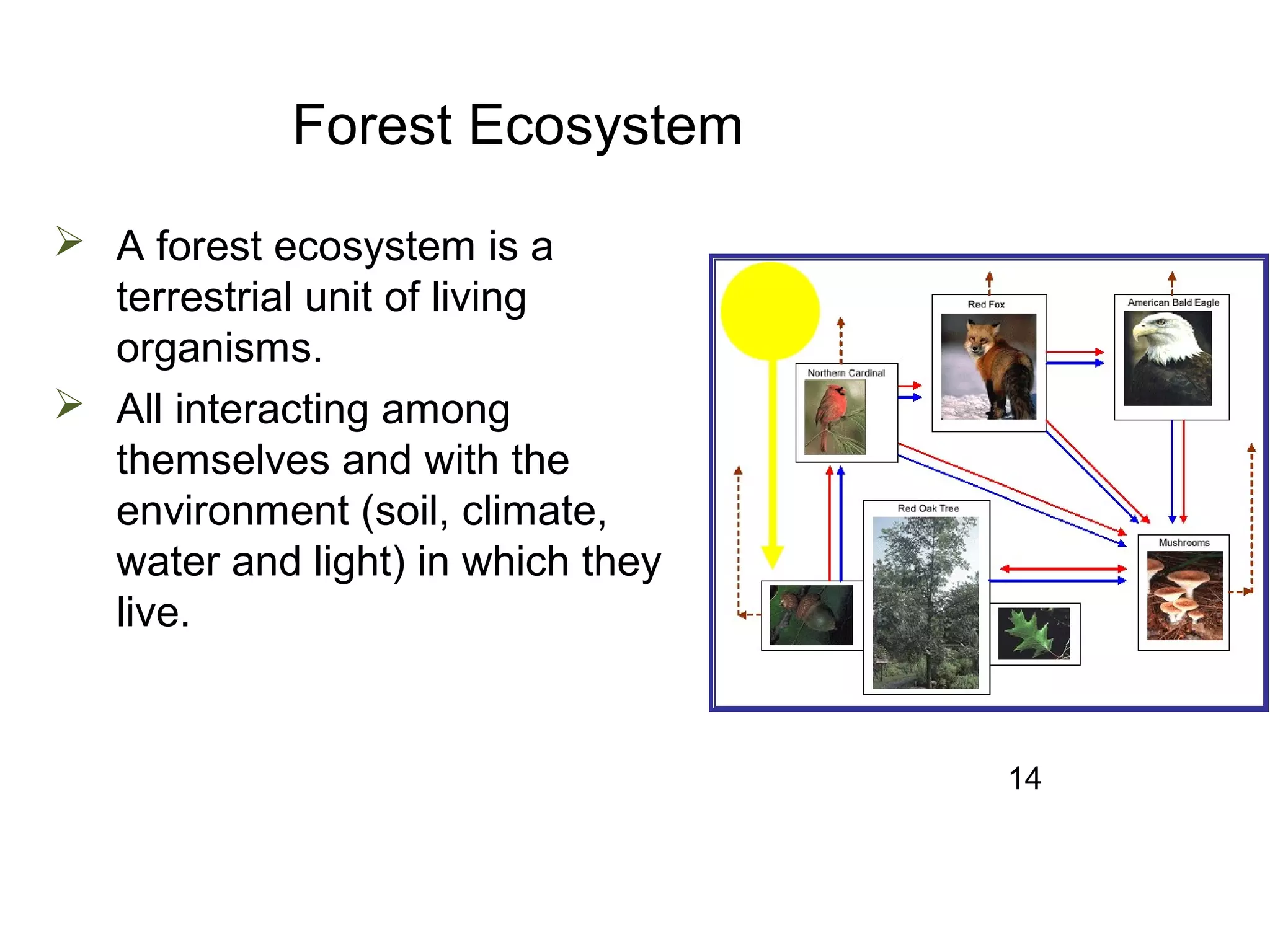
Forest Ecosystem
 A forest ecosystem is a
terrestrial unit of living
organisms.
 All interacting among
themselves and with the
environment (soil, climate,
water and light) in which they
live.
14
Types Of Forest Ecosystems
Tropical Rain Forest
( Average rain fall: <150cm/year)
Temp: 18oC
Warmed , humid, high diversity of
animal, plant, insects
Tropical Deciduous Forest
(Rain fall: 100-120cm/yr)
Climate is not evenly distributed
Temperate Deciduous
(cold climate, annual temp: 7-15oC)
Summer is very hot and winter is very cold
Tall decidous tree
Boreal Forest/TIAGA/CONIFEROUS
Climate is very cold
Rainfall: 100mm to 350 mm
Temperate Rain forest
Very cold
Winter rain fall
Summer is very hot and Dry
Functions Forest Ecosystems
Enhance the water resources in both quality and quantity
 Hydrological cycle depend on the forest ecosystem
Forest gives shelter to wildlife and fish
Considered as a pathway for exchange and regulation of
atmospheric gases, water and trace elements
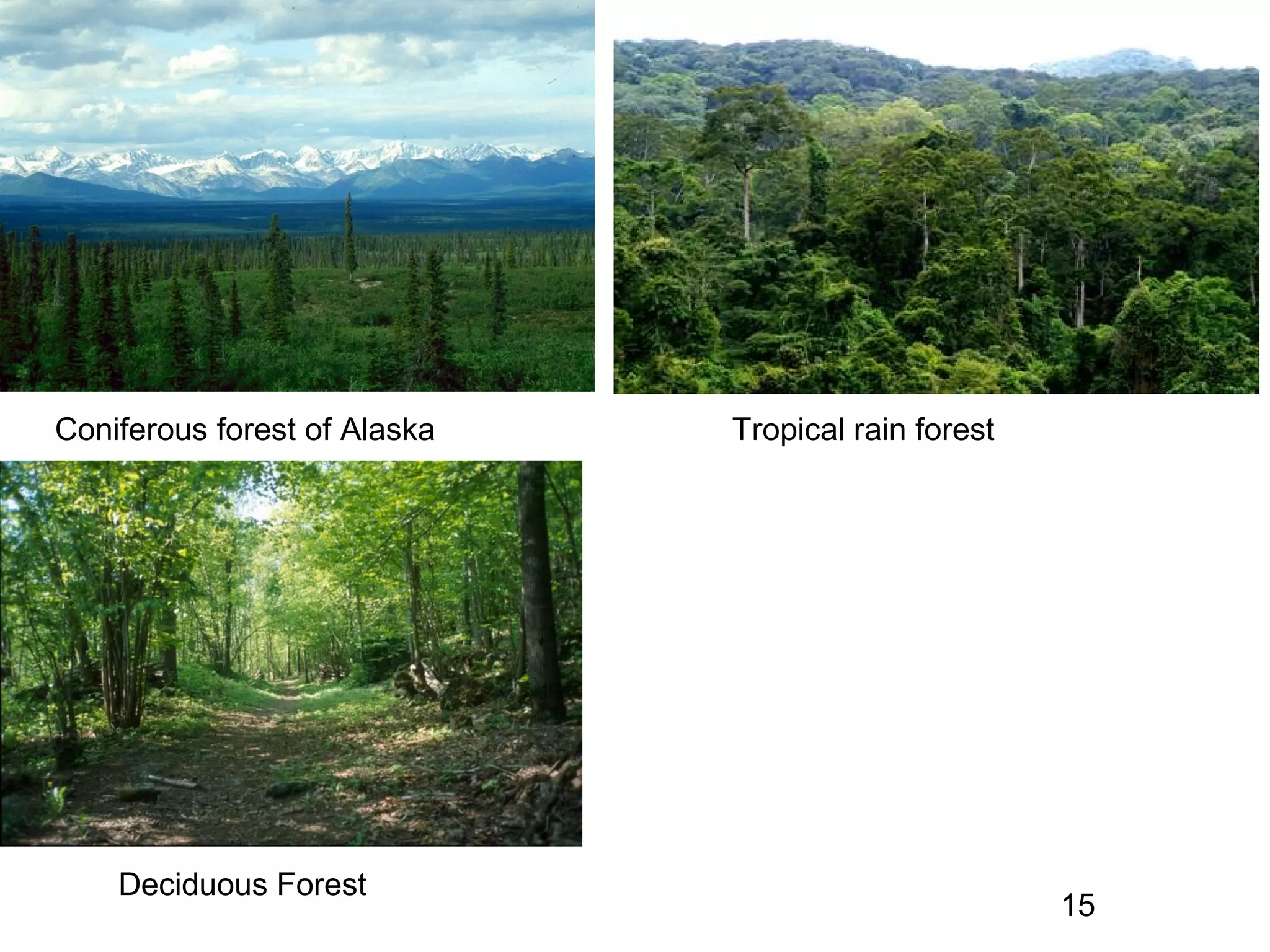
Coniferous forest of Alaska Tropical rain forest
Deciduous Forest
15
Grassland Ecosystem
Grasslands are areas where the vegetation is dominated
by grasses
Types Of Grassland
Ecosystem
 Tropical and Savannas grasslands
Tropical and subtropical grasslands,
savannas, and shrublands are
a grassland terrestrial biome located
in semi-arid to semi-
humid climate regions
of subtropical and tropical latitudes.
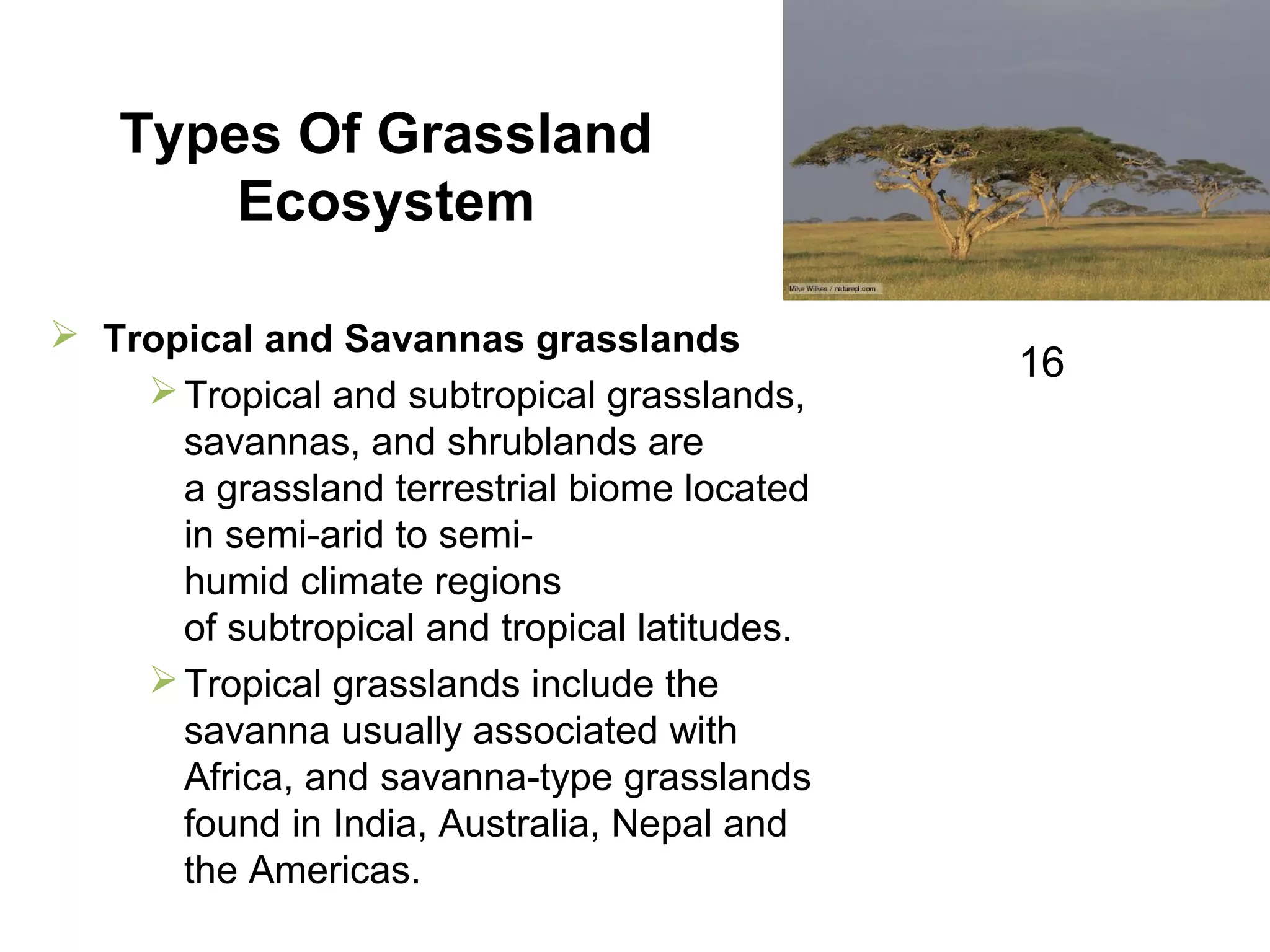
Tropical grasslands include the
savanna usually associated with
Africa, and savanna-type grasslands
found in India, Australia, Nepal and
the Americas.
16
 Temperate grasslands
Temperature: warm to hot season (often
with a cold to freezing season in winter)
Soil: fertile with rich nutrients and
minerals
Plants: grass; trees or shrubs in savanna
and shrubland
Animals: large, grazing mammals; birds;
reptiles
Rain fall: 25-60cm/yr
Although large areas have now been
converted to agriculture, in the past
temperate grasslands were home to
herds of large grazing animals such as
bison, deer or kangaroos.
North America, the steppes of Russia
and the pampas of Argentina.
17
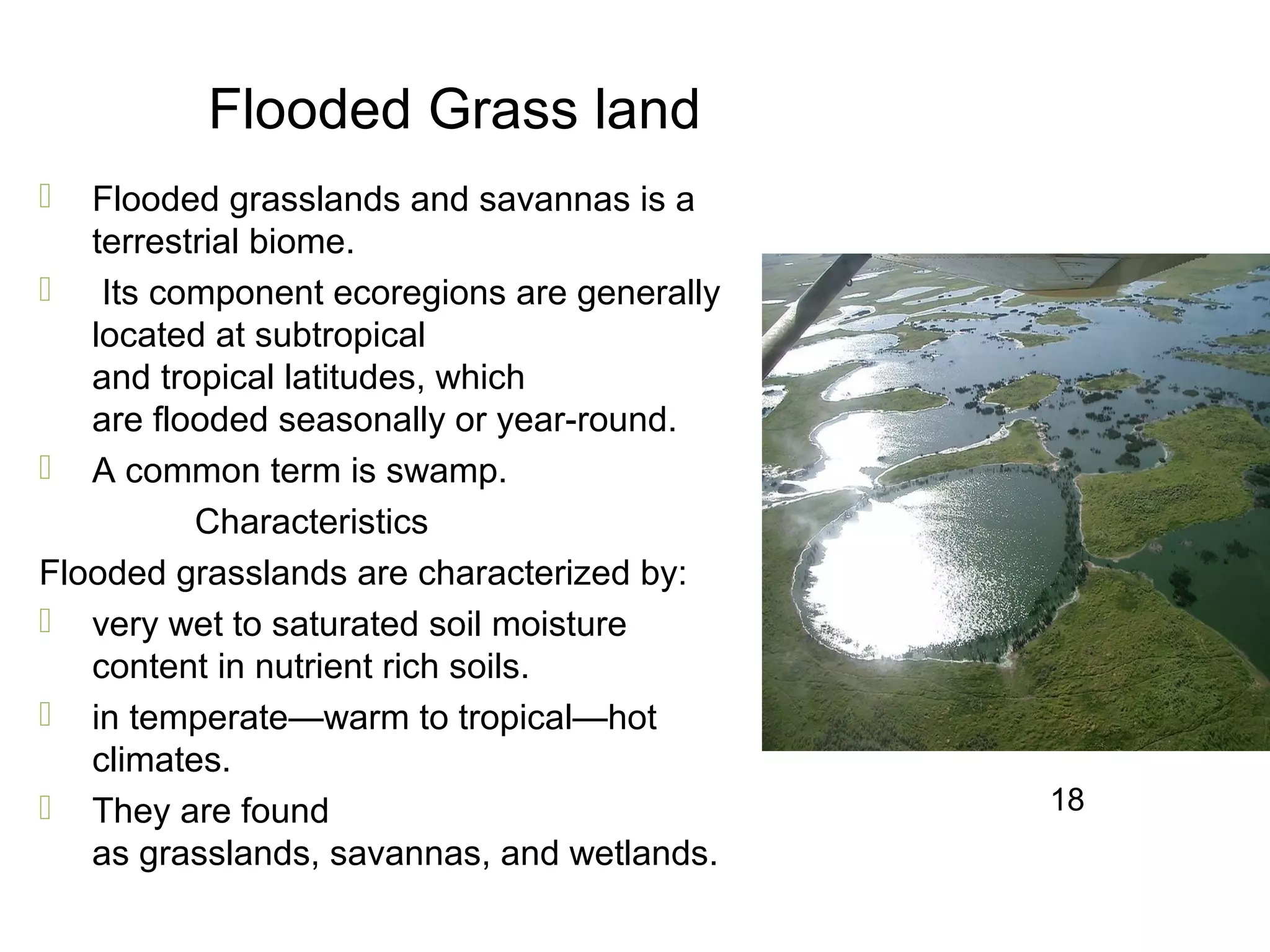
Flooded Grass land
 Flooded grasslands and savannas is a
terrestrial biome.
 Its component ecoregions are generally
located at subtropical
and tropical latitudes, which
are flooded seasonally or year-round.
 A common term is swamp.
Characteristics
Flooded grasslands are characterized by:
 very wet to saturated soil moisture
content in nutrient rich soils.
 in temperate—warm to tropical—hot
climates.
 They are found
as grasslands, savannas, and wetlands.
18
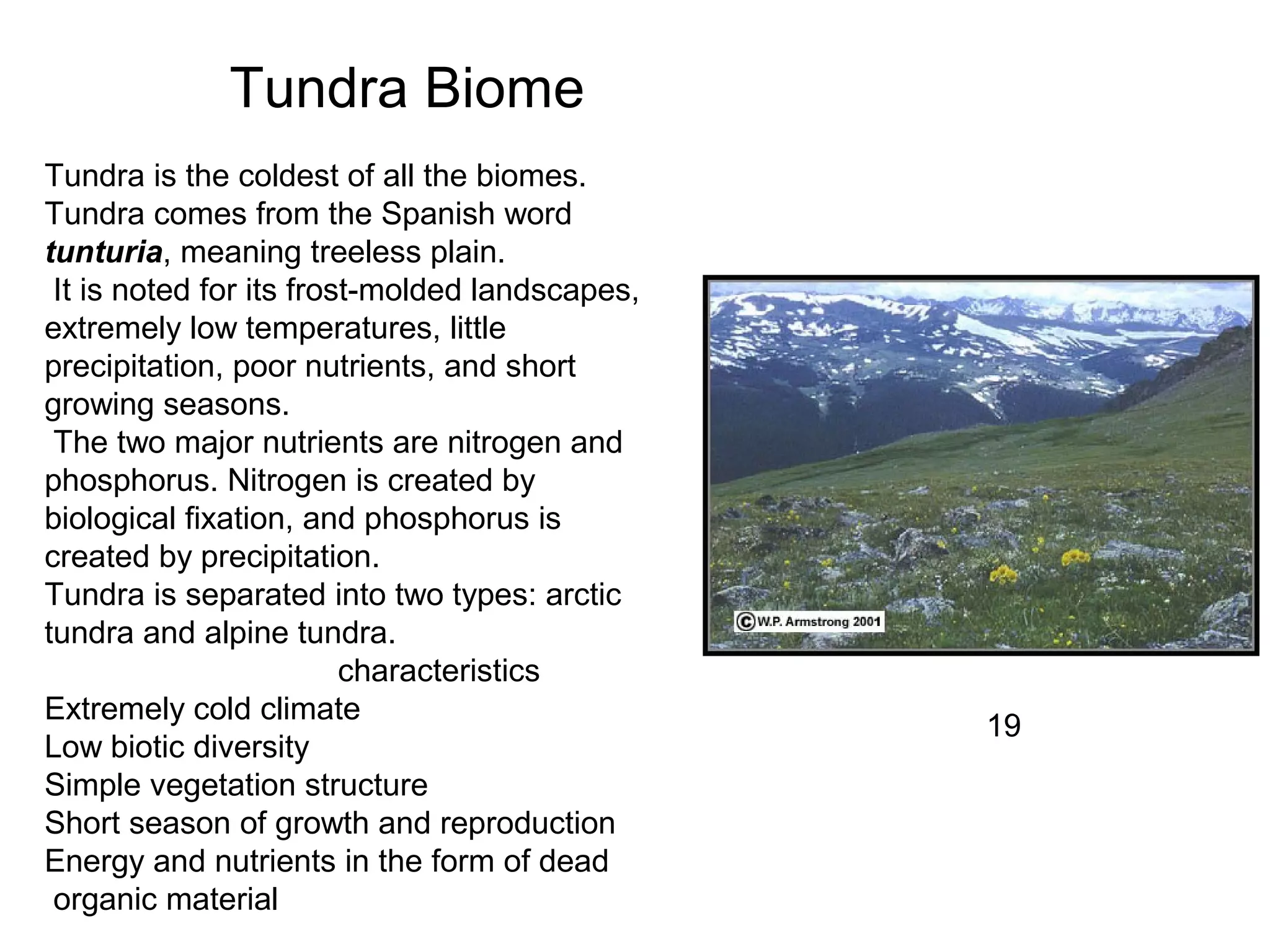
Tundra Biome
Tundra is the coldest of all the biomes.
Tundra comes from the Spanish word
tunturia, meaning treeless plain.
It is noted for its frost-molded landscapes,
extremely low temperatures, little
precipitation, poor nutrients, and short
growing seasons.
The two major nutrients are nitrogen and
phosphorus. Nitrogen is created by
biological fixation, and phosphorus is
created by precipitation.
Tundra is separated into two types: arctic
tundra and alpine tundra.
characteristics
Extremely cold climate
Low biotic diversity
Simple vegetation structure
Short season of growth and reproduction
Energy and nutrients in the form of dead
organic material
19
Arctic
Arctic tundra is located in the northern hemisphere, encircling the north
pole and extending south to the coniferous forests of the taiga.
The arctic is known for its cold, desert-like conditions.
The growing season ranges from 50 to 60 days.
The average winter temperature is -34° C (-30° F), but the average
summer temperature is 3-12° C (37-54° F) which enables this biome to
sustain life.
Rainfall may vary in different regions of the arctic. Yearly precipitation,
including melting snow, is 15 to 25 cm (6 to 10 inches). Soil is formed
slowly.
Alpine
Alpine tundra is located on mountains throughout the world at high
altitude where trees cannot grow. The growing season is approximately
180 days
Mammals: pikas, marmots, mountain goats, sheep, elk
Birds: grouselike birds
Insects: springtails, beetles, grasshoppers, butterflies
Montane
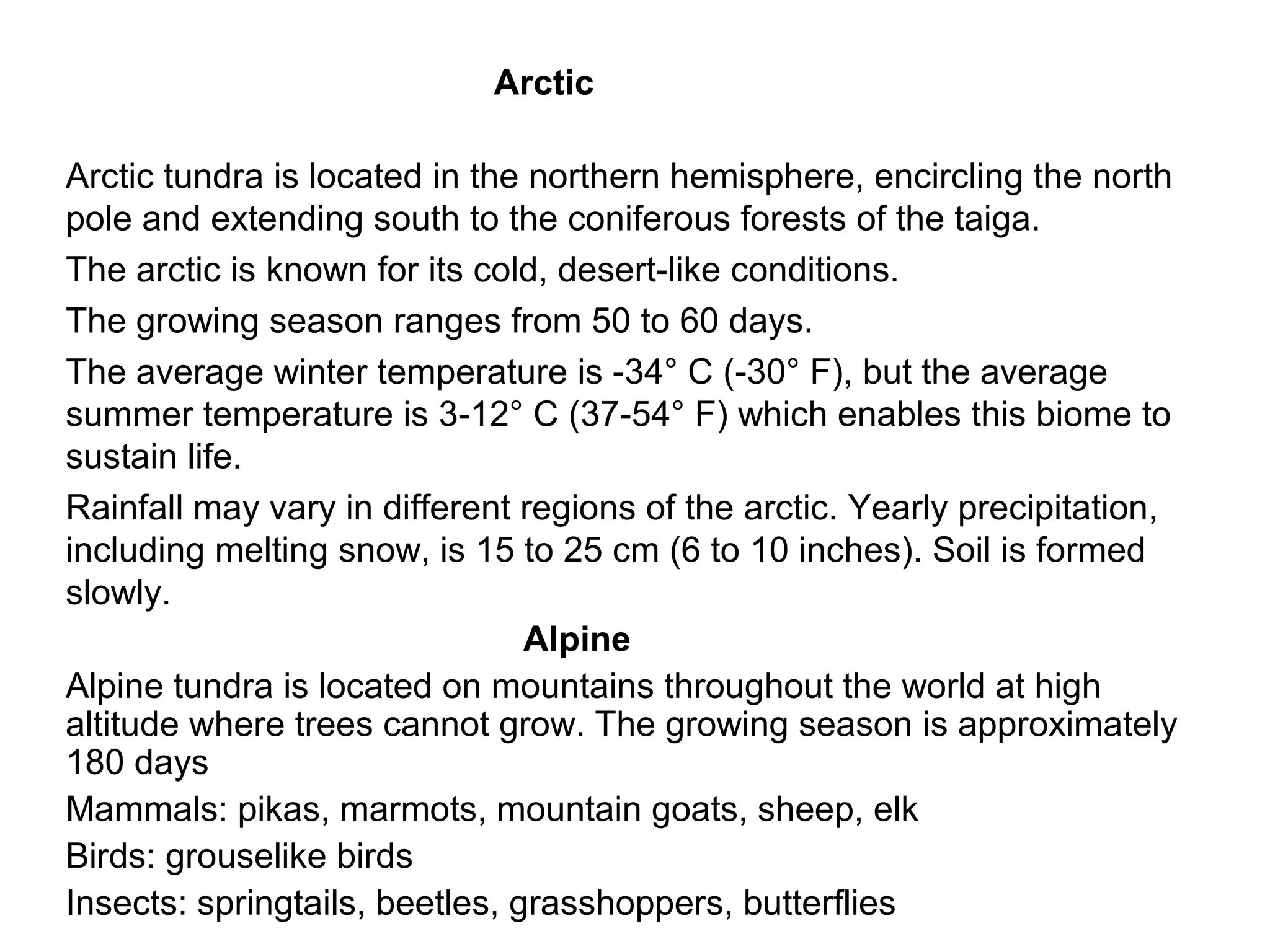
High-altitude grasslands located on
high mountain ranges around the
world, like the Páramo of the Andes
Mountains. They are part of the
montane grasslands and shrublands
biome and also constitute tundra.
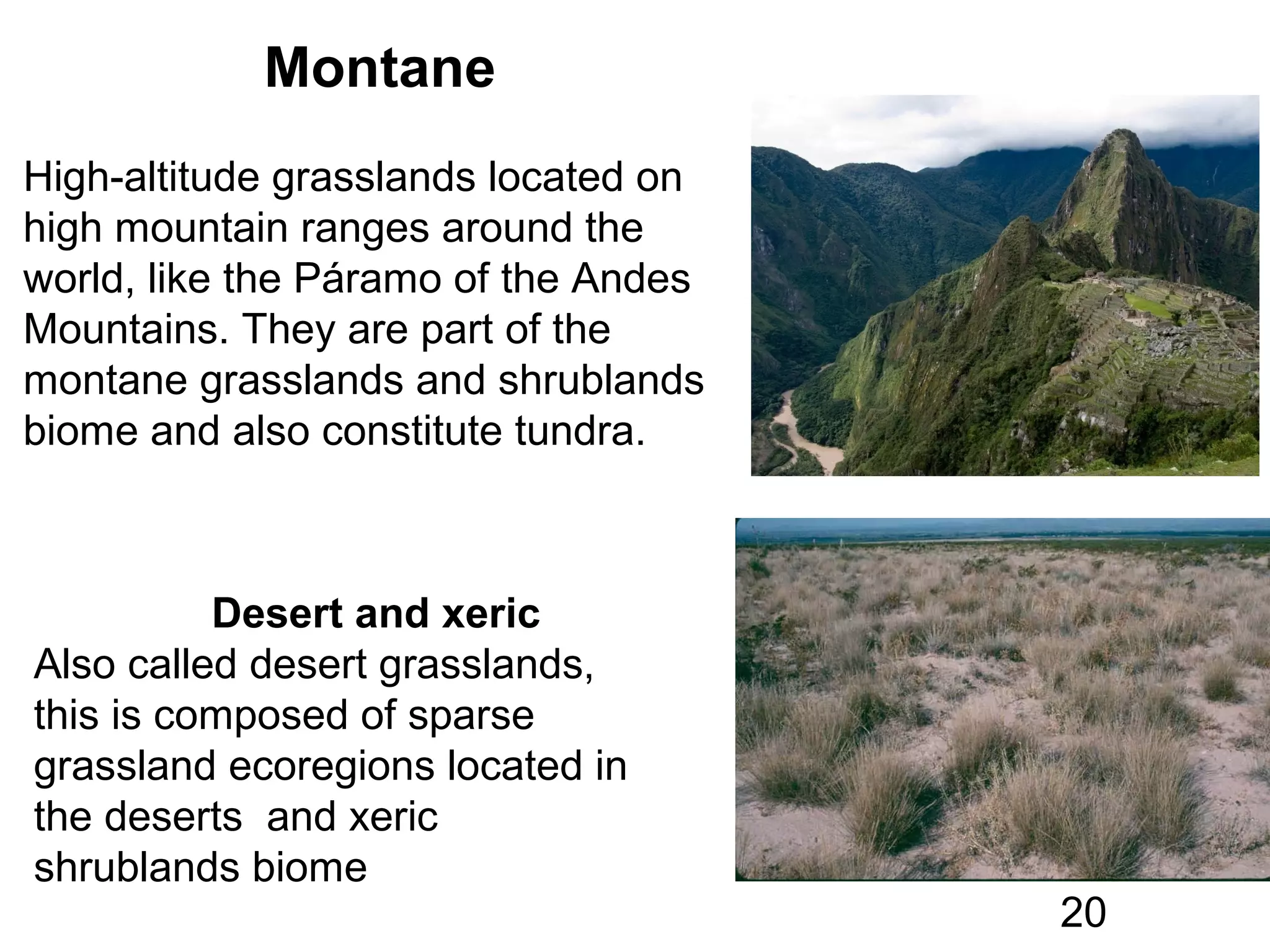
Desert and xeric
Also called desert grasslands,
this is composed of sparse
grassland ecoregions located in
the deserts and xeric
shrublands biome
20
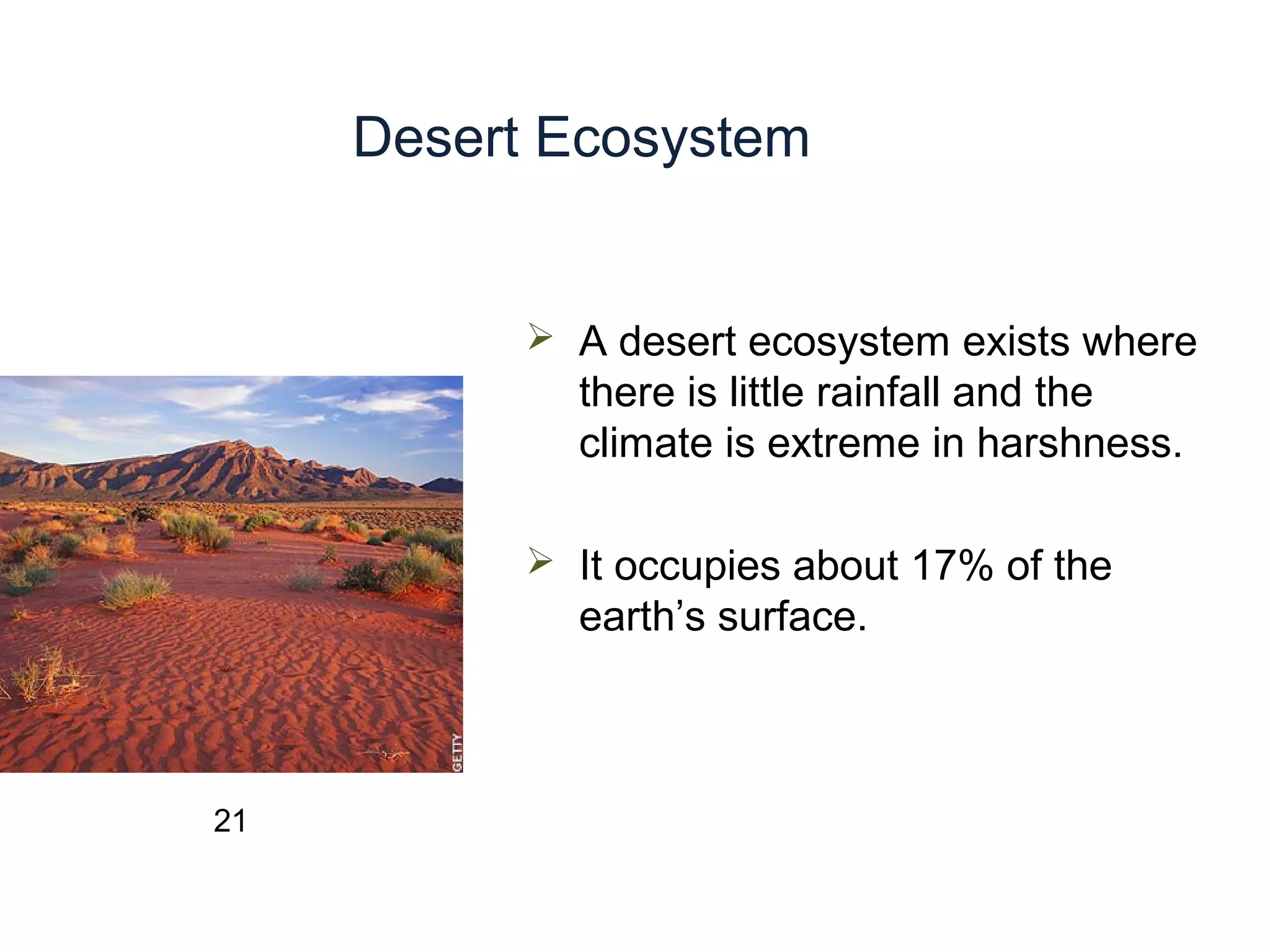
Desert Ecosystem
 A desert ecosystem exists where
there is little rainfall and the
climate is extreme in harshness.
 It occupies about 17% of the
earth’s surface.
21
Types Of Desert Ecosystem
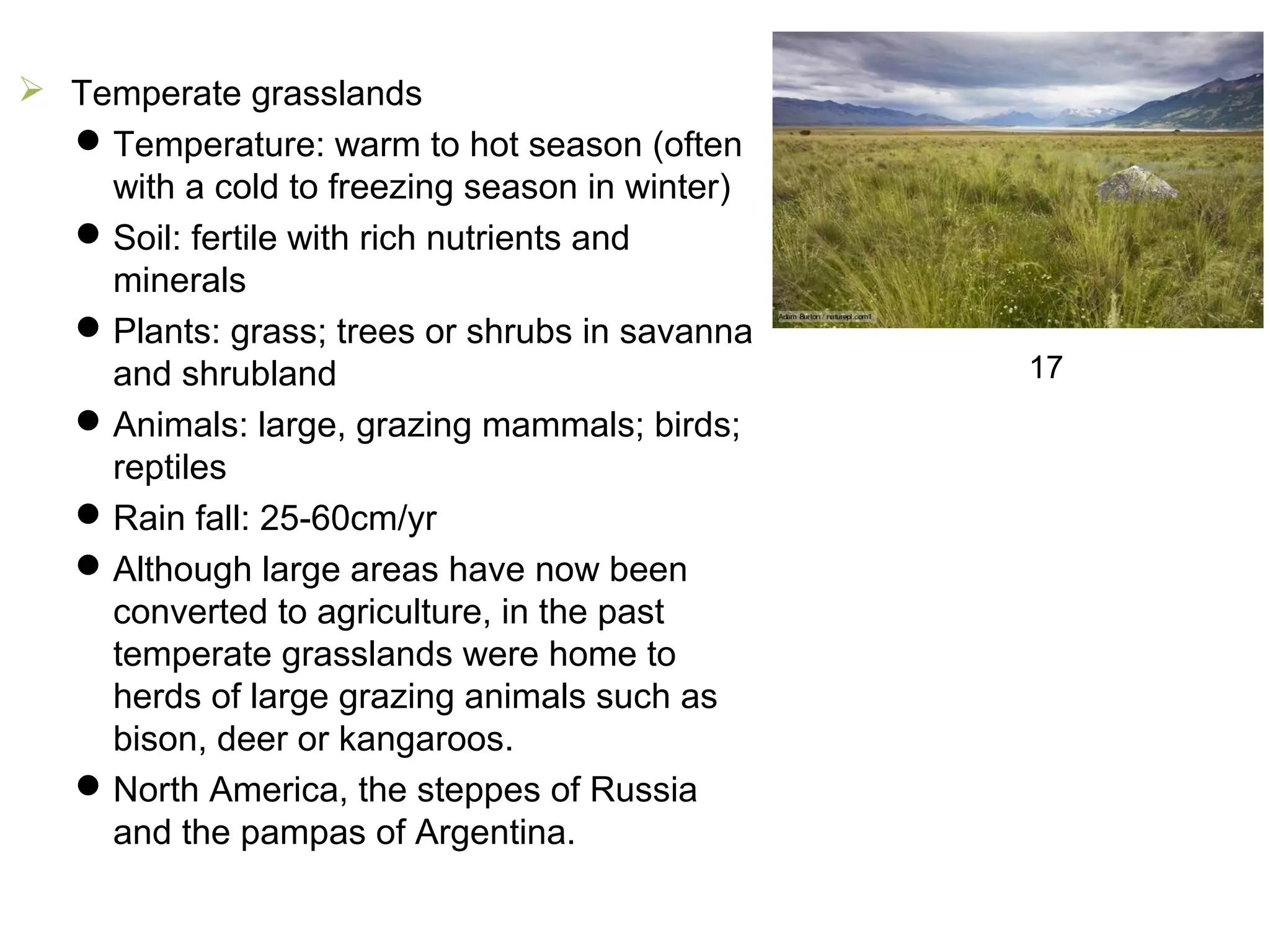
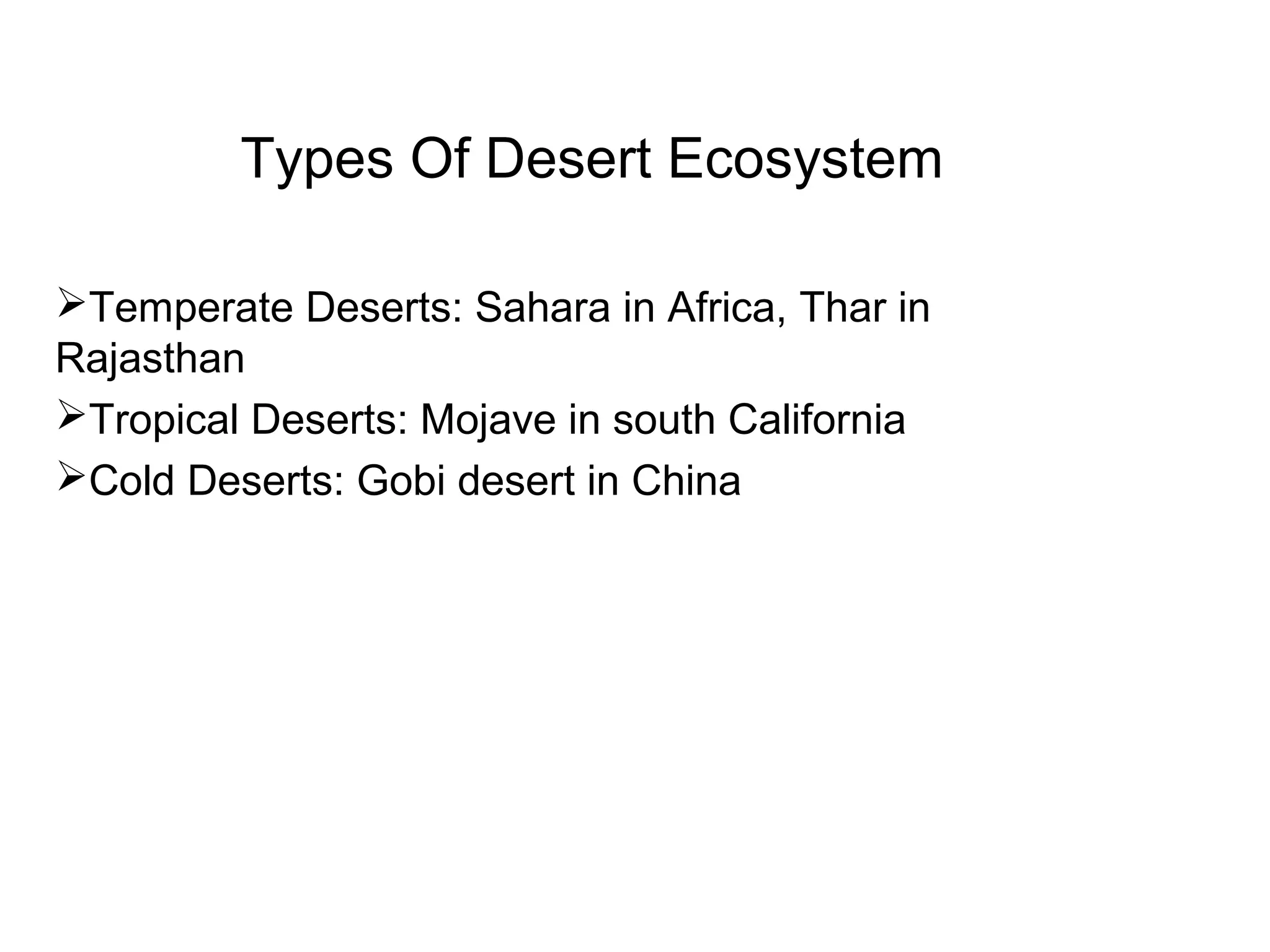
Temperate Deserts: Sahara in Africa, Thar in
Rajasthan
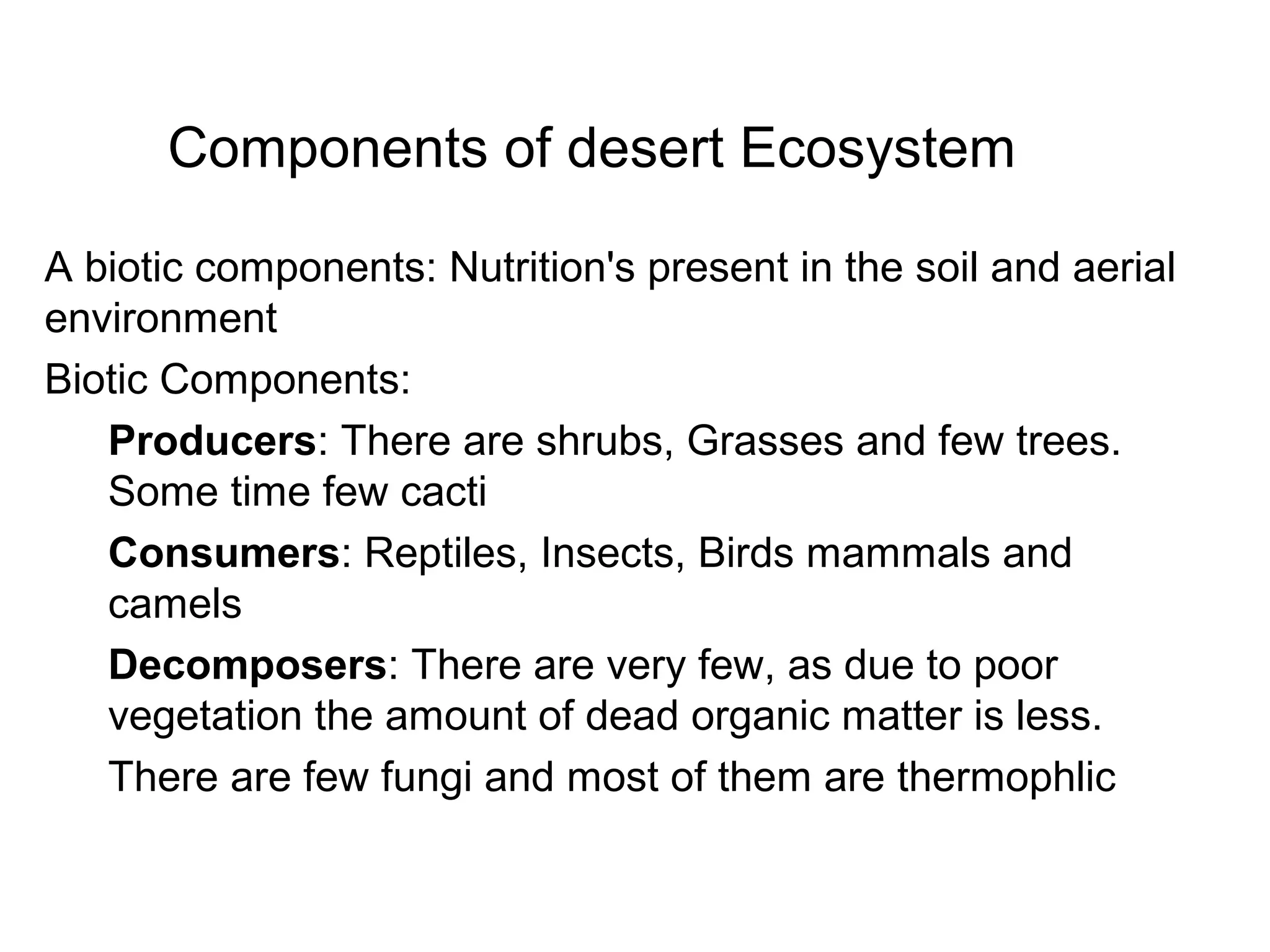
Tropical Deserts: Mojave in south California
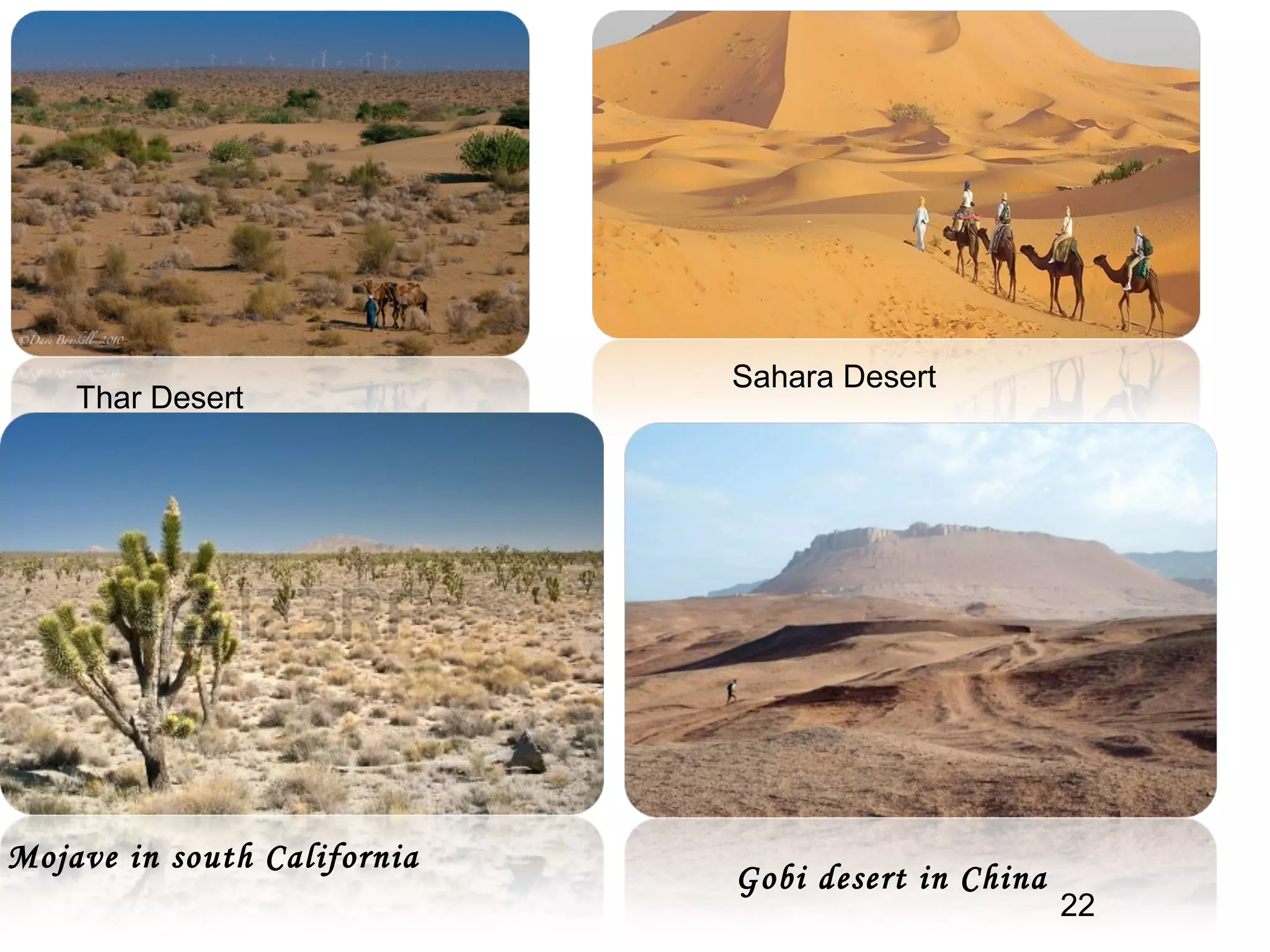
Cold Deserts: Gobi desert in China
Components of desert Ecosystem
A biotic components: Nutrition's present in the soil and aerial
environment
Biotic Components:
Producers: There are shrubs, Grasses and few trees.
Some time few cacti
Consumers: Reptiles, Insects, Birds mammals and
camels
Decomposers: There are very few, as due to poor
vegetation the amount of dead organic matter is less.
There are few fungi and most of them are thermophlic
Thar Desert
Sahara Desert
Mojave in south California
Gobi desert in China
22
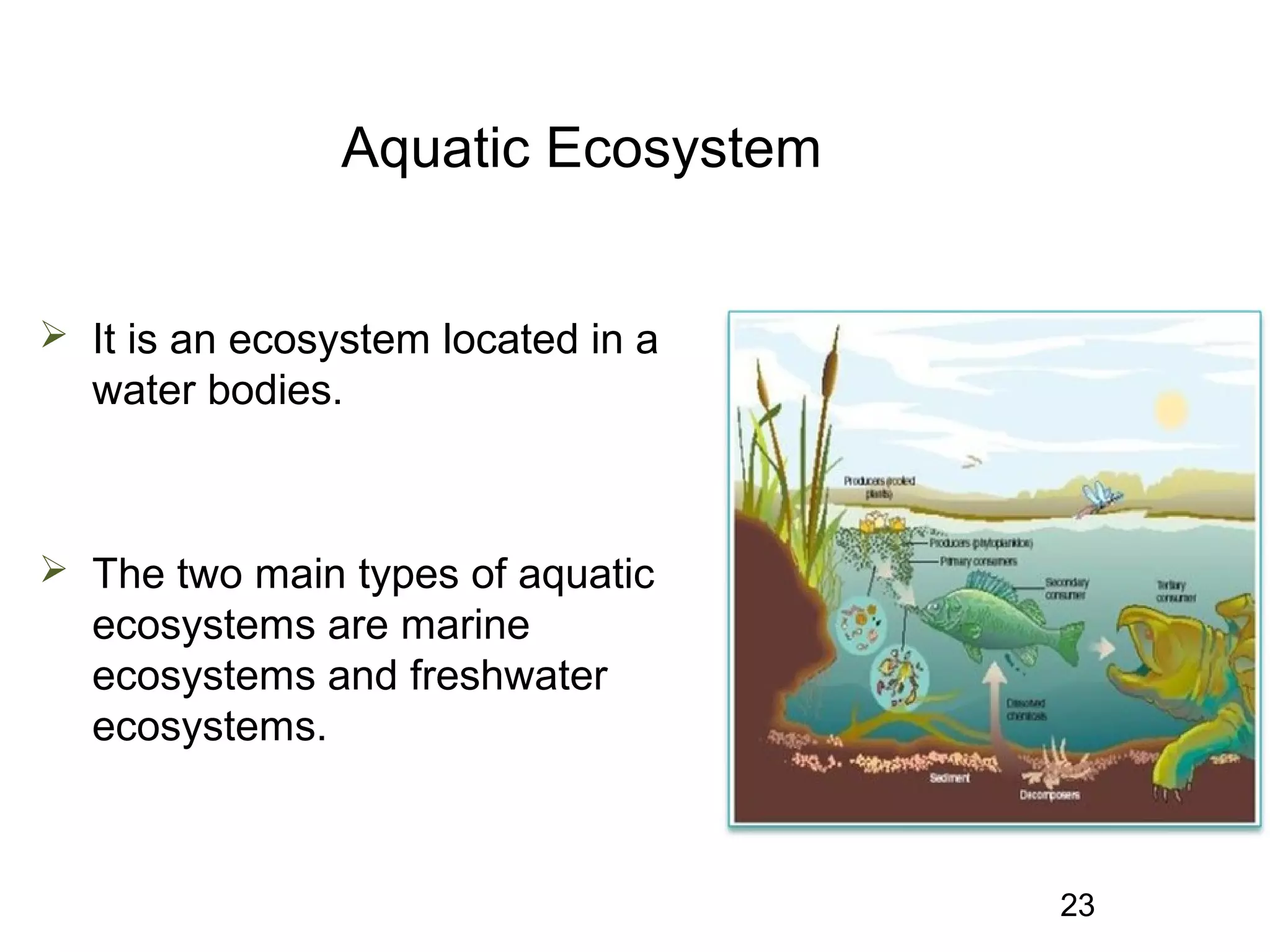
Aquatic Ecosystem
 It is an ecosystem located in a
water bodies.
 The two main types of aquatic
ecosystems are marine
ecosystems and freshwater
ecosystems.
23
Types Of Aquatic Ecosystem
Freshwater Ecosystem
1. Pond ecosystem
2. Lake ecosystem
3. Stream
4. Riverine Ecosystem
5. Fresh water marshes ecosystem
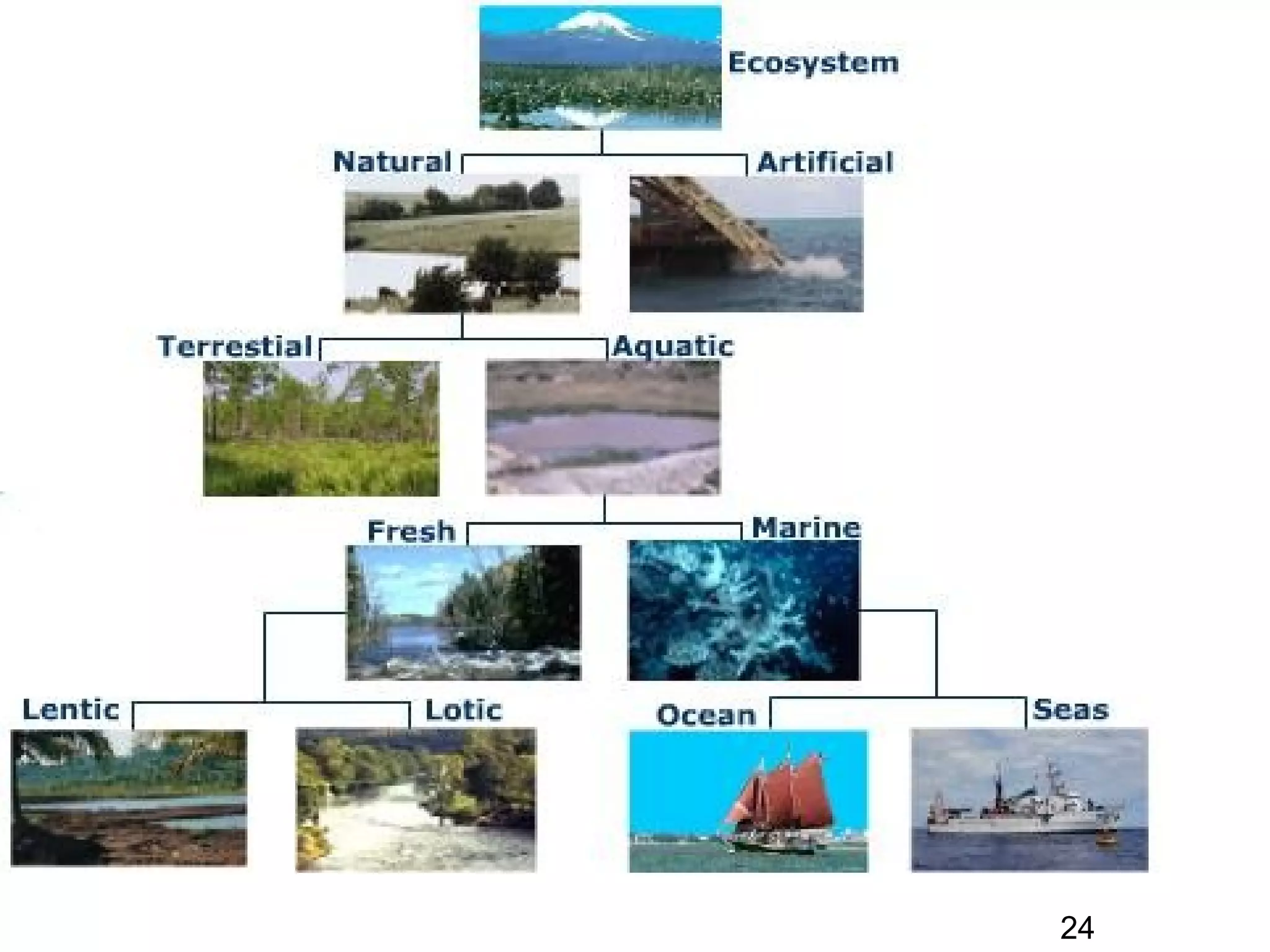
On the basis of water flow, fresh water ecosystem
classified into two
- Lentic ecosystem (Standing water
bodies)
- Lotic ecosystem (Running or flowing
water bodies)
LOTIC ECOSYSTEMS
 Lotic ecosystem may be perennial or seasonal
 Perennials occasionally subjected to floods which cause
damage to the surrounding areas
 Lotic series distinguished by continued flow of water in
one direction
 Lotic systems are richer in oxygen and nutrients than lentic
systems
Egs: Spring,Stream or river ecosystems
LENTIC ECOSYSTEM
 It may be perennial or seasonal
 Oxygen content in the surface water to a depth of 3-5
meters is enough to support life
 In deeper levels oxygen is less and biological activities
decreases
 In bottom levels anaerobic conditions prevail and
organisms that can thrive under such conditions are
found at this depth
 Egs: Lake,Pond,Swamp,Reservoirs etc
24
POND ECOSYSTEM
It is a simplest fresh water aquatic ecosystem
It is a small body of standing shallow water
It may receive enough water during rainy season
It is a self sufficient & self regulatory ecosystem
Life span of small seasonal ponds ranges from a few weeks
or months
Life span of larger ponds are several hundred years
Pond water contain a mixture of living organisms, both plants
& animals, and inorganic and organic components.
LAKE ECOSYSTEM
Big and natural fresh water bodies with standing water
Functions like a giant permanent pond
Lakes are formed when precipitation run-off or ground water
seepage fills up depressions in the land formed by
geological changes.
ZONATION
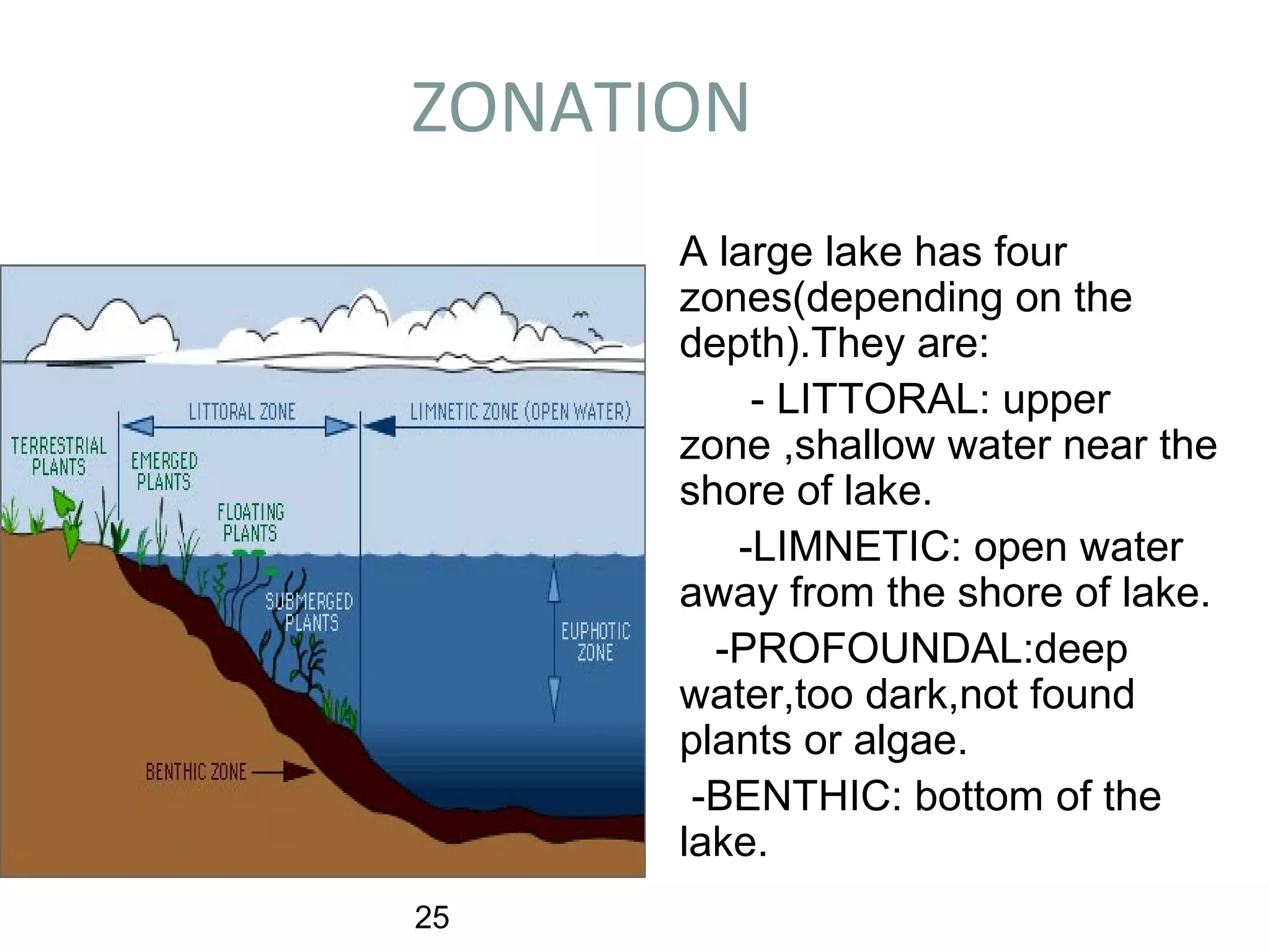
A large lake has four
zones(depending on the
depth).They are:
- LITTORAL: upper
zone ,shallow water near the
shore of lake.
-LIMNETIC: open water
away from the shore of lake.
-PROFOUNDAL:deep
water,too dark,not found
plants or algae.
-BENTHIC: bottom of the
lake.
25
Types of Lake
Artificial lake: Due to construction
Obligotrophic lake: Low nutrition concentration
Masotrphic: Moderate Nutrition
Eutrophic: More amount of Nutrition : Dal Lake
Dystrophic lake: Brown water with low pH and humic acid
Desert salt lake: High concentration of Salts: Sambhar lake
Rajasthan
Volcanic lake: It occures by volcano: Japan
Meromictic lake : Rich in salt
RIVER AND STREAM ECOSYSTEM
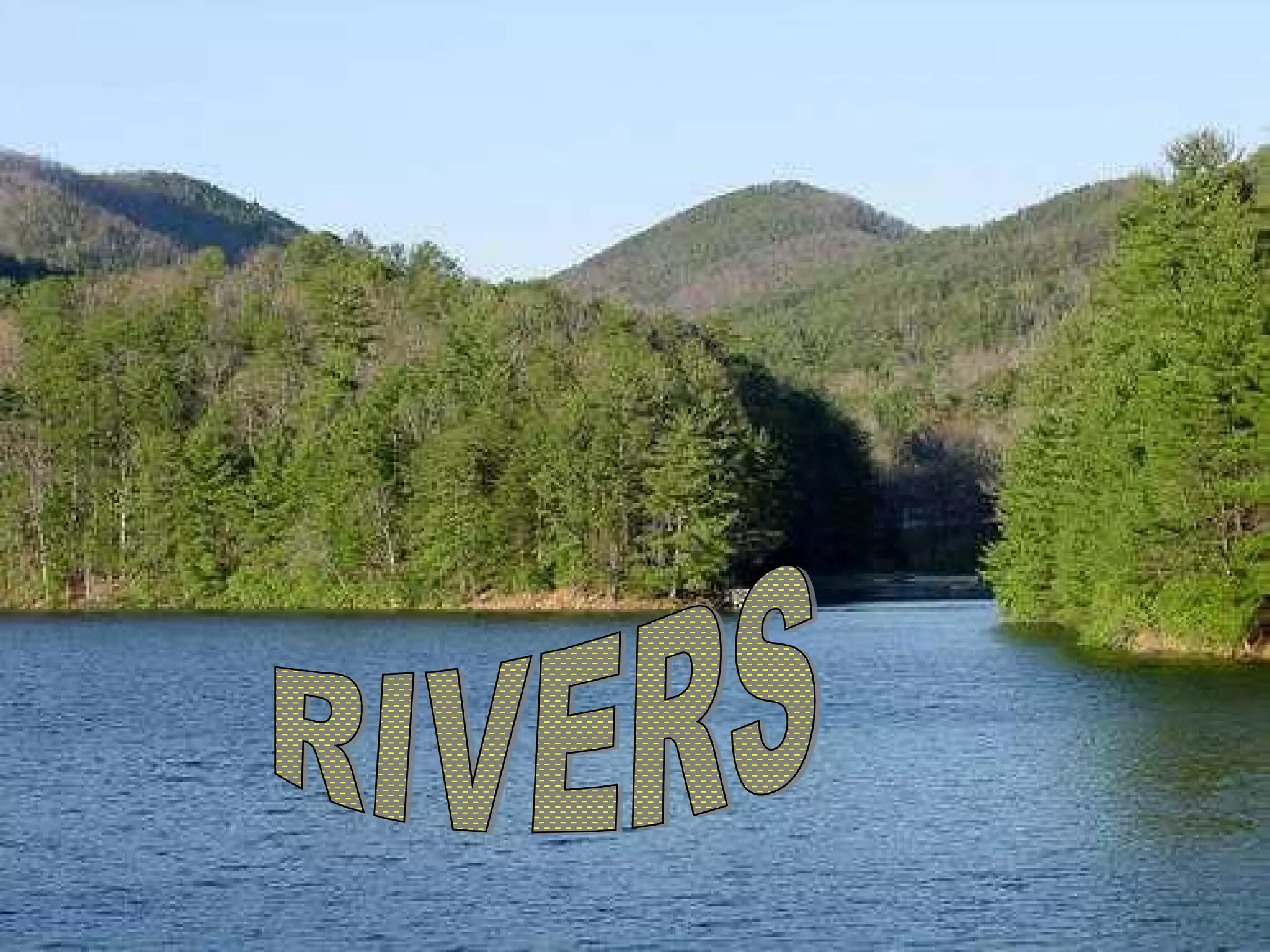
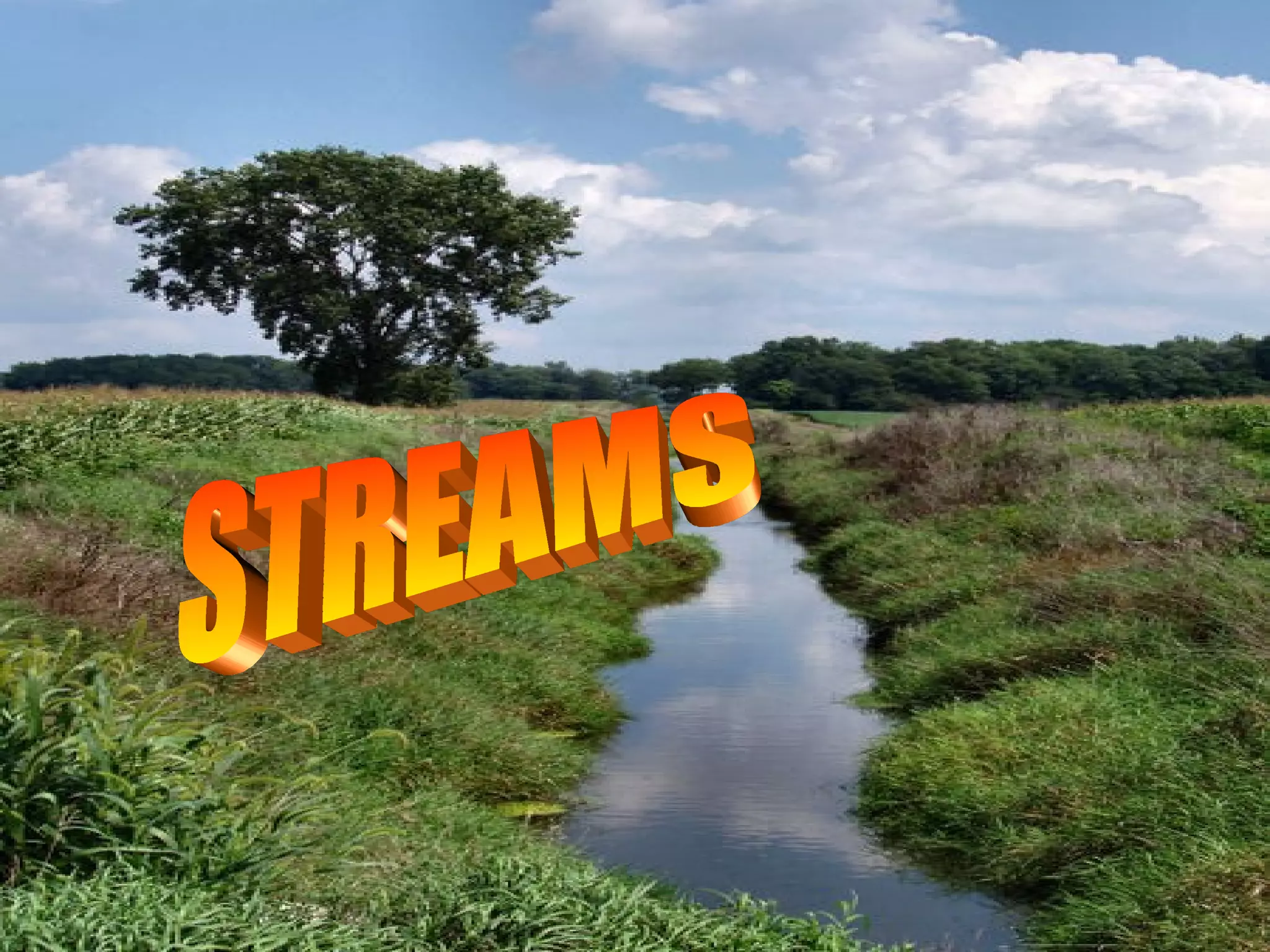
They are flowing fresh water bodies.
Flowing water follows distinct “channels”.
Small channels – STREAMS
Large channels – RIVERS
Plants and animals live in streams and rivers depend upon
the movement and speed of the water.
FRESHWATER MARSHES
ECOSYSTEM
It tend to be naturally fertile ecosystem.
It is valuable in maintaining water tables in adjacent
ecosystems.
Periodic fluctuations in water levels resulting from seasonal
and annual rainfall variation often accomplishes tidal like
actions in terms of maintaining long range stability and
fertility.
Marine Ecosystem
70% world cover by the water and 97% of this water is
available in oceans and Seas.
They play key role in survival of 2,50,000 species
Oceans are major sinks of CO2 and play important role in
Carbon cycle, Hydrological cycle
Major ocean: Pacific, Atlantic, Indian, Arctic
Pacific: Largest and cover 1/3 part of Earth
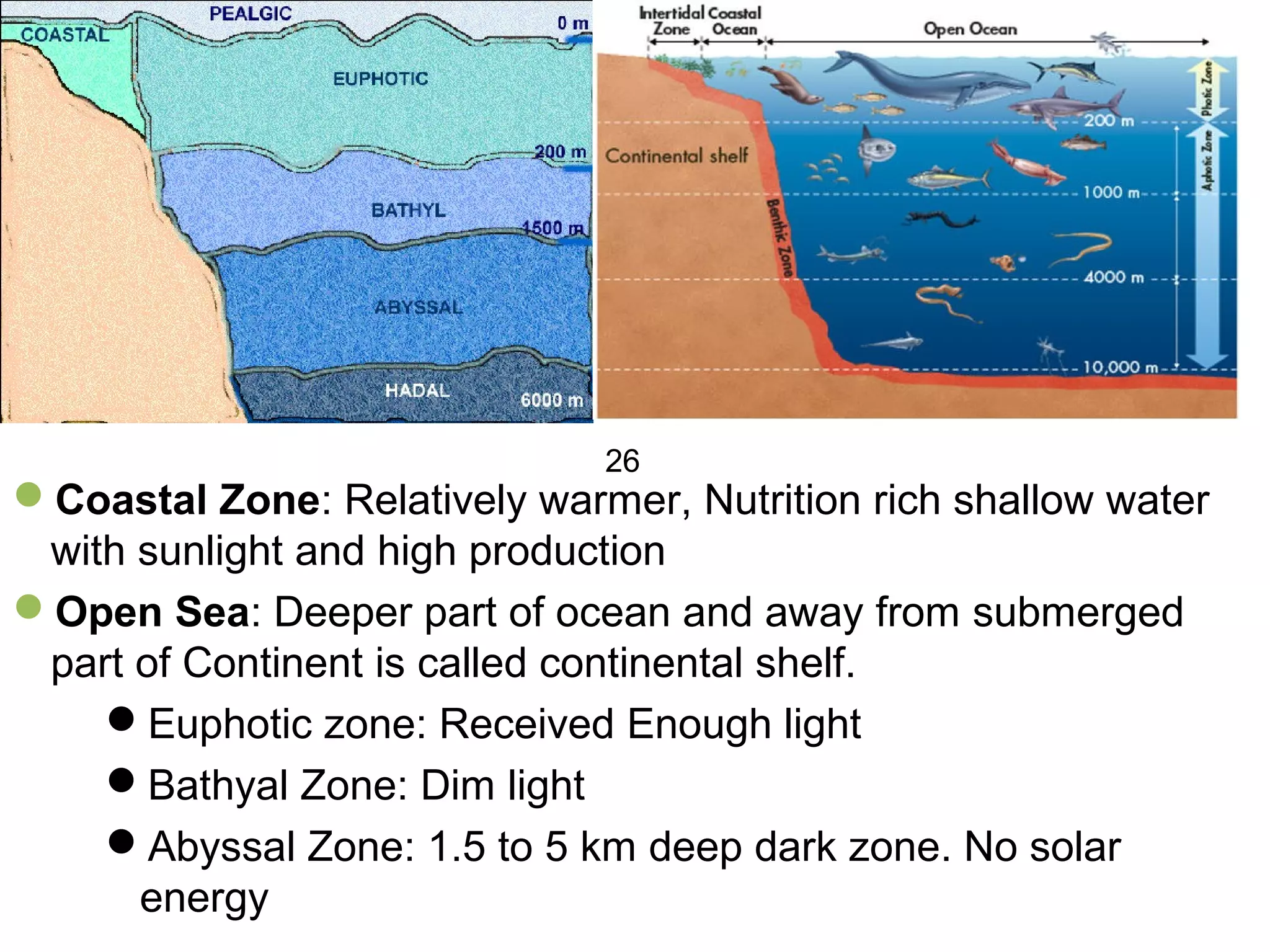
Coastal Zone: Relatively warmer, Nutrition rich shallow water
with sunlight and high production
Open Sea: Deeper part of ocean and away from submerged
part of Continent is called continental shelf.
Euphotic zone: Received Enough light
Bathyal Zone: Dim light
Abyssal Zone: 1.5 to 5 km deep dark zone. No solar
energy
26
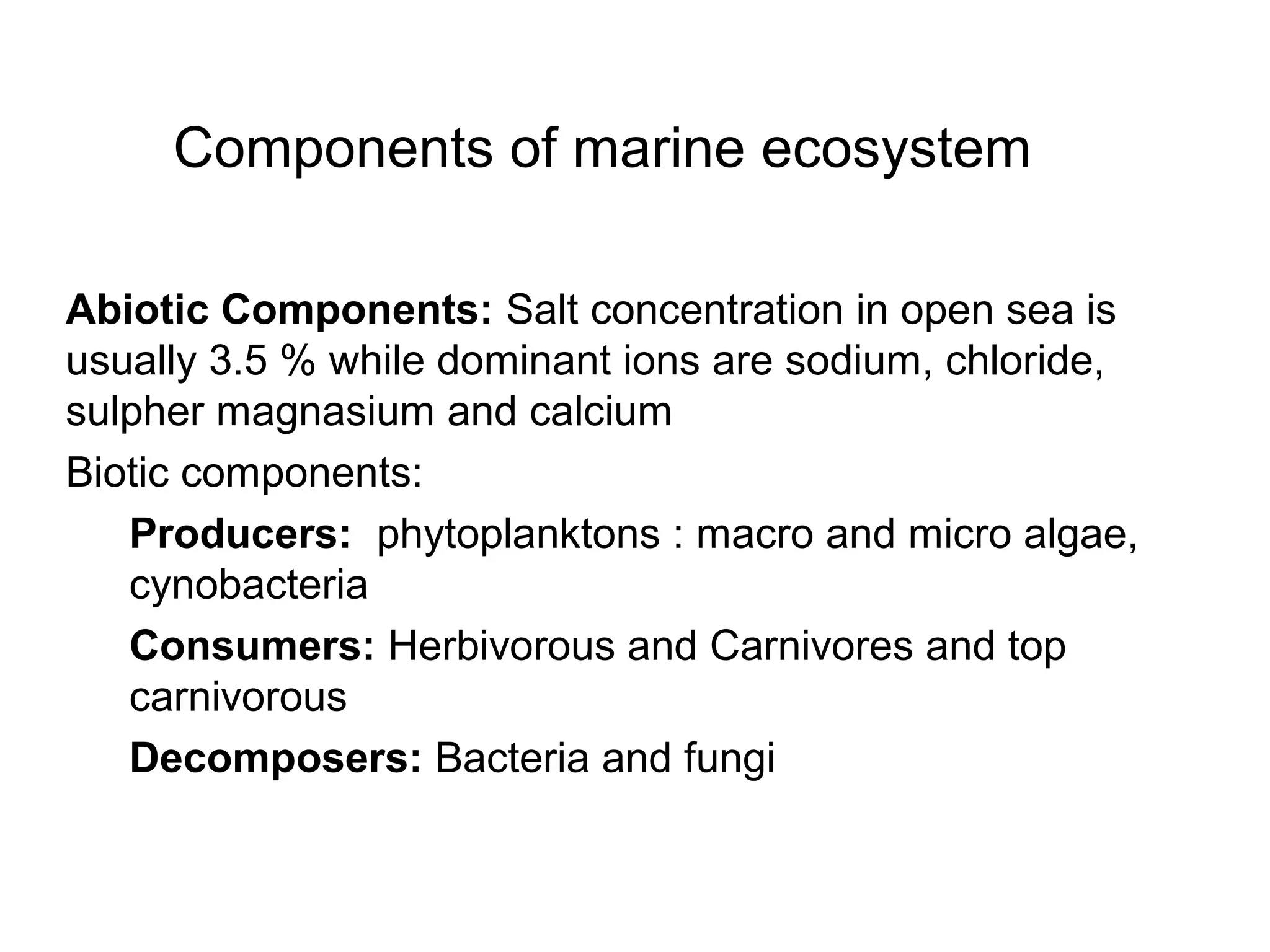
Components of marine ecosystem
Abiotic Components: Salt concentration in open sea is
usually 3.5 % while dominant ions are sodium, chloride,
sulpher magnasium and calcium
Biotic components:
Producers: phytoplanktons : macro and micro algae,
cynobacteria
Consumers: Herbivorous and Carnivores and top
carnivorous
Decomposers: Bacteria and fungi
Biogeochemical CyclesBiogeochemical Cycles
Biogeochemical Cycles
describe the flow of essential elementsessential elements from the environment
through living organisms and back into the environment.
The biogeochemical cycle is the continuous flow of elements
and compounds between organisms and the earth
Types of cycles
Hydrological cycle: deal with the interchange of water with
organisms and environment
Gaseous cycle: Deal with inter change with gases
Sedimentary cycle: Deals with SO4 and PO4 cycle and
concern with the interchange of nutrition and minerals
Elemental Cycles
H, O, and C make up > 99 % of the Earth’s biomass
N, Ca, K, Mg, S, and P are significant nutrients
Cycling of C, O, N, P, and S are discussed in this chapter
Concepts in Biogeo. Cycles
 Reservoir - where material or mass is stored
 Flux: rate of flow of material
 Steady state: inflow = outflow
 Dynamic state: fluxes are reservoirs are changing with time
 Residence time: length of time a chemical stays in a
reservoir
 Feedback: positive and negative
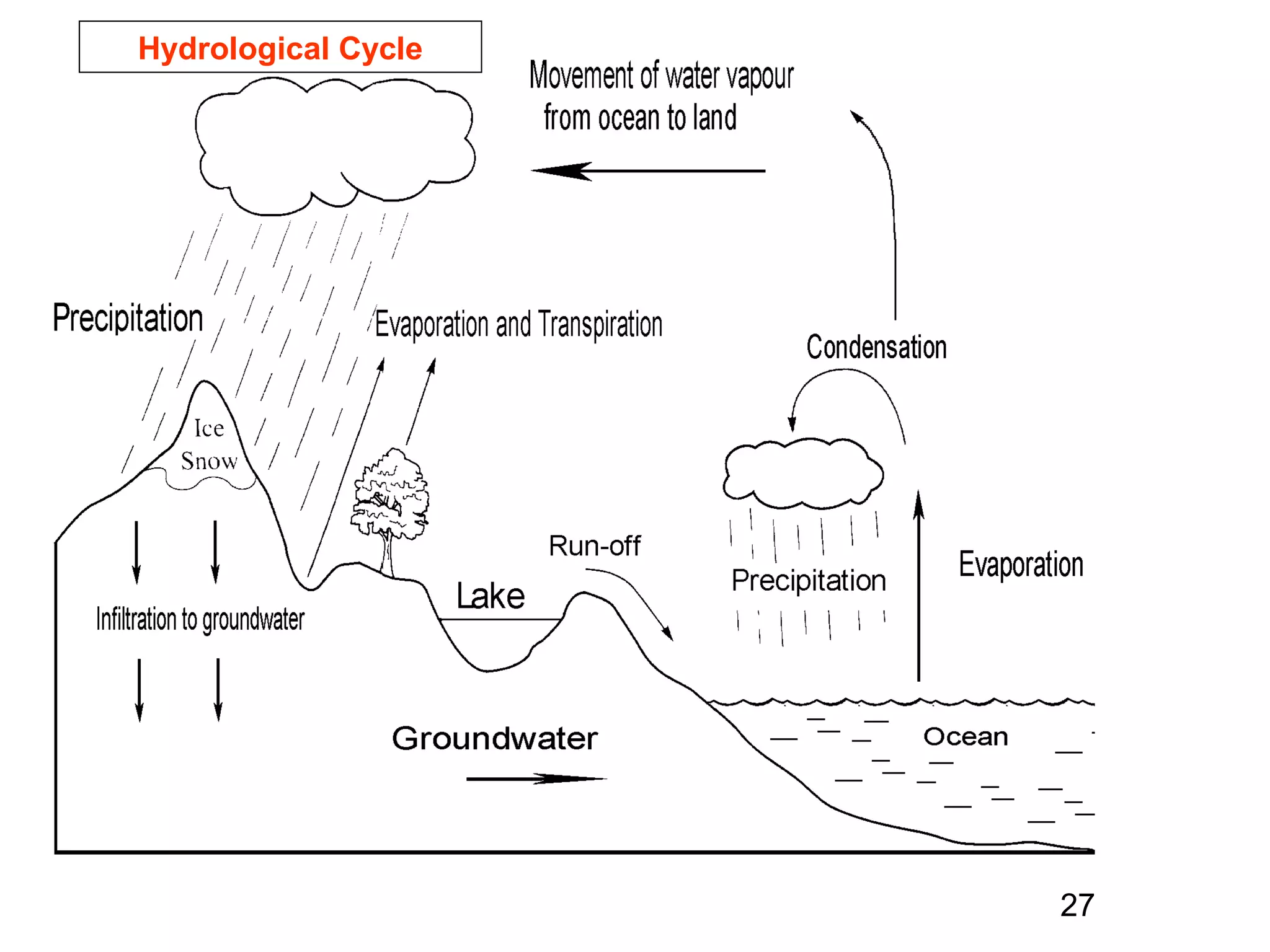
Hydrological cycle
1. Reservoir – oceans, air (as water vapor), groundwater,
lakes and glaciers; evaporation, wind and precipitation
(rain) move water from oceans to land.
2. Assimilation – plants absorb water from the ground,
animals drink water or eat other organisms which are
composed mostly of water.
3. Release – plants transpire, animals breathe and expel
liquid wastes.
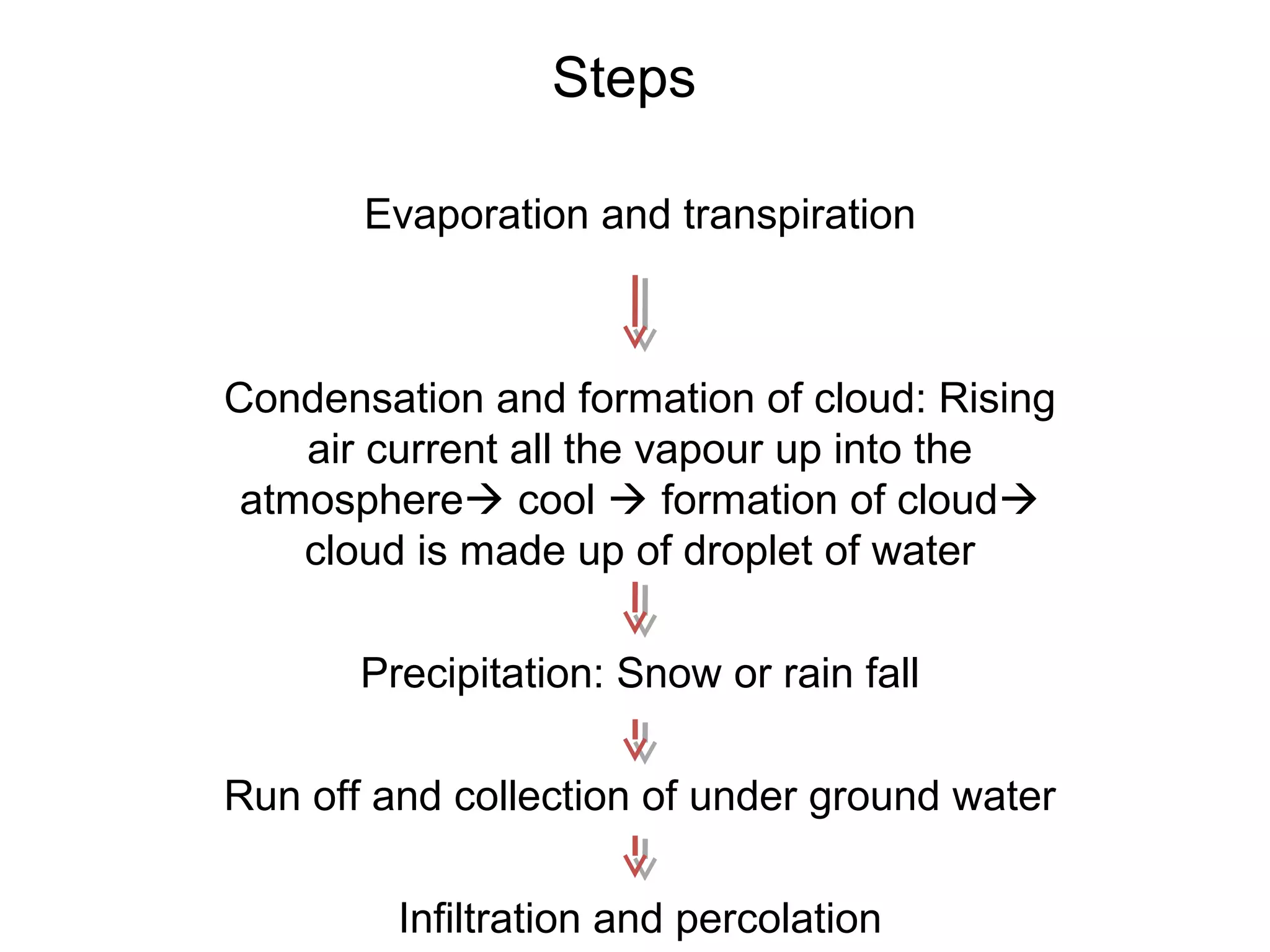
Steps
Evaporation and transpiration
Condensation and formation of cloud: Rising
air current all the vapour up into the
atmosphere cool  formation of cloud
cloud is made up of droplet of water
Precipitation: Snow or rain fall
Run off and collection of under ground water
Infiltration and percolation
Hydrological Cycle
27
Human Impact
Pollution of water
Reduces the vegetation cover increases the surface ran
off decreases the percolation
Global warming
Heavy deforestation reduces the transpiration loss of water
through plants and trees
Carbon cycle
Earth atmosphere contains 0.03% of CO2
CO2 is the basic source of carbon and constitutes of all
organic material
It found in caves ands mines and also evolves from
volcanoes
Reservoirs of Carbon
Carbon is found in all four spheres
Biosphere - organic matter
Atmosphere - CO2, CH4
Hydrosphere - H2CO3 ,HCO3
-
, CO3
=
Lithosphere - CaCO3 , coal, oil, and gas
Processes: photosynthesis, formation of sediments,
weathering, combustion, plate tectonics
Decay of organic material
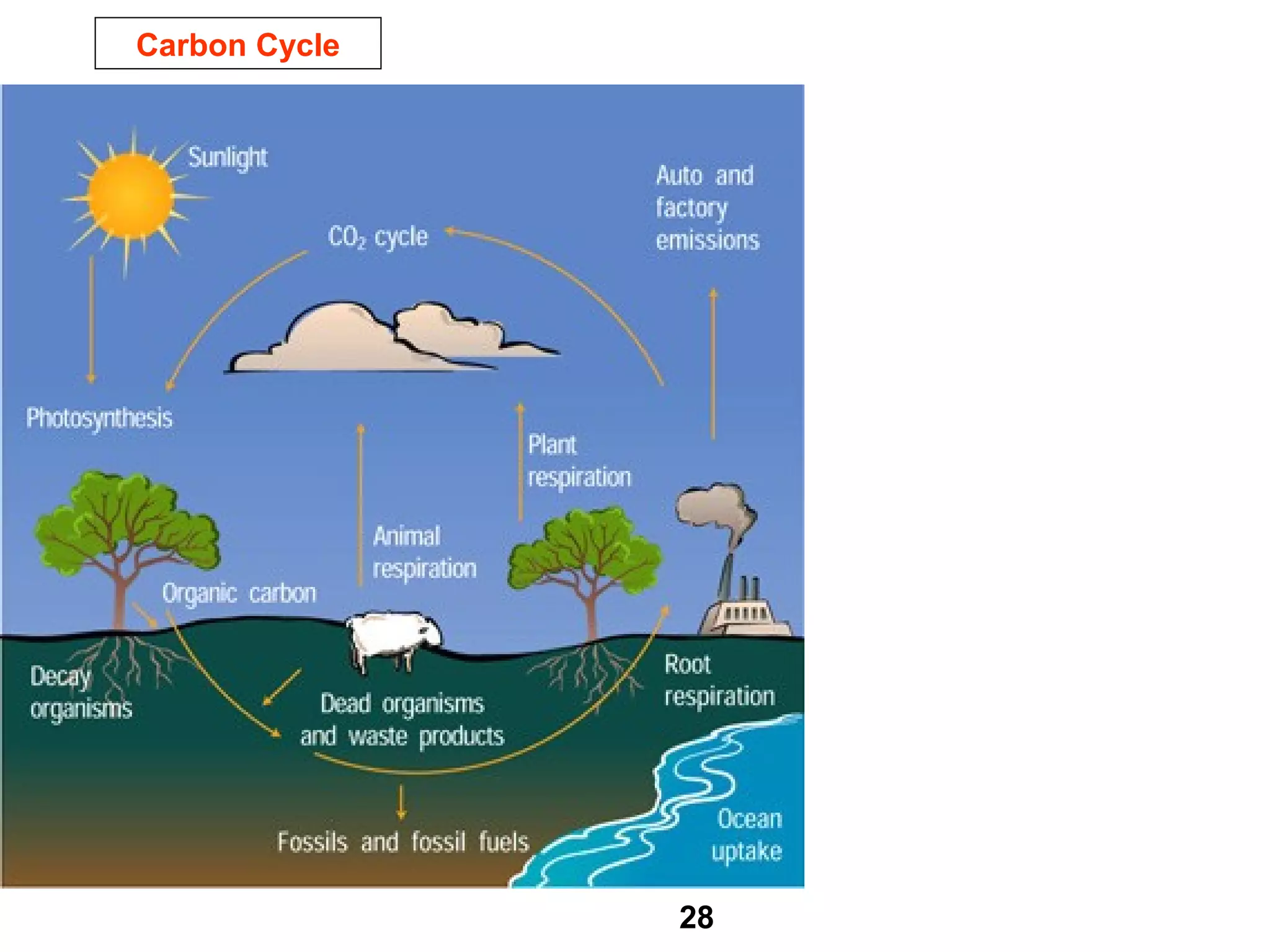
Carbon CycleCarbon Cycle
(carbon is required for building
organic compounds)
1. Reservoir – atmosphere (as CO2), fossil fuels (oil, coal),
durable organic materials (for example:
cellulose).
2. Assimilation – plants use CO2 in photosynthesis;
animals consume plants.
3. Release – plants and animals release CO2 through
respiration and decomposition; CO2 is
released as wood and fossil fuels are burned.
Carbon Cycle
28
Human Interference
Human-induced processes
Extraction and combustion of fossil fuels (speeds up the
medium-term cycling)
Cement manufacturing
Deforestation (biomass burning)
All of these processes release CO2 into the atmosphere and
affect the natural cycling of carbon
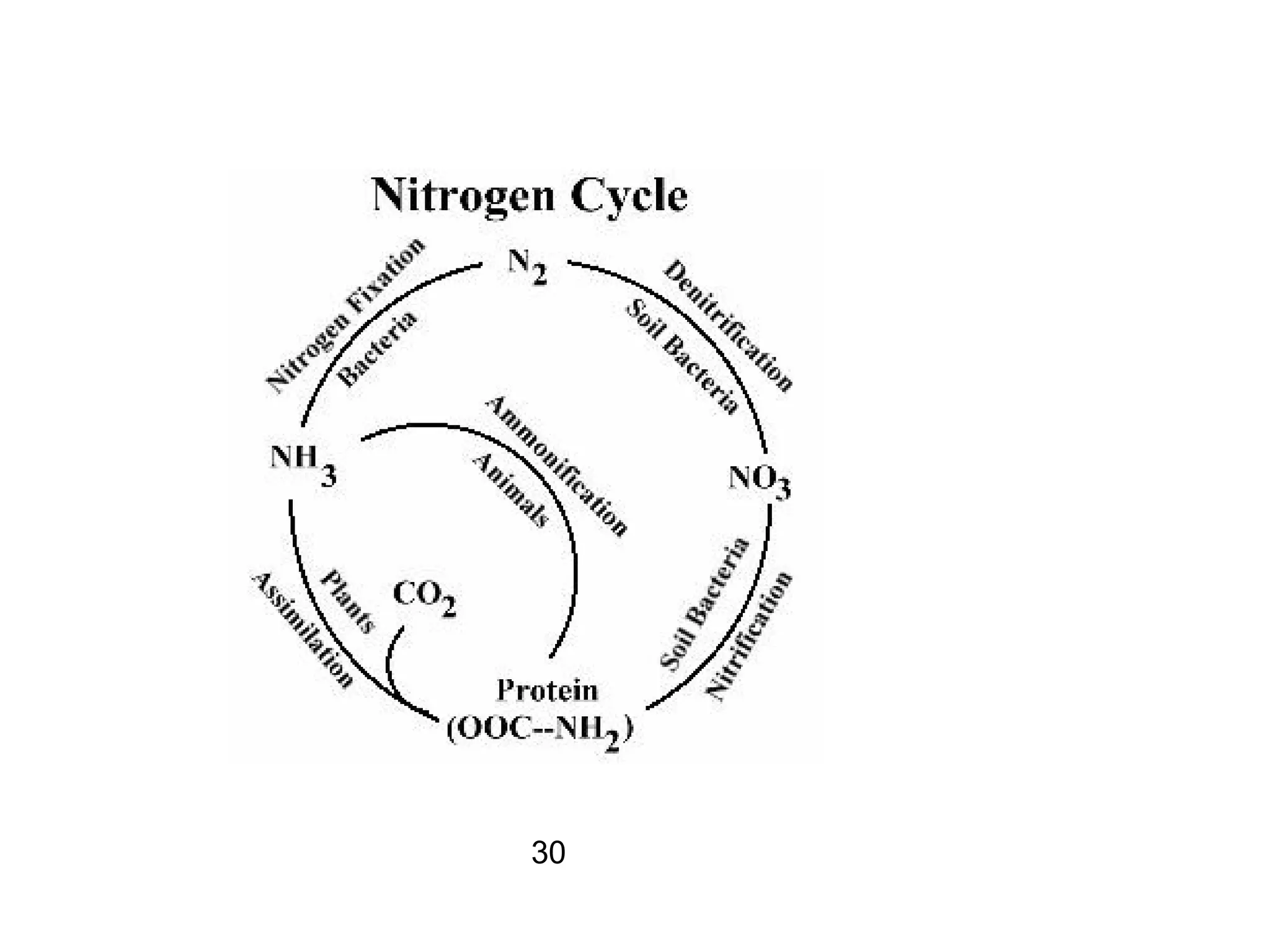
Nitrogen cycle
Nitrogen is an essential constituent of animals and plants.
Green plant combined with Nitrogen and carbohydrates to
make proteins and Nucleic acid
78 %
Not directly used most form of life
Taken by Process called nitrogen fixation
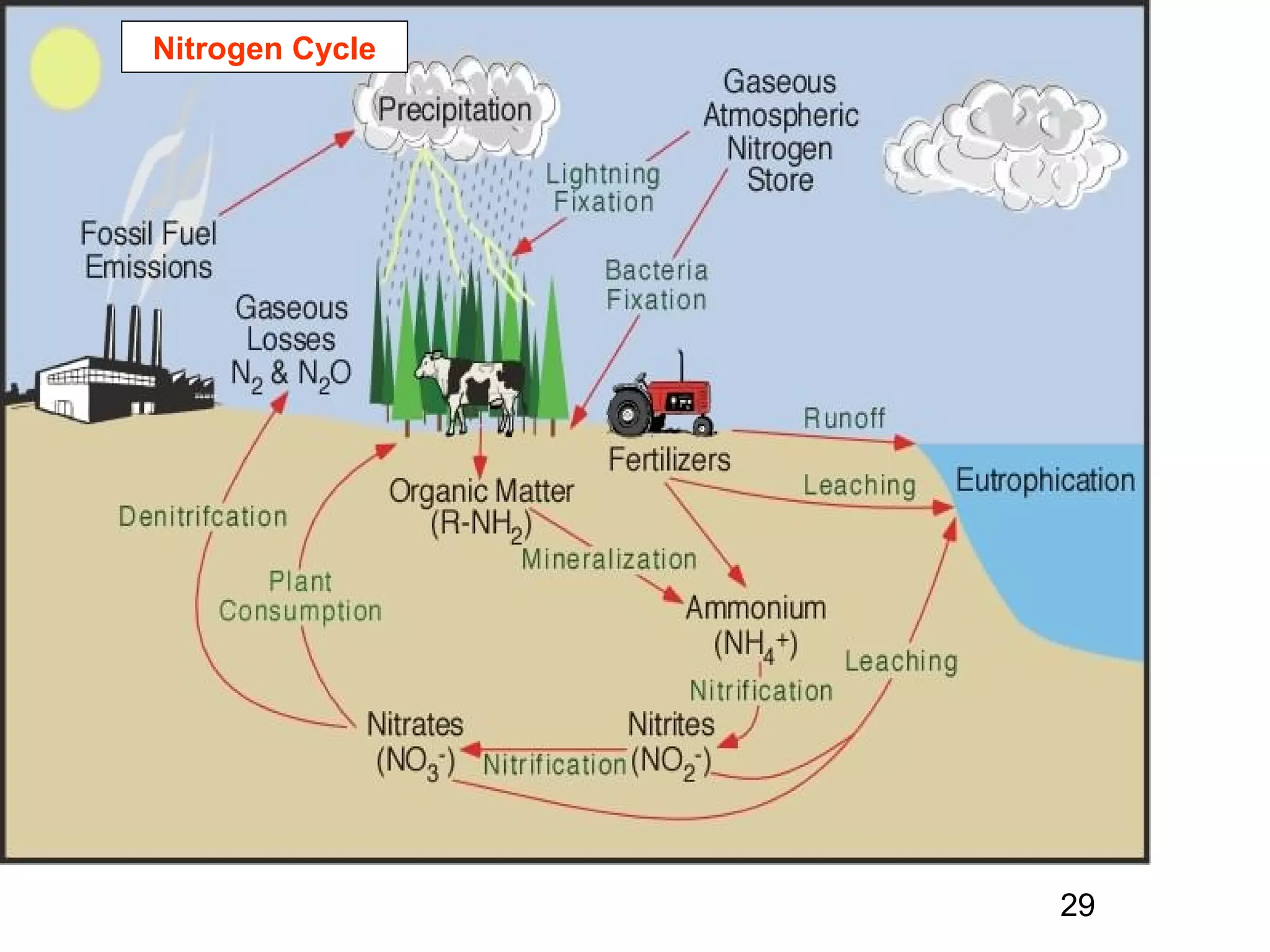
Nitrogen CycleNitrogen Cycle
(Nitrogen is required for the manufacture of
amino acids and nucleic acids)
1. Reservoir – atmosphere (as N2); soil (as NH4
+
or
ammonium, NH3 or ammonia, N02
-
or nitrite,
N03
-
or nitrate
Nitrogen CycleNitrogen Cycle
2. Assimilation – plants absorb nitrogen as either NH4
+
or as
N03
-
, animals obtain nitrogen by eating plants
and other animals. The stages in the
assimilation of nitrogen are as follows:
Steps
Nitrogen fixation
Ammonification
Nitrification and Denitrification
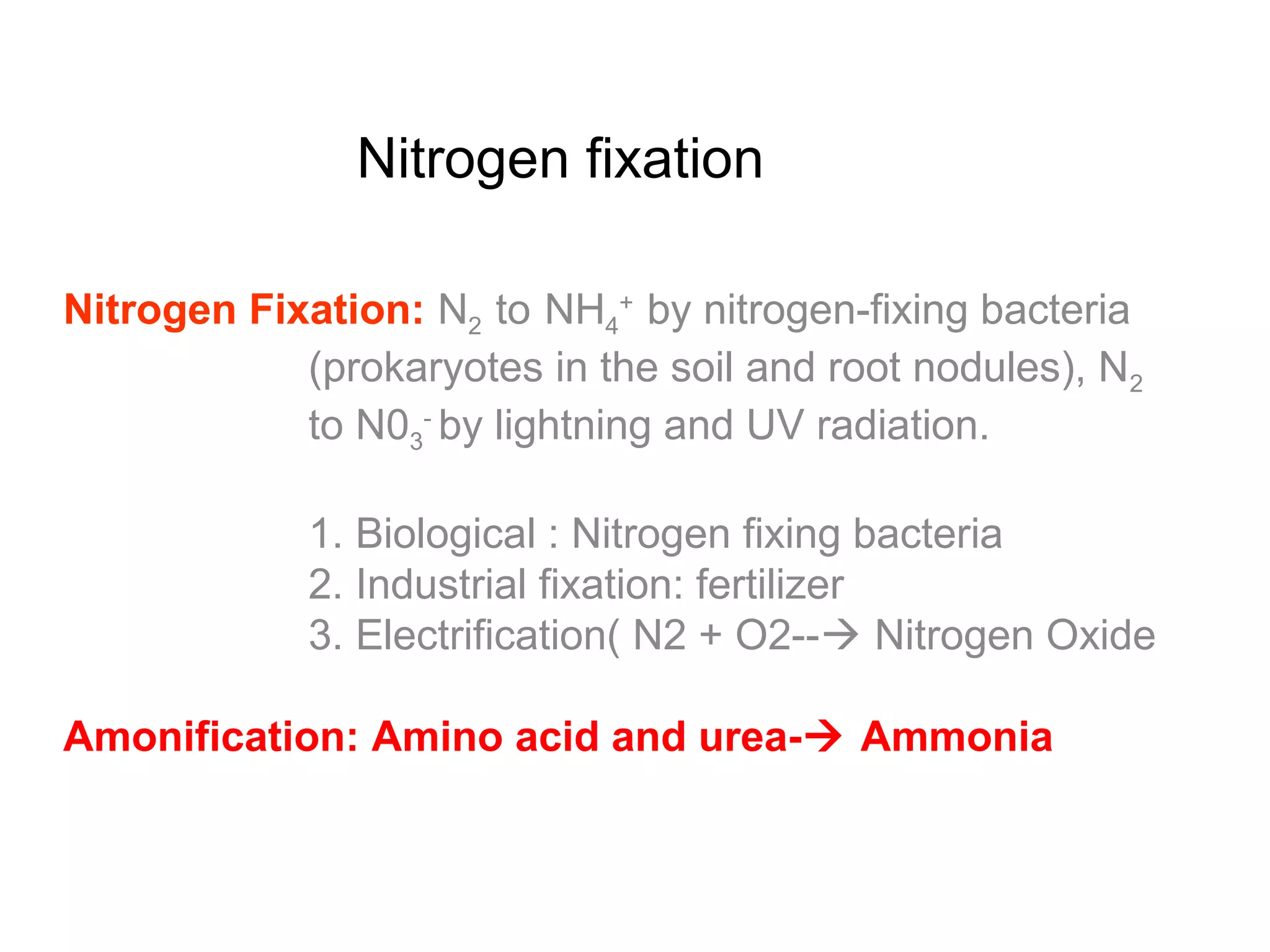
Nitrogen fixation
Nitrogen Fixation: N2 to NH4
+
by nitrogen-fixing bacteria
(prokaryotes in the soil and root nodules), N2
to N03
-
by lightning and UV radiation.
1. Biological : Nitrogen fixing bacteria
2. Industrial fixation: fertilizer
3. Electrification( N2 + O2-- Nitrogen Oxide
Amonification: Amino acid and urea- Ammonia
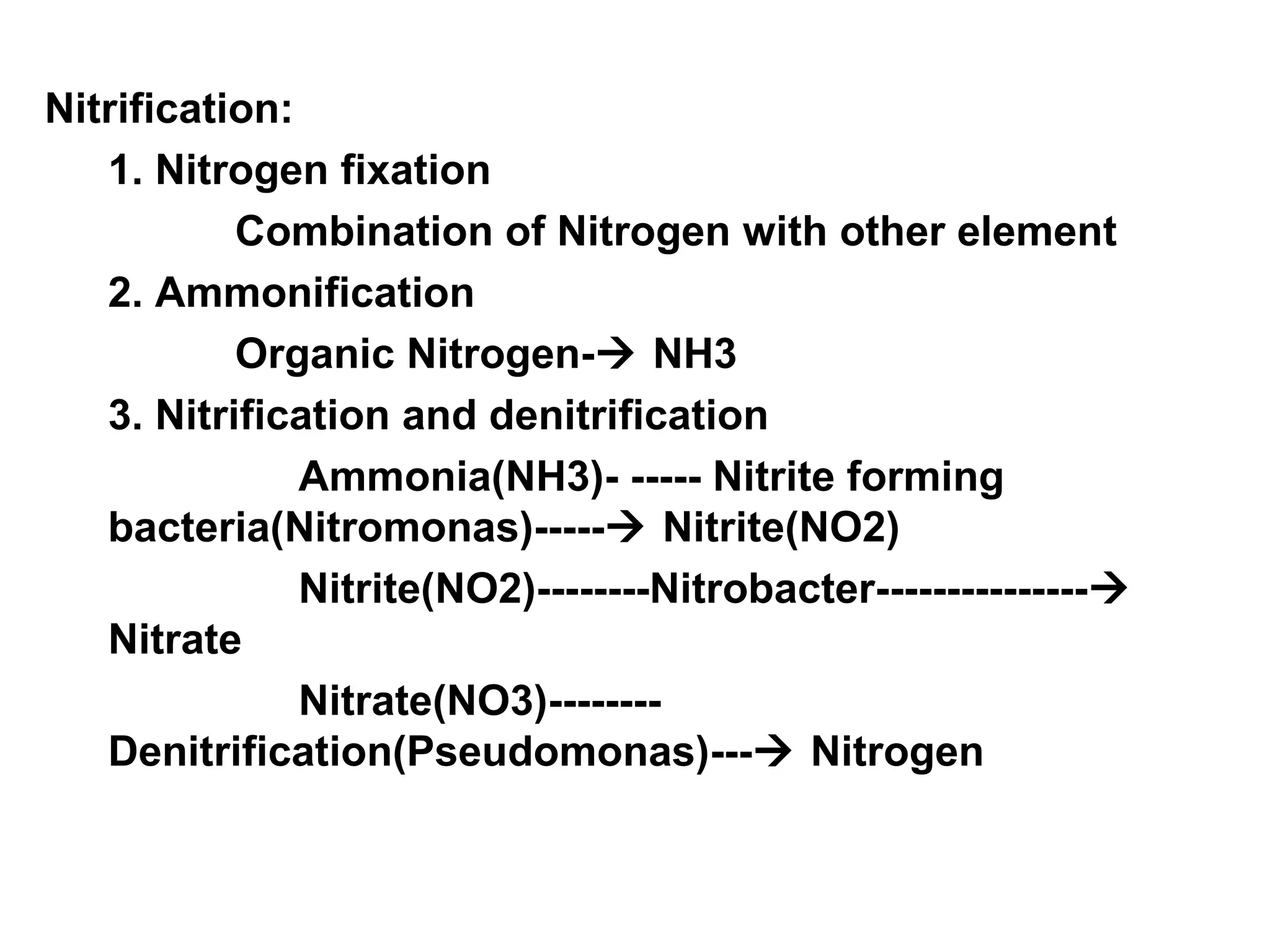
Nitrification:
1. Nitrogen fixation
Combination of Nitrogen with other element
2. Ammonification
Organic Nitrogen- NH3
3. Nitrification and denitrification
Ammonia(NH3)- ----- Nitrite forming
bacteria(Nitromonas)----- Nitrite(NO2)
Nitrite(NO2)--------Nitrobacter---------------
Nitrate
Nitrate(NO3)--------
Denitrification(Pseudomonas)--- Nitrogen
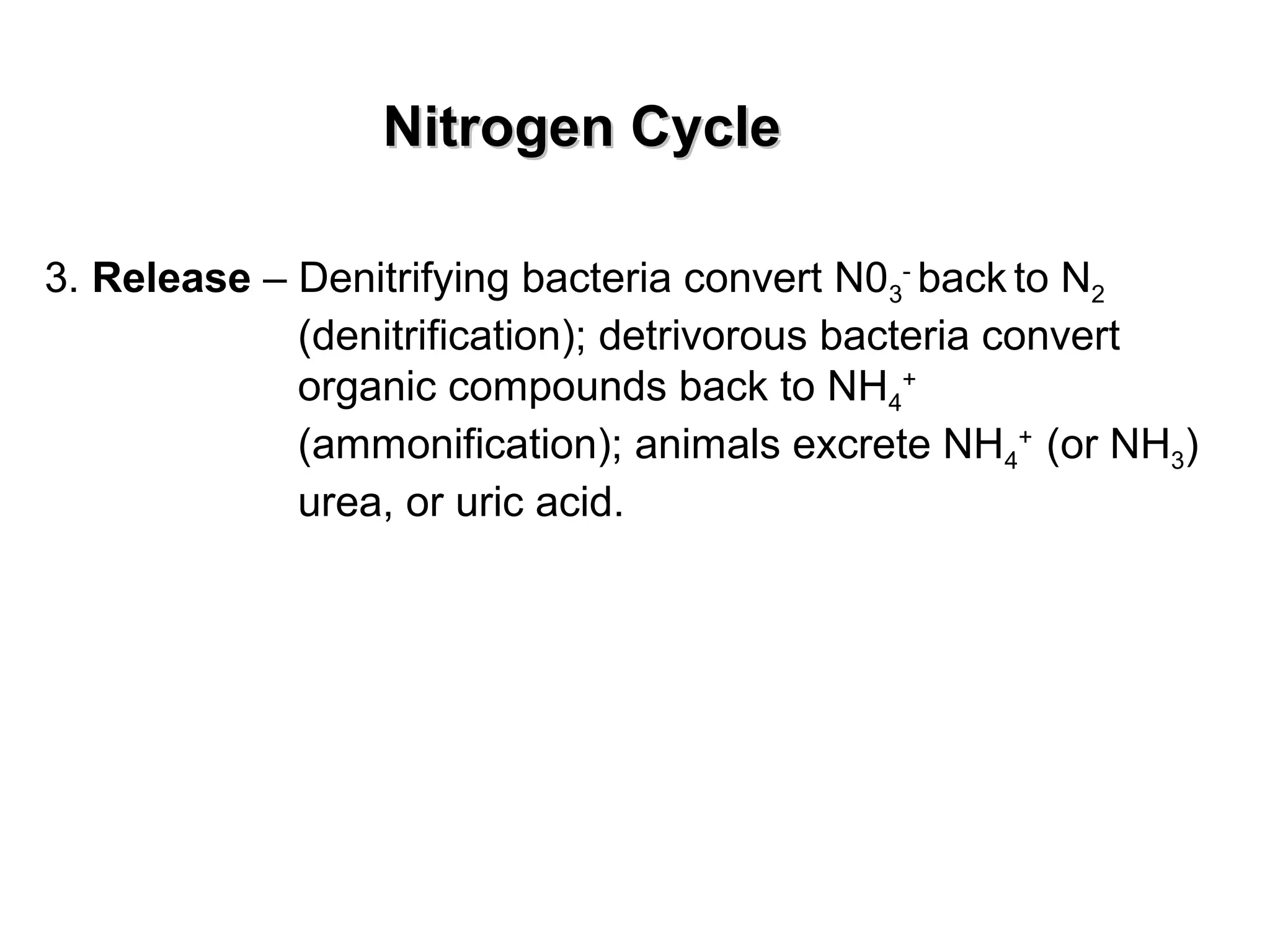
Nitrogen CycleNitrogen Cycle
3. Release – Denitrifying bacteria convert N03
-
back to N2
(denitrification); detrivorous bacteria convert
organic compounds back to NH4
+
(ammonification); animals excrete NH4
+
(or NH3)
urea, or uric acid.
Nitrogen Cycle
29
30
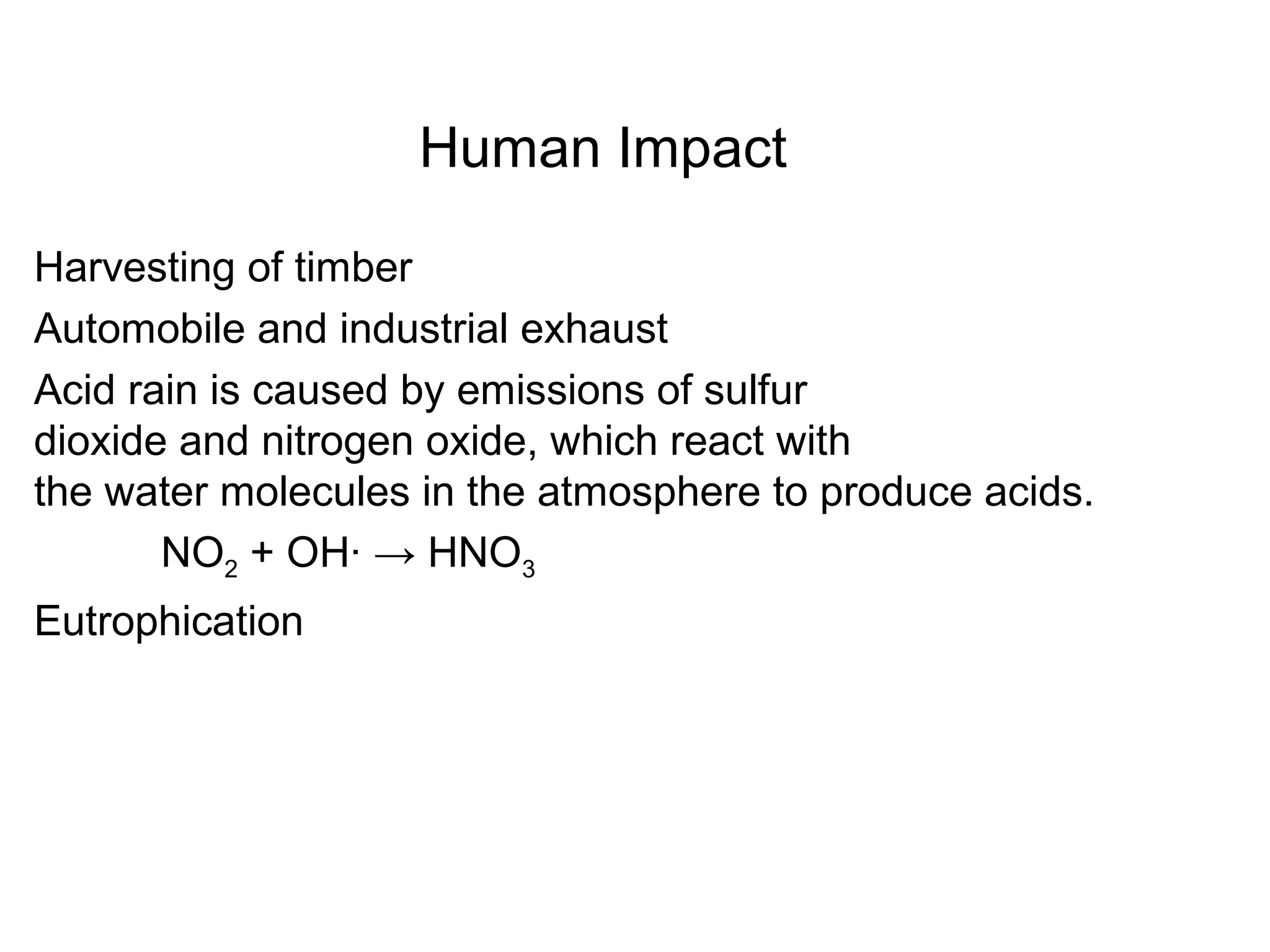
Human Impact
Harvesting of timber
Automobile and industrial exhaust
Acid rain is caused by emissions of sulfur
dioxide and nitrogen oxide, which react with
the water molecules in the atmosphere to produce acids.
NO2 + OH· → HNO3
Eutrophication
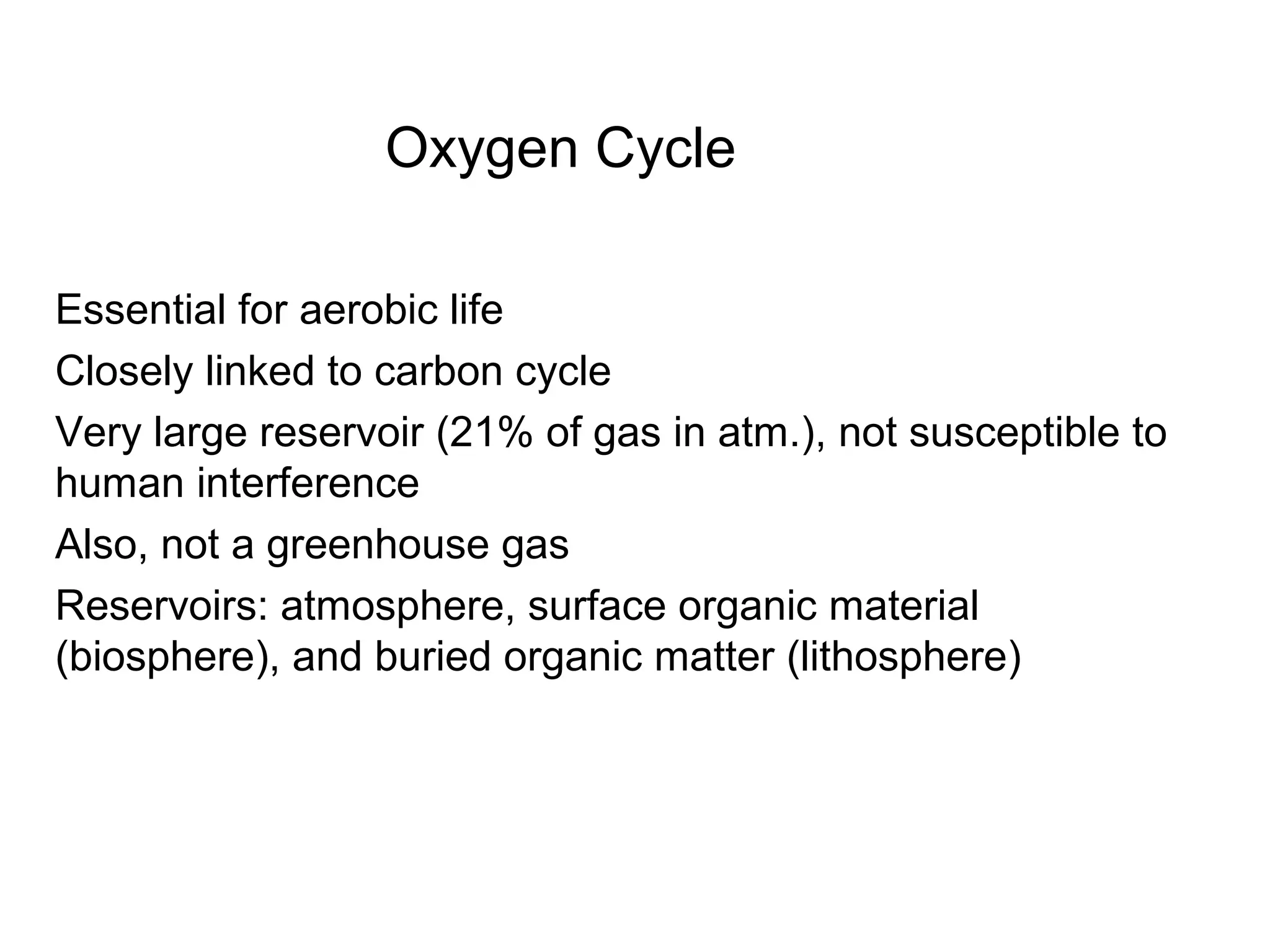
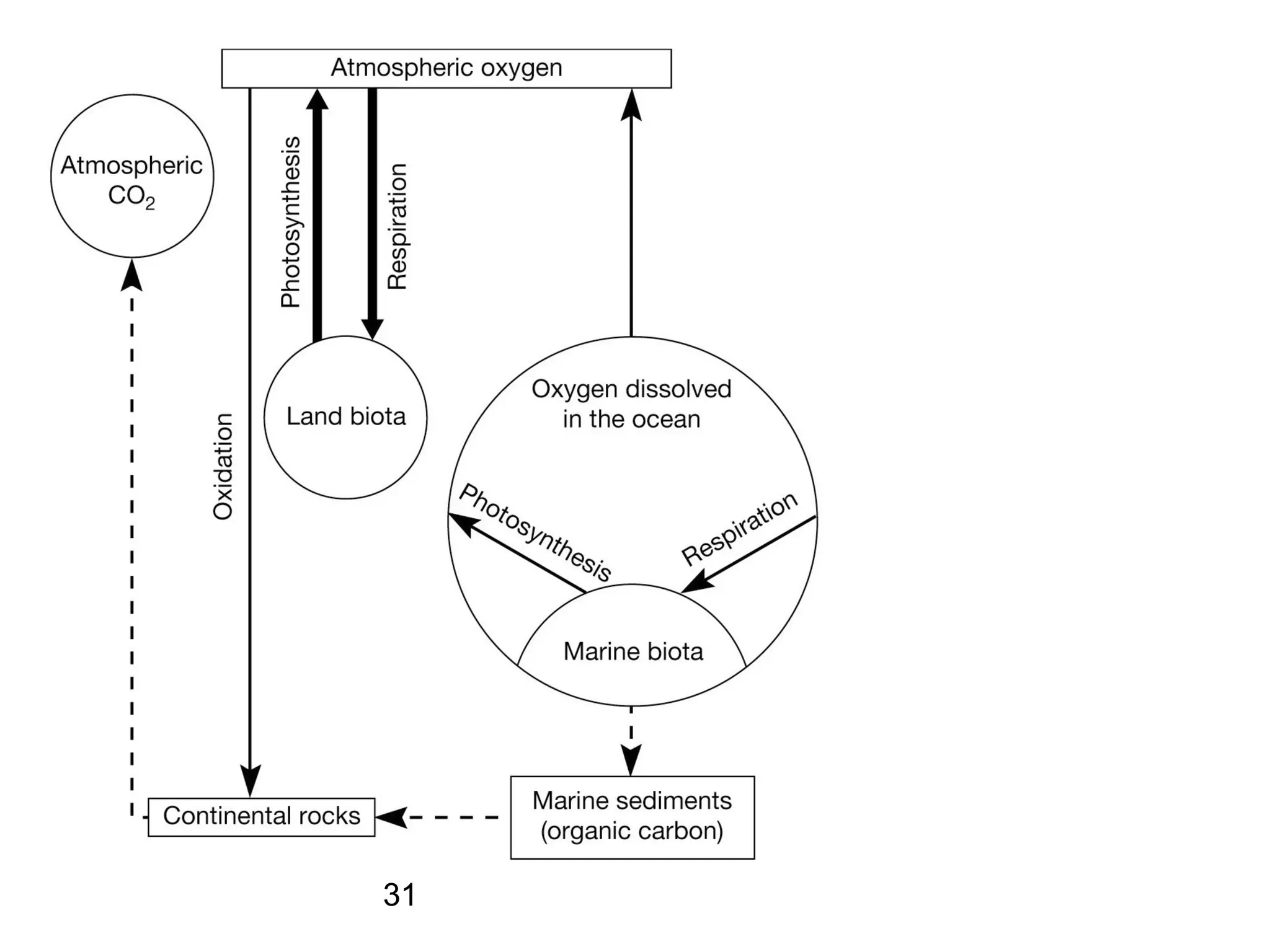
Oxygen Cycle
Essential for aerobic life
Closely linked to carbon cycle
Very large reservoir (21% of gas in atm.), not susceptible to
human interference
Also, not a greenhouse gas
Reservoirs: atmosphere, surface organic material
(biosphere), and buried organic matter (lithosphere)
Oxygen Cycle
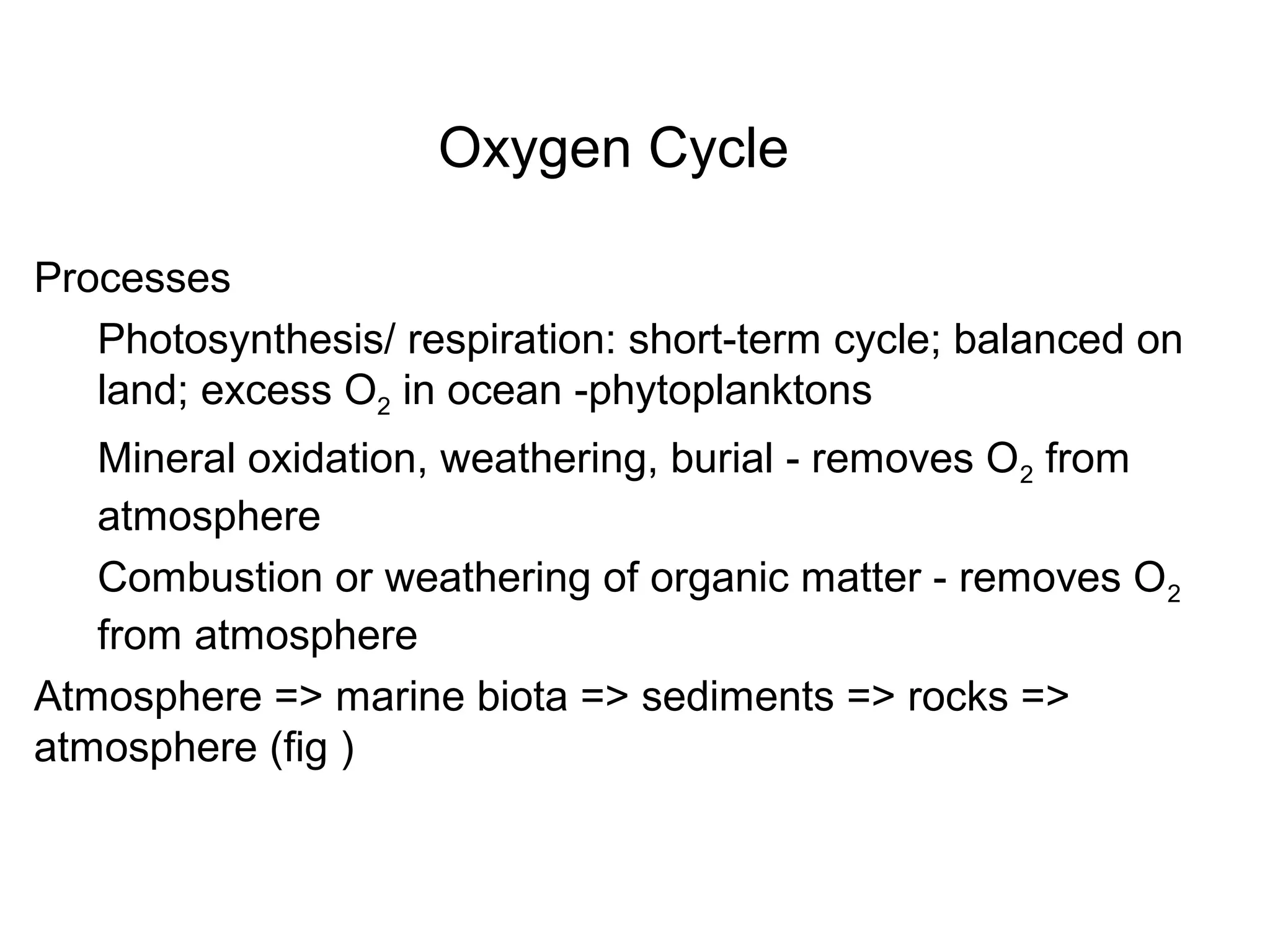
Processes
Photosynthesis/ respiration: short-term cycle; balanced on
land; excess O2 in ocean -phytoplanktons
Mineral oxidation, weathering, burial - removes O2 from
atmosphere
Combustion or weathering of organic matter - removes O2
from atmosphere
Atmosphere => marine biota => sediments => rocks =>
atmosphere (fig )
Oxygen
Cycle
31
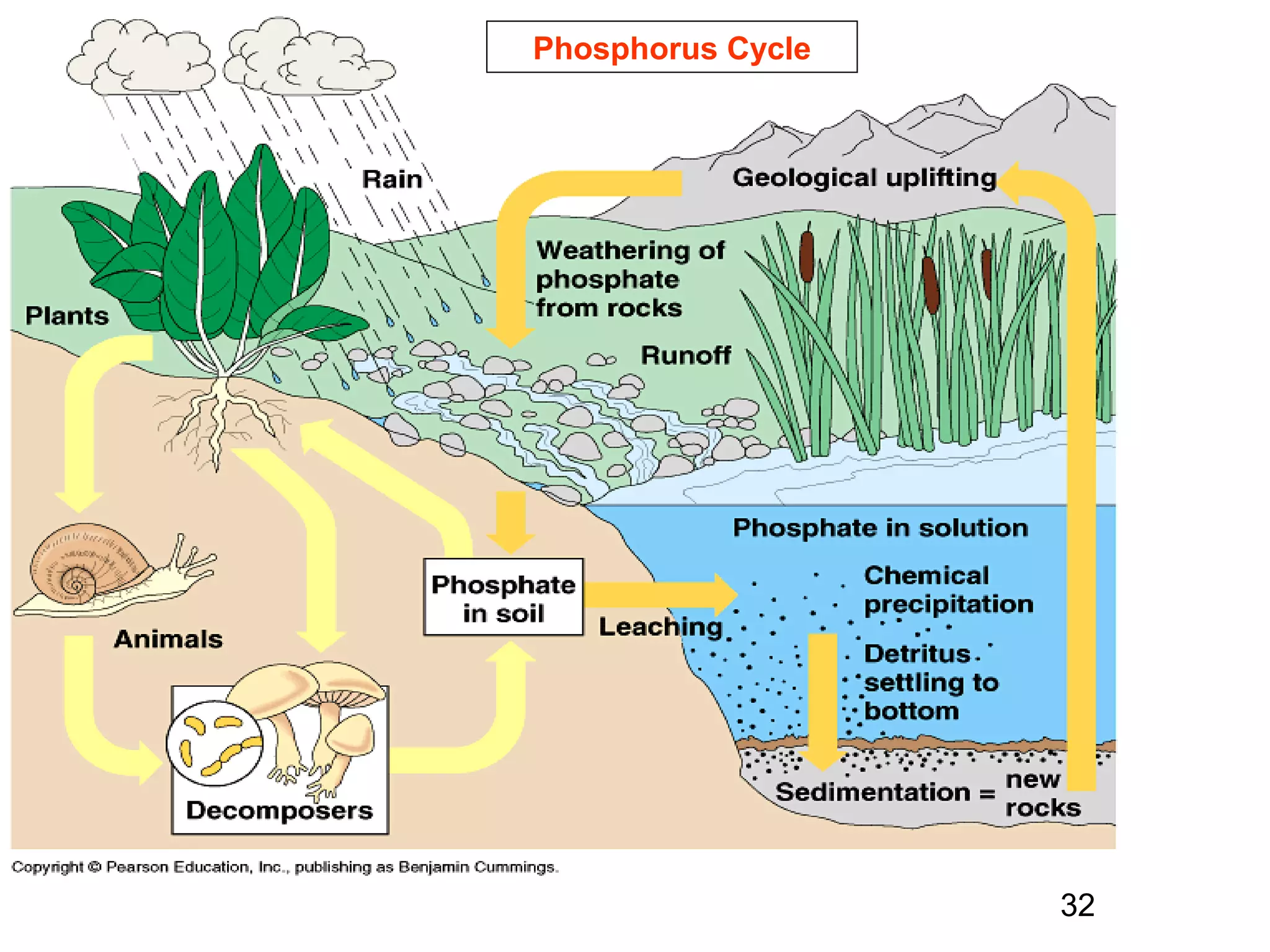
Phosphorus Cycle
32
Phosphorus CyclePhosphorus Cycle
(Phosphorus is required for the manufacture
of ATP and all nucleic acids)
1. Reservoir – erosion transfers phosphorus to water and soil;
sediments and rocks that accumulate on ocean
floors return to the surface as a result of uplifting
by geological processes
2. Assimilation – plants absorb inorganic PO4
3-
(phosphate)
from soils; animals obtain organic phosphorus
when they plants and other animals
3. Release – plants and animals release phosphorus when
they decompose; animals excrete phosphorus in
their waste products
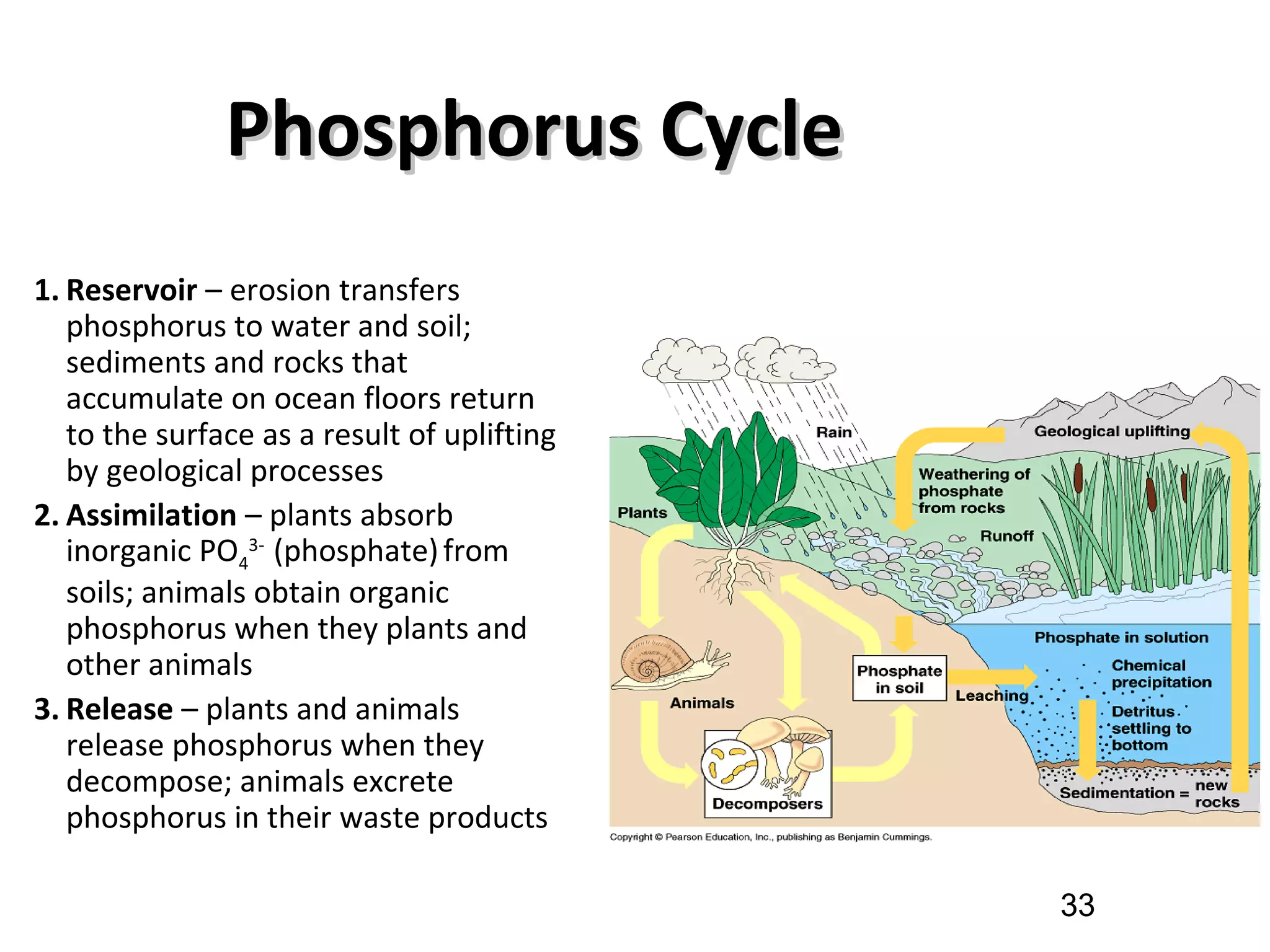
Phosphorus CyclePhosphorus Cycle
1. Reservoir – erosion transfers
phosphorus to water and soil;
sediments and rocks that
accumulate on ocean floors return
to the surface as a result of uplifting
by geological processes
2. Assimilation – plants absorb
inorganic PO4
3-
(phosphate)from
soils; animals obtain organic
phosphorus when they plants and
other animals
3. Release – plants and animals
release phosphorus when they
decompose; animals excrete
phosphorus in their waste products
33
Biogeochemical cycles of other minerals,
such as calcium and magnesium, are
similar to the phosphorus cycle.
References/Sources
1. https://lh5.ggpht.com/H2dq WsdPCrPGpOOsCS1f79kJCCu2IcRa4rgIFVyMYv0ed0xKM
2. https://lh4.ggpht.com/lal2jVY5nTqn-GYyGkNhOhEqbBwunhrQBzG68xJAs5pDe_1aIMv
3. https://lh4.ggpht.com/8bjS8iqi4zzR-ztiMXz2hgjGOGGUS8AMGN1tgpWCEYIx2QUMs8
4. https://lh3.ggpht.com/H1N_Kb3iEM3D9-Picz9yIF7BNGfYzxsDIBVvJe2r4HPZ-B60Qw_
5. https://lh4.ggpht.com/ZoYBuSR4OAetsf9Na4mwRp7sbnW2jAb3gQItbnuIQWfW6EWSU
6. https://lh4.ggpht.com/QouMVLtdYF9J5Xrz8wCmv-e7_OTGgdRAK1BBTmi0F1FrzGl4If
7. https://lh4.ggpht.com/eylCTs29meic1tKd8Ucy58-zmedwIWxjhT7oIF3M2aifdMbqC9vRX
8. https://lh6.ggpht.com/uSxc2sdAeDFVfeSje2xwLBqm89do_hoosxY9p6OhsLxPchW52V
9. https://lh4.ggpht.com/pW3IYpfQP5boJp9RH5lOAwYYBAcoaXziNwo9to2ZIOK5dsRGfh
10.https://lh4.ggpht.com/-qDNe-rS_wlb_uMkQr_8iSF6OSYB8Dgqa4zBtQUR1Hla_z1ebpa
11. https://lh3.ggpht.com/pMRtqE8hnDqCMIuuE5R4VTIDAT9Yj_KddkX3kQgILLzmIv
12. https://lh4.ggpht.com/NpHetwkBTgIptqOSIz43iUV0-xCiGbcwudy1iXPj_QrVMiAK
13. https://lh3.ggpht.com/jB0b-LrnXVA4T7qCMzAAWRbC4bpYxpGEf3csySGZ5wnKC
14. https://lh3.ggpht.com/hN2v5TWrNrJmTDBGzZ4FBhHMOEuZRJuMUivQkN8zDccT
15. https://lh4.ggpht.com/qAhs9XnefWApsz4w_0PvfaIJNQFzoAfL3dfrNduqvl1nCsfD
16. https://lh5.ggpht.com/2HNzKyG5_cw2gyRK2gks4jDoQO0VfQp6K1Mhd_g7zQEB
17. https://lh6.ggpht.com/KxV3xbr3kiMOe4oqrwtkovN1nFd9aoqJG0-MEU1Ay9hFnT
18. https://lh5.ggpht.com/t4p2rm66kwhsaAy7ZnHQPsKLSftOMoEGzgn8iv4Fy31DrB
19. https://lh4.ggpht.com/QOn_1o9GvgE_jWbKWnHicd6gdLBGrPATtABO8oSpm3a_
20. https://lh5.ggpht.com/JOghxjEzJ4rEZk4eI_rgp-gMG5KP_T2NqYADBpxayfGow1TW
21. https://lh4.ggpht.com/ANB3fOJea4GnjqpFE2NEG-LG095W-k9wLKbIS0F2CMlqM
22. https://lh3.ggpht.com/6BVS2KMpIbSSy9SwNslKg4VI1T5ZJp0vzx8pouenNzdIf-vxP
23. https://lh4.ggpht.com/O0Tef7MPahcV4Wq4lbkho2rnafNZ9lFX0HmET_iYAo
nh8yHrJ2_6_RZtmVKEVit0dj18K6Y=s88
24. https://lh6.ggpht.com/9N_YMc2xBXTH3LhJgm47-
RZ1Tmcj9dYgpbdlhcwiWehNedm3InWx9QZcwGDpsgwWsuYurFk=s109
25. https://lh4.ggpht.com/kwDP_QNbM13TnEUWvVtNmDs9d5Py5RW4WlpoF
ptNJ8_yaKIA-spRAX_F495qkBWplH-9eSs=s131
26. https://lh4.ggpht.com/5qUlTUGvnKp24MwkwcGiElzL0MtSCUQQl00UqorLlT
NjcKShsdk-NwwgAgJKasC5rr_P4Q=s119
27. https://lh5.ggpht.com/YcuXul7f8TVY5HwXoK0lGIFLDDVFKsFukYyFh2OicfgO
D0N1EdCpelLhO9oFsf-DYWJQR40=s112
28. https://lh4.ggpht.com/MF0yJQBypOTf-LwfF-
WjZANZ1OOJmn0E5gOtfwD7l7CWeD-yIHlBg96spbSIEn5YDzsyyw=s85
29. https://lh6.ggpht.com/XveKC4eCf-izIRSCczOsWM3WrB-dAQ4XBeJ-
srEW_1NH1AHfa1h2zMPut6dsAcOAa9oym44=s129
30. https://lh3.ggpht.com/6uGiBEBa2VCvsUVoeh7mcjfhmE_uvvAAF5PulQbiqi
2VHMa6LBlyVE70wbTHbJfXUtHHVY4=s85
31. https://lh4.ggpht.com/RlQIuwaG3OdM4VoIQiq4BW8URhkwcrf7Tyx3Sp7v
V1e258isYr_RAQYQJl5EsXObaHa3xA=s85
32. https://lh5.ggpht.com/inUdRc-
SxFJd74wYMrXQ_qfQuphz3Vv0zciYKQQLXyhhxidsFybgBTb9lo97Tm27UTO
6HQ=s97
33. https://lh4.ggpht.com/OuvgkVuf6hIxtMC8KZ1aiJmiSscQ3MfjqPR0BHrhNk
jLNzt9wE_RNXsLPraJtHPm32kDS1U=s97
Book/Web Resources
• Environment & Ecology by Dr Gourkrishna Dasmohapatra

Diploma. ii es unit 2.1 environment ecology and ecosystem

  • 1.
  • 2.
    Ecology and Ecosystems Ecology is the scientific study of relations that living organisms have with respect to each other and their natural environment.  Under ecology, we study various ecosystems which are a part of the biosphere.  An ecosystem includes all the organisms and the nonliving environment that are found in a particular place.
  • 3.
  • 4.
    Ecological Succession  Ecologicalsuccession is the observed process of change in the species structure of an ecological community over time.  Ecological succession occurs when the conditions of an environment suddenly and drastically change. 2
  • 5.
    Trophic Levels • Atropic level is the position occupied by an organism in a food chain. Trophic levels can be analyzed on an energy pyramid. • Producers are found at the base of the pyramid and compromise the first trophic level. • Primary consumers make up the second trophic level. • Secondary consumers make up the third trophic level. • Finally tertiary consumers make up the top trophic level. 3
  • 6.
    Food Chain  Afood chain shows the feeding relationship between different living things in a particular habitat.  Food chains show how energy is passed from the sun to producers, from producers to consumers, and from consumers to decomposers.  In any ecosystem, many food chains overlap. When this happens, the food chain forms a food web.
  • 7.
    Grazing Food Chain The"grazing" food chain includes the producers and consumers that cycle energy from living plants. The "detritus" food chain cycles energy from non- living remains of both plants and animals (also called detritus). The "grazing" food chain has a number of steps that start with the producers, or the plants, and flows through a series of levels of consumers. At each step only about 10% of the energy is passed up through the chain. The rest is passed back into the atmosphere as heat through breathing and decomposition. 4
  • 8.
    In the firststep plants convert the sun’s energy to chemical energy through a process called photosynthesis. The chemical energy is stored both as food and as structural elements in the plant. The next step involves the primary consumers, animals that eat only plants. At step three are the secondary consumers, also called predators; these animals eat primary consumers. At step four are the tertiary consumers that eat secondary consumers, and sometimes primary consumers as well
  • 9.
    Detritus food chain The"detritus" food chain cycles energy from non-living remains of both plants and animals (also called detritus). The "detritus" food chain is a system where the energy produced by the breakdown of dead plant and animal matter is cycled into the "grazing" food chain. Detritus is organic matter formed by decaying animal or plant tissue, or fecal matter. Detritus eaters (or detritivores) such as insects, worms and other small organisms feed on dead plants, waste products from animals and dead animals. Decomposers are fungal or bacterial organisms that work within the dead material to help break it down, activating decay and decomposition. This important part of the ecosystem takes the last of the energy that was originally absorbed by the plants and returns it to the soil. 5
  • 10.
    Characteristics of DetritusFood Chain a)Primary source of energy is dead organic matter called 'detritus' which are fallen leaves, plant parts or dead animal bodies. b) Primary consumers are 'detritivores' including protozoans, bacteria, fungi, etc which feed upon the detritus saprophytically. c) Detritivores are in turn eaten by secondary consumers such as insect larvae, nematodes, etc. d) Detritus food chains are generally shorter than grazing food chains e) In nature, detritus food chains are vital as the dead organic matter of grazing food chain is acted upon by the detritivores to recycle the inorganic elements into the ecosystem.
  • 11.
  • 12.
    Food Web  FoodWebs are Food Chains that intersect each other. Food webs are what really happens in nature.  A predator from one food chain may be linked to the prey of another food chain  Several food chains linked together 7
  • 13.
  • 14.
    An ecological pyramidis a graphical representation designed to show…….  the number of organisms,  energy relationships, and  biomass of an ecosystem. They are also called Eltonian pyramids after Charles Elton, who developed the concept of ecological pyramids. Charles Elton (1927) developed the concept of ecological pyramids who noted that "…the animals at the base of a food chain are relatively abundant while those at the end are relatively few in number…" 8
  • 15.
    Producer organisms (usuallygreen plants) form the base of the pyramid, With succeeding levels above representing the different trophic levels (respective position of the organisms within ecological food chains). Succeeding levels in the pyramid represent the dependence of the organisms at a given level on the organisms at lower level.
  • 16.
    There are threetypes of pyramids: of numbers, of biomass, and of energy. 9
  • 17.
    Pyramid of Biomass Biomass is (is the mass of living biological organisms in a given area or ecosystem at a given time) renewable organic (living) material.  A pyramid of biomass is a representation of the amount of energy contained in biomass, at different trophic levels for a particular time.  It is measured in grams per meter2, or calories per meter2. This demonstrates the amount of matter lost between trophic levels.  Each level is dependent on its lower level for energy, hence the lower level determines how much energy will be available to the upper level. Also, energy is lost in transfer so the amount of energy is less higher up the pyramid.
  • 18.
     There aretwo types of biomass pyramids: upright and inverted.  An upright pyramid is one where the combined weight of producers is larger than the combined weight of consumers. An example is a forest ecosystem.  An inverted pyramid is one where the combined weight of producers is smaller than the combined weight of consumers. An example is an aquatic ecosystem.
  • 19.
  • 20.
    Pyramid of Numbers The pyramid of numbers represents the number of organisms in each trophic level. This pyramid consists of a plot of relationships between the number herbivores (primary consumers), first level carnivore (secondary consumers), second level carnivore (tertiary consumers) and so forth. This shape varies from ecosystem to ecosystem because the number of organisms at each level is variable  Upright, partly upright and inverted are the three types of pyramids of numbers.  An aquatic ecosystem is an example of upright pyramid where the number of organisms becomes fewer and fewer higher up in the pyramid.  A forest ecosystem is an example of a partially upright pyramid, as fewer producers support more primary consumers, but there are less secondary and tertiary consumers.  An inverted pyramid of numbers is one where the number of organisms depending on the lower levels grows closer toward the apex. A parasitic food chain is an example.
  • 21.
  • 22.
  • 23.
    Pyramid of Energy Thepyramid of energy represents the total amount of energy consumed by each trophic level. An energy pyramid is always upright as the total amount of energy available for utilization in the layers above is less than the energy available in the lower levels. This happens because during energy transfer from lower to higher levels, some energy is always lost.
  • 24.
  • 25.
    Functions of NaturalEcosystem Air pollution are tapped by leaves of tree and convert into harmless compounds Waste water gets filtrated through the natural soil and make drinkable
  • 26.
    Types Of Ecosystems Forest Ecosystem  Grassland Ecosystem  Desert Ecosystem  Aquatic Ecosystem  Estuarine Ecosystem
  • 27.
    Forest Ecosystem  Aforest ecosystem is a terrestrial unit of living organisms.  All interacting among themselves and with the environment (soil, climate, water and light) in which they live. 14
  • 28.
    Types Of ForestEcosystems Tropical Rain Forest ( Average rain fall: <150cm/year) Temp: 18oC Warmed , humid, high diversity of animal, plant, insects Tropical Deciduous Forest (Rain fall: 100-120cm/yr) Climate is not evenly distributed
  • 29.
    Temperate Deciduous (cold climate,annual temp: 7-15oC) Summer is very hot and winter is very cold Tall decidous tree Boreal Forest/TIAGA/CONIFEROUS Climate is very cold Rainfall: 100mm to 350 mm Temperate Rain forest Very cold Winter rain fall Summer is very hot and Dry
  • 30.
    Functions Forest Ecosystems Enhancethe water resources in both quality and quantity  Hydrological cycle depend on the forest ecosystem Forest gives shelter to wildlife and fish Considered as a pathway for exchange and regulation of atmospheric gases, water and trace elements
  • 31.
    Coniferous forest ofAlaska Tropical rain forest Deciduous Forest 15
  • 32.
    Grassland Ecosystem Grasslands areareas where the vegetation is dominated by grasses
  • 33.
    Types Of Grassland Ecosystem Tropical and Savannas grasslands Tropical and subtropical grasslands, savannas, and shrublands are a grassland terrestrial biome located in semi-arid to semi- humid climate regions of subtropical and tropical latitudes. Tropical grasslands include the savanna usually associated with Africa, and savanna-type grasslands found in India, Australia, Nepal and the Americas. 16
  • 34.
     Temperate grasslands Temperature:warm to hot season (often with a cold to freezing season in winter) Soil: fertile with rich nutrients and minerals Plants: grass; trees or shrubs in savanna and shrubland Animals: large, grazing mammals; birds; reptiles Rain fall: 25-60cm/yr Although large areas have now been converted to agriculture, in the past temperate grasslands were home to herds of large grazing animals such as bison, deer or kangaroos. North America, the steppes of Russia and the pampas of Argentina. 17
  • 35.
    Flooded Grass land Flooded grasslands and savannas is a terrestrial biome.  Its component ecoregions are generally located at subtropical and tropical latitudes, which are flooded seasonally or year-round.  A common term is swamp. Characteristics Flooded grasslands are characterized by:  very wet to saturated soil moisture content in nutrient rich soils.  in temperate—warm to tropical—hot climates.  They are found as grasslands, savannas, and wetlands. 18
  • 36.
    Tundra Biome Tundra isthe coldest of all the biomes. Tundra comes from the Spanish word tunturia, meaning treeless plain. It is noted for its frost-molded landscapes, extremely low temperatures, little precipitation, poor nutrients, and short growing seasons. The two major nutrients are nitrogen and phosphorus. Nitrogen is created by biological fixation, and phosphorus is created by precipitation. Tundra is separated into two types: arctic tundra and alpine tundra. characteristics Extremely cold climate Low biotic diversity Simple vegetation structure Short season of growth and reproduction Energy and nutrients in the form of dead organic material 19
  • 37.
    Arctic Arctic tundra islocated in the northern hemisphere, encircling the north pole and extending south to the coniferous forests of the taiga. The arctic is known for its cold, desert-like conditions. The growing season ranges from 50 to 60 days. The average winter temperature is -34° C (-30° F), but the average summer temperature is 3-12° C (37-54° F) which enables this biome to sustain life. Rainfall may vary in different regions of the arctic. Yearly precipitation, including melting snow, is 15 to 25 cm (6 to 10 inches). Soil is formed slowly. Alpine Alpine tundra is located on mountains throughout the world at high altitude where trees cannot grow. The growing season is approximately 180 days Mammals: pikas, marmots, mountain goats, sheep, elk Birds: grouselike birds Insects: springtails, beetles, grasshoppers, butterflies
  • 38.
    Montane High-altitude grasslands locatedon high mountain ranges around the world, like the Páramo of the Andes Mountains. They are part of the montane grasslands and shrublands biome and also constitute tundra. Desert and xeric Also called desert grasslands, this is composed of sparse grassland ecoregions located in the deserts and xeric shrublands biome 20
  • 39.
    Desert Ecosystem  Adesert ecosystem exists where there is little rainfall and the climate is extreme in harshness.  It occupies about 17% of the earth’s surface. 21
  • 40.
    Types Of DesertEcosystem Temperate Deserts: Sahara in Africa, Thar in Rajasthan Tropical Deserts: Mojave in south California Cold Deserts: Gobi desert in China
  • 41.
    Components of desertEcosystem A biotic components: Nutrition's present in the soil and aerial environment Biotic Components: Producers: There are shrubs, Grasses and few trees. Some time few cacti Consumers: Reptiles, Insects, Birds mammals and camels Decomposers: There are very few, as due to poor vegetation the amount of dead organic matter is less. There are few fungi and most of them are thermophlic
  • 42.
    Thar Desert Sahara Desert Mojavein south California Gobi desert in China 22
  • 43.
    Aquatic Ecosystem  Itis an ecosystem located in a water bodies.  The two main types of aquatic ecosystems are marine ecosystems and freshwater ecosystems. 23
  • 44.
    Types Of AquaticEcosystem Freshwater Ecosystem 1. Pond ecosystem 2. Lake ecosystem 3. Stream 4. Riverine Ecosystem 5. Fresh water marshes ecosystem
  • 45.
    On the basisof water flow, fresh water ecosystem classified into two - Lentic ecosystem (Standing water bodies) - Lotic ecosystem (Running or flowing water bodies)
  • 46.
    LOTIC ECOSYSTEMS  Loticecosystem may be perennial or seasonal  Perennials occasionally subjected to floods which cause damage to the surrounding areas  Lotic series distinguished by continued flow of water in one direction  Lotic systems are richer in oxygen and nutrients than lentic systems Egs: Spring,Stream or river ecosystems
  • 47.
    LENTIC ECOSYSTEM  Itmay be perennial or seasonal  Oxygen content in the surface water to a depth of 3-5 meters is enough to support life  In deeper levels oxygen is less and biological activities decreases  In bottom levels anaerobic conditions prevail and organisms that can thrive under such conditions are found at this depth  Egs: Lake,Pond,Swamp,Reservoirs etc
  • 48.
  • 49.
    POND ECOSYSTEM It isa simplest fresh water aquatic ecosystem It is a small body of standing shallow water It may receive enough water during rainy season It is a self sufficient & self regulatory ecosystem
  • 50.
    Life span ofsmall seasonal ponds ranges from a few weeks or months Life span of larger ponds are several hundred years Pond water contain a mixture of living organisms, both plants & animals, and inorganic and organic components.
  • 51.
    LAKE ECOSYSTEM Big andnatural fresh water bodies with standing water Functions like a giant permanent pond Lakes are formed when precipitation run-off or ground water seepage fills up depressions in the land formed by geological changes.
  • 52.
    ZONATION A large lakehas four zones(depending on the depth).They are: - LITTORAL: upper zone ,shallow water near the shore of lake. -LIMNETIC: open water away from the shore of lake. -PROFOUNDAL:deep water,too dark,not found plants or algae. -BENTHIC: bottom of the lake. 25
  • 53.
    Types of Lake Artificiallake: Due to construction Obligotrophic lake: Low nutrition concentration Masotrphic: Moderate Nutrition Eutrophic: More amount of Nutrition : Dal Lake Dystrophic lake: Brown water with low pH and humic acid Desert salt lake: High concentration of Salts: Sambhar lake Rajasthan Volcanic lake: It occures by volcano: Japan Meromictic lake : Rich in salt
  • 54.
    RIVER AND STREAMECOSYSTEM They are flowing fresh water bodies. Flowing water follows distinct “channels”. Small channels – STREAMS Large channels – RIVERS Plants and animals live in streams and rivers depend upon the movement and speed of the water.
  • 57.
    FRESHWATER MARSHES ECOSYSTEM It tendto be naturally fertile ecosystem. It is valuable in maintaining water tables in adjacent ecosystems. Periodic fluctuations in water levels resulting from seasonal and annual rainfall variation often accomplishes tidal like actions in terms of maintaining long range stability and fertility.
  • 58.
    Marine Ecosystem 70% worldcover by the water and 97% of this water is available in oceans and Seas. They play key role in survival of 2,50,000 species Oceans are major sinks of CO2 and play important role in Carbon cycle, Hydrological cycle Major ocean: Pacific, Atlantic, Indian, Arctic Pacific: Largest and cover 1/3 part of Earth
  • 59.
    Coastal Zone: Relativelywarmer, Nutrition rich shallow water with sunlight and high production Open Sea: Deeper part of ocean and away from submerged part of Continent is called continental shelf. Euphotic zone: Received Enough light Bathyal Zone: Dim light Abyssal Zone: 1.5 to 5 km deep dark zone. No solar energy 26
  • 60.
    Components of marineecosystem Abiotic Components: Salt concentration in open sea is usually 3.5 % while dominant ions are sodium, chloride, sulpher magnasium and calcium Biotic components: Producers: phytoplanktons : macro and micro algae, cynobacteria Consumers: Herbivorous and Carnivores and top carnivorous Decomposers: Bacteria and fungi
  • 61.
  • 62.
    Biogeochemical Cycles describe theflow of essential elementsessential elements from the environment through living organisms and back into the environment. The biogeochemical cycle is the continuous flow of elements and compounds between organisms and the earth
  • 63.
    Types of cycles Hydrologicalcycle: deal with the interchange of water with organisms and environment Gaseous cycle: Deal with inter change with gases Sedimentary cycle: Deals with SO4 and PO4 cycle and concern with the interchange of nutrition and minerals
  • 64.
    Elemental Cycles H, O,and C make up > 99 % of the Earth’s biomass N, Ca, K, Mg, S, and P are significant nutrients Cycling of C, O, N, P, and S are discussed in this chapter
  • 65.
    Concepts in Biogeo.Cycles  Reservoir - where material or mass is stored  Flux: rate of flow of material  Steady state: inflow = outflow  Dynamic state: fluxes are reservoirs are changing with time  Residence time: length of time a chemical stays in a reservoir  Feedback: positive and negative
  • 66.
    Hydrological cycle 1. Reservoir– oceans, air (as water vapor), groundwater, lakes and glaciers; evaporation, wind and precipitation (rain) move water from oceans to land. 2. Assimilation – plants absorb water from the ground, animals drink water or eat other organisms which are composed mostly of water. 3. Release – plants transpire, animals breathe and expel liquid wastes.
  • 67.
    Steps Evaporation and transpiration Condensationand formation of cloud: Rising air current all the vapour up into the atmosphere cool  formation of cloud cloud is made up of droplet of water Precipitation: Snow or rain fall Run off and collection of under ground water Infiltration and percolation
  • 68.
  • 69.
    Human Impact Pollution ofwater Reduces the vegetation cover increases the surface ran off decreases the percolation Global warming Heavy deforestation reduces the transpiration loss of water through plants and trees
  • 70.
    Carbon cycle Earth atmospherecontains 0.03% of CO2 CO2 is the basic source of carbon and constitutes of all organic material It found in caves ands mines and also evolves from volcanoes
  • 71.
    Reservoirs of Carbon Carbonis found in all four spheres Biosphere - organic matter Atmosphere - CO2, CH4 Hydrosphere - H2CO3 ,HCO3 - , CO3 = Lithosphere - CaCO3 , coal, oil, and gas Processes: photosynthesis, formation of sediments, weathering, combustion, plate tectonics Decay of organic material
  • 72.
    Carbon CycleCarbon Cycle (carbonis required for building organic compounds) 1. Reservoir – atmosphere (as CO2), fossil fuels (oil, coal), durable organic materials (for example: cellulose). 2. Assimilation – plants use CO2 in photosynthesis; animals consume plants. 3. Release – plants and animals release CO2 through respiration and decomposition; CO2 is released as wood and fossil fuels are burned.
  • 73.
  • 74.
    Human Interference Human-induced processes Extractionand combustion of fossil fuels (speeds up the medium-term cycling) Cement manufacturing Deforestation (biomass burning) All of these processes release CO2 into the atmosphere and affect the natural cycling of carbon
  • 75.
    Nitrogen cycle Nitrogen isan essential constituent of animals and plants. Green plant combined with Nitrogen and carbohydrates to make proteins and Nucleic acid 78 % Not directly used most form of life Taken by Process called nitrogen fixation
  • 76.
    Nitrogen CycleNitrogen Cycle (Nitrogenis required for the manufacture of amino acids and nucleic acids) 1. Reservoir – atmosphere (as N2); soil (as NH4 + or ammonium, NH3 or ammonia, N02 - or nitrite, N03 - or nitrate
  • 77.
    Nitrogen CycleNitrogen Cycle 2.Assimilation – plants absorb nitrogen as either NH4 + or as N03 - , animals obtain nitrogen by eating plants and other animals. The stages in the assimilation of nitrogen are as follows:
  • 78.
  • 79.
    Nitrogen fixation Nitrogen Fixation:N2 to NH4 + by nitrogen-fixing bacteria (prokaryotes in the soil and root nodules), N2 to N03 - by lightning and UV radiation. 1. Biological : Nitrogen fixing bacteria 2. Industrial fixation: fertilizer 3. Electrification( N2 + O2-- Nitrogen Oxide Amonification: Amino acid and urea- Ammonia
  • 80.
    Nitrification: 1. Nitrogen fixation Combinationof Nitrogen with other element 2. Ammonification Organic Nitrogen- NH3 3. Nitrification and denitrification Ammonia(NH3)- ----- Nitrite forming bacteria(Nitromonas)----- Nitrite(NO2) Nitrite(NO2)--------Nitrobacter--------------- Nitrate Nitrate(NO3)-------- Denitrification(Pseudomonas)--- Nitrogen
  • 81.
    Nitrogen CycleNitrogen Cycle 3.Release – Denitrifying bacteria convert N03 - back to N2 (denitrification); detrivorous bacteria convert organic compounds back to NH4 + (ammonification); animals excrete NH4 + (or NH3) urea, or uric acid.
  • 82.
  • 83.
  • 84.
    Human Impact Harvesting oftimber Automobile and industrial exhaust Acid rain is caused by emissions of sulfur dioxide and nitrogen oxide, which react with the water molecules in the atmosphere to produce acids. NO2 + OH· → HNO3 Eutrophication
  • 85.
    Oxygen Cycle Essential foraerobic life Closely linked to carbon cycle Very large reservoir (21% of gas in atm.), not susceptible to human interference Also, not a greenhouse gas Reservoirs: atmosphere, surface organic material (biosphere), and buried organic matter (lithosphere)
  • 86.
    Oxygen Cycle Processes Photosynthesis/ respiration:short-term cycle; balanced on land; excess O2 in ocean -phytoplanktons Mineral oxidation, weathering, burial - removes O2 from atmosphere Combustion or weathering of organic matter - removes O2 from atmosphere Atmosphere => marine biota => sediments => rocks => atmosphere (fig )
  • 87.
  • 88.
  • 89.
    Phosphorus CyclePhosphorus Cycle (Phosphorusis required for the manufacture of ATP and all nucleic acids) 1. Reservoir – erosion transfers phosphorus to water and soil; sediments and rocks that accumulate on ocean floors return to the surface as a result of uplifting by geological processes 2. Assimilation – plants absorb inorganic PO4 3- (phosphate) from soils; animals obtain organic phosphorus when they plants and other animals 3. Release – plants and animals release phosphorus when they decompose; animals excrete phosphorus in their waste products
  • 90.
    Phosphorus CyclePhosphorus Cycle 1.Reservoir – erosion transfers phosphorus to water and soil; sediments and rocks that accumulate on ocean floors return to the surface as a result of uplifting by geological processes 2. Assimilation – plants absorb inorganic PO4 3- (phosphate)from soils; animals obtain organic phosphorus when they plants and other animals 3. Release – plants and animals release phosphorus when they decompose; animals excrete phosphorus in their waste products 33
  • 91.
    Biogeochemical cycles ofother minerals, such as calcium and magnesium, are similar to the phosphorus cycle.
  • 92.
    References/Sources 1. https://lh5.ggpht.com/H2dq WsdPCrPGpOOsCS1f79kJCCu2IcRa4rgIFVyMYv0ed0xKM 2.https://lh4.ggpht.com/lal2jVY5nTqn-GYyGkNhOhEqbBwunhrQBzG68xJAs5pDe_1aIMv 3. https://lh4.ggpht.com/8bjS8iqi4zzR-ztiMXz2hgjGOGGUS8AMGN1tgpWCEYIx2QUMs8 4. https://lh3.ggpht.com/H1N_Kb3iEM3D9-Picz9yIF7BNGfYzxsDIBVvJe2r4HPZ-B60Qw_ 5. https://lh4.ggpht.com/ZoYBuSR4OAetsf9Na4mwRp7sbnW2jAb3gQItbnuIQWfW6EWSU 6. https://lh4.ggpht.com/QouMVLtdYF9J5Xrz8wCmv-e7_OTGgdRAK1BBTmi0F1FrzGl4If 7. https://lh4.ggpht.com/eylCTs29meic1tKd8Ucy58-zmedwIWxjhT7oIF3M2aifdMbqC9vRX 8. https://lh6.ggpht.com/uSxc2sdAeDFVfeSje2xwLBqm89do_hoosxY9p6OhsLxPchW52V 9. https://lh4.ggpht.com/pW3IYpfQP5boJp9RH5lOAwYYBAcoaXziNwo9to2ZIOK5dsRGfh 10.https://lh4.ggpht.com/-qDNe-rS_wlb_uMkQr_8iSF6OSYB8Dgqa4zBtQUR1Hla_z1ebpa
  • 93.
    11. https://lh3.ggpht.com/pMRtqE8hnDqCMIuuE5R4VTIDAT9Yj_KddkX3kQgILLzmIv 12. https://lh4.ggpht.com/NpHetwkBTgIptqOSIz43iUV0-xCiGbcwudy1iXPj_QrVMiAK 13.https://lh3.ggpht.com/jB0b-LrnXVA4T7qCMzAAWRbC4bpYxpGEf3csySGZ5wnKC 14. https://lh3.ggpht.com/hN2v5TWrNrJmTDBGzZ4FBhHMOEuZRJuMUivQkN8zDccT 15. https://lh4.ggpht.com/qAhs9XnefWApsz4w_0PvfaIJNQFzoAfL3dfrNduqvl1nCsfD 16. https://lh5.ggpht.com/2HNzKyG5_cw2gyRK2gks4jDoQO0VfQp6K1Mhd_g7zQEB 17. https://lh6.ggpht.com/KxV3xbr3kiMOe4oqrwtkovN1nFd9aoqJG0-MEU1Ay9hFnT 18. https://lh5.ggpht.com/t4p2rm66kwhsaAy7ZnHQPsKLSftOMoEGzgn8iv4Fy31DrB 19. https://lh4.ggpht.com/QOn_1o9GvgE_jWbKWnHicd6gdLBGrPATtABO8oSpm3a_
  • 94.
    20. https://lh5.ggpht.com/JOghxjEzJ4rEZk4eI_rgp-gMG5KP_T2NqYADBpxayfGow1TW 21. https://lh4.ggpht.com/ANB3fOJea4GnjqpFE2NEG-LG095W-k9wLKbIS0F2CMlqM 22.https://lh3.ggpht.com/6BVS2KMpIbSSy9SwNslKg4VI1T5ZJp0vzx8pouenNzdIf-vxP 23. https://lh4.ggpht.com/O0Tef7MPahcV4Wq4lbkho2rnafNZ9lFX0HmET_iYAo nh8yHrJ2_6_RZtmVKEVit0dj18K6Y=s88 24. https://lh6.ggpht.com/9N_YMc2xBXTH3LhJgm47- RZ1Tmcj9dYgpbdlhcwiWehNedm3InWx9QZcwGDpsgwWsuYurFk=s109 25. https://lh4.ggpht.com/kwDP_QNbM13TnEUWvVtNmDs9d5Py5RW4WlpoF ptNJ8_yaKIA-spRAX_F495qkBWplH-9eSs=s131 26. https://lh4.ggpht.com/5qUlTUGvnKp24MwkwcGiElzL0MtSCUQQl00UqorLlT NjcKShsdk-NwwgAgJKasC5rr_P4Q=s119 27. https://lh5.ggpht.com/YcuXul7f8TVY5HwXoK0lGIFLDDVFKsFukYyFh2OicfgO D0N1EdCpelLhO9oFsf-DYWJQR40=s112 28. https://lh4.ggpht.com/MF0yJQBypOTf-LwfF- WjZANZ1OOJmn0E5gOtfwD7l7CWeD-yIHlBg96spbSIEn5YDzsyyw=s85
  • 95.
    29. https://lh6.ggpht.com/XveKC4eCf-izIRSCczOsWM3WrB-dAQ4XBeJ- srEW_1NH1AHfa1h2zMPut6dsAcOAa9oym44=s129 30. https://lh3.ggpht.com/6uGiBEBa2VCvsUVoeh7mcjfhmE_uvvAAF5PulQbiqi 2VHMa6LBlyVE70wbTHbJfXUtHHVY4=s85 31.https://lh4.ggpht.com/RlQIuwaG3OdM4VoIQiq4BW8URhkwcrf7Tyx3Sp7v V1e258isYr_RAQYQJl5EsXObaHa3xA=s85 32. https://lh5.ggpht.com/inUdRc- SxFJd74wYMrXQ_qfQuphz3Vv0zciYKQQLXyhhxidsFybgBTb9lo97Tm27UTO 6HQ=s97 33. https://lh4.ggpht.com/OuvgkVuf6hIxtMC8KZ1aiJmiSscQ3MfjqPR0BHrhNk jLNzt9wE_RNXsLPraJtHPm32kDS1U=s97
  • 96.
    Book/Web Resources • Environment& Ecology by Dr Gourkrishna Dasmohapatra