Energy Flow and
Productivity
Presented by,
Karnavat Dimpal B.
Msc sem-2 (Botany)
Paper CBO-405
Department of life sciences HNGU,patan
Contain:-
1.Energy Flow
Pyramid of Energy
Pyramid of Biomass
pyramid of Number
2.Productivity
Primary Productivity
Secondary Productivity
copyright cmassengale 2
3
Energy FlowEnergy Flow
• EnergyEnergy in an ecosystem originallyin an ecosystem originally
comes from the suncomes from the sun
• Energy flows through EcosystemsEnergy flows through Ecosystems
fromfrom producers to consumersproducers to consumers
– ProducersProducers (make food)(make food)
– ConsumersConsumers (use food by eating(use food by eating
producers or other consumers)producers or other consumers)
copyright cmassengale
4
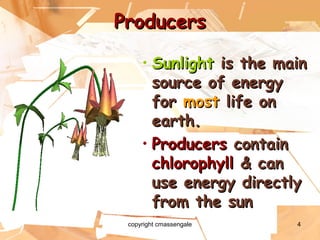
ProducersProducers
• SunlightSunlight is the mainis the main
source of energysource of energy
forfor mostmost life onlife on
earth.earth.
• ProducersProducers containcontain
chlorophyllchlorophyll & can& can
use energy directlyuse energy directly
from the sunfrom the sun
copyright cmassengale
5
AutotrophsAutotrophs
• An Autotroph is any organismAn Autotroph is any organism
thatthat can produce its own foodcan produce its own food
supply!supply!
• Autotrophs are also calledAutotrophs are also called
ProducersProducers
• Plants, algae, some protists, &Plants, algae, some protists, &
some bacteria are examplessome bacteria are examples
copyright cmassengale
6
Niche of a ProducerNiche of a Producer
• Captures energyCaptures energy and transformsand transforms
it intoit into organic, stored energyorganic, stored energy forfor
the use of living organisms.the use of living organisms.
• May beMay be photoautotrophsphotoautotrophs usingusing
light energy (e.g.light energy (e.g. plantsplants))
• May beMay be chemoautotrophschemoautotrophs usingusing
chemical energy (e.g.chemical energy (e.g.
cyanobactericyanobacteria)a)
copyright cmassengale
7
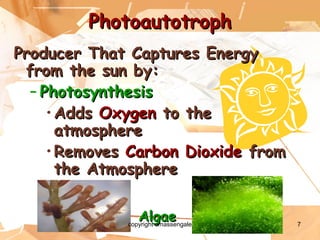
PhotoautotrophPhotoautotroph
Producer That Captures EnergyProducer That Captures Energy
from the sun by:from the sun by:
– PhotosynthesisPhotosynthesis
• AddsAdds OxygenOxygen to theto the
atmosphereatmosphere
• RemovesRemoves Carbon DioxideCarbon Dioxide fromfrom
the Atmospherethe Atmosphere
AlgaeAlgaecopyright cmassengale
8
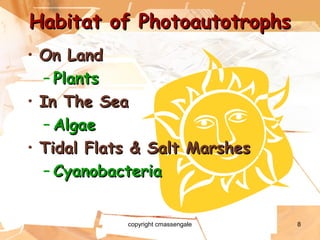
• On LandOn Land
– PlantsPlants
• In The SeaIn The Sea
– AlgaeAlgae
• Tidal Flats & Salt MarshesTidal Flats & Salt Marshes
– CyanobacteriaCyanobacteria
Habitat of PhotoautotrophsHabitat of Photoautotrophs
copyright cmassengale
9
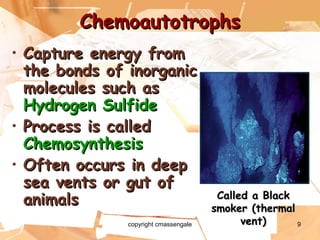
ChemoautotrophsChemoautotrophs
• Capture energy fromCapture energy from
the bonds of inorganicthe bonds of inorganic
molecules such asmolecules such as
Hydrogen SulfideHydrogen Sulfide
• Process is calledProcess is called
ChemosynthesisChemosynthesis
• Often occurs in deepOften occurs in deep
sea vents or gut ofsea vents or gut of
animalsanimals Called a BlackCalled a Black
smoker (thermalsmoker (thermal
vent)vent)copyright cmassengale
10
ConsumersConsumers
Heterotrophs eat other organismsHeterotrophs eat other organisms
to obtain energy.to obtain energy.
• OmnivoresOmnivores (Humans)(Humans)
– Eat Plants & AnimalsEat Plants & Animals
• Detritivores (Scavengers)Detritivores (Scavengers)
– Feed On Dead Plant & AnimalFeed On Dead Plant & Animal
Remains (buzzards)Remains (buzzards)
• DecomposersDecomposers
– Fungi & BacteriaFungi & Bacteria
copyright cmassengale
11
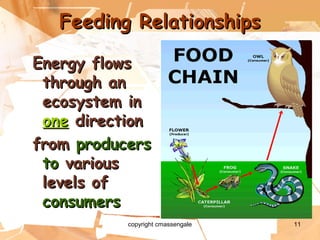
Feeding RelationshipsFeeding Relationships
Energy flowsEnergy flows
through anthrough an
ecosystem inecosystem in
oneone directiondirection
fromfrom producersproducers
toto variousvarious
levels oflevels of
consumersconsumers
copyright cmassengale
12
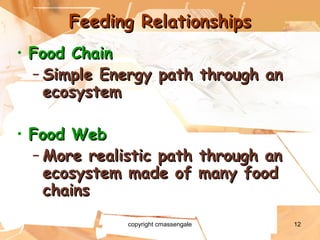
Feeding RelationshipsFeeding Relationships
• Food ChainFood Chain
– Simple Energy path through anSimple Energy path through an
ecosystemecosystem
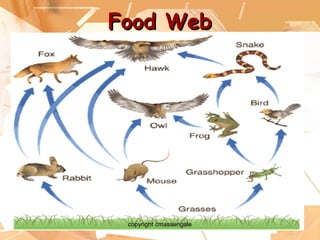
• Food WebFood Web
– More realistic path through anMore realistic path through an
ecosystem made of many foodecosystem made of many food
chainschains
copyright cmassengale
13
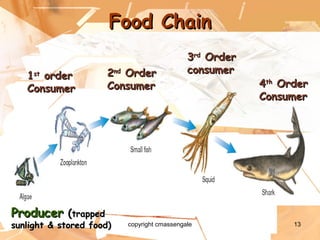
Food ChainFood Chain
ProducerProducer ((trappedtrapped
sunlight & stored food)sunlight & stored food)
11stst
orderorder
ConsumerConsumer
22ndnd
OrderOrder
ConsumerConsumer
33rdrd
OrderOrder
consumerconsumer
44thth
OrderOrder
ConsumerConsumer
copyright cmassengale
14
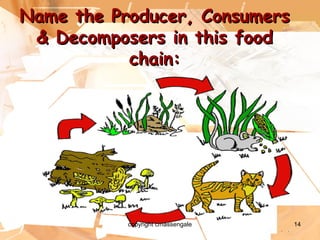
Name the Producer, ConsumersName the Producer, Consumers
& Decomposers in this food& Decomposers in this food
chain:chain:
copyright cmassengale
15
Food WebFood Web
copyright cmassengale
16
Trophic LevelsTrophic Levels
Each Level In A Food Chain or FoodEach Level In A Food Chain or Food
Web is aWeb is a Trophic LevelTrophic Level..
• ProducersProducers
– Always The First Trophic LevelAlways The First Trophic Level
– How Energy Enters The SystemHow Energy Enters The System
• HerbivoresHerbivores
– Second Trophic LevelSecond Trophic Level
copyright cmassengale
17
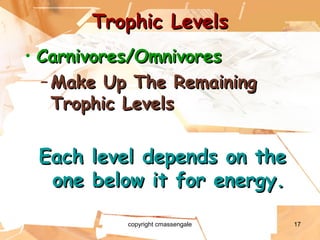
Trophic LevelsTrophic Levels
• Carnivores/OmnivoresCarnivores/Omnivores
– Make Up The RemainingMake Up The Remaining
Trophic LevelsTrophic Levels
Each level depends on theEach level depends on the
one below it for energy.one below it for energy.
copyright cmassengale
18
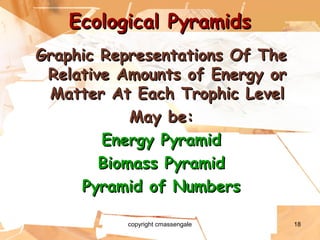
Ecological PyramidsEcological Pyramids
Graphic Representations Of TheGraphic Representations Of The
Relative Amounts of Energy orRelative Amounts of Energy or
Matter At Each Trophic LevelMatter At Each Trophic Level
May be:May be:
Energy PyramidEnergy Pyramid
Biomass PyramidBiomass Pyramid
Pyramid of NumbersPyramid of Numbers
copyright cmassengale
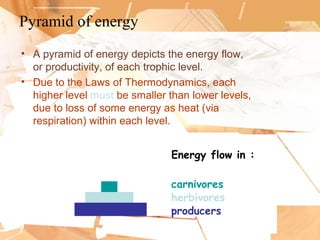
Pyramid of energy
• A pyramid of energy depicts the energy flow,
or productivity, of each trophic level.
• Due to the Laws of Thermodynamics, each
higher level must be smaller than lower levels,
due to loss of some energy as heat (via
respiration) within each level.
producers
herbivores
carnivores
Energy flow in :
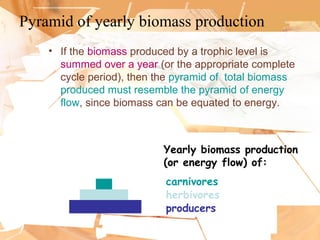
Pyramid of yearly biomass production
• If the biomass produced by a trophic level is
summed over a year (or the appropriate complete
cycle period), then the pyramid of total biomass
produced must resemble the pyramid of energy
flow, since biomass can be equated to energy.
producers
herbivores
carnivores
Yearly biomass production
(or energy flow) of:
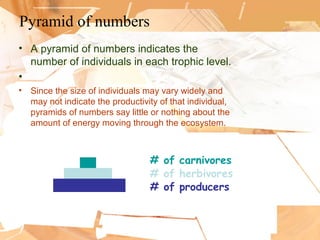
Pyramid of numbers
• A pyramid of numbers indicates the
number of individuals in each trophic level.
•
• Since the size of individuals may vary widely and
may not indicate the productivity of that individual,
pyramids of numbers say little or nothing about the
amount of energy moving through the ecosystem.
# of producers
# of herbivores
# of carnivores
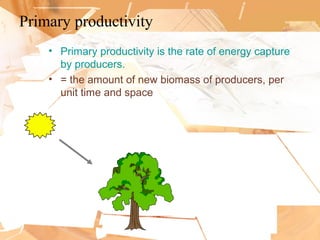
Primary productivity
• Primary productivity is the rate of energy capture
by producers.
• = the amount of new biomass of producers, per
unit time and space
• Gross primary production (GPP)
• = total amount of energy captured
• Net primary production (NPP)
• = GPP - respiration
• Net primary production is thus the amount of
energy stored by the producers and potentially
available to consumers and decomposers.
• Secondary productivity is the rate of production of
new biomass by consumers, i.e., the rate at which
consumers convert organic material into new
biomass of consumers.
• Note that secondary production simply involves the
repackaging of energy previously captured by
producers--no additional energy is introduced into
the food chain.
• And, since there are multiple levels of consumers
and no new energy is being captured and introduced
into the system, the modifiers gross and net are not
very appropriate and are not usually used.
• References
1.www.authorstream.com
2.Fundamentals of environmental biology(Agrawal
K C)
copyright cmassengale 25
Thank You
copyright cmassengale 26

Energy flow and productivities

  • 1.
    Energy Flow and Productivity Presentedby, Karnavat Dimpal B. Msc sem-2 (Botany) Paper CBO-405 Department of life sciences HNGU,patan
  • 2.
    Contain:- 1.Energy Flow Pyramid ofEnergy Pyramid of Biomass pyramid of Number 2.Productivity Primary Productivity Secondary Productivity copyright cmassengale 2
  • 3.
    3 Energy FlowEnergy Flow •EnergyEnergy in an ecosystem originallyin an ecosystem originally comes from the suncomes from the sun • Energy flows through EcosystemsEnergy flows through Ecosystems fromfrom producers to consumersproducers to consumers – ProducersProducers (make food)(make food) – ConsumersConsumers (use food by eating(use food by eating producers or other consumers)producers or other consumers) copyright cmassengale
  • 4.
    4 ProducersProducers • SunlightSunlight isthe mainis the main source of energysource of energy forfor mostmost life onlife on earth.earth. • ProducersProducers containcontain chlorophyllchlorophyll & can& can use energy directlyuse energy directly from the sunfrom the sun copyright cmassengale
  • 5.
    5 AutotrophsAutotrophs • An Autotrophis any organismAn Autotroph is any organism thatthat can produce its own foodcan produce its own food supply!supply! • Autotrophs are also calledAutotrophs are also called ProducersProducers • Plants, algae, some protists, &Plants, algae, some protists, & some bacteria are examplessome bacteria are examples copyright cmassengale
  • 6.
    6 Niche of aProducerNiche of a Producer • Captures energyCaptures energy and transformsand transforms it intoit into organic, stored energyorganic, stored energy forfor the use of living organisms.the use of living organisms. • May beMay be photoautotrophsphotoautotrophs usingusing light energy (e.g.light energy (e.g. plantsplants)) • May beMay be chemoautotrophschemoautotrophs usingusing chemical energy (e.g.chemical energy (e.g. cyanobactericyanobacteria)a) copyright cmassengale
  • 7.
    7 PhotoautotrophPhotoautotroph Producer That CapturesEnergyProducer That Captures Energy from the sun by:from the sun by: – PhotosynthesisPhotosynthesis • AddsAdds OxygenOxygen to theto the atmosphereatmosphere • RemovesRemoves Carbon DioxideCarbon Dioxide fromfrom the Atmospherethe Atmosphere AlgaeAlgaecopyright cmassengale
  • 8.
    8 • On LandOnLand – PlantsPlants • In The SeaIn The Sea – AlgaeAlgae • Tidal Flats & Salt MarshesTidal Flats & Salt Marshes – CyanobacteriaCyanobacteria Habitat of PhotoautotrophsHabitat of Photoautotrophs copyright cmassengale
  • 9.
    9 ChemoautotrophsChemoautotrophs • Capture energyfromCapture energy from the bonds of inorganicthe bonds of inorganic molecules such asmolecules such as Hydrogen SulfideHydrogen Sulfide • Process is calledProcess is called ChemosynthesisChemosynthesis • Often occurs in deepOften occurs in deep sea vents or gut ofsea vents or gut of animalsanimals Called a BlackCalled a Black smoker (thermalsmoker (thermal vent)vent)copyright cmassengale
  • 10.
    10 ConsumersConsumers Heterotrophs eat otherorganismsHeterotrophs eat other organisms to obtain energy.to obtain energy. • OmnivoresOmnivores (Humans)(Humans) – Eat Plants & AnimalsEat Plants & Animals • Detritivores (Scavengers)Detritivores (Scavengers) – Feed On Dead Plant & AnimalFeed On Dead Plant & Animal Remains (buzzards)Remains (buzzards) • DecomposersDecomposers – Fungi & BacteriaFungi & Bacteria copyright cmassengale
  • 11.
    11 Feeding RelationshipsFeeding Relationships EnergyflowsEnergy flows through anthrough an ecosystem inecosystem in oneone directiondirection fromfrom producersproducers toto variousvarious levels oflevels of consumersconsumers copyright cmassengale
  • 12.
    12 Feeding RelationshipsFeeding Relationships •Food ChainFood Chain – Simple Energy path through anSimple Energy path through an ecosystemecosystem • Food WebFood Web – More realistic path through anMore realistic path through an ecosystem made of many foodecosystem made of many food chainschains copyright cmassengale
  • 13.
    13 Food ChainFood Chain ProducerProducer((trappedtrapped sunlight & stored food)sunlight & stored food) 11stst orderorder ConsumerConsumer 22ndnd OrderOrder ConsumerConsumer 33rdrd OrderOrder consumerconsumer 44thth OrderOrder ConsumerConsumer copyright cmassengale
  • 14.
    14 Name the Producer,ConsumersName the Producer, Consumers & Decomposers in this food& Decomposers in this food chain:chain: copyright cmassengale
  • 15.
  • 16.
    16 Trophic LevelsTrophic Levels EachLevel In A Food Chain or FoodEach Level In A Food Chain or Food Web is aWeb is a Trophic LevelTrophic Level.. • ProducersProducers – Always The First Trophic LevelAlways The First Trophic Level – How Energy Enters The SystemHow Energy Enters The System • HerbivoresHerbivores – Second Trophic LevelSecond Trophic Level copyright cmassengale
  • 17.
    17 Trophic LevelsTrophic Levels •Carnivores/OmnivoresCarnivores/Omnivores – Make Up The RemainingMake Up The Remaining Trophic LevelsTrophic Levels Each level depends on theEach level depends on the one below it for energy.one below it for energy. copyright cmassengale
  • 18.
    18 Ecological PyramidsEcological Pyramids GraphicRepresentations Of TheGraphic Representations Of The Relative Amounts of Energy orRelative Amounts of Energy or Matter At Each Trophic LevelMatter At Each Trophic Level May be:May be: Energy PyramidEnergy Pyramid Biomass PyramidBiomass Pyramid Pyramid of NumbersPyramid of Numbers copyright cmassengale
  • 19.
    Pyramid of energy •A pyramid of energy depicts the energy flow, or productivity, of each trophic level. • Due to the Laws of Thermodynamics, each higher level must be smaller than lower levels, due to loss of some energy as heat (via respiration) within each level. producers herbivores carnivores Energy flow in :
  • 20.
    Pyramid of yearlybiomass production • If the biomass produced by a trophic level is summed over a year (or the appropriate complete cycle period), then the pyramid of total biomass produced must resemble the pyramid of energy flow, since biomass can be equated to energy. producers herbivores carnivores Yearly biomass production (or energy flow) of:
  • 21.
    Pyramid of numbers •A pyramid of numbers indicates the number of individuals in each trophic level. • • Since the size of individuals may vary widely and may not indicate the productivity of that individual, pyramids of numbers say little or nothing about the amount of energy moving through the ecosystem. # of producers # of herbivores # of carnivores
  • 22.
    Primary productivity • Primaryproductivity is the rate of energy capture by producers. • = the amount of new biomass of producers, per unit time and space
  • 23.
    • Gross primaryproduction (GPP) • = total amount of energy captured • Net primary production (NPP) • = GPP - respiration • Net primary production is thus the amount of energy stored by the producers and potentially available to consumers and decomposers.
  • 24.
    • Secondary productivityis the rate of production of new biomass by consumers, i.e., the rate at which consumers convert organic material into new biomass of consumers. • Note that secondary production simply involves the repackaging of energy previously captured by producers--no additional energy is introduced into the food chain. • And, since there are multiple levels of consumers and no new energy is being captured and introduced into the system, the modifiers gross and net are not very appropriate and are not usually used.
  • 25.
    • References 1.www.authorstream.com 2.Fundamentals ofenvironmental biology(Agrawal K C) copyright cmassengale 25
  • 26.