Dr. M.Saraswathi,
ECOLOGY:
 Everything in the natural world is connected.
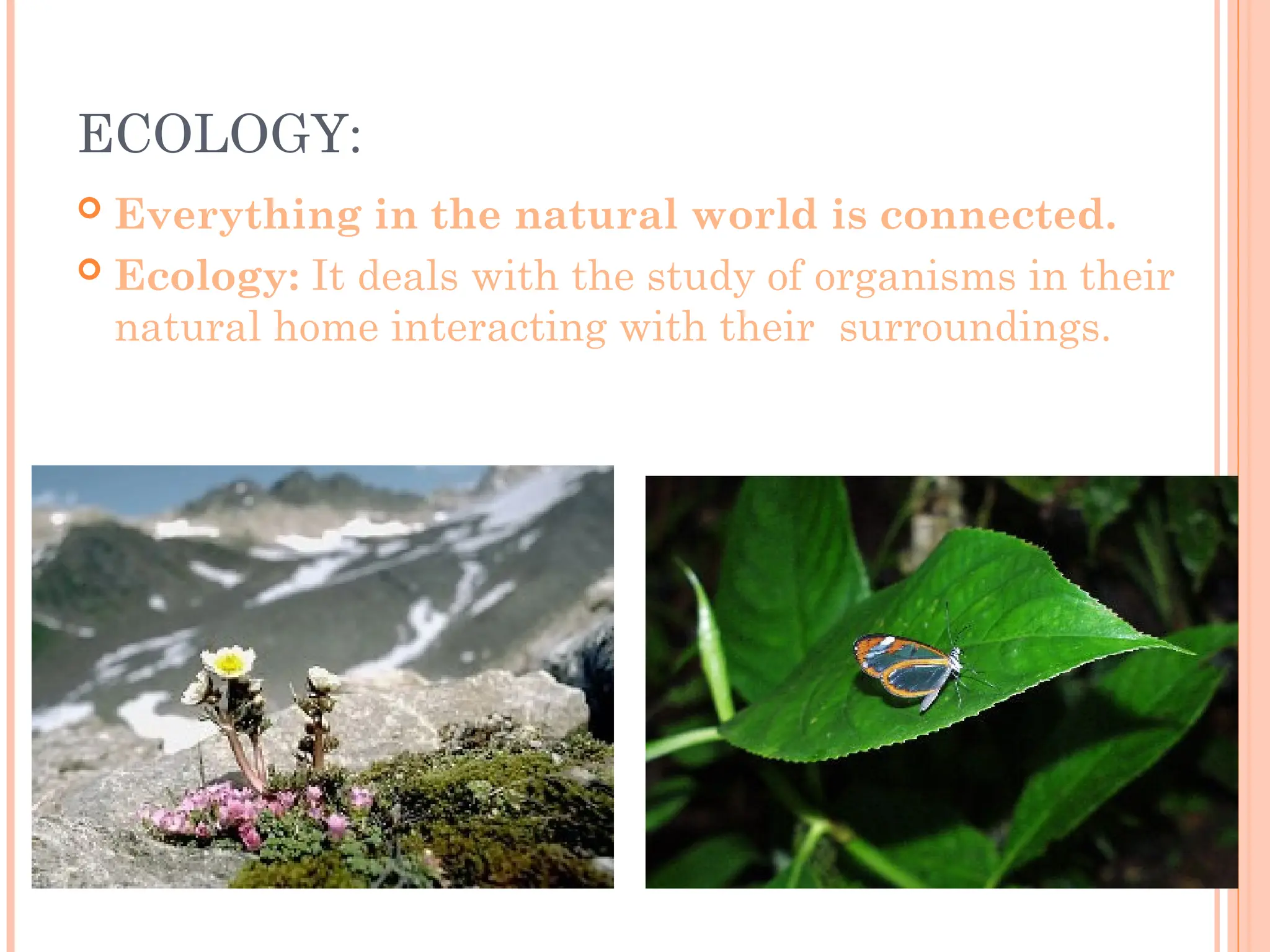
 Ecology: It deals with the study of organisms in their
natural home interacting with their surroundings.
ECOSYSTEM
• The self-sustaining structural and functional interaction
between living and non-living components.
• Ecosystem is the basic functional unit of ecology.
• Ecosystem is derived from Greek, means “Study of
home”.
• Ecosystem has been defined as a system of organisms
with surroundings.
An ecosystem consists of two main components
Abiotic or Non-living components.
1. Climatic Factors
2. Physical Factors
3. Chemical factors
Biotic or Living components.
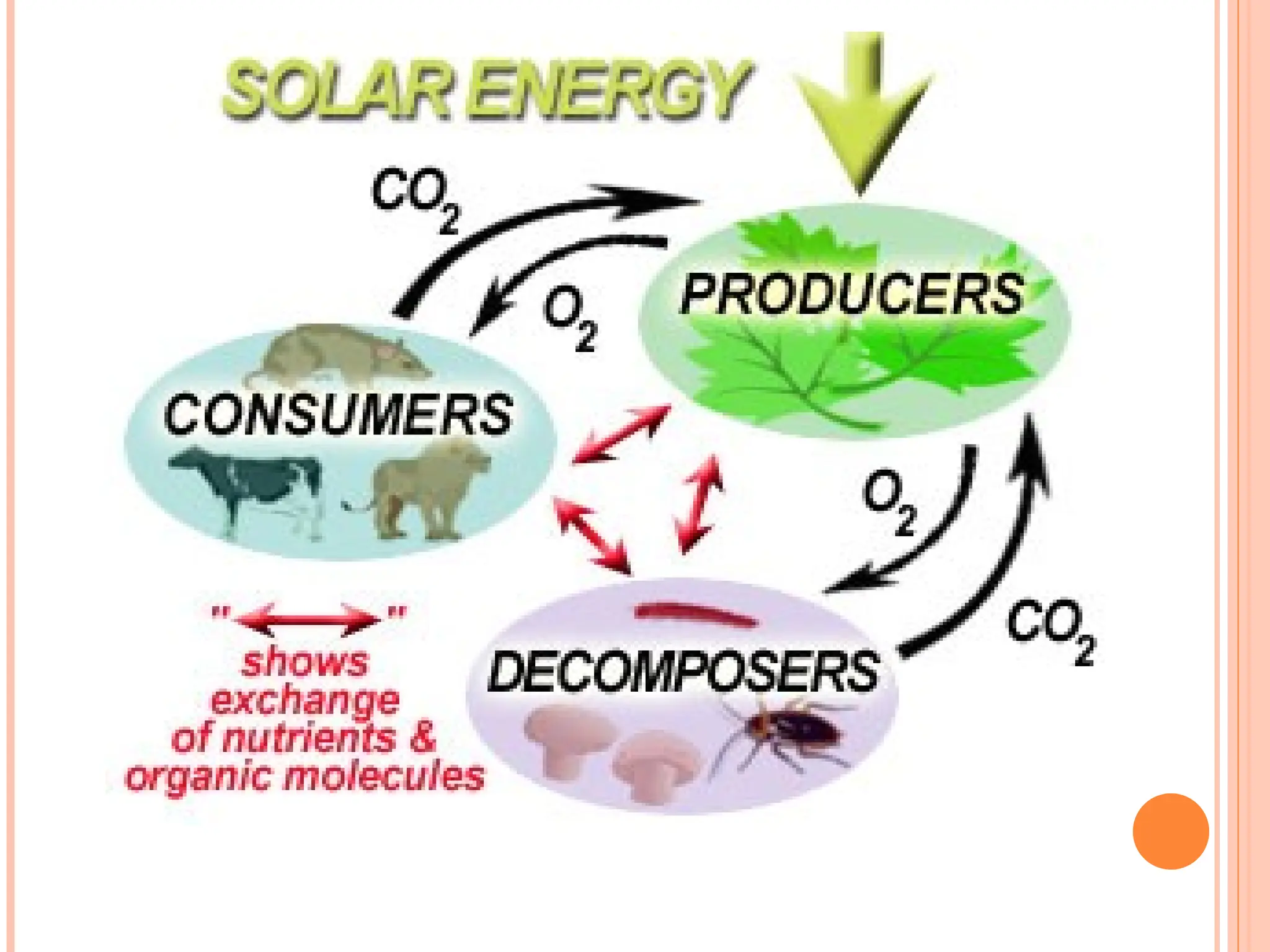
1. Autotrophs or Producers
2. Heterotrophs or Consumers
3. Saprotrophs or Decomposers
ABIOTIC FACTORS:
1. Climatic Factors: Temperatures,
Moisture, Wind etc.,
2. Physical Factors: light, Fire,
pressure etc.,
3. Chemical Factors: inorganic substances (minerals),
pH,
Salinity and organic substances etc.,
BIOTIC COMPONENTS
Autotrophs
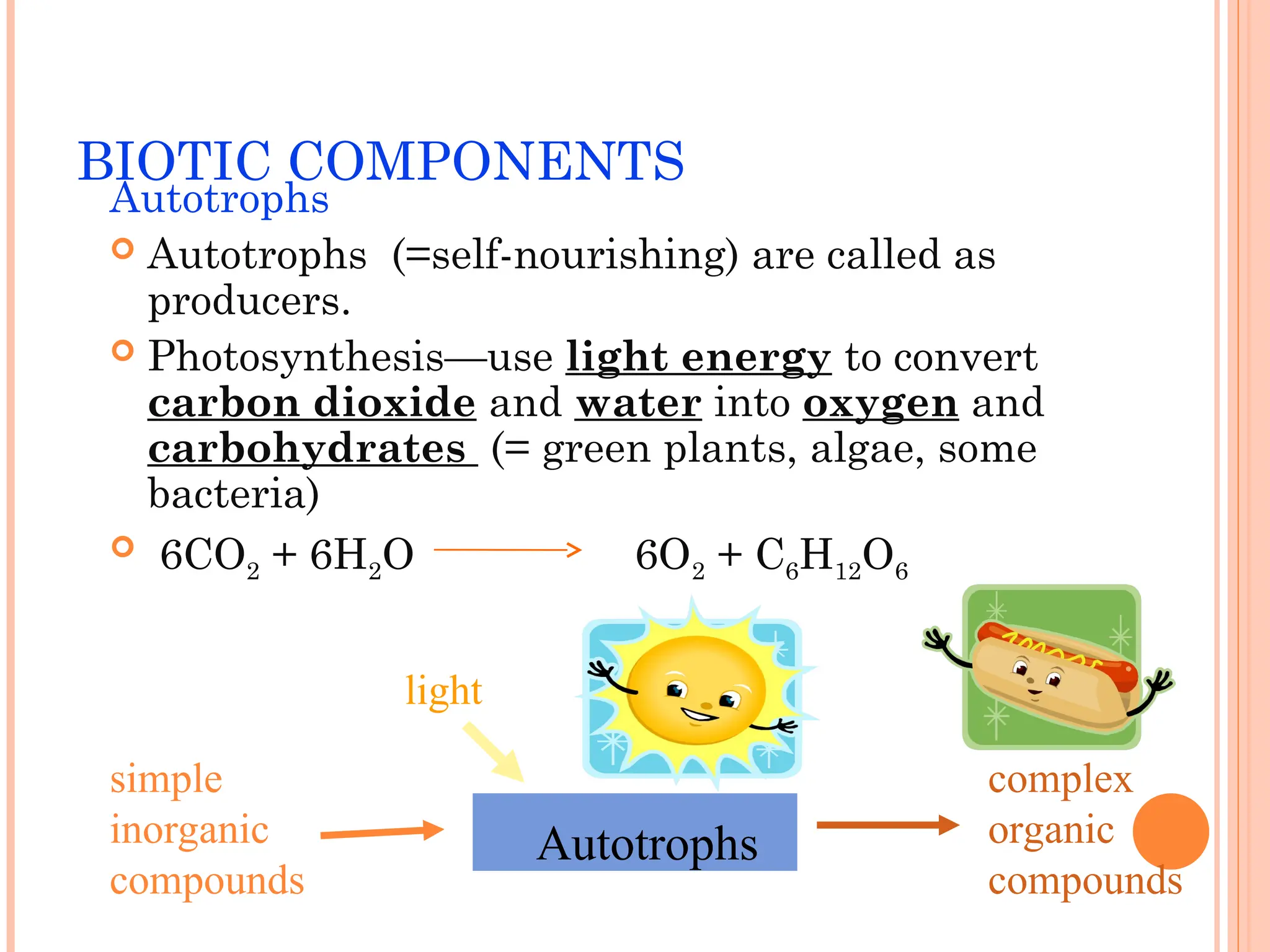
 Autotrophs (=self-nourishing) are called as
producers.
 Photosynthesis—use light energy to convert
carbon dioxide and water into oxygen and
carbohydrates (= green plants, algae, some
bacteria)
 6CO2 + 6H2O 6O2 + C6H12O6
Autotrophs
simple
inorganic
compounds
complex
organic
compounds
light
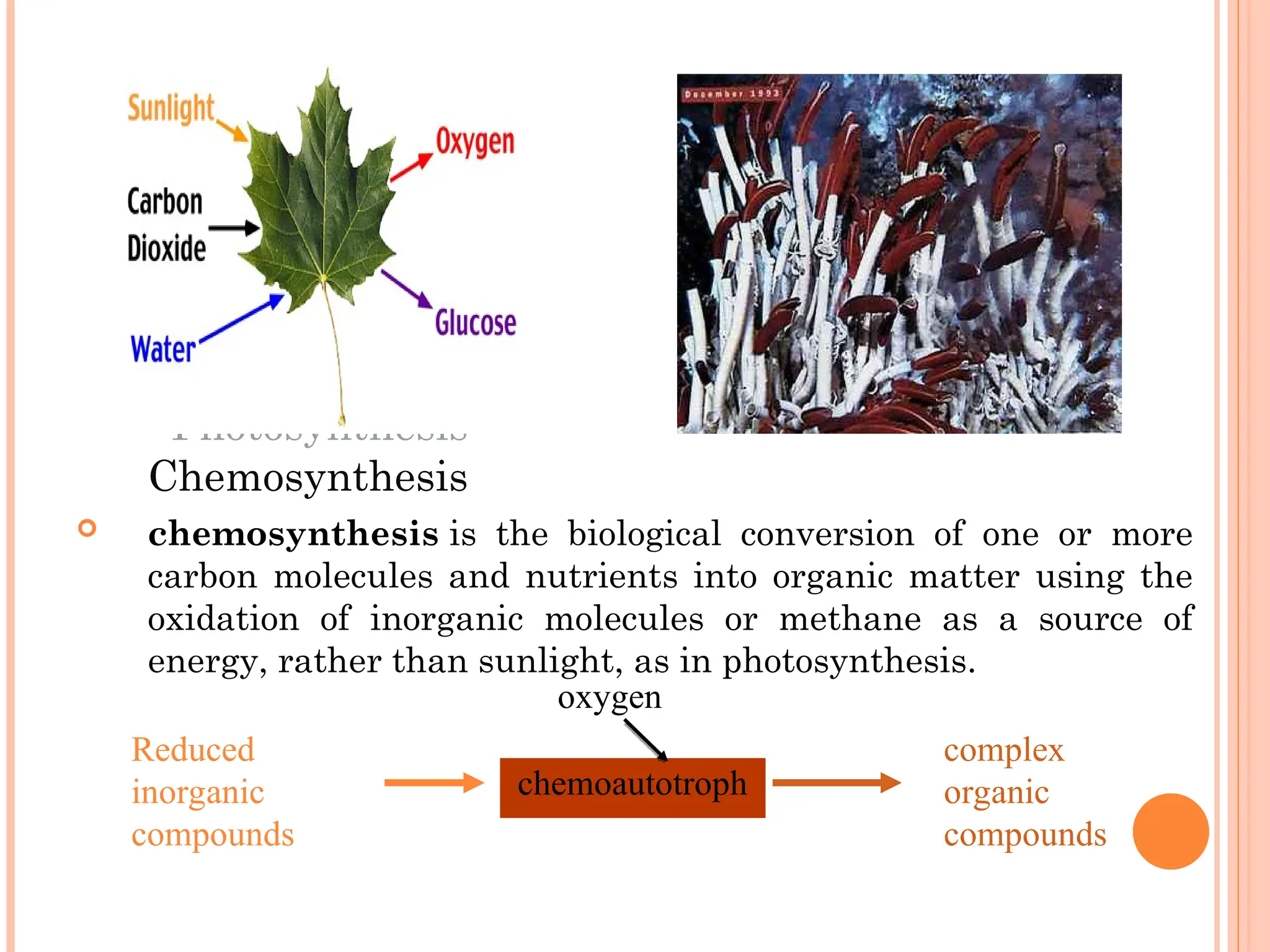
Photosynthesis
Chemosynthesis
 chemosynthesis is the biological conversion of one or more
carbon molecules and nutrients into organic matter using the
oxidation of inorganic molecules or methane as a source of
energy, rather than sunlight, as in photosynthesis.
chemoautotroph
Reduced
inorganic
compounds
complex
organic
compounds
oxygen
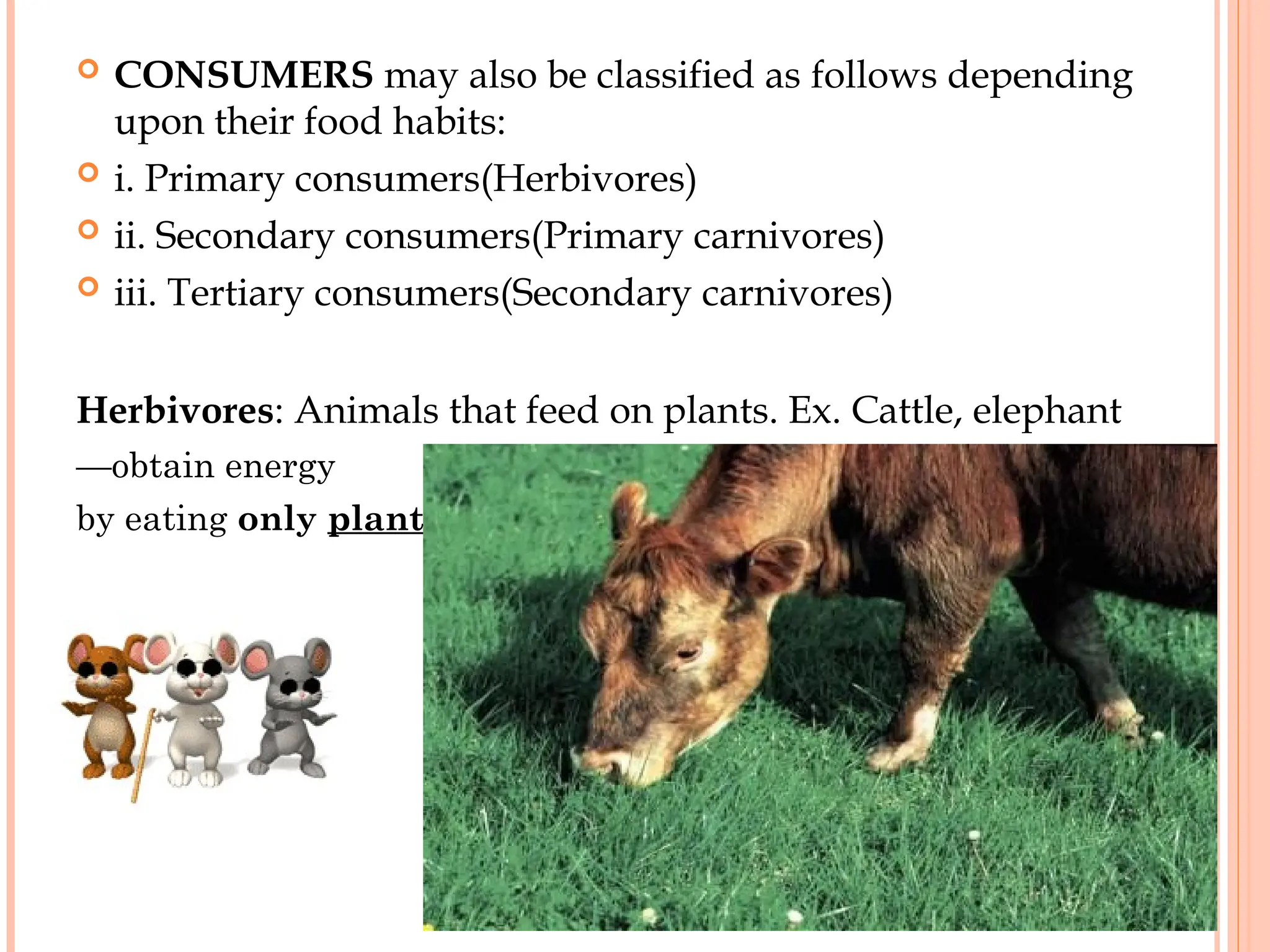
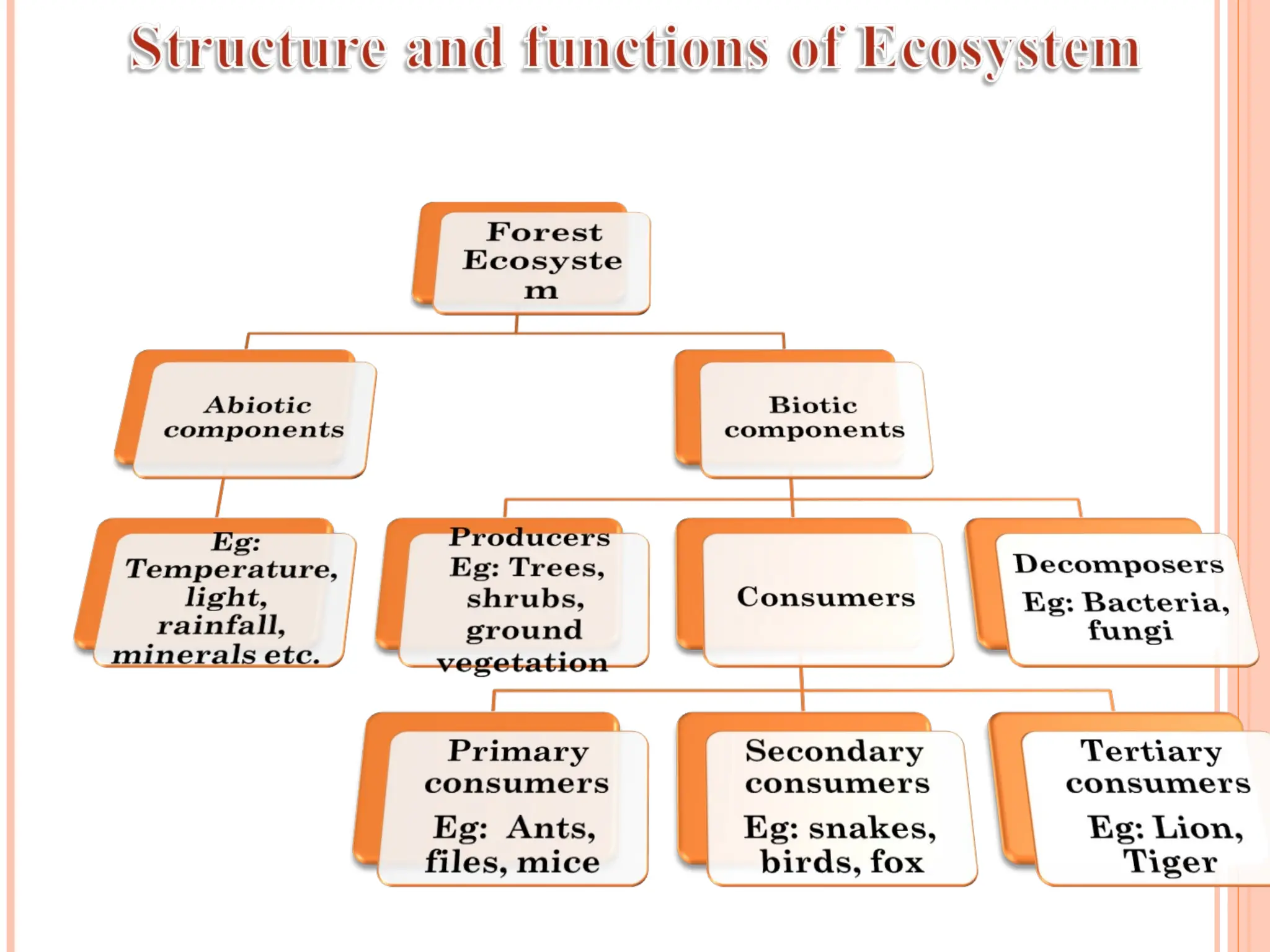
 CONSUMERS may also be classified as follows depending
upon their food habits:
 i. Primary consumers(Herbivores)
 ii. Secondary consumers(Primary carnivores)
 iii. Tertiary consumers(Secondary carnivores)
Herbivores: Animals that feed on plants. Ex. Cattle, elephant
—obtain energy
by eating only plants
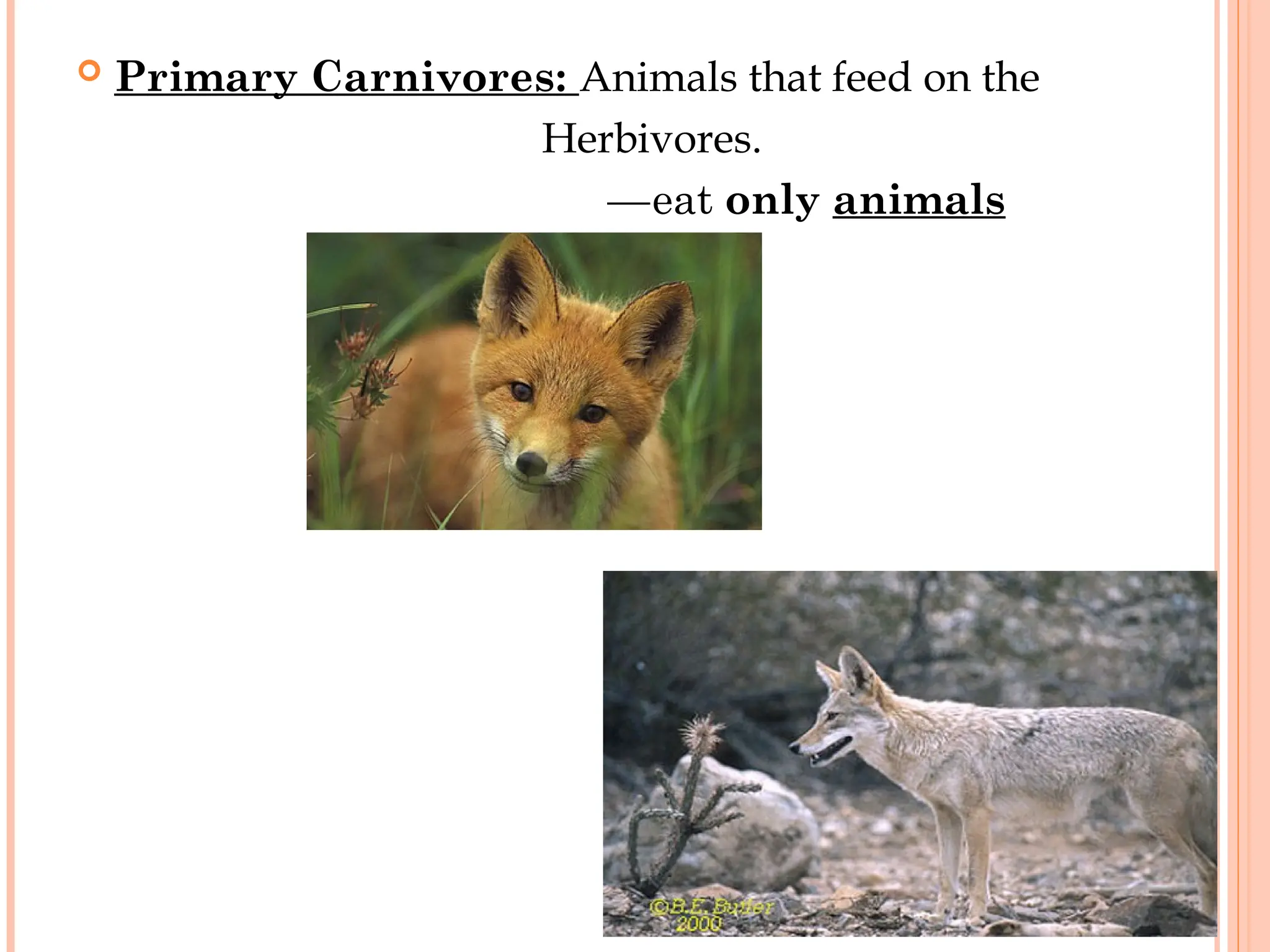
 Primary Carnivores: Animals that feed on the
Herbivores.
—eat only animals
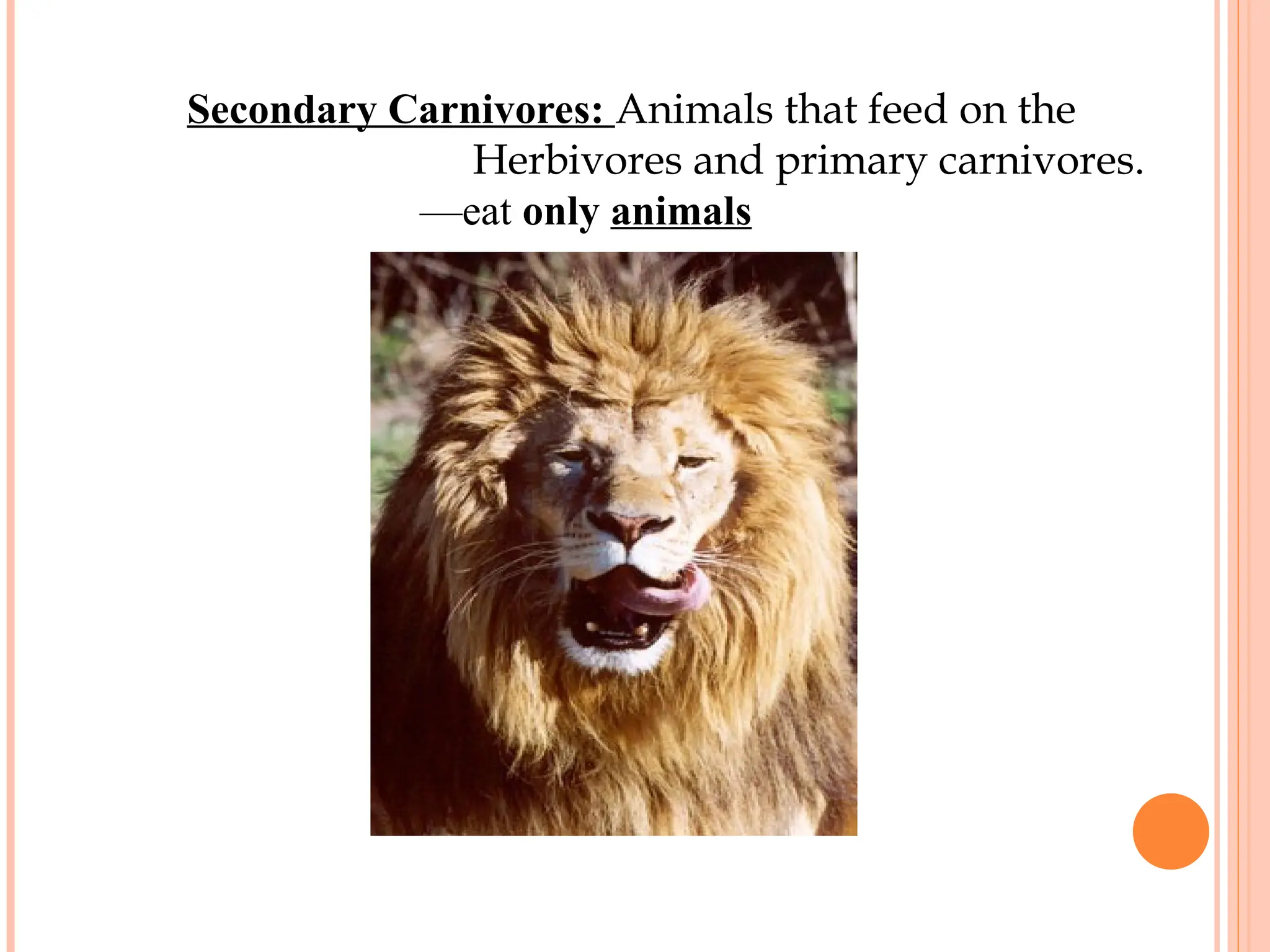
Secondary Carnivores: Animals that feed on the
Herbivores and primary carnivores.
—eat only animals
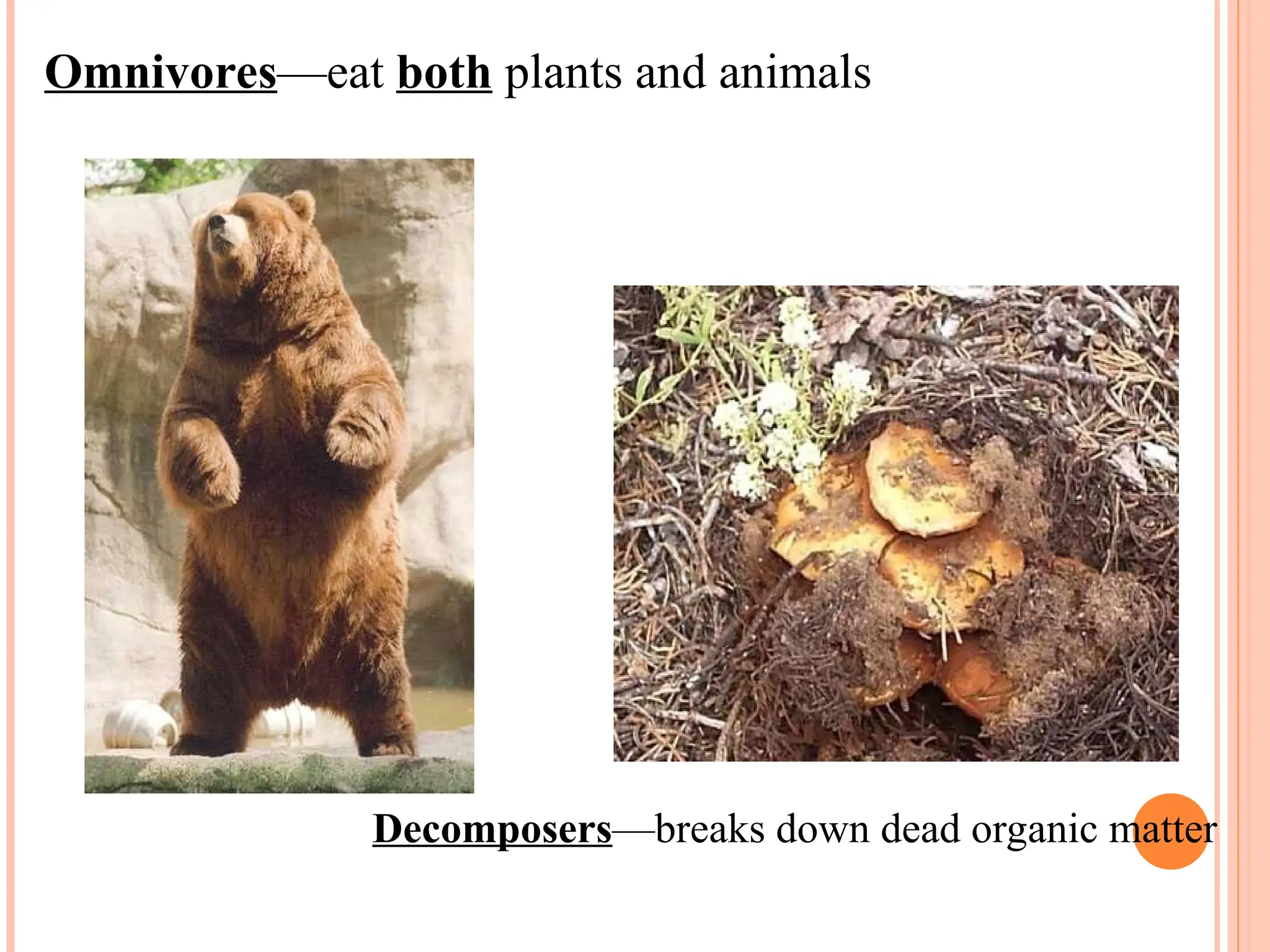
Omnivores—eat both plants and animals
Decomposers—breaks down dead organic matter
The function of an ecosystem is to allow flow of energy and cycling of
nutrients
1. Primary Function: Manufacture of starch by photosynthesis with
the help of minerals take from their edaphic environment.
2. Secondary Function: Distribution of energy in the form of food
for all consumers.
3. Tertiary Function: When plants and animals die, then
decomposers(like certain bacteria and fungi) act on their dead
bodies and decompose them into simple materials like carbon
dioxide, water and minerals which go back to air, water bodies
and soil from where they were taken.
Energy flow in an ecosystem:
 Energy is the most essential requirement for all living
organisms.
 Solar energy is the main source of earth planet. Solar energy is
transformed to chemical energy in photosynthesis by green
plants.
 Some amount of chemical energy is used by plants for their
growth, remaining is utilized for all living organisms.
 This is the first and most essential step to provide energy for all
living organisms in an ecosystem. Thus, the energy enters in
the ecosystem through photosynthesis and passes different
feeding levels.
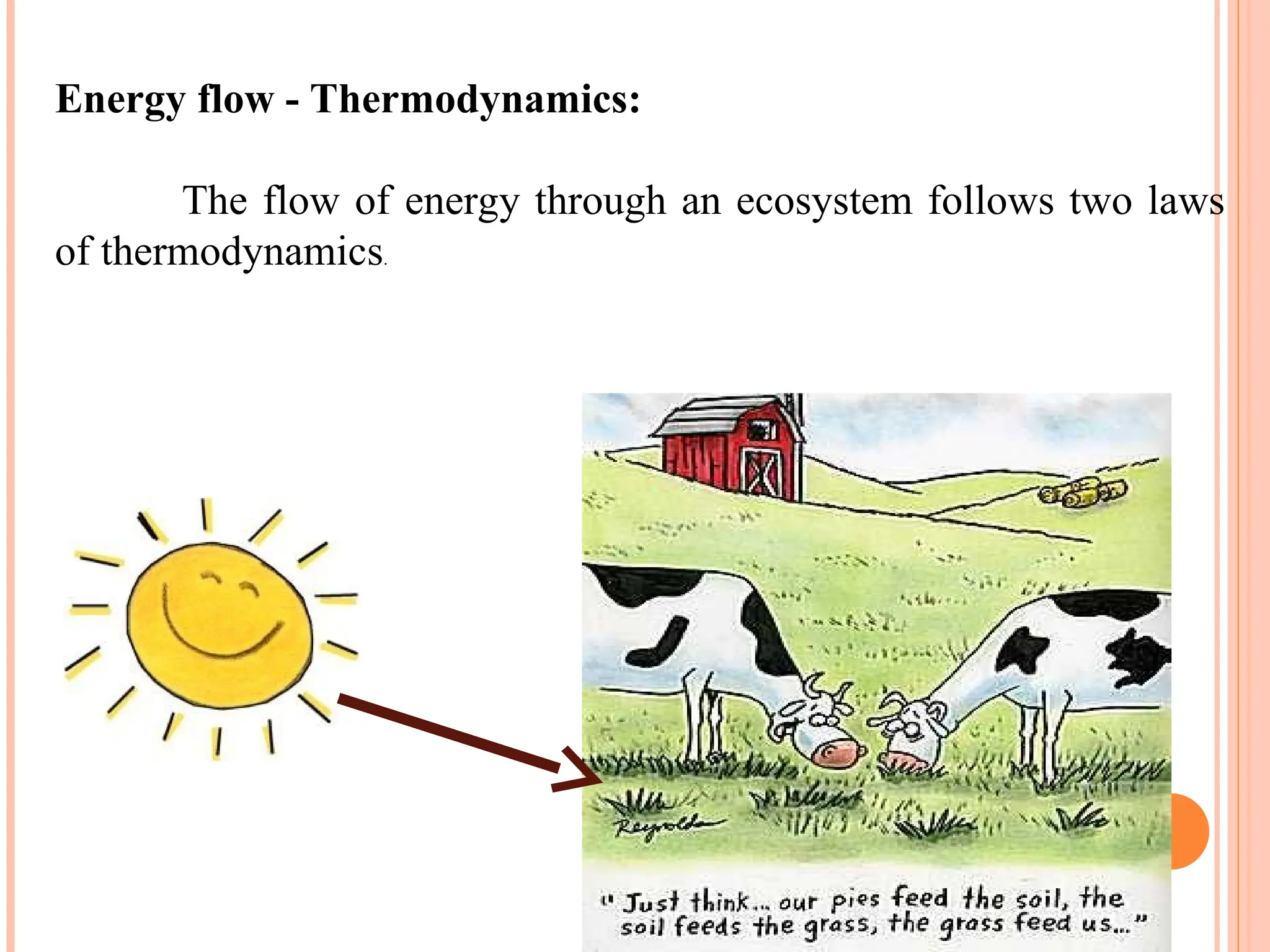
Energy flow - Thermodynamics:
The flow of energy through an ecosystem follows two laws
of thermodynamics.
ENERGY FLOW- LAWS OF
THERMODYNAMICS
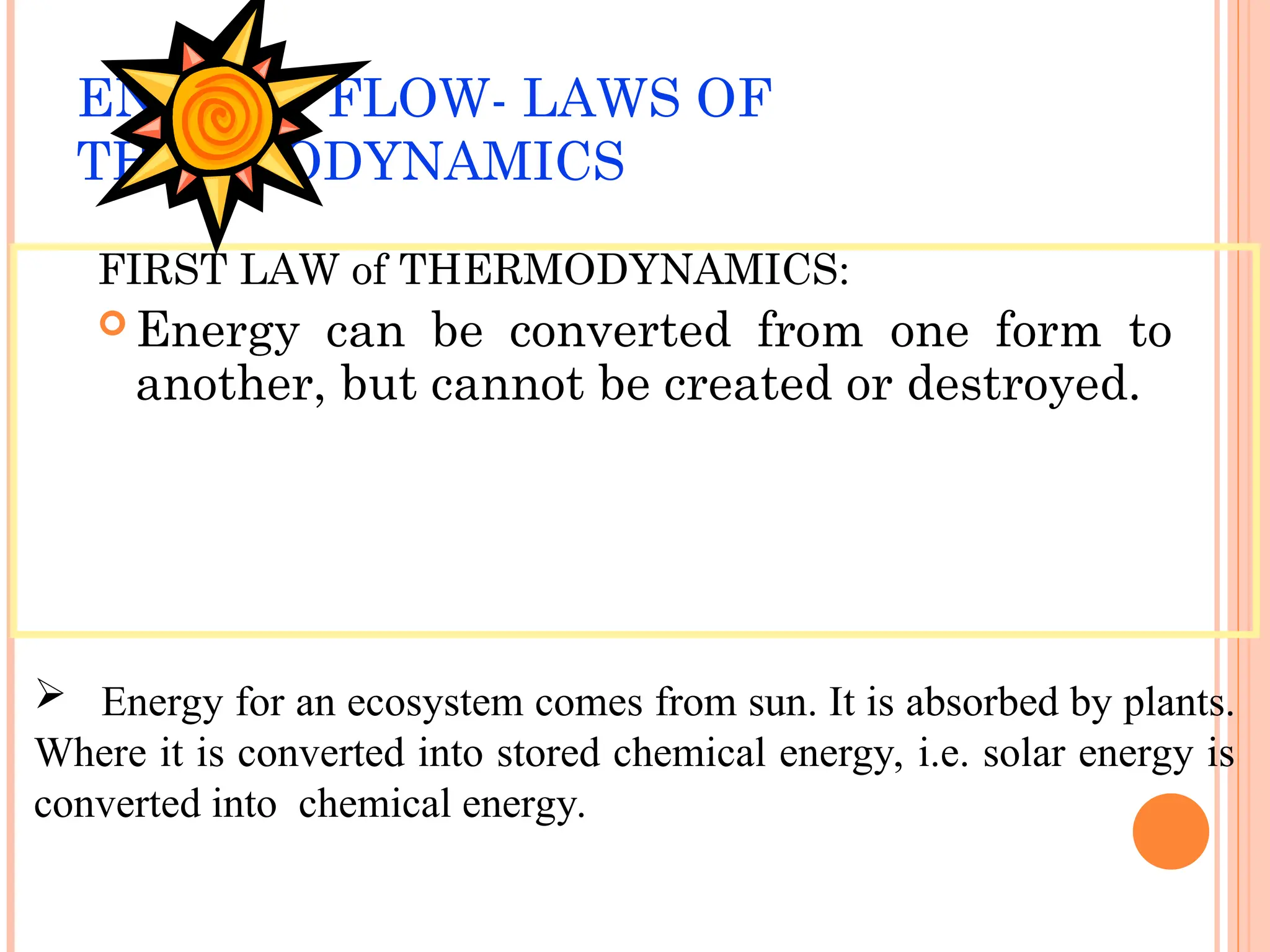
FIRST LAW of THERMODYNAMICS:
 Energy can be converted from one form to
another, but cannot be created or destroyed.
 Energy for an ecosystem comes from sun. It is absorbed by plants.
Where it is converted into stored chemical energy, i.e. solar energy is
converted into chemical energy.
SECOND LAW of THERMODYNAMICS
 It states that “whenever energy is transformed, that is a loss of
energy through the release of heat”.
 In energy exchanges in a closed system, the potential energy of
the final state will be less than that of the initial state
Examples
 Internal combustion engines in cars are 25% efficient in
converting chemical energy to kinetic energy; the rest is not used
or is lost as heat.
 There will be a loss of energy in the form of heat as it moves
from one tropic level to another tropic level. The loss of energy
takes through respiration, running, hunting e etc.
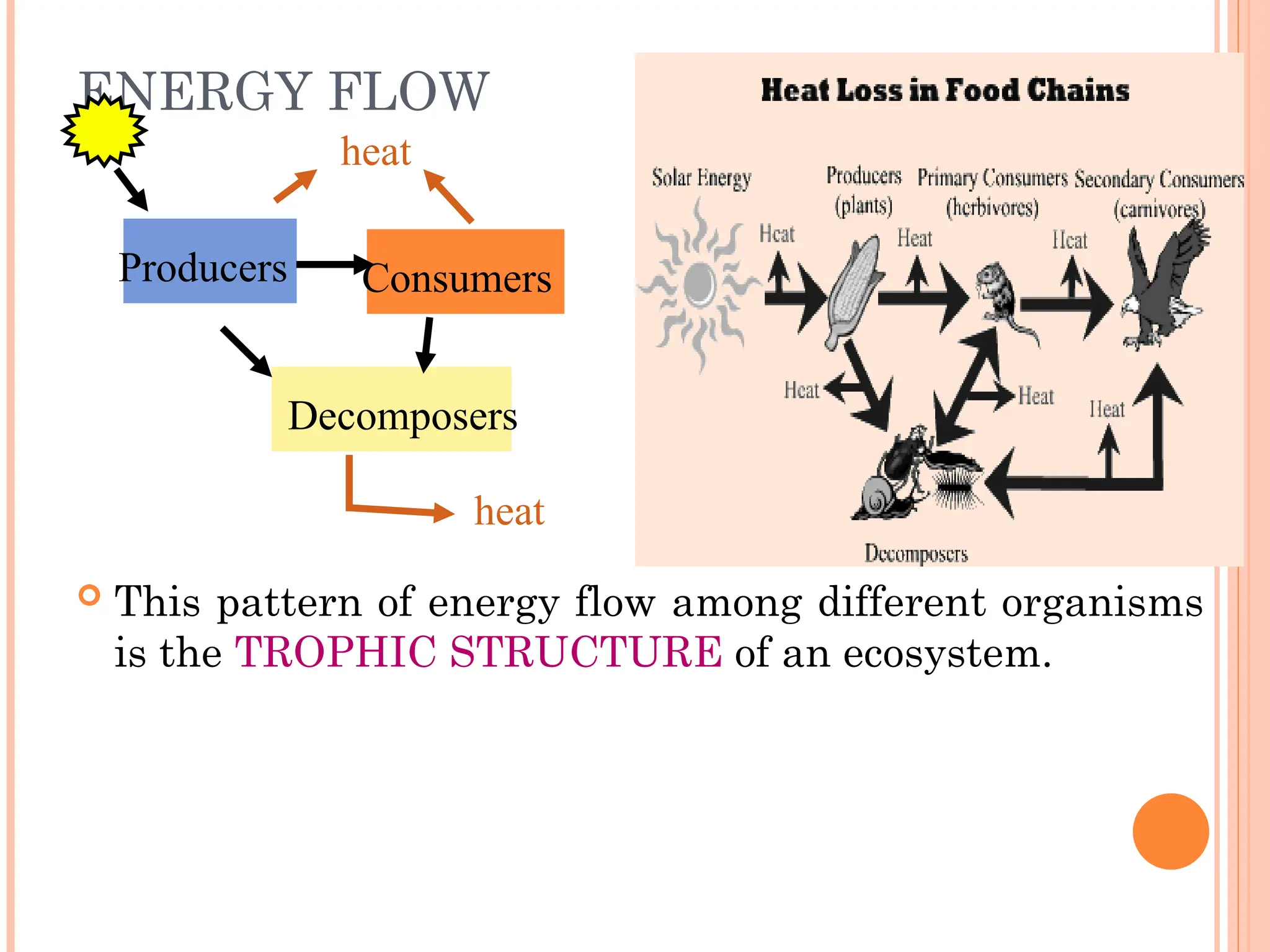
ENERGY FLOW
 This pattern of energy flow among different organisms
is the TROPHIC STRUCTURE of an ecosystem.
heat
Producers Consumers
Decomposers
heat
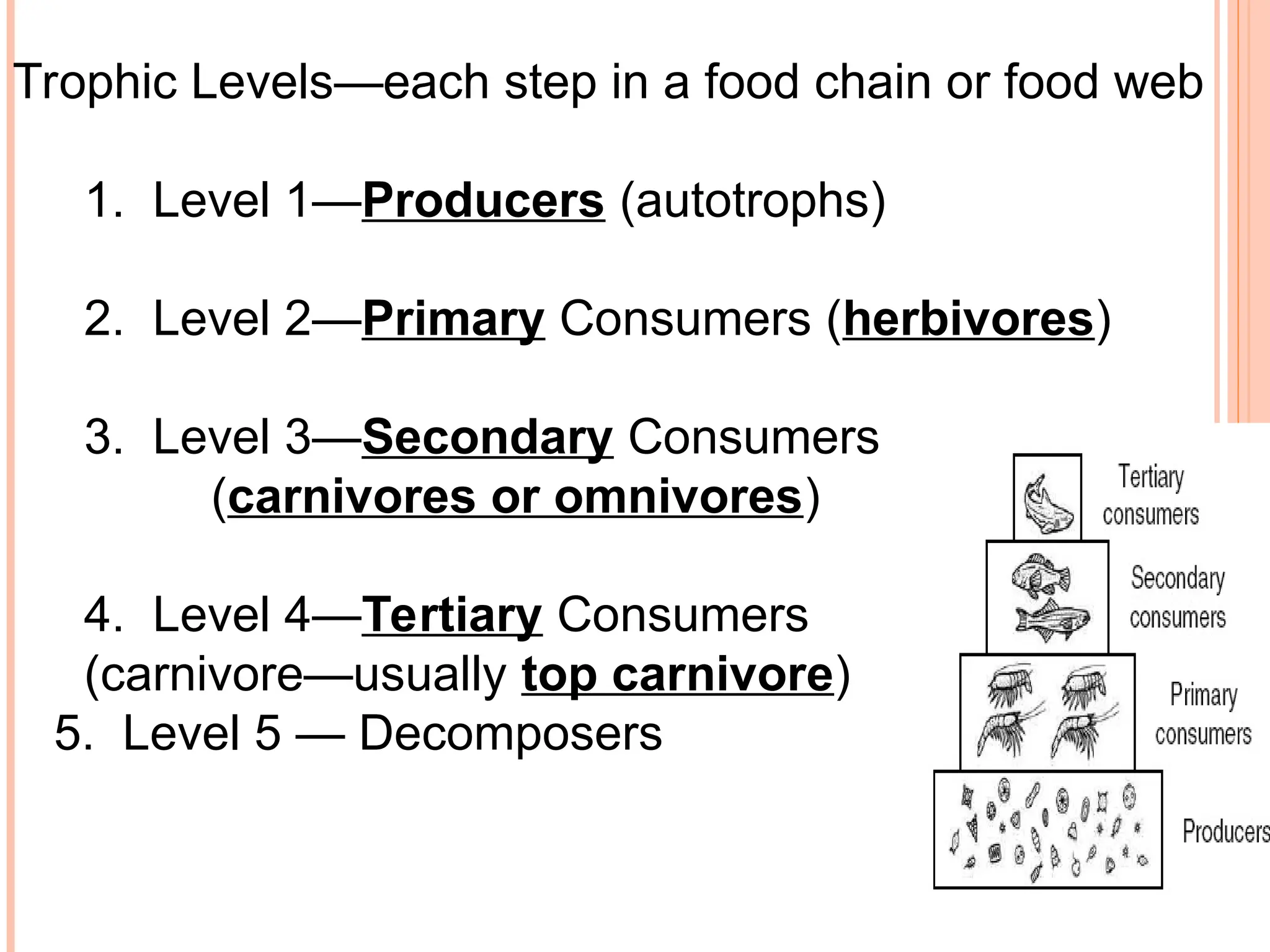
Trophic Levels—each step in a food chain or food web
1. Level 1—Producers (autotrophs)
2. Level 2—Primary Consumers (herbivores)
3. Level 3—Secondary Consumers
(carnivores or omnivores)
4. Level 4—Tertiary Consumers
(carnivore—usually top carnivore)
5. Level 5 — Decomposers
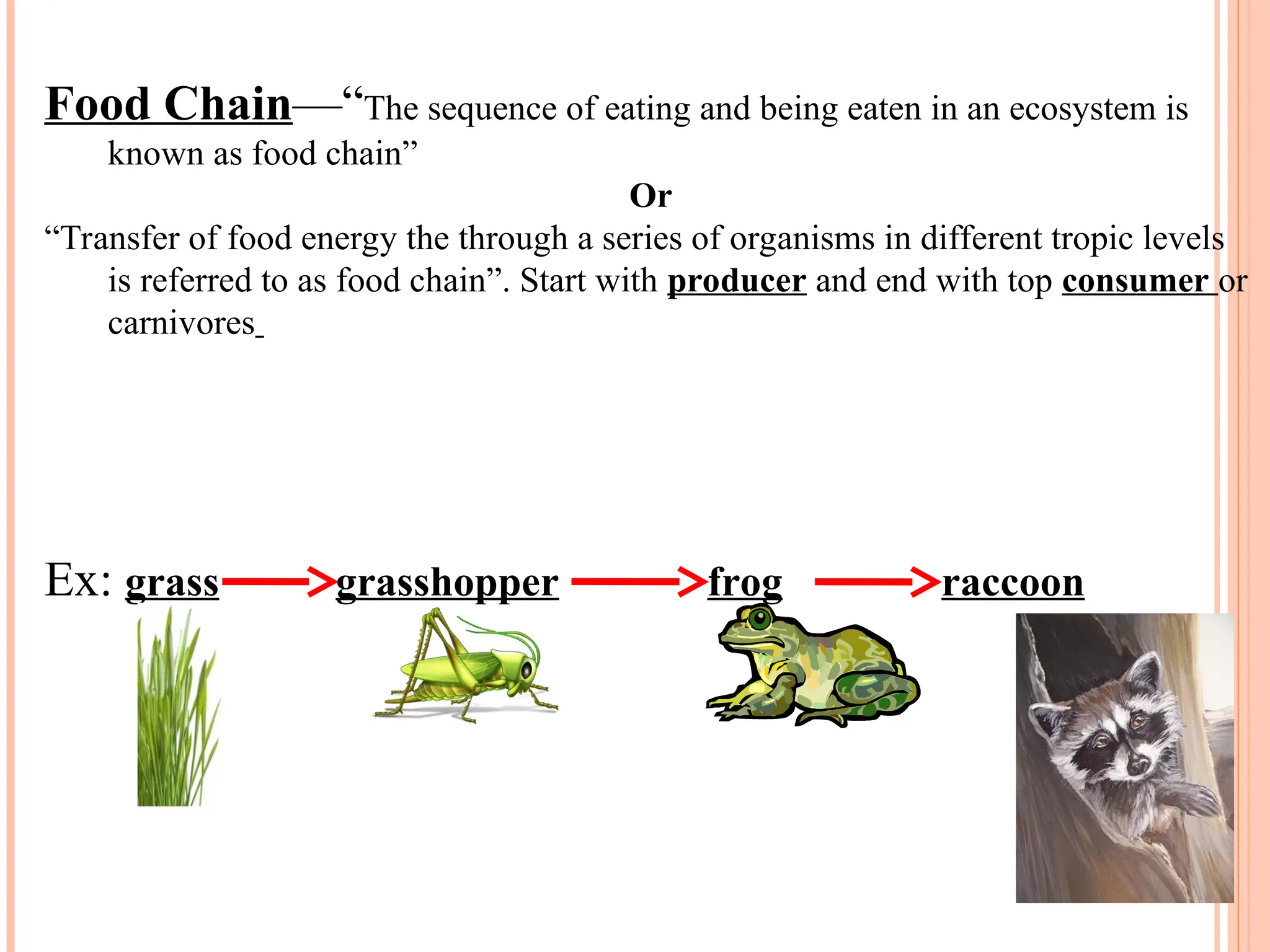
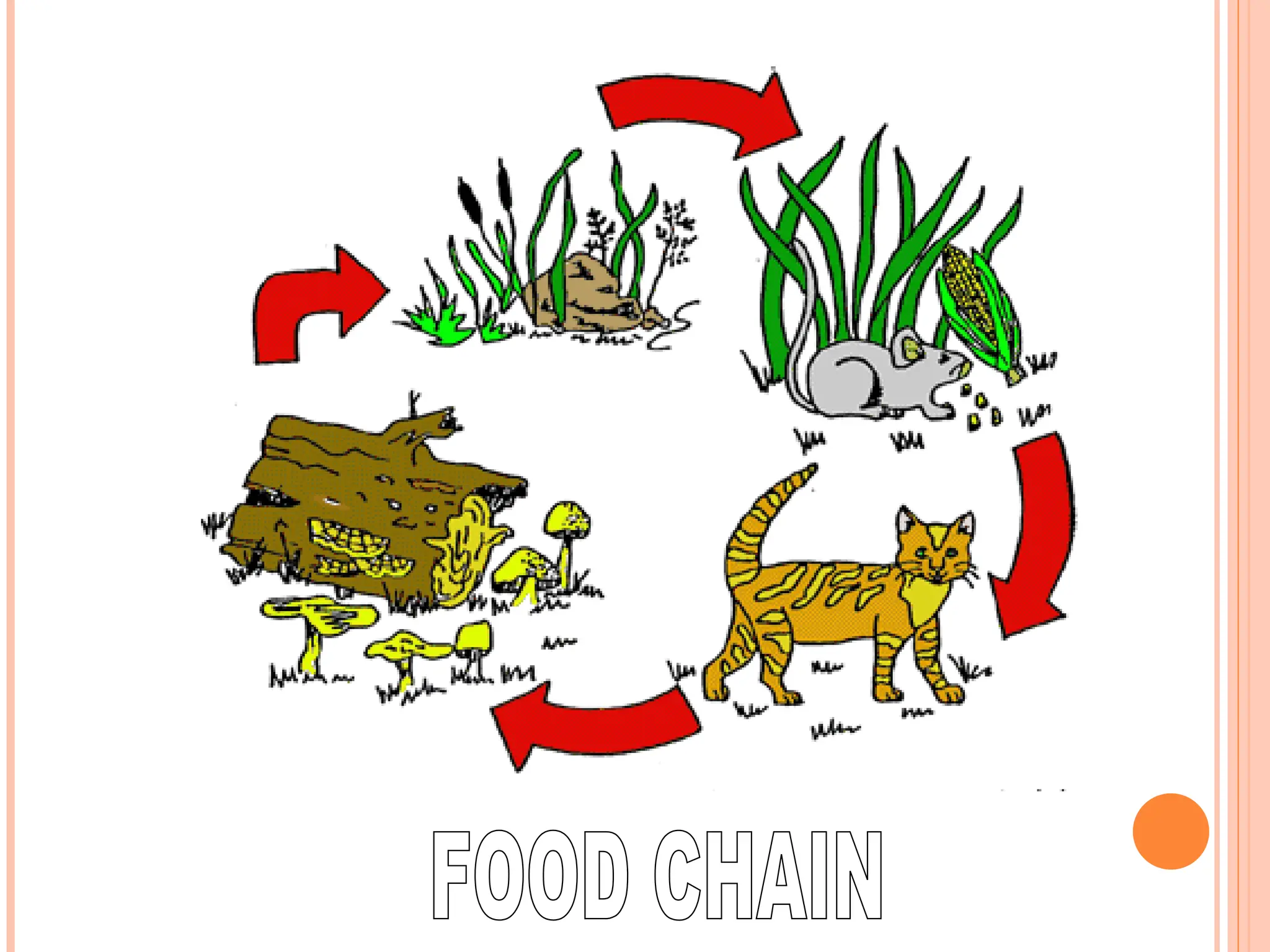
Food Chain—“The sequence of eating and being eaten in an ecosystem is
known as food chain”
Or
“Transfer of food energy the through a series of organisms in different tropic levels
is referred to as food chain”. Start with producer and end with top consumer or
carnivores
Ex: grass grasshopper frog raccoon
Types of food chain:
1.Grazing food chain: The food chain starts from plants
goes through herbivores and ends with carnivores. This
food chain depends on the autotrophs, which can capture
the energy from solar radiation.
2.Detritus food chain: Detritus food chain starts from
dead organic matters and ends with inorganic compounds.
In this type of food chain, microorganisms are feed their
food from animal and plants dead bodies. Microorganisms
are also called as detritivores.
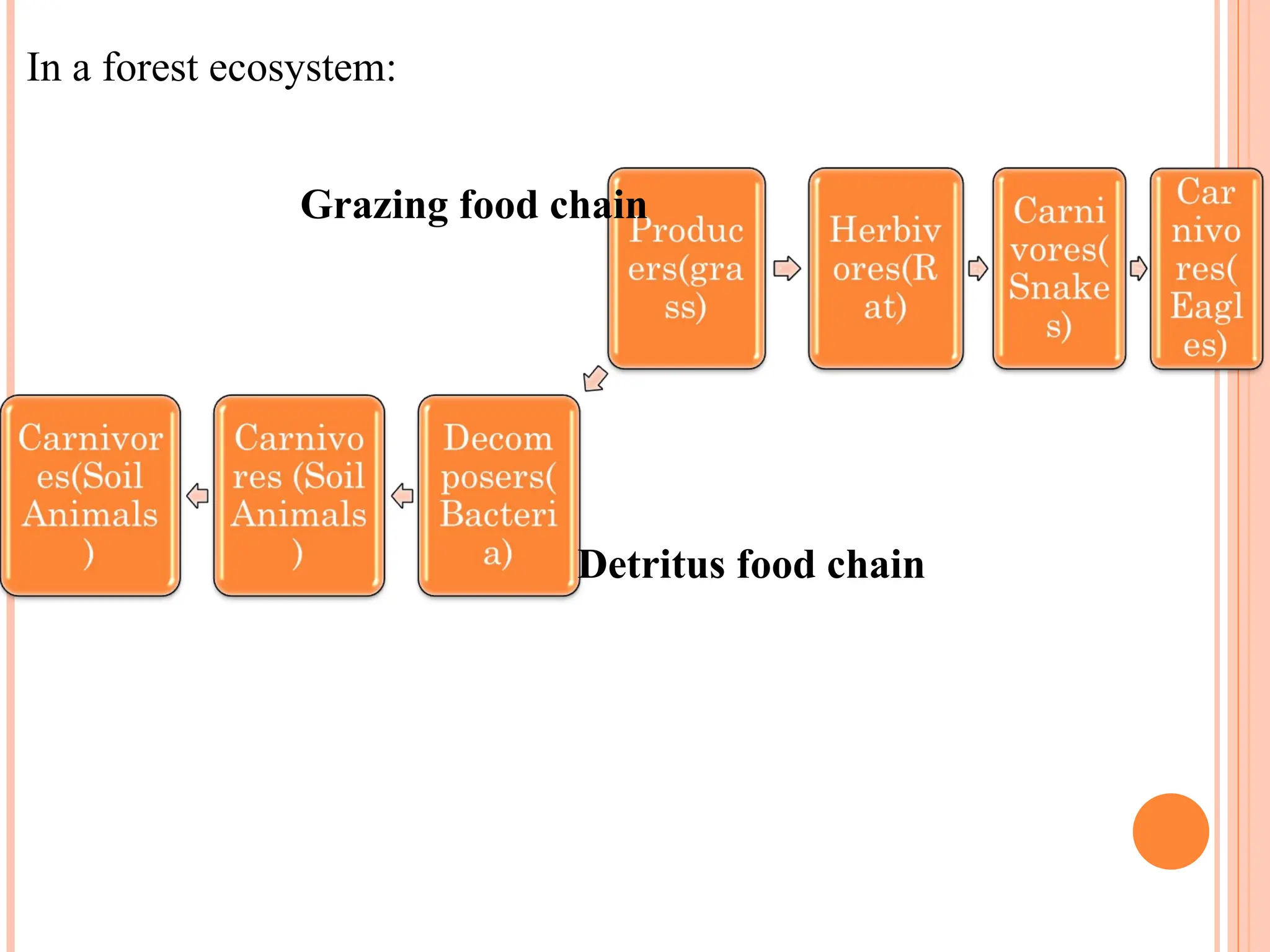
In a forest ecosystem:
Grazing food chain
Detritus food chain
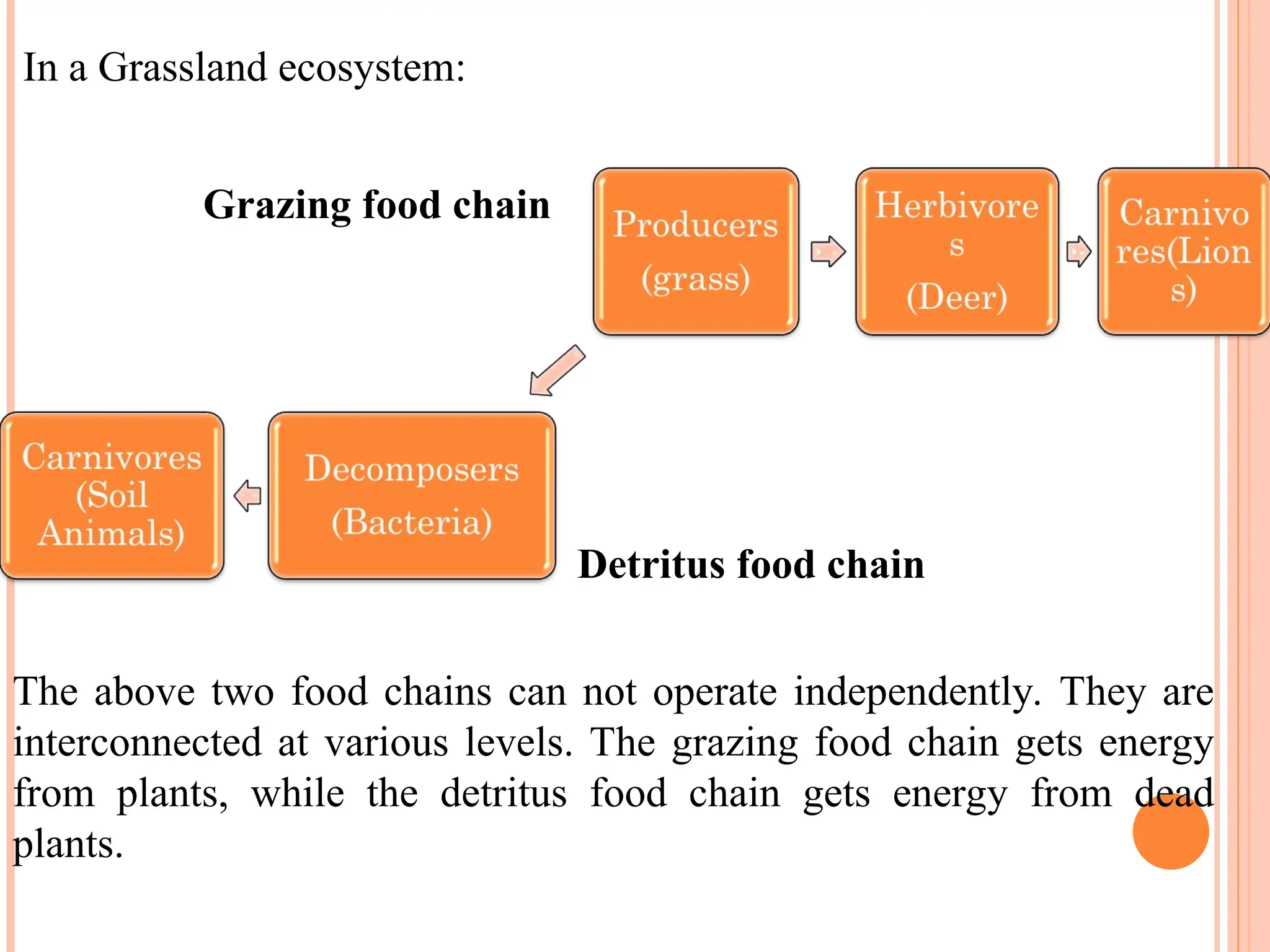
In a Grassland ecosystem:
Grazing food chain
Detritus food chain
The above two food chains can not operate independently. They are
interconnected at various levels. The grazing food chain gets energy
from plants, while the detritus food chain gets energy from dead
plants.
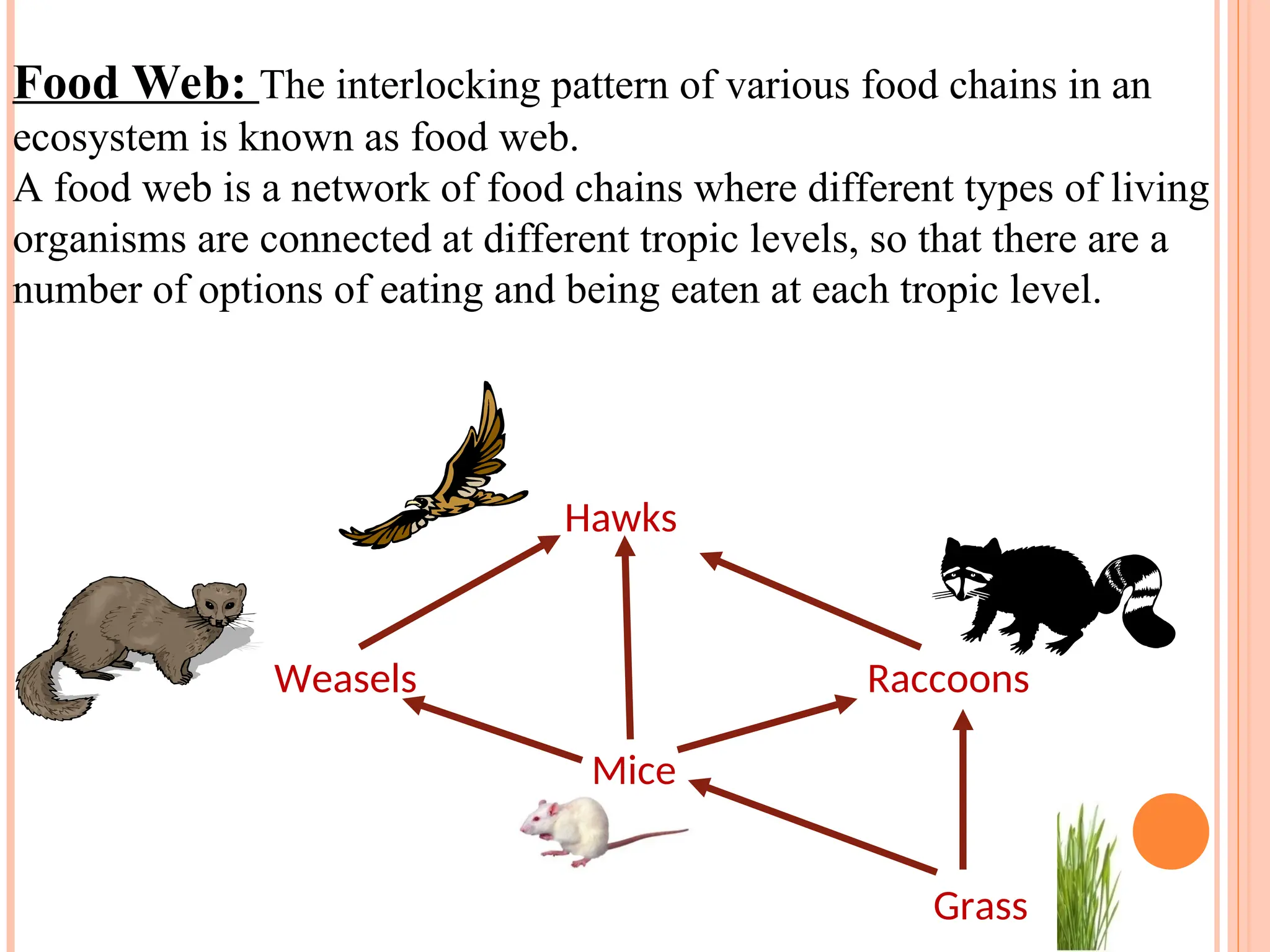
Food Web: The interlocking pattern of various food chains in an
ecosystem is known as food web.
A food web is a network of food chains where different types of living
organisms are connected at different tropic levels, so that there are a
number of options of eating and being eaten at each tropic level.
Hawks
Weasels Raccoons
Mice
Grass
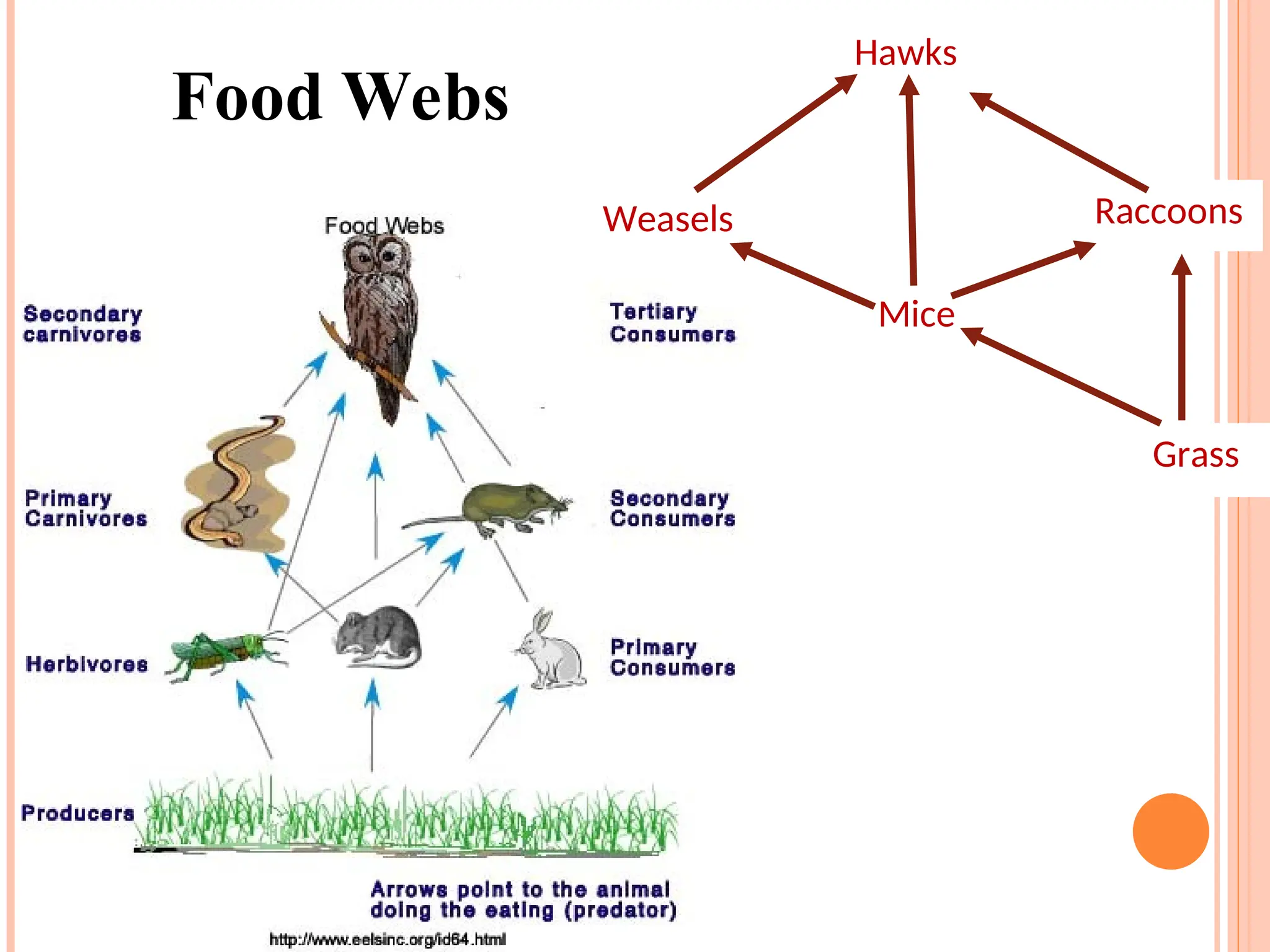
Hawks
Weasels Raccoons
Mice
Grass
Food Webs
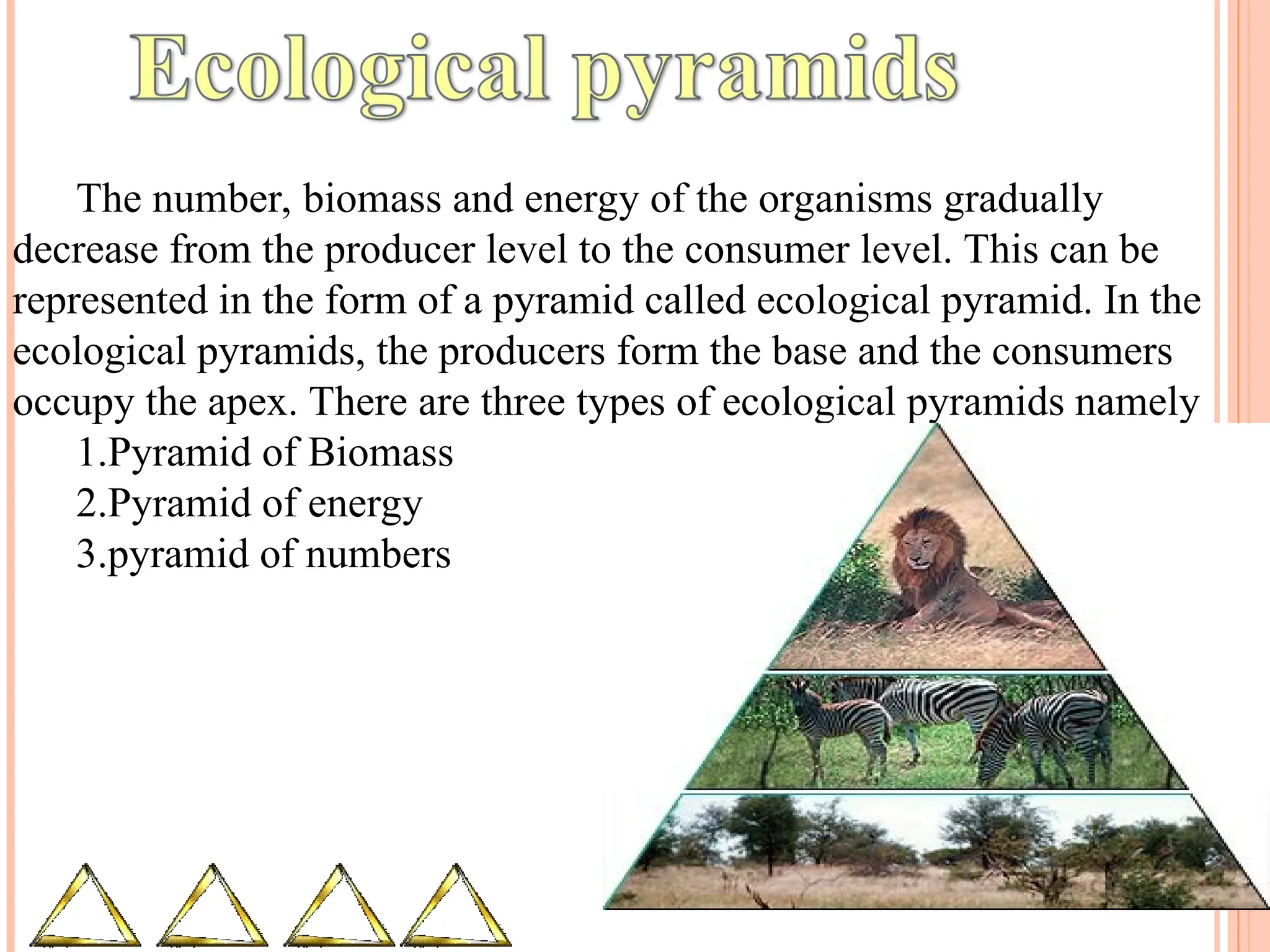
The number, biomass and energy of the organisms gradually
decrease from the producer level to the consumer level. This can be
represented in the form of a pyramid called ecological pyramid. In the
ecological pyramids, the producers form the base and the consumers
occupy the apex. There are three types of ecological pyramids namely
1.Pyramid of Biomass
2.Pyramid of energy
3.pyramid of numbers
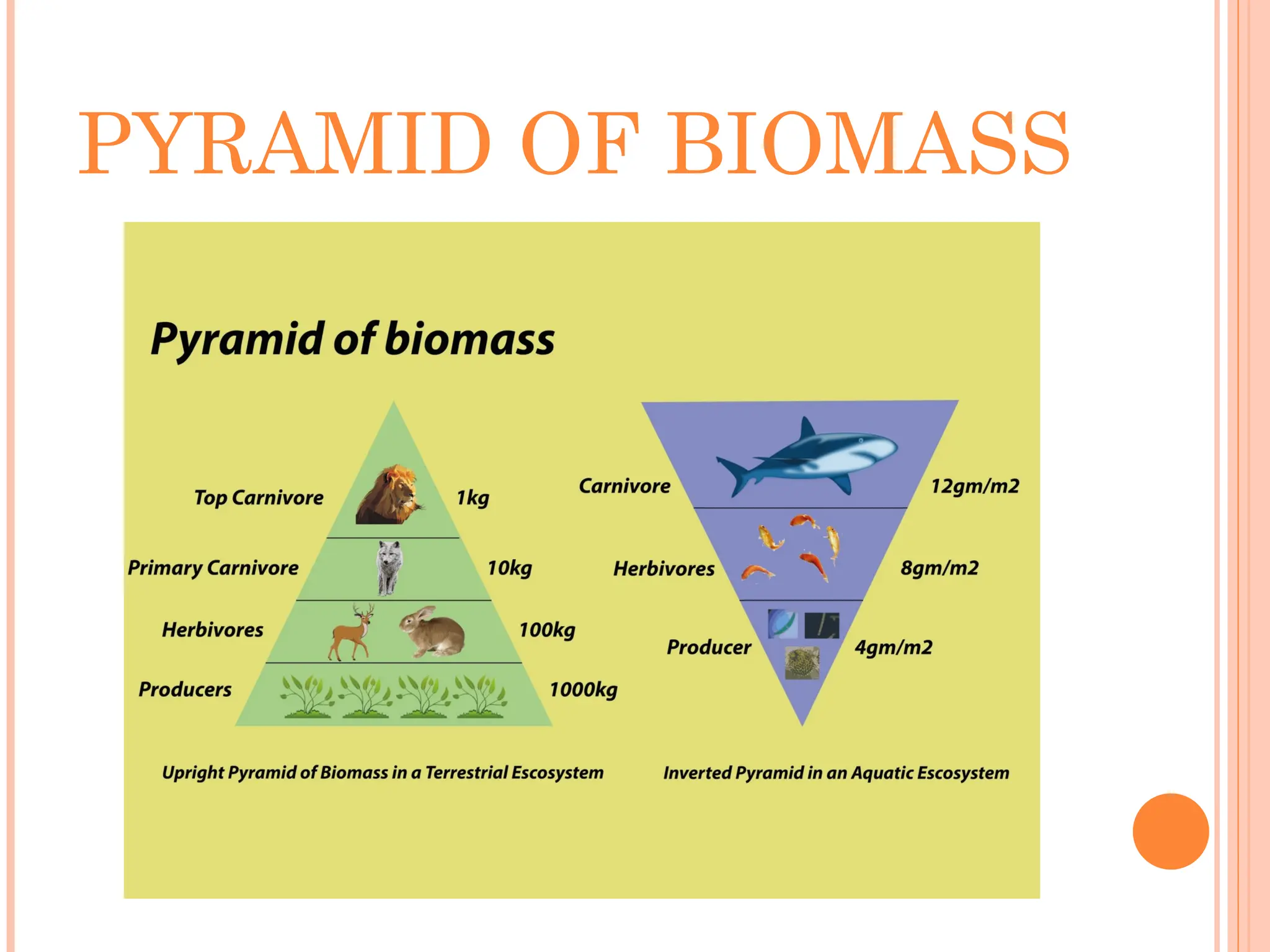
PYRAMID OF BIOMASS:
• The amount of biomass in each trophic level
 In this particular type of ecological pyramid, each level
takes into account the amount of biomass produced by
each trophic level.
 The pyramid of biomass is also upright except for that
observed in oceans where large numbers of
zooplanktons depend on a relatively smaller number of
phytoplanktons.
PYRAMID OF BIOMASS
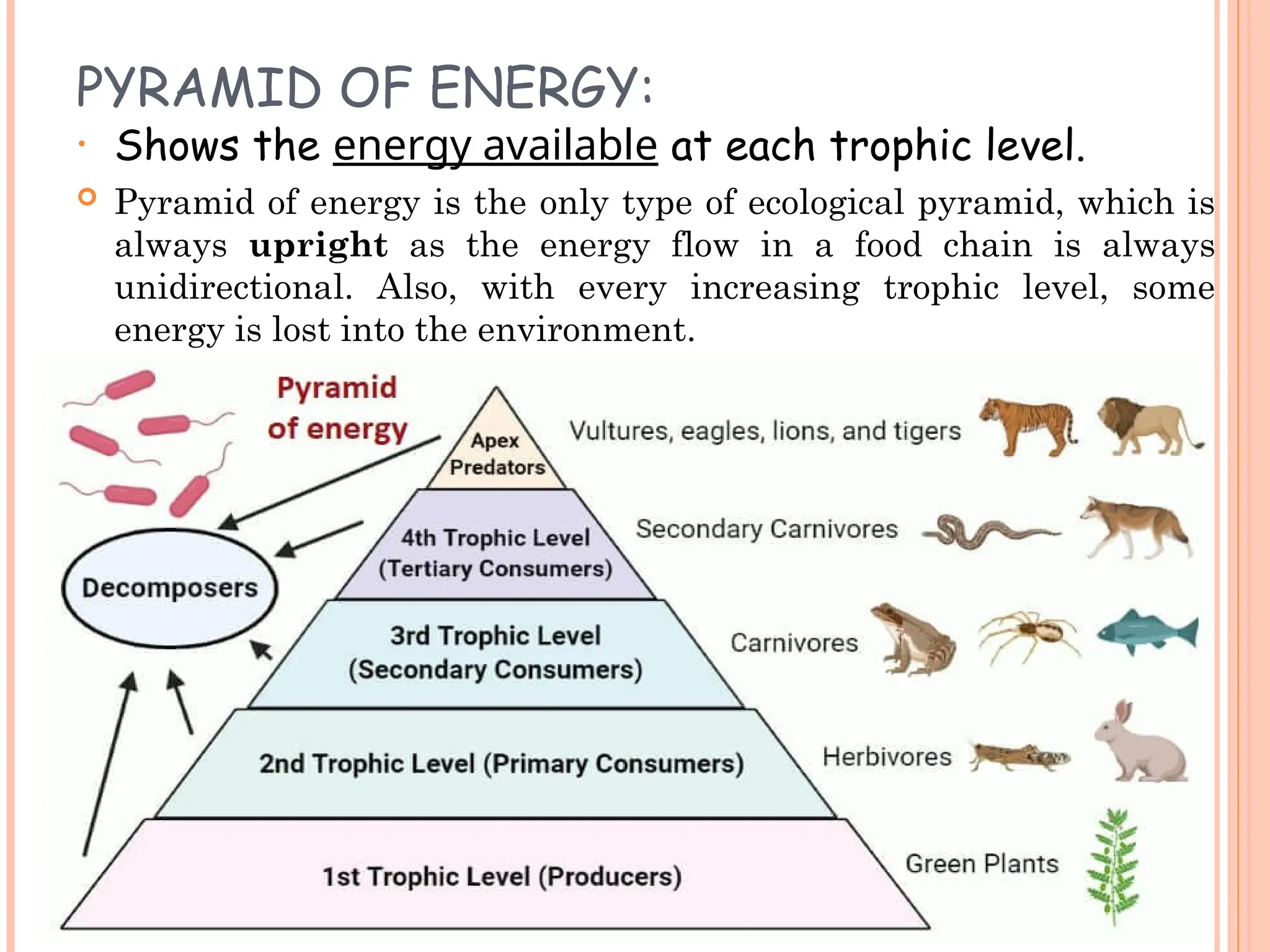
PYRAMID OF ENERGY:
• Shows the energy available at each trophic level.
 Pyramid of energy is the only type of ecological pyramid, which is
always upright as the energy flow in a food chain is always
unidirectional. Also, with every increasing trophic level, some
energy is lost into the environment.
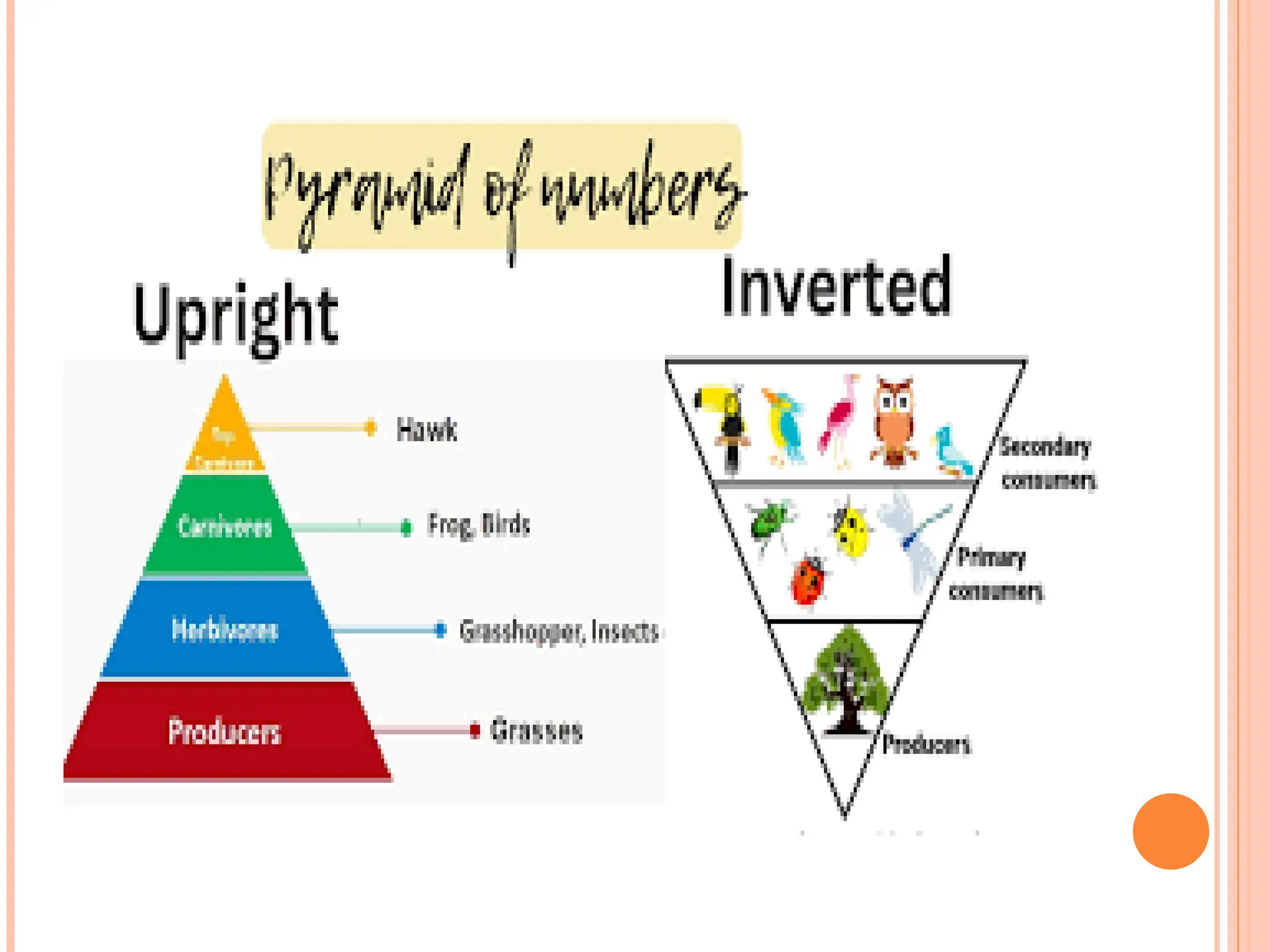
PYRAMID OF NUMBERS:
In this type of ecological pyramid, the
number of organisms in each trophic level is
considered as a level in the pyramid.
The pyramid of numbers is usually upright
except for some situations like that of the
detritus food chain, where many organisms
feed on one dead plant or animal.
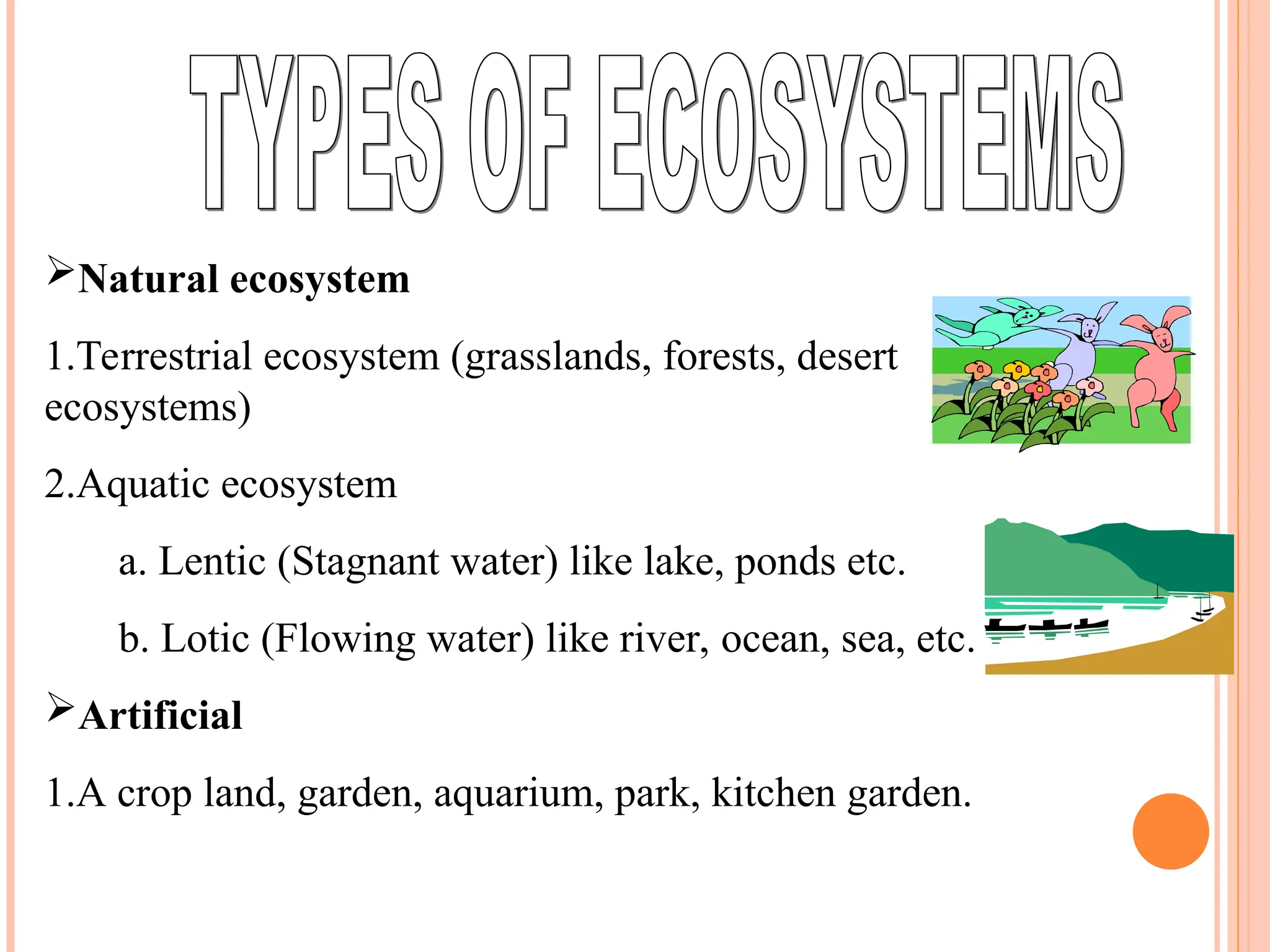
Natural ecosystem
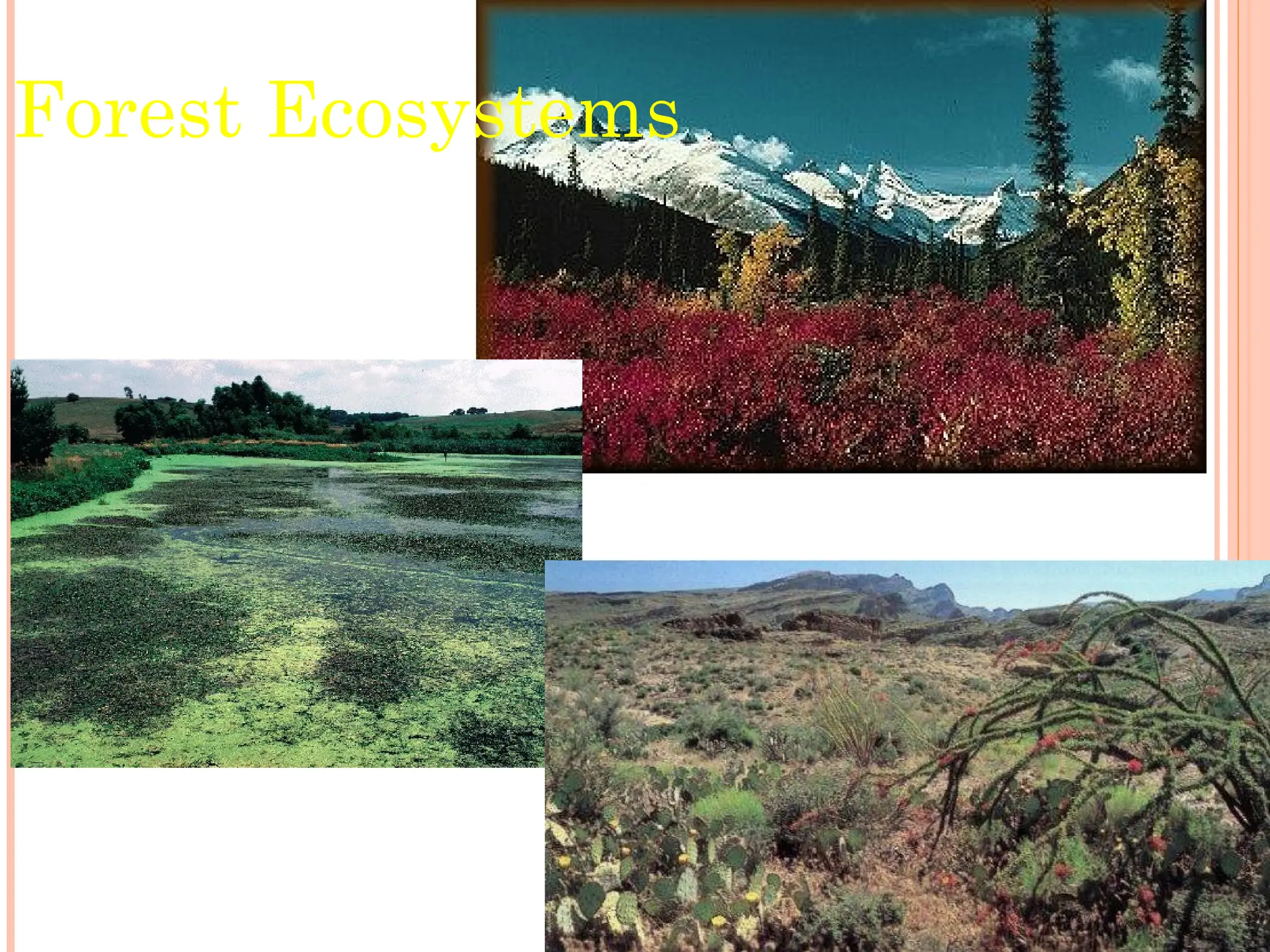
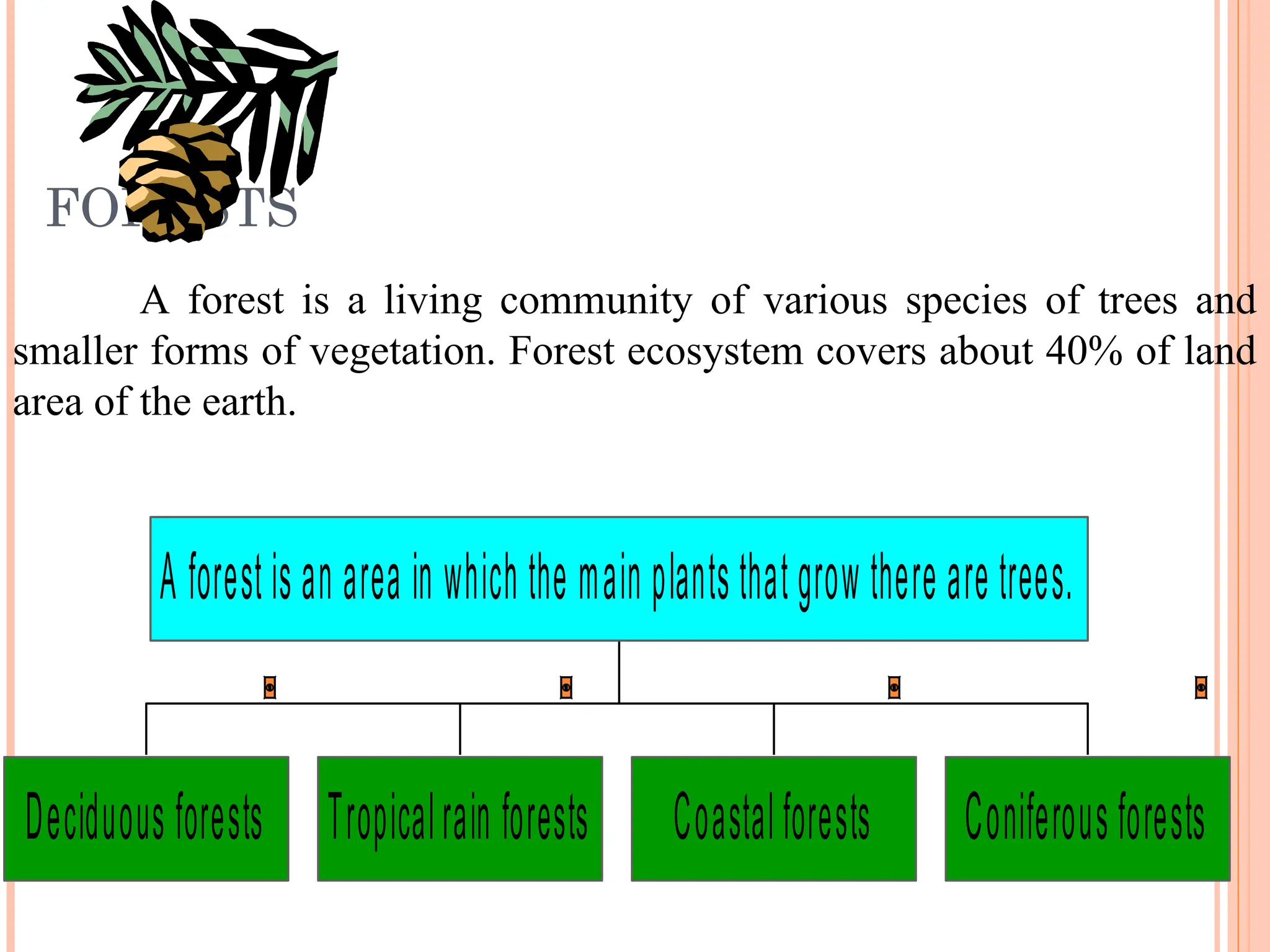
1.Terrestrial ecosystem (grasslands, forests, desert
ecosystems)
2.Aquatic ecosystem
a. Lentic (Stagnant water) like lake, ponds etc.
b. Lotic (Flowing water) like river, ocean, sea, etc.
Artificial
1.A crop land, garden, aquarium, park, kitchen garden.
Forest Ecosystems
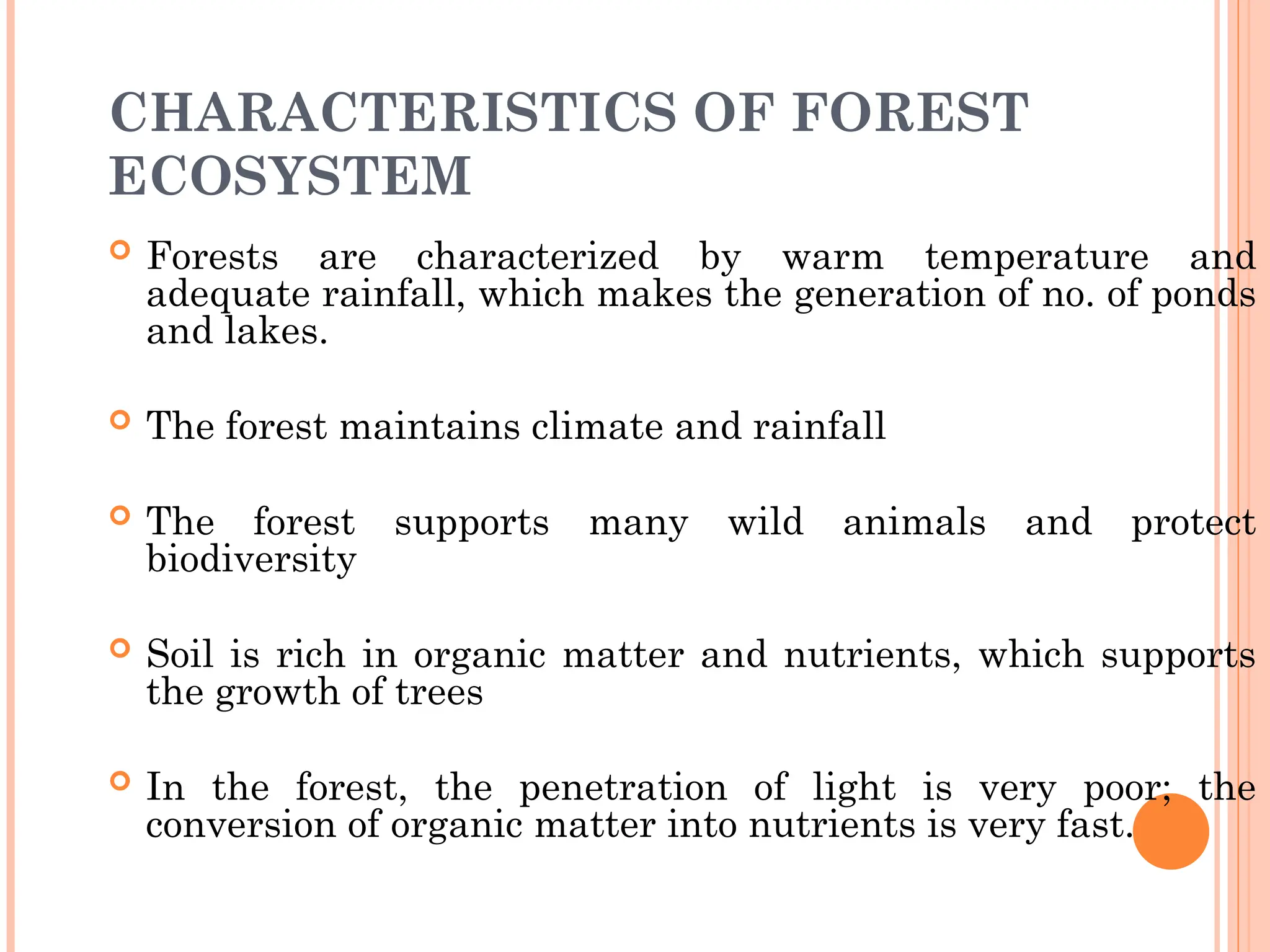
FORESTS
Deciduous forests Tropicalrain forests Coastalforests Coniferous forests
A forest is an area in which the main plants that grow there are trees.
A forest is a living community of various species of trees and
smaller forms of vegetation. Forest ecosystem covers about 40% of land
area of the earth.
CHARACTERISTICS OF FOREST
ECOSYSTEM
 Forests are characterized by warm temperature and
adequate rainfall, which makes the generation of no. of ponds
and lakes.
 The forest maintains climate and rainfall
 The forest supports many wild animals and protect
biodiversity
 Soil is rich in organic matter and nutrients, which supports
the growth of trees
 In the forest, the penetration of light is very poor; the
conversion of organic matter into nutrients is very fast.
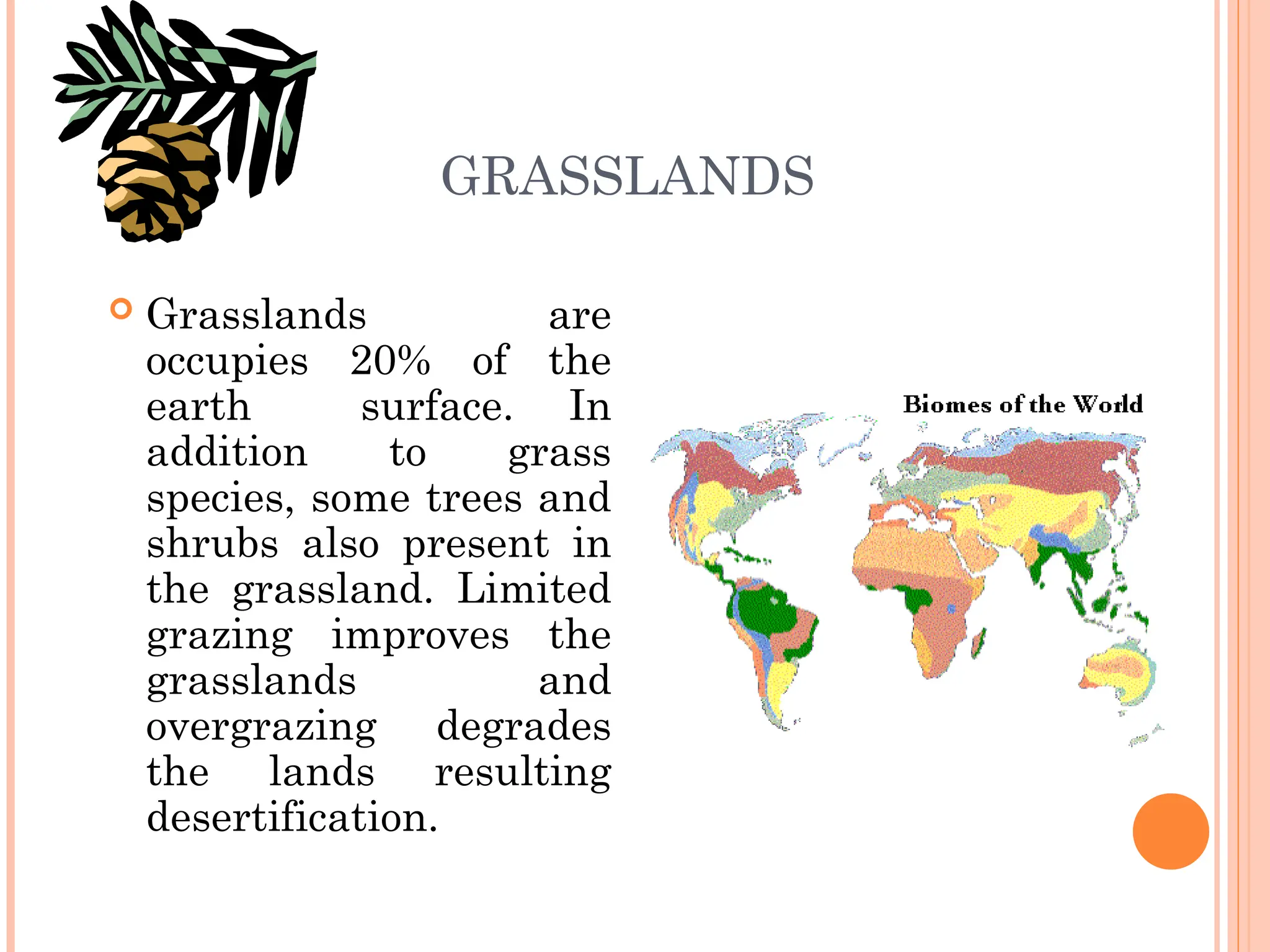
GRASSLAND ECOSYSTEMS
GRASSLANDS
 Grasslands are
occupies 20% of the
earth surface. In
addition to grass
species, some trees and
shrubs also present in
the grassland. Limited
grazing improves the
grasslands and
overgrazing degrades
the lands resulting
desertification.
TYPES GRASSLANDS
Depending upon the
climate conditions,
grasslands can be
classified into three
types
1. Tropical grasslands
2. Temperate grasslands
3. Polar grasslands
CHARACTERISTICS OF GRASSLANDS
 Grassland ecosystem is a plain land occupied by grasses
 Soil is very rich in nutrients and organic matters.
 Since it has tall grass, it is ideal place for grazing
animals.
 It is characterized by low or uneven rainfall.
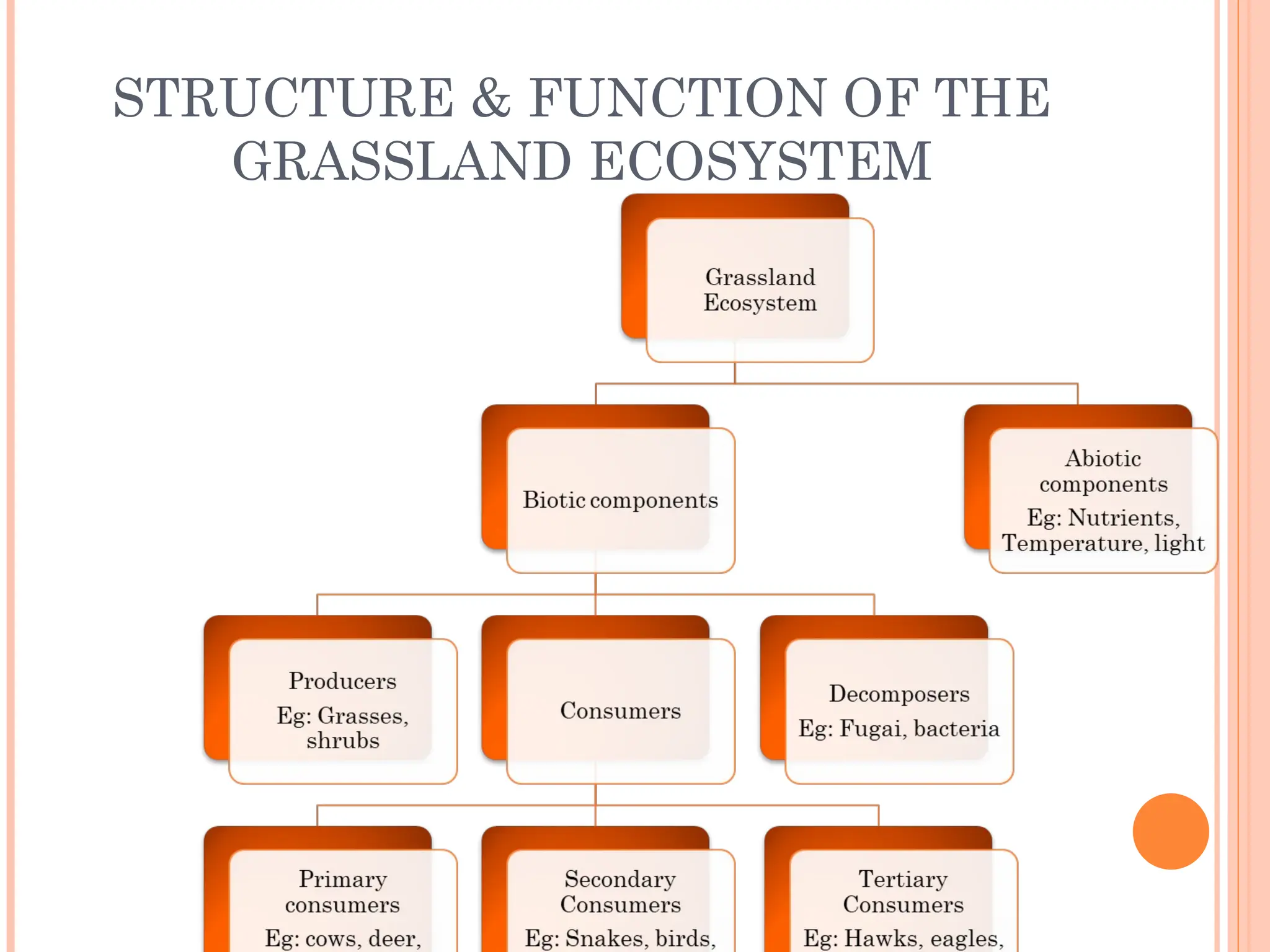
STRUCTURE & FUNCTION OF THE
GRASSLAND ECOSYSTEM
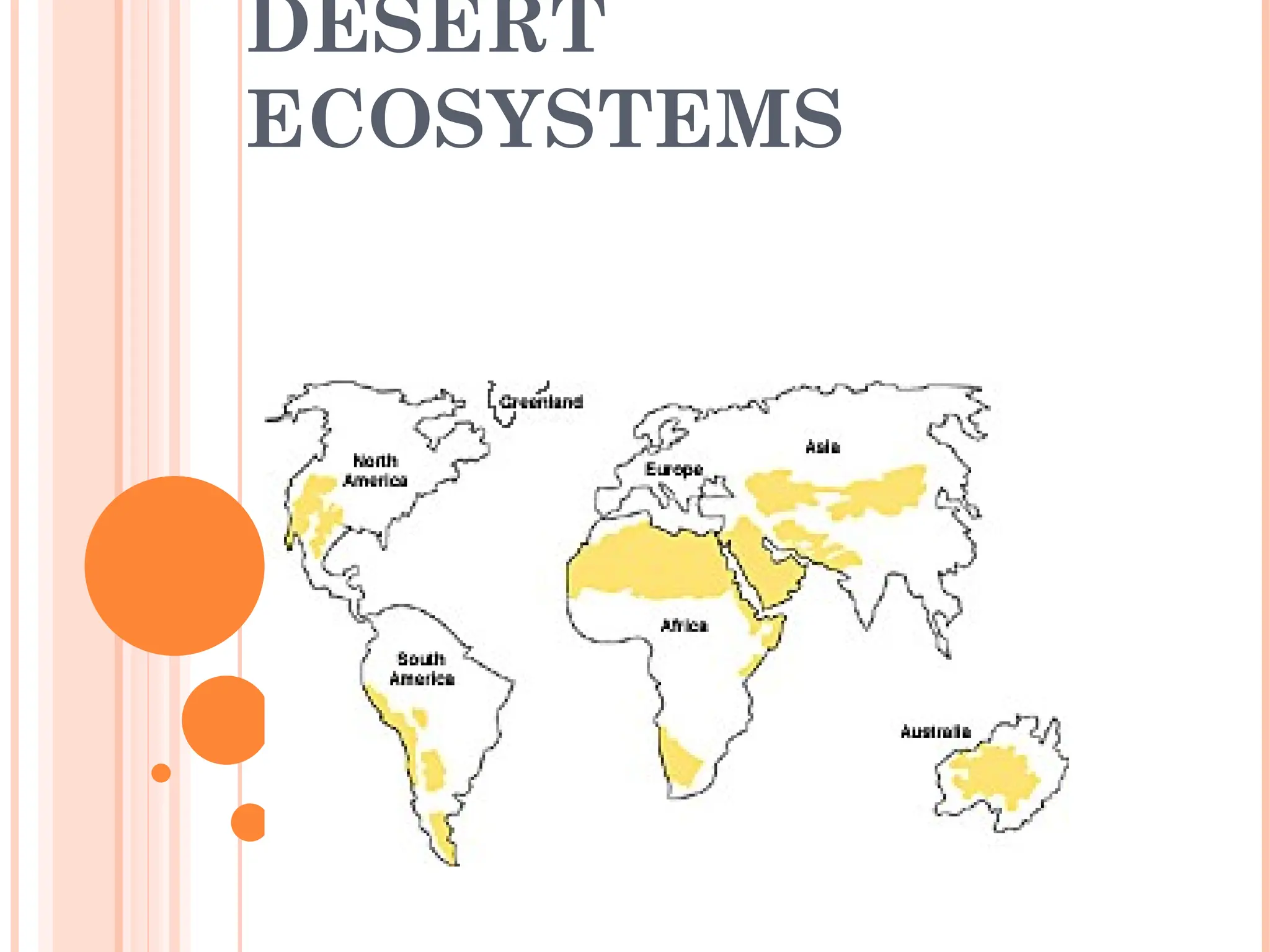
DESERT
ECOSYSTEMS
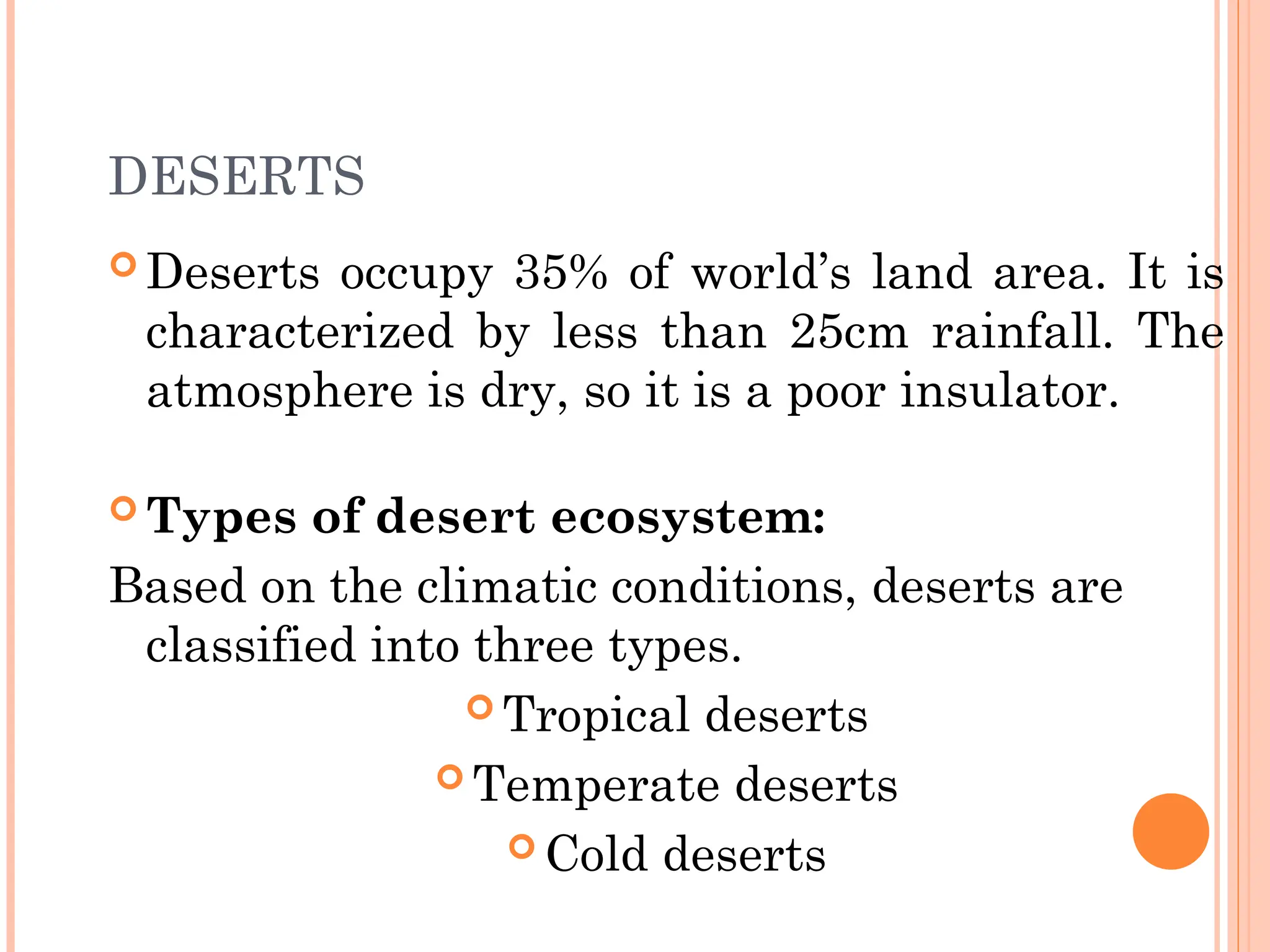
DESERTS
 Deserts occupy 35% of world’s land area. It is
characterized by less than 25cm rainfall. The
atmosphere is dry, so it is a poor insulator.
 Types of desert ecosystem:
Based on the climatic conditions, deserts are
classified into three types.
 Tropical deserts
 Temperate deserts
 Cold deserts
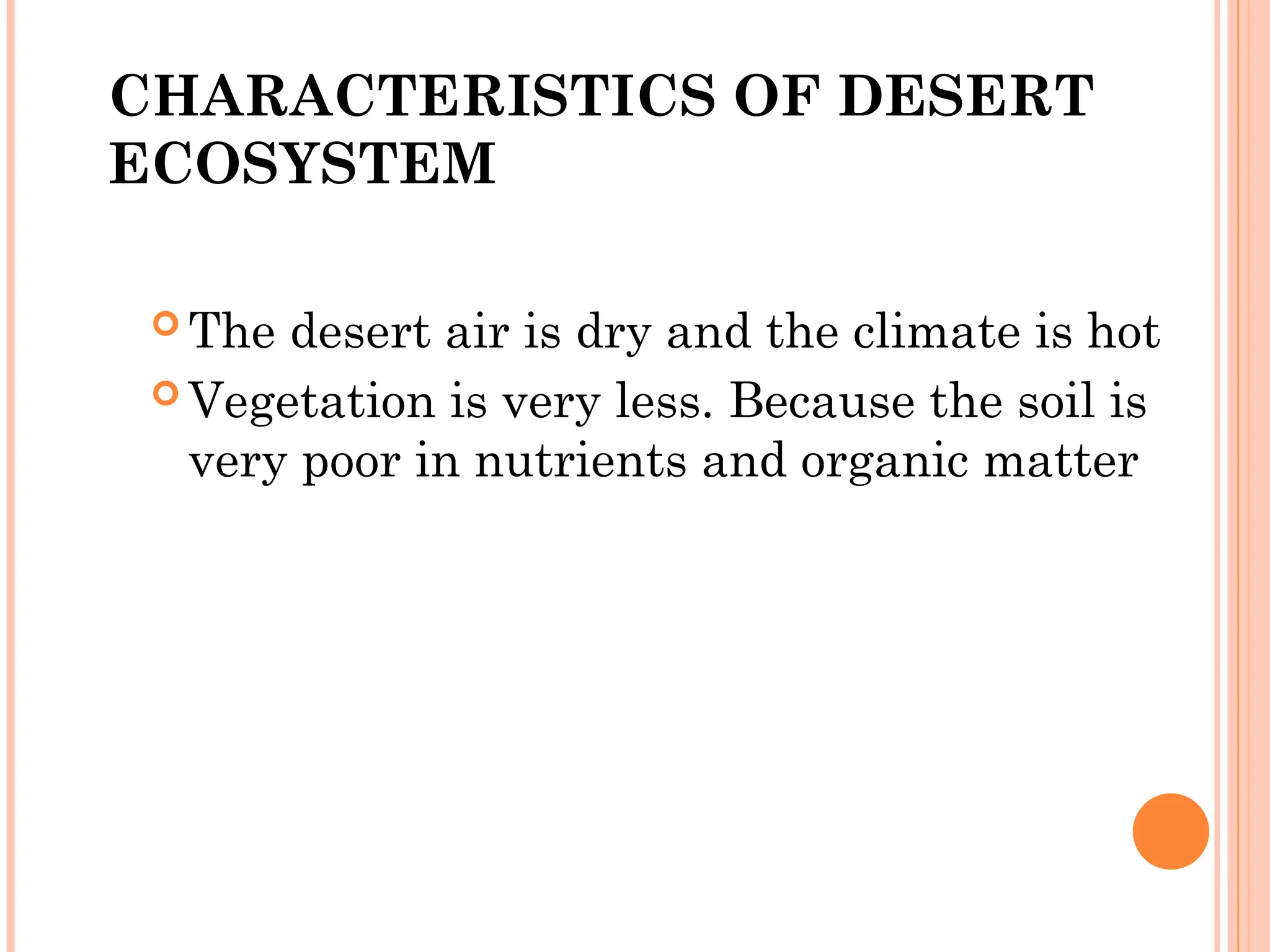
CHARACTERISTICS OF DESERT
ECOSYSTEM
 The desert air is dry and the climate is hot
 Vegetation is very less. Because the soil is
very poor in nutrients and organic matter
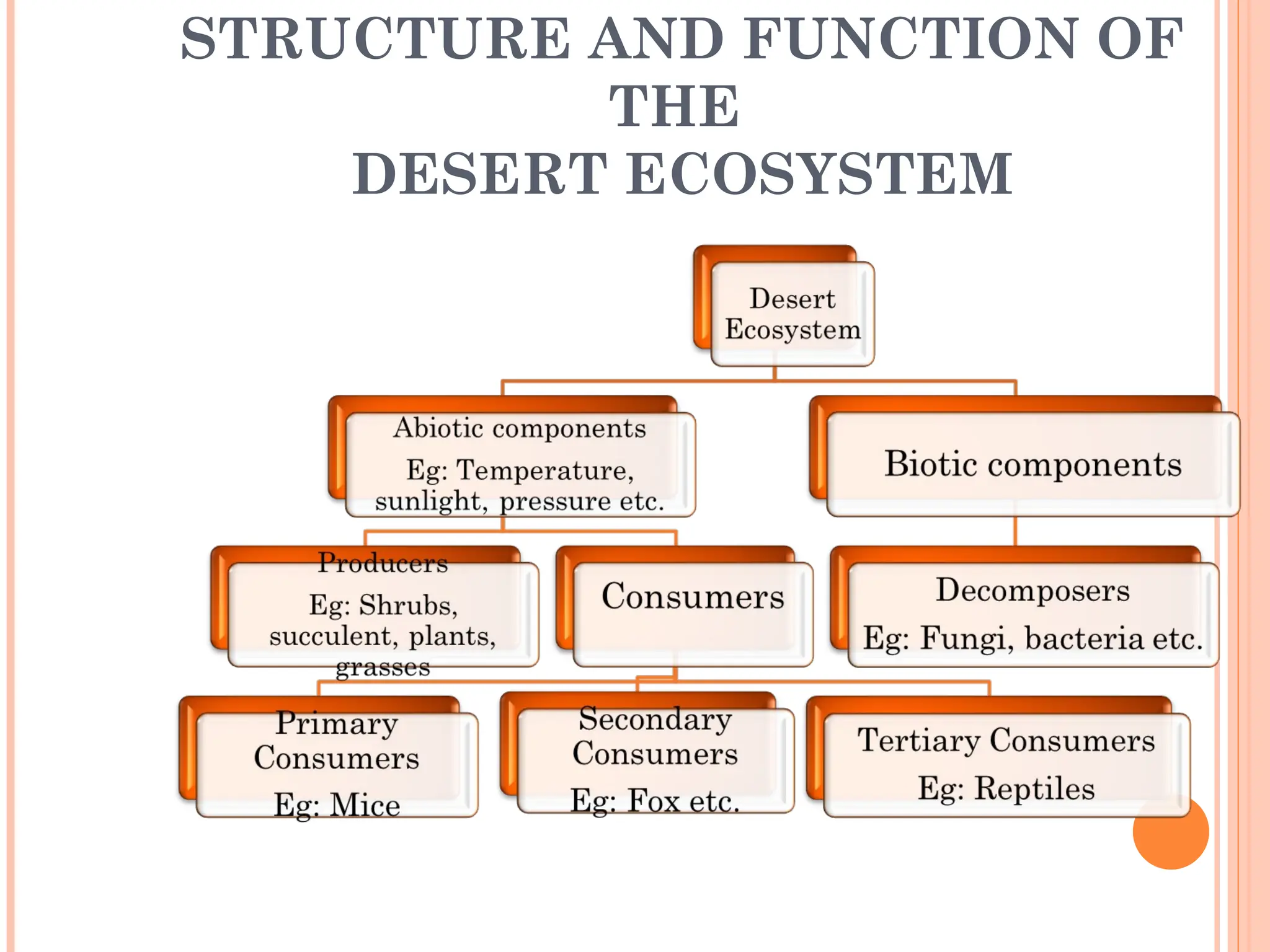
STRUCTURE AND FUNCTION OF
THE
DESERT ECOSYSTEM
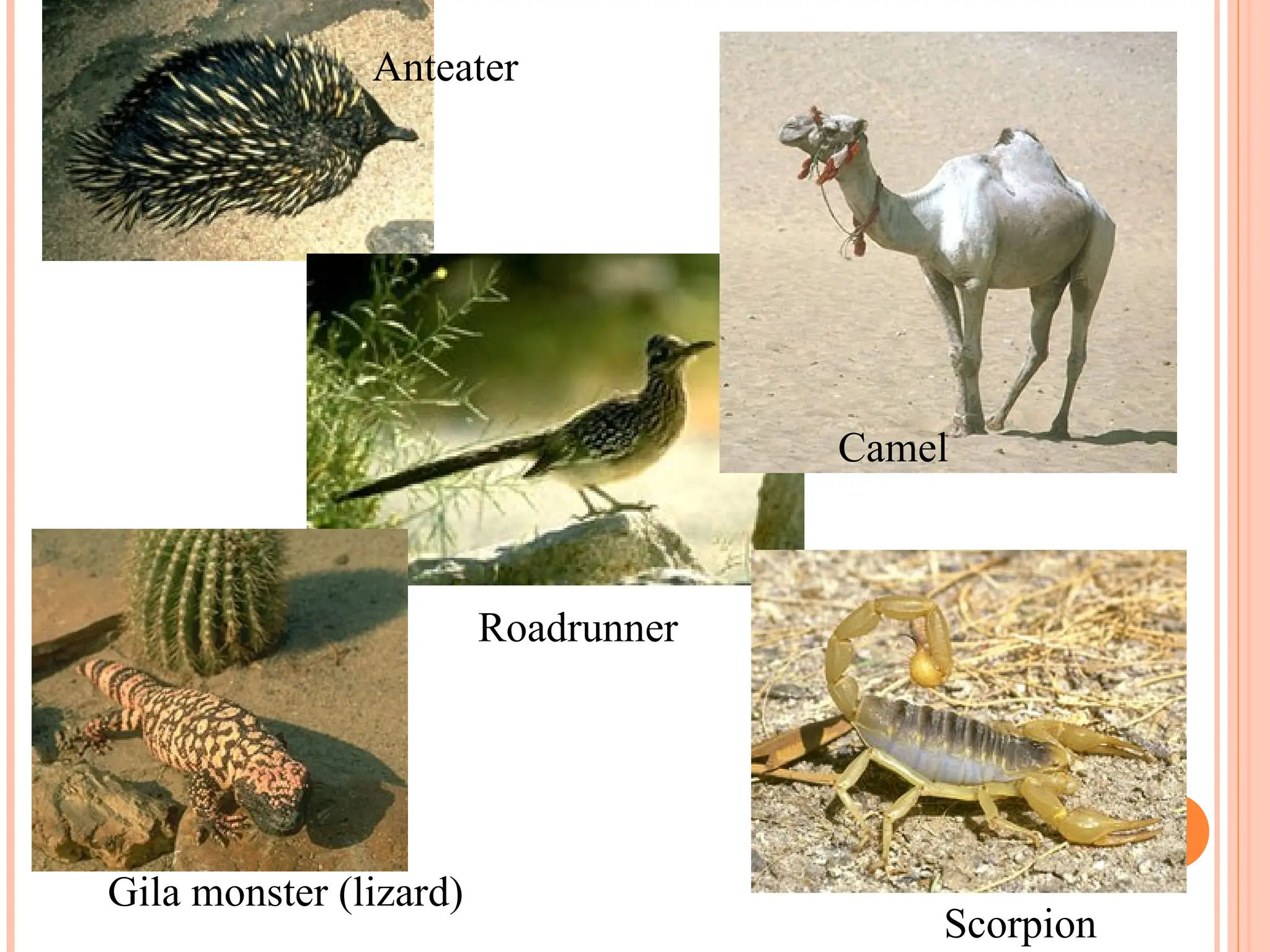
Roadrunner
Anteater
Scorpion
Gila monster (lizard)
Camel
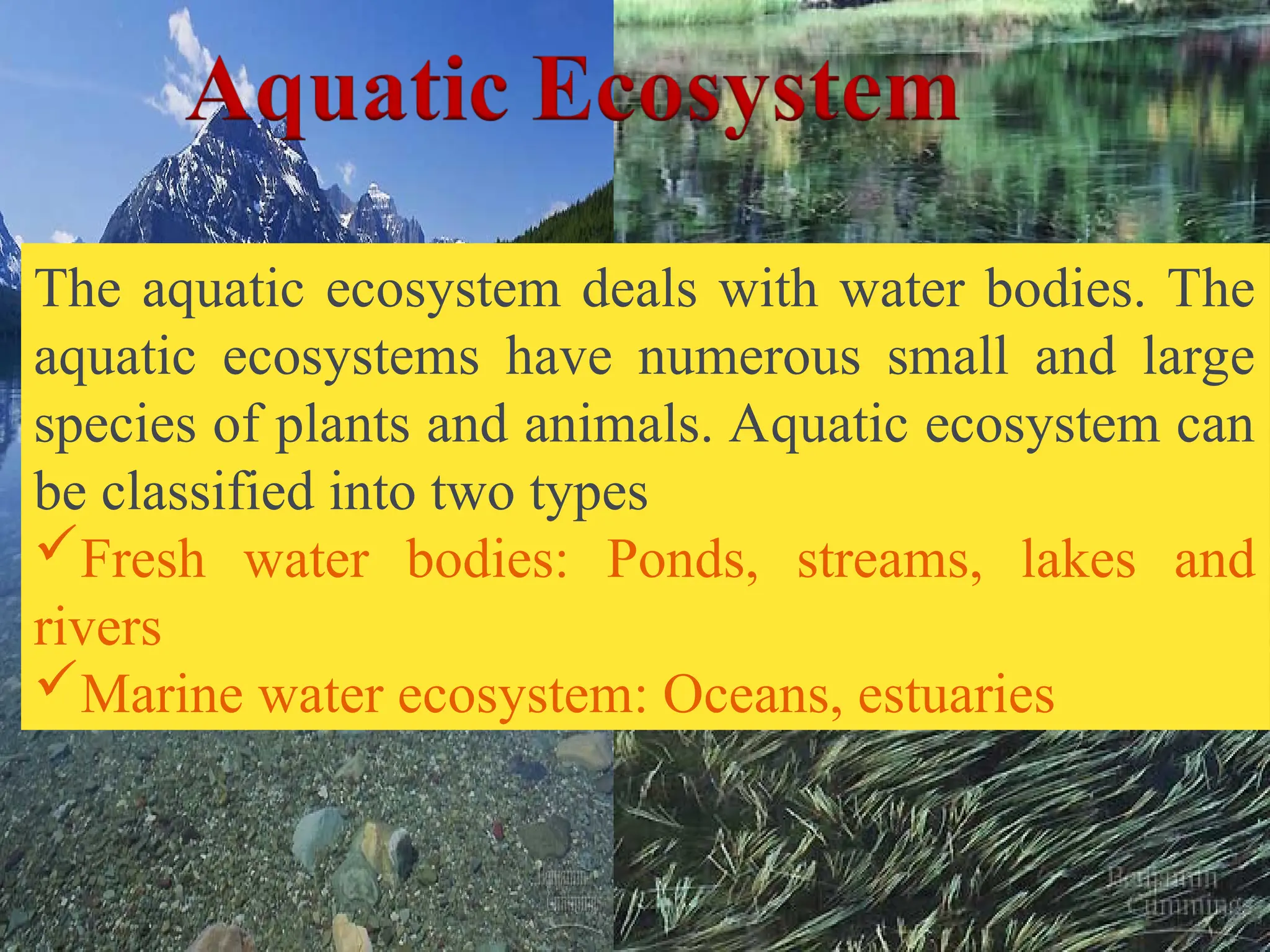
The aquatic ecosystem deals with water bodies. The
aquatic ecosystems have numerous small and large
species of plants and animals. Aquatic ecosystem can
be classified into two types
Fresh water bodies: Ponds, streams, lakes and
rivers
Marine water ecosystem: Oceans, estuaries
PONDS ECOSYSTEM
PONDS ECOSYSTEM
Ponds Ecosystem
Ponds Ecosystem
It is a small fresh water aquatic ecosystem,
where water is stagnant. It receives water
during rainy season.
Characteristics of ponds:
Pond is temporary, only seasonal
Ponds get polluted easily due to limited
amount of water
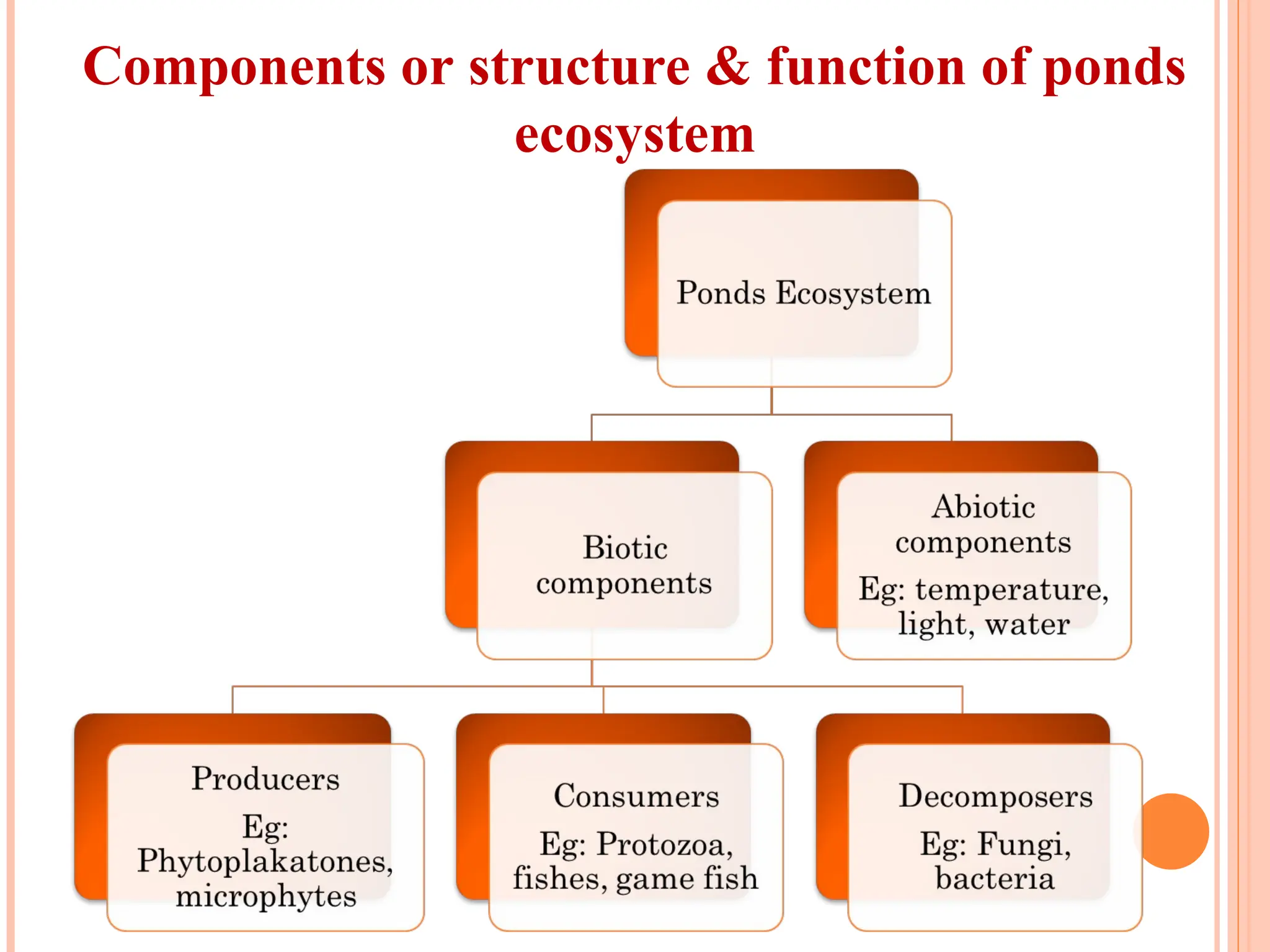
Components or structure & function of ponds
ecosystem
LAKES
LAKES
ECOSYSTEM
ECOSYSTEM
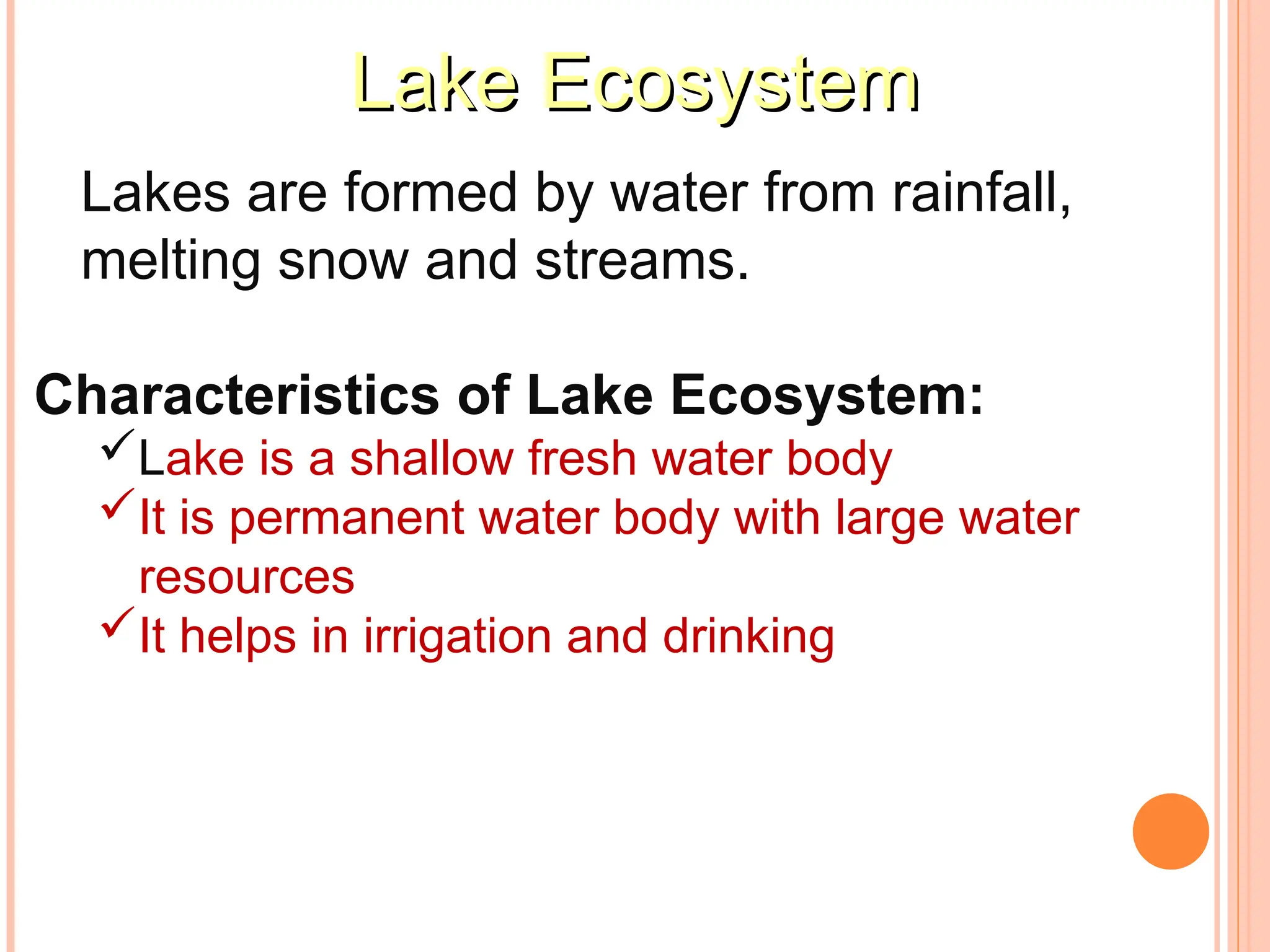
Lake Ecosystem
Lake Ecosystem
Lakes are formed by water from rainfall,
melting snow and streams.
Characteristics of Lake Ecosystem:
Lake is a shallow fresh water body
It is permanent water body with large water
resources
It helps in irrigation and drinking
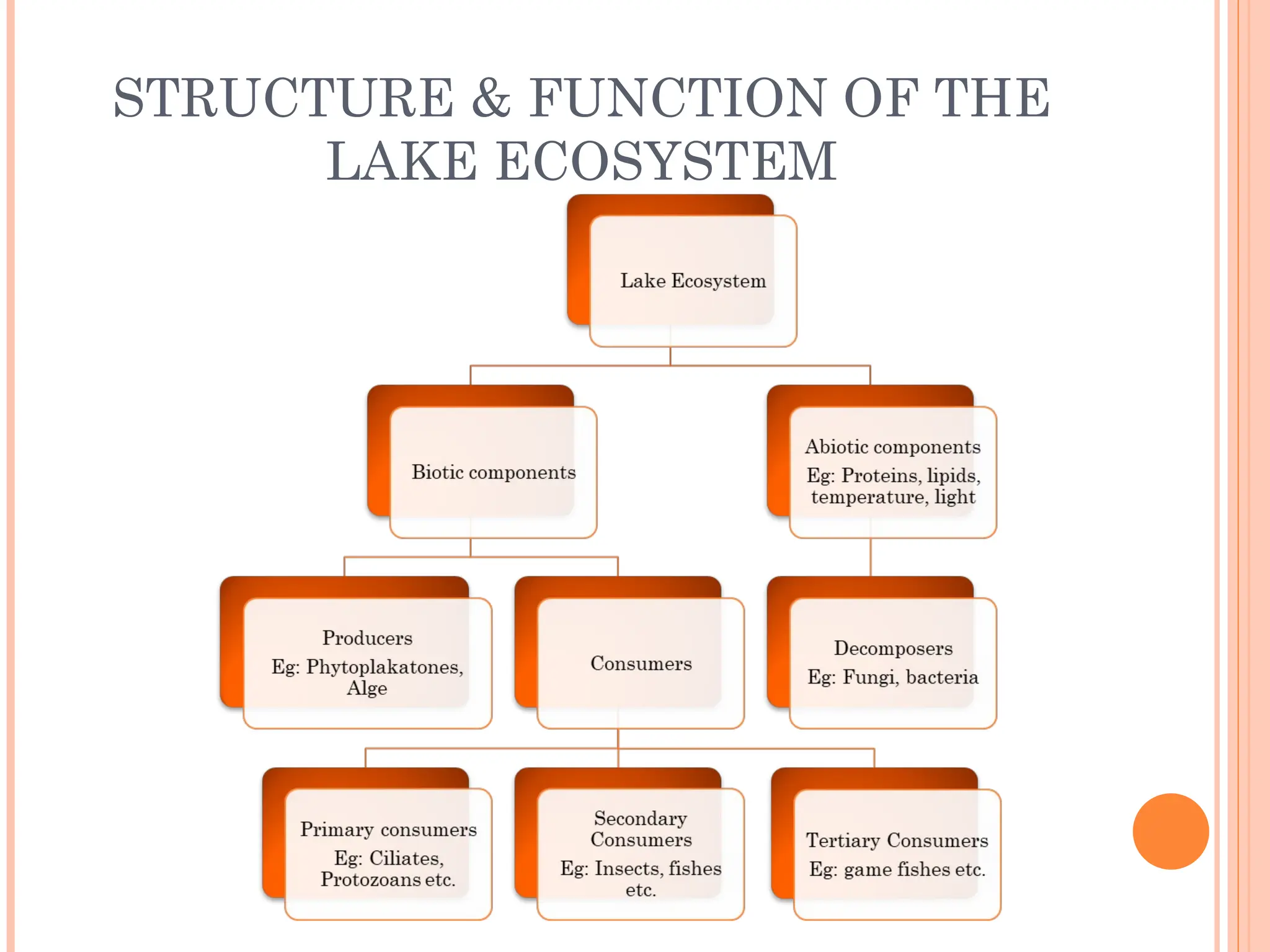
STRUCTURE & FUNCTION OF THE
LAKE ECOSYSTEM
RIVER/ STREAM
ECOSYSTEMS
RIVER/STREAM ECOSYSTEM
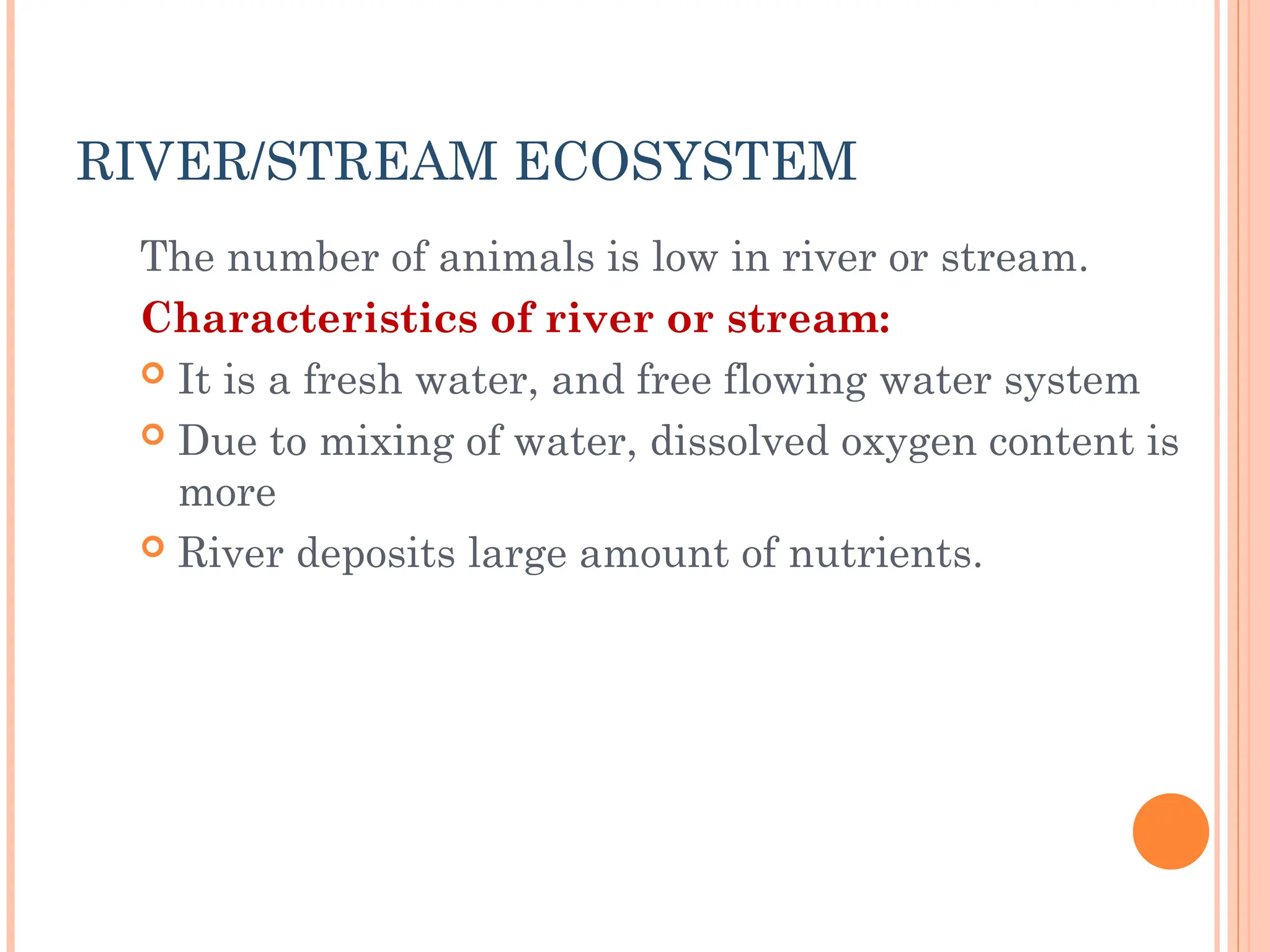
The number of animals is low in river or stream.
Characteristics of river or stream:
 It is a fresh water, and free flowing water system
 Due to mixing of water, dissolved oxygen content is
more
 River deposits large amount of nutrients.
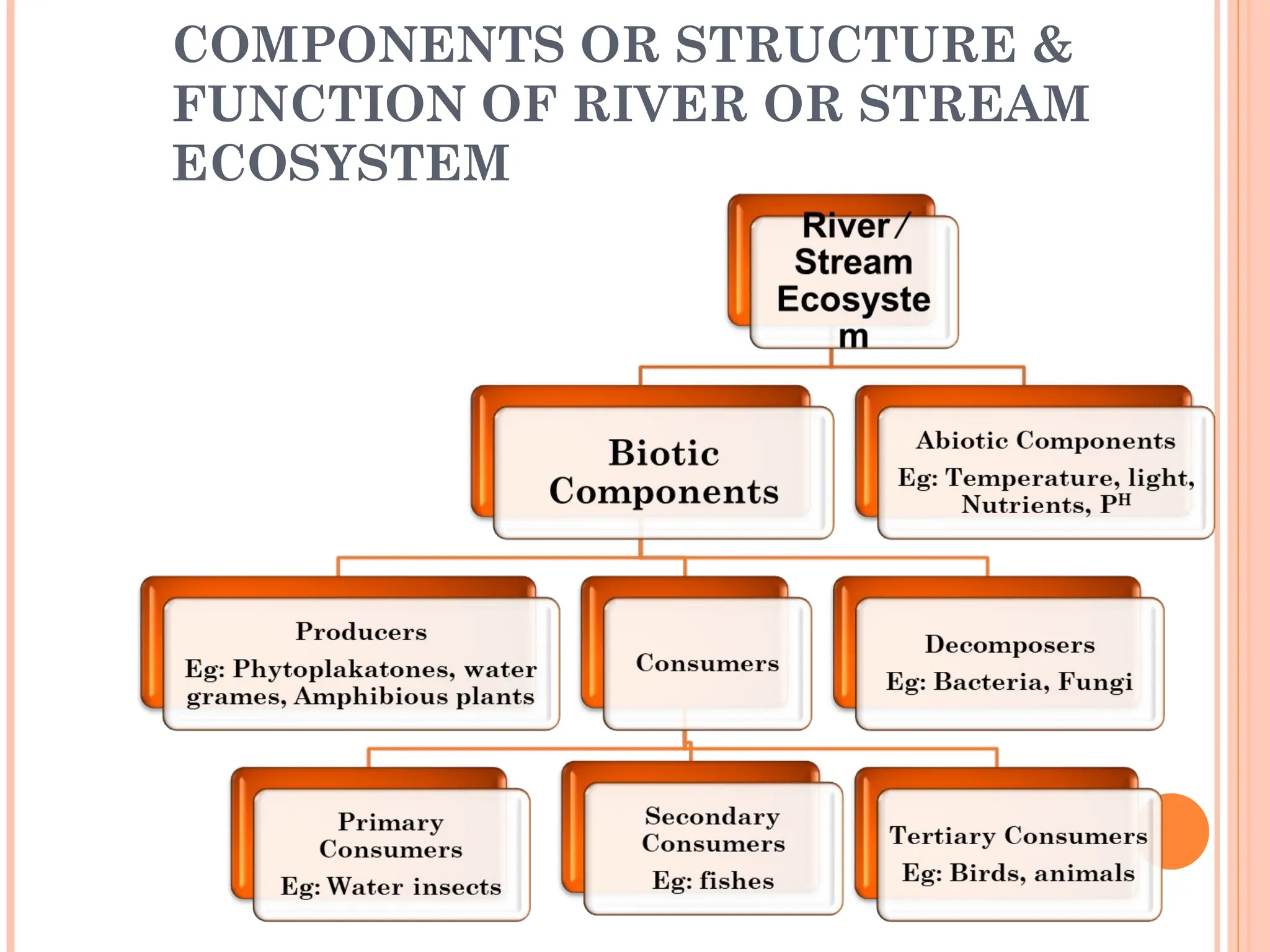
COMPONENTS OR STRUCTURE &
FUNCTION OF RIVER OR STREAM
ECOSYSTEM
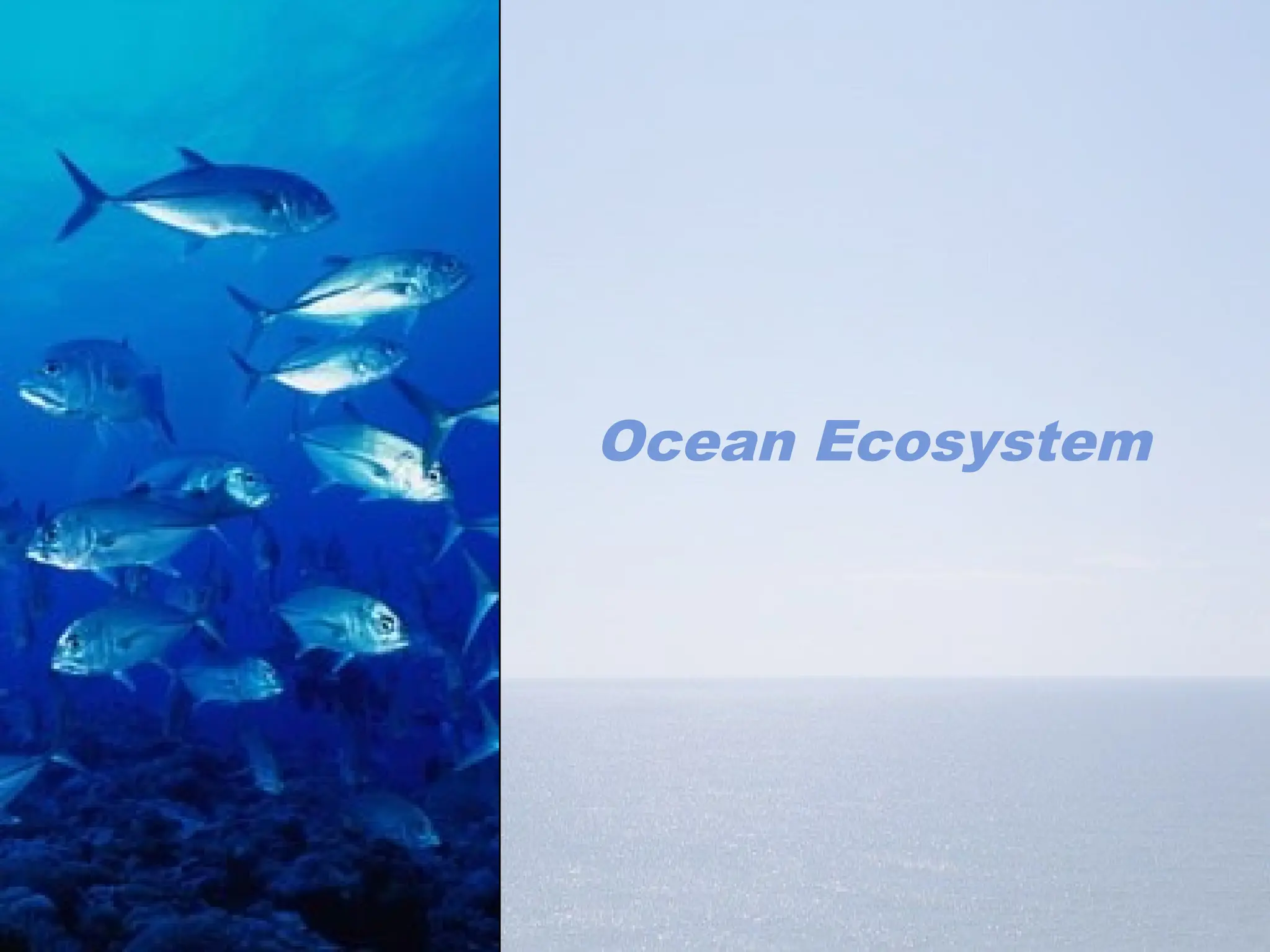
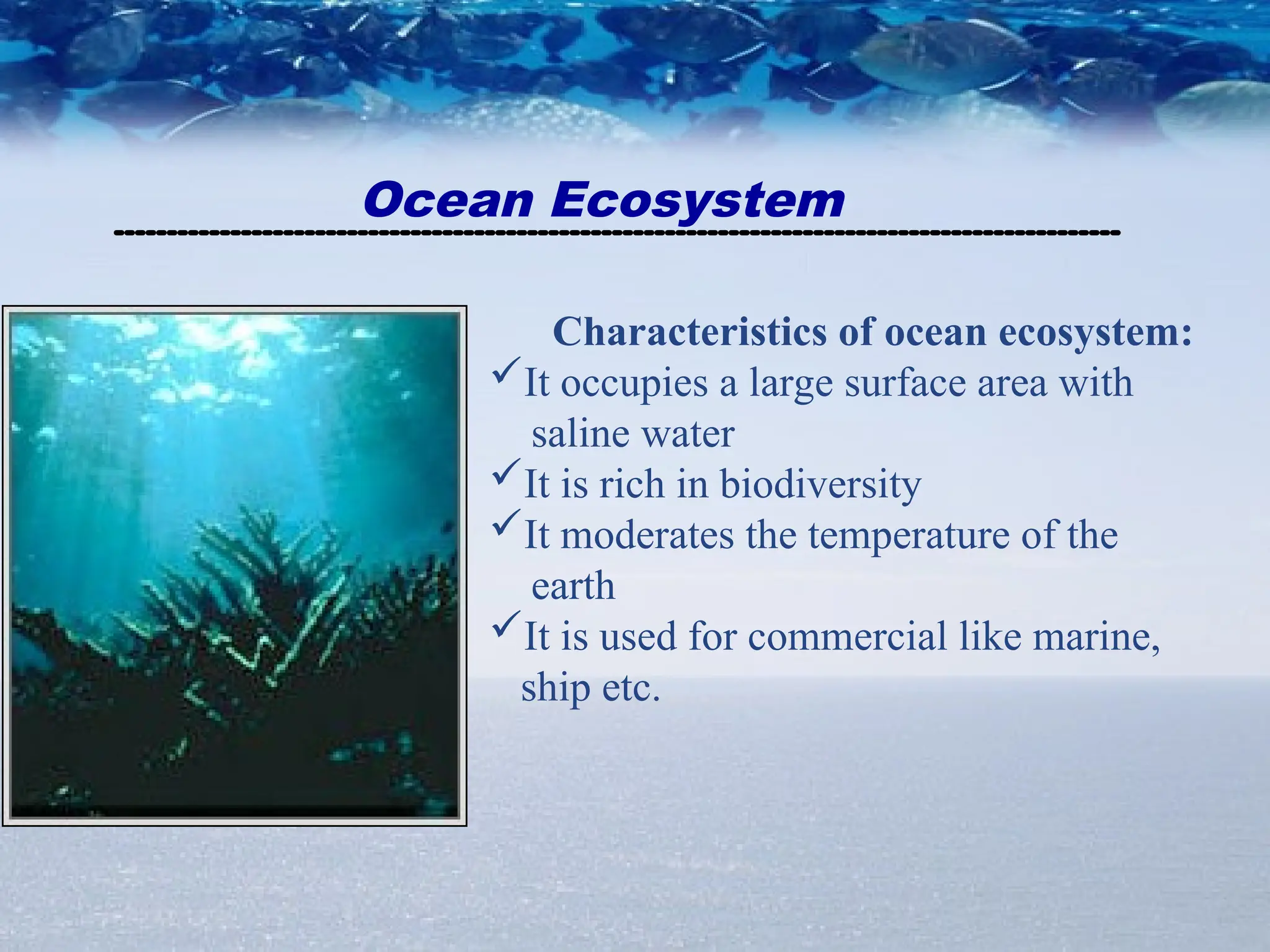
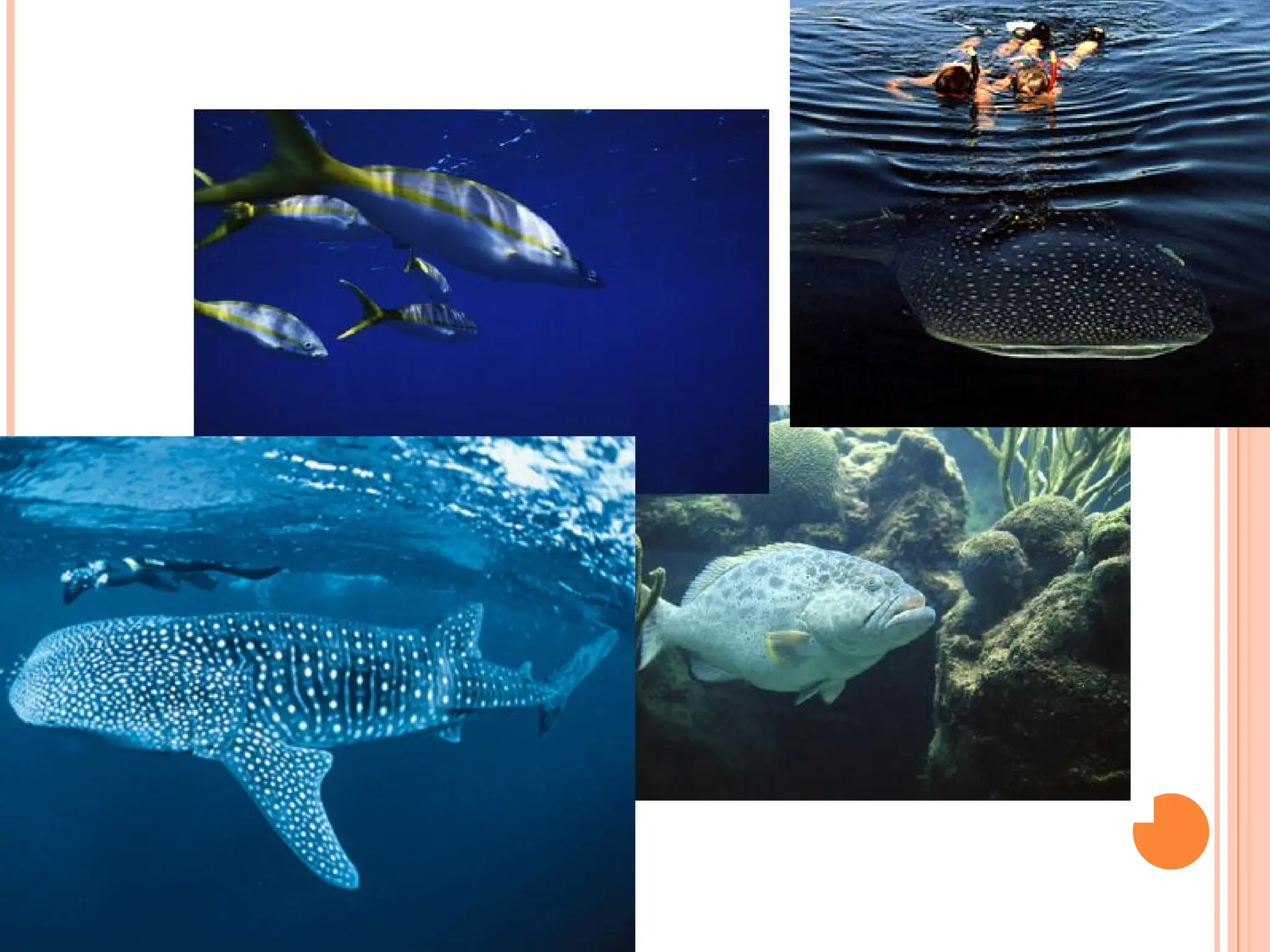
Ocean Ecosystem
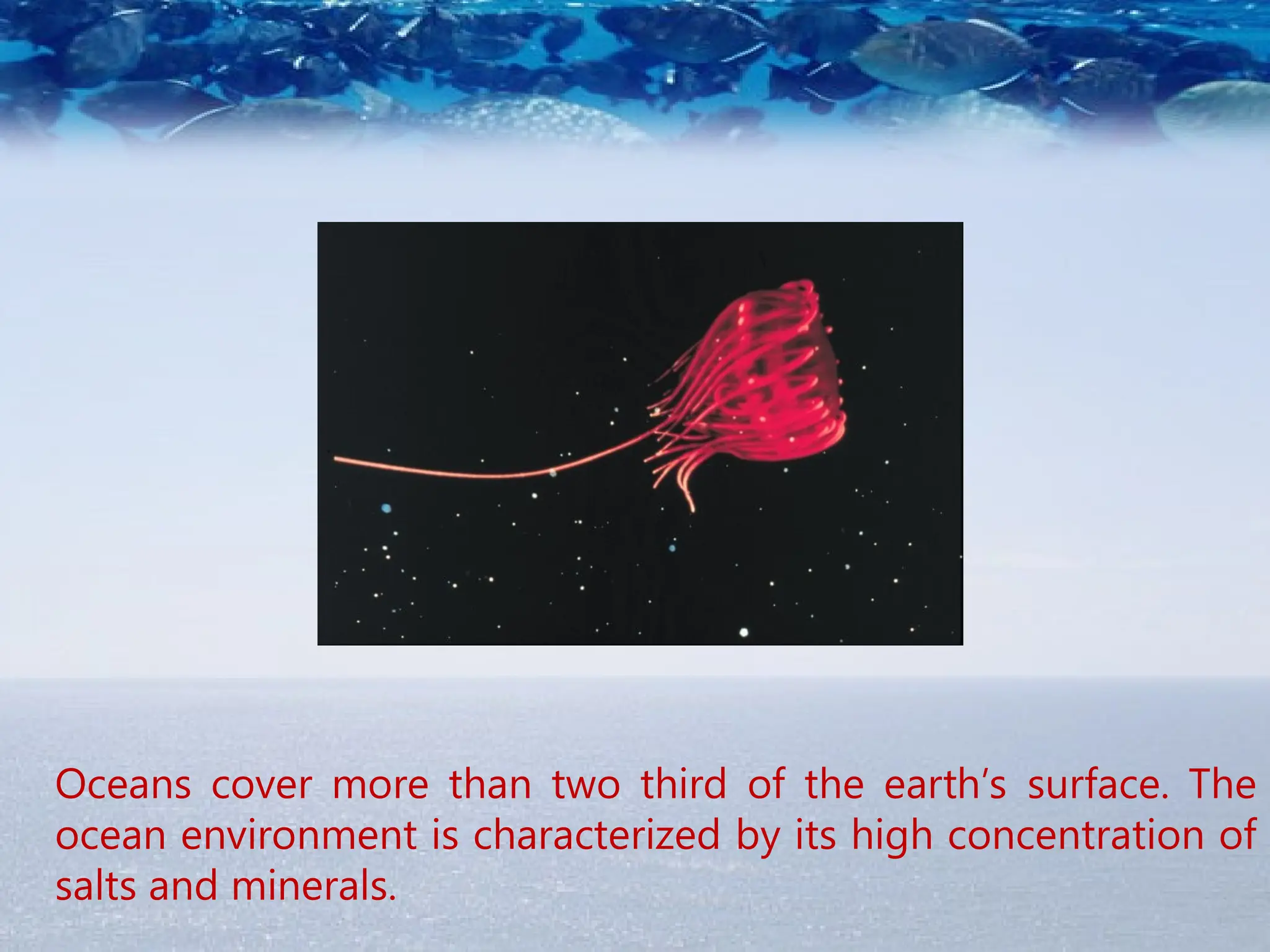
Oceans cover more than two third of the earth’s surface. The
ocean environment is characterized by its high concentration of
salts and minerals.
Characteristics of ocean ecosystem:
It occupies a large surface area with
saline water
It is rich in biodiversity
It moderates the temperature of the
earth
It is used for commercial like marine,
ship etc.
Ocean Ecosystem
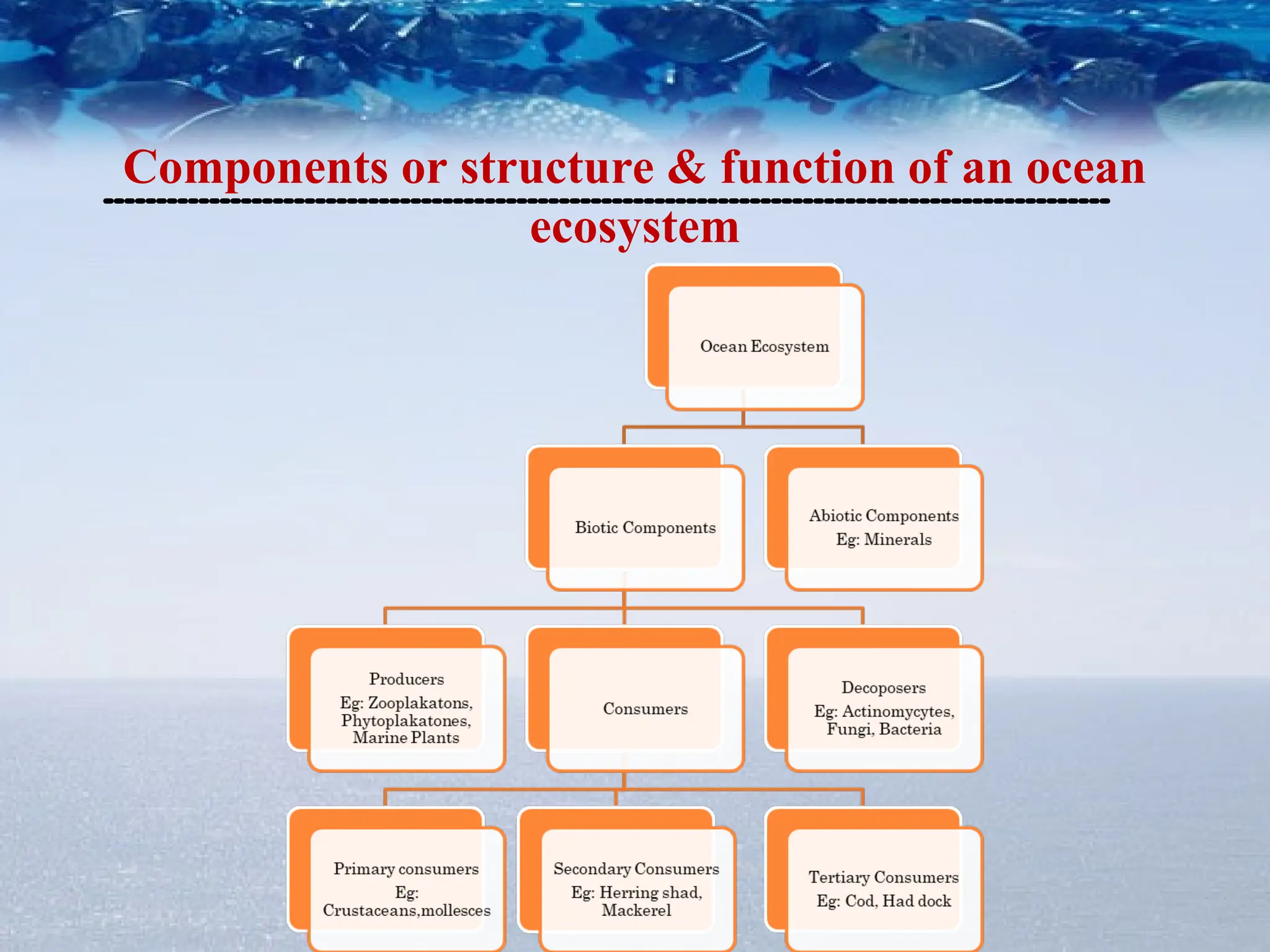
Components or structure & function of an ocean
ecosystem
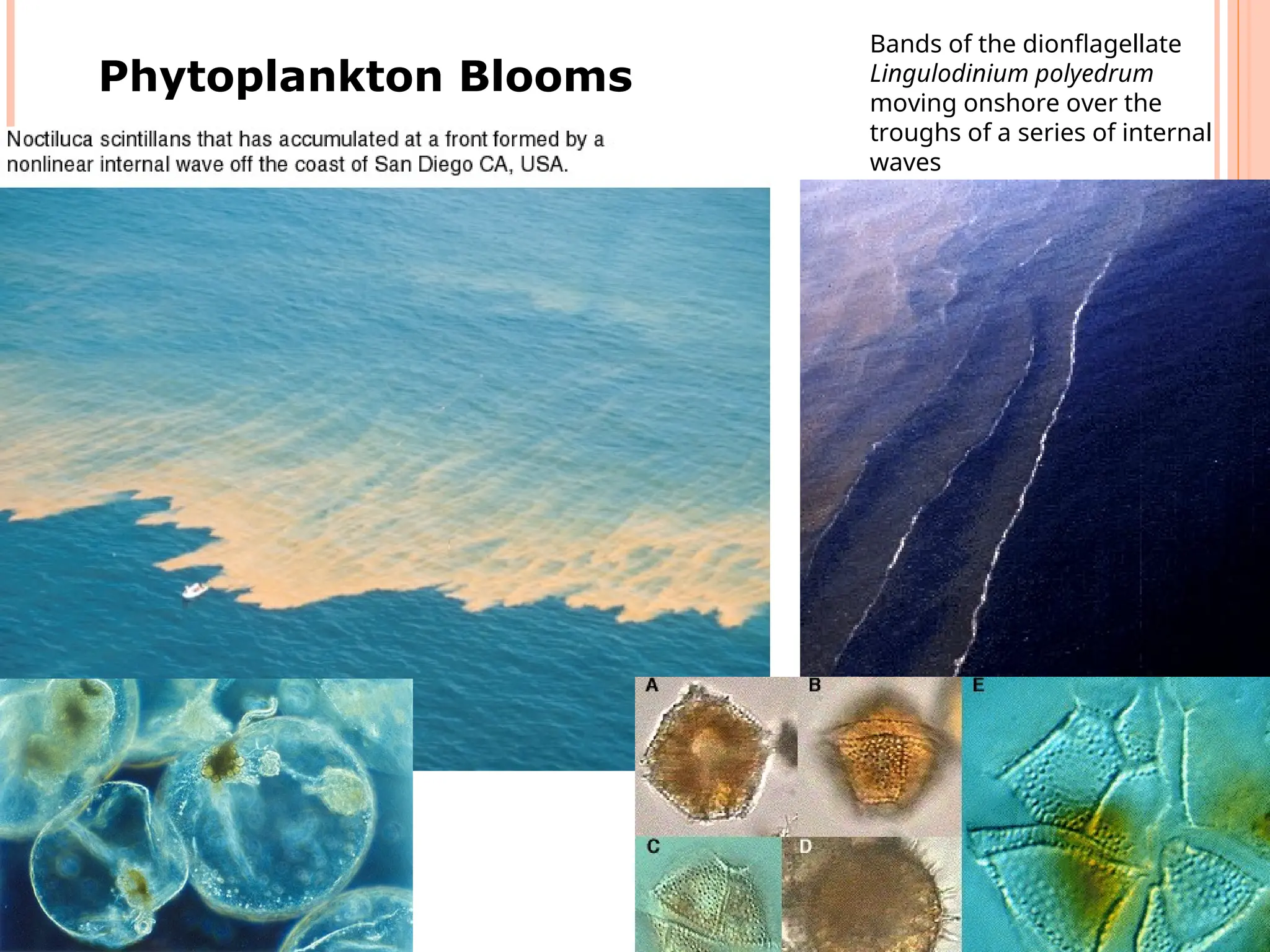
Phytoplankton Blooms
Bands of the dionflagellate
Lingulodinium polyedrum
moving onshore over the
troughs of a series of internal
waves
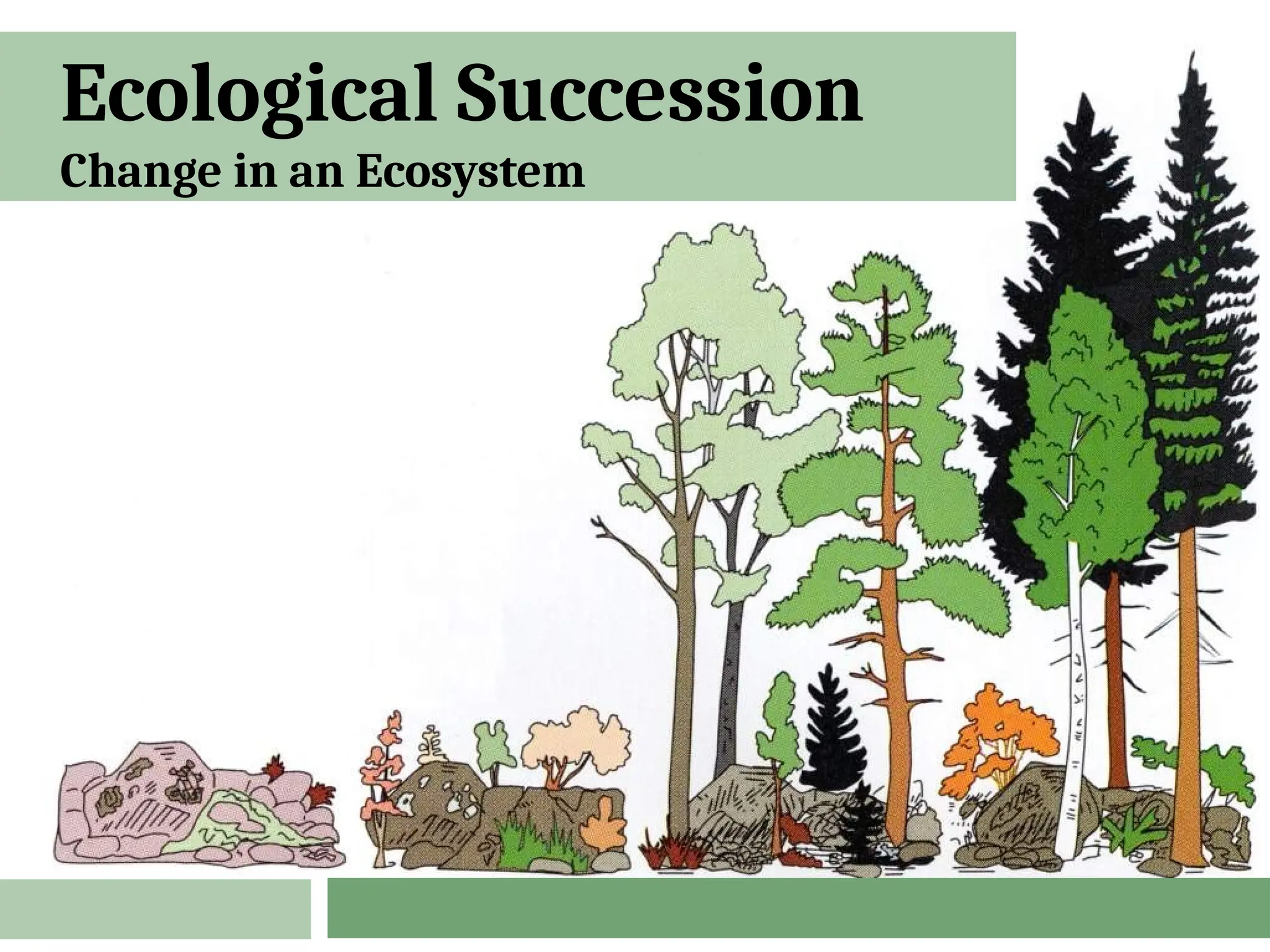
Ecological Succession
Change in an Ecosystem
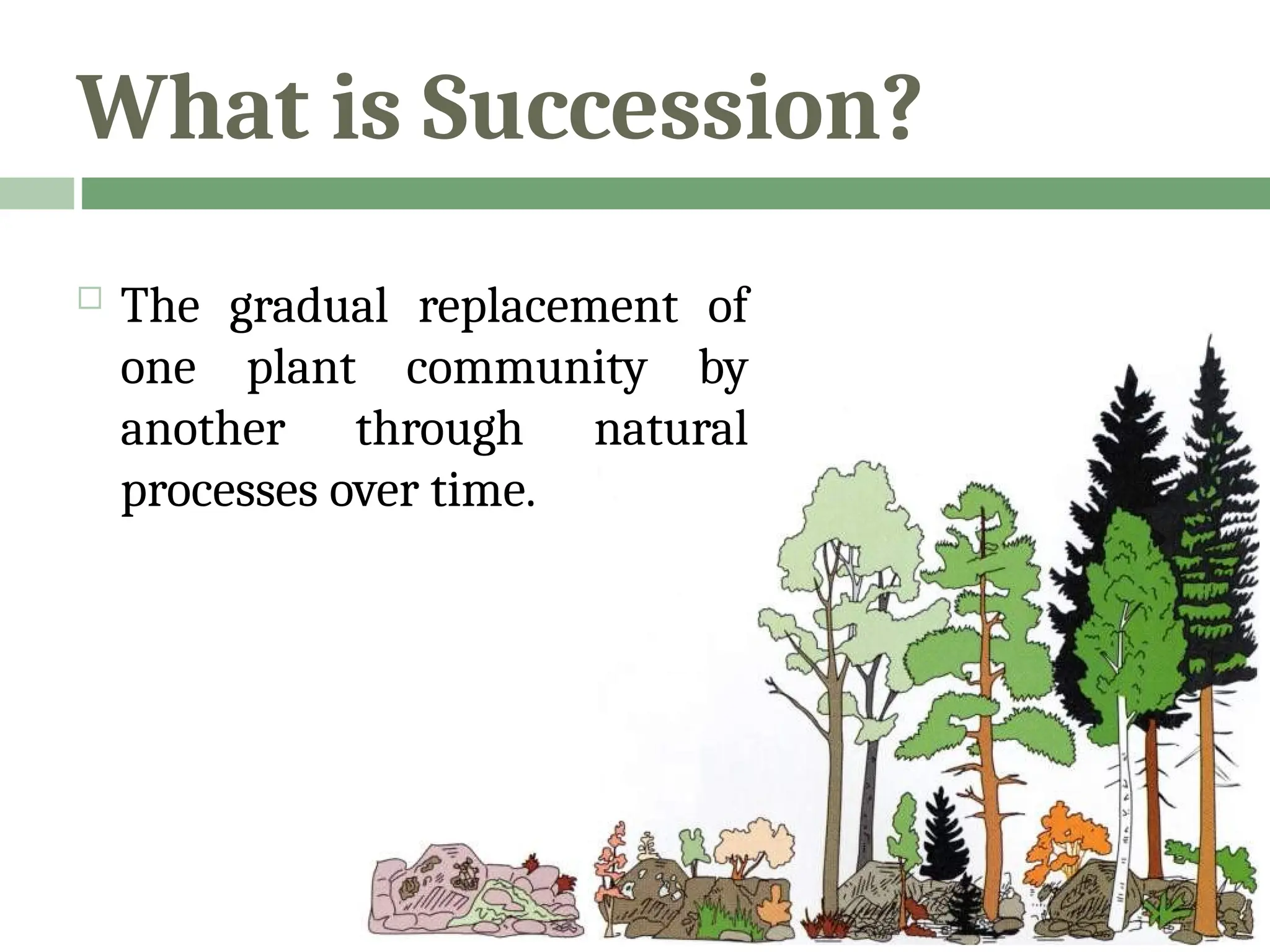
What is Succession?
 The gradual replacement of
one plant community by
another through natural
processes over time.
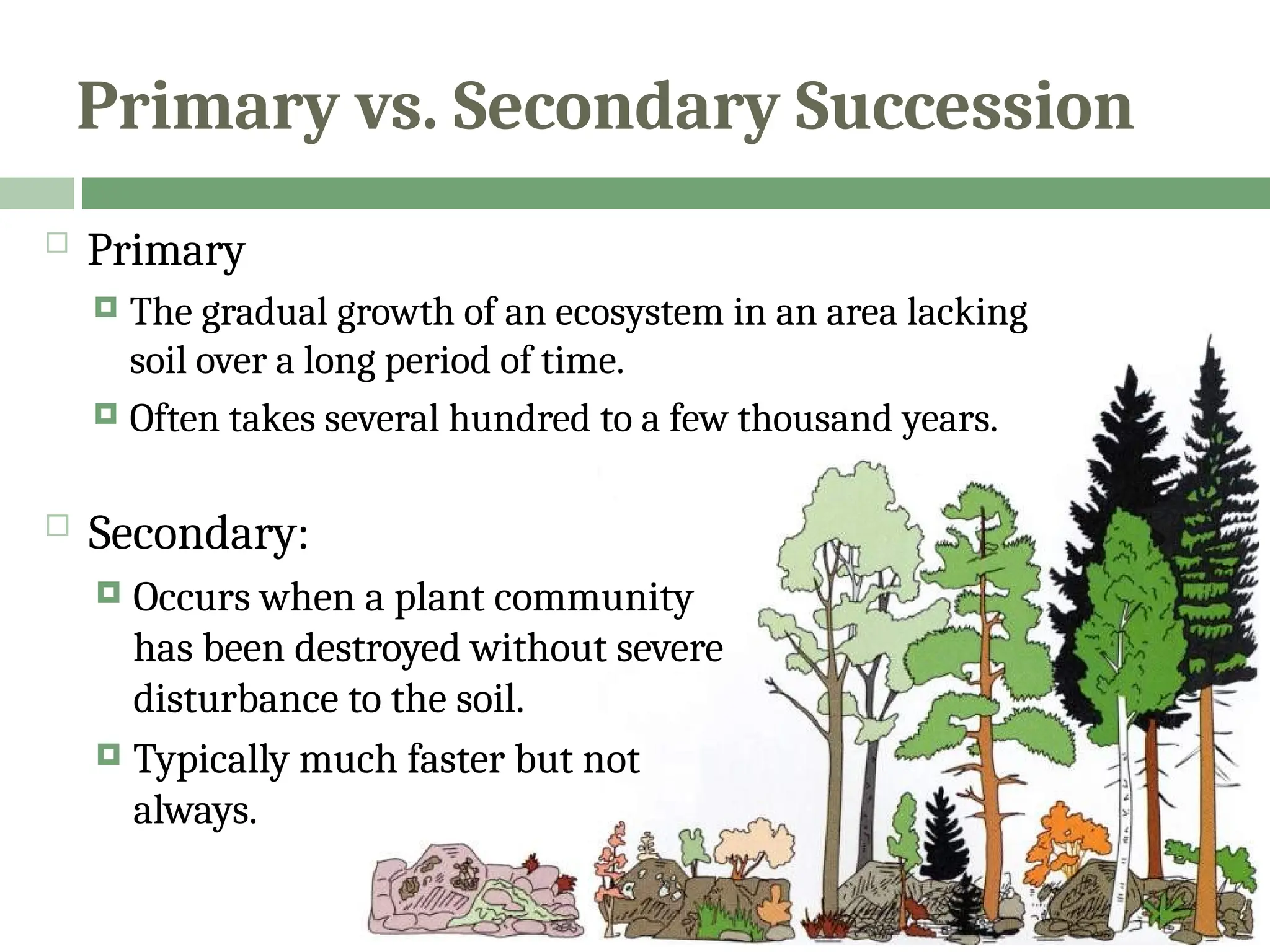
Primary vs. Secondary Succession
 Primary
 The gradual growth of an ecosystem in an area lacking
soil over a long period of time.
 Often takes several hundred to a few thousand years.
 Secondary:
 Occurs when a plant community
has been destroyed without severe
disturbance to the soil.
 Typically much faster but not
always.
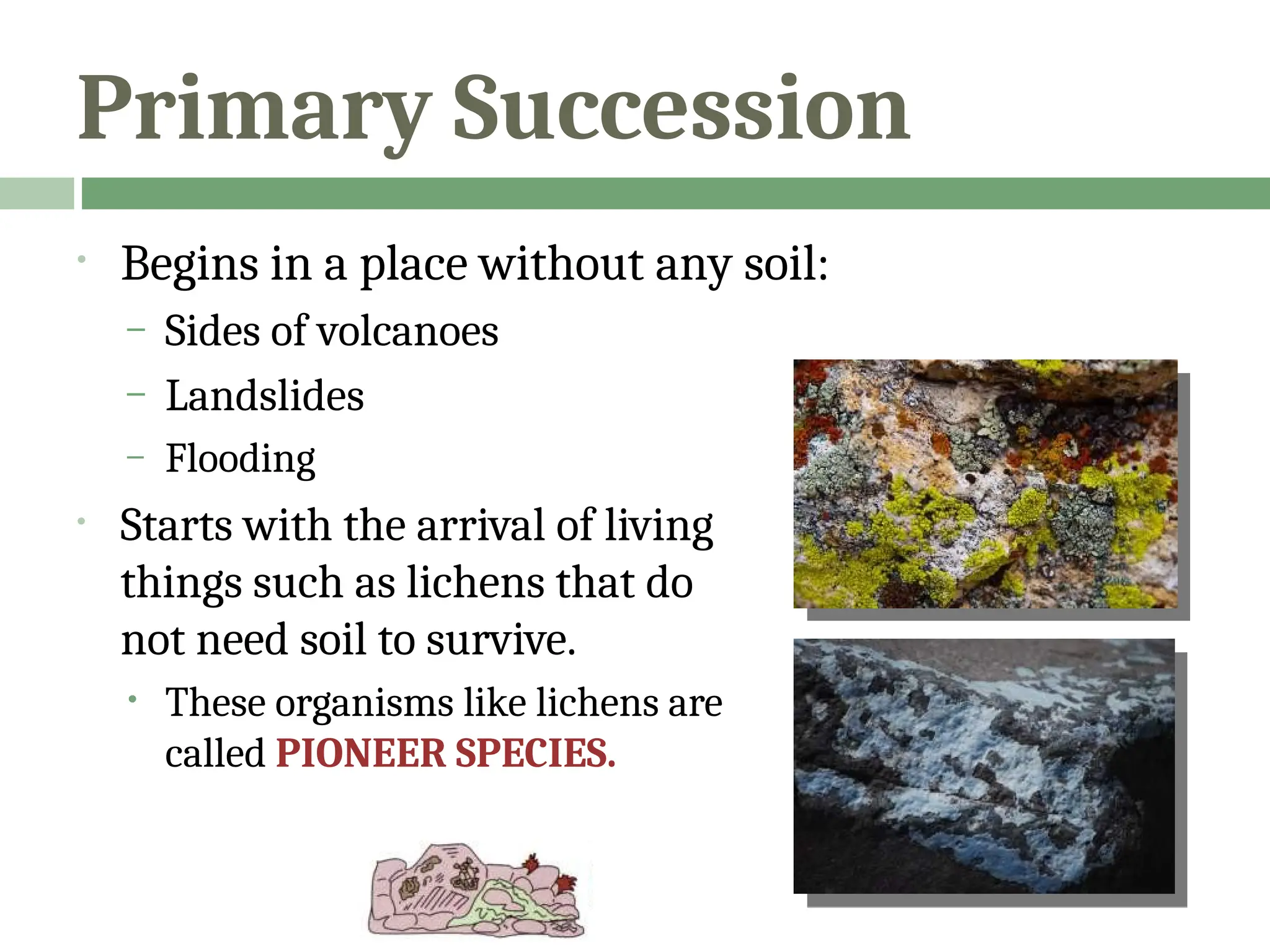
Primary Succession
• Begins in a place without any soil:
– Sides of volcanoes
– Landslides
– Flooding
• Starts with the arrival of living
things such as lichens that do
not need soil to survive.
• These organisms like lichens are
called PIONEER SPECIES.
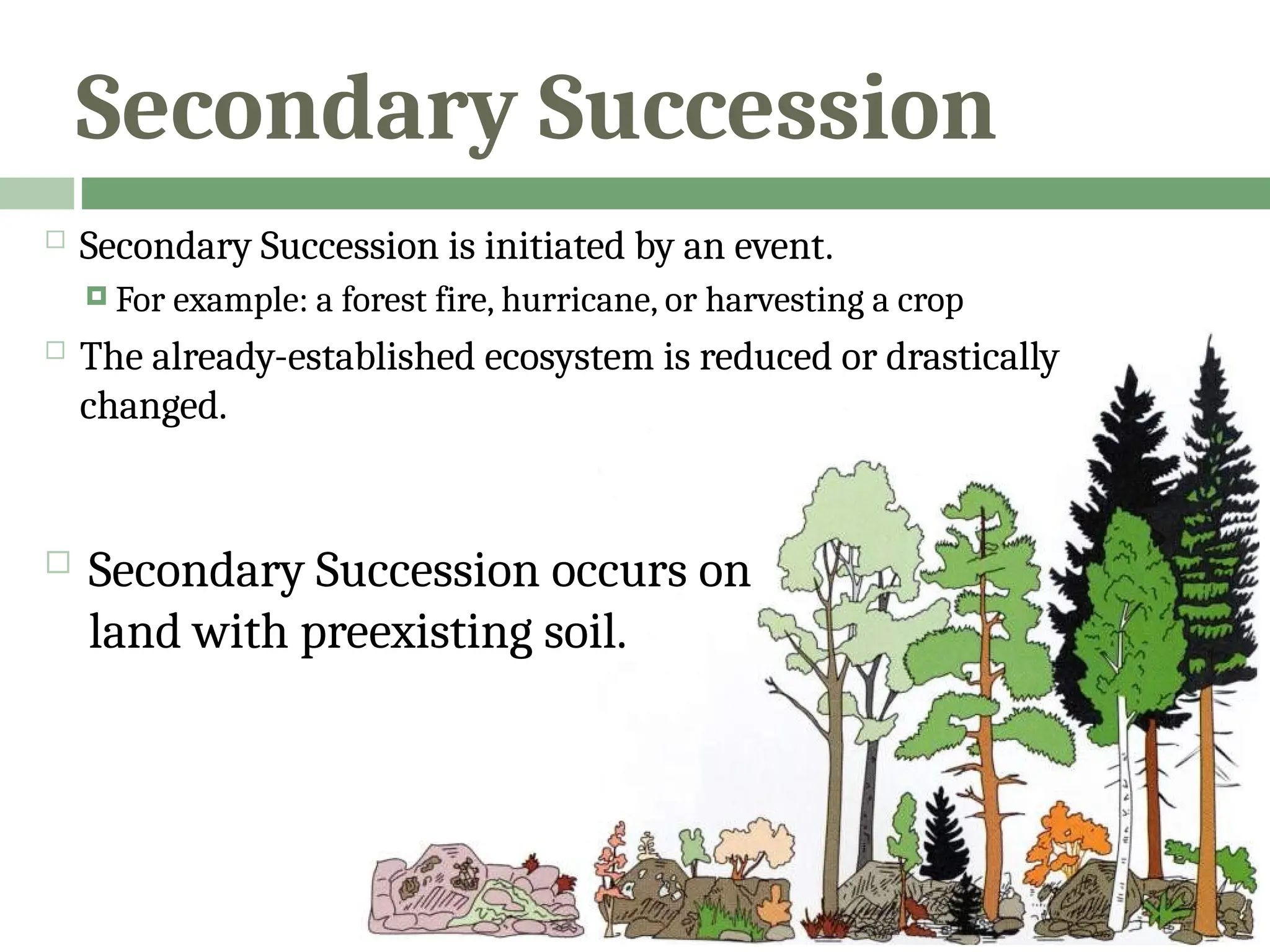
Secondary Succession
 Secondary Succession is initiated by an event.
 For example: a forest fire, hurricane, or harvesting a crop
 The already-established ecosystem is reduced or drastically
changed.
 Secondary Succession occurs on
land with preexisting soil.
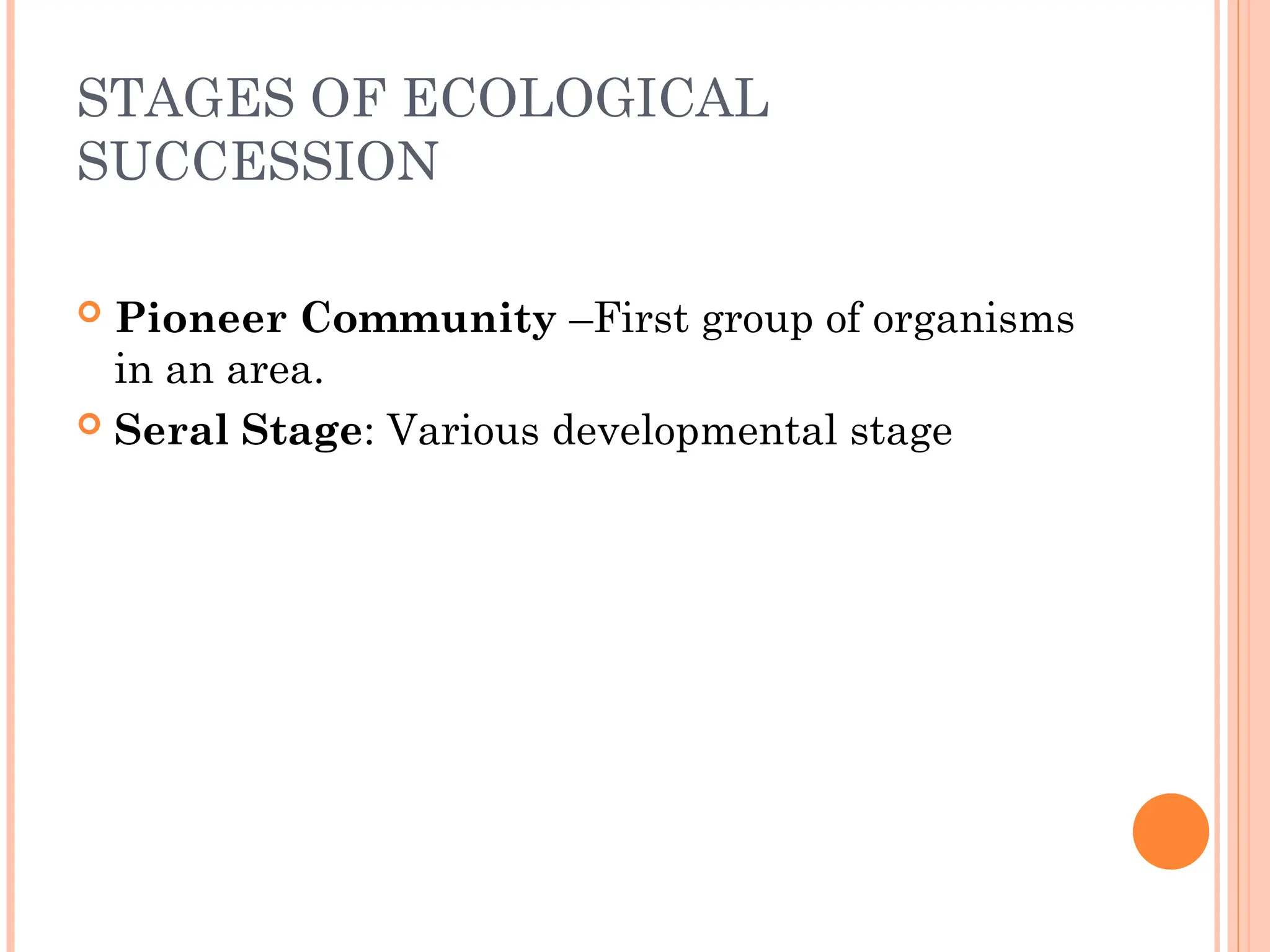
STAGES OF ECOLOGICAL
SUCCESSION
 Pioneer Community –First group of organisms
in an area.
 Seral Stage: Various developmental stage
Unit-2 Ecosystems and food chains, ecological pyramids

Unit-2 Ecosystems and food chains, ecological pyramids

  • 1.
  • 2.
    ECOLOGY:  Everything inthe natural world is connected.  Ecology: It deals with the study of organisms in their natural home interacting with their surroundings.
  • 3.
    ECOSYSTEM • The self-sustainingstructural and functional interaction between living and non-living components. • Ecosystem is the basic functional unit of ecology. • Ecosystem is derived from Greek, means “Study of home”. • Ecosystem has been defined as a system of organisms with surroundings.
  • 4.
    An ecosystem consistsof two main components Abiotic or Non-living components. 1. Climatic Factors 2. Physical Factors 3. Chemical factors Biotic or Living components. 1. Autotrophs or Producers 2. Heterotrophs or Consumers 3. Saprotrophs or Decomposers
  • 5.
    ABIOTIC FACTORS: 1. ClimaticFactors: Temperatures, Moisture, Wind etc., 2. Physical Factors: light, Fire, pressure etc., 3. Chemical Factors: inorganic substances (minerals), pH, Salinity and organic substances etc.,
  • 6.
    BIOTIC COMPONENTS Autotrophs  Autotrophs(=self-nourishing) are called as producers.  Photosynthesis—use light energy to convert carbon dioxide and water into oxygen and carbohydrates (= green plants, algae, some bacteria)  6CO2 + 6H2O 6O2 + C6H12O6 Autotrophs simple inorganic compounds complex organic compounds light
  • 7.
    Photosynthesis Chemosynthesis  chemosynthesis isthe biological conversion of one or more carbon molecules and nutrients into organic matter using the oxidation of inorganic molecules or methane as a source of energy, rather than sunlight, as in photosynthesis. chemoautotroph Reduced inorganic compounds complex organic compounds oxygen
  • 8.
     CONSUMERS mayalso be classified as follows depending upon their food habits:  i. Primary consumers(Herbivores)  ii. Secondary consumers(Primary carnivores)  iii. Tertiary consumers(Secondary carnivores) Herbivores: Animals that feed on plants. Ex. Cattle, elephant —obtain energy by eating only plants
  • 9.
     Primary Carnivores:Animals that feed on the Herbivores. —eat only animals
  • 10.
    Secondary Carnivores: Animalsthat feed on the Herbivores and primary carnivores. —eat only animals
  • 11.
    Omnivores—eat both plantsand animals Decomposers—breaks down dead organic matter
  • 12.
    The function ofan ecosystem is to allow flow of energy and cycling of nutrients 1. Primary Function: Manufacture of starch by photosynthesis with the help of minerals take from their edaphic environment. 2. Secondary Function: Distribution of energy in the form of food for all consumers. 3. Tertiary Function: When plants and animals die, then decomposers(like certain bacteria and fungi) act on their dead bodies and decompose them into simple materials like carbon dioxide, water and minerals which go back to air, water bodies and soil from where they were taken.
  • 14.
    Energy flow inan ecosystem:  Energy is the most essential requirement for all living organisms.  Solar energy is the main source of earth planet. Solar energy is transformed to chemical energy in photosynthesis by green plants.  Some amount of chemical energy is used by plants for their growth, remaining is utilized for all living organisms.  This is the first and most essential step to provide energy for all living organisms in an ecosystem. Thus, the energy enters in the ecosystem through photosynthesis and passes different feeding levels.
  • 15.
    Energy flow -Thermodynamics: The flow of energy through an ecosystem follows two laws of thermodynamics.
  • 16.
    ENERGY FLOW- LAWSOF THERMODYNAMICS FIRST LAW of THERMODYNAMICS:  Energy can be converted from one form to another, but cannot be created or destroyed.  Energy for an ecosystem comes from sun. It is absorbed by plants. Where it is converted into stored chemical energy, i.e. solar energy is converted into chemical energy.
  • 17.
    SECOND LAW ofTHERMODYNAMICS  It states that “whenever energy is transformed, that is a loss of energy through the release of heat”.  In energy exchanges in a closed system, the potential energy of the final state will be less than that of the initial state Examples  Internal combustion engines in cars are 25% efficient in converting chemical energy to kinetic energy; the rest is not used or is lost as heat.  There will be a loss of energy in the form of heat as it moves from one tropic level to another tropic level. The loss of energy takes through respiration, running, hunting e etc.
  • 18.
    ENERGY FLOW  Thispattern of energy flow among different organisms is the TROPHIC STRUCTURE of an ecosystem. heat Producers Consumers Decomposers heat
  • 19.
    Trophic Levels—each stepin a food chain or food web 1. Level 1—Producers (autotrophs) 2. Level 2—Primary Consumers (herbivores) 3. Level 3—Secondary Consumers (carnivores or omnivores) 4. Level 4—Tertiary Consumers (carnivore—usually top carnivore) 5. Level 5 — Decomposers
  • 20.
    Food Chain—“The sequenceof eating and being eaten in an ecosystem is known as food chain” Or “Transfer of food energy the through a series of organisms in different tropic levels is referred to as food chain”. Start with producer and end with top consumer or carnivores Ex: grass grasshopper frog raccoon
  • 22.
    Types of foodchain: 1.Grazing food chain: The food chain starts from plants goes through herbivores and ends with carnivores. This food chain depends on the autotrophs, which can capture the energy from solar radiation. 2.Detritus food chain: Detritus food chain starts from dead organic matters and ends with inorganic compounds. In this type of food chain, microorganisms are feed their food from animal and plants dead bodies. Microorganisms are also called as detritivores.
  • 23.
    In a forestecosystem: Grazing food chain Detritus food chain
  • 24.
    In a Grasslandecosystem: Grazing food chain Detritus food chain The above two food chains can not operate independently. They are interconnected at various levels. The grazing food chain gets energy from plants, while the detritus food chain gets energy from dead plants.
  • 25.
    Food Web: Theinterlocking pattern of various food chains in an ecosystem is known as food web. A food web is a network of food chains where different types of living organisms are connected at different tropic levels, so that there are a number of options of eating and being eaten at each tropic level. Hawks Weasels Raccoons Mice Grass
  • 26.
  • 27.
    The number, biomassand energy of the organisms gradually decrease from the producer level to the consumer level. This can be represented in the form of a pyramid called ecological pyramid. In the ecological pyramids, the producers form the base and the consumers occupy the apex. There are three types of ecological pyramids namely 1.Pyramid of Biomass 2.Pyramid of energy 3.pyramid of numbers
  • 28.
    PYRAMID OF BIOMASS: •The amount of biomass in each trophic level  In this particular type of ecological pyramid, each level takes into account the amount of biomass produced by each trophic level.  The pyramid of biomass is also upright except for that observed in oceans where large numbers of zooplanktons depend on a relatively smaller number of phytoplanktons.
  • 29.
  • 30.
    PYRAMID OF ENERGY: •Shows the energy available at each trophic level.  Pyramid of energy is the only type of ecological pyramid, which is always upright as the energy flow in a food chain is always unidirectional. Also, with every increasing trophic level, some energy is lost into the environment.
  • 31.
    PYRAMID OF NUMBERS: Inthis type of ecological pyramid, the number of organisms in each trophic level is considered as a level in the pyramid. The pyramid of numbers is usually upright except for some situations like that of the detritus food chain, where many organisms feed on one dead plant or animal.
  • 33.
    Natural ecosystem 1.Terrestrial ecosystem(grasslands, forests, desert ecosystems) 2.Aquatic ecosystem a. Lentic (Stagnant water) like lake, ponds etc. b. Lotic (Flowing water) like river, ocean, sea, etc. Artificial 1.A crop land, garden, aquarium, park, kitchen garden.
  • 34.
  • 35.
    FORESTS Deciduous forests Tropicalrainforests Coastalforests Coniferous forests A forest is an area in which the main plants that grow there are trees. A forest is a living community of various species of trees and smaller forms of vegetation. Forest ecosystem covers about 40% of land area of the earth.
  • 36.
    CHARACTERISTICS OF FOREST ECOSYSTEM Forests are characterized by warm temperature and adequate rainfall, which makes the generation of no. of ponds and lakes.  The forest maintains climate and rainfall  The forest supports many wild animals and protect biodiversity  Soil is rich in organic matter and nutrients, which supports the growth of trees  In the forest, the penetration of light is very poor; the conversion of organic matter into nutrients is very fast.
  • 38.
  • 39.
    GRASSLANDS  Grasslands are occupies20% of the earth surface. In addition to grass species, some trees and shrubs also present in the grassland. Limited grazing improves the grasslands and overgrazing degrades the lands resulting desertification.
  • 40.
    TYPES GRASSLANDS Depending uponthe climate conditions, grasslands can be classified into three types 1. Tropical grasslands 2. Temperate grasslands 3. Polar grasslands
  • 41.
    CHARACTERISTICS OF GRASSLANDS Grassland ecosystem is a plain land occupied by grasses  Soil is very rich in nutrients and organic matters.  Since it has tall grass, it is ideal place for grazing animals.  It is characterized by low or uneven rainfall.
  • 42.
    STRUCTURE & FUNCTIONOF THE GRASSLAND ECOSYSTEM
  • 43.
  • 44.
    DESERTS  Deserts occupy35% of world’s land area. It is characterized by less than 25cm rainfall. The atmosphere is dry, so it is a poor insulator.  Types of desert ecosystem: Based on the climatic conditions, deserts are classified into three types.  Tropical deserts  Temperate deserts  Cold deserts
  • 45.
    CHARACTERISTICS OF DESERT ECOSYSTEM The desert air is dry and the climate is hot  Vegetation is very less. Because the soil is very poor in nutrients and organic matter
  • 46.
    STRUCTURE AND FUNCTIONOF THE DESERT ECOSYSTEM
  • 47.
  • 48.
    The aquatic ecosystemdeals with water bodies. The aquatic ecosystems have numerous small and large species of plants and animals. Aquatic ecosystem can be classified into two types Fresh water bodies: Ponds, streams, lakes and rivers Marine water ecosystem: Oceans, estuaries
  • 49.
  • 50.
    Ponds Ecosystem Ponds Ecosystem Itis a small fresh water aquatic ecosystem, where water is stagnant. It receives water during rainy season. Characteristics of ponds: Pond is temporary, only seasonal Ponds get polluted easily due to limited amount of water
  • 51.
    Components or structure& function of ponds ecosystem
  • 52.
  • 53.
    Lake Ecosystem Lake Ecosystem Lakesare formed by water from rainfall, melting snow and streams. Characteristics of Lake Ecosystem: Lake is a shallow fresh water body It is permanent water body with large water resources It helps in irrigation and drinking
  • 54.
    STRUCTURE & FUNCTIONOF THE LAKE ECOSYSTEM
  • 55.
  • 56.
    RIVER/STREAM ECOSYSTEM The numberof animals is low in river or stream. Characteristics of river or stream:  It is a fresh water, and free flowing water system  Due to mixing of water, dissolved oxygen content is more  River deposits large amount of nutrients.
  • 57.
    COMPONENTS OR STRUCTURE& FUNCTION OF RIVER OR STREAM ECOSYSTEM
  • 58.
  • 59.
    Oceans cover morethan two third of the earth’s surface. The ocean environment is characterized by its high concentration of salts and minerals.
  • 60.
    Characteristics of oceanecosystem: It occupies a large surface area with saline water It is rich in biodiversity It moderates the temperature of the earth It is used for commercial like marine, ship etc. Ocean Ecosystem
  • 61.
    Components or structure& function of an ocean ecosystem
  • 63.
    Phytoplankton Blooms Bands ofthe dionflagellate Lingulodinium polyedrum moving onshore over the troughs of a series of internal waves
  • 65.
  • 66.
    What is Succession? The gradual replacement of one plant community by another through natural processes over time.
  • 67.
    Primary vs. SecondarySuccession  Primary  The gradual growth of an ecosystem in an area lacking soil over a long period of time.  Often takes several hundred to a few thousand years.  Secondary:  Occurs when a plant community has been destroyed without severe disturbance to the soil.  Typically much faster but not always.
  • 68.
    Primary Succession • Beginsin a place without any soil: – Sides of volcanoes – Landslides – Flooding • Starts with the arrival of living things such as lichens that do not need soil to survive. • These organisms like lichens are called PIONEER SPECIES.
  • 69.
    Secondary Succession  SecondarySuccession is initiated by an event.  For example: a forest fire, hurricane, or harvesting a crop  The already-established ecosystem is reduced or drastically changed.  Secondary Succession occurs on land with preexisting soil.
  • 70.
    STAGES OF ECOLOGICAL SUCCESSION Pioneer Community –First group of organisms in an area.  Seral Stage: Various developmental stage