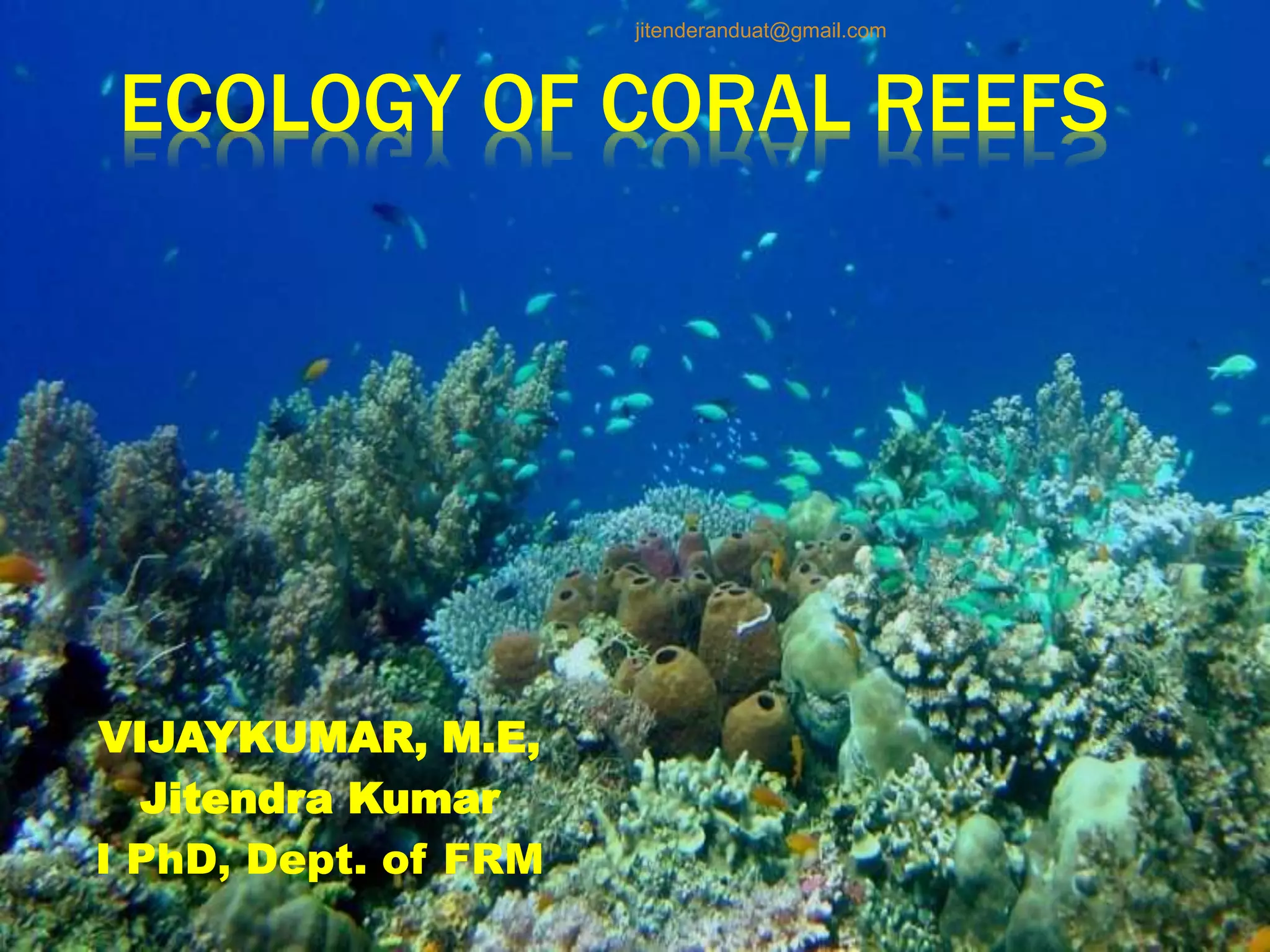
ECOLOGY OF CORAL REEFS
VIJAYKUMAR, M.E,
Jitendra Kumar
I PhD, Dept. of FRM
jitenderanduat@gmail.com
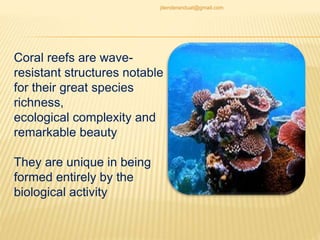
Coral reefs are wave-
resistant structures notable
for their great species
richness,
ecological complexity and
remarkable beauty
They are unique in being
formed entirely by the
biological activity
jitenderanduat@gmail.com
 Often called rain forests of the sea, due to
their richest biodiversity. They occupy less
than 0.1% of the world’s ocean surface, but
provide home for 25% of marine species
jitenderanduat@gmail.com
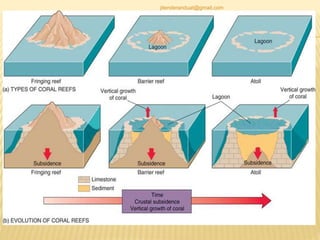
ORIGIN OF REEFS
 Subsidence theory – (Darwin-Dana)
 Solution theory – (Semper-Murray)
 Submerged bank theory
 Glacial epoch theory - Daly
jitenderanduat@gmail.com
It involves understanding biotic
and abiotic factors influencing the
distribution and abundance of
living things of coral community
jitenderanduat@gmail.com
DISTRIBUTION
 Corals occur throughout the oceans, but
colonial reef-building (hermatypic) corals are
confined to the tropics and sub-tropics where
calcification rates are greatly enhanced
 Reefs grow best in warm, marine, shallow,
clear, sunny and agitated waters
jitenderanduat@gmail.com
LIMITING FACTORS
 Latitude
 Temperature
 Light
 Salinity
 Turbidity & Sedimentation
 Wave action
 Aerial exposure
jitenderanduat@gmail.com
 Coral reefs, just like any other ecosystem on our
planet, rely on a variety of biotic and abiotic
factors to keep them healthy and functional.
 Without stable temperature, pH, light intensity,
water flow, salinity, and chemical composition of
sea water, coral reefs could not exist, but
without a stable trophic cascade, coral reefs
could not survive.
jitenderanduat@gmail.com
Biotic Factors
• Competitors
• Disease
• Predators
• Food availability
• Habitat availability
• Symbiotic relationships
Abiotic Factors
• pH
• Temperature
• Weather conditions
• Water availability
• Chemical composition of environment
• nitrates, phosphates, ammonia, O2, pollution
jitenderanduat@gmail.com
TYPES OF CORALS
 Hard corals, also known as scleractinian and
stony coral, produce a rigid skeleton made of
calcium carbonate (CaCO3) in crystal form
called aragonite. Anatomic structures such
as septa, tentacles, and mesenteries are
found in sets of six, so hard corals are also
often termed hexa corals.
jitenderanduat@gmail.com
 One of the characteristic feature of hermatypic
corals is the presence of unicellular algae
(Symbiodinium microadriaticum) with in the
gastrodermal tissue.
 By their influence on coral growth and
calcification rates these symbiotic zooxanthellae
play a fundamental role in the reef-building
process
jitenderanduat@gmail.com
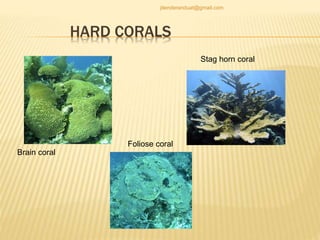
HARD CORALS
Brain coral
Stag horn coral
Foliose coral
jitenderanduat@gmail.com
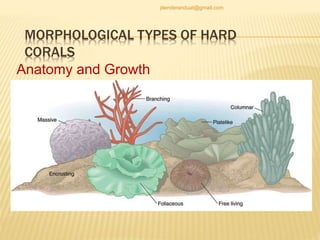
MORPHOLOGICAL TYPES OF HARD
CORALS
Anatomy and Growth
jitenderanduat@gmail.com
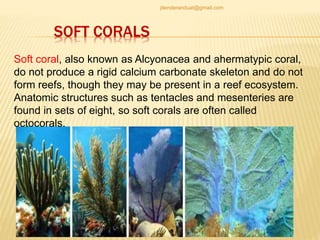
SOFT CORALS
Soft coral, also known as Alcyonacea and ahermatypic coral,
do not produce a rigid calcium carbonate skeleton and do not
form reefs, though they may be present in a reef ecosystem.
Anatomic structures such as tentacles and mesenteries are
found in sets of eight, so soft corals are often called
octocorals.
jitenderanduat@gmail.com
DIVERSITY OF CORAL REEFS
 Reefs are home to a large variety of organisms, including
fish, seabirds, sponges, cnidarians (which includes some types of
corals and jellyfish), worms, crustaceans (including shrimp, cleaner
shrimp, spinylobsters and crabs), mollusks (including
cephalopods), echinoderms (including starfish, sea
urchins and sea cucumbers), sea squirts, sea turtles and sea
snakes.
 Aside from humans, mammals are rare on coral reefs, with
visiting cetaceans such as dolphins being the main exception.
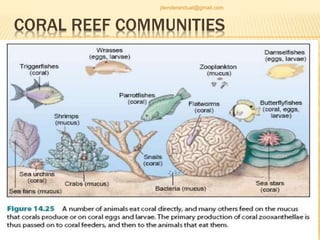
 A few of these varied species fed directly on corals, while others
graze on algae on the reef.
 Reef biomass is positively related to species diversity.
jitenderanduat@gmail.com
CORAL REEF COMMUNITIES
jitenderanduat@gmail.com
NUTRITION
 Corals have developed several unique ways
of feeding; they receive nutrients from
symbiotic algae, capture particles such as
plankton, and take up dissolved substances
from the water.
jitenderanduat@gmail.com
 In order to fully appreciate the importance of a
balanced ecosystem such as a coral reef, we
must first understand its trophic structure; the
organisms that make up each trophic level, and
the functions of each level in the maintenance
of a healthy reef.
jitenderanduat@gmail.com
TROPHIC STRUCTURE
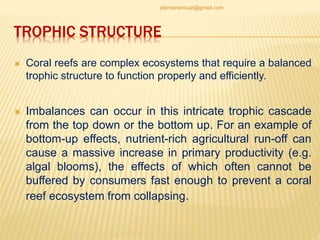
 Coral reefs are complex ecosystems that require a balanced
trophic structure to function properly and efficiently.
 Imbalances can occur in this intricate trophic cascade
from the top down or the bottom up. For an example of
bottom-up effects, nutrient-rich agricultural run-off can
cause a massive increase in primary productivity (e.g.
algal blooms), the effects of which often cannot be
buffered by consumers fast enough to prevent a coral
reef ecosystem from collapsing.
jitenderanduat@gmail.com
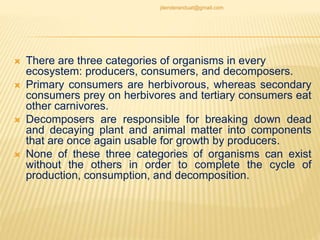
 There are three categories of organisms in every
ecosystem: producers, consumers, and decomposers.
 Primary consumers are herbivorous, whereas secondary
consumers prey on herbivores and tertiary consumers eat
other carnivores.
 Decomposers are responsible for breaking down dead
and decaying plant and animal matter into components
that are once again usable for growth by producers.
 None of these three categories of organisms can exist
without the others in order to complete the cycle of
production, consumption, and decomposition.
jitenderanduat@gmail.com
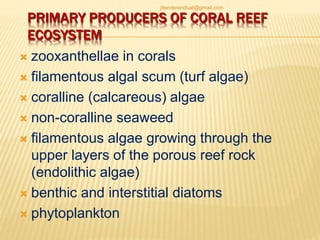
PRIMARY PRODUCERS OF CORAL REEF
ECOSYSTEM
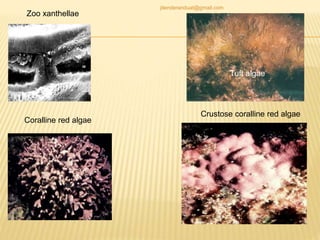
 zooxanthellae in corals
 filamentous algal scum (turf algae)
 coralline (calcareous) algae
 non-coralline seaweed
 filamentous algae growing through the
upper layers of the porous reef rock
(endolithic algae)
 benthic and interstitial diatoms
 phytoplankton
jitenderanduat@gmail.com
Tuft algae
Zoo xanthellae
Coralline red algae
Crustose coralline red algae
jitenderanduat@gmail.com
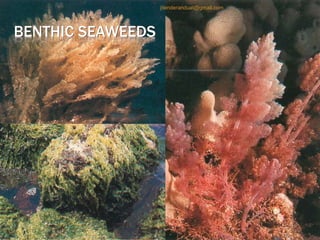
BENTHIC SEAWEEDS
jitenderanduat@gmail.com
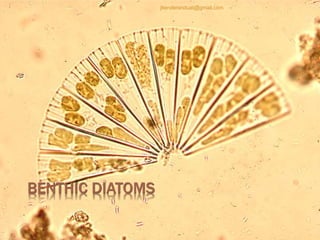
BENTHIC DIATOMS
jitenderanduat@gmail.com
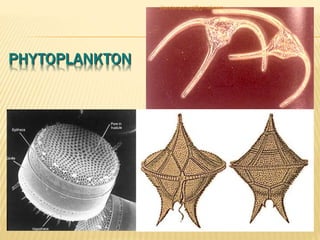
PHYTOPLANKTON
jitenderanduat@gmail.com
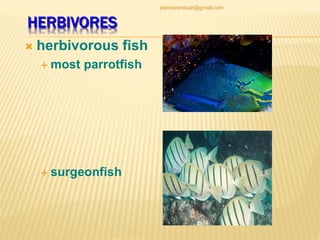
HERBIVORES
 herbivorous fish
 most parrotfish
 surgeonfish
jitenderanduat@gmail.com
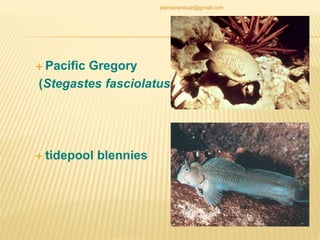
 Pacific Gregory
(Stegastes fasciolatus)
 tidepool blennies
jitenderanduat@gmail.com
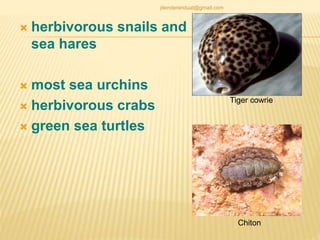
 herbivorous snails and
sea hares
 most sea urchins
 herbivorous crabs
 green sea turtles
Chiton
Tiger cowrie
jitenderanduat@gmail.com
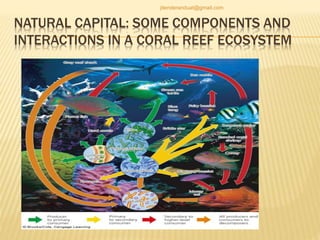
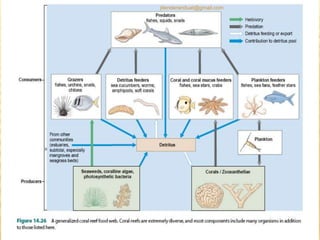
NATURAL CAPITAL: SOME COMPONENTS AND
INTERACTIONS IN A CORAL REEF ECOSYSTEM
jitenderanduat@gmail.com
 Consumers
 - primary consumers
 Phytoplankton and other single-celled primary
producers are eaten by primary consumers.
 Due to the large community of primary consumers on
coral reefs, phytoplankton levels in coral reef waters
can be 15-65% lower than in adjacent open ocean
waters.
 Benthic grazers and some coral species feed by
filtering phytoplankton out of the water while other
vertebrate and invertebrate grazers eat algae and
seaweed; many species of parrotfish, surgeonfish
and blennies have a diet that consists entirely of
coralline, filamentous, and calciferous algae.
jitenderanduat@gmail.com
 Secondary consumers
 The animals in this trophic level feed on primary
consumers and are consequently carnivorous.
Secondary consumers in a reef ecosystem can
be divided into four main groups: (1) zoo
plankton feeders, (2) corallivores - organisms
that feed on coral tissue, (3) feeders on other
benthic invertebrates, and (4) piscivores - fish
eaters.
 Plankton feeders can be small sessile
invertebrates like barnacles, corals like sun
polyps (Tubastrea sp.) and gorgonians, small
damselfish or 15-ton whale sharks.
jitenderanduat@gmail.com
 Corallivores can be sub-divided into polyp
eaters, coral scrapers, mucus feeders etc.
 Many species of butterfly fish, damselfish
specialize in eating coral polyps
 Some common coral scrapers are specific
species of triggerfish, parrotfish, blennies,
puffers, and butterfly fish.
 Some animals that feed on coral mucus are
coral guard crabs and shrimps
jitenderanduat@gmail.com
 Benthic invertebrates like mollusks,
gastropods, worms, and crustaceans are
eaten by many kinds of fish (e.g. goatfish,
wrasses, triggerfish, etc.) and other larger
invertebrates
 Piscivores are carnivores that eat fish; many
species of fish are piscivores as well as
some mollusks and arthropods.
jitenderanduat@gmail.com
 Tertiary (top) consumers
 Tertiary consumers are large reef fish at the
top of the food chain that eat many smaller
fish. Some examples of top consumers in a
coral reef ecosystem are sharks, barracudas,
and moray eels. Marine mammals such as
dolphins and seals, and sea birds, if present,
are considered tertiary consumers, too.
jitenderanduat@gmail.com
 Decomposers (and Detritivores)
 Decomposers serve an extremely important function in all
ecosystems; they break down dead biological matter and
waste products and convert them into usable energy
while returning important materials to the environment.
 The main decomposers in coral reefs are bacteria; these
bacteria play an integral part in the nitrogen cycle
whereby ammonia (NH4) is converted into nitrite (NO2)
by bacteria in the genus Nitrosomonas, after which nitrite
is then converted into nitrate (NO3) by bacteria in the
genus Nitrobacter.
 The ultimate result is that levels of toxic wastes are kept
very low and that waste products are converted into
components that are available to producers in a readily-
usable form.
jitenderanduat@gmail.com
 Coral reefs are complex ecosystems that
require a balanced trophic structure to function
properly and efficiently.
 Imbalances can occur in this intricate trophic
cascade from the top down or the bottom up.
For an example of bottom-up effects, nutrient-
rich agricultural run-off can cause a massive
increase in primary productivity (e.g. algal
blooms), the effects of which often cannot be
buffered by consumers fast enough to prevent a
coral reef ecosystem from collapsing.
jitenderanduat@gmail.com
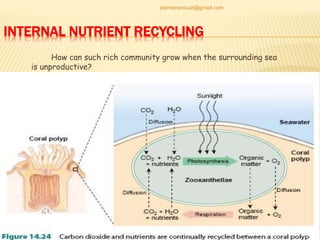
PRODUCTIVITY OF CORAL REEFS
 The symbiotic arrangement between the algae
and corals results in nutrients being tightly
recycled with in coral reefs. This internal
nutrient cycling is of primary importance in
maintaining the productivity of the reef
 The gross primary productivity ranges from
about 1500 to 5000 g.C/m2/year, values much
higher than those of open tropical Oceans
jitenderanduat@gmail.com
INTERNAL NUTRIENT RECYCLING
How can such rich community grow when the surrounding sea
is unproductive?
jitenderanduat@gmail.com
IMPORTANCE OF CORAL REEFS
Protection from coastal erosion
Very high diversity = ecological stability
Source of important natural chemicals being researched as
cures for cancer, arthritis, human infections, viruses, etc
Reef fisheries
Tourism
jitenderanduat@gmail.com
THREATS TO CORAL REEFS
 There are two types of threats to coral reefs,
anthropogenic and natural
 Destructive and non-sustainable fishery
practices
 Coral bleaching – socio economic impacts, reef
based tourism and fisheries
 Coral mining – construction, lime industry,
ornamental purposes
 Pollution – agriculture, coastal development
 Sedimentation - deforestation
jitenderanduat@gmail.com
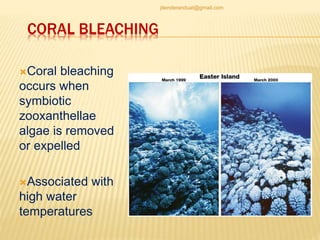
CORAL BLEACHING
Coral bleaching
occurs when
symbiotic
zooxanthellae
algae is removed
or expelled
Associated with
high water
temperatures
jitenderanduat@gmail.com
 Diseases – Black band, white band and red
band diseases were observed in corals
especially in shallow areas
 In addition to the direct human interferences,
global climate change poses serious threat –
increase in temperature, and a possible
increase in the incidence of storms
jitenderanduat@gmail.com
 Reefs are subjected to physical-erosion and bio-
erosion
 Physical erosion – intense wave action,
currents, tropical storms
 Bio erosion
 Removal of large no. of animals from reefs may
alter the ecology
 Sea urchins graze up on the coral frame work
( fish, molluscs are over fished)
jitenderanduat@gmail.com
 Crown of thorns star fish – Acanthaster
planci
( triton snail) Destruction of Great Barrier Reef
 Others
 As building material – Maldive islands
 For ornamental purposes
 Destructive fishing methods – dynamite,
sodium cyanide
 Anchoring – Reefs of Florida
jitenderanduat@gmail.com
 Walking over the reef during low tide
 Mangrove deforestation – Gulf of Kutch
jitenderanduat@gmail.com

Coral ecology ppt

  • 1.
    ECOLOGY OF CORALREEFS VIJAYKUMAR, M.E, Jitendra Kumar I PhD, Dept. of FRM jitenderanduat@gmail.com
  • 2.
    Coral reefs arewave- resistant structures notable for their great species richness, ecological complexity and remarkable beauty They are unique in being formed entirely by the biological activity jitenderanduat@gmail.com
  • 3.
     Often calledrain forests of the sea, due to their richest biodiversity. They occupy less than 0.1% of the world’s ocean surface, but provide home for 25% of marine species jitenderanduat@gmail.com
  • 4.
    ORIGIN OF REEFS Subsidence theory – (Darwin-Dana)  Solution theory – (Semper-Murray)  Submerged bank theory  Glacial epoch theory - Daly jitenderanduat@gmail.com
  • 5.
  • 6.
    It involves understandingbiotic and abiotic factors influencing the distribution and abundance of living things of coral community jitenderanduat@gmail.com
  • 7.
    DISTRIBUTION  Corals occurthroughout the oceans, but colonial reef-building (hermatypic) corals are confined to the tropics and sub-tropics where calcification rates are greatly enhanced  Reefs grow best in warm, marine, shallow, clear, sunny and agitated waters jitenderanduat@gmail.com
  • 8.
    LIMITING FACTORS  Latitude Temperature  Light  Salinity  Turbidity & Sedimentation  Wave action  Aerial exposure jitenderanduat@gmail.com
  • 9.
     Coral reefs,just like any other ecosystem on our planet, rely on a variety of biotic and abiotic factors to keep them healthy and functional.  Without stable temperature, pH, light intensity, water flow, salinity, and chemical composition of sea water, coral reefs could not exist, but without a stable trophic cascade, coral reefs could not survive. jitenderanduat@gmail.com
  • 10.
    Biotic Factors • Competitors •Disease • Predators • Food availability • Habitat availability • Symbiotic relationships Abiotic Factors • pH • Temperature • Weather conditions • Water availability • Chemical composition of environment • nitrates, phosphates, ammonia, O2, pollution jitenderanduat@gmail.com
  • 11.
    TYPES OF CORALS Hard corals, also known as scleractinian and stony coral, produce a rigid skeleton made of calcium carbonate (CaCO3) in crystal form called aragonite. Anatomic structures such as septa, tentacles, and mesenteries are found in sets of six, so hard corals are also often termed hexa corals. jitenderanduat@gmail.com
  • 12.
     One ofthe characteristic feature of hermatypic corals is the presence of unicellular algae (Symbiodinium microadriaticum) with in the gastrodermal tissue.  By their influence on coral growth and calcification rates these symbiotic zooxanthellae play a fundamental role in the reef-building process jitenderanduat@gmail.com
  • 13.
    HARD CORALS Brain coral Staghorn coral Foliose coral jitenderanduat@gmail.com
  • 14.
    MORPHOLOGICAL TYPES OFHARD CORALS Anatomy and Growth jitenderanduat@gmail.com
  • 15.
    SOFT CORALS Soft coral,also known as Alcyonacea and ahermatypic coral, do not produce a rigid calcium carbonate skeleton and do not form reefs, though they may be present in a reef ecosystem. Anatomic structures such as tentacles and mesenteries are found in sets of eight, so soft corals are often called octocorals. jitenderanduat@gmail.com
  • 16.
    DIVERSITY OF CORALREEFS  Reefs are home to a large variety of organisms, including fish, seabirds, sponges, cnidarians (which includes some types of corals and jellyfish), worms, crustaceans (including shrimp, cleaner shrimp, spinylobsters and crabs), mollusks (including cephalopods), echinoderms (including starfish, sea urchins and sea cucumbers), sea squirts, sea turtles and sea snakes.  Aside from humans, mammals are rare on coral reefs, with visiting cetaceans such as dolphins being the main exception.  A few of these varied species fed directly on corals, while others graze on algae on the reef.  Reef biomass is positively related to species diversity. jitenderanduat@gmail.com
  • 17.
  • 18.
    NUTRITION  Corals havedeveloped several unique ways of feeding; they receive nutrients from symbiotic algae, capture particles such as plankton, and take up dissolved substances from the water. jitenderanduat@gmail.com
  • 19.
     In orderto fully appreciate the importance of a balanced ecosystem such as a coral reef, we must first understand its trophic structure; the organisms that make up each trophic level, and the functions of each level in the maintenance of a healthy reef. jitenderanduat@gmail.com
  • 20.
    TROPHIC STRUCTURE  Coralreefs are complex ecosystems that require a balanced trophic structure to function properly and efficiently.  Imbalances can occur in this intricate trophic cascade from the top down or the bottom up. For an example of bottom-up effects, nutrient-rich agricultural run-off can cause a massive increase in primary productivity (e.g. algal blooms), the effects of which often cannot be buffered by consumers fast enough to prevent a coral reef ecosystem from collapsing. jitenderanduat@gmail.com
  • 21.
     There arethree categories of organisms in every ecosystem: producers, consumers, and decomposers.  Primary consumers are herbivorous, whereas secondary consumers prey on herbivores and tertiary consumers eat other carnivores.  Decomposers are responsible for breaking down dead and decaying plant and animal matter into components that are once again usable for growth by producers.  None of these three categories of organisms can exist without the others in order to complete the cycle of production, consumption, and decomposition. jitenderanduat@gmail.com
  • 22.
    PRIMARY PRODUCERS OFCORAL REEF ECOSYSTEM  zooxanthellae in corals  filamentous algal scum (turf algae)  coralline (calcareous) algae  non-coralline seaweed  filamentous algae growing through the upper layers of the porous reef rock (endolithic algae)  benthic and interstitial diatoms  phytoplankton jitenderanduat@gmail.com
  • 23.
    Tuft algae Zoo xanthellae Corallinered algae Crustose coralline red algae jitenderanduat@gmail.com
  • 24.
  • 25.
  • 26.
  • 27.
    HERBIVORES  herbivorous fish most parrotfish  surgeonfish jitenderanduat@gmail.com
  • 28.
     Pacific Gregory (Stegastesfasciolatus)  tidepool blennies jitenderanduat@gmail.com
  • 29.
     herbivorous snailsand sea hares  most sea urchins  herbivorous crabs  green sea turtles Chiton Tiger cowrie jitenderanduat@gmail.com
  • 30.
  • 31.
    NATURAL CAPITAL: SOMECOMPONENTS AND INTERACTIONS IN A CORAL REEF ECOSYSTEM jitenderanduat@gmail.com
  • 32.
     Consumers  -primary consumers  Phytoplankton and other single-celled primary producers are eaten by primary consumers.  Due to the large community of primary consumers on coral reefs, phytoplankton levels in coral reef waters can be 15-65% lower than in adjacent open ocean waters.  Benthic grazers and some coral species feed by filtering phytoplankton out of the water while other vertebrate and invertebrate grazers eat algae and seaweed; many species of parrotfish, surgeonfish and blennies have a diet that consists entirely of coralline, filamentous, and calciferous algae. jitenderanduat@gmail.com
  • 33.
     Secondary consumers The animals in this trophic level feed on primary consumers and are consequently carnivorous. Secondary consumers in a reef ecosystem can be divided into four main groups: (1) zoo plankton feeders, (2) corallivores - organisms that feed on coral tissue, (3) feeders on other benthic invertebrates, and (4) piscivores - fish eaters.  Plankton feeders can be small sessile invertebrates like barnacles, corals like sun polyps (Tubastrea sp.) and gorgonians, small damselfish or 15-ton whale sharks. jitenderanduat@gmail.com
  • 34.
     Corallivores canbe sub-divided into polyp eaters, coral scrapers, mucus feeders etc.  Many species of butterfly fish, damselfish specialize in eating coral polyps  Some common coral scrapers are specific species of triggerfish, parrotfish, blennies, puffers, and butterfly fish.  Some animals that feed on coral mucus are coral guard crabs and shrimps jitenderanduat@gmail.com
  • 35.
     Benthic invertebrateslike mollusks, gastropods, worms, and crustaceans are eaten by many kinds of fish (e.g. goatfish, wrasses, triggerfish, etc.) and other larger invertebrates  Piscivores are carnivores that eat fish; many species of fish are piscivores as well as some mollusks and arthropods. jitenderanduat@gmail.com
  • 36.
     Tertiary (top)consumers  Tertiary consumers are large reef fish at the top of the food chain that eat many smaller fish. Some examples of top consumers in a coral reef ecosystem are sharks, barracudas, and moray eels. Marine mammals such as dolphins and seals, and sea birds, if present, are considered tertiary consumers, too. jitenderanduat@gmail.com
  • 37.
     Decomposers (andDetritivores)  Decomposers serve an extremely important function in all ecosystems; they break down dead biological matter and waste products and convert them into usable energy while returning important materials to the environment.  The main decomposers in coral reefs are bacteria; these bacteria play an integral part in the nitrogen cycle whereby ammonia (NH4) is converted into nitrite (NO2) by bacteria in the genus Nitrosomonas, after which nitrite is then converted into nitrate (NO3) by bacteria in the genus Nitrobacter.  The ultimate result is that levels of toxic wastes are kept very low and that waste products are converted into components that are available to producers in a readily- usable form. jitenderanduat@gmail.com
  • 38.
     Coral reefsare complex ecosystems that require a balanced trophic structure to function properly and efficiently.  Imbalances can occur in this intricate trophic cascade from the top down or the bottom up. For an example of bottom-up effects, nutrient- rich agricultural run-off can cause a massive increase in primary productivity (e.g. algal blooms), the effects of which often cannot be buffered by consumers fast enough to prevent a coral reef ecosystem from collapsing. jitenderanduat@gmail.com
  • 39.
  • 40.
    PRODUCTIVITY OF CORALREEFS  The symbiotic arrangement between the algae and corals results in nutrients being tightly recycled with in coral reefs. This internal nutrient cycling is of primary importance in maintaining the productivity of the reef  The gross primary productivity ranges from about 1500 to 5000 g.C/m2/year, values much higher than those of open tropical Oceans jitenderanduat@gmail.com
  • 41.
    INTERNAL NUTRIENT RECYCLING Howcan such rich community grow when the surrounding sea is unproductive? jitenderanduat@gmail.com
  • 42.
    IMPORTANCE OF CORALREEFS Protection from coastal erosion Very high diversity = ecological stability Source of important natural chemicals being researched as cures for cancer, arthritis, human infections, viruses, etc Reef fisheries Tourism jitenderanduat@gmail.com
  • 43.
    THREATS TO CORALREEFS  There are two types of threats to coral reefs, anthropogenic and natural  Destructive and non-sustainable fishery practices  Coral bleaching – socio economic impacts, reef based tourism and fisheries  Coral mining – construction, lime industry, ornamental purposes  Pollution – agriculture, coastal development  Sedimentation - deforestation jitenderanduat@gmail.com
  • 44.
    CORAL BLEACHING Coral bleaching occurswhen symbiotic zooxanthellae algae is removed or expelled Associated with high water temperatures jitenderanduat@gmail.com
  • 45.
     Diseases –Black band, white band and red band diseases were observed in corals especially in shallow areas  In addition to the direct human interferences, global climate change poses serious threat – increase in temperature, and a possible increase in the incidence of storms jitenderanduat@gmail.com
  • 46.
     Reefs aresubjected to physical-erosion and bio- erosion  Physical erosion – intense wave action, currents, tropical storms  Bio erosion  Removal of large no. of animals from reefs may alter the ecology  Sea urchins graze up on the coral frame work ( fish, molluscs are over fished) jitenderanduat@gmail.com
  • 47.
     Crown ofthorns star fish – Acanthaster planci ( triton snail) Destruction of Great Barrier Reef  Others  As building material – Maldive islands  For ornamental purposes  Destructive fishing methods – dynamite, sodium cyanide  Anchoring – Reefs of Florida jitenderanduat@gmail.com
  • 48.
     Walking overthe reef during low tide  Mangrove deforestation – Gulf of Kutch jitenderanduat@gmail.com
  • 49.