SPECIAL - PURPOSE DIODES
Presenting By: Submitted To:
Adnan Qayum Lecturer Engr. Iqbal Munir
13SWTBTECE156 Govt. College of Technology
B.Tech Electrical, Ist year Swat.
adnanqayum2005@gmail.com
It includes the followings:
Schottky diode
Pin diode
Tunnel diode
Step recovery diode/snap diode
Laser diode
Impatt diode
Gunn diode
Constant-current diodes
 Zener diodes
 Vericap / Varactor diodes/variable capacitance diode
 Optical diodes (i) light emitting diode (LED) (ii) photo
diode
 Other types of diodes
Zener Diodes
• A Zener diode is a type of diode that
permits current not only in the forward
direction like a normal diode, but also in the
reverse direction if the voltage is larger than
the breakdown voltage known as "Zener knee
voltage" or "Zener voltage". The device was
named after Clarence Zener, who discovered
this electrical property.
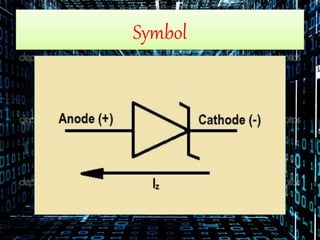
Symbol
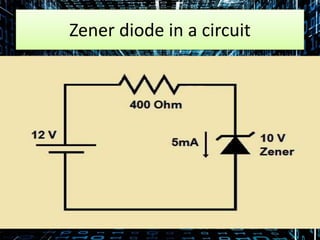
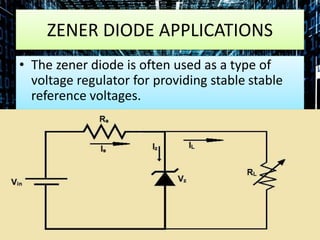
Zener diode in a circuit
ZENER DIODE APPLICATIONS
• The zener diode is often used as a type of
voltage regulator for providing stable stable
reference voltages.
Varactor Diodes
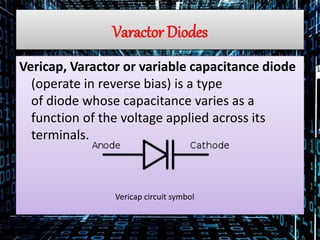
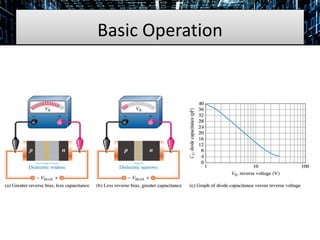
Vericap, Varactor or variable capacitance diode
(operate in reverse bias) is a type
of diode whose capacitance varies as a
function of the voltage applied across its
terminals.
Vericap circuit symbol
Basic Operation
An Application
A major application of varactors is in tuning circuits. For example, electronic tuners in
TV and other commercial receivers utilize varactors. When use in a resonant circuit,
the varactor act as variable capacitor, thus allowing the resonant frequency to be
adjusted by a variable voltage level, where the varactor diode provides the total
variable capacitance in the parallel resonant band-pass filter
Optical Diodes
Two types
i) Light Emitting Diode (LED)
ii) Photo Diode
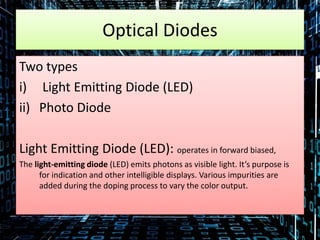
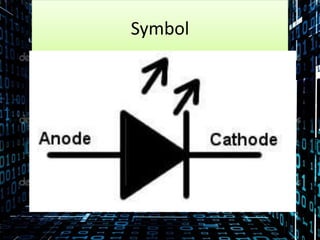
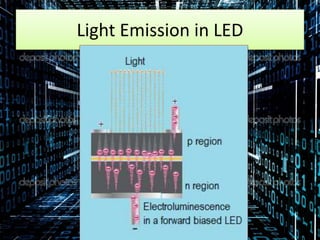
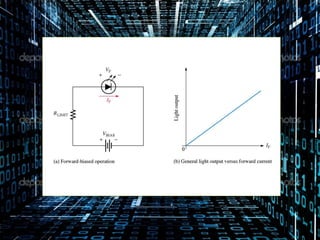
Light Emitting Diode (LED): operates in forward biased,
The light-emitting diode (LED) emits photons as visible light. It’s purpose is
for indication and other intelligible displays. Various impurities are
added during the doping process to vary the color output.
Symbol
Light Emission in LED
Applications
• Visual signals where light goes more or less directly from the
source to the human eye, to convey a message or meaning.
• Illumination where light is reflected from objects to give visual
response of these objects.
• Measuring and interacting with processes involving no human
vision.
• Narrow band light sensors where LEDs operate in a reverse-
bias mode and respond to incident light, instead of emitting
light
The Photodiode
A photodiode is a semiconductor device that
converts light into current. The current is generated
when photons are absorbed in the photodiode. A
small amount of current is also produced when no
light is present. Photodiodes may contain optical
filters, built-in lenses, and may have large or small
surface areas. Photodiodes usually have a slower
response time as its surface area increases. The
common, traditional solar cell used to generate
electric solar power is a large area photodiode. A
photodiode is designed to operate in reverse bias.
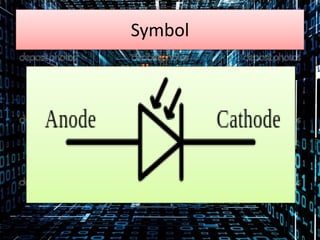
Symbol
Principle of operation
A photodiode is a p-n junction structure. When a photon of
sufficient energy strikes the diode, it creates an
electron, hole pair. This mechanism is also known as the
inner photoelectric effect. If the absorption occurs in the
junction's depletion region, or one diffusion length away
from it, these carriers are swept from the junction by the
built-in electric field of the depletion region. Thus holes
move toward the anode, and electrons toward the cathode,
and a photocurrent is produced. The total current through
the photodiode is the sum of the dark current (current that
is generated in the absence of light) and the photocurrent,
so the dark current must be minimized to maximize the
sensitivity of the device
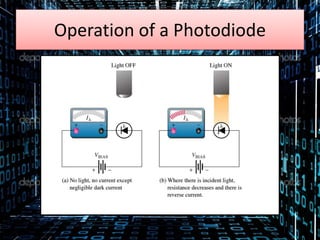
Operation of a Photodiode
Other types of Diodes
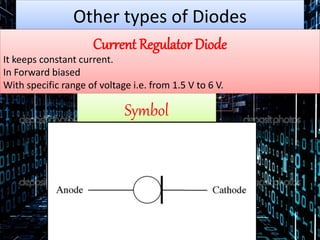
Current Regulator Diode
It keeps constant current.
In Forward biased
With specific range of voltage i.e. from 1.5 V to 6 V.
Symbol
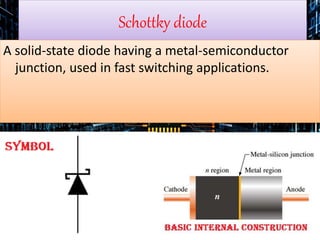
Schottky diode
A solid-state diode having a metal-semiconductor
junction, used in fast switching applications.
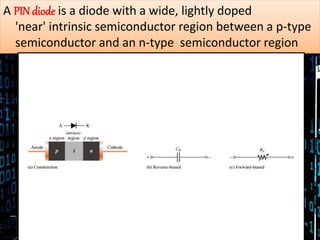
A PIN diode is a diode with a wide, lightly doped
'near' intrinsic semiconductor region between a p-type
semiconductor and an n-type semiconductor region
Step recoverydiode (SRD) is a semiconductor junction diode having the ability to
generate extremely short pulses.
• The step recovery diode or SRD is able to be
used as a microwave radio frequency
generator and pulse sharpener. Although used
in more specialist applications, the SRD is
nevertheless a very useful component that is
capable of some very high levels of
performance. As such it is a very useful tool in
the armoury of the RF design engineer to be
used when the occasion requires.
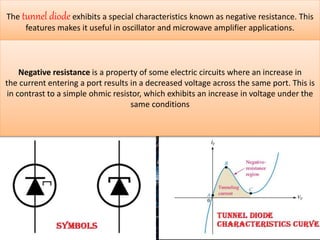
The tunnel diode exhibits a special characteristics known as negative resistance. This
features makes it useful in oscillator and microwave amplifier applications.
Negative resistance is a property of some electric circuits where an increase in
the current entering a port results in a decreased voltage across the same port. This is
in contrast to a simple ohmic resistor, which exhibits an increase in voltage under the
same conditions
The Laser Diode
• A laser diode is electrically a P-i-n diode. The active region of the laser
diode is in the intrinsic (I) region, and the carriers, electrons and holes, are
pumped into it from the N and P regions respectively
• laser diode, or LD, is an electrically pumped semiconductor laser in which
the active medium is formed by a p-n junction of a semiconductor
diode similar to that found in a light-emitting diode.
• The laser diode is the most common type of laser produced. Laser diodes
have a very wide range of uses that include, but are not limited to, fiber
optic communications, barcode readers, laser pointers, CD/DVD/Blu-ray
reading and recording, laser printing, scanning and increasingly directional
lighting sources.
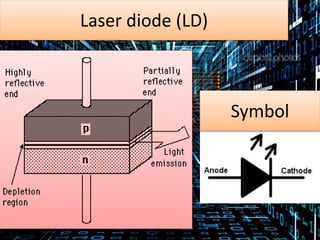
Laser diode (LD)
Symbol
x

Special purpose diodes

  • 1.
    SPECIAL - PURPOSEDIODES Presenting By: Submitted To: Adnan Qayum Lecturer Engr. Iqbal Munir 13SWTBTECE156 Govt. College of Technology B.Tech Electrical, Ist year Swat. adnanqayum2005@gmail.com
  • 2.
    It includes thefollowings: Schottky diode Pin diode Tunnel diode Step recovery diode/snap diode Laser diode Impatt diode Gunn diode Constant-current diodes  Zener diodes  Vericap / Varactor diodes/variable capacitance diode  Optical diodes (i) light emitting diode (LED) (ii) photo diode  Other types of diodes
  • 3.
    Zener Diodes • AZener diode is a type of diode that permits current not only in the forward direction like a normal diode, but also in the reverse direction if the voltage is larger than the breakdown voltage known as "Zener knee voltage" or "Zener voltage". The device was named after Clarence Zener, who discovered this electrical property.
  • 4.
  • 5.
    Zener diode ina circuit
  • 6.
    ZENER DIODE APPLICATIONS •The zener diode is often used as a type of voltage regulator for providing stable stable reference voltages.
  • 7.
    Varactor Diodes Vericap, Varactoror variable capacitance diode (operate in reverse bias) is a type of diode whose capacitance varies as a function of the voltage applied across its terminals. Vericap circuit symbol
  • 8.
  • 9.
    An Application A majorapplication of varactors is in tuning circuits. For example, electronic tuners in TV and other commercial receivers utilize varactors. When use in a resonant circuit, the varactor act as variable capacitor, thus allowing the resonant frequency to be adjusted by a variable voltage level, where the varactor diode provides the total variable capacitance in the parallel resonant band-pass filter
  • 10.
    Optical Diodes Two types i)Light Emitting Diode (LED) ii) Photo Diode Light Emitting Diode (LED): operates in forward biased, The light-emitting diode (LED) emits photons as visible light. It’s purpose is for indication and other intelligible displays. Various impurities are added during the doping process to vary the color output.
  • 11.
  • 12.
  • 14.
    Applications • Visual signalswhere light goes more or less directly from the source to the human eye, to convey a message or meaning. • Illumination where light is reflected from objects to give visual response of these objects. • Measuring and interacting with processes involving no human vision. • Narrow band light sensors where LEDs operate in a reverse- bias mode and respond to incident light, instead of emitting light
  • 15.
    The Photodiode A photodiodeis a semiconductor device that converts light into current. The current is generated when photons are absorbed in the photodiode. A small amount of current is also produced when no light is present. Photodiodes may contain optical filters, built-in lenses, and may have large or small surface areas. Photodiodes usually have a slower response time as its surface area increases. The common, traditional solar cell used to generate electric solar power is a large area photodiode. A photodiode is designed to operate in reverse bias.
  • 16.
  • 17.
    Principle of operation Aphotodiode is a p-n junction structure. When a photon of sufficient energy strikes the diode, it creates an electron, hole pair. This mechanism is also known as the inner photoelectric effect. If the absorption occurs in the junction's depletion region, or one diffusion length away from it, these carriers are swept from the junction by the built-in electric field of the depletion region. Thus holes move toward the anode, and electrons toward the cathode, and a photocurrent is produced. The total current through the photodiode is the sum of the dark current (current that is generated in the absence of light) and the photocurrent, so the dark current must be minimized to maximize the sensitivity of the device
  • 18.
    Operation of aPhotodiode
  • 19.
    Other types ofDiodes Current Regulator Diode It keeps constant current. In Forward biased With specific range of voltage i.e. from 1.5 V to 6 V. Symbol
  • 20.
    Schottky diode A solid-statediode having a metal-semiconductor junction, used in fast switching applications.
  • 21.
    A PIN diodeis a diode with a wide, lightly doped 'near' intrinsic semiconductor region between a p-type semiconductor and an n-type semiconductor region
  • 22.
    Step recoverydiode (SRD)is a semiconductor junction diode having the ability to generate extremely short pulses. • The step recovery diode or SRD is able to be used as a microwave radio frequency generator and pulse sharpener. Although used in more specialist applications, the SRD is nevertheless a very useful component that is capable of some very high levels of performance. As such it is a very useful tool in the armoury of the RF design engineer to be used when the occasion requires.
  • 23.
    The tunnel diodeexhibits a special characteristics known as negative resistance. This features makes it useful in oscillator and microwave amplifier applications. Negative resistance is a property of some electric circuits where an increase in the current entering a port results in a decreased voltage across the same port. This is in contrast to a simple ohmic resistor, which exhibits an increase in voltage under the same conditions
  • 24.
    The Laser Diode •A laser diode is electrically a P-i-n diode. The active region of the laser diode is in the intrinsic (I) region, and the carriers, electrons and holes, are pumped into it from the N and P regions respectively • laser diode, or LD, is an electrically pumped semiconductor laser in which the active medium is formed by a p-n junction of a semiconductor diode similar to that found in a light-emitting diode. • The laser diode is the most common type of laser produced. Laser diodes have a very wide range of uses that include, but are not limited to, fiber optic communications, barcode readers, laser pointers, CD/DVD/Blu-ray reading and recording, laser printing, scanning and increasingly directional lighting sources.
  • 25.
  • 26.