1
VALIDATION
SUBJECT:MODERN PHARMACEUTICS
FACULTY-IN-CHARGE:
Dr. PRASANTH MS
ASSOCIATE PROFESSOR,
DEPARTMENT OF PHARMACEUTICS
PRESENTED BY:
LANIYA NASRIN K
1ST
SEMESTER M PHARM,
DEPARTMENT OF PHARMACEUTICS
GOVERNMENT MEDICAL COLLEGE,THIRUVANANTHAPURAM
2
PHARMACEUTICAL VALIDATION
SCOPE OF VALIDATION
MERIT OF VALIDATION
VALIDATION MASTER PLAN
CALIBRATION MASTER PLAN
ICH AND WHO GUIDELINES FOR VALIDATION AND CALIBRATION OF
EQUIPMENTS
REFERENCES
CONTENTS
3
01 PHARMACEUTICAL
VALIDATION
4
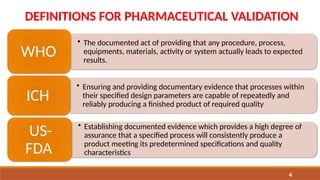
DEFINITIONS FOR PHARMACEUTICAL VALIDATION
• The documented act of providing that any procedure, process,
equipments, materials, activity or system actually leads to expected
results.
WHO
• Ensuring and providing documentary evidence that processes within
their specified design parameters are capable of repeatedly and
reliably producing a finished product of required quality
ICH
• Establishing documented evidence which provides a high degree of
assurance that a specified process will consistently produce a
product meeting its predetermined specifications and quality
characteristics
US-
FDA
5
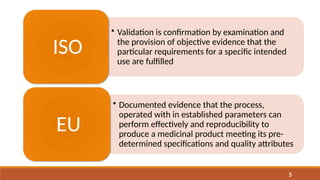
• Validation is confirmation by examination and
the provision of objective evidence that the
particular requirements for a specific intended
use are fulfilled
ISO
• Documented evidence that the process,
operated with in established parameters can
perform effectively and reproducibility to
produce a medicinal product meeting its pre-
determined specifications and quality attributes
EU
6
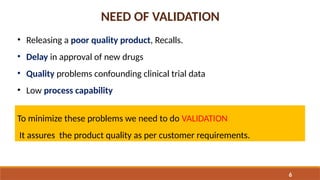
• Releasing a poor quality product, Recalls.
• Delay in approval of new drugs
• Quality problems confounding clinical trial data
• Low process capability
NEED OF VALIDATION
To minimize these problems we need to do VALIDATION
It assures the product quality as per customer requirements.
7
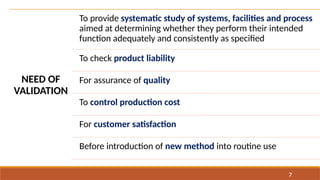
NEED OF
VALIDATION
To provide systematic study of systems, facilities and process
aimed at determining whether they perform their intended
function adequately and consistently as specified
To check product liability
For assurance of quality
To control production cost
For customer satisfaction
Before introduction of new method into routine use
8
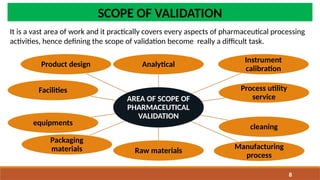
SCOPE OF VALIDATION
It is a vast area of work and it practically covers every aspects of pharmaceutical processing
activities, hence defining the scope of validation become really a difficult task.
AREA OF SCOPE OF
PHARMACEUTICAL
VALIDATION
Analytical
Instrument
calibration
Process utility
service
cleaning
Manufacturing
process
Raw materials
Packaging
materials
equipments
Facilities
Product design
9
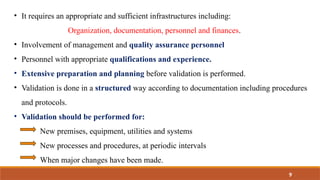
• It requires an appropriate and sufficient infrastructures including:
Organization, documentation, personnel and finances.
• Involvement of management and quality assurance personnel
• Personnel with appropriate qualifications and experience.
• Extensive preparation and planning before validation is performed.
• Validation is done in a structured way according to documentation including procedures
and protocols.
• Validation should be performed for:
New premises, equipment, utilities and systems
New processes and procedures, at periodic intervals
When major changes have been made.
10
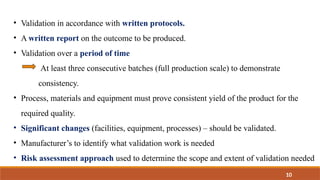
• Validation in accordance with written protocols.
• A written report on the outcome to be produced.
• Validation over a period of time
At least three consecutive batches (full production scale) to demonstrate
consistency.
• Process, materials and equipment must prove consistent yield of the product for the
required quality.
• Significant changes (facilities, equipment, processes) – should be validated.
• Manufacturer’s to identify what validation work is needed
• Risk assessment approach used to determine the scope and extent of validation needed
11
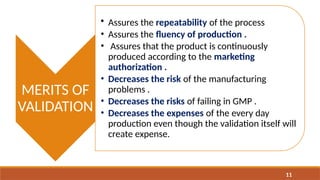
MERITS OF
VALIDATION
• Assures the repeatability of the process
• Assures the fluency of production .
• Assures that the product is continuously
produced according to the marketing
authorization .
• Decreases the risk of the manufacturing
problems .
• Decreases the risks of failing in GMP .
• Decreases the expenses of the every day
production even though the validation itself will
create expense.
12
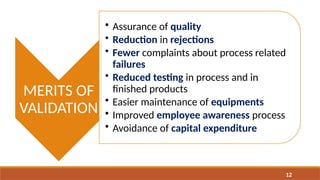
MERITS OF
VALIDATION
• Assurance of quality
• Reduction in rejections
• Fewer complaints about process related
failures
• Reduced testing in process and in
finished products
• Easier maintenance of equipments
• Improved employee awareness process
• Avoidance of capital expenditure
13
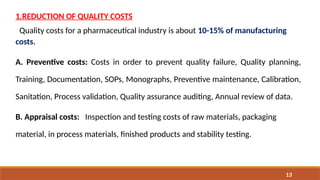
1.REDUCTION OF QUALITY COSTS
Quality costs for a pharmaceutical industry is about 10-15% of manufacturing
costs.
A. Preventive costs: Costs in order to prevent quality failure, Quality planning,
Training, Documentation, SOPs, Monographs, Preventive maintenance, Calibration,
Sanitation, Process validation, Quality assurance auditing, Annual review of data.
B. Appraisal costs: Inspection and testing costs of raw materials, packaging
material, in process materials, finished products and stability testing.
14
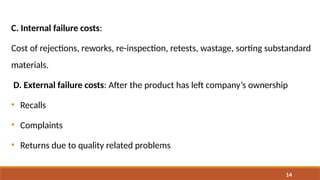
C. Internal failure costs:
Cost of rejections, reworks, re-inspection, retests, wastage, sorting substandard
materials.
D. External failure costs: After the product has left company’s ownership
• Recalls
• Complaints
• Returns due to quality related problems
15
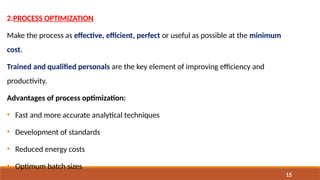
2.PROCESS OPTIMIZATION
Make the process as effective, efficient, perfect or useful as possible at the minimum
cost.
Trained and qualified personals are the key element of improving efficiency and
productivity.
Advantages of process optimization:
• Fast and more accurate analytical techniques
• Development of standards
• Reduced energy costs
• Optimum batch sizes
16
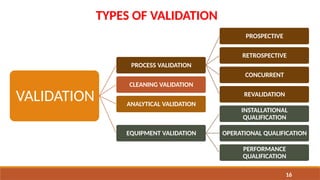
VALIDATION
PROCESS VALIDATION
PROSPECTIVE
RETROSPECTIVE
CONCURRENT
REVALIDATION
CLEANING VALIDATION
ANALYTICAL VALIDATION
EQUIPMENT VALIDATION
INSTALLATIONAL
QUALIFICATION
OPERATIONAL QUALIFICATION
PERFORMANCE
QUALIFICATION
TYPES OF VALIDATION
17
DOCUMENTATION
OF VALIDATION
AND CALIBRATION
•The validation and calibration activity cannot be
completed without proper documentation of each
and every minute activity with all details.
•Documentation of validation and calibration includes:
1.VALIDATION MASTER PLAN(VMP)
2.VALIDATION PROTOCOL(VP)
3.VALIDATION REPORTS(VR)
4.STANDARD OPERATING PROCEDURE(SOP)
5.CALIBRATION MASTER PLAN(CMP)
6.CALIBRATION CERTIFICATE(CP)
18
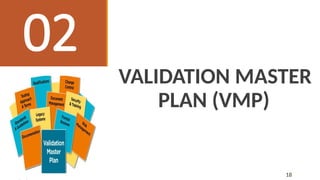
02
VALIDATION MASTER
PLAN (VMP)
19
VALIDATION MASTER PLAN (VMP)
• VMP is a comprehensive document describing the applicable validation
requirement for the facility, and providing a plan for the meeting those
requirements
• It is a documented evidence that provides a high degree of assurance that a
specific process will consistently produce a product that meets its
pre-determined specifications and quality attributes.
20
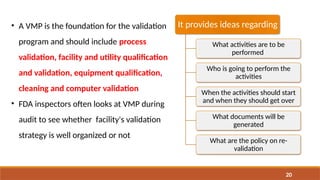
It provides ideas regarding
What activities are to be
performed
Who is going to perform the
activities
When the activities should start
and when they should get over
What documents will be
generated
What are the policy on re-
validation
• A VMP is the foundation for the validation
program and should include process
validation, facility and utility qualification
and validation, equipment qualification,
cleaning and computer validation
• FDA inspectors often looks at VMP during
audit to see whether facility's validation
strategy is well organized or not
21
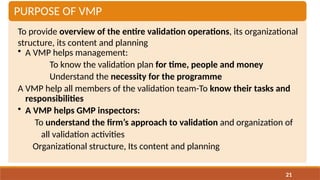
PURPOSE OF VMP
To provide overview of the entire validation operations, its organizational
structure, its content and planning
• A VMP helps management:
To know the validation plan for time, people and money
Understand the necessity for the programme
A VMP help all members of the validation team-To know their tasks and
responsibilities
• A VMP helps GMP inspectors:
To understand the firm’s approach to validation and organization of
all validation activities
Organizational structure, Its content and planning
22
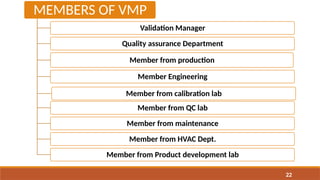
MEMBERS OF VMP
Validation Manager
Quality assurance Department
Member from production
Member Engineering
Member from calibration lab
Member from QC lab
Member from maintenance
Member from HVAC Dept.
Member from Product development lab
23
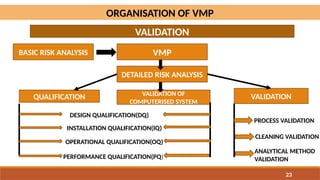
ORGANISATION OF VMP
VALIDATION
BASIC RISK ANALYSIS VMP
DETAILED RISK ANALYSIS
QUALIFICATION VALIDATION OF
COMPUTERISED SYSTEM
VALIDATION
DESIGN QUALIFICATION(DQ)
INSTALLATION QUALIFICATION(IQ)
OPERATIONAL QUALIFICATION(OQ)
PERFORMANCE QUALIFICATION(PQ)
PROCESS VALIDATION
CLEANING VALIDATION
ANALYTICAL METHOD
VALIDATION
24
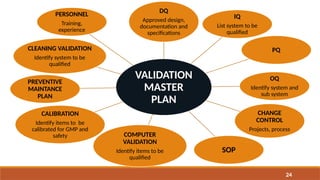
VALIDATION
MASTER
PLAN
DQ
Approved design,
documentation and
specifications
IQ
List system to be
qualified
PQ
OQ
Identify system and
sub system
CHANGE
CONTROL
Projects, process
SOP
COMPUTER
VALIDATION
Identify items to be
qualified
CALIBRATION
Identify items to be
calibrated for GMP and
safety
PREVENTIVE
MAINTANCE
PLAN
CLEANING VALIDATION
Identify system to be
qualified
PERSONNEL
Training,
experience
25
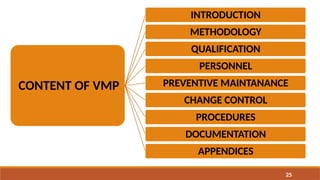
CONTENT OF VMP
INTRODUCTION
METHODOLOGY
QUALIFICATION
PERSONNEL
PREVENTIVE MAINTANANCE
CHANGE CONTROL
PROCEDURES
DOCUMENTATION
APPENDICES
26
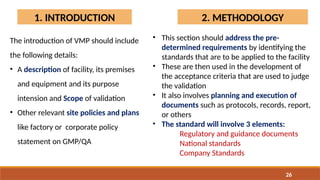
1. INTRODUCTION 2. METHODOLOGY
The introduction of VMP should include
the following details:
• A description of facility, its premises
and equipment and its purpose
intension and Scope of validation
• Other relevant site policies and plans
like factory or corporate policy
statement on GMP/QA
• This section should address the pre-
determined requirements by identifying the
standards that are to be applied to the facility
• These are then used in the development of
the acceptance criteria that are used to judge
the validation
• It also involves planning and execution of
documents such as protocols, records, report,
or others
• The standard will involve 3 elements:
Regulatory and guidance documents
National standards
Company Standards
27
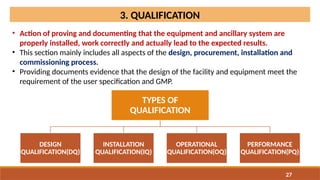
3. QUALIFICATION
• Action of proving and documenting that the equipment and ancillary system are
properly installed, work correctly and actually lead to the expected results.
• This section mainly includes all aspects of the design, procurement, installation and
commissioning process.
• Providing documents evidence that the design of the facility and equipment meet the
requirement of the user specification and GMP.
TYPES OF
QUALIFICATION
DESIGN
QUALIFICATION(DQ)
INSTALLATION
QUALIFICATION(IQ)
OPERATIONAL
QUALIFICATION(OQ)
PERFORMANCE
QUALIFICATION(PQ)
28
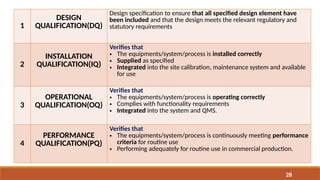
1
DESIGN
QUALIFICATION(DQ)
Design specification to ensure that all specified design element have
been included and that the design meets the relevant regulatory and
statutory requirements
2
INSTALLATION
QUALIFICATION(IQ)
Verifies that
• The equipments/system/process is installed correctly
• Supplied as specified
• Integrated into the site calibration, maintenance system and available
for use
3
OPERATIONAL
QUALIFICATION(OQ)
Verifies that
• The equipments/system/process is operating correctly
• Complies with functionality requirements
• Integrated into the system and QMS.
4
PERFORMANCE
QUALIFICATION(PQ)
Verifies that
• The equipments/system/process is continuously meeting performance
criteria for routine use
• Performing adequately for routine use in commercial production.
29
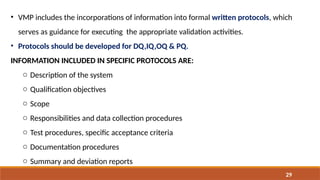
• VMP includes the incorporations of information into formal written protocols, which
serves as guidance for executing the appropriate validation activities.
• Protocols should be developed for DQ,IQ,OQ & PQ.
INFORMATION INCLUDED IN SPECIFIC PROTOCOLS ARE:
o Description of the system
o Qualification objectives
o Scope
o Responsibilities and data collection procedures
o Test procedures, specific acceptance criteria
o Documentation procedures
o Summary and deviation reports
30
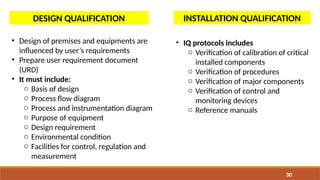
DESIGN QUALIFICATION INSTALLATION QUALIFICATION
• Design of premises and equipments are
influenced by user’s requirements
• Prepare user requirement document
(URD)
• It must include:
o Basis of design
o Process flow diagram
o Process and instrumentation diagram
o Purpose of equipment
o Design requirement
o Environmental condition
o Facilities for control, regulation and
measurement
• IQ protocols includes
o Verification of calibration of critical
installed components
o Verification of procedures
o Verification of major components
o Verification of control and
monitoring devices
o Reference manuals
31
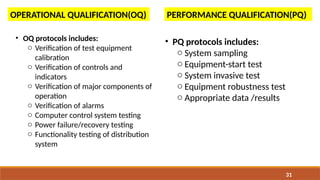
OPERATIONAL QUALIFICATION(OQ) PERFORMANCE QUALIFICATION(PQ)
• OQ protocols includes:
o Verification of test equipment
calibration
o Verification of controls and
indicators
o Verification of major components of
operation
o Verification of alarms
o Computer control system testing
o Power failure/recovery testing
o Functionality testing of distribution
system
• PQ protocols includes:
o System sampling
o Equipment-start test
o System invasive test
o Equipment robustness test
o Appropriate data /results
32
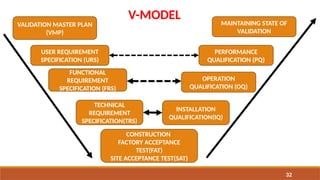
VALIDATION MASTER PLAN
(VMP)
USER REQUIREMENT
SPECIFICATION (URS)
FUNCTIONAL
REQUIREMENT
SPECIFICATION (FRS)
TECHNICAL
REQUIREMENT
SPECIFICATION(TRS)
CONSTRUCTION
FACTORY ACCEPTANCE
TEST(FAT)
SITE ACCEPTANCE TEST(SAT)
INSTALLATION
QUALIFICATION(IQ)
OPERATION
QUALIFICATION (OQ)
PERFORMANCE
QUALIFICATION (PQ)
MAINTAINING STATE OF
VALIDATION
V-MODEL
33
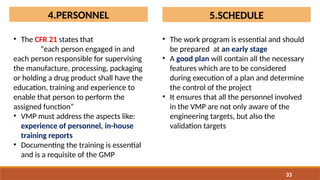
4.PERSONNEL 5.SCHEDULE
• The CFR 21 states that
“each person engaged in and
each person responsible for supervising
the manufacture, processing, packaging
or holding a drug product shall have the
education, training and experience to
enable that person to perform the
assigned function”
• VMP must address the aspects like:
experience of personnel, in-house
training reports
• Documenting the training is essential
and is a requisite of the GMP
• The work program is essential and should
be prepared at an early stage
• A good plan will contain all the necessary
features which are to be considered
during execution of a plan and determine
the control of the project
• It ensures that all the personnel involved
in the VMP are not only aware of the
engineering targets, but also the
validation targets
34
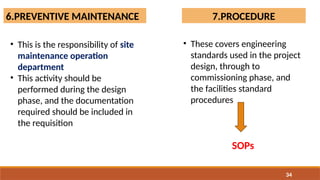
6.PREVENTIVE MAINTENANCE
• This is the responsibility of site
maintenance operation
department
• This activity should be
performed during the design
phase, and the documentation
required should be included in
the requisition
7.PROCEDURE
• These covers engineering
standards used in the project
design, through to
commissioning phase, and
the facilities standard
procedures
SOPs
35
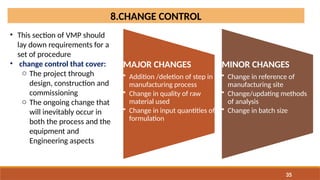
8.CHANGE CONTROL
• This section of VMP should
lay down requirements for a
set of procedure
• change control that cover:
o The project through
design, construction and
commissioning
o The ongoing change that
will inevitably occur in
both the process and the
equipment and
Engineering aspects
MAJOR CHANGES
• Addition /deletion of step in
manufacturing process
• Change in quality of raw
material used
• Change in input quantities of
formulation
MINOR CHANGES
• Change in reference of
manufacturing site
• Change/updating methods
of analysis
• Change in batch size
36
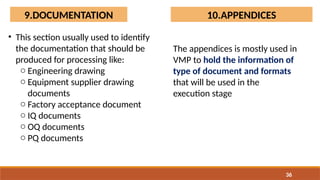
9.DOCUMENTATION 10.APPENDICES
• This section usually used to identify
the documentation that should be
produced for processing like:
o Engineering drawing
o Equipment supplier drawing
documents
o Factory acceptance document
o IQ documents
o OQ documents
o PQ documents
The appendices is mostly used in
VMP to hold the information of
type of document and formats
that will be used in the
execution stage
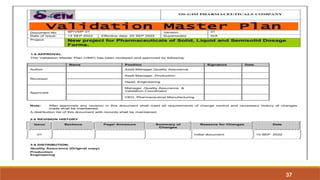
37
Template
38
03 CALIBRATION MASTER
PLAN (CMP)
39
CALIBRATION
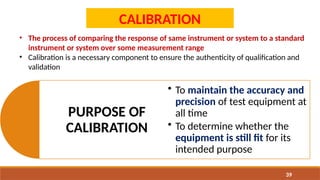
• The process of comparing the response of same instrument or system to a standard
instrument or system over some measurement range
• Calibration is a necessary component to ensure the authenticity of qualification and
validation
PURPOSE OF
CALIBRATION
• To maintain the accuracy and
precision of test equipment at
all time
• To determine whether the
equipment is still fit for its
intended purpose
40
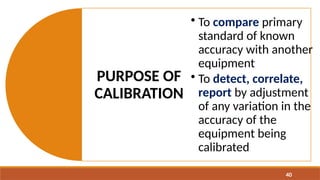
PURPOSE OF
CALIBRATION
• To compare primary
standard of known
accuracy with another
equipment
• To detect, correlate,
report by adjustment
of any variation in the
accuracy of the
equipment being
calibrated
41
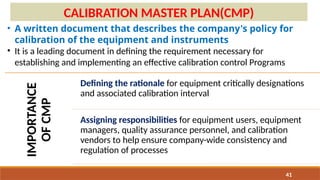
CALIBRATION MASTER PLAN(CMP)
• A written document that describes the company's policy for
calibration of the equipment and instruments
• It is a leading document in defining the requirement necessary for
establishing and implementing an effective calibration control Programs
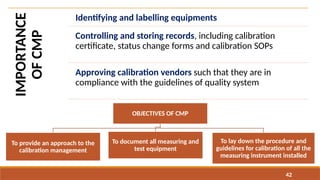
IMPORTANCE
OF
CMP
Defining the rationale for equipment critically designations
and associated calibration interval
Assigning responsibilities for equipment users, equipment
managers, quality assurance personnel, and calibration
vendors to help ensure company-wide consistency and
regulation of processes
42
IMPORTANCE
OF
CMP
Identifying and labelling equipments
Controlling and storing records, including calibration
certificate, status change forms and calibration SOPs
Approving calibration vendors such that they are in
compliance with the guidelines of quality system
OBJECTIVES OF CMP
To provide an approach to the
calibration management
To document all measuring and
test equipment
To lay down the procedure and
guidelines for calibration of all the
measuring instrument installed
43
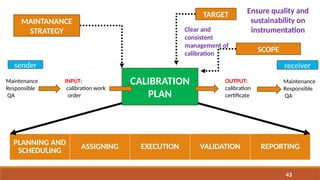
CALIBRATION
PLAN
PLANNING AND
SCHEDULING
ASSIGNING EXECUTION VALIDATION REPORTING
MAINTANANCE
STRATEGY
TARGET
SCOPE
sender
Maintenance
Responsible
QA
INPUT:
calibration work
order
OUTPUT:
calibration
certificate
Maintenance
Responsible
QA
receiver
Ensure quality and
sustainability on
instrumentation
Clear and
consistent
management of
calibration
44
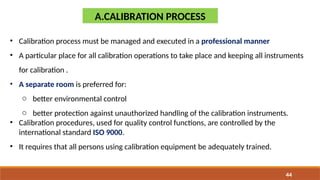
• Calibration process must be managed and executed in a professional manner
• A particular place for all calibration operations to take place and keeping all instruments
for calibration .
• A separate room is preferred for:
o better environmental control
o better protection against unauthorized handling of the calibration instruments.
• Calibration procedures, used for quality control functions, are controlled by the
international standard ISO 9000.
• It requires that all persons using calibration equipment be adequately trained.
A.CALIBRATION PROCESS
45
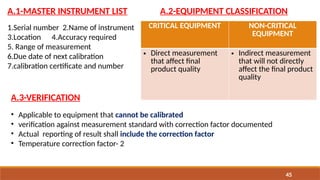
A.1-MASTER INSTRUMENT LIST A.2-EQUIPMENT CLASSIFICATION
1.Serial number 2.Name of instrument
3.Location 4.Accuracy required
5. Range of measurement
6.Due date of next calibration
7.calibration certificate and number
CRITICAL EQUIPMENT NON-CRITICAL
EQUIPMENT
• Direct measurement
that affect final
product quality
• Indirect measurement
that will not directly
affect the final product
quality
A.3-VERIFICATION
• Applicable to equipment that cannot be calibrated
• verification against measurement standard with correction factor documented
• Actual reporting of result shall include the correction factor
• Temperature correction factor- 2
46
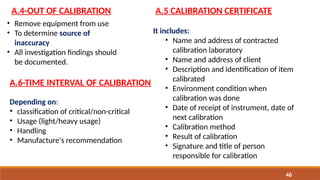
A.4-OUT OF CALIBRATION
• Remove equipment from use
• To determine source of
inaccuracy
• All investigation findings should
be documented.
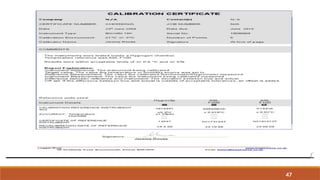
A.5 CALIBRATION CERTIFICATE
It includes:
• Name and address of contracted
calibration laboratory
• Name and address of client
• Description and identification of item
calibrated
• Environment condition when
calibration was done
• Date of receipt of instrument, date of
next calibration
• Calibration method
• Result of calibration
• Signature and title of person
responsible for calibration
A.6-TIME INTERVAL OF CALIBRATION
Depending on:
• classification of critical/non-critical
• Usage (light/heavy usage)
• Handling
• Manufacture's recommendation
47
48
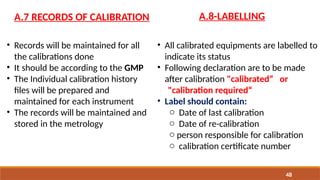
A.7 RECORDS OF CALIBRATION
• Records will be maintained for all
the calibrations done
• It should be according to the GMP
• The Individual calibration history
files will be prepared and
maintained for each instrument
• The records will be maintained and
stored in the metrology
A.8-LABELLING
• All calibrated equipments are labelled to
indicate its status
• Following declaration are to be made
after calibration "calibrated“ or
"calibration required“
• Label should contain:
o Date of last calibration
o Date of re-calibration
o person responsible for calibration
o calibration certificate number
49
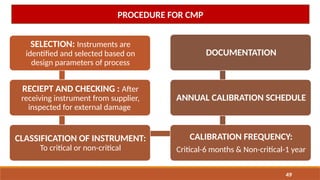
PROCEDURE FOR CMP
SELECTION: Instruments are
identified and selected based on
design parameters of process
RECIEPT AND CHECKING : After
receiving instrument from supplier,
inspected for external damage
CLASSIFICATION OF INSTRUMENT:
To critical or non-critical
CALIBRATION FREQUENCY:
Critical-6 months & Non-critical-1 year
ANNUAL CALIBRATION SCHEDULE
DOCUMENTATION
50
04
ICH AND WHO GUIDELINES
FOR CALIBRATION AND
VALIDATION OF
EQUIPMENTS
51
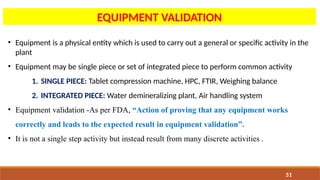
EQUIPMENT VALIDATION
• Equipment is a physical entity which is used to carry out a general or specific activity in the
plant
• Equipment may be single piece or set of integrated piece to perform common activity
1. SINGLE PIECE: Tablet compression machine, HPC, FTIR, Weighing balance
2. INTEGRATED PIECE: Water demineralizing plant, Air handling system
• Equipment validation -As per FDA, “Action of proving that any equipment works
correctly and leads to the expected result in equipment validation”.
• It is not a single step activity but instead result from many discrete activities .
52
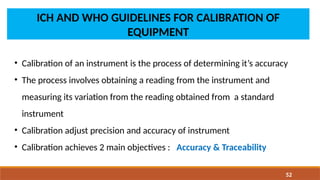
ICH AND WHO GUIDELINES FOR CALIBRATION OF
EQUIPMENT
• Calibration of an instrument is the process of determining it’s accuracy
• The process involves obtaining a reading from the instrument and
measuring its variation from the reading obtained from a standard
instrument
• Calibration adjust precision and accuracy of instrument
• Calibration achieves 2 main objectives : Accuracy & Traceability
53
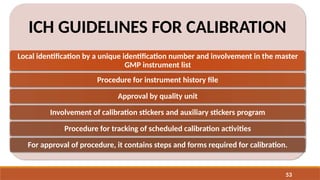
ICH GUIDELINES FOR CALIBRATION
Local identification by a unique identification number and involvement in the master
GMP instrument list
Procedure for instrument history file
Approval by quality unit
Involvement of calibration stickers and auxiliary stickers program
Procedure for tracking of scheduled calibration activities
For approval of procedure, it contains steps and forms required for calibration.
54
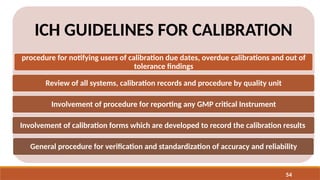
ICH GUIDELINES FOR CALIBRATION
procedure for notifying users of calibration due dates, overdue calibrations and out of
tolerance findings
Review of all systems, calibration records and procedure by quality unit
Involvement of procedure for reporting any GMP critical Instrument
Involvement of calibration forms which are developed to record the calibration results
General procedure for verification and standardization of accuracy and reliability
55
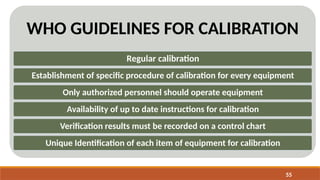
WHO GUIDELINES FOR CALIBRATION
Regular calibration
Establishment of specific procedure of calibration for every equipment
Only authorized personnel should operate equipment
Availability of up to date instructions for calibration
Verification results must be recorded on a control chart
Unique Identification of each item of equipment for calibration
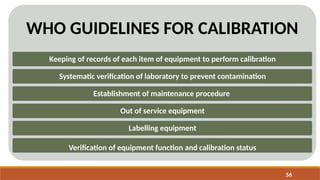
56
WHO GUIDELINES FOR CALIBRATION
Keeping of records of each item of equipment to perform calibration
Systematic verification of laboratory to prevent contamination
Establishment of maintenance procedure
Out of service equipment
Labelling equipment
Verification of equipment function and calibration status
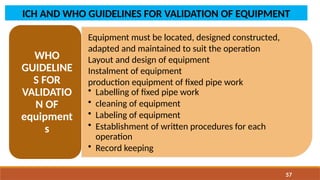
57
ICH AND WHO GUIDELINES FOR VALIDATION OF EQUIPMENT
Equipment must be located, designed constructed,
adapted and maintained to suit the operation
Layout and design of equipment
Instalment of equipment
production equipment of fixed pipe work
• Labelling of fixed pipe work
• cleaning of equipment
• Labeling of equipment
• Establishment of written procedures for each
operation
• Record keeping
WHO
GUIDELINE
S FOR
VALIDATIO
N OF
equipment
s
58
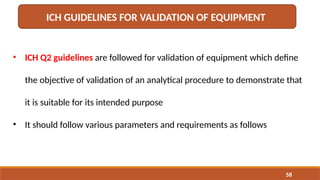
ICH GUIDELINES FOR VALIDATION OF EQUIPMENT
• ICH Q2 guidelines are followed for validation of equipment which define
the objective of validation of an analytical procedure to demonstrate that
it is suitable for its intended purpose
• It should follow various parameters and requirements as follows
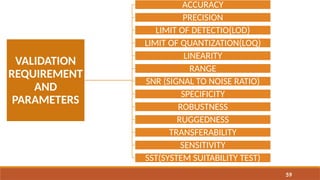
59
VALIDATION
REQUIREMENT
AND
PARAMETERS
ACCURACY
PRECISION
LIMIT OF DETECTIO(LOD)
LIMIT OF QUANTIZATION(LOQ)
LINEARITY
RANGE
SNR (SIGNAL TO NOISE RATIO)
SPECIFICITY
ROBUSTNESS
RUGGEDNESS
TRANSFERABILITY
SENSITIVITY
SST(SYSTEM SUITABILITY TEST)
60
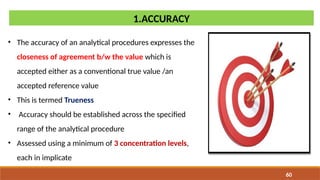
1.ACCURACY
• The accuracy of an analytical procedures expresses the
closeness of agreement b/w the value which is
accepted either as a conventional true value /an
accepted reference value
• This is termed Trueness
• Accuracy should be established across the specified
range of the analytical procedure
• Assessed using a minimum of 3 concentration levels,
each in implicate
61
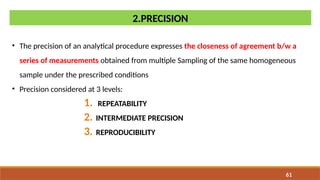
2.PRECISION
• The precision of an analytical procedure expresses the closeness of agreement b/w a
series of measurements obtained from multiple Sampling of the same homogeneous
sample under the prescribed conditions
• Precision considered at 3 levels:
1. REPEATABILITY
2. INTERMEDIATE PRECISION
3. REPRODUCIBILITY
62
2.A-REPEATABILITY
• Express the precision under the
same operating conditions such
as same measurements/same
procedure/same equipment over
a short interval of time
• Referred as Intra-assay precision
• should be assessed using of 9
determinations/ minimum of 6
determinations at the 100% level
2.B-REPRODUCIBILITY
• Expresses the precision between
the laboratories or inter-
laboratory trials
• It is beneficial when an analytical
method is standardized or is going
to be used in more than one
laboratory
• It is not always needed for single
lab validation
63
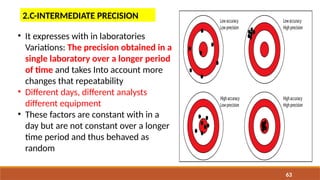
2.C-INTERMEDIATE PRECISION
• It expresses with in laboratories
Variations: The precision obtained in a
single laboratory over a longer period
of time and takes Into account more
changes that repeatability
• Different days, different analysts
different equipment
• These factors are constant with in a
day but are not constant over a longer
time period and thus behaved as
random
64
3.LIMIT OF DETECTION(LOD)
• The detection limit of an individual analytical procedures is the lowest amount
of analyte in a sample which can be detected but not necessarily quantitated
as an exact value.
APPROACHES FOR DETERMINING LOD
BASED ON VISUAL EVALUATION:
Determined by the analysis of samples with known concentrations of analyte and by
establishing the minimum level at which the analyte can be reliably detected
BASED ON SIGNAL-TO-NOISE APPROACH:
This can only be applied to analytical procedures which exhibit baseline noise and
establishing by signal to noise ratio of 8:1
65
4.LIMIT OF QUANTITATION(LOQ)
• The quantitation Limit of an individual analytical procedure is the lowest amount of
analyte in a Sample which can be quantitatively determined
• For the determination of Impurities and or degradation
APPROACHES FOR LOQ
BASED ON VISUAL INSPECTION: For non-instrumental methods but
mat also used with instrumental methods
BASED ON SIGNAL-TO-NOISE: Only applied to analytical procedures
which exhibits baseline noise and estimated ratio is 10:1
66
5.LINEARITY 6.ROBUSTNESS
• The linearity of an analytical procedure
is its ability to obtain test results which
are directly proportional to the
concentration of analyte in the sample
• Robustness is a measure of its capacity
to remain unaffected by small, but
deliberated in method parameters and
provides an indication of its reliability
during normal usage
1. Change in of mobile phase
2. Change in column
3. Change in temperature
4. Flow rate
• Visual inspection of
plot(signals vs
concentration of
analyte)
• Acceptance
criteria:r2>0.95
• Statistical methods –
linearity regression
and correlation
coefficient
LINEARITY
EVALUATED
BY
67
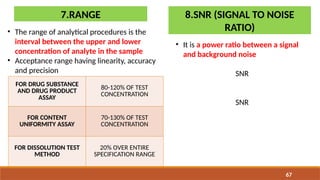
7.RANGE 8.SNR (SIGNAL TO NOISE
RATIO)
• The range of analytical procedures is the
interval between the upper and lower
concentration of analyte in the sample
• Acceptance range having linearity, accuracy
and precision
FOR DRUG SUBSTANCE
AND DRUG PRODUCT
ASSAY
80-120% OF TEST
CONCENTRATION
FOR CONTENT
UNIFORMITY ASSAY
70-130% OF TEST
CONCENTRATION
FOR DISSOLUTION TEST
METHOD
20% OVER ENTIRE
SPECIFICATION RANGE
• It is a power ratio between a signal
and background noise
SNR
SNR
68
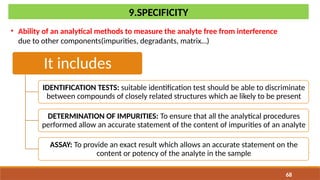
9.SPECIFICITY
• Ability of an analytical methods to measure the analyte free from interference
due to other components(impurities, degradants, matrix…)
It includes
IDENTIFICATION TESTS: suitable identification test should be able to discriminate
between compounds of closely related structures which ae likely to be present
DETERMINATION OF IMPURITIES: To ensure that all the analytical procedures
performed allow an accurate statement of the content of impurities of an analyte
ASSAY: To provide an exact result which allows an accurate statement on the
content or potency of the analyte in the sample
69
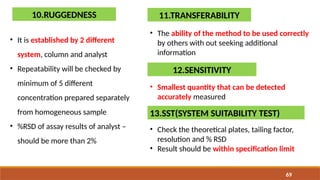
10.RUGGEDNESS 11.TRANSFERABILITY
12.SENSITIVITY
13.SST(SYSTEM SUITABILITY TEST)
• The ability of the method to be used correctly
by others with out seeking additional
information
• Smallest quantity that can be detected
accurately measured
• Check the theoretical plates, tailing factor,
resolution and % RSD
• Result should be within specification limit
• It is established by 2 different
system, column and analyst
• Repeatability will be checked by
minimum of 5 different
concentration prepared separately
from homogeneous sample
• %RSD of assay results of analyst –
should be more than 2%
70
05
1. Validation in pharmaceutical industry, PP
Sharma, 2nd
edition,pageno:107-123
2. Pharmaceutical process validation, Robert A Bash
and Alfred H Wachter, drugs and the
pharmaceutical sciences, 3rd
edition, page no:15
3. Validation of analytical procedures: text and
methodology Q2(R1) ICH harmonized tripartite
guideline, www.database.ich.org
4. ICH guideline Q2(R2) on validation,
www.ema.Europa.eu
5. Process of validation in pharmaceutical industry-
www.core.ac.uk
6. Calibration master plan- www.flairpharma.com
REFERENCES
71
THANK YOU

Editor's Notes

  • #3 Ted bayers and bud loftus