Preformulation studies Part I
Represented by: Eman Ateia
 Introduction
 Preformulation studies Definition
 Objectives of Preformulation Studies
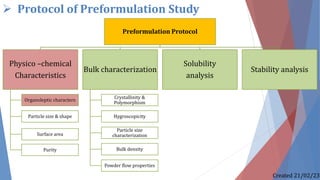
 Protocol of Preformulation Study:
1)Physico-chemical properties
2)Bulk characterization studies
3)Solubility profile (pKa, pH, Partition coefficient) and its significance
4)Stability analysis
Created 21/02/23
➢ Introduction:
 Before the development of any dosage form of a drug substance, it is crucial that
particular fundamental physical and chemical properties of a drug substance
are determined.
 These properties form the basis for fabricating a drug’s combination with
appropriate pharmaceutical excipients for producing the right dosage form.
 This preliminary stage of evaluation is described as the preformulation phase
and is at the interface between the drug entity and formulation development
Created 21/02/23
➢ Introduction:
 Medicinal chemists can manipulate structural traits of potential drug candidates on the
basis of information received on the stability, solubility and cell penetrability from
preformulation studies.
 Pharmacologists can use the same information to determine drug therapeutic and toxic
levels.
 Pharmaceutical analysts can optimize assay procedures for determination of the drug
substance/product.
 Formulators integrate preformulation data such as drug physicochemical
characteristics for designing a suitable dosage form for drug delivery by appropriate
excipient selection and opting for the right processing conditions
Created 21/02/23
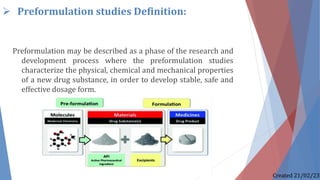
➢ Preformulation studies Definition:
Preformulation may be described as a phase of the research and
development process where the preformulation studies
characterize the physical, chemical and mechanical properties
of a new drug substance, in order to develop stable, safe and
effective dosage form.
Created 21/02/23
➢ Objectives of Preformulation Studies:
 To formulate an elegant, safe, efficacious dosage form with good bioavailability.
 Determination of all the properties of drug and the best suitable dosage form for the
drug molecule.
 To establish the necessary physicochemical parameters of new drug substances.
 To formulate new dosage form of already existing drug.
 To determine kinetic rate profile.
 To establish physical characteristics.
 To establish compatibility with common excipients.
Created 21/02/23
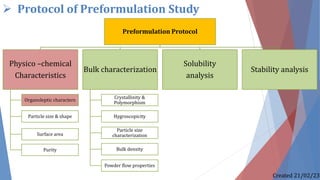
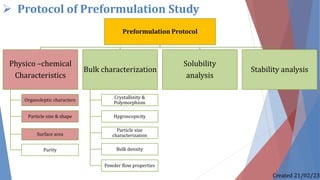
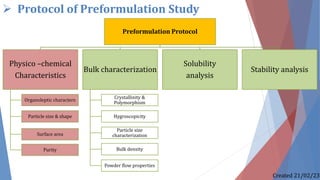
➢ Protocol of Preformulation Study
Preformulation Protocol
Physico –chemical
Characteristics
Organoleptic characters
Particle size & shape
Purity
Surface area
Bulk characterization
Crystallinity &
Polymorphism
Hygroscopicity
Particle size
characterization
Bulk density
Powder flow properties
Solubility
analysis
Stability analysis
Created 21/02/23
1) Physico –chemical Characteristics
 Physical and chemical reactions involved in the formation of or changes in
the structure of atoms and molecules and their interaction affecting the
drug kinetics.
 Investigation of physical and chemical properties of a drug substance -
alone and or when combined with excipients is crucial during pre-
formulation studies.
Created 21/02/23
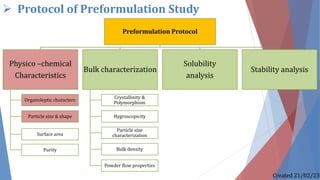
➢ Protocol of Preformulation Study
Preformulation Protocol
Physico –chemical
Characteristics
Organoleptic characters
Particle size & shape
Purity
Surface area
Bulk characterization
Crystallinity &
Polymorphism
Hygroscopicity
Particle size
characterization
Bulk density
Powder flow properties
Solubility
analysis
Stability analysis
Created 21/02/23
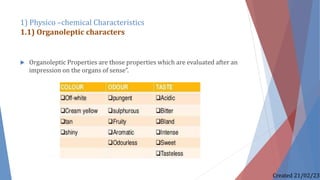
 Organoleptic Properties are those properties which are evaluated after an
impression on the organs of sense”.
1) Physico –chemical Characteristics
1.1) Organoleptic characters
Created 21/02/23
 Color is generally a function of a drug’s inherent chemical structure relating to a certain level
of unsaturation. Color intensity relates to the extent of conjugated unsaturation as well as the
presence of chromophores (ethylene, acetylene, carbonyls, acids, esters and nitrile
groups etc.)
 Odour is defined as ‘Taste from a distance’, it is very closely allied to taste. Without odour
most of substances lack in taste appeal.
▪ Odourous volatile substances generate vapors these interact with olfactory cells and elicit
receptors and exit. The brain receives impulses from group of microscopic olfactory receptors
in the nose which it co-ordinates with the gustatory stimuli to produce the mingled sensation
that is recognized as the flavour of the substance.
▪ The substance may exhibit an inherent odor characteristic of major functional groups present.
1) Physico –chemical Characteristics
1.1) Organoleptic characters
Created 21/02/23
 Taste: primary effects of taste are sweet, sour, and salty. There is a close co-relation ship between
chemical structure and taste.
 Sour taste is due to acidic nature.
▪ Sour taste [H+] and lipid solubility of substance i.e., acids get ionized in aqueous solution(it depends on H+ ion
concentration) examples: Lemon, Vinegar, Citric acid, Malic acid, Apple.
 Salty taste is due to cationic species, halide salts.
▪ Example: Sodium chloride, sodium bromide, sodium iodide. Increase in molecular weight of halide results in
increase in bitter taste. example: potassium bromide, Ammonium salts.
▪ Sodium chloride is salty, whereas , potassium chloride is bitter.
 Sweet taste is due to polyhydroxy compounds.
▪ Sweet taste [OH-] and aqueous solubility. Example: sugar, glycerin, alpha amino acids, etc.
1) Physico –chemical Characteristics
1.1) Organoleptic characters
Created 21/02/23
Taste: If taste is considered as unpalatable, consideration is to be given to the use of a less soluble
chemical form of the drug.
Directly affect the palatability of the final dosage form. On a related note, if taste is found
unpalatable, a lesser soluble form of the drug is employed. Also, the odour and taste can be
masked by inclusion of the right flavours and excipients or by coating the final product or drug
substance.
1) Physico –chemical Characteristics
1.1) Organoleptic characters
Created 21/02/23
 Role in liquid dosage form:
 In monophasic liquid(i.e., syrup)- it has noticible taste, if bitter drug then for monophasic flavouring
agent with sweetening agent gives pleasant taste. Therefore, syrup retains flavour in mouth for longer time
and due to high viscosities it decreases contact of bitter drug with taste buds and give mouthfeel effect.
 Biphasic Liquid- (i.e., soluble drug in form of emulsion or Insoluble drug in form of suspension)
Entrapment of bitter drug in emulsion increases palatability and insoluble drug in form of suspension is
more palatable then solution as less reaction with taste buds.
1) Physico –chemical Characteristics
1.1) Organoleptic characters
Created 21/02/23
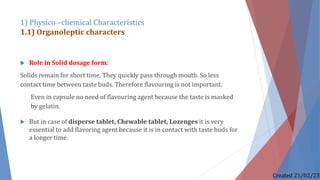
 Role in Solid dosage form:
Solids remain for short time. They quickly pass through mouth. So less
contact time between taste buds. Therefore flavouring is not important.
Even in capsule no need of flavouring agent because the taste is masked
by gelatin.
 But in case of disperse tablet, Chewable tablet, Lozenges it is very
essential to add flavoring agent because it is in contact with taste buds for
a longer time.
1) Physico –chemical Characteristics
1.1) Organoleptic characters
Created 21/02/23
➢ Protocol of Preformulation Study
Preformulation Protocol
Physico –chemical
Characteristics
Organoleptic characters
Particle size & shape
Purity
Surface area
Bulk characterization
Crystallinity &
Polymorphism
Hygroscopicity
Particle size
characterization
Bulk density
Powder flow properties
Solubility
analysis
Stability analysis
Created 21/02/23
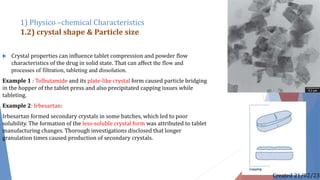
 Crystal properties can influence tablet compression and powder flow
characteristics of the drug in solid state. That can affect the flow and
processes of filtration, tableting and dissolution.
Example 1 : Tolbutamide and its plate-like crystal form caused particle bridging
in the hopper of the tablet press and also precipitated capping issues while
tableting.
Example 2: Irbesartan:
Irbesartan formed secondary crystals in some batches, which led to poor
solubility. The formation of the less-soluble crystal form was attributed to tablet
manufacturing changes. Thorough investigations disclosed that longer
granulation times caused production of secondary crystals.
1) Physico –chemical Characteristics
1.2) crystal shape & Particle size
Created 21/02/23
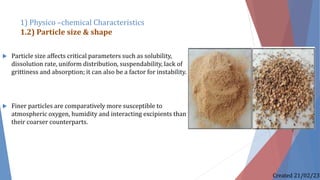
 Particle size affects critical parameters such as solubility,
dissolution rate, uniform distribution, suspendability, lack of
grittiness and absorption; it can also be a factor for instability.
 Finer particles are comparatively more susceptible to
atmospheric oxygen, humidity and interacting excipients than
their coarser counterparts.
1) Physico –chemical Characteristics
1.2) Particle size & shape
Created 21/02/23
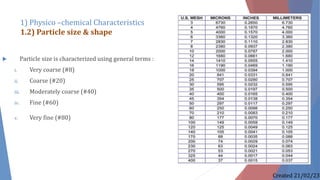
 Particle size is characterized using general terms :
i. Very coarse (#8)
ii. Coarse (#20)
iii. Moderately coarse (#40)
iv. Fine (#60)
v. Very fine (#80)
1) Physico –chemical Characteristics
1.2) Particle size & shape
Created 21/02/23
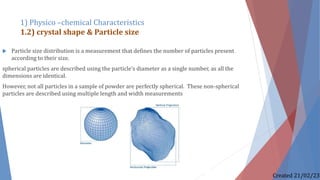
 Particle size distribution is a measurement that defines the number of particles present
according to their size.
spherical particles are described using the particle’s diameter as a single number, as all the
dimensions are identical.
However, not all particles in a sample of powder are perfectly spherical. These non-spherical
particles are described using multiple length and width measurements
1) Physico –chemical Characteristics
1.2) crystal shape & Particle size
Created 21/02/23
 These descriptions of the non-spherical particle provide higher levels of accuracy
but involve greater complexity in their measurement.
 Therefore, most methods make the assumption that every particle is a sphere and
the reported value is expressed using the equivalent spherical diameter.
1) Physico –chemical Characteristics
1.2) Particle size & shape
Created 21/02/23
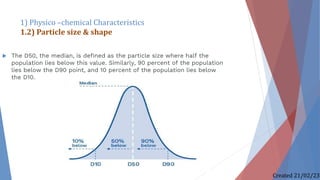
 The D50, the median, is defined as the particle size where half the
population lies below this value. Similarly, 90 percent of the population
lies below the D90 point, and 10 percent of the population lies below
the D10.
1) Physico –chemical Characteristics
1.2) Particle size & shape
Created 21/02/23
 Methods to Determine Particle Size:
1. Sieving
2. Microscopy
3. Sedimentation rate method
4. Light energy diffraction
5. Laser holography
1) Physico –chemical Characteristics
1.2) Particle size & shape
Created 21/02/23
 Methods to Determine Particle Size:
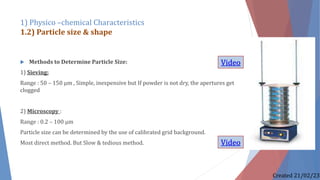
1) Sieving:
Range : 50 – 150 µm , Simple, inexpensive but If powder is not dry, the apertures get
clogged
2) Microscopy :
Range : 0.2 – 100 µm
Particle size can be determined by the use of calibrated grid background.
Most direct method. But Slow & tedious method.
1) Physico –chemical Characteristics
1.2) Particle size & shape
Created 21/02/23
Video
Video
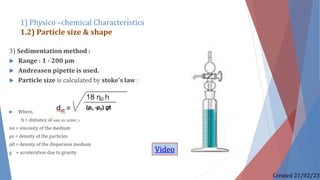
3) Sedimentation method :
 Range : 1 - 200 µm
 Andreasen pipette is used.
 Particle size is calculated by stoke’s law :
 Where,
h = distance of fall in time, t
no = viscosity of the medium
ρs = density of the particles
ρ0 = density of the dispersion medium
g = acceleration due to gravity
1) Physico –chemical Characteristics
1.2) Particle size & shape
Created 21/02/23
Video
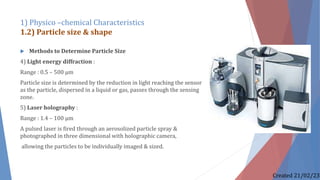
 Methods to Determine Particle Size
4) Light energy diffraction :
Range : 0.5 – 500 µm
Particle size is determined by the reduction in light reaching the sensor
as the particle, dispersed in a liquid or gas, passes through the sensing
zone.
5) Laser holography :
Range : 1.4 – 100 µm
A pulsed laser is fired through an aerosolized particle spray &
photographed in three dimensional with holographic camera,
allowing the particles to be individually imaged & sized.
1) Physico –chemical Characteristics
1.2) Particle size & shape
Created 21/02/23
➢ Protocol of Preformulation Study
Preformulation Protocol
Physico –chemical
Characteristics
Organoleptic characters
Particle size & shape
Purity
Surface area
Bulk characterization
Crystallinity &
Polymorphism
Hygroscopicity
Particle size
characterization
Bulk density
Powder flow properties
Solubility
analysis
Stability analysis
Created 21/02/23
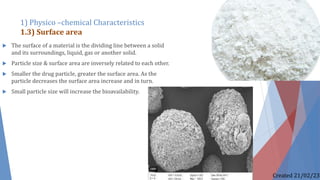
 The surface of a material is the dividing line between a solid
and its surroundings, liquid, gas or another solid.
 Particle size & surface area are inversely related to each other.
 Smaller the drug particle, greater the surface area. As the
particle decreases the surface area increase and in turn.
 Small particle size will increase the bioavailability.
1) Physico –chemical Characteristics
1.3) Surface area
Created 21/02/23
 Whenever solid matter is divided into smaller particles new surfaces are created thereby
increasing the surface area. Similarly, when pores are created within the particle interior (by
dissolution, decomposition or some other physical or chemical means) the surface area is also
increased.
 However size reduction is not required in following cases when drug is unstable.
• Degrade in solution form.
• Produce undesirable effects.
• When sustained effect is desired.
1) Physico –chemical Characteristics
1.3) Surface area
Created 21/02/23
In Solid dosage forms:
 The degree of tablet swelling taking place can be determined from the surface area of a
superdisintegrant.
 The functionality of a lubricant varies with its surface area, causing dissolution problems.
 The increase in the surface area allows exposure of more surfaces to the dissolution medium.
Hence, a material having higher surface area will be dissolved rapidly and its availability for
absorption is at a rate that may cause negative pharmacodynamic implications.
1) Physico –chemical Characteristics
1.3) Surface area
Created 21/02/23
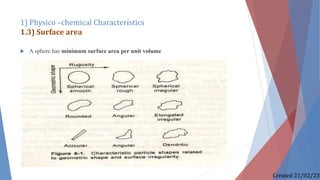
 A sphere has minimum surface area per unit volume
1) Physico –chemical Characteristics
1.3) Surface area
Created 21/02/23
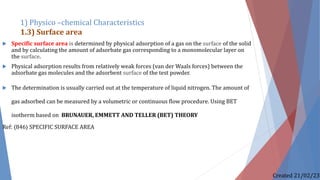
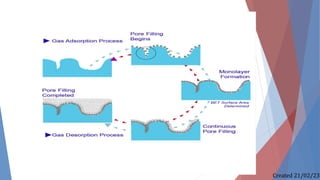
 Specific surface area is determined by physical adsorption of a gas on the surface of the solid
and by calculating the amount of adsorbate gas corresponding to a monomolecular layer on
the surface.
 Physical adsorption results from relatively weak forces (van der Waals forces) between the
adsorbate gas molecules and the adsorbent surface of the test powder.
 The determination is usually carried out at the temperature of liquid nitrogen. The amount of
gas adsorbed can be measured by a volumetric or continuous flow procedure. Using BET
isotherm based on BRUNAUER, EMMETT AND TELLER (BET) THEORY
Ref: 〈846〉 SPECIFIC SURFACE AREA
1) Physico –chemical Characteristics
1.3) Surface area
Created 21/02/23
Created 21/02/23
➢ Protocol of Preformulation Study
Preformulation Protocol
Physico –chemical
Characteristics
Organoleptic characters
Particle size & shape
Purity
Surface area
Bulk characterization
Crystallinity &
Polymorphism
Hygroscopicity
Particle size
characterization
Bulk density
Powder flow properties
Solubility
analysis
Stability analysis
Created 21/02/23
 Designed to estimate the levels of all known & significant impurities & contaminates in the
drug substance under evaluation.
 Study performed in an analytical research & development group.
 It is another parameter which allows for comparison with subsequent batches.
 Occasionally, an impurity can affect stability.
1) Physico –chemical Characteristics
1.4) Purity
Created 21/02/23
Methods to Determine Purity:
 Thin layer chromatography is a wide ranging applicability & is an excellent tool for characterizing
the purity.
 HPLC, paper chromatography & gas chromatography are also useful.
 More quantitative information can be obtained by using quantitative differential scanning
colorimetry (DSC).
.
1) Physico –chemical Characteristics
1.4) Purity
Created 21/02/23
 Differential scanning calorimetry (DSC) is able to quickly analyze the absolute
purity of chemical compounds within a single run.
 Chapter <891> of the US pharmacopeia and chapter 2.2.34 of the European
Pharmacopeia are dealing with thermal analysis. The total amount of impurities
which are melting together with the main component (called eutectic
impurities) can be investigated by analyzing the profile of the corresponding
melting peak.
 The calculation is based on the fact that an increasing impurity content leads to
broadening of the melting effect. Additionally, the peak is shifted to lower
temperature values.
1) Physico –chemical Characteristics
1.4) Purity
Created 21/02/23
Created 21/02/23
A sphere has Maximum surface area per unit volume ?
Differential scanning calorimetry (DSC) could be used to
determined specific surface area?
Particle size & surface area are inversely related to each
other ?
Methods to Determine Particle Size: Sieving ,Microscopy ,
Sedimentation rate method , Light energy diffraction , Laser
holography?
According to (BET theory ), liquid Oxygen is the choice to
determined surface area ?
Created 21/02/23
Preformulation studies Part I by Eman Ateia_00.pdf

Preformulation studies Part I by Eman Ateia_00.pdf

  • 1.
    Preformulation studies PartI Represented by: Eman Ateia
  • 2.
     Introduction  Preformulationstudies Definition  Objectives of Preformulation Studies  Protocol of Preformulation Study: 1)Physico-chemical properties 2)Bulk characterization studies 3)Solubility profile (pKa, pH, Partition coefficient) and its significance 4)Stability analysis Created 21/02/23
  • 3.
    ➢ Introduction:  Beforethe development of any dosage form of a drug substance, it is crucial that particular fundamental physical and chemical properties of a drug substance are determined.  These properties form the basis for fabricating a drug’s combination with appropriate pharmaceutical excipients for producing the right dosage form.  This preliminary stage of evaluation is described as the preformulation phase and is at the interface between the drug entity and formulation development Created 21/02/23
  • 4.
    ➢ Introduction:  Medicinalchemists can manipulate structural traits of potential drug candidates on the basis of information received on the stability, solubility and cell penetrability from preformulation studies.  Pharmacologists can use the same information to determine drug therapeutic and toxic levels.  Pharmaceutical analysts can optimize assay procedures for determination of the drug substance/product.  Formulators integrate preformulation data such as drug physicochemical characteristics for designing a suitable dosage form for drug delivery by appropriate excipient selection and opting for the right processing conditions Created 21/02/23
  • 5.
    ➢ Preformulation studiesDefinition: Preformulation may be described as a phase of the research and development process where the preformulation studies characterize the physical, chemical and mechanical properties of a new drug substance, in order to develop stable, safe and effective dosage form. Created 21/02/23
  • 6.
    ➢ Objectives ofPreformulation Studies:  To formulate an elegant, safe, efficacious dosage form with good bioavailability.  Determination of all the properties of drug and the best suitable dosage form for the drug molecule.  To establish the necessary physicochemical parameters of new drug substances.  To formulate new dosage form of already existing drug.  To determine kinetic rate profile.  To establish physical characteristics.  To establish compatibility with common excipients. Created 21/02/23
  • 7.
    ➢ Protocol ofPreformulation Study Preformulation Protocol Physico –chemical Characteristics Organoleptic characters Particle size & shape Purity Surface area Bulk characterization Crystallinity & Polymorphism Hygroscopicity Particle size characterization Bulk density Powder flow properties Solubility analysis Stability analysis Created 21/02/23
  • 8.
    1) Physico –chemicalCharacteristics  Physical and chemical reactions involved in the formation of or changes in the structure of atoms and molecules and their interaction affecting the drug kinetics.  Investigation of physical and chemical properties of a drug substance - alone and or when combined with excipients is crucial during pre- formulation studies. Created 21/02/23
  • 9.
    ➢ Protocol ofPreformulation Study Preformulation Protocol Physico –chemical Characteristics Organoleptic characters Particle size & shape Purity Surface area Bulk characterization Crystallinity & Polymorphism Hygroscopicity Particle size characterization Bulk density Powder flow properties Solubility analysis Stability analysis Created 21/02/23
  • 10.
     Organoleptic Propertiesare those properties which are evaluated after an impression on the organs of sense”. 1) Physico –chemical Characteristics 1.1) Organoleptic characters Created 21/02/23
  • 11.
     Color isgenerally a function of a drug’s inherent chemical structure relating to a certain level of unsaturation. Color intensity relates to the extent of conjugated unsaturation as well as the presence of chromophores (ethylene, acetylene, carbonyls, acids, esters and nitrile groups etc.)  Odour is defined as ‘Taste from a distance’, it is very closely allied to taste. Without odour most of substances lack in taste appeal. ▪ Odourous volatile substances generate vapors these interact with olfactory cells and elicit receptors and exit. The brain receives impulses from group of microscopic olfactory receptors in the nose which it co-ordinates with the gustatory stimuli to produce the mingled sensation that is recognized as the flavour of the substance. ▪ The substance may exhibit an inherent odor characteristic of major functional groups present. 1) Physico –chemical Characteristics 1.1) Organoleptic characters Created 21/02/23
  • 12.
     Taste: primaryeffects of taste are sweet, sour, and salty. There is a close co-relation ship between chemical structure and taste.  Sour taste is due to acidic nature. ▪ Sour taste [H+] and lipid solubility of substance i.e., acids get ionized in aqueous solution(it depends on H+ ion concentration) examples: Lemon, Vinegar, Citric acid, Malic acid, Apple.  Salty taste is due to cationic species, halide salts. ▪ Example: Sodium chloride, sodium bromide, sodium iodide. Increase in molecular weight of halide results in increase in bitter taste. example: potassium bromide, Ammonium salts. ▪ Sodium chloride is salty, whereas , potassium chloride is bitter.  Sweet taste is due to polyhydroxy compounds. ▪ Sweet taste [OH-] and aqueous solubility. Example: sugar, glycerin, alpha amino acids, etc. 1) Physico –chemical Characteristics 1.1) Organoleptic characters Created 21/02/23
  • 13.
    Taste: If tasteis considered as unpalatable, consideration is to be given to the use of a less soluble chemical form of the drug. Directly affect the palatability of the final dosage form. On a related note, if taste is found unpalatable, a lesser soluble form of the drug is employed. Also, the odour and taste can be masked by inclusion of the right flavours and excipients or by coating the final product or drug substance. 1) Physico –chemical Characteristics 1.1) Organoleptic characters Created 21/02/23
  • 14.
     Role inliquid dosage form:  In monophasic liquid(i.e., syrup)- it has noticible taste, if bitter drug then for monophasic flavouring agent with sweetening agent gives pleasant taste. Therefore, syrup retains flavour in mouth for longer time and due to high viscosities it decreases contact of bitter drug with taste buds and give mouthfeel effect.  Biphasic Liquid- (i.e., soluble drug in form of emulsion or Insoluble drug in form of suspension) Entrapment of bitter drug in emulsion increases palatability and insoluble drug in form of suspension is more palatable then solution as less reaction with taste buds. 1) Physico –chemical Characteristics 1.1) Organoleptic characters Created 21/02/23
  • 15.
     Role inSolid dosage form: Solids remain for short time. They quickly pass through mouth. So less contact time between taste buds. Therefore flavouring is not important. Even in capsule no need of flavouring agent because the taste is masked by gelatin.  But in case of disperse tablet, Chewable tablet, Lozenges it is very essential to add flavoring agent because it is in contact with taste buds for a longer time. 1) Physico –chemical Characteristics 1.1) Organoleptic characters Created 21/02/23
  • 16.
    ➢ Protocol ofPreformulation Study Preformulation Protocol Physico –chemical Characteristics Organoleptic characters Particle size & shape Purity Surface area Bulk characterization Crystallinity & Polymorphism Hygroscopicity Particle size characterization Bulk density Powder flow properties Solubility analysis Stability analysis Created 21/02/23
  • 17.
     Crystal propertiescan influence tablet compression and powder flow characteristics of the drug in solid state. That can affect the flow and processes of filtration, tableting and dissolution. Example 1 : Tolbutamide and its plate-like crystal form caused particle bridging in the hopper of the tablet press and also precipitated capping issues while tableting. Example 2: Irbesartan: Irbesartan formed secondary crystals in some batches, which led to poor solubility. The formation of the less-soluble crystal form was attributed to tablet manufacturing changes. Thorough investigations disclosed that longer granulation times caused production of secondary crystals. 1) Physico –chemical Characteristics 1.2) crystal shape & Particle size Created 21/02/23
  • 18.
     Particle sizeaffects critical parameters such as solubility, dissolution rate, uniform distribution, suspendability, lack of grittiness and absorption; it can also be a factor for instability.  Finer particles are comparatively more susceptible to atmospheric oxygen, humidity and interacting excipients than their coarser counterparts. 1) Physico –chemical Characteristics 1.2) Particle size & shape Created 21/02/23
  • 19.
     Particle sizeis characterized using general terms : i. Very coarse (#8) ii. Coarse (#20) iii. Moderately coarse (#40) iv. Fine (#60) v. Very fine (#80) 1) Physico –chemical Characteristics 1.2) Particle size & shape Created 21/02/23
  • 20.
     Particle sizedistribution is a measurement that defines the number of particles present according to their size. spherical particles are described using the particle’s diameter as a single number, as all the dimensions are identical. However, not all particles in a sample of powder are perfectly spherical. These non-spherical particles are described using multiple length and width measurements 1) Physico –chemical Characteristics 1.2) crystal shape & Particle size Created 21/02/23
  • 21.
     These descriptionsof the non-spherical particle provide higher levels of accuracy but involve greater complexity in their measurement.  Therefore, most methods make the assumption that every particle is a sphere and the reported value is expressed using the equivalent spherical diameter. 1) Physico –chemical Characteristics 1.2) Particle size & shape Created 21/02/23
  • 22.
     The D50,the median, is defined as the particle size where half the population lies below this value. Similarly, 90 percent of the population lies below the D90 point, and 10 percent of the population lies below the D10. 1) Physico –chemical Characteristics 1.2) Particle size & shape Created 21/02/23
  • 23.
     Methods toDetermine Particle Size: 1. Sieving 2. Microscopy 3. Sedimentation rate method 4. Light energy diffraction 5. Laser holography 1) Physico –chemical Characteristics 1.2) Particle size & shape Created 21/02/23
  • 24.
     Methods toDetermine Particle Size: 1) Sieving: Range : 50 – 150 µm , Simple, inexpensive but If powder is not dry, the apertures get clogged 2) Microscopy : Range : 0.2 – 100 µm Particle size can be determined by the use of calibrated grid background. Most direct method. But Slow & tedious method. 1) Physico –chemical Characteristics 1.2) Particle size & shape Created 21/02/23 Video Video
  • 25.
    3) Sedimentation method:  Range : 1 - 200 µm  Andreasen pipette is used.  Particle size is calculated by stoke’s law :  Where, h = distance of fall in time, t no = viscosity of the medium ρs = density of the particles ρ0 = density of the dispersion medium g = acceleration due to gravity 1) Physico –chemical Characteristics 1.2) Particle size & shape Created 21/02/23 Video
  • 26.
     Methods toDetermine Particle Size 4) Light energy diffraction : Range : 0.5 – 500 µm Particle size is determined by the reduction in light reaching the sensor as the particle, dispersed in a liquid or gas, passes through the sensing zone. 5) Laser holography : Range : 1.4 – 100 µm A pulsed laser is fired through an aerosolized particle spray & photographed in three dimensional with holographic camera, allowing the particles to be individually imaged & sized. 1) Physico –chemical Characteristics 1.2) Particle size & shape Created 21/02/23
  • 27.
    ➢ Protocol ofPreformulation Study Preformulation Protocol Physico –chemical Characteristics Organoleptic characters Particle size & shape Purity Surface area Bulk characterization Crystallinity & Polymorphism Hygroscopicity Particle size characterization Bulk density Powder flow properties Solubility analysis Stability analysis Created 21/02/23
  • 28.
     The surfaceof a material is the dividing line between a solid and its surroundings, liquid, gas or another solid.  Particle size & surface area are inversely related to each other.  Smaller the drug particle, greater the surface area. As the particle decreases the surface area increase and in turn.  Small particle size will increase the bioavailability. 1) Physico –chemical Characteristics 1.3) Surface area Created 21/02/23
  • 29.
     Whenever solidmatter is divided into smaller particles new surfaces are created thereby increasing the surface area. Similarly, when pores are created within the particle interior (by dissolution, decomposition or some other physical or chemical means) the surface area is also increased.  However size reduction is not required in following cases when drug is unstable. • Degrade in solution form. • Produce undesirable effects. • When sustained effect is desired. 1) Physico –chemical Characteristics 1.3) Surface area Created 21/02/23
  • 30.
    In Solid dosageforms:  The degree of tablet swelling taking place can be determined from the surface area of a superdisintegrant.  The functionality of a lubricant varies with its surface area, causing dissolution problems.  The increase in the surface area allows exposure of more surfaces to the dissolution medium. Hence, a material having higher surface area will be dissolved rapidly and its availability for absorption is at a rate that may cause negative pharmacodynamic implications. 1) Physico –chemical Characteristics 1.3) Surface area Created 21/02/23
  • 31.
     A spherehas minimum surface area per unit volume 1) Physico –chemical Characteristics 1.3) Surface area Created 21/02/23
  • 32.
     Specific surfacearea is determined by physical adsorption of a gas on the surface of the solid and by calculating the amount of adsorbate gas corresponding to a monomolecular layer on the surface.  Physical adsorption results from relatively weak forces (van der Waals forces) between the adsorbate gas molecules and the adsorbent surface of the test powder.  The determination is usually carried out at the temperature of liquid nitrogen. The amount of gas adsorbed can be measured by a volumetric or continuous flow procedure. Using BET isotherm based on BRUNAUER, EMMETT AND TELLER (BET) THEORY Ref: 〈846〉 SPECIFIC SURFACE AREA 1) Physico –chemical Characteristics 1.3) Surface area Created 21/02/23
  • 33.
  • 34.
    ➢ Protocol ofPreformulation Study Preformulation Protocol Physico –chemical Characteristics Organoleptic characters Particle size & shape Purity Surface area Bulk characterization Crystallinity & Polymorphism Hygroscopicity Particle size characterization Bulk density Powder flow properties Solubility analysis Stability analysis Created 21/02/23
  • 35.
     Designed toestimate the levels of all known & significant impurities & contaminates in the drug substance under evaluation.  Study performed in an analytical research & development group.  It is another parameter which allows for comparison with subsequent batches.  Occasionally, an impurity can affect stability. 1) Physico –chemical Characteristics 1.4) Purity Created 21/02/23
  • 36.
    Methods to DeterminePurity:  Thin layer chromatography is a wide ranging applicability & is an excellent tool for characterizing the purity.  HPLC, paper chromatography & gas chromatography are also useful.  More quantitative information can be obtained by using quantitative differential scanning colorimetry (DSC). . 1) Physico –chemical Characteristics 1.4) Purity Created 21/02/23
  • 37.
     Differential scanningcalorimetry (DSC) is able to quickly analyze the absolute purity of chemical compounds within a single run.  Chapter <891> of the US pharmacopeia and chapter 2.2.34 of the European Pharmacopeia are dealing with thermal analysis. The total amount of impurities which are melting together with the main component (called eutectic impurities) can be investigated by analyzing the profile of the corresponding melting peak.  The calculation is based on the fact that an increasing impurity content leads to broadening of the melting effect. Additionally, the peak is shifted to lower temperature values. 1) Physico –chemical Characteristics 1.4) Purity Created 21/02/23
  • 38.
  • 39.
    A sphere hasMaximum surface area per unit volume ? Differential scanning calorimetry (DSC) could be used to determined specific surface area? Particle size & surface area are inversely related to each other ? Methods to Determine Particle Size: Sieving ,Microscopy , Sedimentation rate method , Light energy diffraction , Laser holography? According to (BET theory ), liquid Oxygen is the choice to determined surface area ? Created 21/02/23