Formulation design for poorly water-
soluble drugs based on
biopharmaceutics
classification system
Submitted by
Siddhartha Mukherjee
M.Pharm(Pharmaceutics)
Semester-I
Dept. of Pharmaceutics, Amity Institute of Pharmacy, Amity University, Noida
INTRODUCTION
• There are many problems arising from the poor solubility of drug
candidates in drug research and development.
• The aqueous solubility of a drug is a critical determinant of its dissolution
rate and bioavailability.
• In such cases, dose escalation would be required until the blood drug
concentration reaches the therapeutic drug concentration range which can be
toxic to the GIT upon oral administration and could lead to reduction in
patient compliance.
• Increasing drug load might result in poor powder properties, such as poor
powder flowability and sticking tendency during granulation and tableting
• The poor solubility of new drug candidates might also affect in vitro assay
performance in drug discovery stage.
• Various approaches to overcome the poor aqueous solubility of drug
candidates have been investigated in drug research and development.
• Changing the chemical structure in the lead optimization phase is
considered to be an option to increase the solubility of drug candidates.
Prodrug approaches might also enhance the aqueous solubility of drug
candidates by introducing a polar functional group into the structure of a
molecule.
BCS CLASSIFICATION SYSTEM
• A better understanding of the physicochemical and biopharmaceutical
properties of drugs would be of great help for developing pharmaceutical
products.
• Biopharmaceutics classification system (BCS) is a useful tool for decision-
making in formulation development from a biopharmaceutical point of view
(Amidon et al.,1995).
• The BCS categorizes drug substances into one of four categories based on their solubility
and intestinal permeability:-
CLASS I-BCS class I drugs are defined as being highly soluble and highly permeable
for instance, metoprolol, propranolol, and theophylline. For BCS class I drugs, there
would be no rate-limiting step for oral absorption.
CLASS II- The molecular characteristics of BCS class II drugs are identified as low
solubility and high permeability. Example cyclosporine, griseofulvin, and
itraconazole.
CLASS III-Drugs with high solubility and low permeability are classified as BCS
class III. Example atenolol, cimetidine, and metformin.
CLASS IV-BCS class IV drugs exhibit challenging molecular properties such as low
solubility and low permeability.
• Recently, the concept of the BCS has been used also for formulation design from early to
clinical stages (Cook et al., 2008; Ku, 2008). Classification of drug candidates based on
the BCS can provide an indication of the difficulty of the development works.
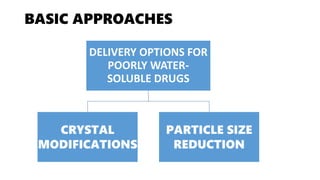
BASIC APPROACHES
DELIVERY OPTIONS FOR
POORLY WATER-
SOLUBLE DRUGS
CRYSTAL
MODIFICATIONS
PARTICLE SIZE
REDUCTION
CRYSTAL MODIFICATIONS
Metastable polymorphs
• Polymorphism in crystalline solids is defined as materials with the same chemical
composition, but different lattice structures and/or different molecular
conformations (Rodriguez-Spong et al.,2004).
• The vast majority of drugs can crystallize into several polymorphs, each
polymorph has a different energy, showing different physicochemical properties,
such as melting point, density, solubility, and stability.
Salt formation
• In the pharmaceutical industry, salt formation approach is commonly used for an
ionizable drug to increase solubility and dissolution rate. Salts are formed via
proton transfer from an acid to a base.
• The solubility and dissolution rate of salt are influenced by the counter ion
containing the salt. The solubility of haloperidol mesylate was significantly higher
than that of its hydrochloride salt at a lower pH range (Li et al., 2005). The
aqueous solubility of a moderately soluble hydrochloride salt for a basic drug is
sometimes reduced in solution containing chloride ion, such as gastric fluids
(common-ion effects). An appropriate salt form should be developed from the
viewpoints of both physicochemical and biopharmaceutical properties.
Co-crystal formation
• In recent years, much attention has been drawn to co-crystal for improving the
dissolution rate of poorly water-soluble drugs. Co-crystal is broadly defined as
crystalline materials comprised of at least two different components (Schultheiss
and Newman, 2009). Pharmaceutical co-crystal is typically composed of an API
and a nontoxic guest molecule (co-crystal former) in a stoichiometric ratio.
• Unlike salt formation, proton transfer between the API and co-crystal former does
not take place in co-crystal formation.
PARTICLE SIZE REDUCTION
Micronization
• Particle size reduction approach is widely used to increase dissolution rate as well
as salt formation. The dissolution rate of a drug proportionally increases with
increasing surface area of drug particles. Micronization approach successfully
enhanced the bioavailability of poorly water-soluble drugs such as griseofulvin,
digoxin and felodipine.
Nanocrystals
• Particle size reduction to nano-meter range (<1 m) is an attractive approach for
poorly water-soluble drugs.
• Nanocrystal formulations have been found to show 1.7–60-fold and 2–30-fold
enhancement in C-max and AUC compared with crystalline formulations with
micro-meter particle size.
• nanocrystal oral formulations using Nano-Crystal® (Elan Drug Technologies) and
IDD-P® (Skye-Pharma) technologies are available on the market
Amorphization
• Amorphous solids have higher energy than crystalline solids. Typically, the
solubility of an amorphous drug is higher than that of the corresponding
crystalline drug.
• The Amorphous formulations were found to show 1.5–82-fold and 1.6–113.5-fold
enhancements in Cmax and AUC compared with crystalline formulation.
Cyclodextrin complexation
• Cyclodextrins are oligosaccharides containing a relatively hydrophobic central
cavity and hydrophilic outer surface (Loftsson and Brewster, 1996). Cyclodextrins
and their derivatives increase the apparent solubility of poorly water-soluble
drugs by forming inclusion complexes.
Self-emulsification
• self-emulsification drug delivery systems (SEDDS) have been utilized to enhance
the oral bioavailability of poorly water-soluble drugs, especially for highly
lipophilic.
• Self-emulsification formulations are isotropic mixtures of oil, surfactant, co-
solvent, and solubilized drug.
• SEDDS are additionally classified into self-micro-emulsification drug delivery
systems (SMEDDS) and self-nano-emulsification drug delivery systems
(SNEDDS) according to the size range of their oil droplets .SMEDDS form micro-
emulsions ranging in droplet size from 100 to 250 nm. Finer micro-emulsions of
less than 100 nm can be obtained using SNEDDS
pH modification
• The pH change significantly influences the saturation solubility of an ionizable
drug by dissociation. The incorporation of pH modifiers in the dosage form can
alter the microenvironmental pH.
• The microenvironmental pH would affect the performance of the solid dosage
form, such as the chemical stability of the drug substance and the dissolution
profile
CONCLUSION
• In the preformulation research phase, approaches for improving dissolution
behaviour of drug candidates would include salt formation, co-crystal formation,
and utilization of metastable crystalline forms. In the pharmaceutical industry, it
is generally preferable to select the most thermodynamically stable crystalline
form to avoid the polymorphic transformation from metastable form to more
stable forms during manufacturing and storage.
• In the phase of formulation design, particle size reduction, amorphization,
emulsification, cyclodextrin complexation, and pH modification would be viable
formulation options to improve the dissolution behaviour of poorly water-soluble
drugs.
• effect the strategic selection of delivery options. In general, saltformation,
micronization, and pH modification in dosage forms are categorized into
conventional technologies, and other technologies, such as nanocrystal
formation, amorphization, and SEDDS, can be identified as non-conventional
technologies. These non-conventional formulations can be prepared in
laboratory-scale experiments; however, scale-up manufacturing might be
problematic.
• In conclusion, a number of delivery options have been developed for
improving the physicochemical and pharmacokinetic behaviours of
poorly water-soluble drugs in academic and industrial research. A
better understanding of the physicochemical properties of drug
substances and the limitations of each delivery option would lead to
efficient formulation development for poorly water-soluble drugs.
References
• Yohei Kawabataa, Koichi Wada, Manabu Nakatani,ShizuoYamadaa,Satomi
Onouea,‘Formulation design for poorly water-soluble drugs based on
biopharmaceutics classification system: Basic approaches and practical
applications’, International Journal of Pharmaceutics 420 (2011) 1– 10.
• Amidon, G.L., Lennernas, H., Shah, V.P., Crison, J.R., 1995. A theoretical basis
for a biopharmaceutic drug classification: the correlation of in vitro drug product
dissolution and in vivo bioavailability. Pharmaceutical Research 12, 413–420.

Formulation design for poorly water-soluble drugs based on biopharmaceutics classification system

  • 1.
    Formulation design forpoorly water- soluble drugs based on biopharmaceutics classification system Submitted by Siddhartha Mukherjee M.Pharm(Pharmaceutics) Semester-I Dept. of Pharmaceutics, Amity Institute of Pharmacy, Amity University, Noida
  • 2.
    INTRODUCTION • There aremany problems arising from the poor solubility of drug candidates in drug research and development. • The aqueous solubility of a drug is a critical determinant of its dissolution rate and bioavailability. • In such cases, dose escalation would be required until the blood drug concentration reaches the therapeutic drug concentration range which can be toxic to the GIT upon oral administration and could lead to reduction in patient compliance. • Increasing drug load might result in poor powder properties, such as poor powder flowability and sticking tendency during granulation and tableting • The poor solubility of new drug candidates might also affect in vitro assay performance in drug discovery stage.
  • 3.
    • Various approachesto overcome the poor aqueous solubility of drug candidates have been investigated in drug research and development. • Changing the chemical structure in the lead optimization phase is considered to be an option to increase the solubility of drug candidates. Prodrug approaches might also enhance the aqueous solubility of drug candidates by introducing a polar functional group into the structure of a molecule. BCS CLASSIFICATION SYSTEM • A better understanding of the physicochemical and biopharmaceutical properties of drugs would be of great help for developing pharmaceutical products. • Biopharmaceutics classification system (BCS) is a useful tool for decision- making in formulation development from a biopharmaceutical point of view (Amidon et al.,1995).
  • 4.
    • The BCScategorizes drug substances into one of four categories based on their solubility and intestinal permeability:- CLASS I-BCS class I drugs are defined as being highly soluble and highly permeable for instance, metoprolol, propranolol, and theophylline. For BCS class I drugs, there would be no rate-limiting step for oral absorption. CLASS II- The molecular characteristics of BCS class II drugs are identified as low solubility and high permeability. Example cyclosporine, griseofulvin, and itraconazole. CLASS III-Drugs with high solubility and low permeability are classified as BCS class III. Example atenolol, cimetidine, and metformin. CLASS IV-BCS class IV drugs exhibit challenging molecular properties such as low solubility and low permeability. • Recently, the concept of the BCS has been used also for formulation design from early to clinical stages (Cook et al., 2008; Ku, 2008). Classification of drug candidates based on the BCS can provide an indication of the difficulty of the development works.
  • 5.
    BASIC APPROACHES DELIVERY OPTIONSFOR POORLY WATER- SOLUBLE DRUGS CRYSTAL MODIFICATIONS PARTICLE SIZE REDUCTION
  • 6.
    CRYSTAL MODIFICATIONS Metastable polymorphs •Polymorphism in crystalline solids is defined as materials with the same chemical composition, but different lattice structures and/or different molecular conformations (Rodriguez-Spong et al.,2004). • The vast majority of drugs can crystallize into several polymorphs, each polymorph has a different energy, showing different physicochemical properties, such as melting point, density, solubility, and stability. Salt formation • In the pharmaceutical industry, salt formation approach is commonly used for an ionizable drug to increase solubility and dissolution rate. Salts are formed via proton transfer from an acid to a base.
  • 7.
    • The solubilityand dissolution rate of salt are influenced by the counter ion containing the salt. The solubility of haloperidol mesylate was significantly higher than that of its hydrochloride salt at a lower pH range (Li et al., 2005). The aqueous solubility of a moderately soluble hydrochloride salt for a basic drug is sometimes reduced in solution containing chloride ion, such as gastric fluids (common-ion effects). An appropriate salt form should be developed from the viewpoints of both physicochemical and biopharmaceutical properties. Co-crystal formation • In recent years, much attention has been drawn to co-crystal for improving the dissolution rate of poorly water-soluble drugs. Co-crystal is broadly defined as crystalline materials comprised of at least two different components (Schultheiss and Newman, 2009). Pharmaceutical co-crystal is typically composed of an API and a nontoxic guest molecule (co-crystal former) in a stoichiometric ratio. • Unlike salt formation, proton transfer between the API and co-crystal former does not take place in co-crystal formation.
  • 8.
    PARTICLE SIZE REDUCTION Micronization •Particle size reduction approach is widely used to increase dissolution rate as well as salt formation. The dissolution rate of a drug proportionally increases with increasing surface area of drug particles. Micronization approach successfully enhanced the bioavailability of poorly water-soluble drugs such as griseofulvin, digoxin and felodipine. Nanocrystals • Particle size reduction to nano-meter range (<1 m) is an attractive approach for poorly water-soluble drugs. • Nanocrystal formulations have been found to show 1.7–60-fold and 2–30-fold enhancement in C-max and AUC compared with crystalline formulations with micro-meter particle size. • nanocrystal oral formulations using Nano-Crystal® (Elan Drug Technologies) and IDD-P® (Skye-Pharma) technologies are available on the market
  • 9.
    Amorphization • Amorphous solidshave higher energy than crystalline solids. Typically, the solubility of an amorphous drug is higher than that of the corresponding crystalline drug. • The Amorphous formulations were found to show 1.5–82-fold and 1.6–113.5-fold enhancements in Cmax and AUC compared with crystalline formulation. Cyclodextrin complexation • Cyclodextrins are oligosaccharides containing a relatively hydrophobic central cavity and hydrophilic outer surface (Loftsson and Brewster, 1996). Cyclodextrins and their derivatives increase the apparent solubility of poorly water-soluble drugs by forming inclusion complexes.
  • 10.
    Self-emulsification • self-emulsification drugdelivery systems (SEDDS) have been utilized to enhance the oral bioavailability of poorly water-soluble drugs, especially for highly lipophilic. • Self-emulsification formulations are isotropic mixtures of oil, surfactant, co- solvent, and solubilized drug. • SEDDS are additionally classified into self-micro-emulsification drug delivery systems (SMEDDS) and self-nano-emulsification drug delivery systems (SNEDDS) according to the size range of their oil droplets .SMEDDS form micro- emulsions ranging in droplet size from 100 to 250 nm. Finer micro-emulsions of less than 100 nm can be obtained using SNEDDS pH modification • The pH change significantly influences the saturation solubility of an ionizable drug by dissociation. The incorporation of pH modifiers in the dosage form can alter the microenvironmental pH. • The microenvironmental pH would affect the performance of the solid dosage form, such as the chemical stability of the drug substance and the dissolution profile
  • 11.
    CONCLUSION • In thepreformulation research phase, approaches for improving dissolution behaviour of drug candidates would include salt formation, co-crystal formation, and utilization of metastable crystalline forms. In the pharmaceutical industry, it is generally preferable to select the most thermodynamically stable crystalline form to avoid the polymorphic transformation from metastable form to more stable forms during manufacturing and storage. • In the phase of formulation design, particle size reduction, amorphization, emulsification, cyclodextrin complexation, and pH modification would be viable formulation options to improve the dissolution behaviour of poorly water-soluble drugs. • effect the strategic selection of delivery options. In general, saltformation, micronization, and pH modification in dosage forms are categorized into conventional technologies, and other technologies, such as nanocrystal formation, amorphization, and SEDDS, can be identified as non-conventional technologies. These non-conventional formulations can be prepared in laboratory-scale experiments; however, scale-up manufacturing might be problematic.
  • 12.
    • In conclusion,a number of delivery options have been developed for improving the physicochemical and pharmacokinetic behaviours of poorly water-soluble drugs in academic and industrial research. A better understanding of the physicochemical properties of drug substances and the limitations of each delivery option would lead to efficient formulation development for poorly water-soluble drugs.
  • 13.
    References • Yohei Kawabataa,Koichi Wada, Manabu Nakatani,ShizuoYamadaa,Satomi Onouea,‘Formulation design for poorly water-soluble drugs based on biopharmaceutics classification system: Basic approaches and practical applications’, International Journal of Pharmaceutics 420 (2011) 1– 10. • Amidon, G.L., Lennernas, H., Shah, V.P., Crison, J.R., 1995. A theoretical basis for a biopharmaceutic drug classification: the correlation of in vitro drug product dissolution and in vivo bioavailability. Pharmaceutical Research 12, 413–420.