Drug Development &
      Biotechnology

   Case Study for PCR901
      November 16, 2011
    Karen, Nichole & Zinia
Outline

 • Introduction
 • Departmental / Team Structure
     – Organogram
 •   Business Model
 •   Research Interests
 •   Services Offered
 •   Project Team Composition
 •   The Legendary Case Study
 •   Challenges & Rewards
Introduction: Biologics and Biopharmaceuticals

 • Biotechnology
    – The use of living organisms and bioprocesses in
      engineering, technology, medicine and other fields
      requiring bioproducts.
 • Biopharmaceutical
    – A medical drug derived from biological sources and
      produced by biotechnology.
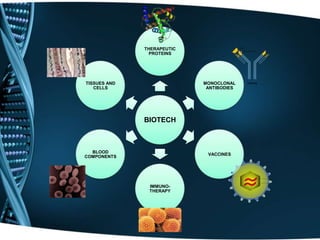
THERAPEUTIC
                PROTEINS


TISSUES AND                 MONOCLONAL
   CELLS                     ANTIBODIES


              BIOTECH


  BLOOD
                             VACCINES
COMPONENTS


               IMMUNO-
               THERAPY
BUSINESS MODEL
“One of the biggest challenges for the
biotechnology and pharmaceutical
companies in the 21st century will be
to develop and deliver drugs that fit
the individual patient’s biology and
pathophysiology”
                   Jan Trost Jorgensen
              principal scientist at Dako
Traditional Business Model

 • Searching for the “Blockbusters”
 • Closed Innovation model
 • a.k.a. the FIPCOs (Fully Integrated
   Pharmaceutical Companies)
    – Majority of research is conducted internally
    – Firms conduct basic research, confident that
      they have downstream manufacturing and
      commercialization capabilities
    – Accidental (serendipitous) discoveries that did
      not fit with corporate therapeutic interests were
      most often cancelled
Traditional Business Model

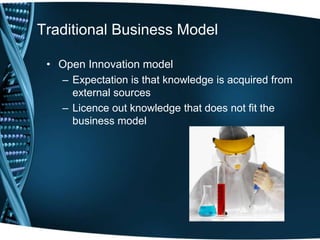
 • Open Innovation model
   – Expectation is that knowledge is acquired from
     external sources
   – Licence out knowledge that does not fit the
     business model
Contemporary Business Model

 • Large pharma:
   – In house development, manufacturing, marketing and
     sales;
   – Some with generic/biosimilar subdivisions
 • Medium pharma:
   – Outsource one or more components, retain in house
     marketing and sales
 • Small pharma:
   – Bring in products researched, developed and
     manufactured elsewhere
   – Simply register, import / acquire, store and distribute
Biotechnology Industry

 • Company size by number of employees (%)

    Size               Percentage
    1 – 20             28.1%
    21 – 50            19.8%
    51 – 100           11.9%
    101 – 200          9.9%
    201 – 400          4.1%
    401+               6.2%
SERVICES OFFERED
• Pre-Clinical & Clinical
  Development
• Registration
  Submissions & Support
• GxP (GMP, GCP, CLP)
  & Regulatory
  Consultancy
• CRO Qualification
• Preparatory regulatory
  audits
• Due Diligence Audits
Typical Areas of Product Development

 •   Vaccines
 •   Peptides and Proteins
 •   Follow On Biologics
 •   Natural Products
 •   Transdermals
 •   Radionucleotides
 •   Osteopathic Devices
 •   In-vitro Diagnostic Reagents
RESEARCH INTERESTS
Growing Importance of Biotech
Medicine
 • Proven to be safe and effective
 • Biotechnology has produced more than 125
   medicines
 • Treatment for some of the most serious and
   intractable diseases
 • In 2008:
    – 633 biotech medicines in development
    – 254 for cancer and related conditions
    – 162 for infectious diseases
 • Full therapeutic potential can take time to be
   realized; new treatment advances are often realized
   after product has been on the market for some time
Drug Discovery Research
On going Research Topics
Specific Research

 Erythropoeteins:
 • The hormone responsible for producing red blood
   cells in bonemarrow
 • Most common use in people with anemia related
   to kidney disfunction
 • Drugs Epoitin alpha ( Epogen, Procrit)
 • Darbepoetin alpha (Aranesp)
Specific Research

 Monoclonal antibodies
 • The newest one approved is Rituximab (Rituxan)
 • Several monoclonal anibodies are being
   researched for treating rheumatoid arthritis (RA)
   and other conditions
 • Anticancer and immunological therapies using
   monoclonal antibodies are being a focus of
   reseach
Current Research Focus


                       Long Term
                       conditions


   Genetic
 Engineering                                 Oncology
                    Biotechnology
                       current


     Gene therapy                   Infectious
                                     diseases
PROJECT TEAM COMPOSITION
Project Team Composition

 • Clinicians
 • Pharmaceutical
   Scientists
 • Regulatory Strategists
 • Business
   Development Experts
 • Market Analysts
DEPARTMENTAL / TEAM
STRUCTURE
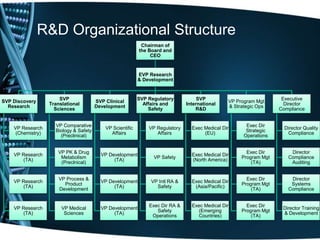
R&D Organizational Structure
                                                             Chairman of
                                                            the Board and
                                                                 CEO


                                                            EVP Research
                                                            & Development


                       SVP                                  SVP Regulatory           SVP                             Executive
SVP Discovery                           SVP Clinical                                             VP Program Mgt
                   Translational                              Affairs and       International                         Director
  Research                              Development                                              & Strategic Ops
                     Sciences                                   Safety              R&D                             Compliance


                     VP Comparative                                                                     Exec Dir
    VP Research                             VP Scientific       VP Regulatory     Exec Medical Dir                    Director Quality
                     Biology & Safety                                                                   Strategic
     (Chemistry)                              Affairs              Affairs             (EU)                            Compliance
                       (Preclinical)                                                                   Operations


                      VP PK & Drug                                                                      Exec Dir        Director
    VP Research                           VP Development                          Exec Medical Dir
                       Metabolism                                 VP Safety                           Program Mgt      Compliance
        (TA)                                   (TA)                               (North America)
                       (Preclnical)                                                                       (TA)          Auditing


                       VP Process &                                                                     Exec Dir        Director
    VP Research                           VP Development         VP Intl RA &     Exec Medical Dir
                         Product                                                                      Program Mgt       Systems
        (TA)                                   (TA)                Safety          (Asia/Pacific)
                       Development                                                                        (TA)         Compliance


                                                                Exec Dir RA &     Exec Medical Dir      Exec Dir
    VP Research         VP Medical        VP Development                                                             Director Training
                                                                   Safety           (Emerging         Program Mgt
        (TA)             Sciences              (TA)                                                                  & Development
                                                                 Operations          Countries)           (TA)
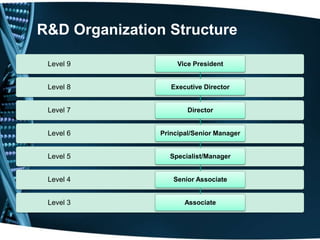
R&D Organization Structure

 Level 9             Vice President


 Level 8           Executive Director


 Level 7                Director


 Level 6        Principal/Senior Manager


 Level 5          Specialist/Manager


 Level 4           Senior Associate


 Level 3               Associate
CASE STUDY
New Product Development


                    Drug
Drug Discovery                 Commercialization
                 Development
New Product Development


                    Drug
Drug Discovery                 Commercialization
                 Development
Drug Discovery

 • Project Procurement
   – Identify unmet medical need
   – What is known about the disease?
   – What are the current treatment options, if any?
   – Does the company have the expertise, technology
     and financial resources?
   – Potential competitors and regulatory constraints?
Drug Discovery

Top 5 Death Causing Diseases in 2005 (NCHS)
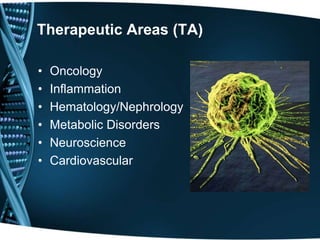
Therapeutic Areas (TA)

•   Oncology
•   Inflammation
•   Hematology/Nephrology
•   Metabolic Disorders
•   Neuroscience
•   Cardiovascular
Drug Discovery

Research Interest
  Target Discovery
    Target Validation
      Screening
        Drug Design
New Product Development


                    Drug
Drug Discovery                 Commercialization
                 Development
Drug Development
                        Preclinical
                         studies


                          Clinical
                       Study: Phase
                              I


       Post-Market                       Clinical
       Surveillance:                  Study: Phase
         Phase IV                           II


                         Clinical
                          Study:
                         Phase III
Product Pipeline: Phase I
        Product Name   Product Modality      Therapeutic Area
   1    AMG139         Antibody              Inflammatory Diseases
   2    AMG145         Antibody              Hypercholesterolemia
   3    AMG151         Oral/Small Molecule   Type II Diabetes
   4    AMG157         Antibody              Asthma
   5    AMG167         Antibody              Bone-Related Conditions
   6    AMG181         Antibody              Ulcerative Colitis
   7    AMG191         Antibody              Inflammatory Diseases
   8    AMG208         Oral/Small Molecule   Various Cancer Types
   9    AMG319         Oral/Small Molecule   Hematologic Malignancies
   10   AMG337         Oral/Small Molecule   Various Cancer Types
Product Pipeline: Phase I (cont'd..)
        Product Name   Product Modality      Therapeutic Area
   11   AMG557         Antibody              Lupus
   12   AMG745         Protein               Muscle-Wasting Disorder

   13   AMG747         Oral/Small Molecule   Neuroscience
   14   AMG761         Antibody              Asthma
   15   AMG780         Antibody              Various Cancer Types
   16   AMG811         Antibody              Lupus
   17   AMG820         Antibody              Various Cancer Types
   18   AMG888         Antibody              Various Cancer Types

   19   AMG900         Oral/Small Molecule   Various Cancer Types

   20   Dulanermin     Protein               Various Cancer Types
Product Pipeline: Phase II
        Product Name   Product Modality      Therapeutic Area
   1    AMG386         Protein               Various Cancer Types

   2    AMG785         Antibody              Bone-Related Conditions
   3    AMG827         Antibody              Inflammatory Diseases
   4    AMG853         Oral/Small Molecule   Asthma
   5    Conatumumab    Antibody              Various Cancer Types
   6    Denosumab      Antibody              Rheumatoid Arthritis
   7    Ganitumab      Antibody              Various Cancer Types
   8    Motesanib      Oral/Small Molecule   Breast Cancer
   9    Nplate®        Protein               Thrombocytopenia
   10   Nplate®        Protein               Myelodysplastic
                                             Syndromes
Product Pipeline: Phase II (cont'd..)
        Product Name          Product Modality      Therapeutic Area
   11   Omecamtiv mercarbil   Oral/Small Molecule   Heart Failure
   12   Rilotumumab           Antibody              Various Cancer Types
   13   Sensipar®             Oral/Small Molecule   Post Renal Transplant
   14   Vectibix®             Antibody              Head and Neck Cancer
Product Pipeline: Phase III
        Product Name   Product Modality       Therapeutic Area
    1   AMG386         Protein                Ovarian Cancer
    2   Anaresp®       Protein                Anemia in Heart Failure
    3   Ganitumab      Antibody               Pancreatic Cancer
    4   Motesanib      Oral/Small Molecules   Lung Cancer
    5   Prolia®        Antibody               Male Osteoporosis
    6   Sensipar®      Oral/Small Molecules   Cardiovascular Disease
                                              and Chronic Kidney
                                              Disease
    7   Vectibix®      Antibody               Colorectal Cancer
    8   XGEVA™         Antbody                Bone Metastases in
                                              Breast Cancer
    9   XGEVA™         Antibody               Bone Metastases in
                                              Prostate Canacer
Marketed Products: Phase IV
      Product Name
 1    Anaresp® (darbepoetin alfa)
 2    Enbrel® (etanercept)
 3    EPOGEN® (Epoetin alfa)
 4    Neulasta® (pegfilgrastin)
 5    NEUPOGEN® (Filgrastim)
 6    Nplate® (romiplostim)
 7    Prolia™ (denosumab)
 8    Sensipar® (cinacalcet)
 9    Vectibix® (denosumab)
 10   XGEVA™ (denosumab)
CHALLENGES & REWARDS
Challenges and Resolutions

 •   More Expensive
 •   Biosimilar Verification
 •   Small molecule vs Large molecule therapies
 •   Required comprehensive immunogenecity testing
 •   Extended post market surveillance
 •   Sterile Environment requirement
 •   Batch-to-batch release – Section 12 of the ACT
Manufacturing techniques for cost
reduction
 • Portable clean room technology
 • The use of cell culture perfusion for production of
   antibodies
 • Sequential micro column chromatography
 • Extensive use of inline dilution of buffer
   concentrates
Advantages

 • Stem cell therapies have the ability to eliminate
   concerns over viral or prion contamination prior to
   organ replacement
 • Biopharmaceuticals have fewer side effects and
   more potent effects on target cells
 • Pharmaceutical biotechnology is being further
   developed to fight cancer, viral infections,
   diabetes and hepatitis
 • Safer and more effective antibiotics, insulins,
   interferons, estrogen and human growth
   hormones are being developed
Conclusions

 • Globally, Canada ranks 2nd in number of biotech
   companies and spends the most on R&D per
   employee1
 • Some slowdown in venture capital since decline
   of Harvard oncomouse patent
 • Significant growth in Quebec, Ontario and BC;
   biotechnology is the place to be for up-and-
   coming innovators


 1Statistics   Canada; http://www.nature.com/bioent/2004/040501/full/bioent810.html
Questions & Comments?

Drug development & biotechnology

  • 1.
    Drug Development & Biotechnology Case Study for PCR901 November 16, 2011 Karen, Nichole & Zinia
  • 2.
    Outline • Introduction • Departmental / Team Structure – Organogram • Business Model • Research Interests • Services Offered • Project Team Composition • The Legendary Case Study • Challenges & Rewards
  • 3.
    Introduction: Biologics andBiopharmaceuticals • Biotechnology – The use of living organisms and bioprocesses in engineering, technology, medicine and other fields requiring bioproducts. • Biopharmaceutical – A medical drug derived from biological sources and produced by biotechnology.
  • 4.
    THERAPEUTIC PROTEINS TISSUES AND MONOCLONAL CELLS ANTIBODIES BIOTECH BLOOD VACCINES COMPONENTS IMMUNO- THERAPY
  • 5.
  • 6.
    “One of thebiggest challenges for the biotechnology and pharmaceutical companies in the 21st century will be to develop and deliver drugs that fit the individual patient’s biology and pathophysiology” Jan Trost Jorgensen principal scientist at Dako
  • 7.
    Traditional Business Model • Searching for the “Blockbusters” • Closed Innovation model • a.k.a. the FIPCOs (Fully Integrated Pharmaceutical Companies) – Majority of research is conducted internally – Firms conduct basic research, confident that they have downstream manufacturing and commercialization capabilities – Accidental (serendipitous) discoveries that did not fit with corporate therapeutic interests were most often cancelled
  • 8.
    Traditional Business Model • Open Innovation model – Expectation is that knowledge is acquired from external sources – Licence out knowledge that does not fit the business model
  • 9.
    Contemporary Business Model • Large pharma: – In house development, manufacturing, marketing and sales; – Some with generic/biosimilar subdivisions • Medium pharma: – Outsource one or more components, retain in house marketing and sales • Small pharma: – Bring in products researched, developed and manufactured elsewhere – Simply register, import / acquire, store and distribute
  • 10.
    Biotechnology Industry •Company size by number of employees (%) Size Percentage 1 – 20 28.1% 21 – 50 19.8% 51 – 100 11.9% 101 – 200 9.9% 201 – 400 4.1% 401+ 6.2%
  • 11.
  • 12.
    • Pre-Clinical &Clinical Development • Registration Submissions & Support • GxP (GMP, GCP, CLP) & Regulatory Consultancy • CRO Qualification • Preparatory regulatory audits • Due Diligence Audits
  • 13.
    Typical Areas ofProduct Development • Vaccines • Peptides and Proteins • Follow On Biologics • Natural Products • Transdermals • Radionucleotides • Osteopathic Devices • In-vitro Diagnostic Reagents
  • 14.
  • 15.
    Growing Importance ofBiotech Medicine • Proven to be safe and effective • Biotechnology has produced more than 125 medicines • Treatment for some of the most serious and intractable diseases • In 2008: – 633 biotech medicines in development – 254 for cancer and related conditions – 162 for infectious diseases • Full therapeutic potential can take time to be realized; new treatment advances are often realized after product has been on the market for some time
  • 16.
  • 17.
  • 18.
    Specific Research Erythropoeteins: • The hormone responsible for producing red blood cells in bonemarrow • Most common use in people with anemia related to kidney disfunction • Drugs Epoitin alpha ( Epogen, Procrit) • Darbepoetin alpha (Aranesp)
  • 19.
    Specific Research Monoclonalantibodies • The newest one approved is Rituximab (Rituxan) • Several monoclonal anibodies are being researched for treating rheumatoid arthritis (RA) and other conditions • Anticancer and immunological therapies using monoclonal antibodies are being a focus of reseach
  • 20.
    Current Research Focus Long Term conditions Genetic Engineering Oncology Biotechnology current Gene therapy Infectious diseases
  • 21.
  • 22.
    Project Team Composition • Clinicians • Pharmaceutical Scientists • Regulatory Strategists • Business Development Experts • Market Analysts
  • 23.
  • 24.
    R&D Organizational Structure Chairman of the Board and CEO EVP Research & Development SVP SVP Regulatory SVP Executive SVP Discovery SVP Clinical VP Program Mgt Translational Affairs and International Director Research Development & Strategic Ops Sciences Safety R&D Compliance VP Comparative Exec Dir VP Research VP Scientific VP Regulatory Exec Medical Dir Director Quality Biology & Safety Strategic (Chemistry) Affairs Affairs (EU) Compliance (Preclinical) Operations VP PK & Drug Exec Dir Director VP Research VP Development Exec Medical Dir Metabolism VP Safety Program Mgt Compliance (TA) (TA) (North America) (Preclnical) (TA) Auditing VP Process & Exec Dir Director VP Research VP Development VP Intl RA & Exec Medical Dir Product Program Mgt Systems (TA) (TA) Safety (Asia/Pacific) Development (TA) Compliance Exec Dir RA & Exec Medical Dir Exec Dir VP Research VP Medical VP Development Director Training Safety (Emerging Program Mgt (TA) Sciences (TA) & Development Operations Countries) (TA)
  • 25.
    R&D Organization Structure Level 9 Vice President Level 8 Executive Director Level 7 Director Level 6 Principal/Senior Manager Level 5 Specialist/Manager Level 4 Senior Associate Level 3 Associate
  • 26.
  • 27.
    New Product Development Drug Drug Discovery Commercialization Development
  • 28.
    New Product Development Drug Drug Discovery Commercialization Development
  • 29.
    Drug Discovery •Project Procurement – Identify unmet medical need – What is known about the disease? – What are the current treatment options, if any? – Does the company have the expertise, technology and financial resources? – Potential competitors and regulatory constraints?
  • 30.
    Drug Discovery Top 5Death Causing Diseases in 2005 (NCHS)
  • 31.
    Therapeutic Areas (TA) • Oncology • Inflammation • Hematology/Nephrology • Metabolic Disorders • Neuroscience • Cardiovascular
  • 32.
    Drug Discovery Research Interest Target Discovery Target Validation Screening Drug Design
  • 33.
    New Product Development Drug Drug Discovery Commercialization Development
  • 34.
    Drug Development Preclinical studies Clinical Study: Phase I Post-Market Clinical Surveillance: Study: Phase Phase IV II Clinical Study: Phase III
  • 35.
    Product Pipeline: PhaseI Product Name Product Modality Therapeutic Area 1 AMG139 Antibody Inflammatory Diseases 2 AMG145 Antibody Hypercholesterolemia 3 AMG151 Oral/Small Molecule Type II Diabetes 4 AMG157 Antibody Asthma 5 AMG167 Antibody Bone-Related Conditions 6 AMG181 Antibody Ulcerative Colitis 7 AMG191 Antibody Inflammatory Diseases 8 AMG208 Oral/Small Molecule Various Cancer Types 9 AMG319 Oral/Small Molecule Hematologic Malignancies 10 AMG337 Oral/Small Molecule Various Cancer Types
  • 36.
    Product Pipeline: PhaseI (cont'd..) Product Name Product Modality Therapeutic Area 11 AMG557 Antibody Lupus 12 AMG745 Protein Muscle-Wasting Disorder 13 AMG747 Oral/Small Molecule Neuroscience 14 AMG761 Antibody Asthma 15 AMG780 Antibody Various Cancer Types 16 AMG811 Antibody Lupus 17 AMG820 Antibody Various Cancer Types 18 AMG888 Antibody Various Cancer Types 19 AMG900 Oral/Small Molecule Various Cancer Types 20 Dulanermin Protein Various Cancer Types
  • 37.
    Product Pipeline: PhaseII Product Name Product Modality Therapeutic Area 1 AMG386 Protein Various Cancer Types 2 AMG785 Antibody Bone-Related Conditions 3 AMG827 Antibody Inflammatory Diseases 4 AMG853 Oral/Small Molecule Asthma 5 Conatumumab Antibody Various Cancer Types 6 Denosumab Antibody Rheumatoid Arthritis 7 Ganitumab Antibody Various Cancer Types 8 Motesanib Oral/Small Molecule Breast Cancer 9 Nplate® Protein Thrombocytopenia 10 Nplate® Protein Myelodysplastic Syndromes
  • 38.
    Product Pipeline: PhaseII (cont'd..) Product Name Product Modality Therapeutic Area 11 Omecamtiv mercarbil Oral/Small Molecule Heart Failure 12 Rilotumumab Antibody Various Cancer Types 13 Sensipar® Oral/Small Molecule Post Renal Transplant 14 Vectibix® Antibody Head and Neck Cancer
  • 39.
    Product Pipeline: PhaseIII Product Name Product Modality Therapeutic Area 1 AMG386 Protein Ovarian Cancer 2 Anaresp® Protein Anemia in Heart Failure 3 Ganitumab Antibody Pancreatic Cancer 4 Motesanib Oral/Small Molecules Lung Cancer 5 Prolia® Antibody Male Osteoporosis 6 Sensipar® Oral/Small Molecules Cardiovascular Disease and Chronic Kidney Disease 7 Vectibix® Antibody Colorectal Cancer 8 XGEVA™ Antbody Bone Metastases in Breast Cancer 9 XGEVA™ Antibody Bone Metastases in Prostate Canacer
  • 40.
    Marketed Products: PhaseIV Product Name 1 Anaresp® (darbepoetin alfa) 2 Enbrel® (etanercept) 3 EPOGEN® (Epoetin alfa) 4 Neulasta® (pegfilgrastin) 5 NEUPOGEN® (Filgrastim) 6 Nplate® (romiplostim) 7 Prolia™ (denosumab) 8 Sensipar® (cinacalcet) 9 Vectibix® (denosumab) 10 XGEVA™ (denosumab)
  • 41.
  • 42.
    Challenges and Resolutions • More Expensive • Biosimilar Verification • Small molecule vs Large molecule therapies • Required comprehensive immunogenecity testing • Extended post market surveillance • Sterile Environment requirement • Batch-to-batch release – Section 12 of the ACT
  • 43.
    Manufacturing techniques forcost reduction • Portable clean room technology • The use of cell culture perfusion for production of antibodies • Sequential micro column chromatography • Extensive use of inline dilution of buffer concentrates
  • 44.
    Advantages • Stemcell therapies have the ability to eliminate concerns over viral or prion contamination prior to organ replacement • Biopharmaceuticals have fewer side effects and more potent effects on target cells • Pharmaceutical biotechnology is being further developed to fight cancer, viral infections, diabetes and hepatitis • Safer and more effective antibiotics, insulins, interferons, estrogen and human growth hormones are being developed
  • 45.
    Conclusions • Globally,Canada ranks 2nd in number of biotech companies and spends the most on R&D per employee1 • Some slowdown in venture capital since decline of Harvard oncomouse patent • Significant growth in Quebec, Ontario and BC; biotechnology is the place to be for up-and- coming innovators 1Statistics Canada; http://www.nature.com/bioent/2004/040501/full/bioent810.html
  • 46.

Editor's Notes

  • #5 Immunotheraphy = can be suppression immunotherapy (allergy products) or activation immunotherapy (cancer products)Tissues and cells = transplantationBlood and blood components = e.g. clotting factorsHuman cells or tissue intended for implantation, transplantation, infusion, or transfer into a human recipient = e.g. bone, skin, corneas, ligaments, tendons, dura mater, heart valves, hematopoietic stem/progenitor cells derived from peripheral and cord blood, oocytes and semen.
  • #6 IMAGE
  • #7 Dako – leading the way in cancer diagnostics
  • #11 Small biotech companies usually derived from universitiesLarge companies such as Genentech, Amgen, Biogen Idec
  • #13 Pre-Clinical & Clinical Development provide Legal strategies and patent development, Clinical protocol development and study designs for phases I through IV, BA and BE clinical approaches and protocol development, PK / PD modeling and simulation, Medical writing, Biostatistical and statistical approaches, Formulation and process evaluation.Registration Submissions & Support provide support with many regulatory submissions. Including IND/NDS, DMF, Annual Reports, PSUR, NDA, BLA, PMA, ANDA, eCTD etc.GxP (GMP, GCP, GLP) & Regulatory Consultancy provide advice to clients on a range of regulatory & technical issues. As well as implementation of quality management systems, Advice on legal and regulatory issues including Patent challenges, Citizen’s petitions, Litigation, and assisting with responses to regulatory inspectionsCRO QualificationHelp acquire an appropriate contract research organization (CRO) or by performing audits to specified GxP standard. Assess potential contract services for Clinical supplies, Production, Packaging, Testing etc.Preparatory regulatory auditsHelp prepare for regulatory inspection by conducting one or more “practice” regulatory audits in advance of the pending “actual” Health Canada, FDA, EMEA, etc. regulatory visit.Due Diligence Audits Assist pharmaceutical companies, investment banks & private venture capitalists in the process of due diligence for potential acquisitions, buy-ins, joint ventures & other investment projects. We perform in-depth assessment of the regulatory compliance status of companies or projects.
  • #16 Get an example of one product that may have multiple indications – Enbrel?
  • #17 Identifying, cutting out and pasting in various genes to create an “expression vector”The expression vector creates RNA from the genetically engineered DNA of the expression vector The protein(s) of interest is made from RNAThe proteins are biopharmaceuticals.
  • #18 Oncology studies is the biggest focus in this sector due to severity of cancers in modern societyInsulin therapies are the second focus in this sector
  • #21 Biopharmaceutical companies are changing their long term focus on long term conditions, such as, cardiovascular disease, diabetes and asthmaGene therapy and genetic engineering development would influence the potential of biopharmaceuticals.
  • #23 Expertise?
  • #31 NCHS = National Center for Health Sciences
  • #36 21 Products
  • #37 21
  • #38 14
  • #40 9
  • #41 AS = Ankylosing Spondylitis