Presentation over image smoothing
                    and sharpening

              -Vinay Kumar Gupta
                      0700410088
What is a Digital Image?
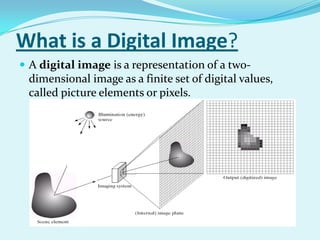
 A digital image is a representation of a two-
 dimensional image as a finite set of digital values,
 called picture elements or pixels.
Why Digital Image Processing?
Digital image processing focuses on two major tasks:

   Improvement of pictorial information for human
    interpretation.

   Processing of image data for storage, transmission and
    representation for autonomous machine perception
Applications:
The use of digital image processing techniques has
exploded and they are now used for all kinds of tasks in
all kinds of areas:
   Image enhancement/restoration
   Artistic effects
   Medical visualisation
   Industrial inspection
   Law enforcement
   Human computer interfaces
Examples: The Hubble Telescope
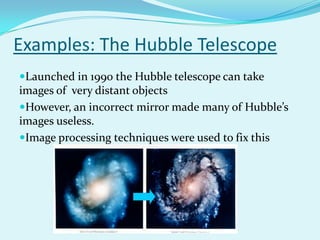
Launched in 1990 the Hubble telescope can take
images of very distant objects
However, an incorrect mirror made many of Hubble’s
images useless.
Image processing techniques were used to fix this
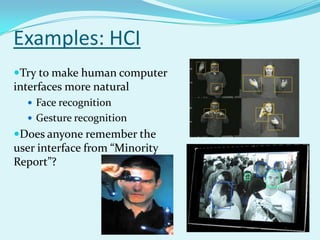
Examples: HCI
Try to make human computer
interfaces more natural
   Face recognition
   Gesture recognition
Does anyone remember the
user interface from “Minority
Report”?
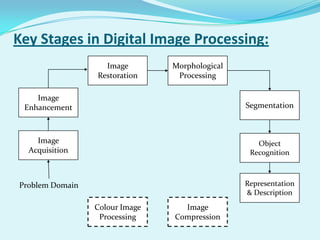
Key Stages in Digital Image Processing:
                   Image        Morphological
                 Restoration     Processing

    Image
 Enhancement                                    Segmentation


    Image                                          Object
  Acquisition                                    Recognition


Problem Domain                                  Representation
                                                & Description
                 Colour Image     Image
                  Processing    Compression
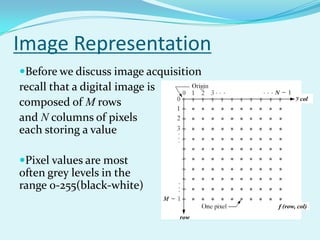
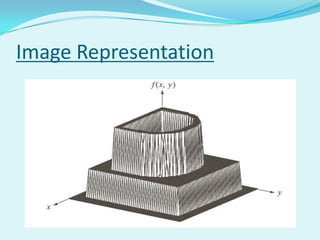
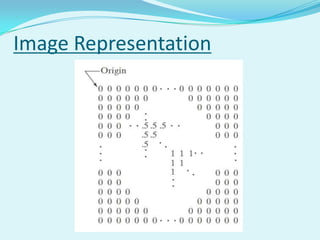
Image Representation
Before we discuss image acquisition
recall that a digital image is
                                                col
composed of M rows
and N columns of pixels
each storing a value

Pixel values are most
often grey levels in the
range 0-255(black-white)
                                       f (row, col)
                                 row
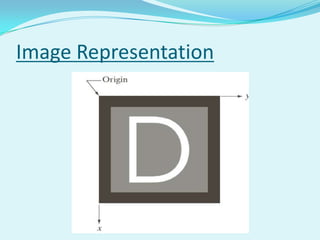
Image Representation
What Is Image Enhancement?
Image enhancement is the process of making images
more useful
The reasons for doing this include:
   Highlighting interesting detail in images
   Removing noise from images
   Making images more visually appealing
Spatial & Frequency Domains
There are two broad categories of image enhancement
techniques
   Spatial domain techniques
       Direct manipulation of image pixels
   Frequency domain techniques
       Manipulation of Fourier transform or wavelet transform of an
        image
For the moment we will concentrate on techniques that
operate in the spatial domain
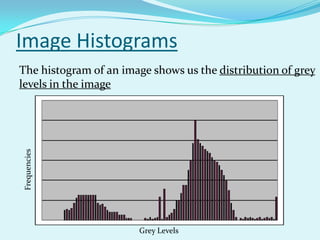
Image Histograms
The histogram of an image shows us the distribution of grey
levels in the image
 Frequencies


                       Grey Levels
Spatial filtering techniques:
  Neighbourhood operations
  What is spatial filtering?
  Smoothing operations
  What happens at the edges?
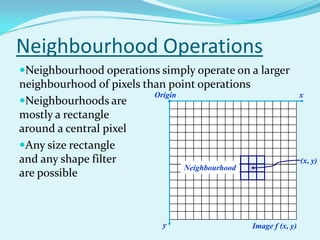
Neighbourhood Operations
Neighbourhood operations simply operate on a larger
neighbourhood of pixels than point operations
                          Origin                                  x
Neighbourhoods are
mostly a rectangle
around a central pixel
Any size rectangle
and any shape filter                                              (x, y)
                                 Neighbourhood
are possible


                            y                    Image f (x, y)
Simple Neighbourhood Operations
Some simple neighbourhood operations include:
   Min:
     Set the pixel value to the minimum in the neighbourhood
   Max:
      Set the pixel value to the maximum in the neighbourhood
   Median:
       The median value of a set of numbers is the midpoint value
    in that set (e.g. from the set [1, 7, 15, 18, 24] 15 is the median).
    Sometimes the median works better than the average
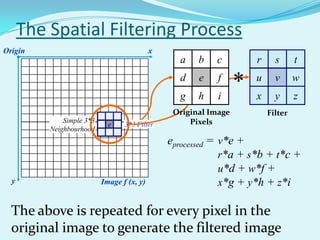
The Spatial Filtering Process
Origin                                      x
                                                  a    b   c          r     s      t
                                                  d
                                                  g
                                                       e
                                                       h
                                                            f
                                                            i
                                                                  *   u
                                                                      x
                                                                            v
                                                                            y
                                                                                   w
                                                                                   z
                                                 Original Image           Filter
              Simple 3*3                             Pixels
                             e    3*3 Filter
          Neighbourhood
                                                eprocessed = v*e +
                                                             r*a + s*b + t*c +
                                                             u*d + w*f +
  y                        Image f (x, y)                    x*g + y*h + z*i

  The above is repeated for every pixel in the
  original image to generate the filtered image
Smoothing Spatial Filters
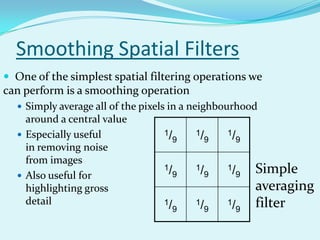
 One of the simplest spatial filtering operations we
can perform is a smoothing operation
   Simply average all of the pixels in a neighbourhood
    around a central value
   Especially useful             1/       1/       1/
                                       9        9        9
    in removing noise
    from images
   Also useful for
                                  1/
                                       9
                                           1/
                                                9
                                                    1/
                                                         9   Simple
    highlighting gross                                       averaging
    detail                        1/       1/       1/       filter
                                       9        9        9
Smoothing Spatial Filtering
Origin                                               x
                                                             104 100 108         1/        1/       1/
                                                                                      9         9        9
                                                                                 1/        1/       1/
                                                              99 106 98

                                                              95   90   85
                                                                             *   1/
                                                                                      9
                                                                                           1/
                                                                                                9
                                                                                                    1/
                                                                                                         9

                                                                                      9         9        9

                          1/  1/  1/
                          104 100 108
                                                          Original Image                  Filter
                            9   9   9
             Simple 3*3   1/
                           99 106 198
                              1/   /9
                                            3*3 Smoothing     Pixels
                            9   9
         Neighbourhood    195
                           /9   1/
                                90    185
                                       /9
                                            Filter
                                  9

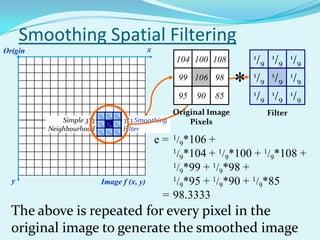
                                                         e = 1/9*106 +
                                                             1/ *104 + 1/ *100 + 1/ *108 +
                                                               9          9        9
                                                             1/ *99 + 1/ *98 +
                                                               9        9
  y                        Image f (x, y)                    1/ *95 + 1/ *90 + 1/ *85
                                                               9        9        9
                                                           = 98.3333
  The above is repeated for every pixel in the
  original image to generate the smoothed image
Sharpening Spatial Filters
Previously we have looked at smoothing filters which
remove fine detail
Sharpening spatial filters seek to highlight fine detail
   Remove blurring from images
   Highlight edges
Sharpening filters are based on spatial differentiation
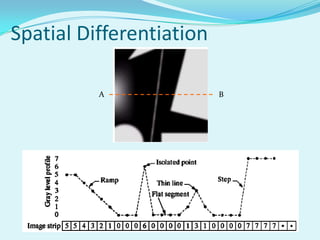
Spatial Differentiation
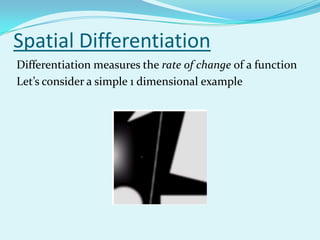
Differentiation measures the rate of change of a function
Let’s consider a simple 1 dimensional example
Spatial Differentiation

          A               B
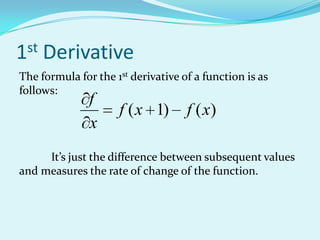
1st   Derivative
The formula for the 1st derivative of a function is as
follows:
               f
                     f ( x 1)       f ( x)
               x
     It’s just the difference between subsequent values
and measures the rate of change of the function.
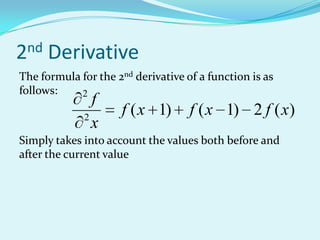
2nd   Derivative
The formula for the 2nd derivative of a function is as
follows:    2
               f
             2
                     f ( x 1)       f ( x 1) 2 f ( x)
               x
Simply takes into account the values both before and
after the current value
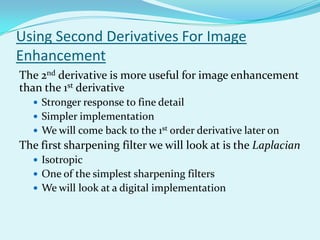
Using Second Derivatives For Image
Enhancement
The 2nd derivative is more useful for image enhancement
than the 1st derivative
   Stronger response to fine detail
   Simpler implementation
   We will come back to the 1st order derivative later on
The first sharpening filter we will look at is the Laplacian
   Isotropic
   One of the simplest sharpening filters
   We will look at a digital implementation
The Laplacian
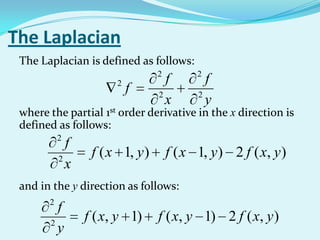
 The Laplacian is defined as follows:
                                 2         2
                       2           f         f
                           f     2         2
                                   x         y
 where the partial 1st order derivative in the x direction is
 defined as follows:
           2
             f
           2
                  f ( x 1, y )       f ( x 1, y ) 2 f ( x, y )
             x
 and in the y direction as follows:
       2
         f
       2
                 f ( x, y 1)     f ( x, y 1) 2 f ( x, y )
         y
The Laplacian (cont…)
 So, the Laplacian can be given as follows:
     2
         f   [ f ( x 1, y ) f ( x 1, y )
                  f ( x, y 1) f ( x, y 1)]
                 4 f ( x, y)
 We can easily build a filter based on this

                       0    1    0

                       1    -4    1

                       0    1    0
The Laplacian (cont…)
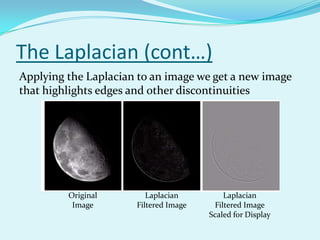
Applying the Laplacian to an image we get a new image
that highlights edges and other discontinuities


         Original        Laplacian         Laplacian
          Image       Filtered Image    Filtered Image
                                       Scaled for Display
But That Is Not Very Enhanced!
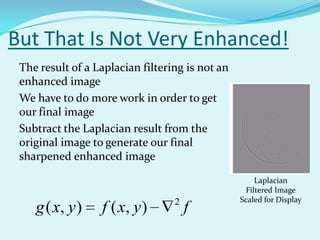
 The result of a Laplacian filtering is not an
 enhanced image
 We have to do more work in order to get
 our final image
 Subtract the Laplacian result from the
 original image to generate our final
 sharpened enhanced image
                                                     Laplacian
                                                  Filtered Image
                                  2              Scaled for Display
    g ( x, y )    f ( x, y )          f
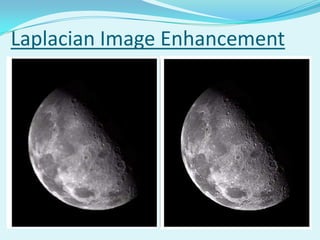
Laplacian Image Enhancement

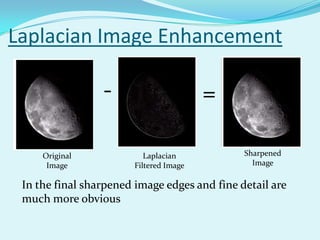
                 -                      =

     Original             Laplacian           Sharpened
      Image            Filtered Image           Image

 In the final sharpened image edges and fine detail are
 much more obvious
Laplacian Image Enhancement
Simplified Image Enhancement
The entire enhancement can be combined into a single
filtering operation
                             2
  g ( x, y )    f ( x, y )      f
               f ( x, y) [ f ( x 1, y)     f ( x 1, y)
                            f ( x, y 1)    f ( x, y 1)
                           4 f ( x, y)]
               5 f ( x, y)   f ( x 1, y) f ( x 1, y)
                             f ( x, y 1) f ( x, y 1)
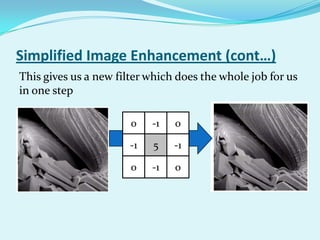
Simplified Image Enhancement (cont…)
This gives us a new filter which does the whole job for us
in one step

                       0    -1   0

                       -1   5    -1

                       0    -1   0
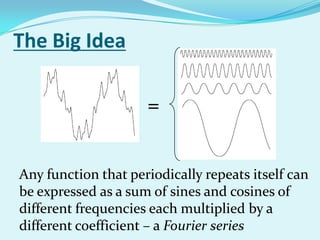
The Big Idea

                     =


Any function that periodically repeats itself can
be expressed as a sum of sines and cosines of
different frequencies each multiplied by a
different coefficient – a Fourier series
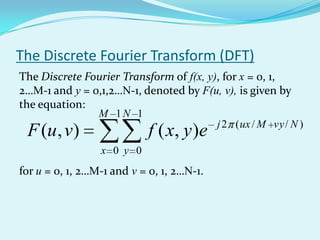
The Discrete Fourier Transform (DFT)
The Discrete Fourier Transform of f(x, y), for x = 0, 1,
2…M-1 and y = 0,1,2…N-1, denoted by F(u, v), is given by
the equation:
                 M 1N 1
                                           j 2 ( ux / M vy / N )
 F (u , v)                  f ( x, y )e
                 x 0 y 0
for u = 0, 1, 2…M-1 and v = 0, 1, 2…N-1.
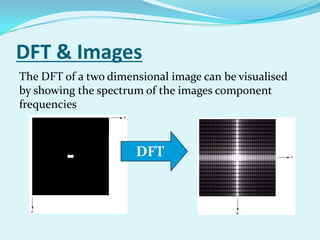
DFT & Images
The DFT of a two dimensional image can be visualised
by showing the spectrum of the images component
frequencies


                      DFT
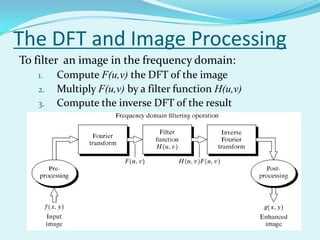
The DFT and Image Processing
To filter an image in the frequency domain:
   1.   Compute F(u,v) the DFT of the image
   2.   Multiply F(u,v) by a filter function H(u,v)
   3.   Compute the inverse DFT of the result
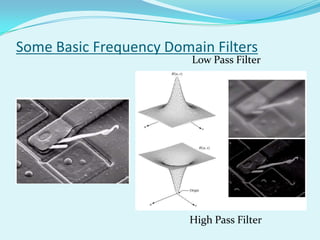
Some Basic Frequency Domain Filters
                         Low Pass Filter


                         High Pass Filter
Smoothing Frequency Domain Filters
Smoothing is achieved in the frequency domain by
dropping out the high frequency components
The basic model for filtering is:
       G(u,v) = H(u,v)F(u,v)
where F(u,v) is the Fourier transform of the image being
filtered and H(u,v) is the filter transform function
Low pass filters – only pass the low frequencies,
drop the high ones.
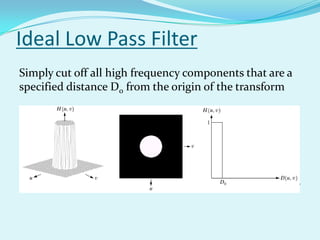
Ideal Low Pass Filter
Simply cut off all high frequency components that are a
specified distance D0 from the origin of the transform


changing the distance changes the behaviour of the filter
Ideal Low Pass Filter (cont…)
The transfer function for the ideal low pass filter can be
given as:
                  1 if D(u, v) D0
     H (u, v)
                  0 if D(u, v) D0

where D(u,v) is given as:
                               2                2 1/ 2
     D(u, v) [(u M / 2)            (v N / 2) ]
Butterworth Low pass Filters
The transfer function of a Butterworth lowpass filter of
order n with cutoff frequency at distance D0 from the
origin is defined as:
                             1
          H (u , v)
                    1 [ D(u , v) / D0 ]2 n
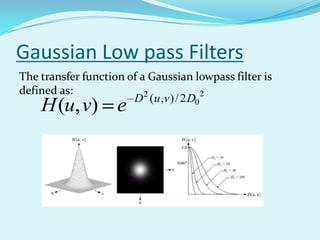
Gaussian Low pass Filters
The transfer function of a Gaussian lowpass filter is
defined as:
                       D2 (u ,v ) / 2 D0 2
    H (u, v) e
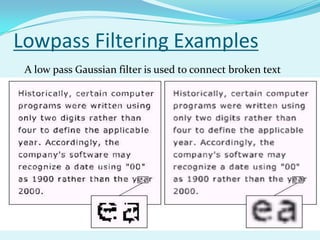
Lowpass Filtering Examples
 A low pass Gaussian filter is used to connect broken text
Sharpening in the Frequency Domain
Edges and fine detail in images are associated with high
frequency components
High pass filters – only pass the high frequencies,
drop the low ones.
High pass frequencies are precisely the reverse of low
pass filters, so:
       Hhp(u, v) = 1 – Hlp(u, v)
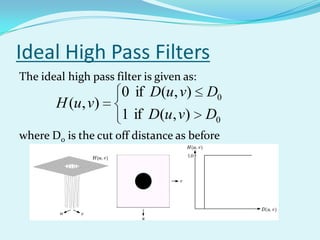
Ideal High Pass Filters
The ideal high pass filter is given as:
                      0 if D(u, v) D0
        H (u, v)
                      1 if D(u, v) D0
where D0 is the cut off distance as before
Butterworth High Pass Filters
The Butterworth high pass filter is given as:
                             1
       H (u , v)                        2n
                   1 [ D0 / D(u , v)]

where n is the order and D0 is the cut off distance as
before
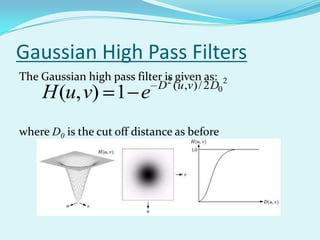
Gaussian High Pass Filters
The Gaussian high pass filter is given as: 2
                            D2 (u ,v ) / 2 D0
    H (u, v) 1 e
where D0 is the cut off distance as before
Frequency Domain Filtering & Spatial
Domain Filtering
Similar jobs can be done in the spatial and frequency
domains
Filtering in the spatial domain can be easier to
understand
Filtering in the frequency domain can be much faster –
especially for large images
Questions?
THANK YOU…!!! 

Digital image processing img smoothning

  • 1.
    Presentation over imagesmoothing and sharpening -Vinay Kumar Gupta 0700410088
  • 2.
    What is aDigital Image?  A digital image is a representation of a two- dimensional image as a finite set of digital values, called picture elements or pixels.
  • 3.
    Why Digital ImageProcessing? Digital image processing focuses on two major tasks:  Improvement of pictorial information for human interpretation.  Processing of image data for storage, transmission and representation for autonomous machine perception
  • 4.
    Applications: The use ofdigital image processing techniques has exploded and they are now used for all kinds of tasks in all kinds of areas:  Image enhancement/restoration  Artistic effects  Medical visualisation  Industrial inspection  Law enforcement  Human computer interfaces
  • 5.
    Examples: The HubbleTelescope Launched in 1990 the Hubble telescope can take images of very distant objects However, an incorrect mirror made many of Hubble’s images useless. Image processing techniques were used to fix this
  • 6.
    Examples: HCI Try tomake human computer interfaces more natural  Face recognition  Gesture recognition Does anyone remember the user interface from “Minority Report”?
  • 7.
    Key Stages inDigital Image Processing: Image Morphological Restoration Processing Image Enhancement Segmentation Image Object Acquisition Recognition Problem Domain Representation & Description Colour Image Image Processing Compression
  • 8.
    Image Representation Before wediscuss image acquisition recall that a digital image is col composed of M rows and N columns of pixels each storing a value Pixel values are most often grey levels in the range 0-255(black-white) f (row, col) row
  • 9.
  • 10.
  • 11.
  • 12.
    What Is ImageEnhancement? Image enhancement is the process of making images more useful The reasons for doing this include:  Highlighting interesting detail in images  Removing noise from images  Making images more visually appealing
  • 13.
    Spatial & FrequencyDomains There are two broad categories of image enhancement techniques  Spatial domain techniques  Direct manipulation of image pixels  Frequency domain techniques  Manipulation of Fourier transform or wavelet transform of an image For the moment we will concentrate on techniques that operate in the spatial domain
  • 14.
    Image Histograms The histogramof an image shows us the distribution of grey levels in the image Frequencies Grey Levels
  • 15.
    Spatial filtering techniques:  Neighbourhood operations  What is spatial filtering?  Smoothing operations  What happens at the edges?
  • 16.
    Neighbourhood Operations Neighbourhood operationssimply operate on a larger neighbourhood of pixels than point operations Origin x Neighbourhoods are mostly a rectangle around a central pixel Any size rectangle and any shape filter (x, y) Neighbourhood are possible y Image f (x, y)
  • 17.
    Simple Neighbourhood Operations Somesimple neighbourhood operations include:  Min: Set the pixel value to the minimum in the neighbourhood  Max: Set the pixel value to the maximum in the neighbourhood  Median: The median value of a set of numbers is the midpoint value in that set (e.g. from the set [1, 7, 15, 18, 24] 15 is the median). Sometimes the median works better than the average
  • 18.
    The Spatial FilteringProcess Origin x a b c r s t d g e h f i * u x v y w z Original Image Filter Simple 3*3 Pixels e 3*3 Filter Neighbourhood eprocessed = v*e + r*a + s*b + t*c + u*d + w*f + y Image f (x, y) x*g + y*h + z*i The above is repeated for every pixel in the original image to generate the filtered image
  • 19.
    Smoothing Spatial Filters One of the simplest spatial filtering operations we can perform is a smoothing operation  Simply average all of the pixels in a neighbourhood around a central value  Especially useful 1/ 1/ 1/ 9 9 9 in removing noise from images  Also useful for 1/ 9 1/ 9 1/ 9 Simple highlighting gross averaging detail 1/ 1/ 1/ filter 9 9 9
  • 20.
    Smoothing Spatial Filtering Origin x 104 100 108 1/ 1/ 1/ 9 9 9 1/ 1/ 1/ 99 106 98 95 90 85 * 1/ 9 1/ 9 1/ 9 9 9 9 1/ 1/ 1/ 104 100 108 Original Image Filter 9 9 9 Simple 3*3 1/ 99 106 198 1/ /9 3*3 Smoothing Pixels 9 9 Neighbourhood 195 /9 1/ 90 185 /9 Filter 9 e = 1/9*106 + 1/ *104 + 1/ *100 + 1/ *108 + 9 9 9 1/ *99 + 1/ *98 + 9 9 y Image f (x, y) 1/ *95 + 1/ *90 + 1/ *85 9 9 9 = 98.3333 The above is repeated for every pixel in the original image to generate the smoothed image
  • 21.
    Sharpening Spatial Filters Previouslywe have looked at smoothing filters which remove fine detail Sharpening spatial filters seek to highlight fine detail  Remove blurring from images  Highlight edges Sharpening filters are based on spatial differentiation
  • 22.
    Spatial Differentiation Differentiation measuresthe rate of change of a function Let’s consider a simple 1 dimensional example
  • 23.
  • 24.
    1st Derivative The formula for the 1st derivative of a function is as follows: f f ( x 1) f ( x) x It’s just the difference between subsequent values and measures the rate of change of the function.
  • 25.
    2nd Derivative The formula for the 2nd derivative of a function is as follows: 2 f 2 f ( x 1) f ( x 1) 2 f ( x) x Simply takes into account the values both before and after the current value
  • 26.
    Using Second DerivativesFor Image Enhancement The 2nd derivative is more useful for image enhancement than the 1st derivative  Stronger response to fine detail  Simpler implementation  We will come back to the 1st order derivative later on The first sharpening filter we will look at is the Laplacian  Isotropic  One of the simplest sharpening filters  We will look at a digital implementation
  • 27.
    The Laplacian TheLaplacian is defined as follows: 2 2 2 f f f 2 2 x y where the partial 1st order derivative in the x direction is defined as follows: 2 f 2 f ( x 1, y ) f ( x 1, y ) 2 f ( x, y ) x and in the y direction as follows: 2 f 2 f ( x, y 1) f ( x, y 1) 2 f ( x, y ) y
  • 28.
    The Laplacian (cont…) So, the Laplacian can be given as follows: 2 f [ f ( x 1, y ) f ( x 1, y ) f ( x, y 1) f ( x, y 1)] 4 f ( x, y) We can easily build a filter based on this 0 1 0 1 -4 1 0 1 0
  • 29.
    The Laplacian (cont…) Applyingthe Laplacian to an image we get a new image that highlights edges and other discontinuities Original Laplacian Laplacian Image Filtered Image Filtered Image Scaled for Display
  • 30.
    But That IsNot Very Enhanced! The result of a Laplacian filtering is not an enhanced image We have to do more work in order to get our final image Subtract the Laplacian result from the original image to generate our final sharpened enhanced image Laplacian Filtered Image 2 Scaled for Display g ( x, y ) f ( x, y ) f
  • 31.
    Laplacian Image Enhancement - = Original Laplacian Sharpened Image Filtered Image Image In the final sharpened image edges and fine detail are much more obvious
  • 32.
  • 33.
    Simplified Image Enhancement Theentire enhancement can be combined into a single filtering operation 2 g ( x, y ) f ( x, y ) f f ( x, y) [ f ( x 1, y) f ( x 1, y) f ( x, y 1) f ( x, y 1) 4 f ( x, y)] 5 f ( x, y) f ( x 1, y) f ( x 1, y) f ( x, y 1) f ( x, y 1)
  • 34.
    Simplified Image Enhancement(cont…) This gives us a new filter which does the whole job for us in one step 0 -1 0 -1 5 -1 0 -1 0
  • 35.
    The Big Idea = Any function that periodically repeats itself can be expressed as a sum of sines and cosines of different frequencies each multiplied by a different coefficient – a Fourier series
  • 36.
    The Discrete FourierTransform (DFT) The Discrete Fourier Transform of f(x, y), for x = 0, 1, 2…M-1 and y = 0,1,2…N-1, denoted by F(u, v), is given by the equation: M 1N 1 j 2 ( ux / M vy / N ) F (u , v) f ( x, y )e x 0 y 0 for u = 0, 1, 2…M-1 and v = 0, 1, 2…N-1.
  • 37.
    DFT & Images TheDFT of a two dimensional image can be visualised by showing the spectrum of the images component frequencies DFT
  • 38.
    The DFT andImage Processing To filter an image in the frequency domain: 1. Compute F(u,v) the DFT of the image 2. Multiply F(u,v) by a filter function H(u,v) 3. Compute the inverse DFT of the result
  • 39.
    Some Basic FrequencyDomain Filters Low Pass Filter High Pass Filter
  • 40.
    Smoothing Frequency DomainFilters Smoothing is achieved in the frequency domain by dropping out the high frequency components The basic model for filtering is: G(u,v) = H(u,v)F(u,v) where F(u,v) is the Fourier transform of the image being filtered and H(u,v) is the filter transform function Low pass filters – only pass the low frequencies, drop the high ones.
  • 41.
    Ideal Low PassFilter Simply cut off all high frequency components that are a specified distance D0 from the origin of the transform changing the distance changes the behaviour of the filter
  • 42.
    Ideal Low PassFilter (cont…) The transfer function for the ideal low pass filter can be given as: 1 if D(u, v) D0 H (u, v) 0 if D(u, v) D0 where D(u,v) is given as: 2 2 1/ 2 D(u, v) [(u M / 2) (v N / 2) ]
  • 43.
    Butterworth Low passFilters The transfer function of a Butterworth lowpass filter of order n with cutoff frequency at distance D0 from the origin is defined as: 1 H (u , v) 1 [ D(u , v) / D0 ]2 n
  • 44.
    Gaussian Low passFilters The transfer function of a Gaussian lowpass filter is defined as: D2 (u ,v ) / 2 D0 2 H (u, v) e
  • 45.
    Lowpass Filtering Examples A low pass Gaussian filter is used to connect broken text
  • 46.
    Sharpening in theFrequency Domain Edges and fine detail in images are associated with high frequency components High pass filters – only pass the high frequencies, drop the low ones. High pass frequencies are precisely the reverse of low pass filters, so: Hhp(u, v) = 1 – Hlp(u, v)
  • 47.
    Ideal High PassFilters The ideal high pass filter is given as: 0 if D(u, v) D0 H (u, v) 1 if D(u, v) D0 where D0 is the cut off distance as before
  • 48.
    Butterworth High PassFilters The Butterworth high pass filter is given as: 1 H (u , v) 2n 1 [ D0 / D(u , v)] where n is the order and D0 is the cut off distance as before
  • 49.
    Gaussian High PassFilters The Gaussian high pass filter is given as: 2 D2 (u ,v ) / 2 D0 H (u, v) 1 e where D0 is the cut off distance as before
  • 50.
    Frequency Domain Filtering& Spatial Domain Filtering Similar jobs can be done in the spatial and frequency domains Filtering in the spatial domain can be easier to understand Filtering in the frequency domain can be much faster – especially for large images
  • 51.
  • 52.