IT INNOVATORS
420, FINCH AVE – WEST, ON- TW2 13R, CANADA
Vijayananda Mohire
November 1, 2011
Engineering Project Report
DIGITAL ENERGY METER
1
DigitalEnergyMeter
ENGINEERING REPORT
DIGITAL ENERGY METER
INTRODUCTION
This report has been designed to demonstrate my project work that I had undertaken as part of my Engineering
course. This is an abridged version of my original project work titled “Digital Energy Meter”. This is intended for
demonstrating my electronic engineering skills and also to showcasemy managerial skills. I am sure you would like to
continue reading this report and develop a passion for technology. You are most welcome to approach me for any
further details and assistance in this regards, especially if you wish to leverage my project experience in assisting you
in your venture in similar areas.
PROJECT DURATION
The project was conceptualized during start of my final academic year in late 1993 and the main work started in
January 1994 after the New Year celebrations with formal approval from our Head of Department. The final
demonstration to the examiners and colleagues was done in July 1994. This was part of my project work that is a pre
requisite for completing my Bachelor‟s Degree in Engineering.
PROJECT LOCATION
The project was carried out in Poojya Dodappa Appa College of Engineering College campus. The campus is located
in Aiwan-E Shahi area, Gulbarga, Karnataka state, India. This is a centrally aided college and has recently obtained the
autonomous status which indicates its self sufficiency and efficient governance in imparting quality education in the
state.
MY ROLE
I was elected and awarded an opportunity to lead and manage a team of five members. I reported to the Head of
Department, for status updates and communicating his advices to the team.
AIMS & OBJECTIVES OF THE PROJECT
 To demonstrate the shortfalls of Electromechanical energy meter using mathematical formulas.
 To measure accurately the energy consumed using Electrical standards and formulas
 To generate accurate meter readings based on precise mathematical computations upto desired fractions and
decimals
 To generate in time bills and reports based on billing intervals and displayed in user understandable format
 To demonstrate basic electronic circuit assembly and use of Microprocessor chipsets
 Demonstrate the use of electronics in utility and practical application to Industry
 To have a modular production unit that has easily replaceable components
 To provide auto trip and glowing of RED LED mechanism in case of faulty operations or abnormal limits
 To have a cost effective replacement for Electromechanical energy meters
 To reduce power consumption by meters by using Electronic components instead of Electromechanical
components
 Reduced maintenance costs and increased reliability
2
DigitalEnergyMeter
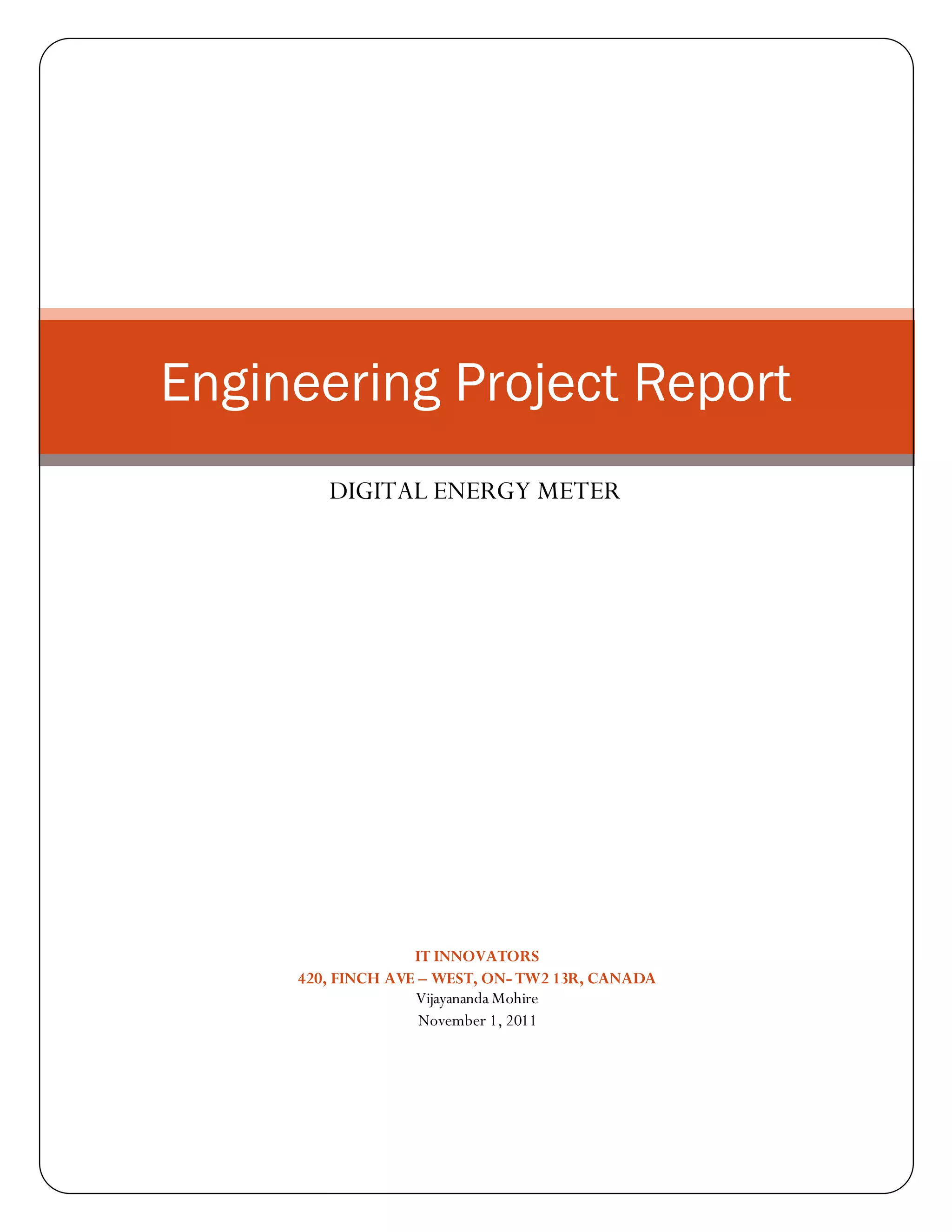
FIGURE1:ELECTROMECHNAICALENERGYMETER
METHODOLOGY
 Review of the Electromechnical energy meter and identify the issues in coordination with Electrical and
Mechanical Engineering departments
 Suggest a viable Microprocessor based solution by doing study using IEEE standards and Industry grade
electronic components like Chip set, Display units, Capacitors, Resistors, Power transformers etc.
 Define the Blue print of the solution for Hardware and Software to be used.
 Develop the Software – here it is programming the Intel 8085 chip using assembly language
 Develop the Hardware- Fabricate the motherboard using printed circuit board, selected chips and devices –
here it is assembly of 8085 chip set with Analog to Digital converter( ADC 0809), Operational amplifier (
µA 741) , rectifiers, Potentiometers, multivibrators( Monoshot - IC 74121)
 Deploy the software onto the 8085 chipset
 Unit and integration test using multimeter and oscilloscope to confirm the voltage levels and phase factors in
the Input power
 Run the tested project and tabulate the results
 Validate the results against the expected standards
 Rectify any issues and rerun the project
 Demonstrate the working project to guide and external reviewer
 Obtain the necessary credentials for successful completion of the project
 Handover the project documentation and project assets to department
MY EN GINEERING ACTIVITIES
ANALYSIS OF ELECTROMECHNICAL METER
The energy meter consists of two A.C electro- magnets as shown in Figure 1. One is M1 is excited by line
current, known as Series magnet. Alternating flux Φ1 produced by M1 is proportional and in phase with
supply line current. Other magnet called Shunt magnet M2 is connected across supply voltage V and
produces flux Φ2. Φ2 is proportional to line
voltage and lags behind it by 90ο. This phase
lag is achieved by adjusting the copper
shading, C (power factor compensator). The
two fluxes induce Electro- Magnetic Field
(E.M.F) in the rotating disc and produce an
eddy current that is converted to mechanical
energy called as torque. In a given period of
time the total number of revolutions is
proportional to electric energy consumed.
Limitations in Induction wattmeter:
1. As the two coils have same resistance,
shunt field does not lag behind supply
voltage by exactly 90ο. So torque is
not zero at zero power factor. To compensate the power factor compensator coil needs to
3
DigitalEnergyMeter
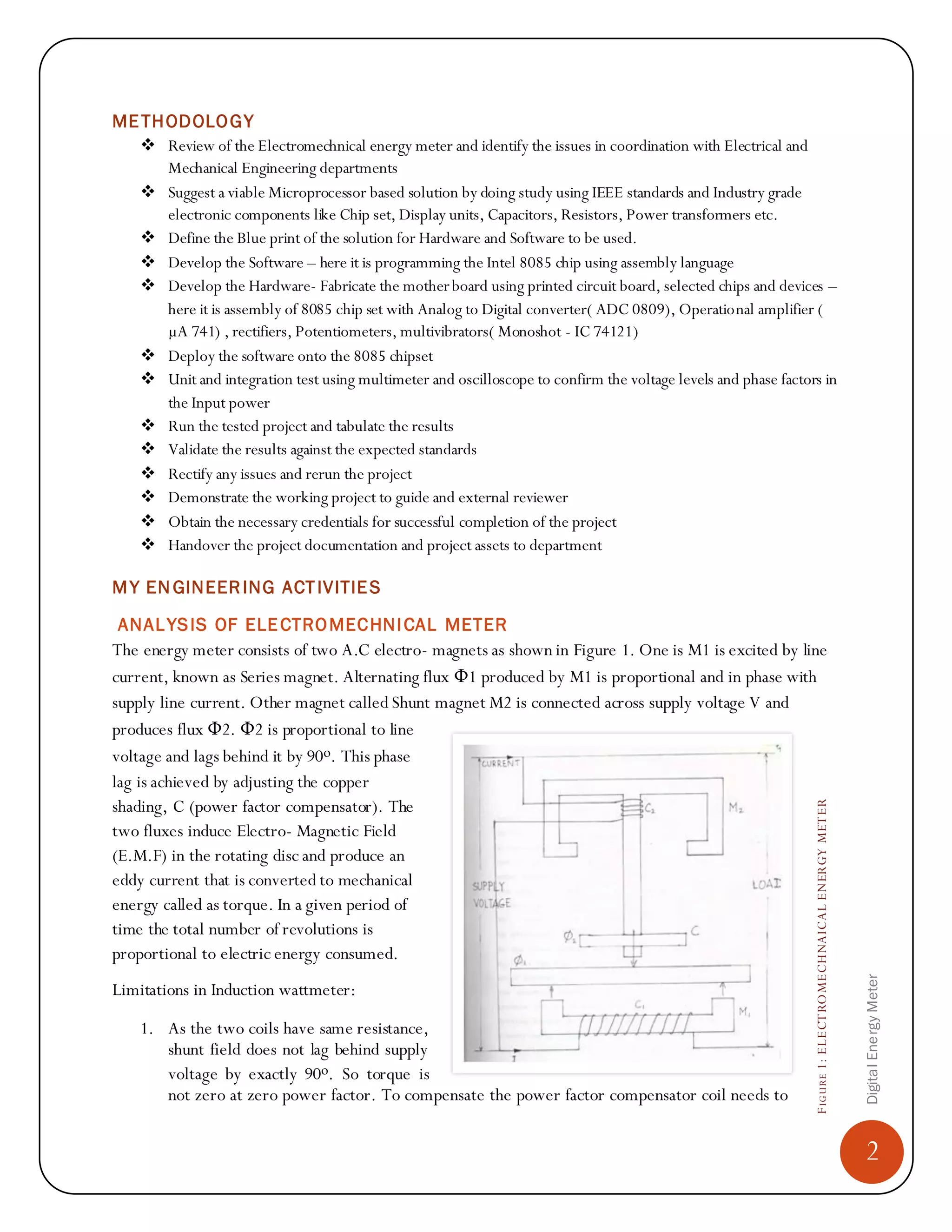
FIGURE2:PCBLAYOUTDESIGN
be adjusted at regular intervals to maintain accuracy.
2. Frictional forces at the rotor bearings give rise to a braking torque on the rotor disc. Due to this
disc rotates slowly even at no load, which is called as creeping.
3. Pressure coil possesses capacitance in addition to inductance. This produces high readings on
lagging power factor on the load.
4. Eddy currents which act as anti fields alter the magnitude and phase of the desired current coil.
5. Temperature induced changes also add to more deviations.
These issues are addressed in the project developed as Digital Energy meter.
DESIGN AND DEVELOP HARDWARE
Figure 2 provides one circuit board design used for holding the power transformers and Peripheral interface
chip. Details of the components used for this PCB described in below sections.
General Electrical theory used:
Electrical energy is the total power delivered over a specific time interval.
W = VI Cos Ø dt
Where,
V= Voltage, I = Current, Ø = Phase angle between V and I
The power is then digitized using electronics and stored in memory of Microprocessor over a period
interval of time. Suitable computation is managed by the Software module based on the voltage and current
measured at particular instance of time.
The hardware was manufactured inhouse with all the raw material and tools like the board base, etching
process, component layout design etc. Even testing and burning of the code onto the EPROM was done in-
house.
4
DigitalEnergyMeter
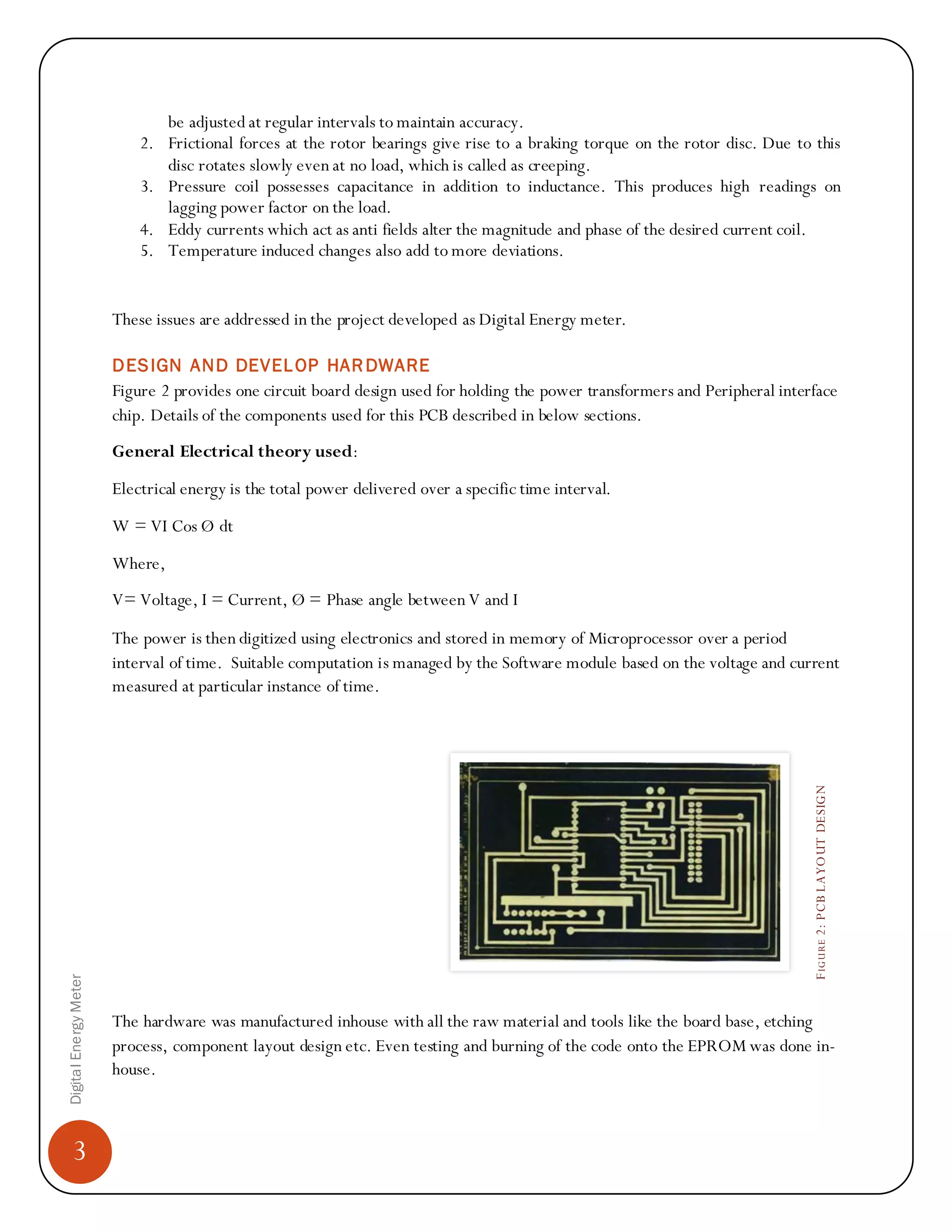
FIGURE3:BASICMODULESOFTHEENRGYMETER
DESIGN OF VOLTAGE PROCESSIN G MODULE
With reference to Figure 3 the voltage processing module has been developed as described below. Supply
voltage can be measured by stepping down to a low value using a voltage power transformer and is then
rectified using full wave bridge to remove any ripples. This is further attenuated using potentiometer and
amplified to suit the signal requirements to 8085 chip. This is then converted to digital counter using
Analog to Digital Converter (ADC)
DESIGN OF CURRENT PROCESSIN G MODULE
With reference to Figure 3 the current processing module has been developed as described below. To
measure the load current a current power transformer is used to step down in ratio of 12: 5. To make this
suitable for further processing suitable resistor is used to convert the current to voltage equivalent. This
provides the simulated voltage equivalent of the current.
DESIGN OF POWER FACTOR PROCESSIN G MODULE
With reference to Figure 3 the power factor processing module has been developed as described below.
The power factor can be measured by measuring the angle between the voltage and current and finding the
cosine of the angle. This is done using zero crossing detectors. Suitable lookup table in software module is
used to obtain the right cosine of the measured angle.
DESIGN AND DEVELOP SOFTWARE
Software is basically to store the digitized values of the respective Voltage, Current and Phase in particular
memory areas.
Suitable registers are used and assembly
language is used to provide the necessary
computations.
Typical registers, interrupt subroutines are used
to obtain the V and I values and the equivalent
Hex values are stored. Computed power is
aggregated as per the provided time interval and
the sum is displayed.
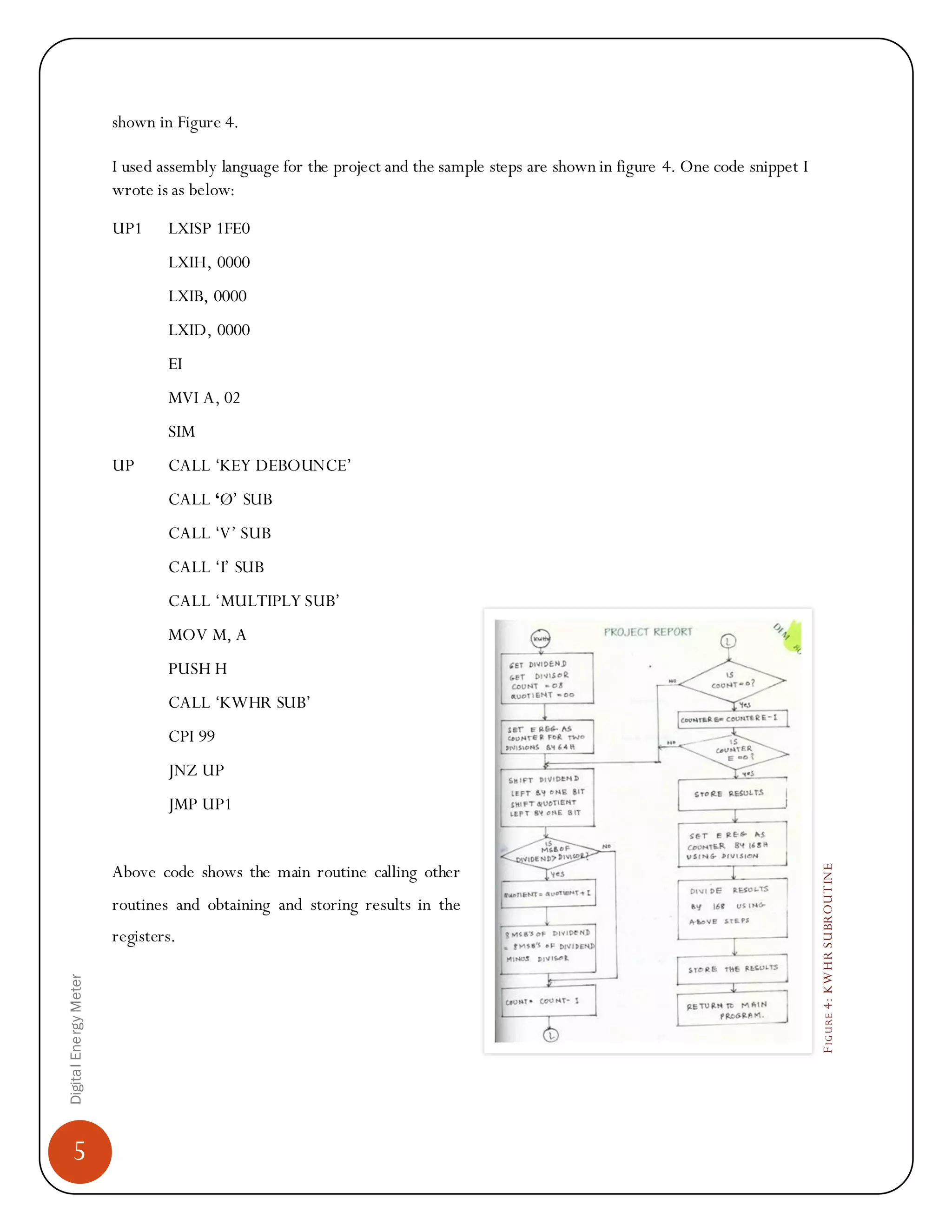
One typical flow chart used in the project is
5
DigitalEnergyMeter
FIGURE4:KWHRSUBROUTINE
shown in Figure 4.
I used assembly language for the project and the sample steps are shown in figure 4. One code snippet I
wrote is as below:
UP1 LXISP 1FE0
LXIH, 0000
LXIB, 0000
LXID, 0000
EI
MVI A, 02
SIM
UP CALL „KEY DEBOUNCE‟
CALL ‘Ø‟ SUB
CALL „V‟ SUB
CALL „I‟ SUB
CALL „MULTIPLY SUB‟
MOV M, A
PUSH H
CALL „KWHR SUB‟
CPI 99
JNZ UP
JMP UP1
Above code shows the main routine calling other
routines and obtaining and storing results in the
registers.
6
DigitalEnergyMeter
MY TECHNIQUES AN D STRATEGIES
1. Technical contribution: I had to study IEEE guides, analyze the current trends in Energy
devices. I had to go through a dozen books from library and get the technical requirements of the
needed chips and electronic components, their make and specifications.
2. Group involvement: Being responsible for overall success of the project I had to interact with
Electrical and Mechanical department Heads and get the guidance and validation of the
methodology used in arriving at accurate limitations in Electro Mechanical systems.
3. Knowledge sharing: I was involved in brainstorm sessions and had team involved in getting the
best of each member. One example is working on the Microprocessor pins that needed good
theoretical understanding of the chip pins and their significance.
4. Challenges faced: I had to persuade team to carry on experimenting and not to give up at any
stage. I did face challenges in the project like at times I had to debug and find the root cause of non
availability of outputs and no show of results during the trial runs. Also I had to re-etch the PCB
and burn the EEPROM.
5. Reporting to Guide: I had been assigned to interact with guide and convey the recommendations
to team. I did get expert guidance from our college staff especially the lab staff who were
cooperative while we overstretched
6. Guiding team: I had to guide the team in certain areas like use of Printed circuit board design
software. I had to spend few extra hours to learn it.
7. Time and cost management: I used the team funds reasonably and avoided costly remakes and
purchases of chips like Processor chip. I had to finish the project in time and I did the planning and
micro planning to retain the project on the right track. We did have an incident where a team
member had overused the components and we had to share and pay for the excess bills we got.
SUMMARY
My responsibility of design, implementation and managing of the Digital energy meter was completed
successfully after successful demonstrating to the examiner and internal staff. This provided me the
necessary confidence in facing the real world challenges and in providing suitable design and solution to real
world problems using Electronics.

Digital Energy Meter Project Report

  • 1.
    IT INNOVATORS 420, FINCHAVE – WEST, ON- TW2 13R, CANADA Vijayananda Mohire November 1, 2011 Engineering Project Report DIGITAL ENERGY METER
  • 2.
    1 DigitalEnergyMeter ENGINEERING REPORT DIGITAL ENERGYMETER INTRODUCTION This report has been designed to demonstrate my project work that I had undertaken as part of my Engineering course. This is an abridged version of my original project work titled “Digital Energy Meter”. This is intended for demonstrating my electronic engineering skills and also to showcasemy managerial skills. I am sure you would like to continue reading this report and develop a passion for technology. You are most welcome to approach me for any further details and assistance in this regards, especially if you wish to leverage my project experience in assisting you in your venture in similar areas. PROJECT DURATION The project was conceptualized during start of my final academic year in late 1993 and the main work started in January 1994 after the New Year celebrations with formal approval from our Head of Department. The final demonstration to the examiners and colleagues was done in July 1994. This was part of my project work that is a pre requisite for completing my Bachelor‟s Degree in Engineering. PROJECT LOCATION The project was carried out in Poojya Dodappa Appa College of Engineering College campus. The campus is located in Aiwan-E Shahi area, Gulbarga, Karnataka state, India. This is a centrally aided college and has recently obtained the autonomous status which indicates its self sufficiency and efficient governance in imparting quality education in the state. MY ROLE I was elected and awarded an opportunity to lead and manage a team of five members. I reported to the Head of Department, for status updates and communicating his advices to the team. AIMS & OBJECTIVES OF THE PROJECT  To demonstrate the shortfalls of Electromechanical energy meter using mathematical formulas.  To measure accurately the energy consumed using Electrical standards and formulas  To generate accurate meter readings based on precise mathematical computations upto desired fractions and decimals  To generate in time bills and reports based on billing intervals and displayed in user understandable format  To demonstrate basic electronic circuit assembly and use of Microprocessor chipsets  Demonstrate the use of electronics in utility and practical application to Industry  To have a modular production unit that has easily replaceable components  To provide auto trip and glowing of RED LED mechanism in case of faulty operations or abnormal limits  To have a cost effective replacement for Electromechanical energy meters  To reduce power consumption by meters by using Electronic components instead of Electromechanical components  Reduced maintenance costs and increased reliability
  • 3.
    2 DigitalEnergyMeter FIGURE1:ELECTROMECHNAICALENERGYMETER METHODOLOGY  Review ofthe Electromechnical energy meter and identify the issues in coordination with Electrical and Mechanical Engineering departments  Suggest a viable Microprocessor based solution by doing study using IEEE standards and Industry grade electronic components like Chip set, Display units, Capacitors, Resistors, Power transformers etc.  Define the Blue print of the solution for Hardware and Software to be used.  Develop the Software – here it is programming the Intel 8085 chip using assembly language  Develop the Hardware- Fabricate the motherboard using printed circuit board, selected chips and devices – here it is assembly of 8085 chip set with Analog to Digital converter( ADC 0809), Operational amplifier ( µA 741) , rectifiers, Potentiometers, multivibrators( Monoshot - IC 74121)  Deploy the software onto the 8085 chipset  Unit and integration test using multimeter and oscilloscope to confirm the voltage levels and phase factors in the Input power  Run the tested project and tabulate the results  Validate the results against the expected standards  Rectify any issues and rerun the project  Demonstrate the working project to guide and external reviewer  Obtain the necessary credentials for successful completion of the project  Handover the project documentation and project assets to department MY EN GINEERING ACTIVITIES ANALYSIS OF ELECTROMECHNICAL METER The energy meter consists of two A.C electro- magnets as shown in Figure 1. One is M1 is excited by line current, known as Series magnet. Alternating flux Φ1 produced by M1 is proportional and in phase with supply line current. Other magnet called Shunt magnet M2 is connected across supply voltage V and produces flux Φ2. Φ2 is proportional to line voltage and lags behind it by 90ο. This phase lag is achieved by adjusting the copper shading, C (power factor compensator). The two fluxes induce Electro- Magnetic Field (E.M.F) in the rotating disc and produce an eddy current that is converted to mechanical energy called as torque. In a given period of time the total number of revolutions is proportional to electric energy consumed. Limitations in Induction wattmeter: 1. As the two coils have same resistance, shunt field does not lag behind supply voltage by exactly 90ο. So torque is not zero at zero power factor. To compensate the power factor compensator coil needs to
  • 4.
    3 DigitalEnergyMeter FIGURE2:PCBLAYOUTDESIGN be adjusted atregular intervals to maintain accuracy. 2. Frictional forces at the rotor bearings give rise to a braking torque on the rotor disc. Due to this disc rotates slowly even at no load, which is called as creeping. 3. Pressure coil possesses capacitance in addition to inductance. This produces high readings on lagging power factor on the load. 4. Eddy currents which act as anti fields alter the magnitude and phase of the desired current coil. 5. Temperature induced changes also add to more deviations. These issues are addressed in the project developed as Digital Energy meter. DESIGN AND DEVELOP HARDWARE Figure 2 provides one circuit board design used for holding the power transformers and Peripheral interface chip. Details of the components used for this PCB described in below sections. General Electrical theory used: Electrical energy is the total power delivered over a specific time interval. W = VI Cos Ø dt Where, V= Voltage, I = Current, Ø = Phase angle between V and I The power is then digitized using electronics and stored in memory of Microprocessor over a period interval of time. Suitable computation is managed by the Software module based on the voltage and current measured at particular instance of time. The hardware was manufactured inhouse with all the raw material and tools like the board base, etching process, component layout design etc. Even testing and burning of the code onto the EPROM was done in- house.
  • 5.
    4 DigitalEnergyMeter FIGURE3:BASICMODULESOFTHEENRGYMETER DESIGN OF VOLTAGEPROCESSIN G MODULE With reference to Figure 3 the voltage processing module has been developed as described below. Supply voltage can be measured by stepping down to a low value using a voltage power transformer and is then rectified using full wave bridge to remove any ripples. This is further attenuated using potentiometer and amplified to suit the signal requirements to 8085 chip. This is then converted to digital counter using Analog to Digital Converter (ADC) DESIGN OF CURRENT PROCESSIN G MODULE With reference to Figure 3 the current processing module has been developed as described below. To measure the load current a current power transformer is used to step down in ratio of 12: 5. To make this suitable for further processing suitable resistor is used to convert the current to voltage equivalent. This provides the simulated voltage equivalent of the current. DESIGN OF POWER FACTOR PROCESSIN G MODULE With reference to Figure 3 the power factor processing module has been developed as described below. The power factor can be measured by measuring the angle between the voltage and current and finding the cosine of the angle. This is done using zero crossing detectors. Suitable lookup table in software module is used to obtain the right cosine of the measured angle. DESIGN AND DEVELOP SOFTWARE Software is basically to store the digitized values of the respective Voltage, Current and Phase in particular memory areas. Suitable registers are used and assembly language is used to provide the necessary computations. Typical registers, interrupt subroutines are used to obtain the V and I values and the equivalent Hex values are stored. Computed power is aggregated as per the provided time interval and the sum is displayed. One typical flow chart used in the project is
  • 6.
    5 DigitalEnergyMeter FIGURE4:KWHRSUBROUTINE shown in Figure4. I used assembly language for the project and the sample steps are shown in figure 4. One code snippet I wrote is as below: UP1 LXISP 1FE0 LXIH, 0000 LXIB, 0000 LXID, 0000 EI MVI A, 02 SIM UP CALL „KEY DEBOUNCE‟ CALL ‘Ø‟ SUB CALL „V‟ SUB CALL „I‟ SUB CALL „MULTIPLY SUB‟ MOV M, A PUSH H CALL „KWHR SUB‟ CPI 99 JNZ UP JMP UP1 Above code shows the main routine calling other routines and obtaining and storing results in the registers.
  • 7.
    6 DigitalEnergyMeter MY TECHNIQUES AND STRATEGIES 1. Technical contribution: I had to study IEEE guides, analyze the current trends in Energy devices. I had to go through a dozen books from library and get the technical requirements of the needed chips and electronic components, their make and specifications. 2. Group involvement: Being responsible for overall success of the project I had to interact with Electrical and Mechanical department Heads and get the guidance and validation of the methodology used in arriving at accurate limitations in Electro Mechanical systems. 3. Knowledge sharing: I was involved in brainstorm sessions and had team involved in getting the best of each member. One example is working on the Microprocessor pins that needed good theoretical understanding of the chip pins and their significance. 4. Challenges faced: I had to persuade team to carry on experimenting and not to give up at any stage. I did face challenges in the project like at times I had to debug and find the root cause of non availability of outputs and no show of results during the trial runs. Also I had to re-etch the PCB and burn the EEPROM. 5. Reporting to Guide: I had been assigned to interact with guide and convey the recommendations to team. I did get expert guidance from our college staff especially the lab staff who were cooperative while we overstretched 6. Guiding team: I had to guide the team in certain areas like use of Printed circuit board design software. I had to spend few extra hours to learn it. 7. Time and cost management: I used the team funds reasonably and avoided costly remakes and purchases of chips like Processor chip. I had to finish the project in time and I did the planning and micro planning to retain the project on the right track. We did have an incident where a team member had overused the components and we had to share and pay for the excess bills we got. SUMMARY My responsibility of design, implementation and managing of the Digital energy meter was completed successfully after successful demonstrating to the examiner and internal staff. This provided me the necessary confidence in facing the real world challenges and in providing suitable design and solution to real world problems using Electronics.