Karthik Sai Reddy Cherlo Int. Journal of Engineering Research and Application www.ijera.com
ISSN : 2248-9622, Vol. 6, Issue 8, ( Part -2) August 2016, pp.32-36
www.ijera.com 32 | P a g e
Real-Time Load Monitoring By Microcontroller to Optimize
Electric Power Utilization
Karthik Sai Reddy Cherlo, Sai Bharadwaj Cheruvu
Department of Electronics and Communication Engineering, Priyadarshini College of Engineering and
Technology , Nellore, India, 524002.
ABSTRACT
This paper describes the design and working of a cost and energy efficient power meter that monitor the usage
of electrical energy consumed by any appliance or machine at any given time. The precise knowledge of the
consumption of each device will let us identify the devices that increases the cost of our electricity bill. The
circuit designed evaluates the consumption of the load of a particular device. As this is real-time monitoring, the
evaluation is instantaneous such that the user can monitor the readings at any given time. The load is displayed
in terms of Watts and the cost can be programmed according to tariff plan and slab rates.
Keywords: microcontroller, hall effect current sensor, energy audit, load monitoring, real-time, cost efficient,
energy efficient.
I. INTRODUCTION
The energy crisis is a broad and complex
issue that is being a real concern to the present day
situation. Most people don’t get connected to its
reality unless the price of the electricity or gas rises.
As limited natural resources that are used to power
industry are diminishing as the demand rises, the
cost of the electricity will also increase significantly.
Over consumption of electric power leads to the
situation of this crisis. The demand for electric
power in the world is ever increasing due to rapid
industrializaton. To meet the demand it is the
responsibility of every individual to reduce the
utilization.
Energy audit and management is the
technique that can be practiced to reduce the electric
consumption. An energy audit is an inspection and
analysis of energy consumption with possible
conservation in domestic sector or industrial
environment.
The advancement in the technology cutting
down the costs of manufacturing electronic devices.
With this advancement we can design an energy
meter per circuit than design an energy meter per
whole house. Through this implementation, we can
have better perception of energy that is being
utilized by each of the household electronic
appliances.
Our project consists of a Hall effect current
sensor which detects the electric current and
produces a signal according to it, a microcontroller
that is programmed to calculate the Wattage and
units, an LCD display that shows the instantaneous
values of the desired outputs.
This article is organized as follows: section
II presents the state of the art, section III presents the
proposed work, section IV is the calculations part,
section V will present the circuit design, section VI
will discuss the features, section VII & VIII are
future scope & conclusion respectively.
II. STATE OF THE ART
The usage of smart meters has come into
existence in the last decade. A smart meter is
an electronic device that records the consumption
of electric energy in intervals of an hour or less
and communicates that information at least daily
back to the utility for monitoring and billing. A
number of smart meters have been designed using
various platforms such as the case of the projects
referenced in [1] [2]. Both of these projects are
based on the arduino and a CT sensor. The second
project in which the Zigbee protocol was used is the
development of the first one. In [1], two sensors
were used to determine the current and voltage
individually.
The usage of arduino and a CT Sensor will
make the designing of the circuit costly. Moreover a
current transformer can only sense current down to
some minimum frequency below which gain falls off
rapidly. A current transformer can't sense a fixed
current. If you are measuring current of something
that is inherently AC, like the power line, then a
current transformer can be appropriate. If you really
need to sense DC current, then you can't use a
current transformer and a Hall effect sensor may be
appropriate.
The proposed project is developing a
prototype of energy meter without actually using the
conventional energy meter by using the PIC
microcontroller and a Hall Effect current sensor, so
that the cost of the product will be much cheaper
RESEARCH ARTICLE OPEN ACCESS
Karthik Sai Reddy Cherlo Int. Journal of Engineering Research and Application www.ijera.com
ISSN : 2248-9622, Vol. 6, Issue 8, ( Part -2) August 2016, pp.32-36
www.ijera.com 33 | P a g e
than the above discussed models. Moreover, a Hall
effect sensors sense the magnetic field caused by
current, and can therefore measure absolute current
The data collected is stored in the EEPROM of the
microcontroller so that when the power goes off it
will store the value of the consumed energy and will
again produce it back when the power turns on. Also
this system will measure the tariff based on the load
and the consumption of the energy.
III. PROPOSED WORK
The PIC microcontroller is coded with a set
of instructions that are helpful to run the process. All
these instructions are stored in the memory and can
be redefined whenever the user want to change the
mode of operation or required to improve the
features. We can interface a number of off the shelf
components to the PIC microcontroller. The PIC we
have used in this project consists of 28 pins of which
one must be grounded one must be given to the
power supply. The remaining pins have their own
functions.
A 16*2 LCD is interfaced with the PIC
microcontroller. Interfacing an LCD to a
microcontroller need the special instruction set.
Firstly, we have to initialize the LCD functions in an
8 bit mode. Then check the LCD by sending various
commands that can be implemented on it.
Thereafter, we can send the data required for the
project by using the special instruction set.
A pair of LED indicators is used to indicate
the power supplied with the kit and to test the
working of the model. An LED indicator is used to
indicate the dumping of the program to the
microcontroller using a PICKIT
programmer/debugger.
A push button switch is assembled in the
device to set and reset the system whenever
required. Also a single pole double throw switch is
used as on/off power switch in the module. We can
also reset the values while the system is running.
Crystal oscillator is used in the module to
set the frequency at which the rate of tariff changes.
By programming the PIC microcontroller we can set
the frequency at which the tariff changes, i.e. how
fast the tariff rate should be increased to a particular
range of load.
We had used a Hall Effect sensor to sense
the current from the load. A 230v voltage is supplied
to the load and it is given to the ACS712 sensor
which is again interfaced to the microcontroller. The
microcontroller receives the information from the
current sensor and set the frequency values
automatically to change the tariff values.
As to make the microcontroller work we
had provided a 5v DC power supply to it at the
respective pin. But from the source we will get a
230v AC power supply which is not suitable to the
microcontroller. So we had used a step down
transformer that converts 230v AC to 12v AC.
Thereafter the 12v AC power is need to be converted
to the 5v DC power, but the voltage regulator cannot
work on ac power supply. A bridge rectifier is used
in the circuit which helps to convert the 12v DC to
12v pulsated DC power. This 12v DC is given a
voltage regulator which turns the power to 5v DC
that is suitable for operating a microcontroller.
The Hall effect sensor will sense down the
electric current and provide the result to the
microcontroller. As the appliance operates on 230v,
the calculation of power (Watts) can be determined
and thus the number of units consumed by the
appliance or device for a particular time can be
measured and the respective charges can be applied.
The slab rates determined by particular electric
boards can be programmed as well, so that the value
will be more precise in the calculation of the cost.
The EEPROM which is inbuilt in the PIC
microcontroller will store the date at the respective
intervals of time. This also ensures that the data
calculated will not be lost when there is a power cut
or when the device is turned off.
IV. CALCULATIONS
The current sensor will gives the value
of current (I) in Amps. As the voltage provided is a
fixed 230v supply, the power can be calculated as
follows
P (Watts) = V (volts) * I (Amps)
Here, P = Power in Watts,
V = Voltage in Volts,
I = Current in Amps.
The power thus obtained is calculated into
energy consumed as follows
E = P/1000 kWh
From the value of energy obtained above,
we can calculate the number of units consumed. As
the unit value of electricity and the cost per unit
value is different for different electricty boards, the
further calcualtions were not made.
V. CIRCUIT DESIGN
 Regulated power supply
 PIC microcontroller
 ACS 712 Current sensor
 LED display
Karthik Sai Reddy Cherlo Int. Journal of Engineering Research and Application www.ijera.com
ISSN : 2248-9622, Vol. 6, Issue 8, ( Part -2) August 2016, pp.32-36
www.ijera.com 34 | P a g e
Fig: 5.1 Schematic diagram of the system
5.1 Regulated power supply
For every electronic circuit the initial stage
is a power supply system which supplies required
power to drive the whole system. The requirements
of the power supply will depend on the
specifications of the components used in the device.
The main components used in this power supply
system are
 230v AC mains
 Transformer (step down)
 Bridge rectifier(DB 107)
 Capacitor
 Voltage regulator IC 7805
 Resistor
 LED
Fig: 5.2 Regulated power supply
5.2 PIC microcontroller
PIC is a family of modified Harvard
architecture microcontrollers made by Microchip
Technology, derived from the PIC1650 originally
developed by General Instrument's Microelectronics
Division. The name PIC initially referred
to Peripheral Interface Controller. The first parts of
the family were available in 1976; by 2013 the
company had shipped more than twelve billion
individual parts, used in a wide variety of embedded
systems.
Early models of PIC had read-only memory
(ROM) or field-programmable EPROM for program
storage, some with provision for erasing memory.
All current models use Flash memory for program
storage, and newer models allow the PIC to
reprogram itself. Program memory and data memory
are separated. Data memory is 8-bit, 16-bit and in
latest models, 32-bit wide. Program instructions vary
in bit-count by the family of PIC, and may be 12, 14,
16, or 24 bits long. The instruction set also varies by
model, with more powerful chips adding instructions
for digital signal processing functions.
The hardware capabilities of PIC devices
range from 8-pin DIP chips up to 100-
pin SMD chips, with discrete I/O pins, ADC and
DAC modules, and communications ports such
as UART, I2C, CAN, and even USB. Low-power
and high-speed variations exist for many types.
Fig: 5.3 PIC Microcontroller pin configuration
The manufacturer supplies computer
software for the development known as MPLAB,
assemblers and C/C++ compilers, and
programmer/debugger hardware under
the MPLAB and PICKit series. Third party and
some open-source tools are also available. Some
parts have in-circuit programming capability; low-
cost development programmers are available as well
has high-production programmers.
PIC devices are popular with both
industrial developers and hobbyists due to their low
cost, wide availability, large user base, an extensive
collection of application notes, and availability of
low cost or free development tools, serial
programming, and re-programmable Flash-memory
capability.
Karthik Sai Reddy Cherlo Int. Journal of Engineering Research and Application www.ijera.com
ISSN : 2248-9622, Vol. 6, Issue 8, ( Part -2) August 2016, pp.32-36
www.ijera.com 35 | P a g e
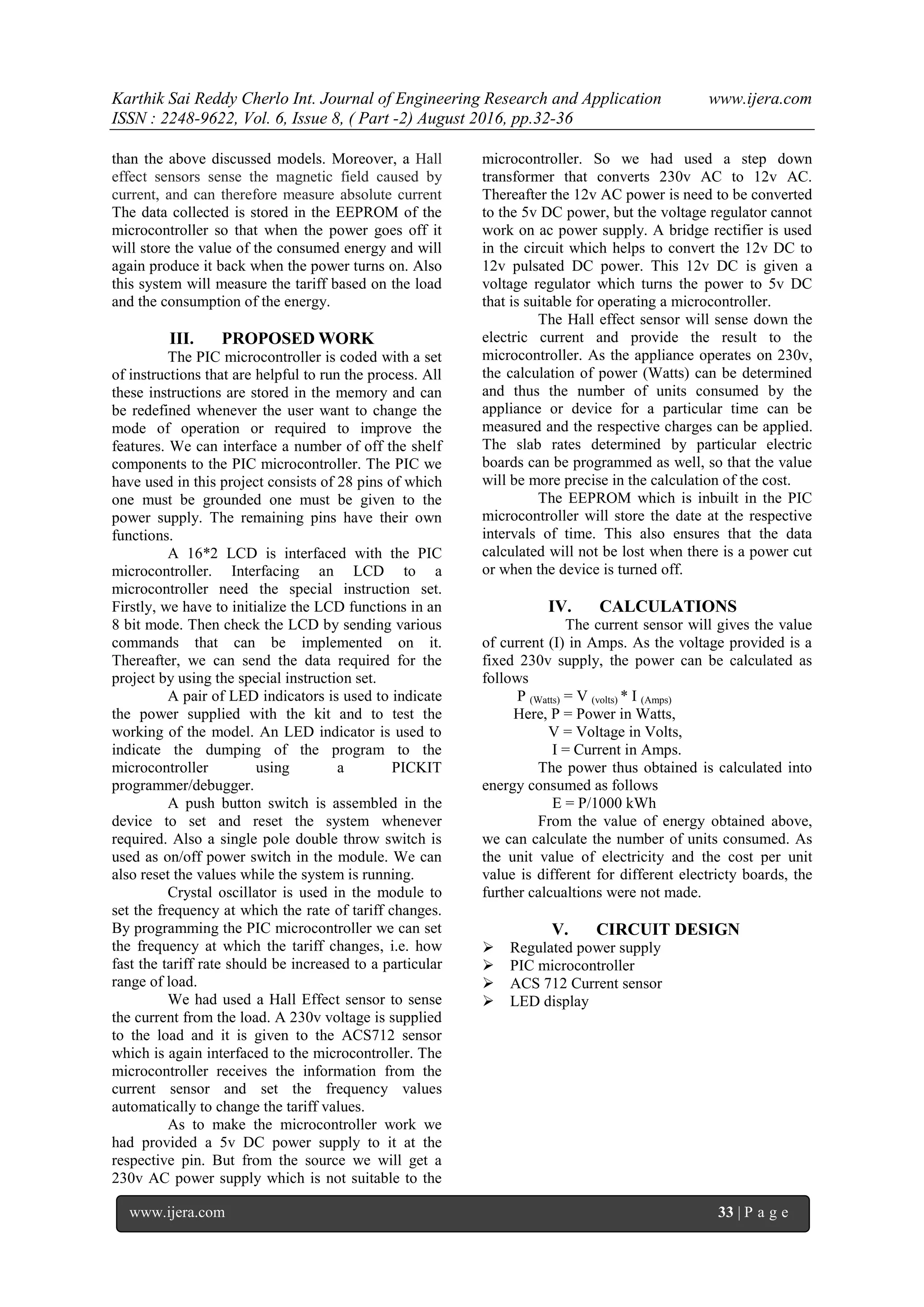
5.3 ACS 712 current sensor
The ACS712 provides economical and
precise solutions for AC or DC current sensing in
industrial, commercial, and communications
systems. The device package allows for easy
implementation by the customer. Typical
applications include motor control, load detection
and management, switch mode power supplies, and
over current fault protection. The device is not
intended for automotive applications. The device
consists of a precise, low-offset, linear Hall circuit
with a copper conduction path located near the
surface of the die. Applied current flowing through
this copper conduction path generates a magnetic
field which the Hall IC converts into a proportional
voltage. Device accuracy is optimized through the
close proximity of the magnetic signal to the Hall
transducer. A precise, proportional voltage is
provided by the low-offset, chopper-stabilized Bi-
CMOS Hall IC, which is programmed for accuracy
after packaging. The output of the device has a
positive slope (>VIOUT (Q)) when an increasing
current flows through the primary copper conduction
path (from pins 1 and 2 to pins 3 and 4), which is the
path used for current sampling. The internal
resistance of this conductive path is 1.2 mΩ typical,
providing low power losses. The thickness of the
copper conductor allows survival of the device at up
to 5× over current conditions. The terminals of the
conductive path are electrically isolated from the
signal leads (pins 5 through 8). This allows the
ACS712 to be used in applications requiring
electrical isolation without the use of Opto-isolators
or other costly isolation techniques.
Fig 5.4: ACS 712 current sensor
The ACS712 is provided in a small, surface
mount SOIC8 package. The lead frame is plated
with 100% matte tin, which is compatible with
standard lead (Pb) free printed circuit board
assembly processes. Internally, the device is Pb-free,
except for flip-chip high-temperature Pb-based
solder balls, currently exempt from RoHS. The
device is fully calibrated prior to shipment.
5.4 LCD Display
One of the most common devices attached
to a microcontroller is an LCD display. Some of the
most common LCD’s connected to the many
microcontrollers are 16x2 and 20x2 displays. This
means 16 characters per line by 2 lines and 20
characters per line by 2 lines, respectively.
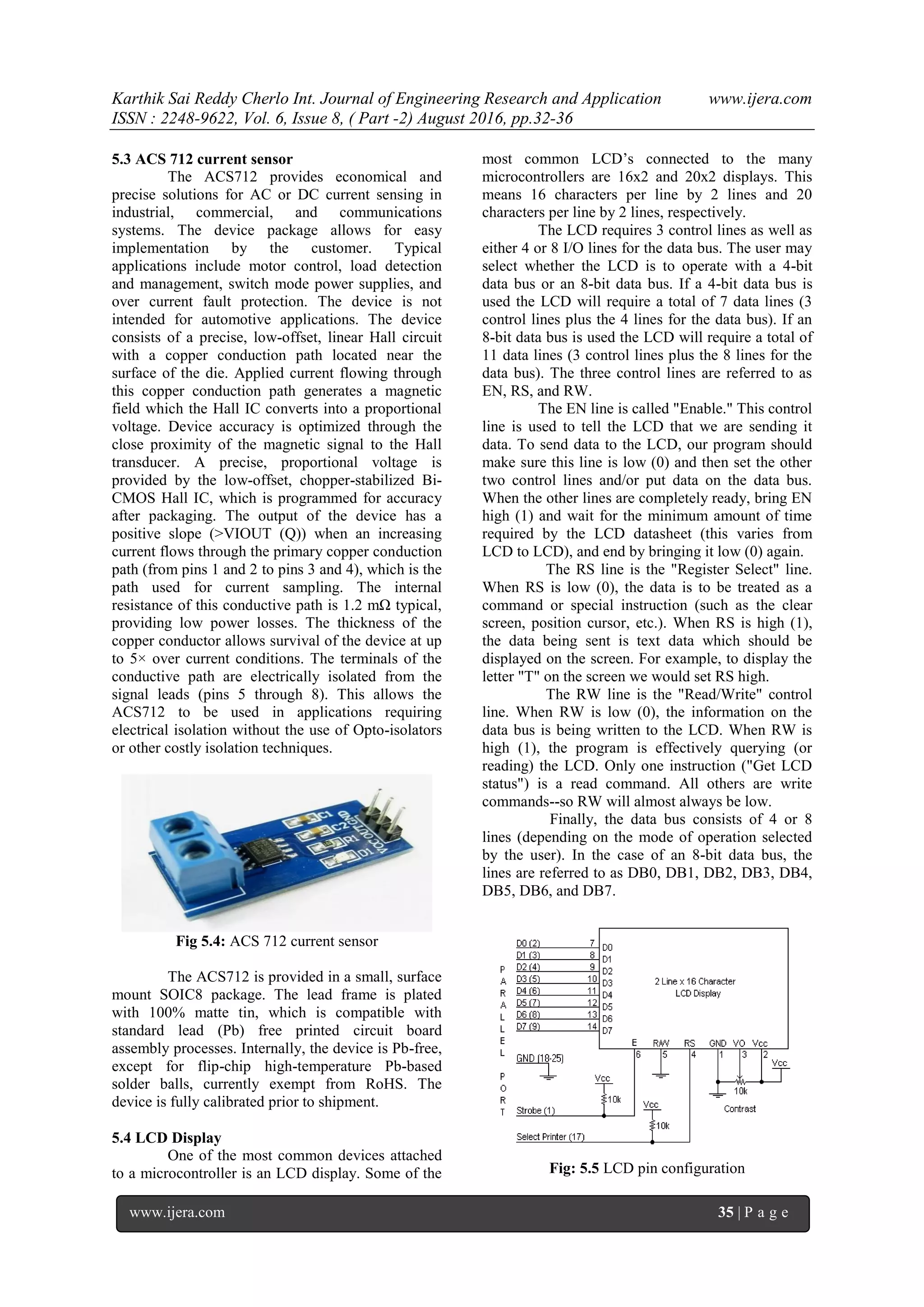
The LCD requires 3 control lines as well as
either 4 or 8 I/O lines for the data bus. The user may
select whether the LCD is to operate with a 4-bit
data bus or an 8-bit data bus. If a 4-bit data bus is
used the LCD will require a total of 7 data lines (3
control lines plus the 4 lines for the data bus). If an
8-bit data bus is used the LCD will require a total of
11 data lines (3 control lines plus the 8 lines for the
data bus). The three control lines are referred to as
EN, RS, and RW.
The EN line is called "Enable." This control
line is used to tell the LCD that we are sending it
data. To send data to the LCD, our program should
make sure this line is low (0) and then set the other
two control lines and/or put data on the data bus.
When the other lines are completely ready, bring EN
high (1) and wait for the minimum amount of time
required by the LCD datasheet (this varies from
LCD to LCD), and end by bringing it low (0) again.
The RS line is the "Register Select" line.
When RS is low (0), the data is to be treated as a
command or special instruction (such as the clear
screen, position cursor, etc.). When RS is high (1),
the data being sent is text data which should be
displayed on the screen. For example, to display the
letter "T" on the screen we would set RS high.
The RW line is the "Read/Write" control
line. When RW is low (0), the information on the
data bus is being written to the LCD. When RW is
high (1), the program is effectively querying (or
reading) the LCD. Only one instruction ("Get LCD
status") is a read command. All others are write
commands--so RW will almost always be low.
Finally, the data bus consists of 4 or 8
lines (depending on the mode of operation selected
by the user). In the case of an 8-bit data bus, the
lines are referred to as DB0, DB1, DB2, DB3, DB4,
DB5, DB6, and DB7.
Fig: 5.5 LCD pin configuration
Karthik Sai Reddy Cherlo Int. Journal of Engineering Research and Application www.ijera.com
ISSN : 2248-9622, Vol. 6, Issue 8, ( Part -2) August 2016, pp.32-36
www.ijera.com 36 | P a g e
Fig: 5.6 LCD display
VI. FEATURES
a. Less expensive design
As we have used the PIC microcontroller
and Hall effect sensor respectively in the place of
Arduino and CT sensor, the design of the circuit will
be less expensive when compared to the before
model.
b. Low power consumption
The less complex design and usage of
minimal power consumption components, the energy
consumed by this device are very less.
6.3 Fast and accurate results
As it is a real-time operating system the
values will be displayed instantaneously with
minimal error.
VII. FUTURE SCOPE
This project is mainly intended to design a
system which helps in continuous monitoring of the
load connected to the device. This system has an
energy meter, load, and LCD interfaced to the
microcontroller. The microcontroller is programmed
in such a way that the energy meter always gives the
reading to the controller which is displayed on the
LCD.
As we are using the EEPROM to store the
data, we can interface a buzzer to the system so that
the system can alert the user after the tariff reaches
to a given set value. By using the EEPROM and the
inbuilt counter in the PIC microcontroller we can
also set the time so that the system works in between
the given period and then switch off automatically.
We can also use the
Zigbee/GSM/WAN/LAN module so that the system
can send the information directly to the users’
mobile or any other module that displays
information from the data received wirelessly
VIII. CONCLUSION
By implementing this kind of real-time
hardware projects successfully and providing the end
user with necessary information about the
consumption of energy by household appliances, the
electricity bills can be reduced to a great extent. The
usage of open software and open hardware
technology will help the future developers to modify
the circuit with the future technology and develop a
better device.
REFERENCES
[1]. Institute of Electrical and Electronics
Engineers (IEEE): Design and Construction
of a Power Meter to Optimize Electric
Power, M. Maryori Sabalza ; Fac. de Ing.,
Univ. Tecnol. De Bolivar, Cartagena,
Colombia ; J. D. Borré O. ; J. C. Martínez
Santos, 10.1109/CIIMA.2014.6983441.
[2]. International Journal of Engineering
Research and Technology (IJERT): Non-
Intrusive Appliance Load Monitoring
System Using Zigbee Protocol” (ISSN:
2278-0181, Vol 3, Issue 4 April 2014).]
Books:
[3]. Micro controllers Architecture,
Programming and Interfacing systems – Raj
Kamal
[4]. Introduction to Embedded Systems – Shibu
K V
[5]. Interfacing PIC Microcontroller: Embedded
design by interactive simulation- Martin P.
Bates
Thesis:
[6]. N. B. Mohamad, “Smart Power Meter for
Domestic Devices,” Master’s thesis,
Universiti Teknologi Malaysia, 2014.

Real-Time Load Monitoring By Microcontroller to Optimize Electric Power Utilization

  • 1.
    Karthik Sai ReddyCherlo Int. Journal of Engineering Research and Application www.ijera.com ISSN : 2248-9622, Vol. 6, Issue 8, ( Part -2) August 2016, pp.32-36 www.ijera.com 32 | P a g e Real-Time Load Monitoring By Microcontroller to Optimize Electric Power Utilization Karthik Sai Reddy Cherlo, Sai Bharadwaj Cheruvu Department of Electronics and Communication Engineering, Priyadarshini College of Engineering and Technology , Nellore, India, 524002. ABSTRACT This paper describes the design and working of a cost and energy efficient power meter that monitor the usage of electrical energy consumed by any appliance or machine at any given time. The precise knowledge of the consumption of each device will let us identify the devices that increases the cost of our electricity bill. The circuit designed evaluates the consumption of the load of a particular device. As this is real-time monitoring, the evaluation is instantaneous such that the user can monitor the readings at any given time. The load is displayed in terms of Watts and the cost can be programmed according to tariff plan and slab rates. Keywords: microcontroller, hall effect current sensor, energy audit, load monitoring, real-time, cost efficient, energy efficient. I. INTRODUCTION The energy crisis is a broad and complex issue that is being a real concern to the present day situation. Most people don’t get connected to its reality unless the price of the electricity or gas rises. As limited natural resources that are used to power industry are diminishing as the demand rises, the cost of the electricity will also increase significantly. Over consumption of electric power leads to the situation of this crisis. The demand for electric power in the world is ever increasing due to rapid industrializaton. To meet the demand it is the responsibility of every individual to reduce the utilization. Energy audit and management is the technique that can be practiced to reduce the electric consumption. An energy audit is an inspection and analysis of energy consumption with possible conservation in domestic sector or industrial environment. The advancement in the technology cutting down the costs of manufacturing electronic devices. With this advancement we can design an energy meter per circuit than design an energy meter per whole house. Through this implementation, we can have better perception of energy that is being utilized by each of the household electronic appliances. Our project consists of a Hall effect current sensor which detects the electric current and produces a signal according to it, a microcontroller that is programmed to calculate the Wattage and units, an LCD display that shows the instantaneous values of the desired outputs. This article is organized as follows: section II presents the state of the art, section III presents the proposed work, section IV is the calculations part, section V will present the circuit design, section VI will discuss the features, section VII & VIII are future scope & conclusion respectively. II. STATE OF THE ART The usage of smart meters has come into existence in the last decade. A smart meter is an electronic device that records the consumption of electric energy in intervals of an hour or less and communicates that information at least daily back to the utility for monitoring and billing. A number of smart meters have been designed using various platforms such as the case of the projects referenced in [1] [2]. Both of these projects are based on the arduino and a CT sensor. The second project in which the Zigbee protocol was used is the development of the first one. In [1], two sensors were used to determine the current and voltage individually. The usage of arduino and a CT Sensor will make the designing of the circuit costly. Moreover a current transformer can only sense current down to some minimum frequency below which gain falls off rapidly. A current transformer can't sense a fixed current. If you are measuring current of something that is inherently AC, like the power line, then a current transformer can be appropriate. If you really need to sense DC current, then you can't use a current transformer and a Hall effect sensor may be appropriate. The proposed project is developing a prototype of energy meter without actually using the conventional energy meter by using the PIC microcontroller and a Hall Effect current sensor, so that the cost of the product will be much cheaper RESEARCH ARTICLE OPEN ACCESS
  • 2.
    Karthik Sai ReddyCherlo Int. Journal of Engineering Research and Application www.ijera.com ISSN : 2248-9622, Vol. 6, Issue 8, ( Part -2) August 2016, pp.32-36 www.ijera.com 33 | P a g e than the above discussed models. Moreover, a Hall effect sensors sense the magnetic field caused by current, and can therefore measure absolute current The data collected is stored in the EEPROM of the microcontroller so that when the power goes off it will store the value of the consumed energy and will again produce it back when the power turns on. Also this system will measure the tariff based on the load and the consumption of the energy. III. PROPOSED WORK The PIC microcontroller is coded with a set of instructions that are helpful to run the process. All these instructions are stored in the memory and can be redefined whenever the user want to change the mode of operation or required to improve the features. We can interface a number of off the shelf components to the PIC microcontroller. The PIC we have used in this project consists of 28 pins of which one must be grounded one must be given to the power supply. The remaining pins have their own functions. A 16*2 LCD is interfaced with the PIC microcontroller. Interfacing an LCD to a microcontroller need the special instruction set. Firstly, we have to initialize the LCD functions in an 8 bit mode. Then check the LCD by sending various commands that can be implemented on it. Thereafter, we can send the data required for the project by using the special instruction set. A pair of LED indicators is used to indicate the power supplied with the kit and to test the working of the model. An LED indicator is used to indicate the dumping of the program to the microcontroller using a PICKIT programmer/debugger. A push button switch is assembled in the device to set and reset the system whenever required. Also a single pole double throw switch is used as on/off power switch in the module. We can also reset the values while the system is running. Crystal oscillator is used in the module to set the frequency at which the rate of tariff changes. By programming the PIC microcontroller we can set the frequency at which the tariff changes, i.e. how fast the tariff rate should be increased to a particular range of load. We had used a Hall Effect sensor to sense the current from the load. A 230v voltage is supplied to the load and it is given to the ACS712 sensor which is again interfaced to the microcontroller. The microcontroller receives the information from the current sensor and set the frequency values automatically to change the tariff values. As to make the microcontroller work we had provided a 5v DC power supply to it at the respective pin. But from the source we will get a 230v AC power supply which is not suitable to the microcontroller. So we had used a step down transformer that converts 230v AC to 12v AC. Thereafter the 12v AC power is need to be converted to the 5v DC power, but the voltage regulator cannot work on ac power supply. A bridge rectifier is used in the circuit which helps to convert the 12v DC to 12v pulsated DC power. This 12v DC is given a voltage regulator which turns the power to 5v DC that is suitable for operating a microcontroller. The Hall effect sensor will sense down the electric current and provide the result to the microcontroller. As the appliance operates on 230v, the calculation of power (Watts) can be determined and thus the number of units consumed by the appliance or device for a particular time can be measured and the respective charges can be applied. The slab rates determined by particular electric boards can be programmed as well, so that the value will be more precise in the calculation of the cost. The EEPROM which is inbuilt in the PIC microcontroller will store the date at the respective intervals of time. This also ensures that the data calculated will not be lost when there is a power cut or when the device is turned off. IV. CALCULATIONS The current sensor will gives the value of current (I) in Amps. As the voltage provided is a fixed 230v supply, the power can be calculated as follows P (Watts) = V (volts) * I (Amps) Here, P = Power in Watts, V = Voltage in Volts, I = Current in Amps. The power thus obtained is calculated into energy consumed as follows E = P/1000 kWh From the value of energy obtained above, we can calculate the number of units consumed. As the unit value of electricity and the cost per unit value is different for different electricty boards, the further calcualtions were not made. V. CIRCUIT DESIGN  Regulated power supply  PIC microcontroller  ACS 712 Current sensor  LED display
  • 3.
    Karthik Sai ReddyCherlo Int. Journal of Engineering Research and Application www.ijera.com ISSN : 2248-9622, Vol. 6, Issue 8, ( Part -2) August 2016, pp.32-36 www.ijera.com 34 | P a g e Fig: 5.1 Schematic diagram of the system 5.1 Regulated power supply For every electronic circuit the initial stage is a power supply system which supplies required power to drive the whole system. The requirements of the power supply will depend on the specifications of the components used in the device. The main components used in this power supply system are  230v AC mains  Transformer (step down)  Bridge rectifier(DB 107)  Capacitor  Voltage regulator IC 7805  Resistor  LED Fig: 5.2 Regulated power supply 5.2 PIC microcontroller PIC is a family of modified Harvard architecture microcontrollers made by Microchip Technology, derived from the PIC1650 originally developed by General Instrument's Microelectronics Division. The name PIC initially referred to Peripheral Interface Controller. The first parts of the family were available in 1976; by 2013 the company had shipped more than twelve billion individual parts, used in a wide variety of embedded systems. Early models of PIC had read-only memory (ROM) or field-programmable EPROM for program storage, some with provision for erasing memory. All current models use Flash memory for program storage, and newer models allow the PIC to reprogram itself. Program memory and data memory are separated. Data memory is 8-bit, 16-bit and in latest models, 32-bit wide. Program instructions vary in bit-count by the family of PIC, and may be 12, 14, 16, or 24 bits long. The instruction set also varies by model, with more powerful chips adding instructions for digital signal processing functions. The hardware capabilities of PIC devices range from 8-pin DIP chips up to 100- pin SMD chips, with discrete I/O pins, ADC and DAC modules, and communications ports such as UART, I2C, CAN, and even USB. Low-power and high-speed variations exist for many types. Fig: 5.3 PIC Microcontroller pin configuration The manufacturer supplies computer software for the development known as MPLAB, assemblers and C/C++ compilers, and programmer/debugger hardware under the MPLAB and PICKit series. Third party and some open-source tools are also available. Some parts have in-circuit programming capability; low- cost development programmers are available as well has high-production programmers. PIC devices are popular with both industrial developers and hobbyists due to their low cost, wide availability, large user base, an extensive collection of application notes, and availability of low cost or free development tools, serial programming, and re-programmable Flash-memory capability.
  • 4.
    Karthik Sai ReddyCherlo Int. Journal of Engineering Research and Application www.ijera.com ISSN : 2248-9622, Vol. 6, Issue 8, ( Part -2) August 2016, pp.32-36 www.ijera.com 35 | P a g e 5.3 ACS 712 current sensor The ACS712 provides economical and precise solutions for AC or DC current sensing in industrial, commercial, and communications systems. The device package allows for easy implementation by the customer. Typical applications include motor control, load detection and management, switch mode power supplies, and over current fault protection. The device is not intended for automotive applications. The device consists of a precise, low-offset, linear Hall circuit with a copper conduction path located near the surface of the die. Applied current flowing through this copper conduction path generates a magnetic field which the Hall IC converts into a proportional voltage. Device accuracy is optimized through the close proximity of the magnetic signal to the Hall transducer. A precise, proportional voltage is provided by the low-offset, chopper-stabilized Bi- CMOS Hall IC, which is programmed for accuracy after packaging. The output of the device has a positive slope (>VIOUT (Q)) when an increasing current flows through the primary copper conduction path (from pins 1 and 2 to pins 3 and 4), which is the path used for current sampling. The internal resistance of this conductive path is 1.2 mΩ typical, providing low power losses. The thickness of the copper conductor allows survival of the device at up to 5× over current conditions. The terminals of the conductive path are electrically isolated from the signal leads (pins 5 through 8). This allows the ACS712 to be used in applications requiring electrical isolation without the use of Opto-isolators or other costly isolation techniques. Fig 5.4: ACS 712 current sensor The ACS712 is provided in a small, surface mount SOIC8 package. The lead frame is plated with 100% matte tin, which is compatible with standard lead (Pb) free printed circuit board assembly processes. Internally, the device is Pb-free, except for flip-chip high-temperature Pb-based solder balls, currently exempt from RoHS. The device is fully calibrated prior to shipment. 5.4 LCD Display One of the most common devices attached to a microcontroller is an LCD display. Some of the most common LCD’s connected to the many microcontrollers are 16x2 and 20x2 displays. This means 16 characters per line by 2 lines and 20 characters per line by 2 lines, respectively. The LCD requires 3 control lines as well as either 4 or 8 I/O lines for the data bus. The user may select whether the LCD is to operate with a 4-bit data bus or an 8-bit data bus. If a 4-bit data bus is used the LCD will require a total of 7 data lines (3 control lines plus the 4 lines for the data bus). If an 8-bit data bus is used the LCD will require a total of 11 data lines (3 control lines plus the 8 lines for the data bus). The three control lines are referred to as EN, RS, and RW. The EN line is called "Enable." This control line is used to tell the LCD that we are sending it data. To send data to the LCD, our program should make sure this line is low (0) and then set the other two control lines and/or put data on the data bus. When the other lines are completely ready, bring EN high (1) and wait for the minimum amount of time required by the LCD datasheet (this varies from LCD to LCD), and end by bringing it low (0) again. The RS line is the "Register Select" line. When RS is low (0), the data is to be treated as a command or special instruction (such as the clear screen, position cursor, etc.). When RS is high (1), the data being sent is text data which should be displayed on the screen. For example, to display the letter "T" on the screen we would set RS high. The RW line is the "Read/Write" control line. When RW is low (0), the information on the data bus is being written to the LCD. When RW is high (1), the program is effectively querying (or reading) the LCD. Only one instruction ("Get LCD status") is a read command. All others are write commands--so RW will almost always be low. Finally, the data bus consists of 4 or 8 lines (depending on the mode of operation selected by the user). In the case of an 8-bit data bus, the lines are referred to as DB0, DB1, DB2, DB3, DB4, DB5, DB6, and DB7. Fig: 5.5 LCD pin configuration
  • 5.
    Karthik Sai ReddyCherlo Int. Journal of Engineering Research and Application www.ijera.com ISSN : 2248-9622, Vol. 6, Issue 8, ( Part -2) August 2016, pp.32-36 www.ijera.com 36 | P a g e Fig: 5.6 LCD display VI. FEATURES a. Less expensive design As we have used the PIC microcontroller and Hall effect sensor respectively in the place of Arduino and CT sensor, the design of the circuit will be less expensive when compared to the before model. b. Low power consumption The less complex design and usage of minimal power consumption components, the energy consumed by this device are very less. 6.3 Fast and accurate results As it is a real-time operating system the values will be displayed instantaneously with minimal error. VII. FUTURE SCOPE This project is mainly intended to design a system which helps in continuous monitoring of the load connected to the device. This system has an energy meter, load, and LCD interfaced to the microcontroller. The microcontroller is programmed in such a way that the energy meter always gives the reading to the controller which is displayed on the LCD. As we are using the EEPROM to store the data, we can interface a buzzer to the system so that the system can alert the user after the tariff reaches to a given set value. By using the EEPROM and the inbuilt counter in the PIC microcontroller we can also set the time so that the system works in between the given period and then switch off automatically. We can also use the Zigbee/GSM/WAN/LAN module so that the system can send the information directly to the users’ mobile or any other module that displays information from the data received wirelessly VIII. CONCLUSION By implementing this kind of real-time hardware projects successfully and providing the end user with necessary information about the consumption of energy by household appliances, the electricity bills can be reduced to a great extent. The usage of open software and open hardware technology will help the future developers to modify the circuit with the future technology and develop a better device. REFERENCES [1]. Institute of Electrical and Electronics Engineers (IEEE): Design and Construction of a Power Meter to Optimize Electric Power, M. Maryori Sabalza ; Fac. de Ing., Univ. Tecnol. De Bolivar, Cartagena, Colombia ; J. D. Borré O. ; J. C. Martínez Santos, 10.1109/CIIMA.2014.6983441. [2]. International Journal of Engineering Research and Technology (IJERT): Non- Intrusive Appliance Load Monitoring System Using Zigbee Protocol” (ISSN: 2278-0181, Vol 3, Issue 4 April 2014).] Books: [3]. Micro controllers Architecture, Programming and Interfacing systems – Raj Kamal [4]. Introduction to Embedded Systems – Shibu K V [5]. Interfacing PIC Microcontroller: Embedded design by interactive simulation- Martin P. Bates Thesis: [6]. N. B. Mohamad, “Smart Power Meter for Domestic Devices,” Master’s thesis, Universiti Teknologi Malaysia, 2014.