Digestive System II: Accessory
Organs, Digestion and Nutrition
ATS Unit 6
Learning Targets
• Identify accessory organs and their
functions in the digestive system.
• Discuss the functions of key enzymes and
macronutrients as they interact in the
process of digestion.
Review of Macronutrients
• We need:
– Carbohydrates
– Proteins
– Lipids
• However, they are not absorbable in the
form we find them in food.
– Digestion is the physical and chemical
process of creating absorbable nutrients.
In the Beginning…
• We intake food through our oral cavities
(mouths).
– Toungue and teeth mash the food to prepare
it for digestion.
– Salivary glands secrete fluid that begins the
digestive process.
• A key ingredient in saliva is amylase, a digestive
enzyme that begins the breakdown of sugars
(carbs).
Chemistry in the Stomach
• Gastric Juices are very acidic and contain
various chemicals:
– Gastrin promotes production of Hydrochloric
Acid
– Hydrochloric acid is made by the parietal, also
intrinsic factor (b12 absorption)
– Pepsin is made by Chief cells and begins protein
digestion.
– Rennin is found in higher levels in infants and
children, and helps digest milk protein.
– Mucous is produced by many mucous cells to
protect the stomach lining from the acid.
Chemistry in the Small Intestine
• There are many enzymes and other chemicals
active that help with the complicated process of
digestion and absorption.
– Secretin and Cholecystokinin stimulate the pancreas
liver and gallbladder to release there enzymes.
– Pancreas releases Protease, Amylase and Lipase to
break down larger molecules of proteins, carbs and
fats. It also releases bicarb to neutralize the
stomach acid.
– Liver produces bile which emulsifies fats.
– Intestines produce enzymes to breakdown sugars
into simple sugars for absorption.
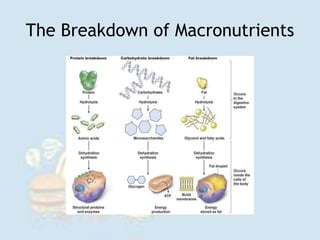
The Breakdown of Macronutrients
The Pancreas
• Both an exocrine gland for the digestive
system and and endocrine gland that
produces hormones.
– Three portions (head, body and tail)
– Lives just under the stomach
– Most of the pancreas works to create the
digestive enzymes and bicarbonate (Acini and
Duct Cells).
– Islets of Langerhans serve the endocrine
purpose.
The Liver and Gallbladder
• The liver a large vascular organ located under the
right side of the diaphragm. It has a right and left
lobe.
– Creates bile which contains bilirubin.
– Creates and stores glycogen
– Detoxifies harmful substances
– Makes blood proteins for clotting.
– Processes waste from protein metabolism (urea)
– Store vitamins
– Breaks down hormones and worn out RBCs.
• The gallbladder sits under the liver, is connected to
the hepatic and common bile duct and is just a
storage area for bile.
After Absorption
• The simplified molecules from the
proteins, fats, carbohydrates, vitamins
and minerals are absorbed by selective,
facilitates, or passive absorption into the
capillaries into eh intestinal walls. They
then are circulated around the body and
used where they are needed.

Digestive system 2 EHS Unit 6

  • 1.
    Digestive System II:Accessory Organs, Digestion and Nutrition ATS Unit 6
  • 2.
    Learning Targets • Identifyaccessory organs and their functions in the digestive system. • Discuss the functions of key enzymes and macronutrients as they interact in the process of digestion.
  • 3.
    Review of Macronutrients •We need: – Carbohydrates – Proteins – Lipids • However, they are not absorbable in the form we find them in food. – Digestion is the physical and chemical process of creating absorbable nutrients.
  • 4.
    In the Beginning… •We intake food through our oral cavities (mouths). – Toungue and teeth mash the food to prepare it for digestion. – Salivary glands secrete fluid that begins the digestive process. • A key ingredient in saliva is amylase, a digestive enzyme that begins the breakdown of sugars (carbs).
  • 5.
    Chemistry in theStomach • Gastric Juices are very acidic and contain various chemicals: – Gastrin promotes production of Hydrochloric Acid – Hydrochloric acid is made by the parietal, also intrinsic factor (b12 absorption) – Pepsin is made by Chief cells and begins protein digestion. – Rennin is found in higher levels in infants and children, and helps digest milk protein. – Mucous is produced by many mucous cells to protect the stomach lining from the acid.
  • 6.
    Chemistry in theSmall Intestine • There are many enzymes and other chemicals active that help with the complicated process of digestion and absorption. – Secretin and Cholecystokinin stimulate the pancreas liver and gallbladder to release there enzymes. – Pancreas releases Protease, Amylase and Lipase to break down larger molecules of proteins, carbs and fats. It also releases bicarb to neutralize the stomach acid. – Liver produces bile which emulsifies fats. – Intestines produce enzymes to breakdown sugars into simple sugars for absorption.
  • 7.
    The Breakdown ofMacronutrients
  • 8.
    The Pancreas • Bothan exocrine gland for the digestive system and and endocrine gland that produces hormones. – Three portions (head, body and tail) – Lives just under the stomach – Most of the pancreas works to create the digestive enzymes and bicarbonate (Acini and Duct Cells). – Islets of Langerhans serve the endocrine purpose.
  • 9.
    The Liver andGallbladder • The liver a large vascular organ located under the right side of the diaphragm. It has a right and left lobe. – Creates bile which contains bilirubin. – Creates and stores glycogen – Detoxifies harmful substances – Makes blood proteins for clotting. – Processes waste from protein metabolism (urea) – Store vitamins – Breaks down hormones and worn out RBCs. • The gallbladder sits under the liver, is connected to the hepatic and common bile duct and is just a storage area for bile.
  • 10.
    After Absorption • Thesimplified molecules from the proteins, fats, carbohydrates, vitamins and minerals are absorbed by selective, facilitates, or passive absorption into the capillaries into eh intestinal walls. They then are circulated around the body and used where they are needed.