Digestive System
Or
Gastrointestinal
Or
AlimentaryTract
By : Priyanka
Research Scholar , LNIPE Gwalior
Digestive system
 The primary function of the digestive system is
to break down food both mechanically and by
the use of enzymes, so that it can be used by the
body for energy and cell growth and repair. It
consists of a large number of organs and
processes with the combined functions of
breaking down our food into smaller molecules
which can be used to produce energy and for
other nutritional purposes; and excreting the
waste consumed and produced by the system.
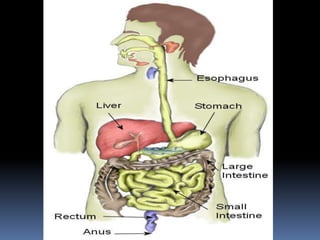
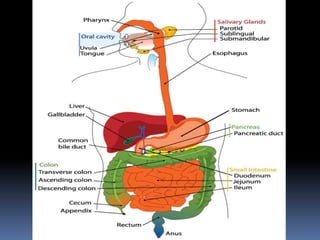
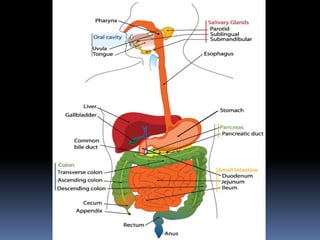
Organs of Digestive system
 Mouth
 Pharynx
 Esophagus
 Stomach
 Small intestine
 Large Intestine
 Rectum
 Anus
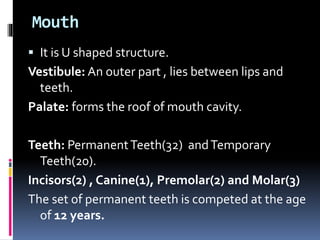
Mouth
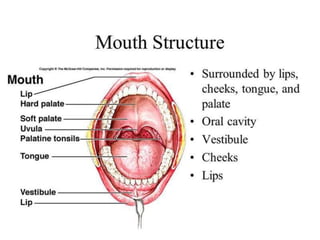
 It is U shaped structure.
Vestibule: An outer part , lies between lips and
teeth.
Palate: forms the roof of mouth cavity.
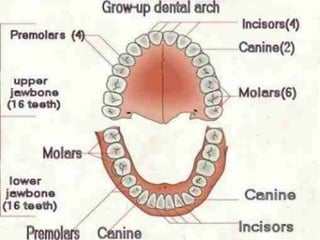
Teeth: PermanentTeeth(32) andTemporary
Teeth(20).
Incisors(2) , Canine(1), Premolar(2) and Molar(3)
The set of permanent teeth is competed at the age
of 12 years.
Different enzymes and actions
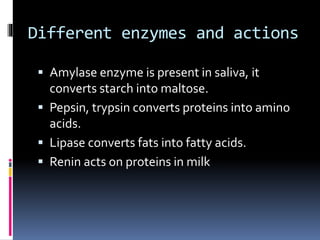
 Amylase enzyme is present in saliva, it
converts starch into maltose.
 Pepsin, trypsin converts proteins into amino
acids.
 Lipase converts fats into fatty acids.
 Renin acts on proteins in milk
Salivary Glands
These are total 6 in number:
 Parotid: duct called Stenson’s duct and is
the largest gland.
 Submandibular Gland: Has a duct called
Whartson’s duct.
 Sublingual: smallest salivary gland.
Saliva: Alkaline fluid containing 99% of water
and the pH of saliva is 7.2.
 It has ptyalin enzyme which converts starch
into maltose.
 It is 20-25 cm long.. It lies behind the wind
pipe(trachea)
 It contains sphincters( prevents stomach acid
from back flowing into esophagus)
Deglutition: Act of swallowing: converting
food into round mass called bolus.
There is a flap called epiglottis which prevents
food from entering into windpipe.
Food travels down the esophagus through a
series of rhythmic contractions called
“Peristalisis”
Oesophagus (food pipe)
Stomach
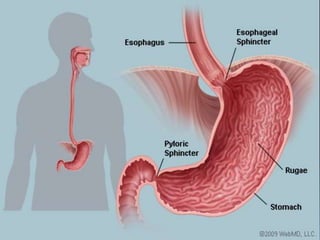
It is a J- shaped organ.. It receives food from
esophagus and this secretes gastric juice.
 Goblet cells: Mucous( prevents stomach from
digesting itself)
 Parietal Cells: HCL(pH 2)
 Peptic/chief cells: Pepsinogen (inactive
protein)
 Pepsin: It is an enzyme which converts
protein into peptone.
Contd.
 Chyme: product of digested food in stomach.
 Pepsin of stomach, tripsin converts proteins
into peptones, polypeptide and finally into
amino acids.
 Lipase, an enzyme of pancreas convert fat
into fatty acids and glycerol.
 No absorption of food occurs in stomach
except glucose but alcohol and water can be
absorbed in stomach.
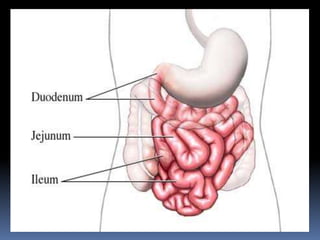
Small Intestine
 Part which extends from pyloric end of
stomach to ceacum.
 At an average it is of 2.4 m long.
It has three parts
 Duodenum 5 %
 Jejunum 40%
 Ileum 55%
Function of small intestine
 The small intestine is the part of the
intestines where 90% of the digestion and
absorption of food occurs, the other 10%
taking place in the stomach and large
intestine.The main function of the small
intestine is absorption of nutrients and
minerals from food.
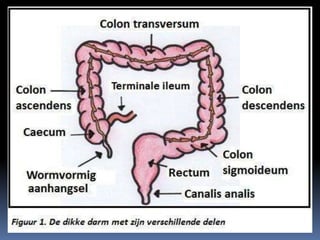
Large Intestine
 Large intestine extends from the end of ileum to
rectum.
 It consists of Ceacum, colon and rectum.
Ceacum:The main function of the ceacum are to
absorb fluids and salts that remain after
completion of intestinal digestion.
Colon: the colon is divided into three i.e. an
ascending, a transverse and descending colon.
Rectum: The main function of the rectum is to act
as a temporary storage site for fecal matter before
it is eliminated from the body through the anal
canal.
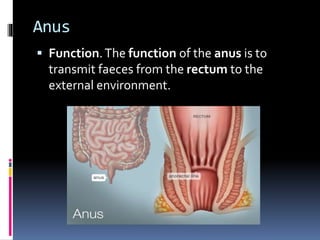
Anus
 Function.The function of the anus is to
transmit faeces from the rectum to the
external environment.
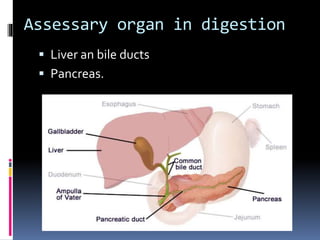
Assessary organ in digestion
 Liver an bile ducts
 Pancreas.
Liver
Liver is the largest abdominal organ and largest
gland of the body .
Hepatic lobule are the structural and functional
unit of liver
It has a mass of about 1.5kg and it produces bile
, a greenish yellow pigment made up of bile
salts as it break down old RBC’s.
 Liver cells are called lobules.
Contd.
 Hepatic Artery: Supplies oxygenated blood
to liver
 Hepatic veins: carry impure blood of liver
and drain into inferior vena cava.
 Bile ducts: secretion of bile is carried out by
bile ducts made up of binary calculi.
Functions of liver
Synthesis and storage of glycogen.
Contd.
Formation of urea
Synthesis of plasma protein.
Natural anticoagulant: Heparin
Storage of vitamin: A, D , E, K.
Bile is an alkaline fluid secreated by liver, stored
in gall bladder .. About 500-1000ml of bile is
secreated by liver per day. It contains 86% of
water , bile salts and bile pigments.
Pancreas(duct of Wirsung)
The pancreas is a compound elongated organ (
exocrine and endocrine).
The exocrine portion secreated an alkaline
pancreatic juice containing enzymes and the
endocrine portion secretes hormones, insulin
and glucagon.
 Amylase : starch into maltose
 Lipase: fats into fatty acids.
 Trypsin: peptones into amino acids.
 Insulin: Secreated by beta cells
 Glucagon: secreated by alpha cells
Digestive system Physiology
The digestive system is responsible for taking
whole food and turning them into energy and
nutrients to allow the body to function, grow,
and repair itself.The six primary processes of
the digestive system include:
 Ingestion of food
 Digestion of food into smaller pieces
 Absorption of nutrients
 Assimilation
 Excretion of wastes
Ingestion
The first function of the digestive system is
ingestion, or the intake of food.
The mouth is responsible for this function, as it
is the orifice through which all food enters the
body.The mouth and stomach are also
responsible for the storage of food as it is
waiting to be digested.
Digestion
 In human beings the digestion of food begins
in mouth itself.The salivary glands helps in
chemical digestion by secreting enzymes.The
human saliva contain an enzyme called
salivary amylase which digests the starch
present into the food.Thus the digestion of
starch begins in mouth itself.
 Then the esophagus carries food to stomach.
 The contraction and expansion movement of
walls of food pipe is called peristaltic
movement.
Contd.
 Now the stomach has three tubular glands.
The walls of stomach secreated gastric juice
i.e. ( HCL, the enzyme pepsin and mucus).
Due to the presence of HCL, the gastric juice
is acidic in nature. In acidic medium the
enzyme pepsin begins the digestion of
proteins present in food.Thus the protein
digestion begins in stomach and another
function of HCL is to kill bacteria which enters
the stomach by food.
Contd.
 The mucus helps to protect the wall from Hcl.
then the partially digested food is then goes
from the stomach to the small intestine.
 The small intestine receives the secretion
from two glands i.e. liver and pancreas . As
bile is alkaline in nature and contains salts
which helps to emulsify or break the fats
present in food. thus bile performs two
functions : makes the acidic food coming
from the stomach alkaline so that pancreatic
enzymes can act on it.
Contd.
Pancreas secretes pancreatic juice which
contain digestive enzymes like pancreatic
amylase, lipase and tripsin.
The walls of intestine contain glands which
secretes intestinal juice.The intestinal juice
contain a number of enzymes which
complete the digestion of complex
carbohydrates into glucose , proteins into
amino acids and glycerol.
Absorption
 After digestion, the molecules of food
become so small that they can pass through
the walls of small intestine which contain
blood capillaries and go into our blood.This is
called absorption the small inestine is the
main region for the absorption of digested
food.
Assimilation
 He blood carries the digested and dissolved
food to all the parts of the body the
assimilated food is then used by the cells for
obtaining energy.Then the digested food
which is not used by body immediately is
stored in the liver in the form of carbohydrate
called “glycogen”
Excretion/ Ejection /Defecation
 A part of food which we eat can not be digested
by our body.This undigested food can not be
absorbed in the small intestine .Then this food is
sent to large intestine .The walls of large
intestine absorb most of the water from that
.due to this the unabsorbed food becomes
almost solid .The large part of the large intestine
rectum stores this undigested food for sometime
and after then this undigested food is passed out
from our body through anus.The act of expelling
the faeces is called egestion or defection
THANKYOU

Digestive system in detail

  • 1.
    Digestive System Or Gastrointestinal Or AlimentaryTract By :Priyanka Research Scholar , LNIPE Gwalior
  • 2.
    Digestive system  Theprimary function of the digestive system is to break down food both mechanically and by the use of enzymes, so that it can be used by the body for energy and cell growth and repair. It consists of a large number of organs and processes with the combined functions of breaking down our food into smaller molecules which can be used to produce energy and for other nutritional purposes; and excreting the waste consumed and produced by the system.
  • 4.
    Organs of Digestivesystem  Mouth  Pharynx  Esophagus  Stomach  Small intestine  Large Intestine  Rectum  Anus
  • 5.
    Mouth  It isU shaped structure. Vestibule: An outer part , lies between lips and teeth. Palate: forms the roof of mouth cavity. Teeth: PermanentTeeth(32) andTemporary Teeth(20). Incisors(2) , Canine(1), Premolar(2) and Molar(3) The set of permanent teeth is competed at the age of 12 years.
  • 7.
    Different enzymes andactions  Amylase enzyme is present in saliva, it converts starch into maltose.  Pepsin, trypsin converts proteins into amino acids.  Lipase converts fats into fatty acids.  Renin acts on proteins in milk
  • 9.
    Salivary Glands These aretotal 6 in number:  Parotid: duct called Stenson’s duct and is the largest gland.  Submandibular Gland: Has a duct called Whartson’s duct.  Sublingual: smallest salivary gland. Saliva: Alkaline fluid containing 99% of water and the pH of saliva is 7.2.  It has ptyalin enzyme which converts starch into maltose.
  • 10.
     It is20-25 cm long.. It lies behind the wind pipe(trachea)  It contains sphincters( prevents stomach acid from back flowing into esophagus) Deglutition: Act of swallowing: converting food into round mass called bolus. There is a flap called epiglottis which prevents food from entering into windpipe. Food travels down the esophagus through a series of rhythmic contractions called “Peristalisis” Oesophagus (food pipe)
  • 11.
    Stomach It is aJ- shaped organ.. It receives food from esophagus and this secretes gastric juice.  Goblet cells: Mucous( prevents stomach from digesting itself)  Parietal Cells: HCL(pH 2)  Peptic/chief cells: Pepsinogen (inactive protein)  Pepsin: It is an enzyme which converts protein into peptone.
  • 13.
    Contd.  Chyme: productof digested food in stomach.  Pepsin of stomach, tripsin converts proteins into peptones, polypeptide and finally into amino acids.  Lipase, an enzyme of pancreas convert fat into fatty acids and glycerol.  No absorption of food occurs in stomach except glucose but alcohol and water can be absorbed in stomach.
  • 15.
    Small Intestine  Partwhich extends from pyloric end of stomach to ceacum.  At an average it is of 2.4 m long. It has three parts  Duodenum 5 %  Jejunum 40%  Ileum 55%
  • 17.
    Function of smallintestine  The small intestine is the part of the intestines where 90% of the digestion and absorption of food occurs, the other 10% taking place in the stomach and large intestine.The main function of the small intestine is absorption of nutrients and minerals from food.
  • 18.
    Large Intestine  Largeintestine extends from the end of ileum to rectum.  It consists of Ceacum, colon and rectum. Ceacum:The main function of the ceacum are to absorb fluids and salts that remain after completion of intestinal digestion. Colon: the colon is divided into three i.e. an ascending, a transverse and descending colon. Rectum: The main function of the rectum is to act as a temporary storage site for fecal matter before it is eliminated from the body through the anal canal.
  • 20.
    Anus  Function.The functionof the anus is to transmit faeces from the rectum to the external environment.
  • 21.
    Assessary organ indigestion  Liver an bile ducts  Pancreas.
  • 22.
    Liver Liver is thelargest abdominal organ and largest gland of the body . Hepatic lobule are the structural and functional unit of liver It has a mass of about 1.5kg and it produces bile , a greenish yellow pigment made up of bile salts as it break down old RBC’s.  Liver cells are called lobules.
  • 23.
    Contd.  Hepatic Artery:Supplies oxygenated blood to liver  Hepatic veins: carry impure blood of liver and drain into inferior vena cava.  Bile ducts: secretion of bile is carried out by bile ducts made up of binary calculi. Functions of liver Synthesis and storage of glycogen.
  • 24.
    Contd. Formation of urea Synthesisof plasma protein. Natural anticoagulant: Heparin Storage of vitamin: A, D , E, K. Bile is an alkaline fluid secreated by liver, stored in gall bladder .. About 500-1000ml of bile is secreated by liver per day. It contains 86% of water , bile salts and bile pigments.
  • 25.
    Pancreas(duct of Wirsung) Thepancreas is a compound elongated organ ( exocrine and endocrine). The exocrine portion secreated an alkaline pancreatic juice containing enzymes and the endocrine portion secretes hormones, insulin and glucagon.  Amylase : starch into maltose  Lipase: fats into fatty acids.  Trypsin: peptones into amino acids.  Insulin: Secreated by beta cells  Glucagon: secreated by alpha cells
  • 27.
    Digestive system Physiology Thedigestive system is responsible for taking whole food and turning them into energy and nutrients to allow the body to function, grow, and repair itself.The six primary processes of the digestive system include:  Ingestion of food  Digestion of food into smaller pieces  Absorption of nutrients  Assimilation  Excretion of wastes
  • 28.
    Ingestion The first functionof the digestive system is ingestion, or the intake of food. The mouth is responsible for this function, as it is the orifice through which all food enters the body.The mouth and stomach are also responsible for the storage of food as it is waiting to be digested.
  • 29.
    Digestion  In humanbeings the digestion of food begins in mouth itself.The salivary glands helps in chemical digestion by secreting enzymes.The human saliva contain an enzyme called salivary amylase which digests the starch present into the food.Thus the digestion of starch begins in mouth itself.  Then the esophagus carries food to stomach.  The contraction and expansion movement of walls of food pipe is called peristaltic movement.
  • 30.
    Contd.  Now thestomach has three tubular glands. The walls of stomach secreated gastric juice i.e. ( HCL, the enzyme pepsin and mucus). Due to the presence of HCL, the gastric juice is acidic in nature. In acidic medium the enzyme pepsin begins the digestion of proteins present in food.Thus the protein digestion begins in stomach and another function of HCL is to kill bacteria which enters the stomach by food.
  • 31.
    Contd.  The mucushelps to protect the wall from Hcl. then the partially digested food is then goes from the stomach to the small intestine.  The small intestine receives the secretion from two glands i.e. liver and pancreas . As bile is alkaline in nature and contains salts which helps to emulsify or break the fats present in food. thus bile performs two functions : makes the acidic food coming from the stomach alkaline so that pancreatic enzymes can act on it.
  • 32.
    Contd. Pancreas secretes pancreaticjuice which contain digestive enzymes like pancreatic amylase, lipase and tripsin. The walls of intestine contain glands which secretes intestinal juice.The intestinal juice contain a number of enzymes which complete the digestion of complex carbohydrates into glucose , proteins into amino acids and glycerol.
  • 33.
    Absorption  After digestion,the molecules of food become so small that they can pass through the walls of small intestine which contain blood capillaries and go into our blood.This is called absorption the small inestine is the main region for the absorption of digested food.
  • 34.
    Assimilation  He bloodcarries the digested and dissolved food to all the parts of the body the assimilated food is then used by the cells for obtaining energy.Then the digested food which is not used by body immediately is stored in the liver in the form of carbohydrate called “glycogen”
  • 35.
    Excretion/ Ejection /Defecation A part of food which we eat can not be digested by our body.This undigested food can not be absorbed in the small intestine .Then this food is sent to large intestine .The walls of large intestine absorb most of the water from that .due to this the unabsorbed food becomes almost solid .The large part of the large intestine rectum stores this undigested food for sometime and after then this undigested food is passed out from our body through anus.The act of expelling the faeces is called egestion or defection
  • 36.