
Human Digestive Systems Objectives
Describe how the human
Digestive system is organized.
Identify the importance of
Digestive system .
How is the human body organized?
Organization of the Body
The levels of organization in a multicellular
organism include:
 cells
 tissues
 organs
 organ systems
Organization of the Body
Every cell in the human body
is both an independent unit and a
co-dependent part of a larger
community—the entire organism.
Organization of the Body
Cells
A cell is the basic unit of structure and
function in living things.
Individual cells in multicellular organisms
are specialized.
Specialized cells are suited to perform
a particular function.
Organization of the BodyOrganization of the Body
Tissues
A group of cells that perform a single
function is called a tissue.
There are four basic types of tissue in
the human body: epithelial, connective,
nervous, and muscle.
Organization of the BodyOrganization of the Body
Organization of the Body
Organs and Organ Systems
A group of different types of tissues that
work together to perform a single
function is called an organ.
A group of organs that perform closely
related functions is an organ system.
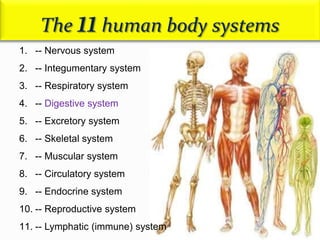
There are eleven organ systems in the
body.
Organization of the Body
The 11human body systems
1. -- Nervous system
2. -- Integumentary system
3. -- Respiratory system
4. -- Digestive system
5. -- Excretory system
6. -- Skeletal system
7. -- Muscular system
8. -- Circulatory system
9. -- Endocrine system
10. -- Reproductive system
11. -- Lymphatic (immune) system
Digestive system
Digestion is chemical and
mechanical process on the
ingested (consumption) food to
prepare it for absorption by the
body.
Function of Digestive System
oIngestion
oChewing
oSwallowing
oDigestion
oAbsorption
oExcretion of undigested food
Digestive system
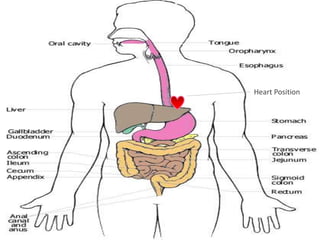
Organs of Digestive System
 Mouth
 Pharynx (Throat)
 Esophagus (Food tube)
 Stomach
 Small intestine
 Large intestine
 Rectum
Digestive system
Heart Position
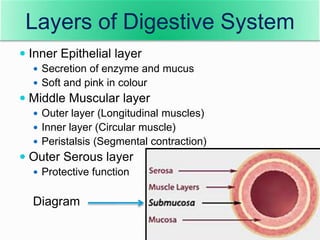
Layers of Digestive System
 Inner Epithelial layer
 Secretion of enzyme and mucus
 Soft and pink in colour
 Middle Muscular layer
 Outer layer (Longitudinal muscles)
 Inner layer (Circular muscle)
 Peristalsis (Segmental contraction)
 Outer Serous layer
 Protective function
Diagram
Organs of Digestive System
oMouth
Beginning of Digestive system
Lips, teeth, gums,tongue.
Palate (soft and hard)
Opening of Salivary glands
oTeeth
Total 32 in adults
oTongue
Helps in mastication
Mixing all saliva with food
Swallowing , Sensation of taste
Speech
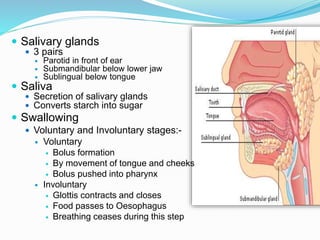
 Salivary glands
 3 pairs
 Parotid in front of ear
 Submandibular below lower jaw
 Sublingual below tongue
 Saliva
 Secretion of salivary glands
 Converts starch into sugar
 Swallowing
 Voluntary and Involuntary stages:-
 Voluntary
 Bolus formation
 By movement of tongue and cheeks
 Bolus pushed into pharynx
 Involuntary
 Glottis contracts and closes
 Food passes to Oesophagus
 Breathing ceases during this step
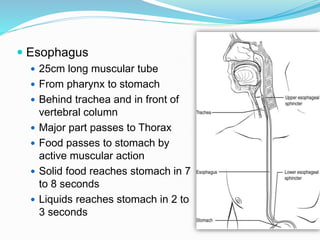
 Esophagus
 25cm long muscular tube
 From pharynx to stomach
 Behind trachea and in front of
vertebral column
 Major part passes to Thorax
 Food passes to stomach by
active muscular action
 Solid food reaches stomach in 7
to 8 seconds
 Liquids reaches stomach in 2 to
3 seconds
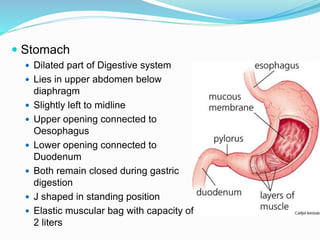
 Stomach
 Dilated part of Digestive system
 Lies in upper abdomen below
diaphragm
 Slightly left to midline
 Upper opening connected to
Oesophagus
 Lower opening connected to
Duodenum
 Both remain closed during gastric
digestion
 J shaped in standing position
 Elastic muscular bag with capacity of
2 liters
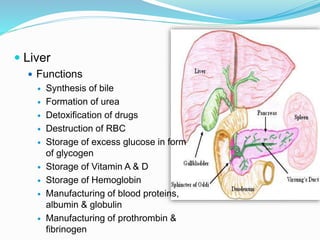
 Liver
 Functions
 Synthesis of bile
 Formation of urea
 Detoxification of drugs
 Destruction of RBC
 Storage of excess glucose in form
of glycogen
 Storage of Vitamin A & D
 Storage of Hemoglobin
 Manufacturing of blood proteins,
albumin & globulin
 Manufacturing of prothrombin &
fibrinogen
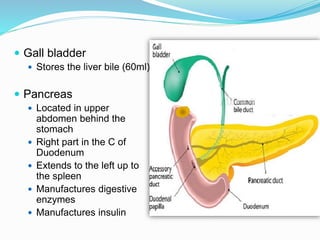
 Gall bladder
 Stores the liver bile (60ml)
 Pancreas
 Located in upper
abdomen behind the
stomach
 Right part in the C of
Duodenum
 Extends to the left up to
the spleen
 Manufactures digestive
enzymes
 Manufactures insulin
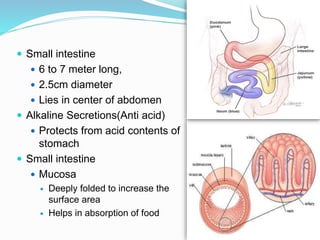
 Small intestine
 6 to 7 meter long,
 2.5cm diameter
 Lies in center of abdomen
 Alkaline Secretions(Anti acid)
 Protects from acid contents of
stomach
 Small intestine
 Mucosa
 Deeply folded to increase the
surface area
 Helps in absorption of food
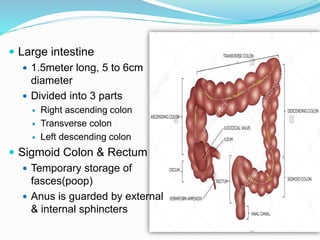
 Large intestine
 1.5meter long, 5 to 6cm
diameter
 Divided into 3 parts
 Right ascending colon
 Transverse colon
 Left descending colon
 Sigmoid Colon & Rectum
 Temporary storage of
fasces(poop)
 Anus is guarded by external
& internal sphincters
Video On Human Digestive system
Question & Answer
1. Our throat divides into two separate tubes: the
windpipe and the gullet.
What prevents food from entering the windpipe?
a) The uvula
b) The tongue
c) The trachea
d) The epiglottis
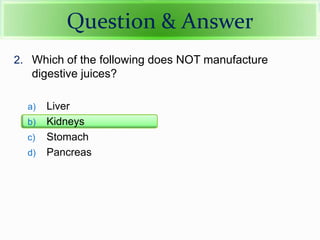
2. Which of the following does NOT manufacture
digestive juices?
a) Liver
b) Kidneys
c) Stomach
d) Pancreas
Question & Answer
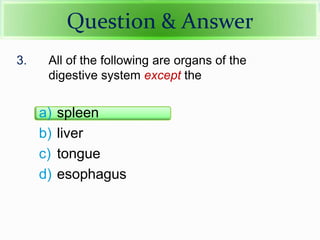
3. All of the following are organs of the
digestive system except the
a) spleen
b) liver
c) tongue
d) esophagus
Question & Answer
Human  Digestive  System : Anatomy and Physiology

Human Digestive System : Anatomy and Physiology

  • 2.
    Human Digestive SystemsObjectives Describe how the human Digestive system is organized. Identify the importance of Digestive system .
  • 3.
    How is thehuman body organized? Organization of the Body
  • 4.
    The levels oforganization in a multicellular organism include:  cells  tissues  organs  organ systems Organization of the Body
  • 5.
    Every cell inthe human body is both an independent unit and a co-dependent part of a larger community—the entire organism. Organization of the Body
  • 6.
    Cells A cell isthe basic unit of structure and function in living things. Individual cells in multicellular organisms are specialized. Specialized cells are suited to perform a particular function. Organization of the BodyOrganization of the Body
  • 7.
    Tissues A group ofcells that perform a single function is called a tissue. There are four basic types of tissue in the human body: epithelial, connective, nervous, and muscle. Organization of the BodyOrganization of the Body
  • 8.
    Organization of theBody Organs and Organ Systems A group of different types of tissues that work together to perform a single function is called an organ. A group of organs that perform closely related functions is an organ system. There are eleven organ systems in the body. Organization of the Body
  • 9.
    The 11human bodysystems 1. -- Nervous system 2. -- Integumentary system 3. -- Respiratory system 4. -- Digestive system 5. -- Excretory system 6. -- Skeletal system 7. -- Muscular system 8. -- Circulatory system 9. -- Endocrine system 10. -- Reproductive system 11. -- Lymphatic (immune) system
  • 10.
    Digestive system Digestion ischemical and mechanical process on the ingested (consumption) food to prepare it for absorption by the body.
  • 11.
    Function of DigestiveSystem oIngestion oChewing oSwallowing oDigestion oAbsorption oExcretion of undigested food Digestive system
  • 12.
    Organs of DigestiveSystem  Mouth  Pharynx (Throat)  Esophagus (Food tube)  Stomach  Small intestine  Large intestine  Rectum Digestive system
  • 13.
  • 14.
    Layers of DigestiveSystem  Inner Epithelial layer  Secretion of enzyme and mucus  Soft and pink in colour  Middle Muscular layer  Outer layer (Longitudinal muscles)  Inner layer (Circular muscle)  Peristalsis (Segmental contraction)  Outer Serous layer  Protective function Diagram
  • 15.
    Organs of DigestiveSystem oMouth Beginning of Digestive system Lips, teeth, gums,tongue. Palate (soft and hard) Opening of Salivary glands oTeeth Total 32 in adults oTongue Helps in mastication Mixing all saliva with food Swallowing , Sensation of taste Speech
  • 16.
     Salivary glands 3 pairs  Parotid in front of ear  Submandibular below lower jaw  Sublingual below tongue  Saliva  Secretion of salivary glands  Converts starch into sugar  Swallowing  Voluntary and Involuntary stages:-  Voluntary  Bolus formation  By movement of tongue and cheeks  Bolus pushed into pharynx  Involuntary  Glottis contracts and closes  Food passes to Oesophagus  Breathing ceases during this step
  • 17.
     Esophagus  25cmlong muscular tube  From pharynx to stomach  Behind trachea and in front of vertebral column  Major part passes to Thorax  Food passes to stomach by active muscular action  Solid food reaches stomach in 7 to 8 seconds  Liquids reaches stomach in 2 to 3 seconds
  • 18.
     Stomach  Dilatedpart of Digestive system  Lies in upper abdomen below diaphragm  Slightly left to midline  Upper opening connected to Oesophagus  Lower opening connected to Duodenum  Both remain closed during gastric digestion  J shaped in standing position  Elastic muscular bag with capacity of 2 liters
  • 19.
     Liver  Functions Synthesis of bile  Formation of urea  Detoxification of drugs  Destruction of RBC  Storage of excess glucose in form of glycogen  Storage of Vitamin A & D  Storage of Hemoglobin  Manufacturing of blood proteins, albumin & globulin  Manufacturing of prothrombin & fibrinogen
  • 20.
     Gall bladder Stores the liver bile (60ml)  Pancreas  Located in upper abdomen behind the stomach  Right part in the C of Duodenum  Extends to the left up to the spleen  Manufactures digestive enzymes  Manufactures insulin
  • 21.
     Small intestine 6 to 7 meter long,  2.5cm diameter  Lies in center of abdomen  Alkaline Secretions(Anti acid)  Protects from acid contents of stomach  Small intestine  Mucosa  Deeply folded to increase the surface area  Helps in absorption of food
  • 22.
     Large intestine 1.5meter long, 5 to 6cm diameter  Divided into 3 parts  Right ascending colon  Transverse colon  Left descending colon  Sigmoid Colon & Rectum  Temporary storage of fasces(poop)  Anus is guarded by external & internal sphincters
  • 23.
    Video On HumanDigestive system
  • 24.
    Question & Answer 1.Our throat divides into two separate tubes: the windpipe and the gullet. What prevents food from entering the windpipe? a) The uvula b) The tongue c) The trachea d) The epiglottis
  • 25.
    2. Which ofthe following does NOT manufacture digestive juices? a) Liver b) Kidneys c) Stomach d) Pancreas Question & Answer
  • 26.
    3. All ofthe following are organs of the digestive system except the a) spleen b) liver c) tongue d) esophagus Question & Answer