Ethics in Healthcare
IHS
Learning Targets
• What are ethics?
• How do ethics impact decision making in
healthcare?
Ethics
• Go beyond what is legal.
• These are moral guidelines that assist in
making decisions in healthcare.
• Ethics are not always easily defined, do
not always have a clear right or wrong
answer.
Examples of Ethic Issues
• Deciding who
receives a single
organ for transplant.
• Deciding when and
how to discontinue
life support.
• Deciding how much
care to afford a
patient who cannot
pay.
• Should assisted
suicide be allowed?
• Should we use
genetics to modify
humans?
• Would a cloned
human being be
treated the same as
one born naturally?
Ethics: The Basics
• First, do no harm.
• Second, do your best
to preserve life and
health before all
else.
• Treat all patients
equally.
• Respect the choices
of the patient.
• Be loyal, sincere,
honest and caring.
• Do unto others…
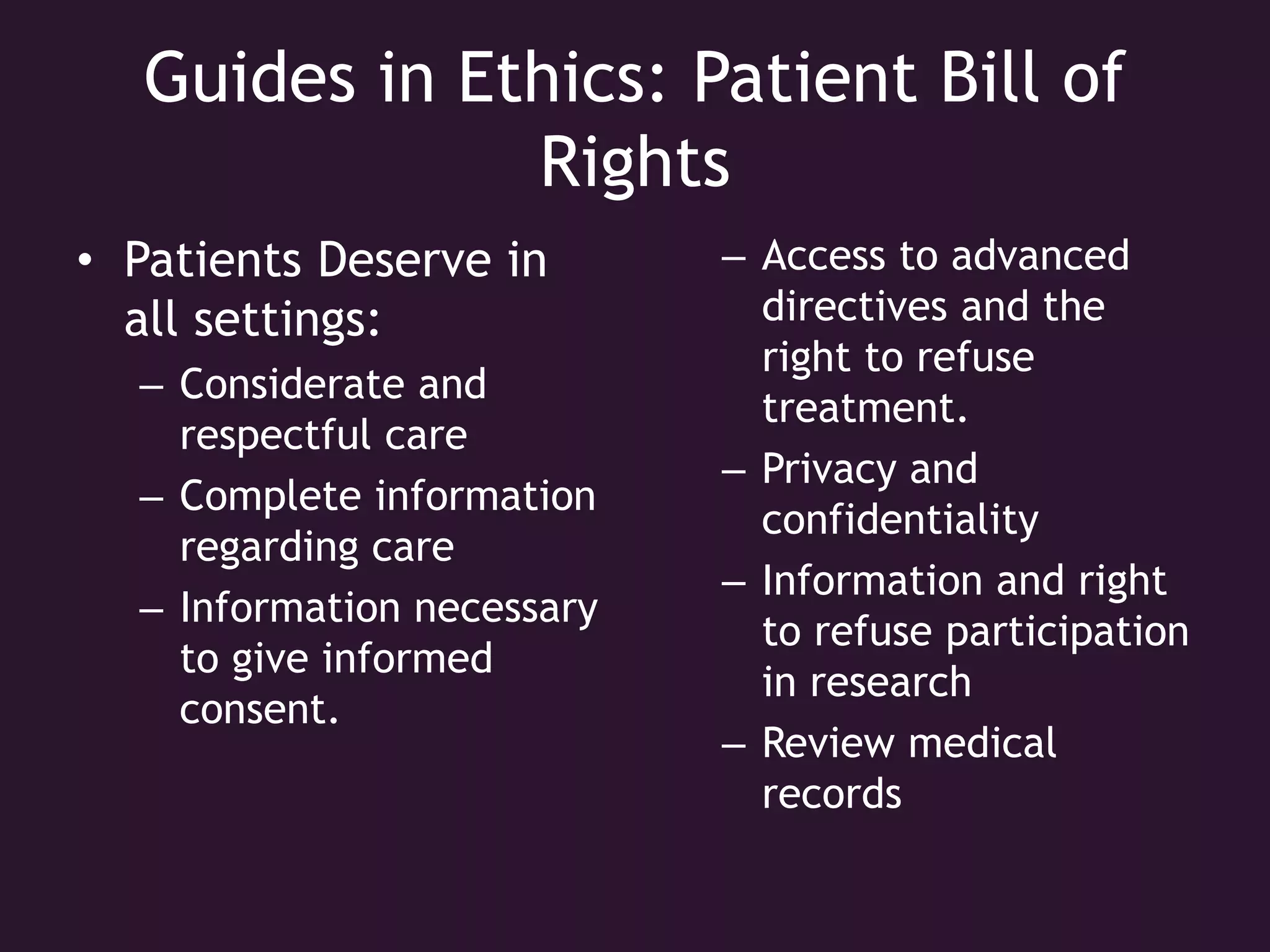
Guides in Ethics: Patient Bill of
Rights
• Patients Deserve in
all settings:
– Considerate and
respectful care
– Complete information
regarding care
– Information necessary
to give informed
consent.
– Access to advanced
directives and the
right to refuse
treatment.
– Privacy and
confidentiality
– Information and right
to refuse participation
in research
– Review medical
records
Advanced Directives in Healthcare
Living Will
• Legal document where
preferences and
direction about life
saving and life sustaining
medical care are made
by the patient, in
advance.
• Ex: DNR
Durable Power of Attorney
(POA)
• Legal Document
designating a person or
persons to make medical
decisions for the patient,
in the event that they
are unable to do so for
themselves.
Patient Right to Self Determination
• States that all patients who are legally
able to make their own decisions must be
given the maximum opportunity to do so,
and that they should be educated to and
given access to creation of Advanced
Directives.
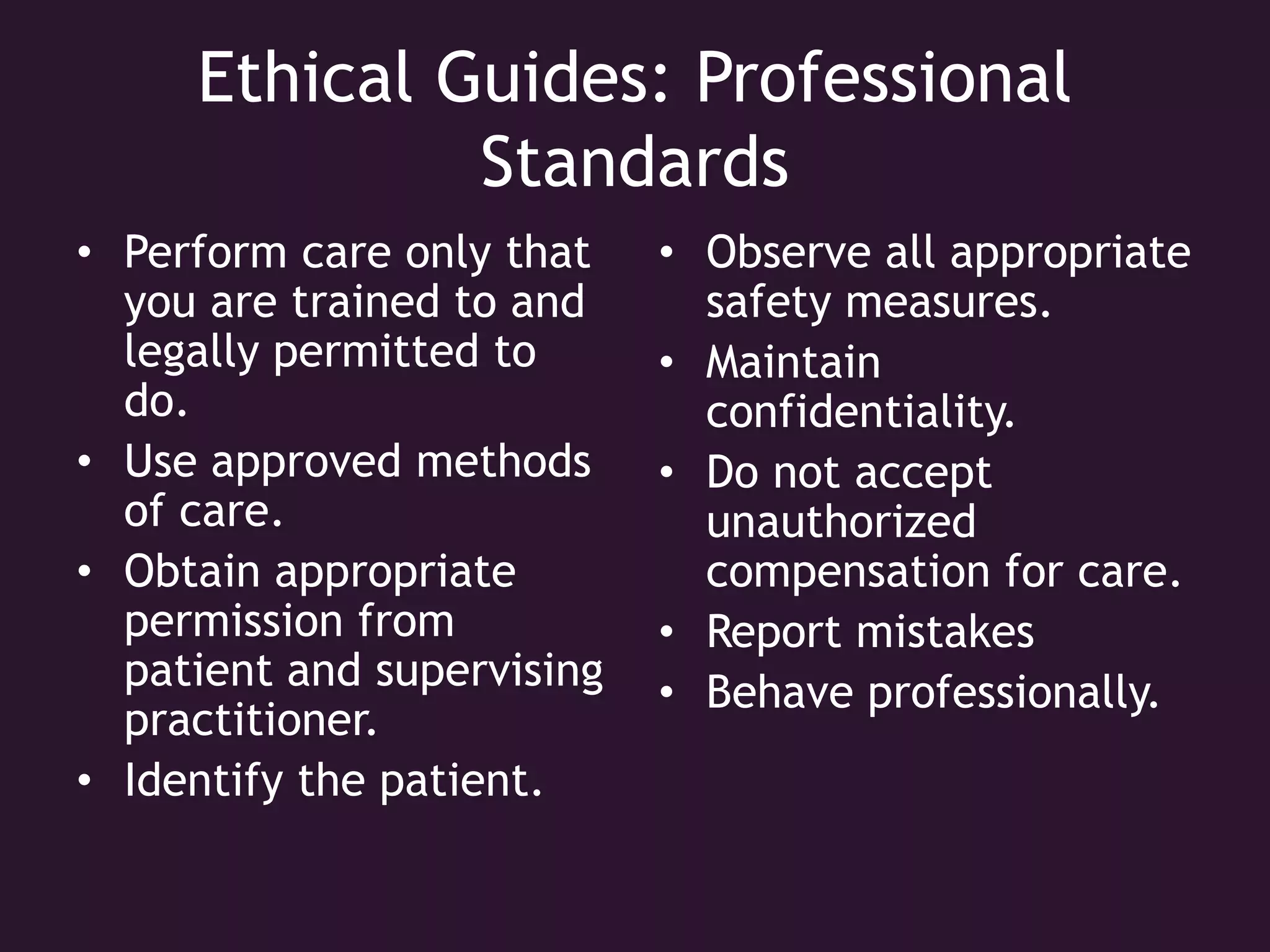
Ethical Guides: Professional
Standards
• Perform care only that
you are trained to and
legally permitted to
do.
• Use approved methods
of care.
• Obtain appropriate
permission from
patient and supervising
practitioner.
• Identify the patient.
• Observe all appropriate
safety measures.
• Maintain
confidentiality.
• Do not accept
unauthorized
compensation for care.
• Report mistakes
• Behave professionally.

Ethics for Introduction to Health Care

  • 1.
  • 2.
    Learning Targets • Whatare ethics? • How do ethics impact decision making in healthcare?
  • 3.
    Ethics • Go beyondwhat is legal. • These are moral guidelines that assist in making decisions in healthcare. • Ethics are not always easily defined, do not always have a clear right or wrong answer.
  • 4.
    Examples of EthicIssues • Deciding who receives a single organ for transplant. • Deciding when and how to discontinue life support. • Deciding how much care to afford a patient who cannot pay. • Should assisted suicide be allowed? • Should we use genetics to modify humans? • Would a cloned human being be treated the same as one born naturally?
  • 5.
    Ethics: The Basics •First, do no harm. • Second, do your best to preserve life and health before all else. • Treat all patients equally. • Respect the choices of the patient. • Be loyal, sincere, honest and caring. • Do unto others…
  • 6.
    Guides in Ethics:Patient Bill of Rights • Patients Deserve in all settings: – Considerate and respectful care – Complete information regarding care – Information necessary to give informed consent. – Access to advanced directives and the right to refuse treatment. – Privacy and confidentiality – Information and right to refuse participation in research – Review medical records
  • 7.
    Advanced Directives inHealthcare Living Will • Legal document where preferences and direction about life saving and life sustaining medical care are made by the patient, in advance. • Ex: DNR Durable Power of Attorney (POA) • Legal Document designating a person or persons to make medical decisions for the patient, in the event that they are unable to do so for themselves.
  • 8.
    Patient Right toSelf Determination • States that all patients who are legally able to make their own decisions must be given the maximum opportunity to do so, and that they should be educated to and given access to creation of Advanced Directives.
  • 9.
    Ethical Guides: Professional Standards •Perform care only that you are trained to and legally permitted to do. • Use approved methods of care. • Obtain appropriate permission from patient and supervising practitioner. • Identify the patient. • Observe all appropriate safety measures. • Maintain confidentiality. • Do not accept unauthorized compensation for care. • Report mistakes • Behave professionally.