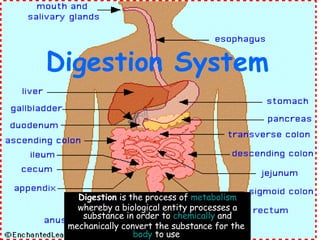
Digestion System   Digestion  is the process of  metabolism  whereby a biological entity processes a substance in order to  chemically  and mechanically convert the substance for the  body  to use .
Phases of human digestion Cephalic phase  - This phase occurs before food enters the stomach and involves preparation of the body for eating and digestion. Sight and thought stimulate the  cerebral cortex . Taste and smell stimulus is sent to the  hypothalamus  and  medulla oblongata . After this it is routed through the  vagus nerve .  Gastric phase - This phase takes 3 to 4 hours. It is stimulated by distention of the stomach and alkaline  pH . Distention activates long and myentric reflexes. This activates the release of  acetylcholine  which stimulates the release of more  gastric   juices . As protein enters the stomach, it binds to  hydrogen  ions, which raises the  pH  of the  stomach  to an  alkaline  level. This triggers  G  cells  to release  gastrin , which in turn stimulates  parietal  cells  to secrete  HCl . HCl release is also triggered by  acetylcholine  and  histamine .  Intestinal phase - This phase has 2 parts, the excitatory and the inhibitory. Partially-digested food fills the  duodenum . This triggers intestinal gastrin to be released. Enterogastric reflex inhibits vagal nuclei, activating  sympathetic   fibers  causing the  pyloric   sphincter  to tighten to prevent more food from entering, and inhibits local reflexes.
Oral cavity   In humans, digestion begins in the  oral cavity  where food is  chewed .  Saliva  is secreted in large amounts (1-1.5 litre/day) by three pairs of exocrine salivary glands (parotid, submandibular, and sublingual) in the oral cavity, and is mixed with the chewed food by the tongue. There are two types of saliva. One is a thin, watery secretion, and its purpose is to wet the food. The other is a thick, mucous secretion, and it acts as a lubricant and causes food particles to stick together and form a  bolus . The saliva serves to clean the oral cavity and moisten the food, and contains digestive  enzymes  such as salivary  amylase , which aids in the  chemical   breakdown  of  polysaccharides  such as  starch  into  disaccharides  such as  maltose . It also contains mucin, a  glycoprotein  which help soften the food into a  bolus . Swallowing transports the chewed food into the  esophagus , passing through the  oropharynx  and  hypopharynx . The mechanism for swallowing is coordinated by the swallowing center in the  medulla oblongata  and  pons . The reflex is initiated by touch receptors in the pharynx as the bolus of food is pushed to the back of the mouth.
Esophagus   The  esophagus , a narrow, muscular tube about 20 centimeters (8 inches) long, starts at the pharynx, passes through the  thorax  and  diaphragm , and ends at the  cardiac   orifice  of the  stomach . The wall of the esophagus is made up of two layers of  smooth   muscles , which form a continuous layer from the esophagus to the  rectum  and contract slowly, over long periods of time. The inner layer of muscles is arranged circularly in a series of descending rings, while the outer layer is arranged longitudinally. At the top of the esophagus, is a flap of tissue called the  epiglottis  that closes during swallowing to prevent food from entering the  trachea  (windpipe). The chewed food is pushed down the esophagus to the stomach through  peristaltic  contraction of these muscles. It takes only seconds for food to pass through the esophagus, and little digestion actually takes place.
Stomach   The food enters the  stomach  after passing through the  cardiac   orifice . In the stomach, food is further broken apart thoroughly mixed with a  gastric   acid  and digestive enzymes that  denature  proteins. The acid itself does not break down food molecules, rather, the acid provides an optimum pH for the reaction of the enzyme  pepsin . The  parietal  cells  of the stomach also secrete a  glycoprotein  called  intrinsic  factor  which enables the absorption of  vitamin  B-12 . Other small molecules such as  alcohol  are  absorbed  in the stomach as well by passing through the membrane of the stomach and entering the  circulatory   system  directly.
Small intestine   After being processed in the stomach, food is passed to the  small  intestine  via the  pyloric   sphincter . The majority of digestion and  absorption  occur here as  chyme  enters the  duodenum . Here it is further mixed with three different liquids: bile , which  emulsifies   fats  to allow absorption,  neutralizes  the chyme, and is used to excrete waste products such as  bilin  and  bile   acids  (which has other uses as well). However, it is not an enzyme!  pancreatic   juice  made by the  pancreas   intestinal enzymes of the alkaline mucosal membranes. The enzymes include:  maltase ,  lactase  and  sucrase , to process  sugars ;  trypsin  and  chymotrypsin  are also added in the small intestine
Large intestine   After the food has been passed through the small intestine, the food enters the  large   intestine . The large intestine is roughly 1.5  meters  long, with three parts: the  cecum  at the junction with the  small  intestine , the  colon , and the  rectum . The colon itself has four parts: the  ascending  colon , the  transverse  colon , the  descending  colon , and the  sigmoid  colon . The large intestine absorbs water from the  bolus  and stores  feces  until it can be  excreted . Food products that cannot go through the  villi , such as  cellulose  ( dietary   fiber ), are mixed with other waste products from the body and become  feces .
The digestion is done of: Carbohydrate digestion. Fat digestion. Digestive hormones.
JOSÉ ANTONIO JIMÉNEZ FRANCISCO J. CABELLO FRANCISCO J. HINOJOSA

Digestion System Hinojosa

  • 1.
    Digestion System Digestion is the process of metabolism whereby a biological entity processes a substance in order to chemically and mechanically convert the substance for the body to use .
  • 2.
    Phases of humandigestion Cephalic phase - This phase occurs before food enters the stomach and involves preparation of the body for eating and digestion. Sight and thought stimulate the cerebral cortex . Taste and smell stimulus is sent to the hypothalamus and medulla oblongata . After this it is routed through the vagus nerve . Gastric phase - This phase takes 3 to 4 hours. It is stimulated by distention of the stomach and alkaline pH . Distention activates long and myentric reflexes. This activates the release of acetylcholine which stimulates the release of more gastric juices . As protein enters the stomach, it binds to hydrogen ions, which raises the pH of the stomach to an alkaline level. This triggers G cells to release gastrin , which in turn stimulates parietal cells to secrete HCl . HCl release is also triggered by acetylcholine and histamine . Intestinal phase - This phase has 2 parts, the excitatory and the inhibitory. Partially-digested food fills the duodenum . This triggers intestinal gastrin to be released. Enterogastric reflex inhibits vagal nuclei, activating sympathetic fibers causing the pyloric sphincter to tighten to prevent more food from entering, and inhibits local reflexes.
  • 3.
    Oral cavity In humans, digestion begins in the oral cavity where food is chewed . Saliva is secreted in large amounts (1-1.5 litre/day) by three pairs of exocrine salivary glands (parotid, submandibular, and sublingual) in the oral cavity, and is mixed with the chewed food by the tongue. There are two types of saliva. One is a thin, watery secretion, and its purpose is to wet the food. The other is a thick, mucous secretion, and it acts as a lubricant and causes food particles to stick together and form a bolus . The saliva serves to clean the oral cavity and moisten the food, and contains digestive enzymes such as salivary amylase , which aids in the chemical breakdown of polysaccharides such as starch into disaccharides such as maltose . It also contains mucin, a glycoprotein which help soften the food into a bolus . Swallowing transports the chewed food into the esophagus , passing through the oropharynx and hypopharynx . The mechanism for swallowing is coordinated by the swallowing center in the medulla oblongata and pons . The reflex is initiated by touch receptors in the pharynx as the bolus of food is pushed to the back of the mouth.
  • 4.
    Esophagus The esophagus , a narrow, muscular tube about 20 centimeters (8 inches) long, starts at the pharynx, passes through the thorax and diaphragm , and ends at the cardiac orifice of the stomach . The wall of the esophagus is made up of two layers of smooth muscles , which form a continuous layer from the esophagus to the rectum and contract slowly, over long periods of time. The inner layer of muscles is arranged circularly in a series of descending rings, while the outer layer is arranged longitudinally. At the top of the esophagus, is a flap of tissue called the epiglottis that closes during swallowing to prevent food from entering the trachea (windpipe). The chewed food is pushed down the esophagus to the stomach through peristaltic contraction of these muscles. It takes only seconds for food to pass through the esophagus, and little digestion actually takes place.
  • 5.
    Stomach The food enters the stomach after passing through the cardiac orifice . In the stomach, food is further broken apart thoroughly mixed with a gastric acid and digestive enzymes that denature proteins. The acid itself does not break down food molecules, rather, the acid provides an optimum pH for the reaction of the enzyme pepsin . The parietal cells of the stomach also secrete a glycoprotein called intrinsic factor which enables the absorption of vitamin B-12 . Other small molecules such as alcohol are absorbed in the stomach as well by passing through the membrane of the stomach and entering the circulatory system directly.
  • 6.
    Small intestine After being processed in the stomach, food is passed to the small intestine via the pyloric sphincter . The majority of digestion and absorption occur here as chyme enters the duodenum . Here it is further mixed with three different liquids: bile , which emulsifies fats to allow absorption, neutralizes the chyme, and is used to excrete waste products such as bilin and bile acids (which has other uses as well). However, it is not an enzyme! pancreatic juice made by the pancreas intestinal enzymes of the alkaline mucosal membranes. The enzymes include: maltase , lactase and sucrase , to process sugars ; trypsin and chymotrypsin are also added in the small intestine
  • 7.
    Large intestine After the food has been passed through the small intestine, the food enters the large intestine . The large intestine is roughly 1.5 meters long, with three parts: the cecum at the junction with the small intestine , the colon , and the rectum . The colon itself has four parts: the ascending colon , the transverse colon , the descending colon , and the sigmoid colon . The large intestine absorbs water from the bolus and stores feces until it can be excreted . Food products that cannot go through the villi , such as cellulose ( dietary fiber ), are mixed with other waste products from the body and become feces .
  • 8.
    The digestion isdone of: Carbohydrate digestion. Fat digestion. Digestive hormones.
  • 9.
    JOSÉ ANTONIO JIMÉNEZFRANCISCO J. CABELLO FRANCISCO J. HINOJOSA