Differentiated Learning Mark Benthall 2007
What is differentiation? Within the classroom students differ from each other in mental, physical, social, and emotional development. Differentiation is a PHILOSOPHY that enables teachers to plan strategically in order to reach the needs of the diverse learners in classrooms today.
What is differentiation? Differentiation is not a set of tools, but a philosophy that a teacher embraces to reach the unique needs of every learner.
What is differentiation? Differentiated instruction gives the teacher a variety of options to successfully reach targeted standards. It meets learners where they are and offers challenging, appropriate options for them in order to achieve success.
Teachers can differentiate: The content that students learn The assessment tools being used The performance tasks selected The instructional strategies used
What do learners need to succeed? ALL students, to succeed, need to believe that they can learn, and that what they are learning is useful, meaningful, and relevant. They need to know that they are responsible for their own learning as well as their own behavior.
What do learners need to succeed? Effective teachers believe that ALL students can learn and can be successful. Effective teachers create a climate where all students feel included. Effective teachers believe that there is potential in each learner and commit to finding the key that will unlock that potential.
Create a Climate for Learning There is no wrong opinion No put-downs or sarcasm Everyone must be heard Mistakes are learning points
Create a Climate for Learning Emotions and Learning: Students living in fear cannot learn. The classroom must feel safe. Safety in the classroom means intellectual safety as well as physical safety. Students who are challenged beyond their skill level are more concerned about being embarrassed or laughed at than the quest for learning.
Create a Climate for Learning Emotions and Learning: In classes where the teacher simply teaches to the “middle,” some students may be bored from a lack of challenge and others may feel fearful from too great a challenge.
Create a Climate for Learning Emotions and Learning: Teachers need to consider where their learners are in relation to the learning goal and plan learning experiences  just beyond  the skill level of each student. All students are more likely to be engaged in learning, rise to the challenge, and have a sense of self-confidence as they approach the task… if they feel they have a chance to succeed.
Create a Climate for Learning Emotions and Learning: Teachers need to consider the degree of complexity of the learning tasks so that they will be challenging, but not overwhelming to the students. Students are most productive in that delicate zone between boredom and anxiety.
The emotional environment interacts with instruction and influences how information is consolidated. Emotional Intelligence: Emotional intelligence is a person’s ability to use his or her emotions intelligently. It involves maintaining a balance between reason and emotion.
Create a Climate for Learning Emotional intelligence can be organized as a set of emotional competencies that occur in 5 domains: 1- Self-Awareness 2- Managing Emotions 3- Self-Motivation 4- Empathy 5- Social Skills
Elements of Differentiation The Teacher Focuses on the Essentials The Teacher Attends to Student Differences Assessment and Instruction are Inseparable
Elements of Differentiation The Teacher Modifies Content, Process, and Products All Students Participate in Respectful Work The Teacher and Students Collaborate in Learning
Elements of Differentiation  The Teacher Balances Group and Individual Norms The teacher and Students Work Together Flexibly
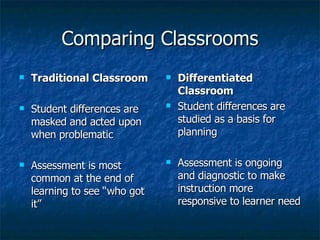
Comparing Classrooms Traditional Classroom Student differences are masked and acted upon when problematic Assessment is most common at the end of learning to see “who got it” Differentiated Classroom Student differences are studied as a basis for planning Assessment is ongoing and diagnostic to make instruction more responsive to learner need
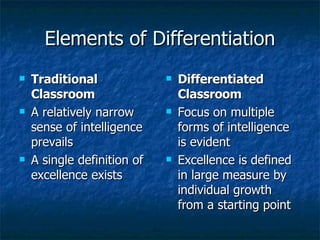
Elements of Differentiation Traditional Classroom A relatively narrow sense of intelligence prevails A single definition of excellence exists Differentiated Classroom Focus on multiple forms of intelligence is evident Excellence is defined in large measure by individual growth from a starting point
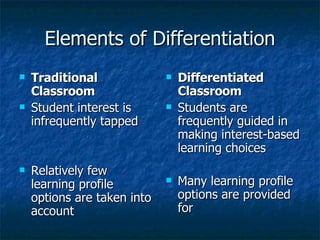
Elements of Differentiation Traditional Classroom Student interest is infrequently tapped Relatively few learning profile options are taken into account Differentiated Classroom Students are frequently guided in making interest-based learning choices Many learning profile options are provided for
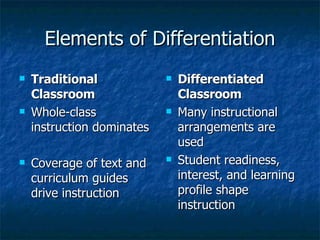
Elements of Differentiation Traditional Classroom Whole-class instruction dominates Coverage of text and curriculum guides drive instruction Differentiated Classroom Many instructional arrangements are used Student readiness, interest, and learning profile shape instruction
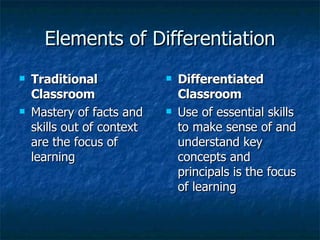
Elements of Differentiation Traditional Classroom Mastery of facts and skills out of context are the focus of learning  Differentiated Classroom Use of essential skills to make sense of and understand key concepts and principals is the focus of learning
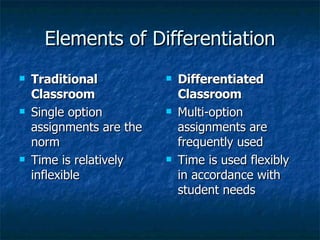
Elements of Differentiation Traditional Classroom Single option assignments are the norm Time is relatively inflexible Differentiated Classroom Multi-option assignments are frequently used Time is used flexibly in accordance with student needs
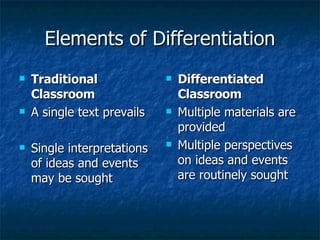
Elements of Differentiation Traditional Classroom A single text prevails Single interpretations of ideas and events may be sought Differentiated Classroom Multiple materials are provided Multiple perspectives on ideas and events are routinely sought
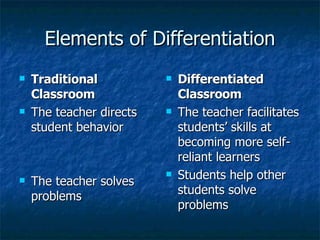
Elements of Differentiation Traditional Classroom The teacher directs student behavior The teacher solves problems Differentiated Classroom The teacher facilitates students’ skills at becoming more self-reliant learners Students help other students solve problems
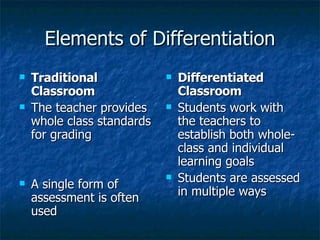
Elements of Differentiation Traditional Classroom The teacher provides whole class standards for grading A single form of assessment is often used Differentiated Classroom Students work with the teachers to establish both whole-class and individual learning goals Students are assessed in multiple ways

Differentiated Learning

  • 1.
  • 2.
    What is differentiation?Within the classroom students differ from each other in mental, physical, social, and emotional development. Differentiation is a PHILOSOPHY that enables teachers to plan strategically in order to reach the needs of the diverse learners in classrooms today.
  • 3.
    What is differentiation?Differentiation is not a set of tools, but a philosophy that a teacher embraces to reach the unique needs of every learner.
  • 4.
    What is differentiation?Differentiated instruction gives the teacher a variety of options to successfully reach targeted standards. It meets learners where they are and offers challenging, appropriate options for them in order to achieve success.
  • 5.
    Teachers can differentiate:The content that students learn The assessment tools being used The performance tasks selected The instructional strategies used
  • 6.
    What do learnersneed to succeed? ALL students, to succeed, need to believe that they can learn, and that what they are learning is useful, meaningful, and relevant. They need to know that they are responsible for their own learning as well as their own behavior.
  • 7.
    What do learnersneed to succeed? Effective teachers believe that ALL students can learn and can be successful. Effective teachers create a climate where all students feel included. Effective teachers believe that there is potential in each learner and commit to finding the key that will unlock that potential.
  • 8.
    Create a Climatefor Learning There is no wrong opinion No put-downs or sarcasm Everyone must be heard Mistakes are learning points
  • 9.
    Create a Climatefor Learning Emotions and Learning: Students living in fear cannot learn. The classroom must feel safe. Safety in the classroom means intellectual safety as well as physical safety. Students who are challenged beyond their skill level are more concerned about being embarrassed or laughed at than the quest for learning.
  • 10.
    Create a Climatefor Learning Emotions and Learning: In classes where the teacher simply teaches to the “middle,” some students may be bored from a lack of challenge and others may feel fearful from too great a challenge.
  • 11.
    Create a Climatefor Learning Emotions and Learning: Teachers need to consider where their learners are in relation to the learning goal and plan learning experiences just beyond the skill level of each student. All students are more likely to be engaged in learning, rise to the challenge, and have a sense of self-confidence as they approach the task… if they feel they have a chance to succeed.
  • 12.
    Create a Climatefor Learning Emotions and Learning: Teachers need to consider the degree of complexity of the learning tasks so that they will be challenging, but not overwhelming to the students. Students are most productive in that delicate zone between boredom and anxiety.
  • 13.
    The emotional environmentinteracts with instruction and influences how information is consolidated. Emotional Intelligence: Emotional intelligence is a person’s ability to use his or her emotions intelligently. It involves maintaining a balance between reason and emotion.
  • 14.
    Create a Climatefor Learning Emotional intelligence can be organized as a set of emotional competencies that occur in 5 domains: 1- Self-Awareness 2- Managing Emotions 3- Self-Motivation 4- Empathy 5- Social Skills
  • 15.
    Elements of DifferentiationThe Teacher Focuses on the Essentials The Teacher Attends to Student Differences Assessment and Instruction are Inseparable
  • 16.
    Elements of DifferentiationThe Teacher Modifies Content, Process, and Products All Students Participate in Respectful Work The Teacher and Students Collaborate in Learning
  • 17.
    Elements of Differentiation The Teacher Balances Group and Individual Norms The teacher and Students Work Together Flexibly
  • 18.
    Comparing Classrooms TraditionalClassroom Student differences are masked and acted upon when problematic Assessment is most common at the end of learning to see “who got it” Differentiated Classroom Student differences are studied as a basis for planning Assessment is ongoing and diagnostic to make instruction more responsive to learner need
  • 19.
    Elements of DifferentiationTraditional Classroom A relatively narrow sense of intelligence prevails A single definition of excellence exists Differentiated Classroom Focus on multiple forms of intelligence is evident Excellence is defined in large measure by individual growth from a starting point
  • 20.
    Elements of DifferentiationTraditional Classroom Student interest is infrequently tapped Relatively few learning profile options are taken into account Differentiated Classroom Students are frequently guided in making interest-based learning choices Many learning profile options are provided for
  • 21.
    Elements of DifferentiationTraditional Classroom Whole-class instruction dominates Coverage of text and curriculum guides drive instruction Differentiated Classroom Many instructional arrangements are used Student readiness, interest, and learning profile shape instruction
  • 22.
    Elements of DifferentiationTraditional Classroom Mastery of facts and skills out of context are the focus of learning Differentiated Classroom Use of essential skills to make sense of and understand key concepts and principals is the focus of learning
  • 23.
    Elements of DifferentiationTraditional Classroom Single option assignments are the norm Time is relatively inflexible Differentiated Classroom Multi-option assignments are frequently used Time is used flexibly in accordance with student needs
  • 24.
    Elements of DifferentiationTraditional Classroom A single text prevails Single interpretations of ideas and events may be sought Differentiated Classroom Multiple materials are provided Multiple perspectives on ideas and events are routinely sought
  • 25.
    Elements of DifferentiationTraditional Classroom The teacher directs student behavior The teacher solves problems Differentiated Classroom The teacher facilitates students’ skills at becoming more self-reliant learners Students help other students solve problems
  • 26.
    Elements of DifferentiationTraditional Classroom The teacher provides whole class standards for grading A single form of assessment is often used Differentiated Classroom Students work with the teachers to establish both whole-class and individual learning goals Students are assessed in multiple ways