Second Term Guide
Learning Activity 2.2
Katherine Feijoo
ENGLISH
METHODOLOGY
 it is a term teachers use to describe the
process of ensuring that classroom lessons run
smoothly despite disruptive
behavior by students.
 Creating a safe, inclusive enviroment for all
students
 The teacher must be able to observe all
students at all times and to monitor work and
behavior.
 Some degree of decoration will help add to
the attractiveness of the room.
 PROXIMITY
 Teachers need to consider how close they should be
to the students they are working with
 APPROPRIACY
 It is important to consider what kind of effect such
physical behavior has so that we can behave in a way
which is appropriate to the students and the
relationship we wish to create with them.
 MOVEMENT
 Most successful teachers move around the classroom
to some extent. That way they can retain their
students’ interest
 AWARENESS
 It means assessing what students have said and
responding appropriately.
 AUDIBILITY
 The teacher must be sure that the students at
the back of the class can hear them just as well
as those at the front
 VARIETY
 It is important for teachers to vary the quality of
their voices - and the volume they speak at -
according to the type of lesson and the type of
activity
 CONSERVATION
 It is important that they breathe correctly so
that they don’t strain their larynxes.
Classroom Interaction is a practice that
enhances the development of the two very
important language skills which are speaking
and listening among the learners. This device
helps the learner to be competent enough to
think critically and share their views among
their peers.
 Help the learner to come face to face with
the various types of interaction that can take
place inside the classroom
 Classroom Interaction aims at meaningful
communication among the students in their
target language
 This practice will help the teacher to have a
detailed study of the nature and the
frequency of student interaction inside the
classroom
Collaborative
Learning
Discussions and
Debate
Interactive
Sessions /
question and
answer
Reading aloud
Telling story
Conversation
with learners
Role Play
Games
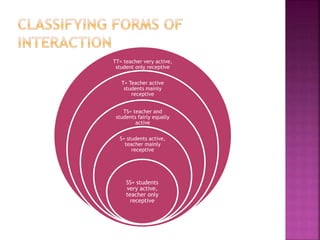
TT= teacher very active,
student only receptive
T= Teacher active
students mainly
receptive
TS= teacher and
students fairly equally
active
S= students active,
teacher mainly
receptive
SS= students
very active,
teacher only
receptive
 This type of interaction is vital for students
because it compares to the relationships
they'll have in their lives, such as the
relationship with a boss or superior. Students
must learn to interact respectfully, but must
also learn how to be assertive without being
rude, so that their points and opinions are
heard without disruption
 One-on-one student interaction is important
because it allows students to understand
what it means to work with a partner
 Students must learn to rely on one other
person and must be able to evaluate what
their own strengths and weaknesses are as
they try to complete a task.
 Group work
 Students work in small groups on tasks that entail
interaction: conveying information, for example, or
group decision-making. The teacher walks around
listening, intervenes little if at all
 Closed-ended teacher questioning
 Only one 'right' response gets approved. Sometimes
cynically called the 'Guess what the teacher wants
you to say' game.
 Individual work
 The teacher gives a task or set of tasks, and students
work on them independently; the teacher walks
around monitoring and assisting where necessary
 Choral responses
 The teacher gives a model which is repeated by
all the class in chorus; or gives a cue which is
responded to in chorus
 Collaboration
 Students do the same sort of tasks as in
‘Individual work', but work together, usually in
pairs, to try to achieve the best results they can.
The teacher may or may not intervene
 Student initiates, teacher answers
 For example, in a guessing game: the students
think of questions and the teacher responds; but
the teacher decides who asks.
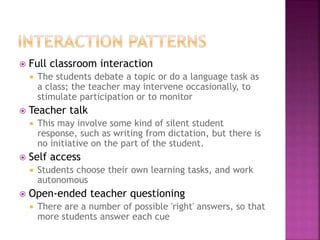
 Full classroom interaction
 The students debate a topic or do a language task as
a class; the teacher may intervene occasionally, to
stimulate participation or to monitor
 Teacher talk
 This may involve some kind of silent student
response, such as writing from dictation, but there is
no initiative on the part of the student.
 Self access
 Students choose their own learning tasks, and work
autonomous
 Open-ended teacher questioning
 There are a number of possible 'right' answers, so that
more students answer each cue
Classroom management and interaction

Classroom management and interaction

  • 1.
    Second Term Guide LearningActivity 2.2 Katherine Feijoo ENGLISH METHODOLOGY
  • 2.
     it isa term teachers use to describe the process of ensuring that classroom lessons run smoothly despite disruptive behavior by students.  Creating a safe, inclusive enviroment for all students  The teacher must be able to observe all students at all times and to monitor work and behavior.  Some degree of decoration will help add to the attractiveness of the room.
  • 3.
     PROXIMITY  Teachersneed to consider how close they should be to the students they are working with  APPROPRIACY  It is important to consider what kind of effect such physical behavior has so that we can behave in a way which is appropriate to the students and the relationship we wish to create with them.  MOVEMENT  Most successful teachers move around the classroom to some extent. That way they can retain their students’ interest  AWARENESS  It means assessing what students have said and responding appropriately.
  • 4.
     AUDIBILITY  Theteacher must be sure that the students at the back of the class can hear them just as well as those at the front  VARIETY  It is important for teachers to vary the quality of their voices - and the volume they speak at - according to the type of lesson and the type of activity  CONSERVATION  It is important that they breathe correctly so that they don’t strain their larynxes.
  • 5.
    Classroom Interaction isa practice that enhances the development of the two very important language skills which are speaking and listening among the learners. This device helps the learner to be competent enough to think critically and share their views among their peers.
  • 6.
     Help thelearner to come face to face with the various types of interaction that can take place inside the classroom  Classroom Interaction aims at meaningful communication among the students in their target language  This practice will help the teacher to have a detailed study of the nature and the frequency of student interaction inside the classroom
  • 7.
    Collaborative Learning Discussions and Debate Interactive Sessions / questionand answer Reading aloud Telling story Conversation with learners Role Play Games
  • 8.
    TT= teacher veryactive, student only receptive T= Teacher active students mainly receptive TS= teacher and students fairly equally active S= students active, teacher mainly receptive SS= students very active, teacher only receptive
  • 9.
     This typeof interaction is vital for students because it compares to the relationships they'll have in their lives, such as the relationship with a boss or superior. Students must learn to interact respectfully, but must also learn how to be assertive without being rude, so that their points and opinions are heard without disruption
  • 10.
     One-on-one studentinteraction is important because it allows students to understand what it means to work with a partner  Students must learn to rely on one other person and must be able to evaluate what their own strengths and weaknesses are as they try to complete a task.
  • 11.
     Group work Students work in small groups on tasks that entail interaction: conveying information, for example, or group decision-making. The teacher walks around listening, intervenes little if at all  Closed-ended teacher questioning  Only one 'right' response gets approved. Sometimes cynically called the 'Guess what the teacher wants you to say' game.  Individual work  The teacher gives a task or set of tasks, and students work on them independently; the teacher walks around monitoring and assisting where necessary
  • 12.
     Choral responses The teacher gives a model which is repeated by all the class in chorus; or gives a cue which is responded to in chorus  Collaboration  Students do the same sort of tasks as in ‘Individual work', but work together, usually in pairs, to try to achieve the best results they can. The teacher may or may not intervene  Student initiates, teacher answers  For example, in a guessing game: the students think of questions and the teacher responds; but the teacher decides who asks.
  • 13.
     Full classroominteraction  The students debate a topic or do a language task as a class; the teacher may intervene occasionally, to stimulate participation or to monitor  Teacher talk  This may involve some kind of silent student response, such as writing from dictation, but there is no initiative on the part of the student.  Self access  Students choose their own learning tasks, and work autonomous  Open-ended teacher questioning  There are a number of possible 'right' answers, so that more students answer each cue