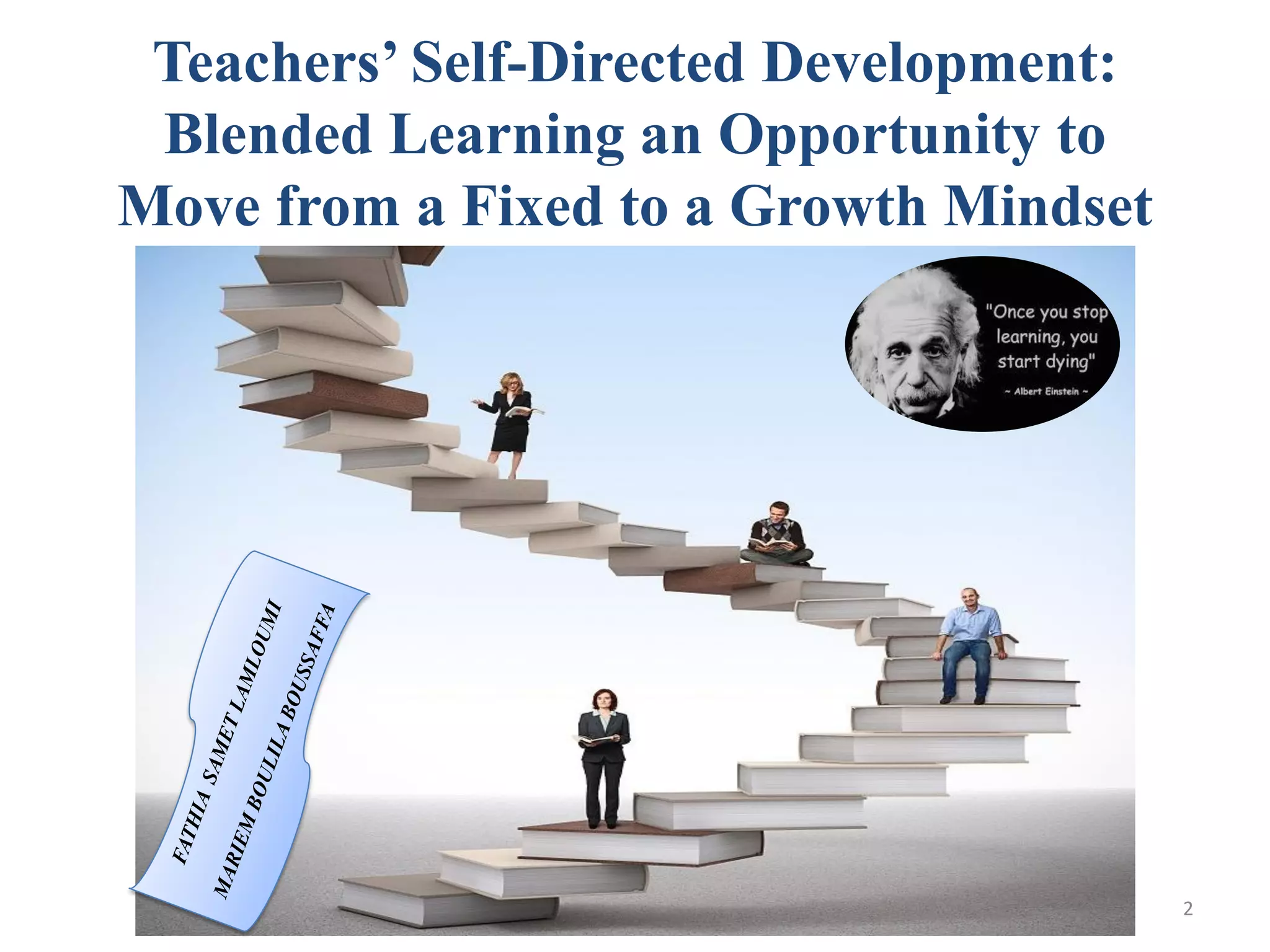
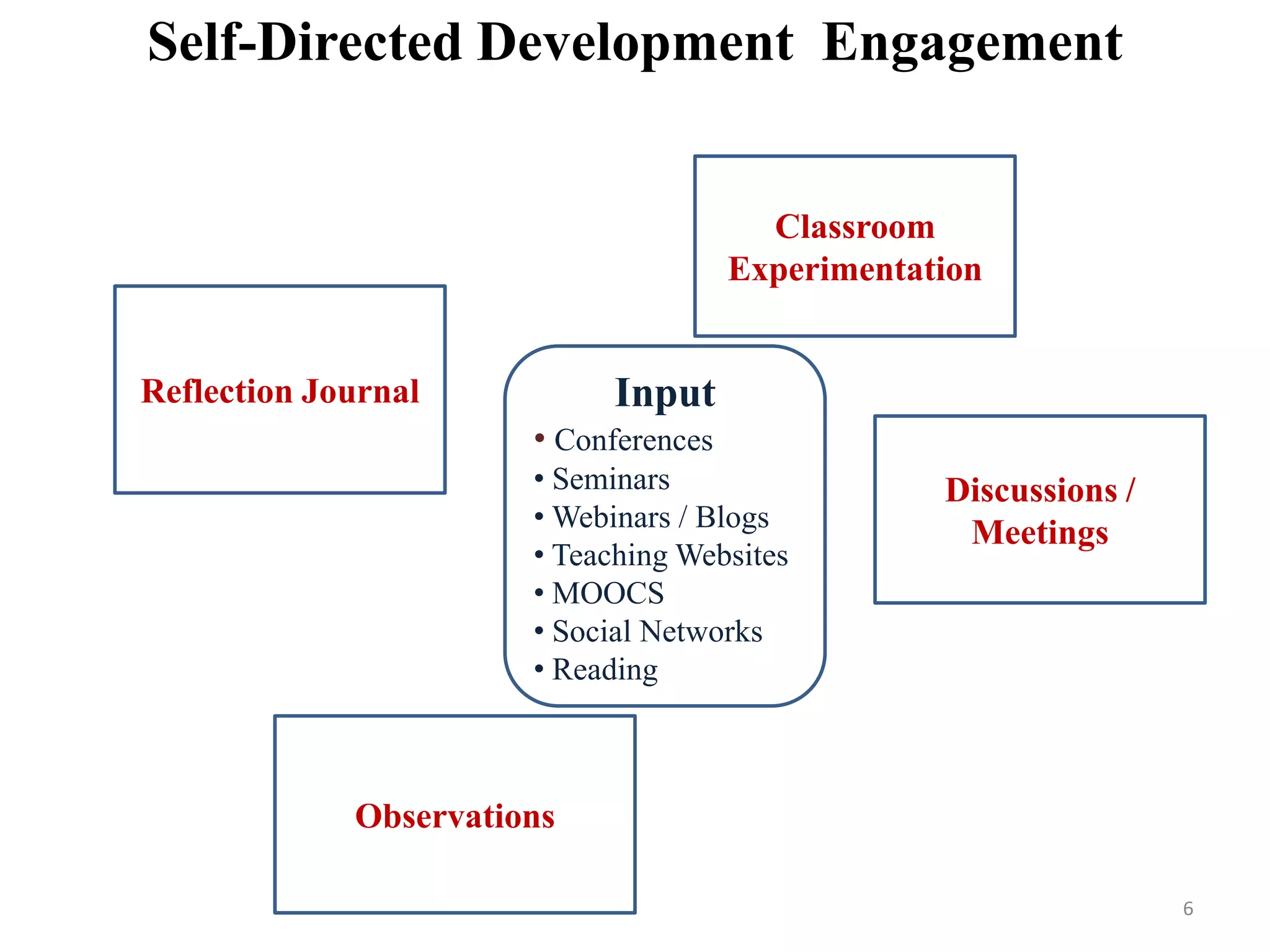
1. This document discusses teachers' self-directed professional development and how blended learning can help teachers move from a fixed to a growth mindset. It provides examples of input teachers can use for self-directed development like conferences, webinars, and social networks.
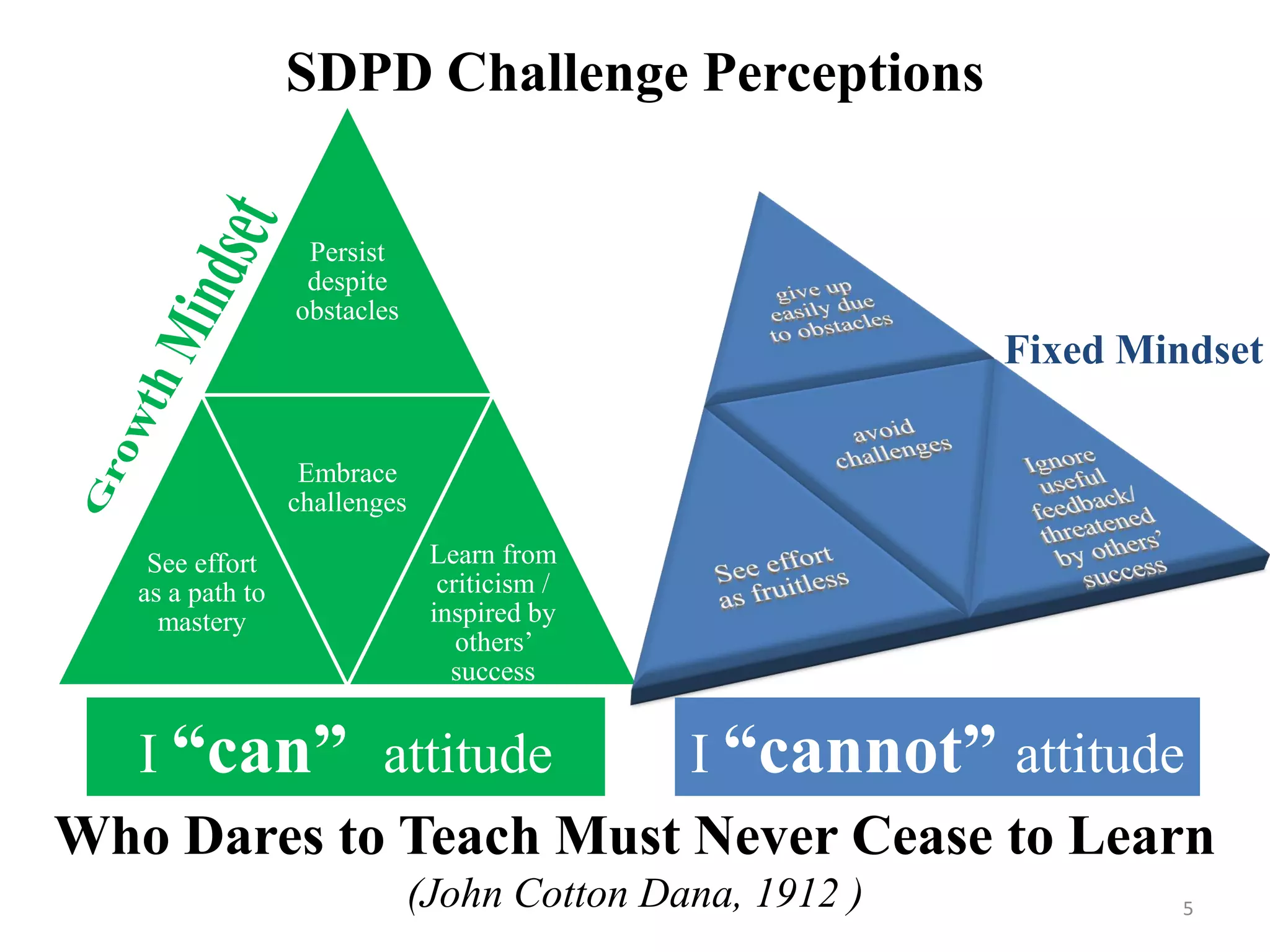
2. The document also discusses challenges like overcoming obstacles and embracing criticism. It provides strategies for engagement like classroom experimentation, reflections, and discussions.
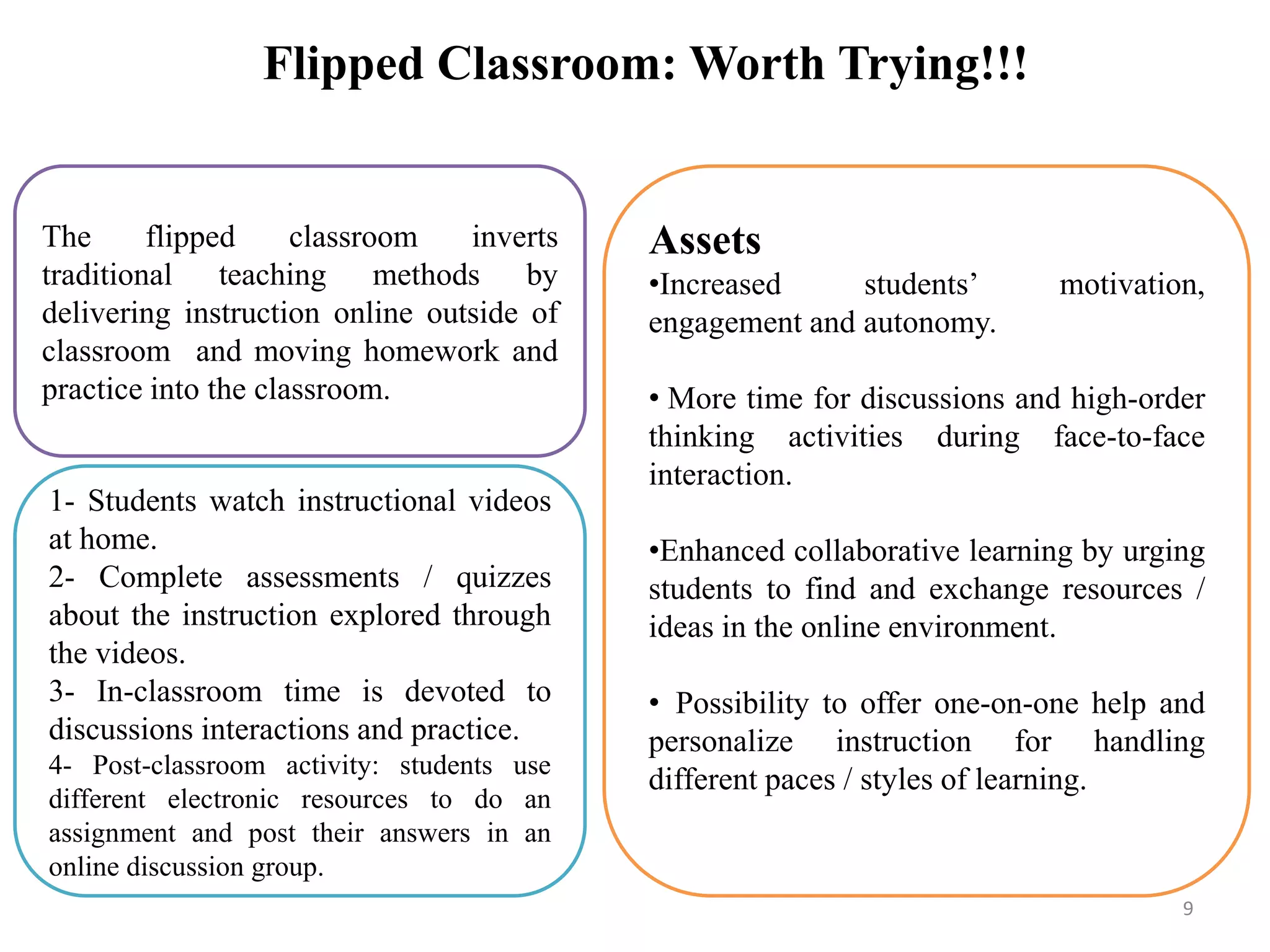
3. As an example, the document outlines flipping the classroom which inverts traditional teaching by delivering instruction online and doing practice in class. Benefits include increased student engagement and allowing more class time for discussions.
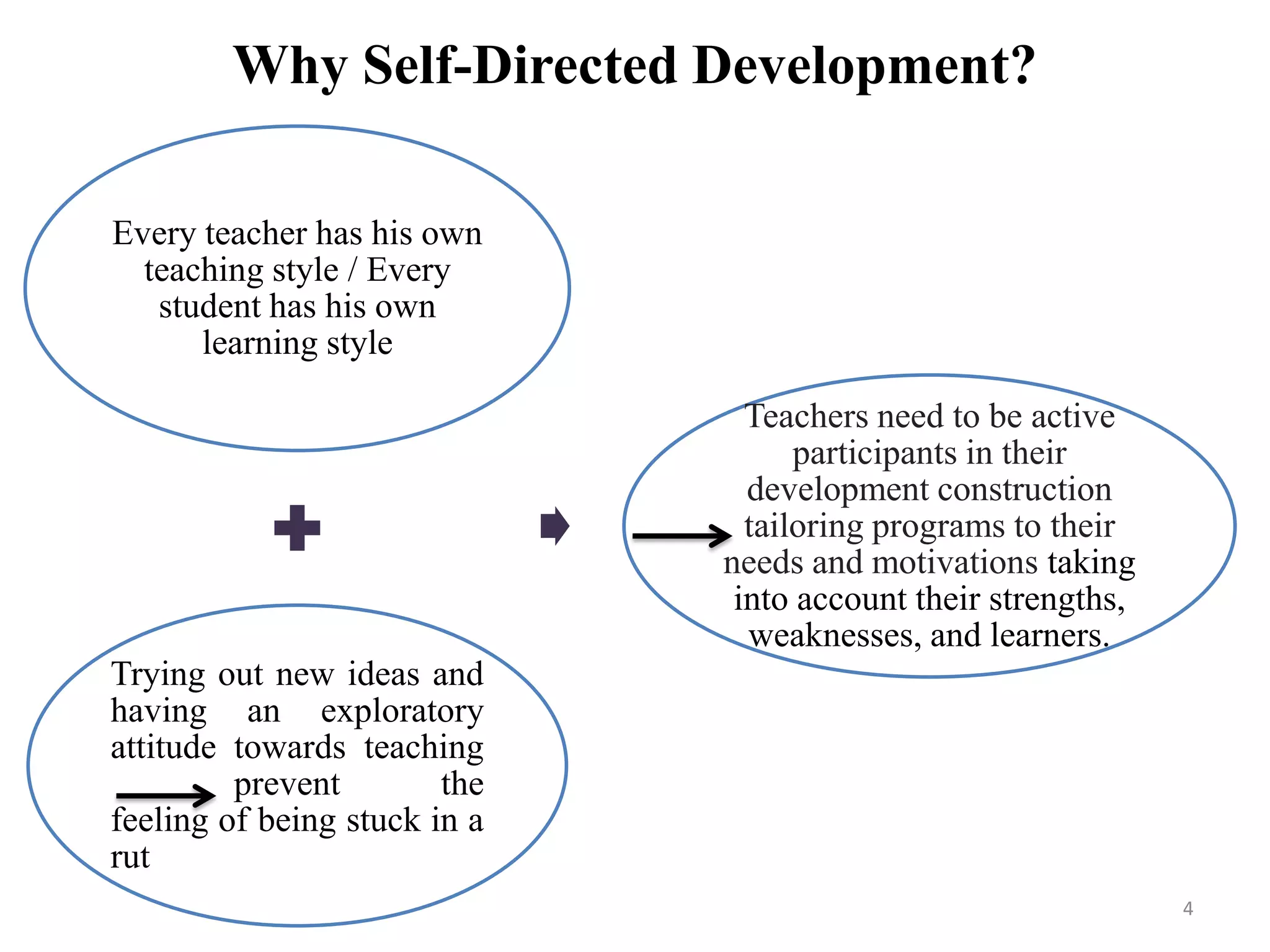
Why Self-Directed Development?
Everyteacher has his own
teaching style / Every
student has his own
learning style
Trying out new ideas and
having an exploratory
attitude towards teaching
prevent the
feeling of being stuck in a
rut
Teachers need to be active
participants in their
development construction
tailoring programs to their
needs and motivations taking
into account their strengths,
weaknesses, and learners.
4
5.
SDPD Challenge Perceptions
WhoDares to Teach Must Never Cease to Learn
(John Cotton Dana, 1912 )
Persist
despite
obstacles
See effort
as a path to
mastery
Embrace
challenges
Learn from
criticism /
inspired by
others’
success
Fixed Mindset
I “can” attitude I “cannot” attitude
5
The Move towardsa Growth-Mindset
Current Reality Desired Reality
Obstacles
8.
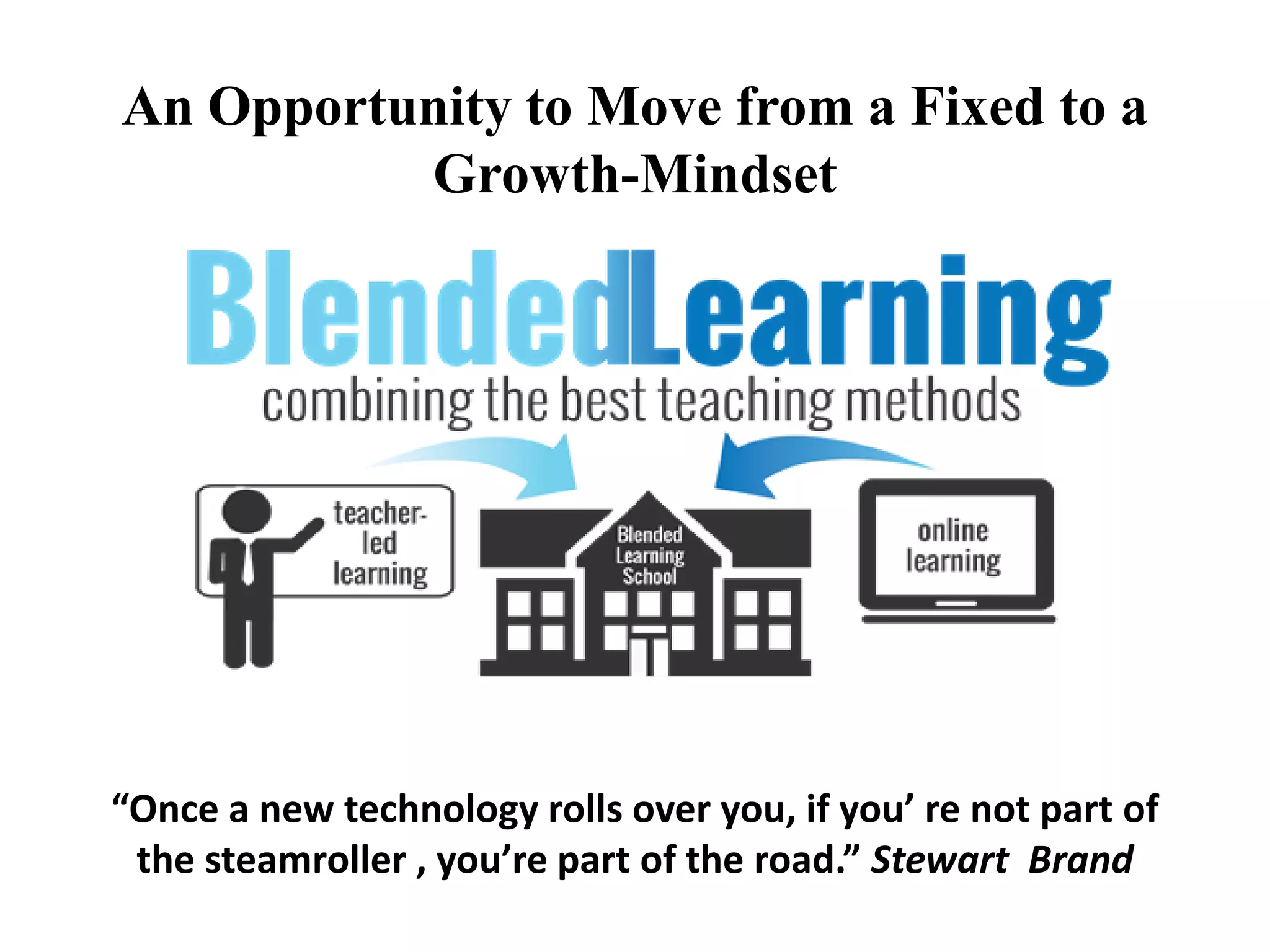
An Opportunity toMove from a Fixed to a
Growth-Mindset
“Once a new technology rolls over you, if you’ re not part of
the steamroller , you’re part of the road.” Stewart Brand
9.
Flipped Classroom: WorthTrying!!!
The flipped classroom inverts
traditional teaching methods by
delivering instruction online outside of
classroom and moving homework and
practice into the classroom.
1- Students watch instructional videos
at home.
2- Complete assessments / quizzes
about the instruction explored through
the videos.
3- In-classroom time is devoted to
discussions interactions and practice.
4- Post-classroom activity: students use
different electronic resources to do an
assignment and post their answers in an
online discussion group.
Assets
•Increased students’ motivation,
engagement and autonomy.
• More time for discussions and high-order
thinking activities during face-to-face
interaction.
•Enhanced collaborative learning by urging
students to find and exchange resources /
ideas in the online environment.
• Possibility to offer one-on-one help and
personalize instruction for handling
different paces / styles of learning.
9
10.
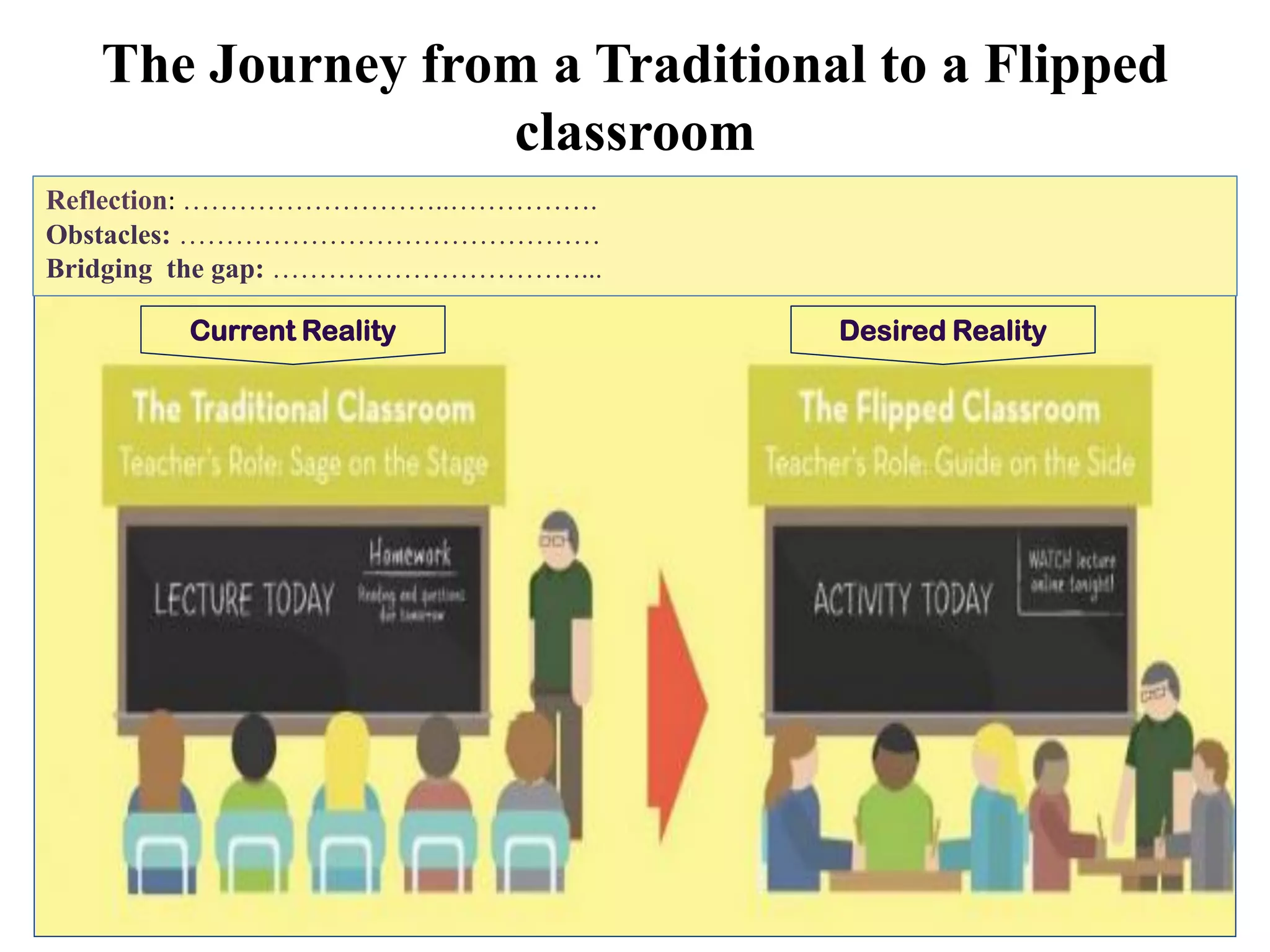
The Journey froma Traditional to a Flipped
classroom
10
Current Reality Desired Reality
Reflection: ………………………..…………….
Obstacles: ………………………………………
Bridging the gap: ……………………………...
11.
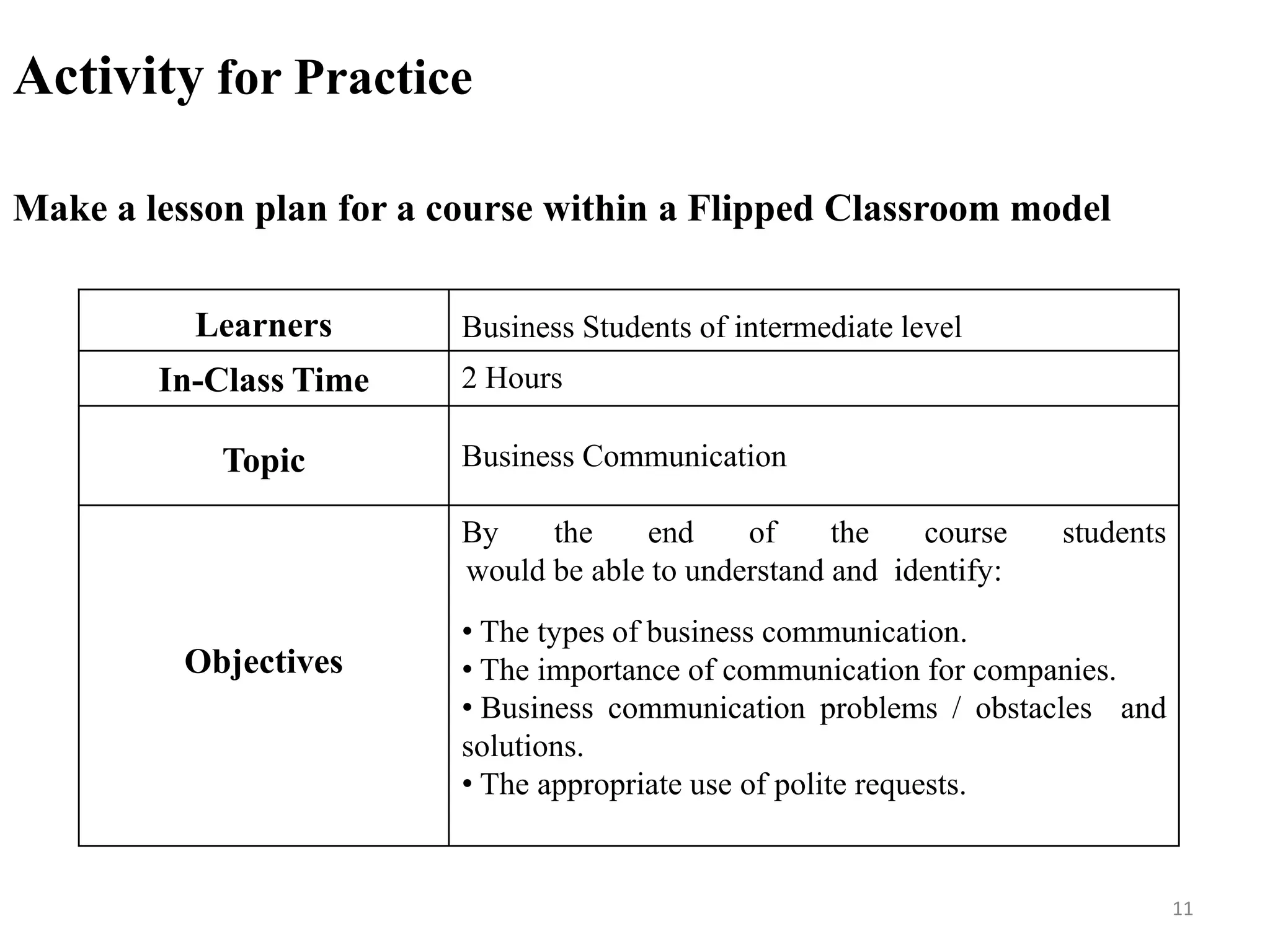
Activity for Practice
Makea lesson plan for a course within a Flipped Classroom model
Learners Business Students of intermediate level
In-Class Time 2 Hours
Topic Business Communication
Objectives
By the end of the course students
would be able to understand and identify:
• The types of business communication.
• The importance of communication for companies.
• Business communication problems / obstacles and
solutions.
• The appropriate use of polite requests.
11
12.
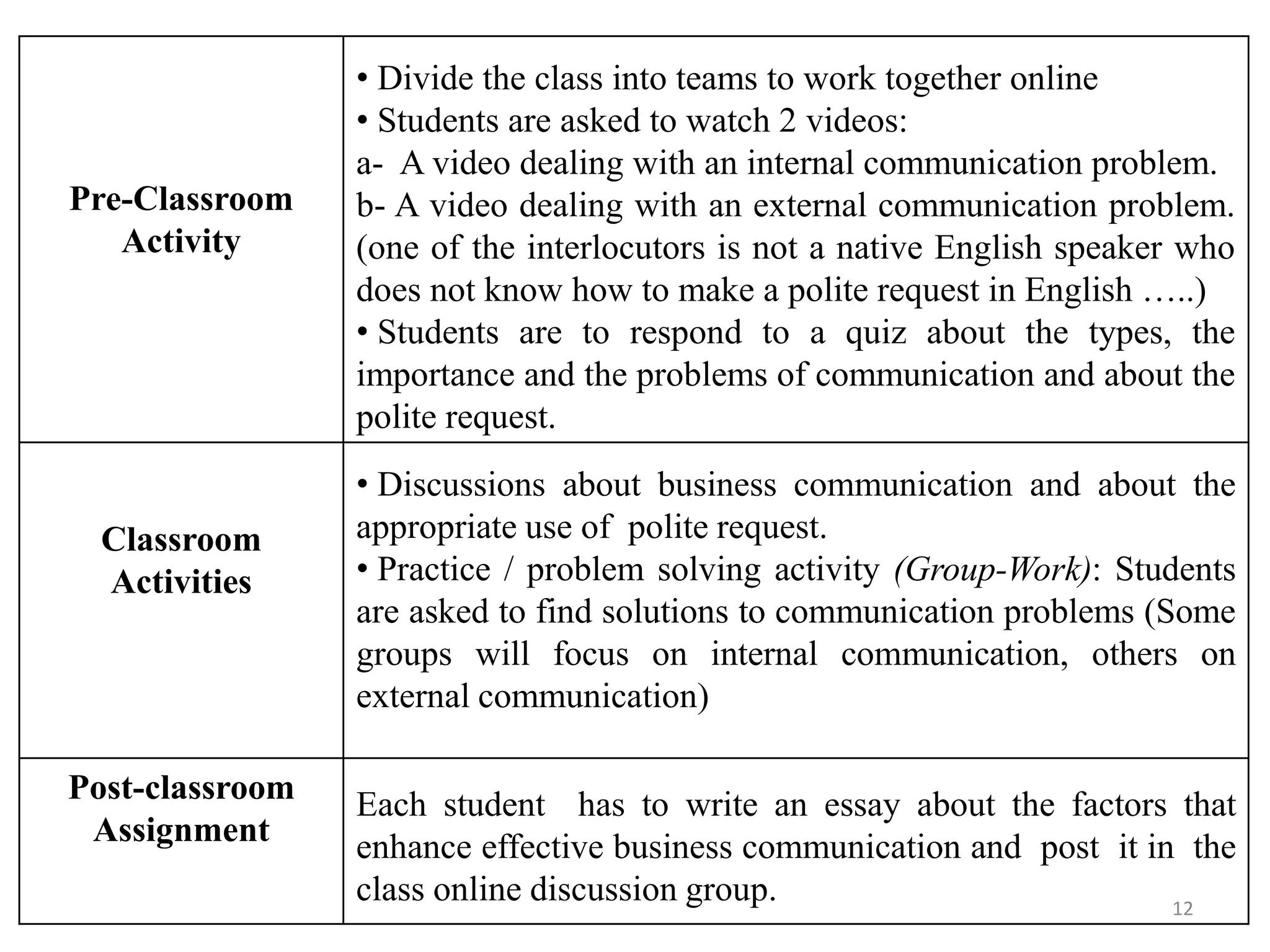
Pre-Classroom
Activity
• Divide theclass into teams to work together online
• Students are asked to watch 2 videos:
a- A video dealing with an internal communication problem.
b- A video dealing with an external communication problem.
(one of the interlocutors is not a native English speaker who
does not know how to make a polite request in English …..)
• Students are to respond to a quiz about the types, the
importance and the problems of communication and about the
polite request.
Classroom
Activities
• Discussions about business communication and about the
appropriate use of polite request.
• Practice / problem solving activity (Group-Work): Students
are asked to find solutions to communication problems (Some
groups will focus on internal communication, others on
external communication)
Post-classroom
Assignment
Each student has to write an essay about the factors that
enhance effective business communication and post it in the
class online discussion group. 12
13.
References
Allais, C. (2015).Innovations in the Continuing Professional Development of English Language
Teachers. System, 52, 151-152.
Borg, S. ( 2015). In Teaching for Success Contemporary perspectives on continuing professional
development. UK: British Council.
Brenda R. B. (2000). Teachers leading their own professional growth: self-directed reflection and
collaboration and changes in perception of self and work in secondary school teachers. In-Service Education,
26(1), 73-97. doi: 10.1080/13674580000200102
Ertmer, P. A., & Ottenbreit-Leftwich, A. T. (2010). Teacher technology change: How knowledge, confidence,
beliefs, and culture intersect. Journal of research on Technology in Education, 42(3), 255-284.
Grootenboer, P. ( 1999). Self-directed Teacher Professional Development. Retrieved from
http://www.aare.edu.au/publications-database.php/2470/self-directed-teacher-professional-development
Nunan, D., & Lamb, C. (1996). The self-directed teacher: Managing the learning process. Cambridge:
Cambridge University Press.
Tribble, C. (Ed.). (2012). Managing change in English language teaching: Lessons from experience. British
Council.
13