TIME TO SHARE AND
IMPLEMENT
OUTSTANDING
TEACHING AND
LEARNING
Teaching and Learning
INSET
5th January 2015
Teaching and Learning
 8.45am Roding Valley 10
Examples of Good Practice
 9.30am PLCs
How they can be effective
Skills - the bigger picture
 9.50am Interventions in Lessons
Examples of Good Practice
 10.00am Data Drop for Year 11 and Online Fire Safety
 11.00am Break
 11.20am Faculty time
 1.00pm Lunch - Canteen
 1.45pm Faculty time
 3.15pm Venue: Hall
 Evaluation and Showcase
Faculty Time
At the end of the day faculties can showcase and share in the Hall
what they have found useful and resources/ideas they have developed
during the afternoon.
Planning for intervention / Use of Tracking Grids
Creation/modification of PLCs
Roding Valley 10 – collaborative planning in Faculties
Create T & L boards in classrooms
Implementing Literacy strategies
Preparation for Post 16
Considering extra curricular
Exploring the GCSEpod
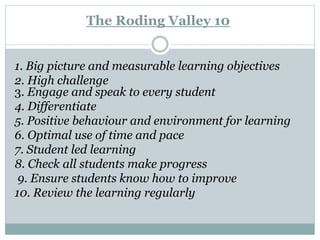
The Roding Valley 10
1. Big picture and measurable learning objectives
2. High challenge
3. Engage and speak to every student
4. Differentiate
5. Positive behaviour and environment for learning
6. Optimal use of time and pace
7. Student led learning
8. Check all students make progress
9. Ensure students know how to improve
10. Review the learning regularly
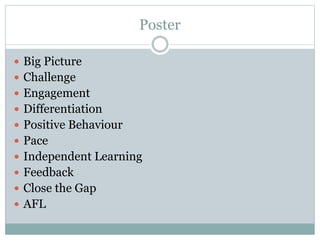
Poster
 Big Picture
 Challenge
 Engagement
 Differentiation
 Positive Behaviour
 Pace
 Independent Learning
 Feedback
 Close the Gap
 AFL
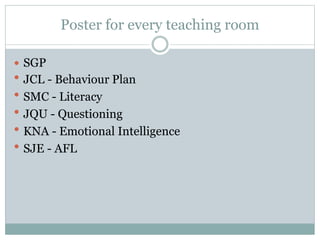
Poster for every teaching room
 SGP
 JCL - Behaviour Plan
 SMC - Literacy
 JQU - Questioning
 KNA - Emotional Intelligence
 SJE - AFL
So…what’s the secret? How do we do
it?
Consistent
Embedded
Habits
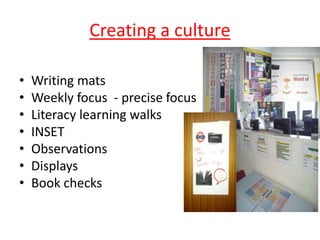
Creating a culture
• Writing mats
• Weekly focus - precise focus
• Literacy learning walks
• INSET
• Observations
• Displays
• Book checks
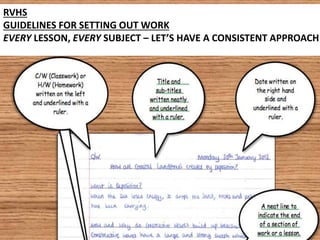
RVHS
GUIDELINES FOR SETTING OUT WORK
EVERY LESSON, EVERY SUBJECT – LET’S HAVE A CONSISTENT APPROACH!
Every member of staff, every lesson…
• Full stops and capital letters.
• No single word/single phrase answers – must
give answers in full sentences.
• All work presented in the same way with the
date written in full.
Socratic Questioning
1: Clarification of a key concept
2: Challenging assumptions and
misconceptions
3: Arguments based on evidence
4: Looking at alternatives
5: Consequences, implications and analysis
6: Questioning the question
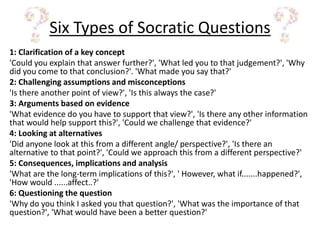
Six Types of Socratic Questions
1: Clarification of a key concept
'Could you explain that answer further?', 'What led you to that judgement?', 'Why
did you come to that conclusion?'. 'What made you say that?'
2: Challenging assumptions and misconceptions
'Is there another point of view?', 'Is this always the case?'
3: Arguments based on evidence
'What evidence do you have to support that view?', 'Is there any other information
that would help support this?', 'Could we challenge that evidence?'
4: Looking at alternatives
'Did anyone look at this from a different angle/ perspective?', 'Is there an
alternative to that point?', 'Could we approach this from a different perspective?'
5: Consequences, implications and analysis
'What are the long-term implications of this?', ' However, what if.......happened?',
'How would ......affect..?'
6: Questioning the question
'Why do you think I asked you that question?', 'What was the importance of that
question?', 'What would have been a better question?'
The term Emotional Intelligence gained publicity in 1990
when Peter Salovey and John Mayer explained their
thoughts on the subject.
This term was popularised by Daniel Goleman with his
1995 publication, Emotional Intelligence: Why it can
matter more than IQ.
Emotional Intelligence
How you relate to your learners?
Can you find a metaphor which best captures how you see yourself in
relation to groups of learners?
• law enforcer to the potentially criminal
• carer to the vulnerable
• salesperson to potential buyer
• preacher to the sinful
• sheepdog to sheep
• website to surfers
• gardener to plants
• tour guide to tour bus
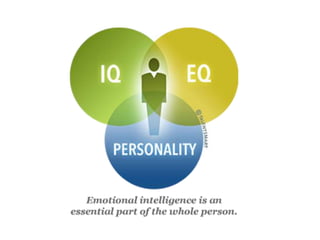
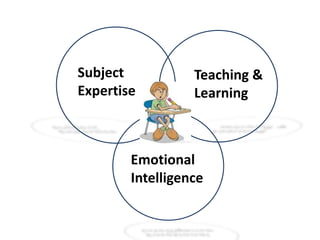
Subject
Expertise
Emotional
Intelligence
Teaching &
Learning
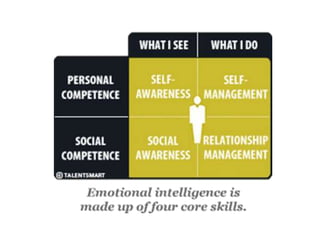
Personal competence is made up of your self-awareness
and self-management skills, which focus more on you
individually than on your interactions with other people.
Personal competence is your ability to stay aware of your
emotions and manage your behaviour and tendencies.
• Self-Awareness is your ability to accurately perceive
your emotions and stay aware of them as they happen.
• Self-Management is your ability to use awareness of
your emotions to stay flexible and positively direct your
behaviour.
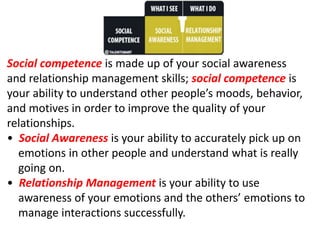
Social competence is made up of your social awareness
and relationship management skills; social competence is
your ability to understand other people’s moods, behavior,
and motives in order to improve the quality of your
relationships.
• Social Awareness is your ability to accurately pick up on
emotions in other people and understand what is really
going on.
• Relationship Management is your ability to use
awareness of your emotions and the others’ emotions to
manage interactions successfully.
In the Classroom
Create an environment of respect.
If you want your students to respect you and your classroom rules,
you must respect each of them.
- acknowledge all forms of diversity (e.g., race or religion) and
disabilities (e.g., physical or learning)
- Do not get frustrated if some students are not learning the
material as quickly as you expect. A major part of emotional
intelligence is showing empathy.
- If you can try a different teaching technique or a different way of
explaining a concept, this could alleviate some of the stress of
learning.
In the Classroom
Manage your emotions while taking responsibility.
There will be situations that frustrate you, but not only should you
obviously learn to hold back visible anger, you should also take
responsibility for your emotions without placing blame on your
students.
Focus on using "I" instead of "You" when making a statement. For
example, instead of saying, "You are not working hard enough to
understand this concept," say, "I am confused about what is
making this concept difficult to understand. Let's try together to
understand what is not making sense."
Avoiding putting the students on the defensive may help open
their minds to learning.
In the Classroom
Validate students.
We as humans like to feel valued rather than dismissed.
So, make an effort to understand what your students may be feeling
and relay this to them while also helping them resolve their own
issues.
If you empower your students to figure out on their own why
something is necessary compared to you just telling them that it is,
they may be more accepting of the task. It is hard being told what to
do, so encourage self-management.
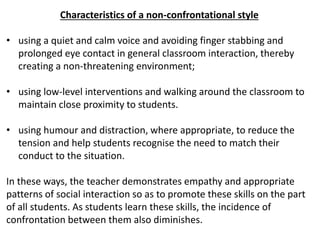
Characteristics of a non-confrontational style
• using a quiet and calm voice and avoiding finger stabbing and
prolonged eye contact in general classroom interaction, thereby
creating a non-threatening environment;
• using low-level interventions and walking around the classroom to
maintain close proximity to students.
• using humour and distraction, where appropriate, to reduce the
tension and help students recognise the need to match their
conduct to the situation.
In these ways, the teacher demonstrates empathy and appropriate
patterns of social interaction so as to promote these skills on the part
of all students. As students learn these skills, the incidence of
confrontation between them also diminishes.
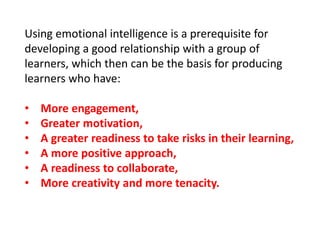
Using emotional intelligence is a prerequisite for
developing a good relationship with a group of
learners, which then can be the basis for producing
learners who have:
• More engagement,
• Greater motivation,
• A greater readiness to take risks in their learning,
• A more positive approach,
• A readiness to collaborate,
• More creativity and more tenacity.
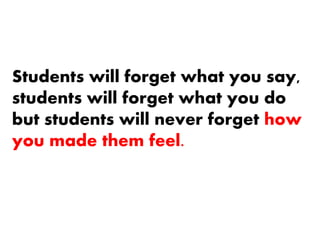
Students will forget what you say,
students will forget what you do
but students will never forget how
you made them feel.
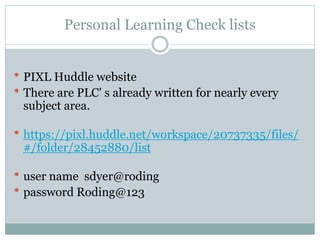
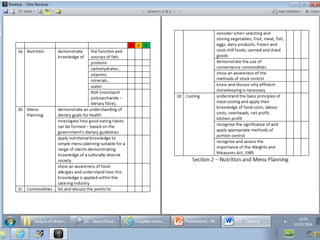
Personal Learning Check lists
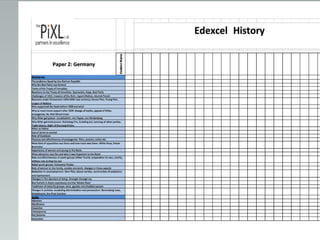
 PIXL Huddle website
 There are PLC' s already written for nearly every
subject area.
 https://pixl.huddle.net/workspace/20737335/files/
#/folder/28452880/list
 user name sdyer@roding
 password Roding@123
Teaching and Learning
TECHNOLOGY
Inset 5 January 2015
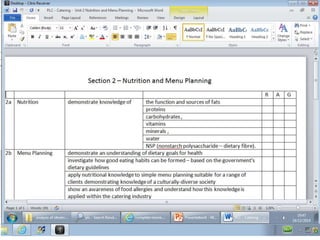
Personal Learning Checklists
PLC
• A Personal Learning Checklist is a tool for
students and teachers to monitor and track
where their learning is at.
= Based on skills that students need to learn
= Based on knowledge/learning objectives that
students need to learn
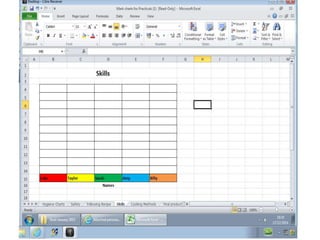
SKILLS: The Bigger Picture
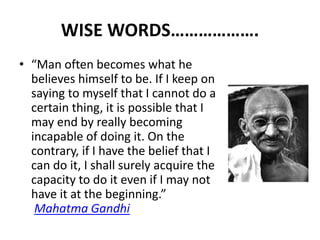
WISE WORDS……………….
• “Man often becomes what he
believes himself to be. If I keep on
saying to myself that I cannot do a
certain thing, it is possible that I
may end by really becoming
incapable of doing it. On the
contrary, if I have the belief that I
can do it, I shall surely acquire the
capacity to do it even if I may not
have it at the beginning.”
Mahatma Gandhi
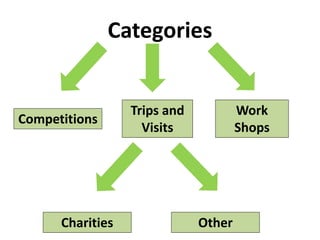
Categories
Competitions
Trips and
Visits
Work
Shops
Charities Other
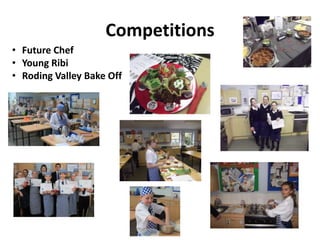
Competitions
• Future Chef
• Young Ribi
• Roding Valley Bake Off
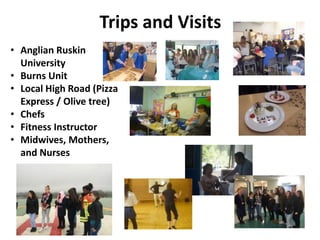
Trips and Visits
• Anglian Ruskin
University
• Burns Unit
• Local High Road (Pizza
Express / Olive tree)
• Chefs
• Fitness Instructor
• Midwives, Mothers,
and Nurses
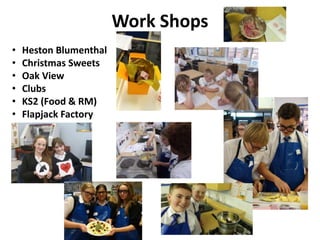
Work Shops
• Heston Blumenthal
• Christmas Sweets
• Oak View
• Clubs
• KS2 (Food & RM)
• Flapjack Factory
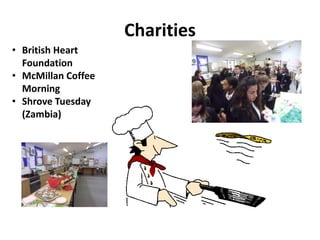
Charities
• British Heart
Foundation
• McMillan Coffee
Morning
• Shrove Tuesday
(Zambia)
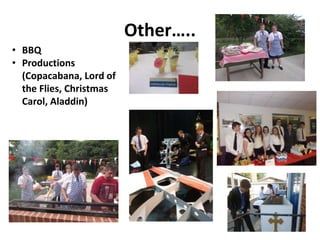
Other…..
• BBQ
• Productions
(Copacabana, Lord of
the Flies, Christmas
Carol, Aladdin)
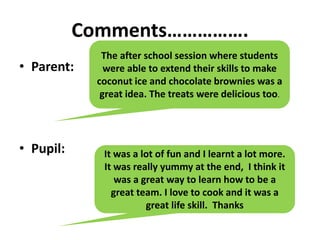
Comments…………….
• Parent:
• Pupil:
The after school session where students
were able to extend their skills to make
coconut ice and chocolate brownies was a
great idea. The treats were delicious too.
It was a lot of fun and I learnt a lot more.
It was really yummy at the end, I think it
was a great way to learn how to be a
great team. I love to cook and it was a
great life skill. Thanks
FINAL THOUGHTS……..
SKILLS: The Bigger Picture
Interventions
Intervention
“Contact with each student in the room each
lesson”
5/1/15
Intervention
(Joseph Rowntree Foundation April 2012)
● Mentoring
● Parental Involvement
● Building Relationships
● Extra Curricular Activities - (academic and study support)
Some good evidence of impact on Attitude and Attainment
● Keeping ambition ‘on track’ rather than raising aspiration
Purpose of Intervention?
Per task/skill
Literacy /Numeracy
Attitude
Attainment
Exam
Low income / disadvantage
Closing the Gap
What does the outcome look like?
Parental Involvement
“The research identified a number of programmes where there are strong
indicators of success. It found that the most effective way of helping children
from low-income households to achieve their ambitions is involving parents in
school; engaging parents in their children’s learning and in their own
learning; and aligning school-home expectations. Parents need to understand
how the education system works and what choices are available for their
children and, critically, how they can work with schools to help their
children reach their full potential”
ARE WE TELLING PARENTS HOW TO HELP?
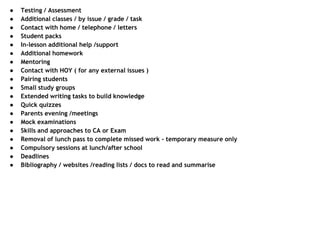
● Testing / Assessment
● Additional classes / by issue / grade / task
● Contact with home / telephone / letters
● Student packs
● In-lesson additional help /support
● Additional homework
● Mentoring
● Contact with HOY ( for any external issues )
● Pairing students
● Small study groups
● Extended writing tasks to build knowledge
● Quick quizzes
● Parents evening /meetings
● Mock examinations
● Skills and approaches to CA or Exam
● Removal of lunch pass to complete missed work - temporary measure only
● Compulsory sessions at lunch/after school
● Deadlines
● Bibliography / websites /reading lists / docs to read and summarise
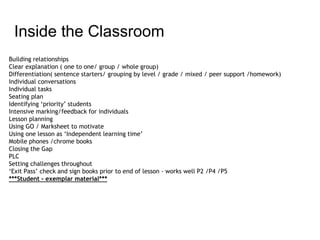
Building relationships
Clear explanation ( one to one/ group / whole group)
Differentiation( sentence starters/ grouping by level / grade / mixed / peer support /homework)
Individual conversations
Individual tasks
Seating plan
Identifying ‘priority’ students
Intensive marking/feedback for individuals
Lesson planning
Using GO / Marksheet to motivate
Using one lesson as ‘Independent learning time’
Mobile phones /chrome books
Closing the Gap
PLC
Setting challenges throughout
‘Exit Pass’ check and sign books prior to end of lesson - works well P2 /P4 /P5
***Student - exemplar material***
Inside the Classroom
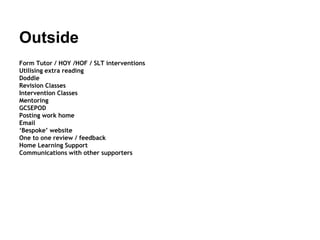
Outside
Form Tutor / HOY /HOF / SLT interventions
Utilising extra reading
Doddle
Revision Classes
Intervention Classes
Mentoring
GCSEPOD
Posting work home
Email
‘Bespoke’ website
One to one review / feedback
Home Learning Support
Communications with other supporters
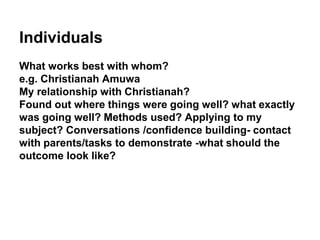
Individuals
What works best with whom?
e.g. Christianah Amuwa

My relationship with Christianah?
Found out where things were going well? what exactly
was going well? Methods used? Applying to my
subject? Conversations /confidence building- contact
with parents/tasks to demonstrate -what should the
outcome look like?
Conclusion
DECIDE:
Who needs intervention?
Why is intervention necessary?
Which intervention/s suits best?
Ask around … what is working for individuals
elsewhere?
Faculty Time to Implement
Year 11 data drop
Online Fire Training

Teaching and learning January 2015 Inset

  • 1.
    TIME TO SHAREAND IMPLEMENT OUTSTANDING TEACHING AND LEARNING Teaching and Learning INSET 5th January 2015
  • 2.
    Teaching and Learning 8.45am Roding Valley 10 Examples of Good Practice  9.30am PLCs How they can be effective Skills - the bigger picture  9.50am Interventions in Lessons Examples of Good Practice  10.00am Data Drop for Year 11 and Online Fire Safety  11.00am Break  11.20am Faculty time  1.00pm Lunch - Canteen  1.45pm Faculty time  3.15pm Venue: Hall  Evaluation and Showcase
  • 3.
    Faculty Time At theend of the day faculties can showcase and share in the Hall what they have found useful and resources/ideas they have developed during the afternoon. Planning for intervention / Use of Tracking Grids Creation/modification of PLCs Roding Valley 10 – collaborative planning in Faculties Create T & L boards in classrooms Implementing Literacy strategies Preparation for Post 16 Considering extra curricular Exploring the GCSEpod
  • 4.
    The Roding Valley10 1. Big picture and measurable learning objectives 2. High challenge 3. Engage and speak to every student 4. Differentiate 5. Positive behaviour and environment for learning 6. Optimal use of time and pace 7. Student led learning 8. Check all students make progress 9. Ensure students know how to improve 10. Review the learning regularly
  • 5.
    Poster  Big Picture Challenge  Engagement  Differentiation  Positive Behaviour  Pace  Independent Learning  Feedback  Close the Gap  AFL
  • 7.
    Poster for everyteaching room  SGP  JCL - Behaviour Plan  SMC - Literacy  JQU - Questioning  KNA - Emotional Intelligence  SJE - AFL
  • 8.
    So…what’s the secret?How do we do it? Consistent Embedded Habits
  • 9.
    Creating a culture •Writing mats • Weekly focus - precise focus • Literacy learning walks • INSET • Observations • Displays • Book checks
  • 10.
    RVHS GUIDELINES FOR SETTINGOUT WORK EVERY LESSON, EVERY SUBJECT – LET’S HAVE A CONSISTENT APPROACH!
  • 11.
    Every member ofstaff, every lesson… • Full stops and capital letters. • No single word/single phrase answers – must give answers in full sentences. • All work presented in the same way with the date written in full.
  • 13.
    Socratic Questioning 1: Clarificationof a key concept 2: Challenging assumptions and misconceptions 3: Arguments based on evidence 4: Looking at alternatives 5: Consequences, implications and analysis 6: Questioning the question
  • 14.
    Six Types ofSocratic Questions 1: Clarification of a key concept 'Could you explain that answer further?', 'What led you to that judgement?', 'Why did you come to that conclusion?'. 'What made you say that?' 2: Challenging assumptions and misconceptions 'Is there another point of view?', 'Is this always the case?' 3: Arguments based on evidence 'What evidence do you have to support that view?', 'Is there any other information that would help support this?', 'Could we challenge that evidence?' 4: Looking at alternatives 'Did anyone look at this from a different angle/ perspective?', 'Is there an alternative to that point?', 'Could we approach this from a different perspective?' 5: Consequences, implications and analysis 'What are the long-term implications of this?', ' However, what if.......happened?', 'How would ......affect..?' 6: Questioning the question 'Why do you think I asked you that question?', 'What was the importance of that question?', 'What would have been a better question?'
  • 16.
    The term EmotionalIntelligence gained publicity in 1990 when Peter Salovey and John Mayer explained their thoughts on the subject. This term was popularised by Daniel Goleman with his 1995 publication, Emotional Intelligence: Why it can matter more than IQ. Emotional Intelligence
  • 18.
    How you relateto your learners? Can you find a metaphor which best captures how you see yourself in relation to groups of learners? • law enforcer to the potentially criminal • carer to the vulnerable • salesperson to potential buyer • preacher to the sinful • sheepdog to sheep • website to surfers • gardener to plants • tour guide to tour bus
  • 19.
  • 21.
    Personal competence ismade up of your self-awareness and self-management skills, which focus more on you individually than on your interactions with other people. Personal competence is your ability to stay aware of your emotions and manage your behaviour and tendencies. • Self-Awareness is your ability to accurately perceive your emotions and stay aware of them as they happen. • Self-Management is your ability to use awareness of your emotions to stay flexible and positively direct your behaviour.
  • 22.
    Social competence ismade up of your social awareness and relationship management skills; social competence is your ability to understand other people’s moods, behavior, and motives in order to improve the quality of your relationships. • Social Awareness is your ability to accurately pick up on emotions in other people and understand what is really going on. • Relationship Management is your ability to use awareness of your emotions and the others’ emotions to manage interactions successfully.
  • 23.
    In the Classroom Createan environment of respect. If you want your students to respect you and your classroom rules, you must respect each of them. - acknowledge all forms of diversity (e.g., race or religion) and disabilities (e.g., physical or learning) - Do not get frustrated if some students are not learning the material as quickly as you expect. A major part of emotional intelligence is showing empathy. - If you can try a different teaching technique or a different way of explaining a concept, this could alleviate some of the stress of learning.
  • 24.
    In the Classroom Manageyour emotions while taking responsibility. There will be situations that frustrate you, but not only should you obviously learn to hold back visible anger, you should also take responsibility for your emotions without placing blame on your students. Focus on using "I" instead of "You" when making a statement. For example, instead of saying, "You are not working hard enough to understand this concept," say, "I am confused about what is making this concept difficult to understand. Let's try together to understand what is not making sense." Avoiding putting the students on the defensive may help open their minds to learning.
  • 25.
    In the Classroom Validatestudents. We as humans like to feel valued rather than dismissed. So, make an effort to understand what your students may be feeling and relay this to them while also helping them resolve their own issues. If you empower your students to figure out on their own why something is necessary compared to you just telling them that it is, they may be more accepting of the task. It is hard being told what to do, so encourage self-management.
  • 26.
    Characteristics of anon-confrontational style • using a quiet and calm voice and avoiding finger stabbing and prolonged eye contact in general classroom interaction, thereby creating a non-threatening environment; • using low-level interventions and walking around the classroom to maintain close proximity to students. • using humour and distraction, where appropriate, to reduce the tension and help students recognise the need to match their conduct to the situation. In these ways, the teacher demonstrates empathy and appropriate patterns of social interaction so as to promote these skills on the part of all students. As students learn these skills, the incidence of confrontation between them also diminishes.
  • 27.
    Using emotional intelligenceis a prerequisite for developing a good relationship with a group of learners, which then can be the basis for producing learners who have: • More engagement, • Greater motivation, • A greater readiness to take risks in their learning, • A more positive approach, • A readiness to collaborate, • More creativity and more tenacity.
  • 28.
    Students will forgetwhat you say, students will forget what you do but students will never forget how you made them feel.
  • 29.
    Personal Learning Checklists  PIXL Huddle website  There are PLC' s already written for nearly every subject area.  https://pixl.huddle.net/workspace/20737335/files/ #/folder/28452880/list  user name sdyer@roding  password Roding@123
  • 31.
  • 32.
  • 33.
    PLC • A PersonalLearning Checklist is a tool for students and teachers to monitor and track where their learning is at. = Based on skills that students need to learn = Based on knowledge/learning objectives that students need to learn
  • 37.
  • 38.
    WISE WORDS………………. • “Manoften becomes what he believes himself to be. If I keep on saying to myself that I cannot do a certain thing, it is possible that I may end by really becoming incapable of doing it. On the contrary, if I have the belief that I can do it, I shall surely acquire the capacity to do it even if I may not have it at the beginning.” Mahatma Gandhi
  • 39.
  • 40.
    Competitions • Future Chef •Young Ribi • Roding Valley Bake Off
  • 41.
    Trips and Visits •Anglian Ruskin University • Burns Unit • Local High Road (Pizza Express / Olive tree) • Chefs • Fitness Instructor • Midwives, Mothers, and Nurses
  • 42.
    Work Shops • HestonBlumenthal • Christmas Sweets • Oak View • Clubs • KS2 (Food & RM) • Flapjack Factory
  • 43.
    Charities • British Heart Foundation •McMillan Coffee Morning • Shrove Tuesday (Zambia)
  • 44.
    Other….. • BBQ • Productions (Copacabana,Lord of the Flies, Christmas Carol, Aladdin)
  • 45.
    Comments……………. • Parent: • Pupil: Theafter school session where students were able to extend their skills to make coconut ice and chocolate brownies was a great idea. The treats were delicious too. It was a lot of fun and I learnt a lot more. It was really yummy at the end, I think it was a great way to learn how to be a great team. I love to cook and it was a great life skill. Thanks
  • 46.
  • 47.
  • 48.
  • 49.
    Intervention “Contact with eachstudent in the room each lesson” 5/1/15
  • 50.
    Intervention (Joseph Rowntree FoundationApril 2012) ● Mentoring ● Parental Involvement ● Building Relationships ● Extra Curricular Activities - (academic and study support) Some good evidence of impact on Attitude and Attainment ● Keeping ambition ‘on track’ rather than raising aspiration
  • 51.
    Purpose of Intervention? Pertask/skill Literacy /Numeracy Attitude Attainment Exam Low income / disadvantage Closing the Gap What does the outcome look like?
  • 52.
    Parental Involvement “The researchidentified a number of programmes where there are strong indicators of success. It found that the most effective way of helping children from low-income households to achieve their ambitions is involving parents in school; engaging parents in their children’s learning and in their own learning; and aligning school-home expectations. Parents need to understand how the education system works and what choices are available for their children and, critically, how they can work with schools to help their children reach their full potential” ARE WE TELLING PARENTS HOW TO HELP?
  • 53.
    ● Testing /Assessment ● Additional classes / by issue / grade / task ● Contact with home / telephone / letters ● Student packs ● In-lesson additional help /support ● Additional homework ● Mentoring ● Contact with HOY ( for any external issues ) ● Pairing students ● Small study groups ● Extended writing tasks to build knowledge ● Quick quizzes ● Parents evening /meetings ● Mock examinations ● Skills and approaches to CA or Exam ● Removal of lunch pass to complete missed work - temporary measure only ● Compulsory sessions at lunch/after school ● Deadlines ● Bibliography / websites /reading lists / docs to read and summarise
  • 54.
    Building relationships Clear explanation( one to one/ group / whole group) Differentiation( sentence starters/ grouping by level / grade / mixed / peer support /homework) Individual conversations Individual tasks Seating plan Identifying ‘priority’ students Intensive marking/feedback for individuals Lesson planning Using GO / Marksheet to motivate Using one lesson as ‘Independent learning time’ Mobile phones /chrome books Closing the Gap PLC Setting challenges throughout ‘Exit Pass’ check and sign books prior to end of lesson - works well P2 /P4 /P5 ***Student - exemplar material*** Inside the Classroom
  • 55.
    Outside Form Tutor /HOY /HOF / SLT interventions Utilising extra reading Doddle Revision Classes Intervention Classes Mentoring GCSEPOD Posting work home Email ‘Bespoke’ website One to one review / feedback Home Learning Support Communications with other supporters
  • 56.
    Individuals What works bestwith whom? e.g. Christianah Amuwa My relationship with Christianah? Found out where things were going well? what exactly was going well? Methods used? Applying to my subject? Conversations /confidence building- contact with parents/tasks to demonstrate -what should the outcome look like?
  • 57.
    Conclusion DECIDE: Who needs intervention? Whyis intervention necessary? Which intervention/s suits best? Ask around … what is working for individuals elsewhere?
  • 58.
    Faculty Time toImplement Year 11 data drop Online Fire Training