Promoting Inclusive
Classrooms
by
Adopting Universal
Design for Learning(UDL)
Suresh Kumar,
Ph.D. Research Scholar,
Aryabhatta Knowledge University, Patna
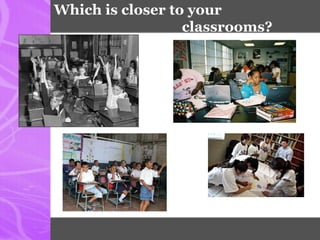
Which is closer to your
classrooms?
Today’s Session at a Glance
 Inclusive Classroom
 Origin of UDL
 The Need for UDL
 What is UDL?
 Principles of UDL
 UDL Learning Guidelines
Defining Features of Inclusive
Classrooms
 Access:
–All children have access to the general
education curriculum and learning
environment.
 Participation:
–All children can participate in all activities and
routines through scaffolding and intervention.
 Support:
–All teachers have the tools they need to help all
young children, who have unique strengths and
needs.
“Creating classroom norms,
expectations and rules are a
golden opportunity to
establish and sustain
student engagement, use it.”
- Dr. Mary Magee Quinn
The Need for UDL
 To fulfill the need of increasingly diverse students with
special reference to differently abled students.
 Increased emphasis on student retention.
 Shift in pedagogy from delivering instruction to promoting
learning.
 Students report:
– Unclear expectations
– Textbooks inaccessible
– Lectures that require extensive note taking
– Assessments that don’t reflect their learning
– Difficulty attaining accommodations
UDL is built on the premise that…
Learning differs across
tasks
Learning differs across
development
Learning differs across
individuals
What is UDL?
“The design of instructional
materials and activities that makes
the learning goals achievable by
individuals with wide differences
in their abilities to see, hear,
speak, move, read, write,
understand English, attend,
organize, engage, and remember”
(U.S. Council for Exceptional Children)
Origin of UDL
 Born from architectural world
 Intended to design and construct
equal access facilities
 Concept transferred to education in
1990s.
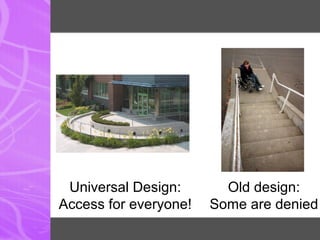
Universal Design:
Access for everyone!
Old design:
Some are denied
Universal design principles
 Not an afterthought: Full access is
designed from the outset (beginning)
 More cost-effective than retrofitting
 More elegant and easy-to-use
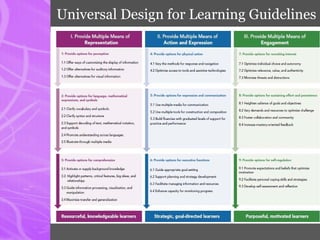
Three Fundamental Principles
 Multiple Means of Representation
– To increase recognition
 Multiple Means of Expression
– To expand purposeful output
 Multiple Means of Engagement
– To enhance involvement
Multiple Means of Representation
In order to support the many
ways children learn, teachers
need to introduce and share
concepts in formats that make
sense to the children.
Multiple Means of Action and
Expression
Refers to the opportunities that
we give to children that allow
them to show us what they
know and what they are able to
do in different ways.
Multiple Means of Engagement
Provide multiple means of
engagement to tap
individual learners’
interests, challenge them
appropriately, and
motivate them to learn.
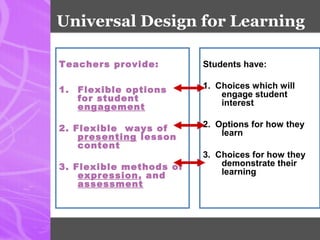
Students have:
1. Choices which will
engage student
interest
2. Options for how they
learn
3. Choices for how they
demonstrate their
learning
Teachers provide:
1. Flexible options
for student
engagement
2. Flexible ways of
presenting lesson
content
3. Flexible methods of
expression, and
assessment
Universal Design for Learning
 Reduces barriers in instruction
 Provides appropriate accommodations
[and] supports
 Maintains high achievement expectations
Universal Design for Learning
 Eliminating or reducing barriers to
academic success for all students
 Valuing diversity in the classroom
through proactive design of inclusive
curriculum
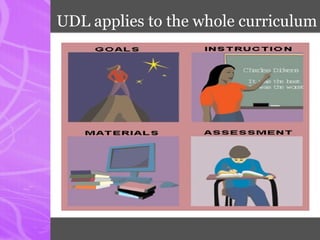
UDL applies to the whole curriculum
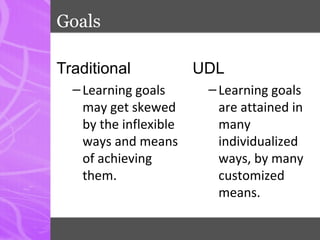
Goals
Traditional
–Learning goals
may get skewed
by the inflexible
ways and means
of achieving
them.
UDL
–Learning goals
are attained in
many
individualized
ways, by many
customized
means.
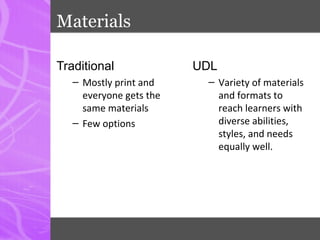
Materials
Traditional
– Mostly print and
everyone gets the
same materials
– Few options
UDL
– Variety of materials
and formats to
reach learners with
diverse abilities,
styles, and needs
equally well.
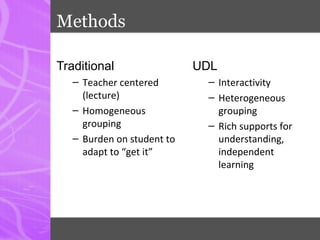
Methods
Traditional
– Teacher centered
(lecture)
– Homogeneous
grouping
– Burden on student to
adapt to “get it”
UDL
– Interactivity
– Heterogeneous
grouping
– Rich supports for
understanding,
independent
learning
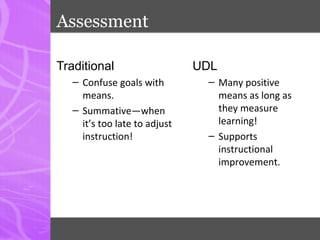
Assessment
Traditional
– Confuse goals with
means.
– Summative—when
it’s too late to adjust
instruction!
UDL
– Many positive
means as long as
they measure
learning!
– Supports
instructional
improvement.
Universal Design for Learning Guidelines
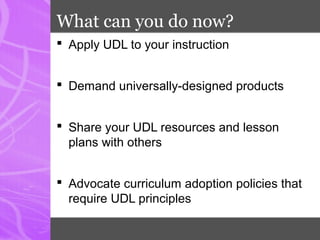
 Apply UDL to your instruction
 Demand universally-designed products
 Share your UDL resources and lesson
plans with others
 Advocate curriculum adoption policies that
require UDL principles
What can you do now?
Summing it all up
The old days will not be again,
even as a man will never again
be a child.(Dakota)
You are shaping the future!
May you be one who makes
things happen for the students
you teach.
May you have a wonderful and
successful school year.
THANK
YOU !

Promoting inclusive classroom adopting udl

  • 1.
    Promoting Inclusive Classrooms by Adopting Universal Designfor Learning(UDL) Suresh Kumar, Ph.D. Research Scholar, Aryabhatta Knowledge University, Patna
  • 2.
    Which is closerto your classrooms?
  • 3.
    Today’s Session ata Glance  Inclusive Classroom  Origin of UDL  The Need for UDL  What is UDL?  Principles of UDL  UDL Learning Guidelines
  • 4.
    Defining Features ofInclusive Classrooms  Access: –All children have access to the general education curriculum and learning environment.  Participation: –All children can participate in all activities and routines through scaffolding and intervention.  Support: –All teachers have the tools they need to help all young children, who have unique strengths and needs.
  • 5.
    “Creating classroom norms, expectationsand rules are a golden opportunity to establish and sustain student engagement, use it.” - Dr. Mary Magee Quinn
  • 6.
    The Need forUDL  To fulfill the need of increasingly diverse students with special reference to differently abled students.  Increased emphasis on student retention.  Shift in pedagogy from delivering instruction to promoting learning.  Students report: – Unclear expectations – Textbooks inaccessible – Lectures that require extensive note taking – Assessments that don’t reflect their learning – Difficulty attaining accommodations
  • 7.
    UDL is builton the premise that… Learning differs across tasks Learning differs across development Learning differs across individuals
  • 8.
    What is UDL? “Thedesign of instructional materials and activities that makes the learning goals achievable by individuals with wide differences in their abilities to see, hear, speak, move, read, write, understand English, attend, organize, engage, and remember” (U.S. Council for Exceptional Children)
  • 9.
    Origin of UDL Born from architectural world  Intended to design and construct equal access facilities  Concept transferred to education in 1990s.
  • 10.
    Universal Design: Access foreveryone! Old design: Some are denied
  • 11.
    Universal design principles Not an afterthought: Full access is designed from the outset (beginning)  More cost-effective than retrofitting  More elegant and easy-to-use
  • 12.
    Three Fundamental Principles Multiple Means of Representation – To increase recognition  Multiple Means of Expression – To expand purposeful output  Multiple Means of Engagement – To enhance involvement
  • 13.
    Multiple Means ofRepresentation In order to support the many ways children learn, teachers need to introduce and share concepts in formats that make sense to the children.
  • 14.
    Multiple Means ofAction and Expression Refers to the opportunities that we give to children that allow them to show us what they know and what they are able to do in different ways.
  • 15.
    Multiple Means ofEngagement Provide multiple means of engagement to tap individual learners’ interests, challenge them appropriately, and motivate them to learn.
  • 16.
    Students have: 1. Choiceswhich will engage student interest 2. Options for how they learn 3. Choices for how they demonstrate their learning Teachers provide: 1. Flexible options for student engagement 2. Flexible ways of presenting lesson content 3. Flexible methods of expression, and assessment Universal Design for Learning
  • 17.
    Universal Design forLearning  Reduces barriers in instruction  Provides appropriate accommodations [and] supports  Maintains high achievement expectations
  • 18.
    Universal Design forLearning  Eliminating or reducing barriers to academic success for all students  Valuing diversity in the classroom through proactive design of inclusive curriculum
  • 19.
    UDL applies tothe whole curriculum
  • 20.
    Goals Traditional –Learning goals may getskewed by the inflexible ways and means of achieving them. UDL –Learning goals are attained in many individualized ways, by many customized means.
  • 21.
    Materials Traditional – Mostly printand everyone gets the same materials – Few options UDL – Variety of materials and formats to reach learners with diverse abilities, styles, and needs equally well.
  • 22.
    Methods Traditional – Teacher centered (lecture) –Homogeneous grouping – Burden on student to adapt to “get it” UDL – Interactivity – Heterogeneous grouping – Rich supports for understanding, independent learning
  • 23.
    Assessment Traditional – Confuse goalswith means. – Summative—when it’s too late to adjust instruction! UDL – Many positive means as long as they measure learning! – Supports instructional improvement.
  • 24.
    Universal Design forLearning Guidelines
  • 25.
     Apply UDLto your instruction  Demand universally-designed products  Share your UDL resources and lesson plans with others  Advocate curriculum adoption policies that require UDL principles What can you do now?
  • 26.
    Summing it allup The old days will not be again, even as a man will never again be a child.(Dakota) You are shaping the future!
  • 27.
    May you beone who makes things happen for the students you teach. May you have a wonderful and successful school year.
  • 28.