Tonight… BE JACK BAUER! Can you take the torture?
Assessment Mark Benthall Copyright 2007 (Like anyone would actually  want   to claim this as their own work!)
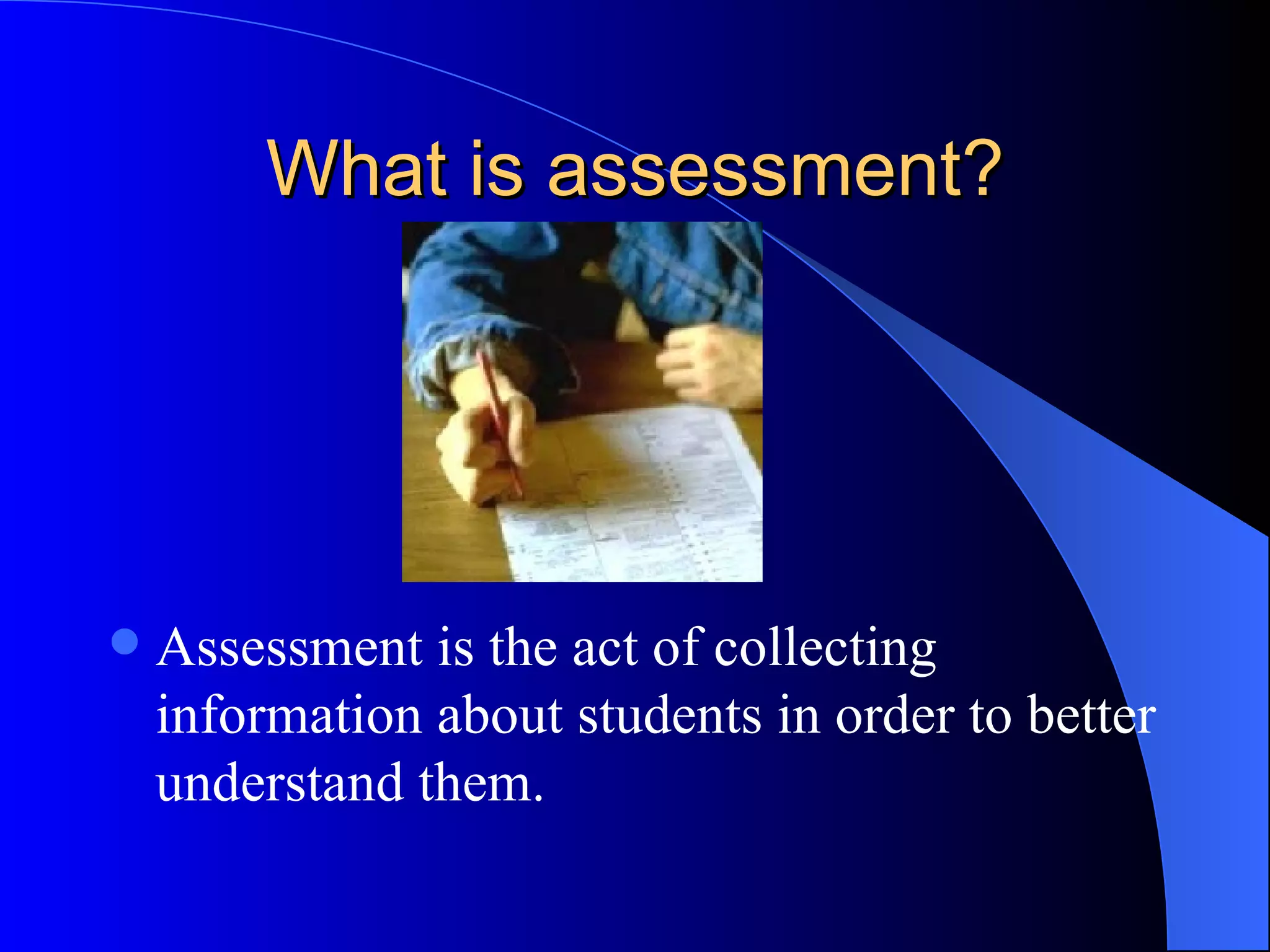
What is assessment? Assessment is the act of collecting information about students in order to better understand them.
Why assess? Serves as a diagnostic tool for instruction Provides feedback Sets standards Evaluates progress Communicates results Motivates performance
How are Testing and Assessment Different? Grant Wiggins, Nationally Recognized Assessment Guru
Two Main Types of Assessment Summative - generally carried out at the end of a course or project.  Typically used to assign a course grade. Formative - generally carried out throughout a course or project.  Used to aide learning.
Through assessment we constantly ask these questions:   Are we teaching what we think we’re teaching? Are the students learning what they are supposed to be learning? Is there a better way to teach this subject? Has anyone actually listened to anything I’ve said for the past two weeks?
Assessment affects educators decisions about: Grades Placement Instructional needs Lesson design Curriculum Early retirement
Assessment A good assessment has  both   validity   and  reliability .
Assessment A valid instrument measures what it is intended to measure.
Reliability relates to the consistency of an assessment. A  reliable assessment  is one which consistently achieves the same results with similar groups of students .
Reliability and Validity In practice, an assessment is rarely totally valid or totally reliable.
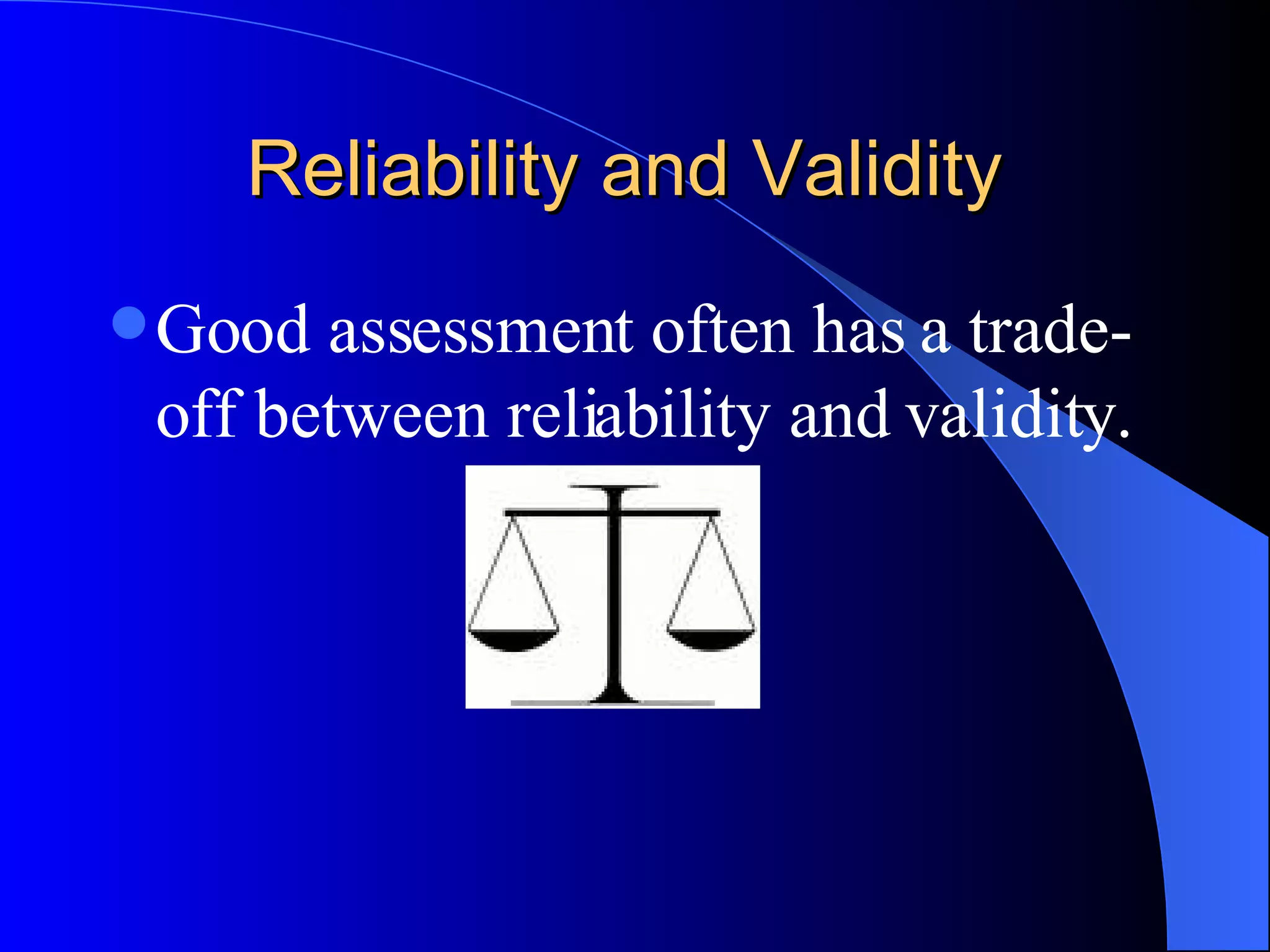
Reliability and Validity  Good assessment often has a trade-off between reliability and validity.
Types of Assessment: Standardized Traditional Authentic   or   Alternative
Standardized Assessment A test that is developed using standard procedures and is then administered and scored in a consistent manner for all test takers.
Standardized Assessment Identifies the instructional needs of individual students Judges students’ proficiency in essential basic skills and measures their educational growth over time Evaluates the effectiveness of educational programs Monitors schools for educational accountability-  No Child Left Behind Act
Standardized Assessment  in Texas   (administered by TEA) TAKS (Texas Assessment of Knowledge and Skills)  Grades 3-11 SDAA (State Developed Alternative Assessment) Grades 3-8 RPTE (Reading Proficiency Tests in English) Grades 3-12
TAKS Controversy: Recent ATPE Study  TAKS does not provide accurate assessment of a student’s academic level TAKS has resulted in narrowing of the curriculum Teachers forced to teach to the test TAKS creates undue anxiety and stress on students, especially at elementary level
Standardized Testing:  Is There a Better Way?
Traditional Assessment Any type of assessment in which students choose a response from a given list.
Traditional Assessment True/False Multiple Choice Matching Fill-in-the-blank (word banks)
True and False Mark each statement as either true or false: T or F  The presenter does not really need to explain this concept to me. T or F  This slide is clearly a transparent attempt to burn minutes in a 6 hour presentation. T or F  The presenter looks a little bit like Brad Pitt ’s   Plumber
Multiple Choice:  Choose the answer that does   NOT  belong. Why on earth is the presenter showing us this ? A) Maybe one of us is an alien and has never heard of multiple choice questions B) People  really care  about multiple choice C) He thinks the guy in the fourth seat on the third row (in the red sweater) is an idiot D) Presenter needed a break as he was writing all the other heavy duty stuff
Matching Match the words on the left with their definitions on the right: Presenter-  A) Sucker Audience-  B) Idiot Person Who  C) Victims Hired Presenter-
Fill-in-the-blanks Fill in the blanks with words from this word bank:  teacher   students   similar   wasted 1) Presenter  ______  five minutes explaining stuff I already knew. 2) When I become a  _______  I hope I can learn to do  _______  things with my own  ________ .
Beyond Your TE Identify the TEKS Use BACKWARD DESIGN What do you want your students to do? How will you know they have met the objectives? Design the assessment Plan the activities
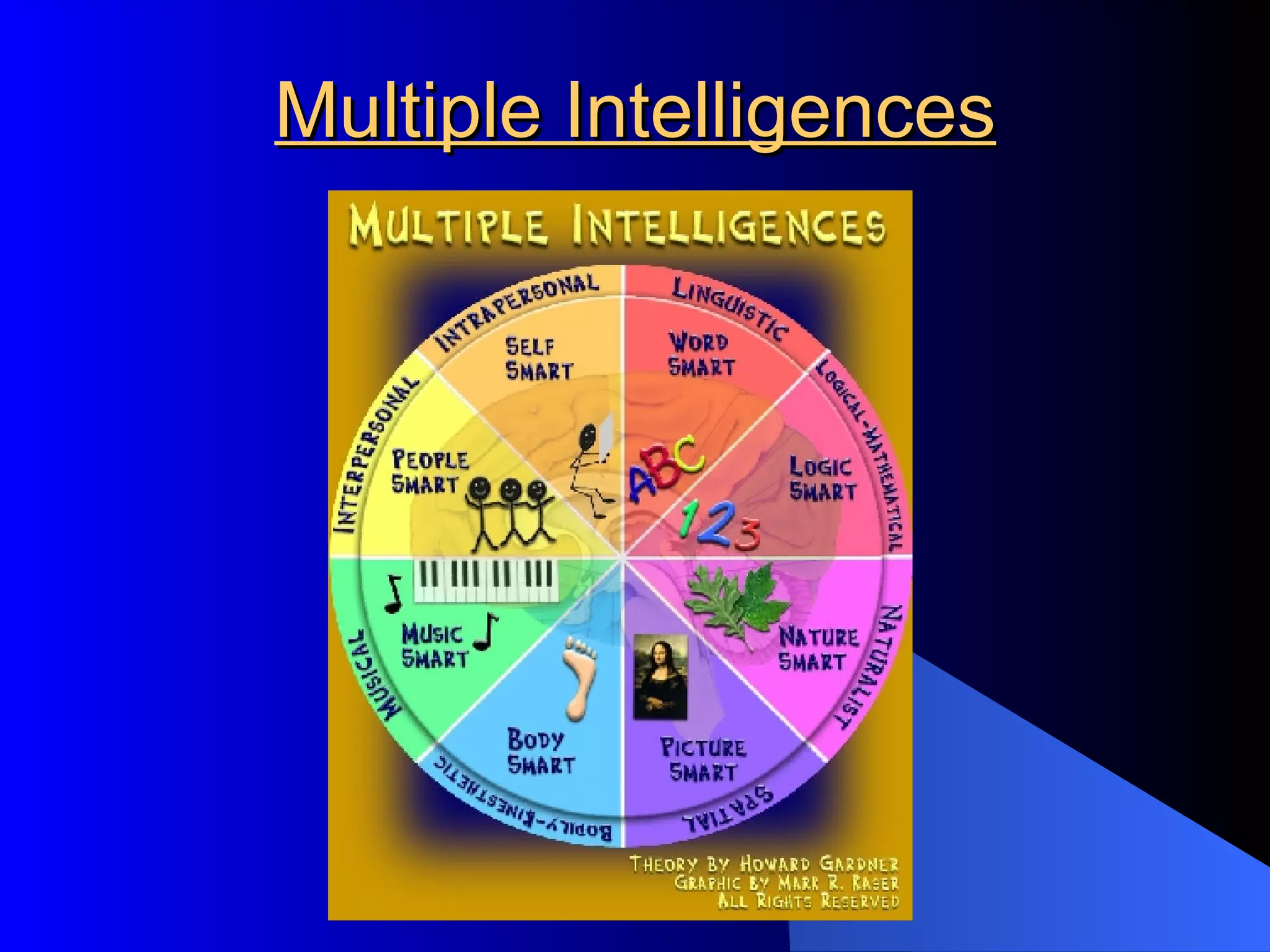
Multiple Intelligences
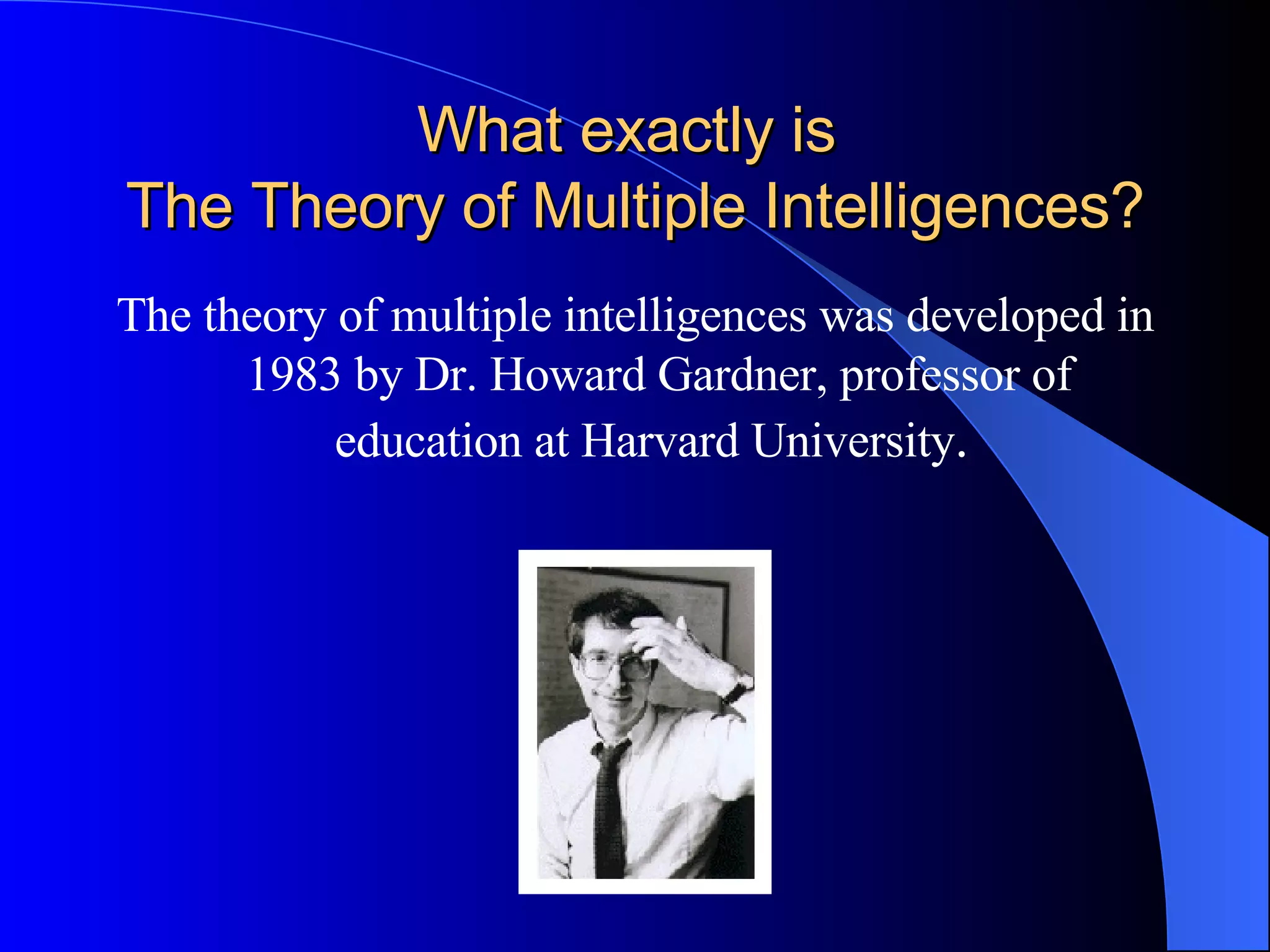
The theory of multiple intelligences was developed in 1983 by Dr. Howard Gardner, professor of education at Harvard University .  What exactly is  The Theory of Multiple Intelligences?
Theory of Multiple Intelligences Howard Gardner, Arch Nemesis of Grant Wiggins
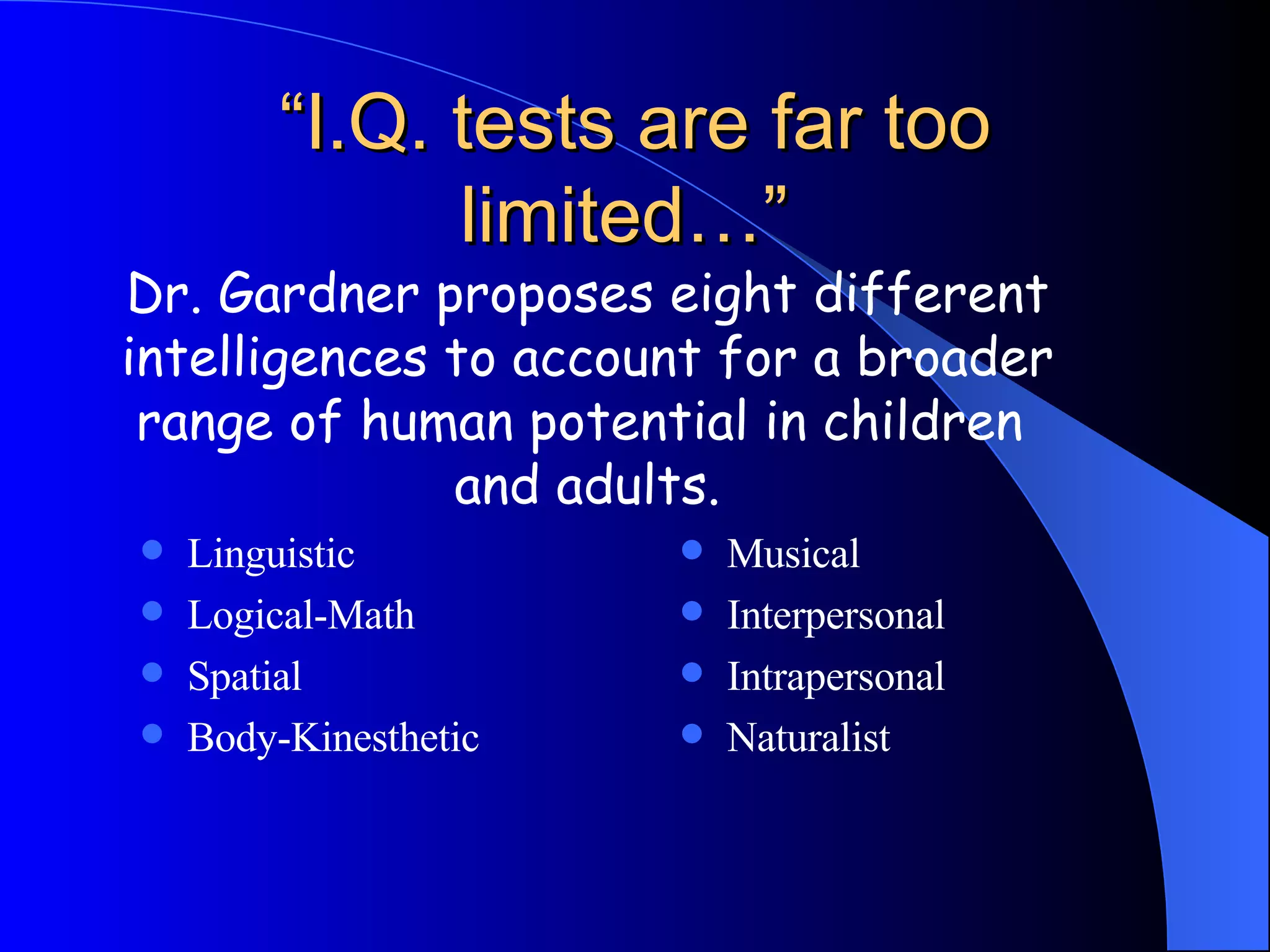
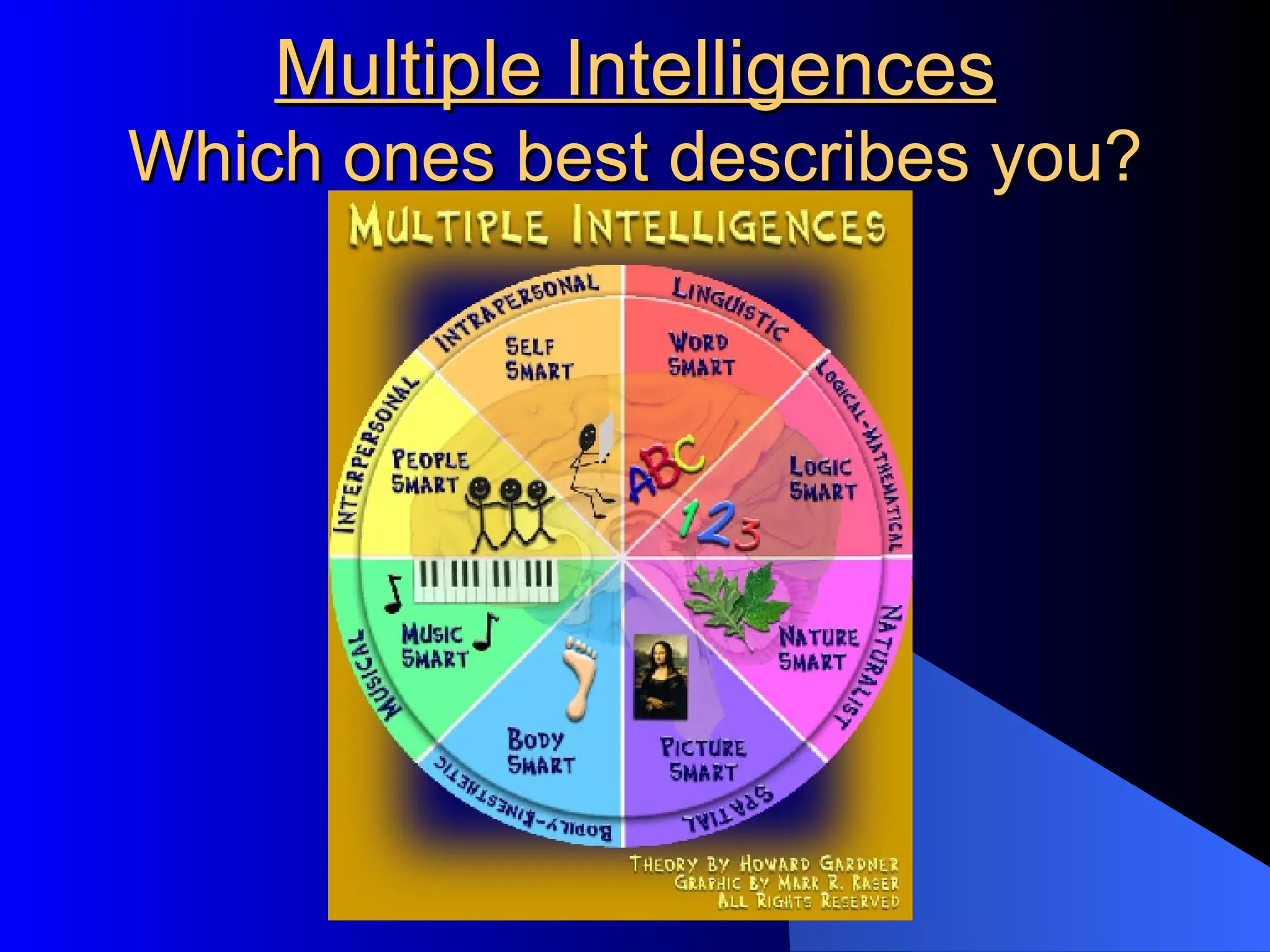
“I.Q. tests are far too limited…”  Linguistic Logical-Math Spatial Body-Kinesthetic Musical Interpersonal Intrapersonal Naturalist Dr. Gardner proposes eight different intelligences to account for a broader  range of human potential in children  and adults.
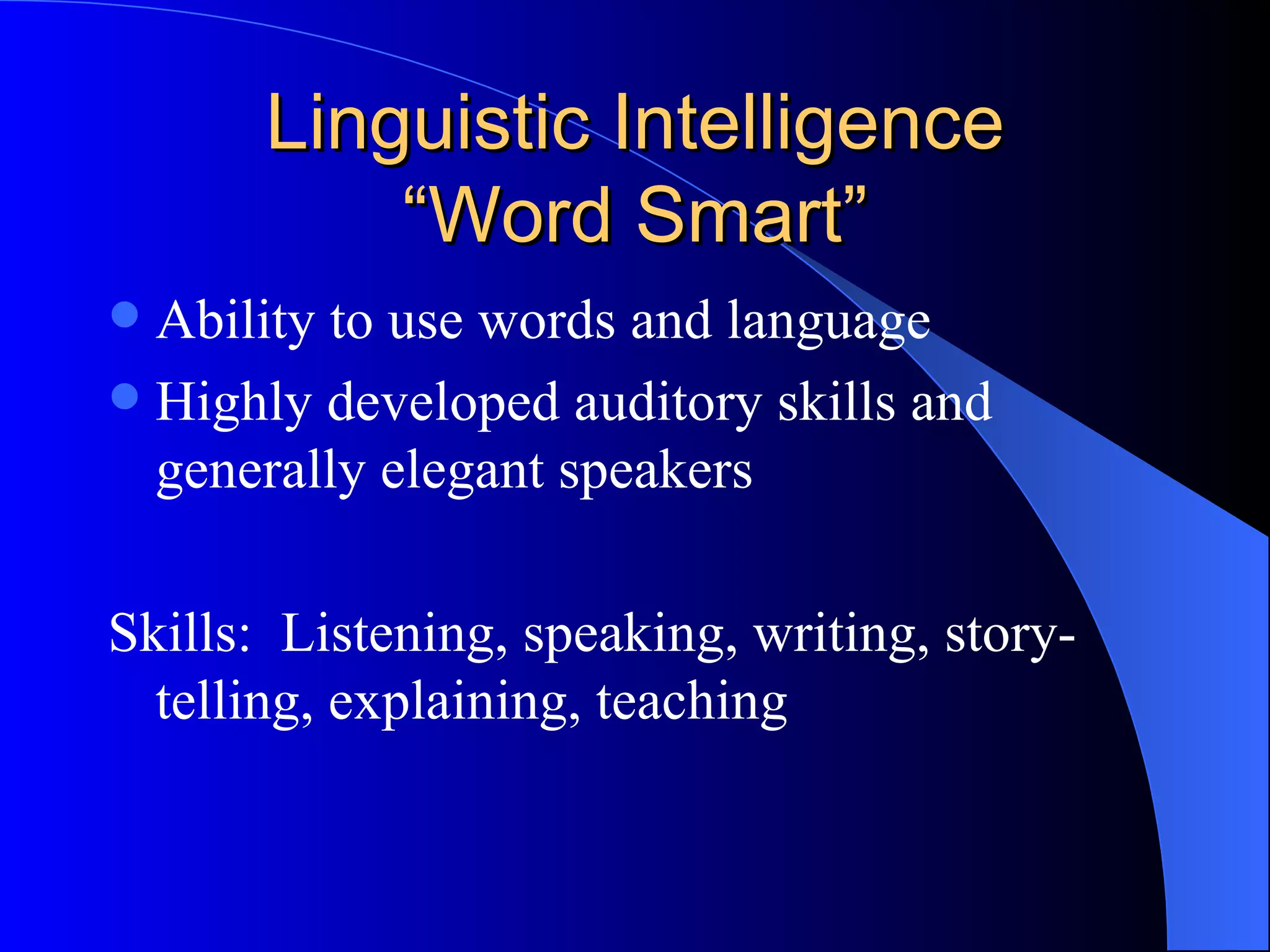
Linguistic Intelligence “Word Smart” Ability to use words and language Highly developed auditory skills and generally elegant speakers Skills:  Listening, speaking, writing, story-telling, explaining, teaching
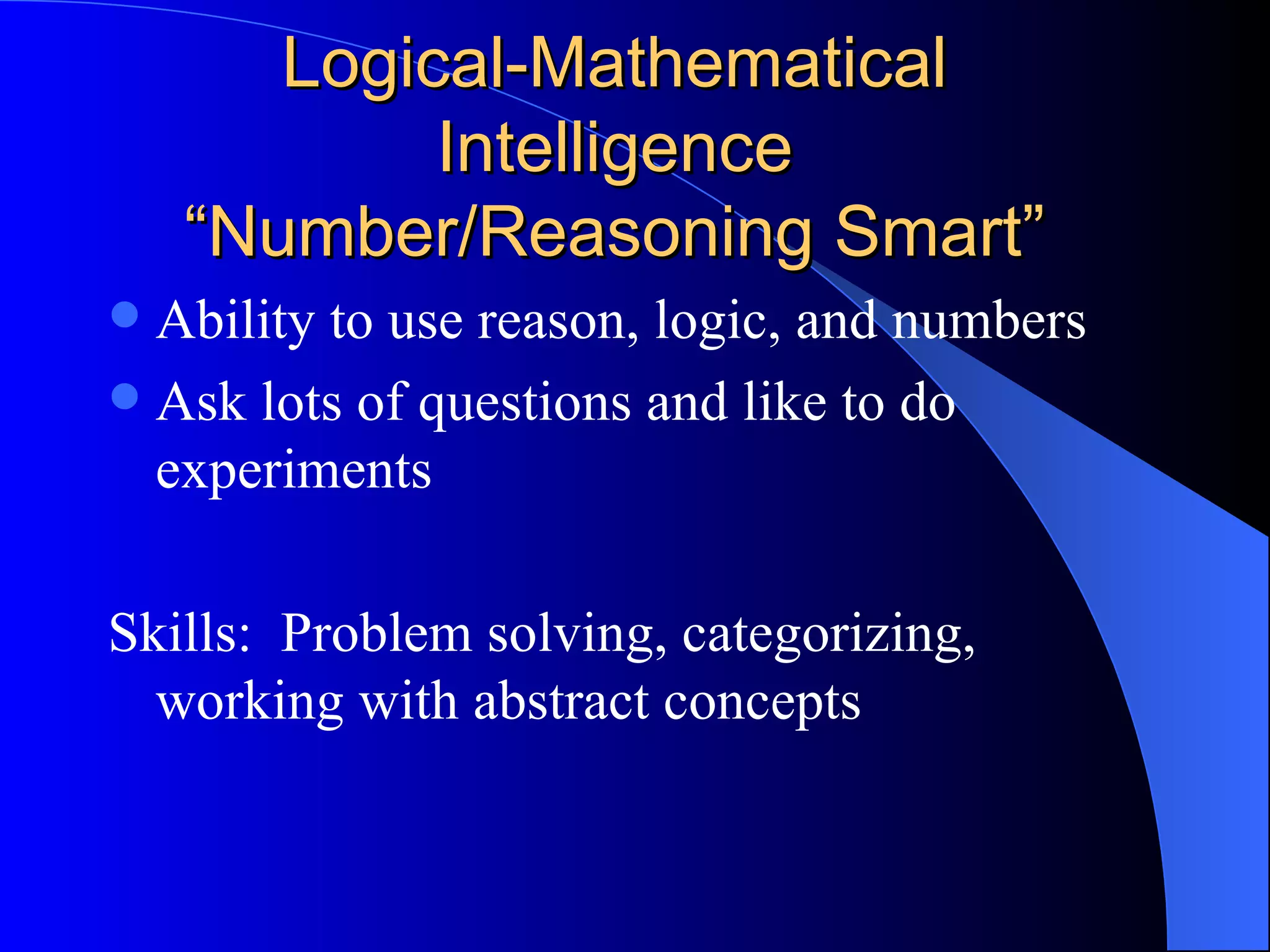
Logical-Mathematical Intelligence “Number/Reasoning Smart” Ability to use reason, logic, and numbers Ask lots of questions and like to do experiments Skills:  Problem solving, categorizing, working with abstract concepts
Spatial Intelligence “Picture Smart” Ability to perceive the visual Enjoy looking at maps, charts, pictures, video, and movies Skills:  Puzzles, reading, sketching, fixing, constructing, design
Body-Kinesthetic Intelligence “Body Smart” Ability to control body movements and handle objects skillfully Good sense of balance and coordination Skills:  Dancing, sports, crafts, acting, working with hands
Musical Intelligence “Music Smart” Ability to produce and appreciate music Respond to music by appreciating or criticizing what they hear Skills:  Singing, playing musical instruments, composing, melodies
Interpersonal Intelligence “People Smart” Ability to relate and understand others Try to see things from a different perspective Skills:  Listening, empathy, counseling, co-operating in groups, motivation
Intrapersonal Intelligence “Self Smart” Ability to self-reflect and be aware of one’s inner state of being Understanding of inner feelings, dreams, and their strengths and weaknesses Skills:  Reflection, analyzing themselves, desires and dreams, reason
Naturalist Intelligence “Nature Smart” Ability to relate to one’s environment Utilizes their surroundings Skills:  Hunting, gathering, building, farming, resourceful
Additional Intelligence Possibilities… Spiritual Existential Moral
Two Main Types of Assessment Summative - generally carried out at the end of a course or project.  Typically used to assign a course grade. Formative - generally carried out throughout a course or project.  Used to aide learning.
Types of Assessment: Standardized Traditional Authentic   or   Alternative
Standardized Assessment A test that is developed using standard procedures and is then administered and scored in a consistent manner for all test takers.
Traditional Assessment Any type of assessment in which students choose a response from a given list.
Multiple Intelligences Which ones best describes you?
The Need for a New Approach to Assessment in Schools Howard Gardner, Arch Rival of Grant Wiggins
Authentic /Alternative Assessment Alternative assessments  includes any assessment in which students  create  responses to a questions. Authentic assessments  elicit demonstrations of knowledge and skills in ways that resemble “real life”.
What is authentic assessment and why is it important? Grant Wiggins, International Assessment Mystic
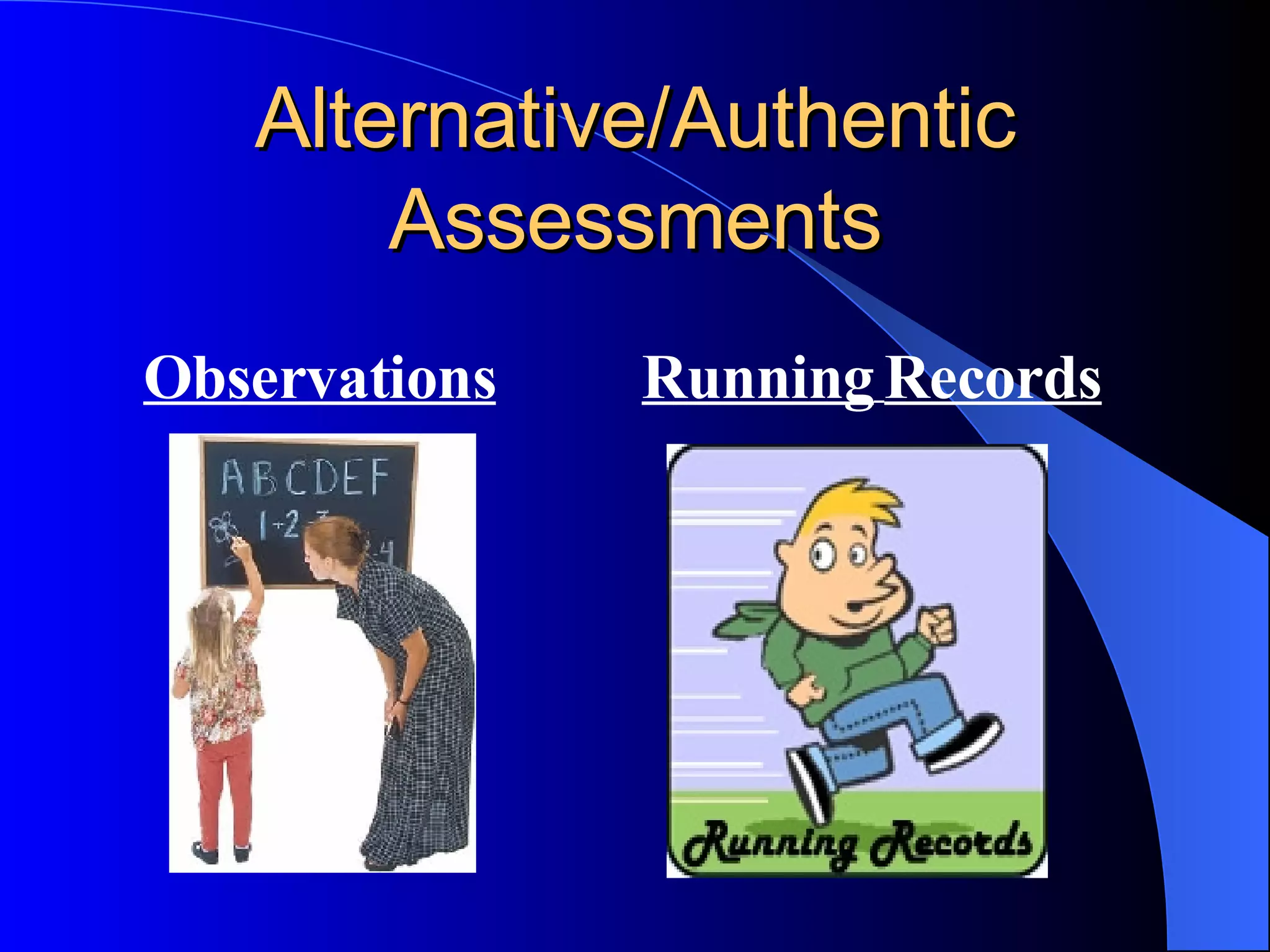
Alternative/Authentic Assessments Observations Running   Records
Alternative/Authentic Assessments Interviews - involve observing and questioning students to get a better idea of their attitudes, thinking processes, level of understanding, ability to make connections, or ability to communicate or apply concepts.
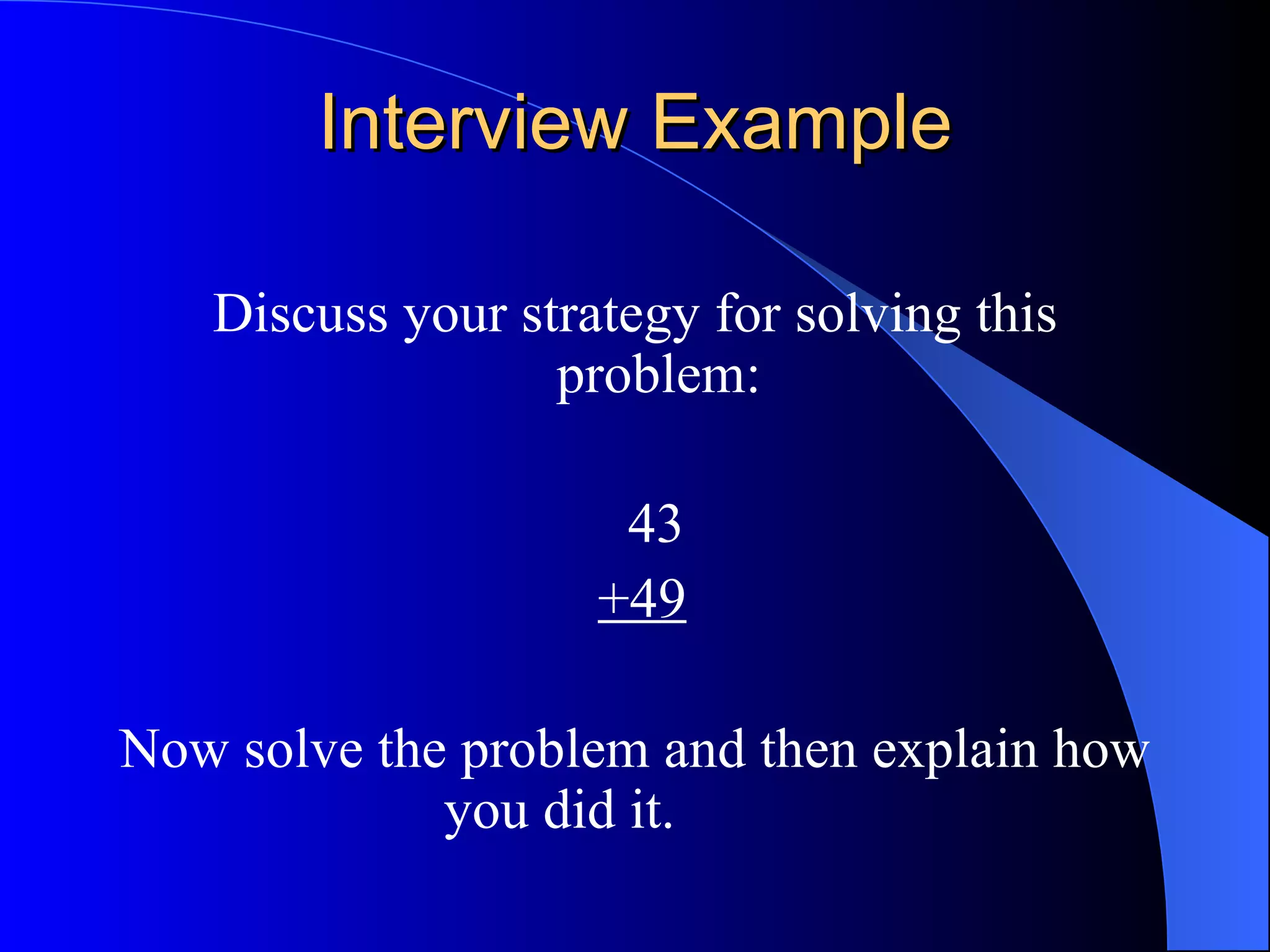
Interview Example Discuss your strategy for solving this problem: 43 +49 Now solve the problem and then explain how you did it.
Alternative/Authentic Assessments Essays  Journals
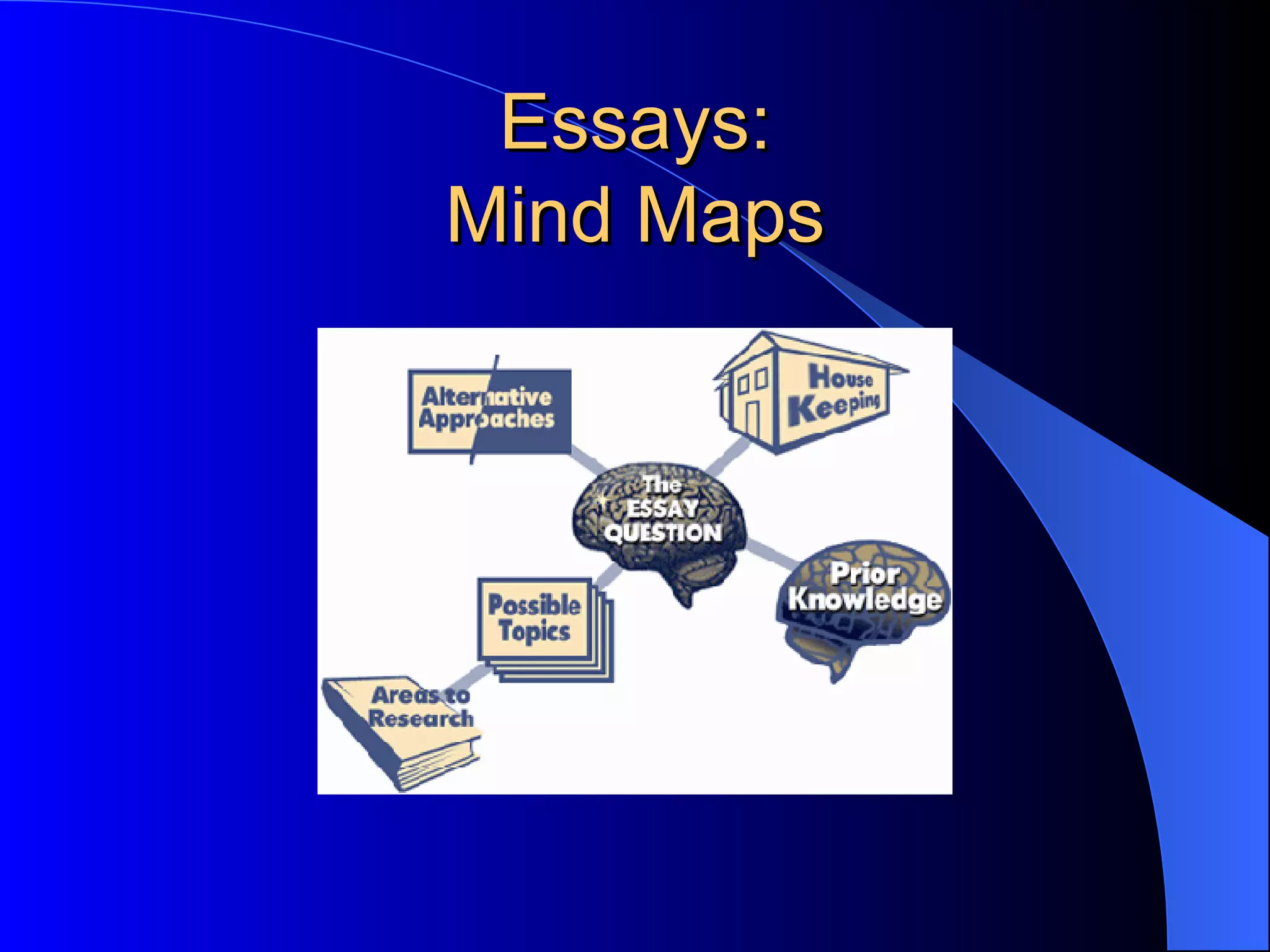
Essays: Mind Maps
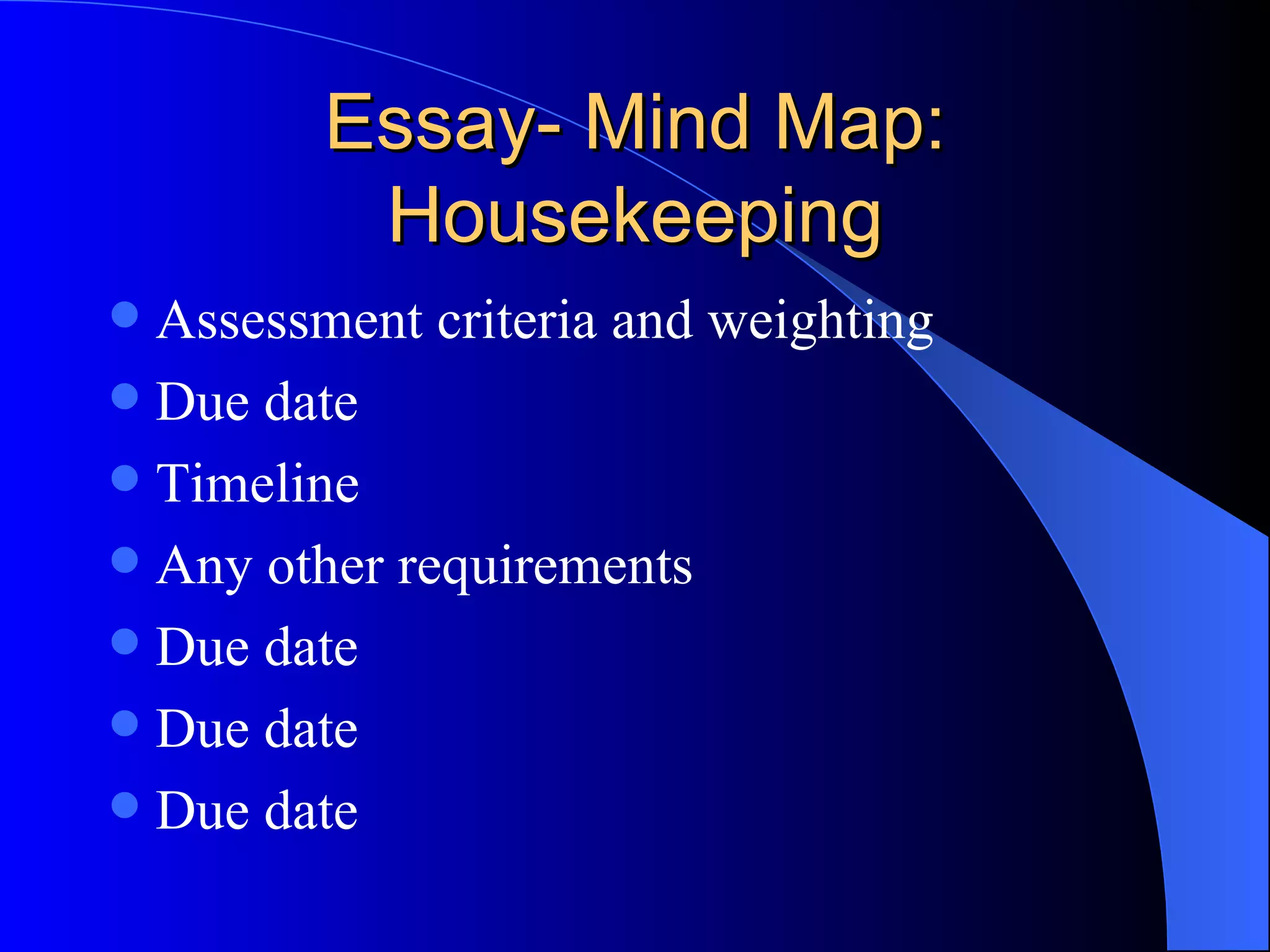
Essay- Mind Map: Housekeeping Assessment criteria and weighting Due date Timeline Any other requirements Due date Due date Due date
Essay-Mind Map: Prior Knowledge Write down on your mind map all that you already know about the essay question Knowledge may come from personal experience, lectures, readings, or other sources
Essay-Mind Map: Possible Topics Most essays will involve the possibility of tacking a number of topics within the question. Write them all down Look for connections, relevance, and priorities
Essay-Mind Map: Areas to Research Suggested by the list of possible topics Choose carefully which areas will be the most productive and relevant to research
Essay-Mind Map: Alternative Approaches Mind mapping  is a tool which encourages creative thinking and innovative solutions to problems. Always look for alternative ways of approaching essay questions and be prepared to go outside normal boundaries.
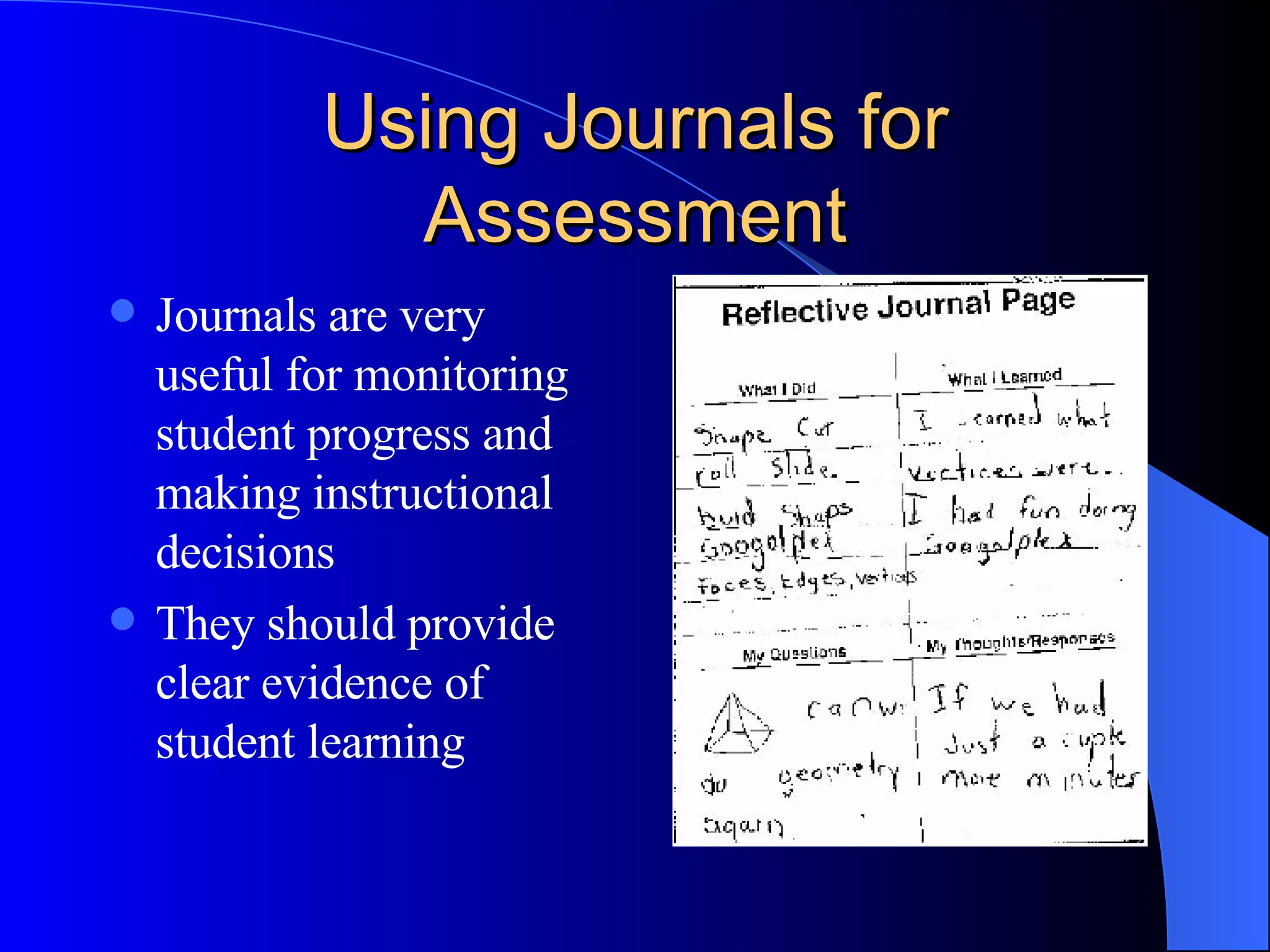
Using Journals for Assessment Journals are very useful for monitoring student progress and making instructional decisions They should provide clear evidence of student learning
Journals Reflect on personal values, goals, and ideas Summarize ideas, experiences, and opinions before and after instruction Sort out experiences, solve problems, and consider varying perspectives Examine relationships with others in the world Can show academic and personal growth
Journals: Let you know your students’… Hopes Fears or anxieties Excitements/joys Personal or academic problems Plans to do away with evil gym coach
Journal Problems Potential to hurt feelings with criticism Solution : Don’t criticize! Journal writing takes time away from other course material Solution : Limit journal writing to 5-10 minute periods
Alternative/Authentic Assessments Creative Performances and Exhibitions- allow many opportunities for students to use kinesthetic, artistic, musical, spatial, media, and other modalities to demonstrate their understanding of concepts and application of skills.
Types of Creative Performances and Exhibitions Drama Dance Songs Oral Presentations Art
Alternative/Authentic Assessments: Portfolios A  portfolio  is a purposeful collection of student work that is continuous and ongoing The purpose should be determined prior to collection They demonstrate growth, proficiency, or experience
Characteristics of Portfolios Should reflect the curriculum Contain samples of work that stretch over an entire marking period Contain work that represents a variety of different assessment tools Contain evaluations of the student’s work by the student, peers, teachers, and sometimes parents
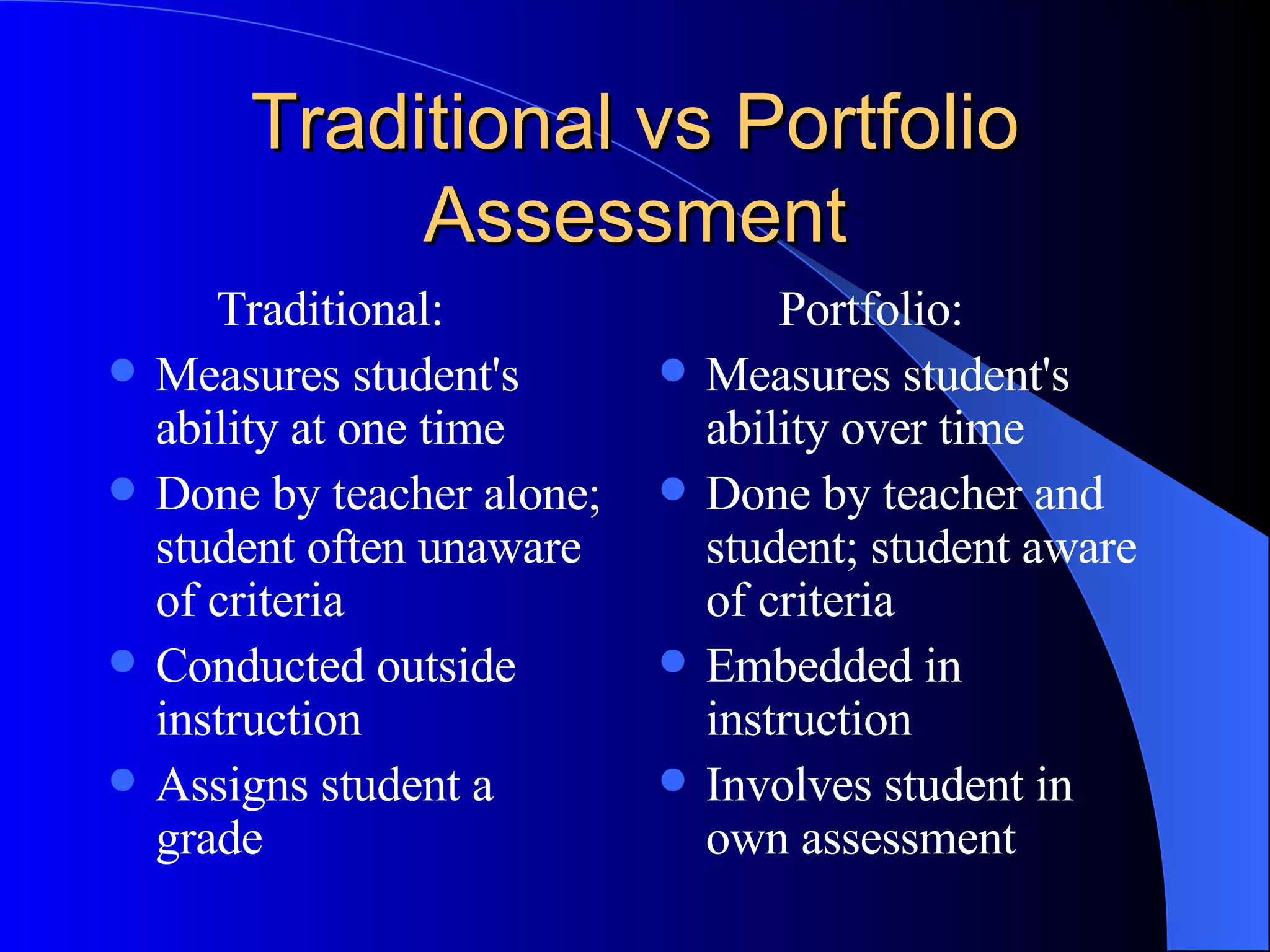
Traditional vs Portfolio Assessment Traditional: Measures student's ability at one time Done by teacher alone; student often unaware of criteria Conducted outside instruction Assigns student a grade Portfolio: Measures student's ability over time Done by teacher and student; student aware of criteria Embedded in instruction Involves student in own assessment
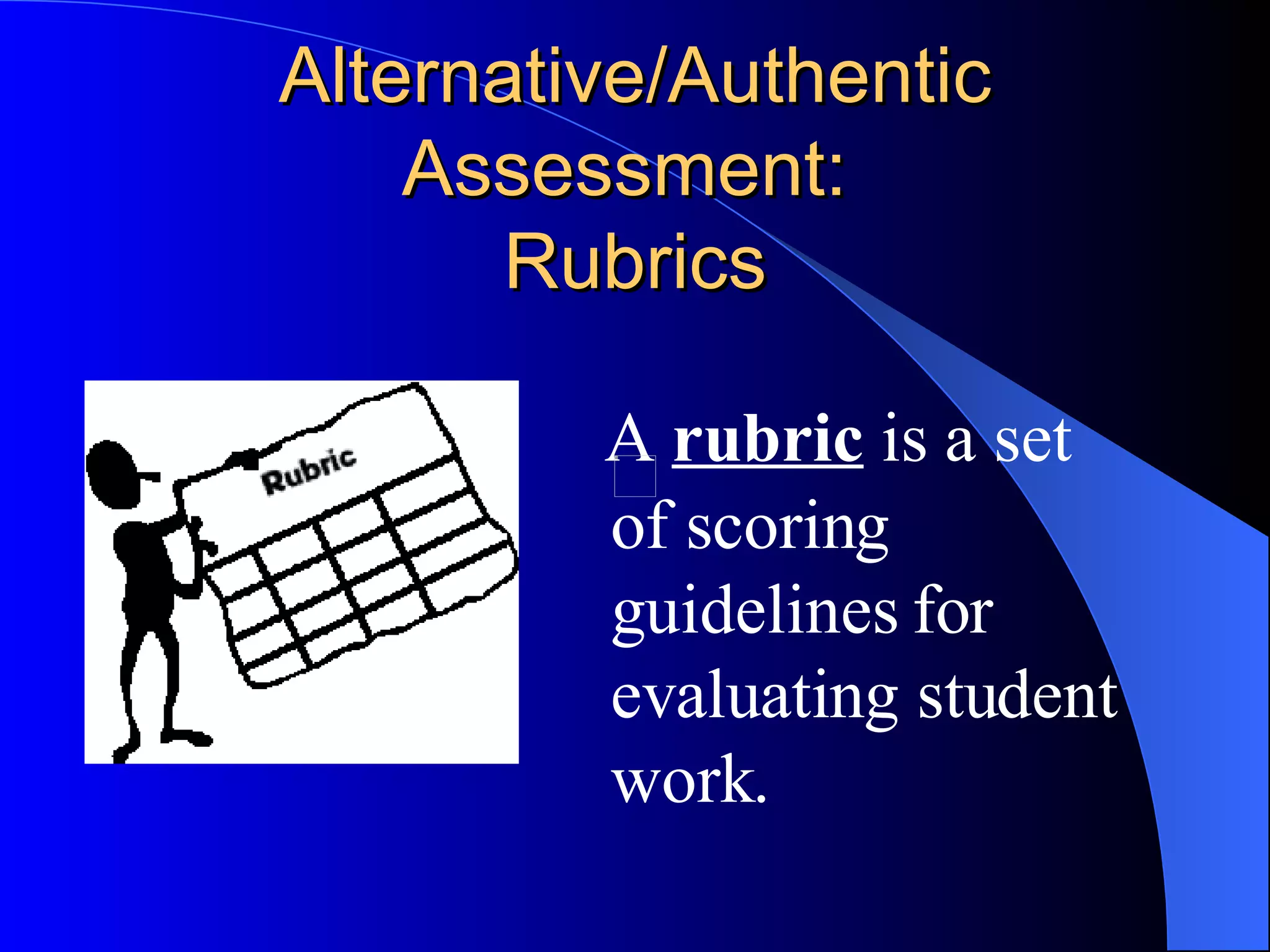
Alternative/Authentic Assessment:  Rubrics A  rubric  is a set of scoring guidelines for evaluating student work.
Why use rubrics? Rubrics differ from traditional methods of assessment since they examine students in the actual process of learning, clearly showing them how their work is being evaluated.
Rubrics: Assessing Project-Based Work
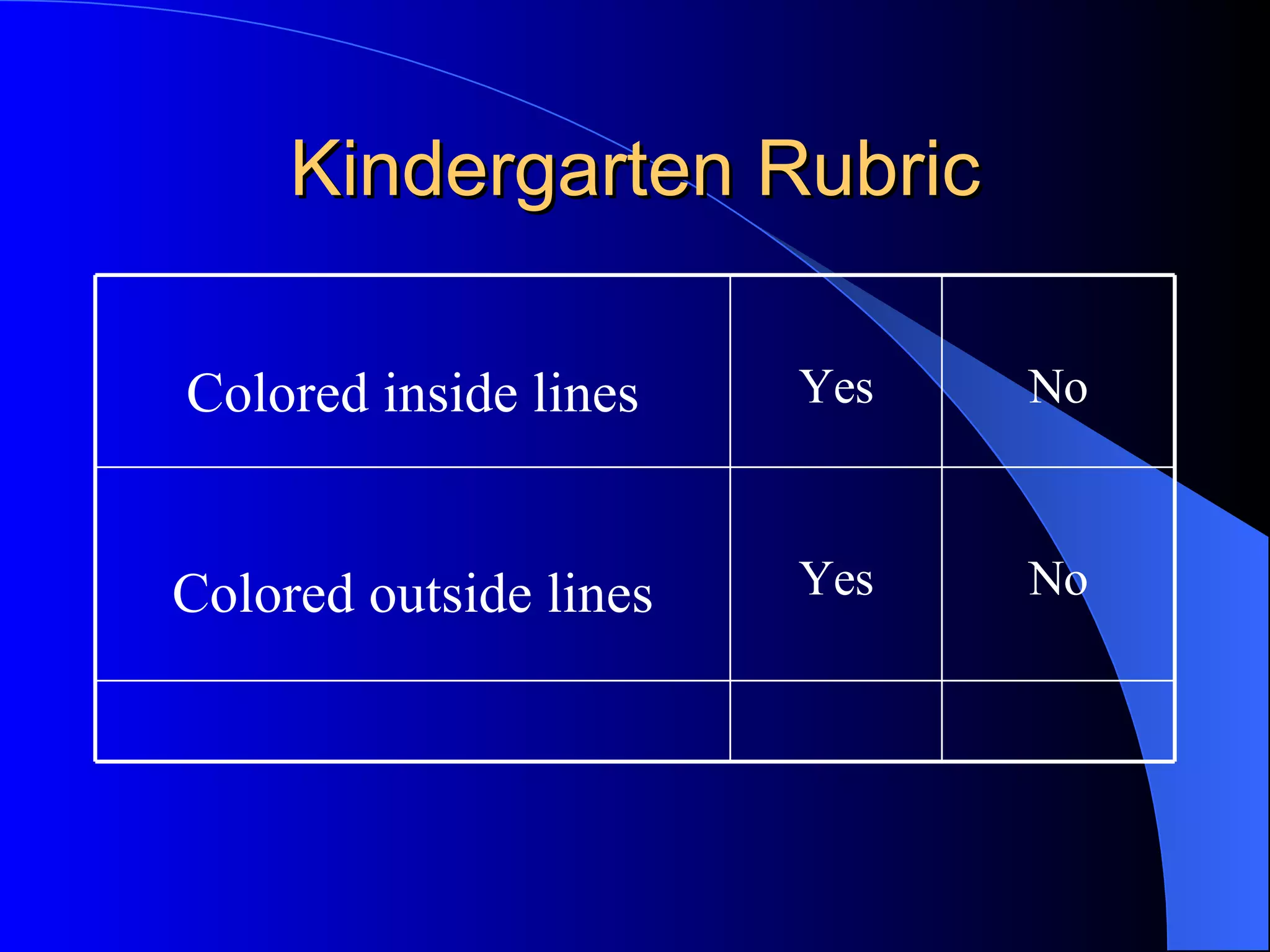
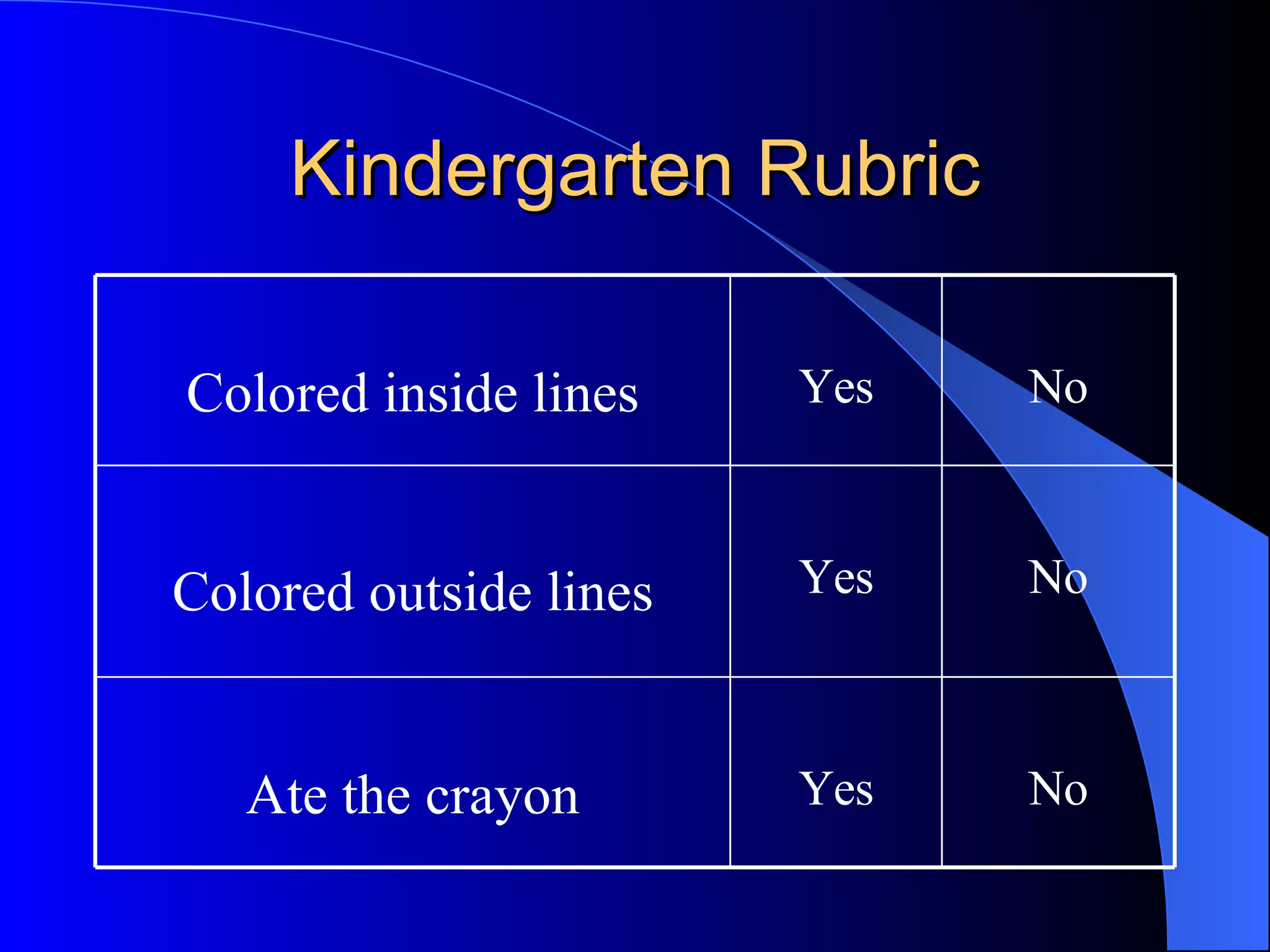
Kindergarten Rubric No Yes Colored outside lines No Yes Colored inside lines
Kindergarten Rubric No Yes Ate the crayon No Yes Colored outside lines No Yes Colored inside lines
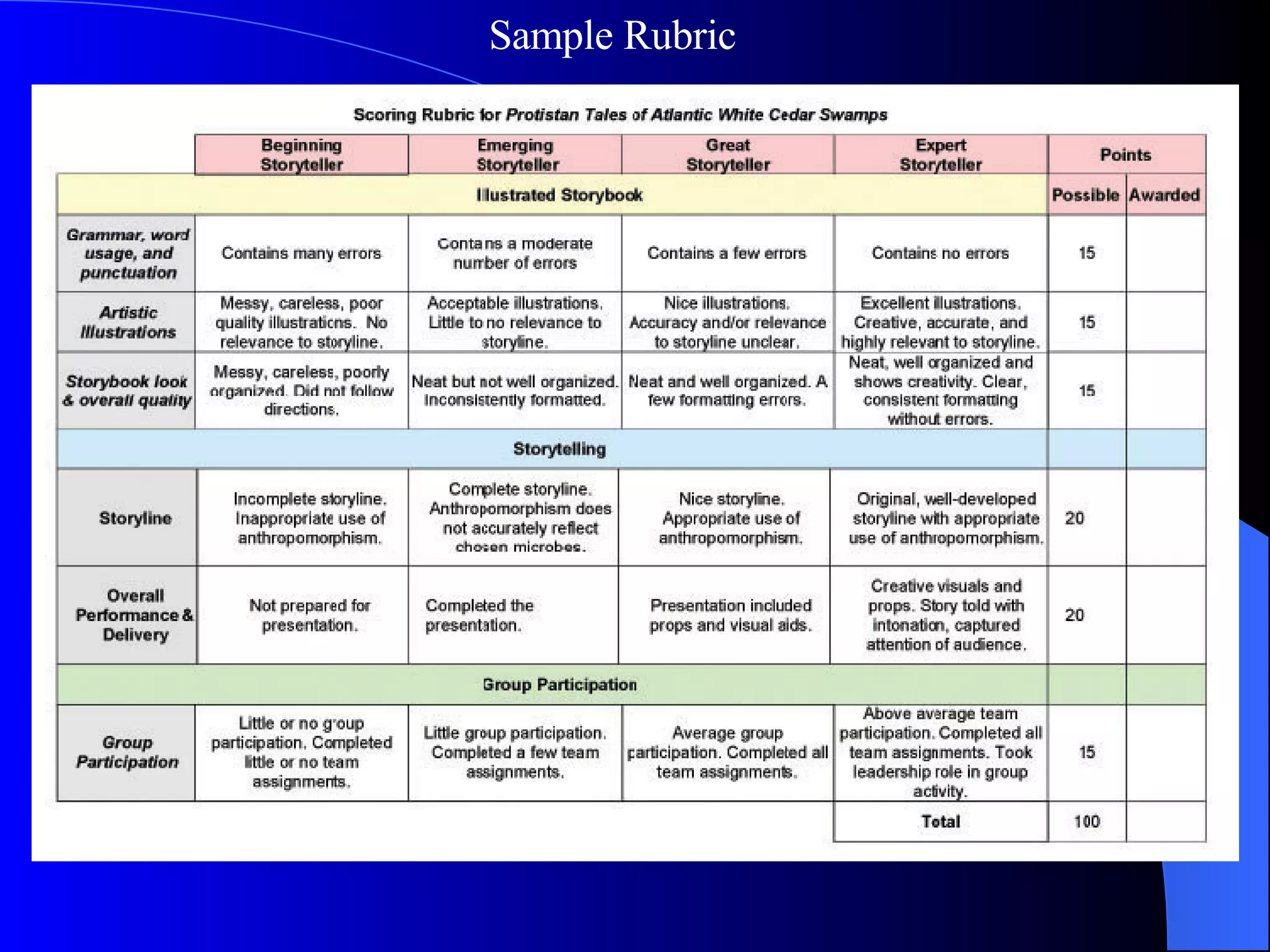
Story Telling Rubric Sample Rubric
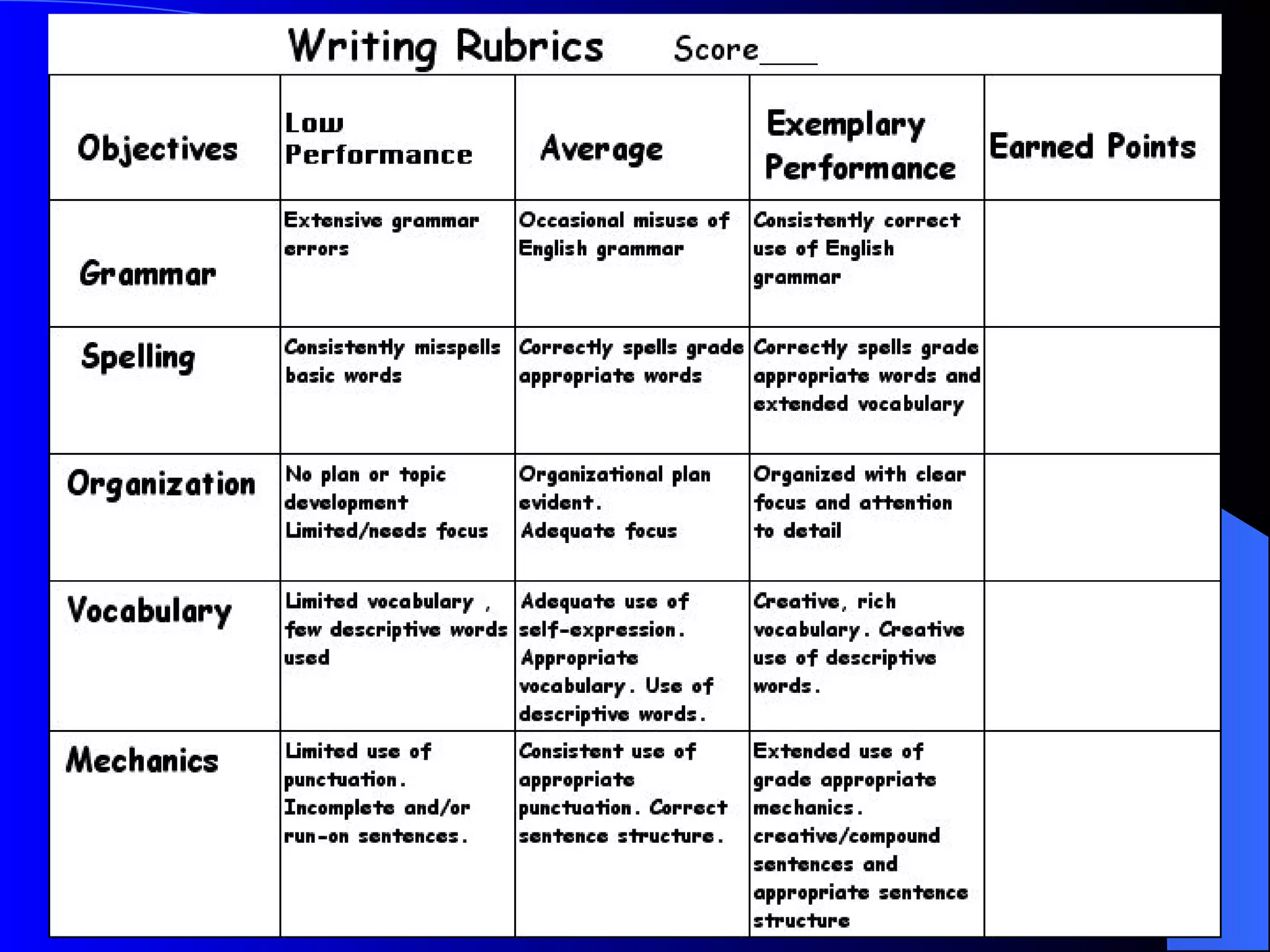
Writing Rubric
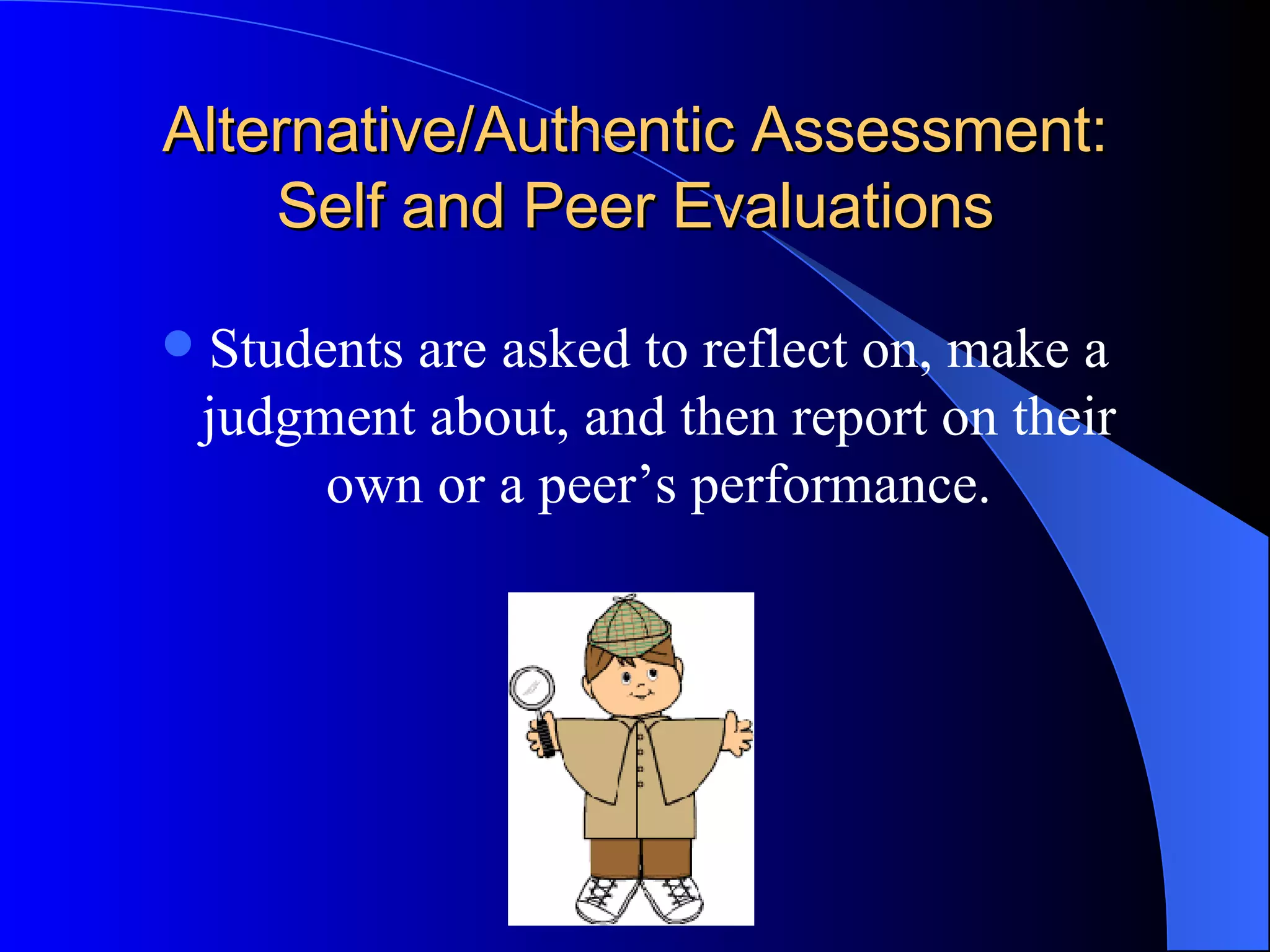
Alternative/Authentic Assessment: Self and Peer Evaluations Students are asked to reflect on, make a judgment about, and then report on their own or a peer’s performance.
Alternative/Authentic Assessment: Peer Evaluations Model constructive feedback for students Make one positive statement and one area of improvement
PDAS and Assessment Domain 1- Assessment is aligned with the stated, implied, or written learning objectives. Quality- Assessment criteria are clear and have been communicated to the student. Quantity- Focus on the number of students that are assessed and the number of students that are successful.
PDAS and Assessment Domain 3-1 Academic progress of students is monitored and assessed. Teacher monitors student work during guided practice Teacher provides for formative assessment prior to independent practice Teacher assesses student progress toward learning goals
Domain 3-1 Academic progress of students is monitored and assessed. Quality- Teacher’s system for obtaining, interpreting, and acting on information on student progress is focused on student progress in learning.  Quantity-  Focus on the number of students that are monitored and assessed.
Domain 3-1 Academic progress of students is monitored and assessed Quality:  EXCEEDS EXPECTATIONS Teacher’s system for obtaining, interpreting and acting on information on student progress is  consistently  focused on short-term and long-term student progress in learning.
Domain 3-1 Academic progress of students is monitored and assessed Quality:  PROFICIENT Teacher’s system for obtaining, interpreting, and acting on information on student progress is focused on student progress in learning.
Domain 3-1 Academic progress of students is monitored and assessed Quality:  BELOW EXPECTATIONS Teacher’s system for obtaining, interpreting and acting on information on student progress is frequently mechanical and is only  occasionally  focused on student progress in learning.
Domain 3-1 Academic progress of students is monitored and assessed Quality:  UNSATISFACTORY Teacher’s system of obtaining, interpreting, and acting on information on student progress is almost always/always mechanical and is  rare/never  focused on student progress in learning.
Domain 3-1 Academic progress of students is monitored and assessed Quality:  EXCEEDS EXPECTATIONS Teacher  consistently  uses a variety of effective, creative, unique, and/or innovative strategies for monitoring, assessing, and/or providing feedback on student progress.
Domain 3-1 Academic progress of students is monitored and assessed Quality:  PROFICIENT Teacher  uses  effective strategies for monitoring, and assessing, and/or providing feedback on student progress.
Domain 3-1 Academic progress of students is monitored and assessed Quality:  BELOW EXPECTATIONS Teacher  occasionally  uses effective strategies for monitoring, and assessing, and/or providing feedback on student progress.
Domain 3-1 Academic progress of students is monitored and assessed Quality:  UNSATISFACTORY Teacher  rarely/never  uses effective strategies for monitoring, and assessing, and/or providing feedback on student progress.
Domain 3-1 Academic progress of students is monitored and assessed Quality:  EXCEEDS EXPECTATIONS The teacher  consistently  acts on assessment data before moving from one stage of instruction to the next and to plan new instruction.
Domain 3-1 Academic progress of students is monitored and assessed Quality:  EXCEEDS EXPECTATIONS The teacher  consistently  provides positive, specific, and timely feedback, which result in student progress toward learning goals (e.g., students repeating their successes and correcting their mistakes).
Domain 3-1 Academic progress of students is monitored and assessed Quality:  EXCEEDS EXPECTATIONS The teacher  consistently  uses monitoring and assessment strategies that reflect and understanding of the unique needs and characteristics of students.
Domain 3-1 Academic progress of students is monitored and assessed Quality:  EXCEEDS EXPECTATIONS The teacher  consistently  conducts formal/informal formative assessments and  consistently  acts on that information to adjust learning to promote student learning.
Domain 3-1 Academic progress of students is monitored and assessed Quantity:  Almost all the time  (90-100%) Academic progress of students is monitored and assessed using both formative and summative assessment.
Domain 3-1 Academic progress of students is monitored and assessed Quantity:  Almost all the time  (90-100%) There is consistent alignment among objectives, instruction, and assessment.
Sorry Mark, it’s past my bedtime. GW   Grant Wiggins, Exalted Dictator of Educational Assessment
“ Give ‘em the link, Mark.” http://www.esc13.net/statewide/pdas/PDASTeacherManual.pdf Hint:  Just Google  Texas PDAS Scoring Guide
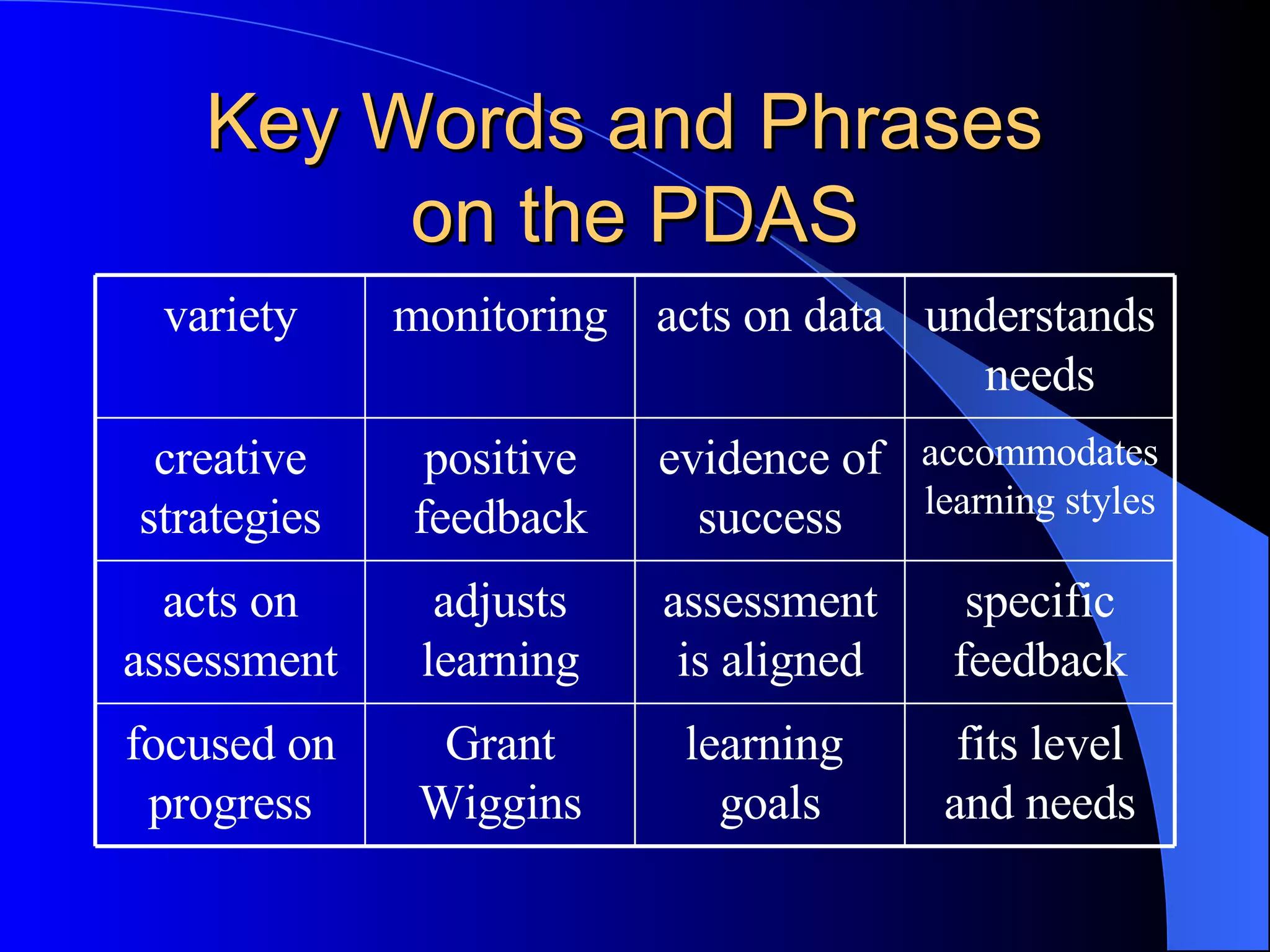
Key Words and Phrases  on the PDAS fits level and needs learning  goals Grant Wiggins focused on progress specific feedback assessment is aligned adjusts learning acts on assessment accommodates learning styles evidence of success positive feedback creative strategies understands needs acts on data monitoring variety
Ways to Know Your PDAS is Going Badly Top 10 Mark Benthall, 2007
#10- Principal’s snoring makes it hard for the kids to do their independent practice. #9-  After explaining the lesson on the board, you turn around to find 4 kids at back table playing high stakes poker. #8-  Principal stops appraisal to join poker game. #7-  Principal laughs hysterically every time you say the word “rubric.”
#6-  You make a spelling mistake on the board… the word was  CAT.   #5-  Your idea of two good math manipulatives are razor blades and broken glass. #4-  During appraisal principal rifles through your desk and discovers half empty bottle of Jim Beam. #3-  Principal realizes it’s the same bottle of Jim Beam that was recently stolen from  his  desk.
#2-  Midway through appraisal principal realizes that picture of new boyfriend on your desk is her ex-husband. And the NUMBER ONE way to know your PDAS is going badly… #1-  Principal has massive heart attack in the middle of the appraisal and with one final heroic effort completes the evaluation and recommends your dismissal.
Personal Assessment: The objective is to get a job so you can make a difference in a child’s life. Follow these directions…
Tips on Getting Hired!!! Get all the training you can.  Attend workshops and put that on your resume. Get certified in more than one area…Special Ed, ESL, etc. Principals  love  any workshop or training that has to do with TAKS. Mention all the RECENT training you’ve had in the job interview.
Tips on Getting Hired!!! Focus on what you bring to the table. Try and turn any perceived fault into a positive. No experience = clean slate ready to learn YOUR way.  No bad habits.  Eager to learn. Older teacher = you get all the life experience and wisdom of a veteran teacher for the cost of a brand new one!  Drinking problem = you’ll fit in with the other teachers.
Tips on Getting Hired!!! Should I substitute? Can be a sure fire way to get hired. Can be a HUGE waste of your time if you choose the wrong school! Make sure there will be positions available. Make sure the district is alternative certified friendly. WORK YOUR BUTT OFF.  Stay and grade every last paper, clean the room before you go, etc. You will get teachers BEGGING to have you sub for them and when the time comes they will recommend you.
Tips on Getting Hired!!! So why NOT sub? Subbing eats your time. The GOAL is to help kids. To help kids you need a job! If you can get a job without subbing, do it!!!  You’ll be helping kids that much faster. My advice is sub only if you can’t get a job any other way, but if you do sub… be the VERY BEST SUB!!!
Tips on Getting Hired!!! Take your resume to the school you are interested and (if possible) meet the principal and give it to her personally.  Stress to the secretary, receptionist, etc. you are NOT wanting an interview, you simply want 30 SECONDS to shake hands and introduce yourself Wait if you have to!!!
Tips on Getting Hired!!! Arrive EARLY for the interview Dress professionally (you can wear jeans AFTER you get the job) Smile and laugh (not a nervous laugh) so they committee sees you as yourself Don’t be a show-off or a smarty-pants (nobody liked it back in third grade and nobody likes it now)
Tips on Getting Hired!!! Most teachers on the hiring committee are more worried about whether you will fit in on their team than whether you can teach. Be careful about the question, “What do you prefer to teach, math and science, or language arts and social studies?”
Tips on Getting Hired!!! It’s all about the kids.  Make  all  your comments kid-oriented. Don’t broadcast your shortcomings. Be honest, but don’t say more than you have to about some things.  Some statements can instantly kill your chances of getting job!!!
Top 10 Things to NOT Say In an Interview Some of the following statements were actually said in job interviews… Can you guess which ones?
Top 10 Things to NOT Say In an Interview  10) “I knew it was risky to wear a sleeveless t-shirt to this interview, but I wanted to show off my prison tat!” 9)  “Yes, I am a published author.  Have you heard of my  Shut Up and Color  series?” 8)  “If you call me about the job, I won’t be home this weekend.  I’m helping my fiancé move to Florida.  He just got a new job.”
Top 10 Things to NOT Say In an Interview 7) “I’m just curious, but does your district actually  do  background checks?” 6) “If you hire me, ( cough cough ) how soon ( cough cough ) before the insurance kicks in?” 5) “Is your faculty pretty nice?  I’m asking because at my last school nobody liked me.”
Top 10 Things to NOT Say In an Interview 4) “So what’s this job pay, anyway?” 3) “Do the teachers actually have to wait till 3:30 to go home, or can we go home as soon as the kids leave?” 2) “I’m not much of a disciplinarian.”
Top 10 Things to NOT Say In an Interview The number ONE thing to not say… “ My husband and I have been married for 10 years but we don’t have any kids because… I don’t like ‘em.”
Not the End, The BEGINNING “ May you all touch the lives of children in very special ways.  May you find the joy in teaching that I have found all these years.  May you find a tiny bit of wisdom in my words. May you start off better prepared than I ever was.  May you grow and bloom and make this world a better place just for having lived.  May you all find a job.” Kram Llahtneb , “ How’d I Do?”

Assessment 2 Power Point

  • 1.
    Tonight… BE JACKBAUER! Can you take the torture?
  • 2.
    Assessment Mark BenthallCopyright 2007 (Like anyone would actually want to claim this as their own work!)
  • 3.
    What is assessment?Assessment is the act of collecting information about students in order to better understand them.
  • 4.
    Why assess? Servesas a diagnostic tool for instruction Provides feedback Sets standards Evaluates progress Communicates results Motivates performance
  • 5.
    How are Testingand Assessment Different? Grant Wiggins, Nationally Recognized Assessment Guru
  • 6.
    Two Main Typesof Assessment Summative - generally carried out at the end of a course or project. Typically used to assign a course grade. Formative - generally carried out throughout a course or project. Used to aide learning.
  • 7.
    Through assessment weconstantly ask these questions: Are we teaching what we think we’re teaching? Are the students learning what they are supposed to be learning? Is there a better way to teach this subject? Has anyone actually listened to anything I’ve said for the past two weeks?
  • 8.
    Assessment affects educatorsdecisions about: Grades Placement Instructional needs Lesson design Curriculum Early retirement
  • 9.
    Assessment A goodassessment has both validity and reliability .
  • 10.
    Assessment A validinstrument measures what it is intended to measure.
  • 11.
    Reliability relates tothe consistency of an assessment. A reliable assessment is one which consistently achieves the same results with similar groups of students .
  • 12.
    Reliability and ValidityIn practice, an assessment is rarely totally valid or totally reliable.
  • 13.
    Reliability and Validity Good assessment often has a trade-off between reliability and validity.
  • 14.
    Types of Assessment:Standardized Traditional Authentic or Alternative
  • 15.
    Standardized Assessment Atest that is developed using standard procedures and is then administered and scored in a consistent manner for all test takers.
  • 16.
    Standardized Assessment Identifiesthe instructional needs of individual students Judges students’ proficiency in essential basic skills and measures their educational growth over time Evaluates the effectiveness of educational programs Monitors schools for educational accountability- No Child Left Behind Act
  • 17.
    Standardized Assessment in Texas (administered by TEA) TAKS (Texas Assessment of Knowledge and Skills) Grades 3-11 SDAA (State Developed Alternative Assessment) Grades 3-8 RPTE (Reading Proficiency Tests in English) Grades 3-12
  • 18.
    TAKS Controversy: RecentATPE Study TAKS does not provide accurate assessment of a student’s academic level TAKS has resulted in narrowing of the curriculum Teachers forced to teach to the test TAKS creates undue anxiety and stress on students, especially at elementary level
  • 19.
    Standardized Testing: Is There a Better Way?
  • 20.
    Traditional Assessment Anytype of assessment in which students choose a response from a given list.
  • 21.
    Traditional Assessment True/FalseMultiple Choice Matching Fill-in-the-blank (word banks)
  • 22.
    True and FalseMark each statement as either true or false: T or F The presenter does not really need to explain this concept to me. T or F This slide is clearly a transparent attempt to burn minutes in a 6 hour presentation. T or F The presenter looks a little bit like Brad Pitt ’s Plumber
  • 23.
    Multiple Choice: Choose the answer that does NOT belong. Why on earth is the presenter showing us this ? A) Maybe one of us is an alien and has never heard of multiple choice questions B) People really care about multiple choice C) He thinks the guy in the fourth seat on the third row (in the red sweater) is an idiot D) Presenter needed a break as he was writing all the other heavy duty stuff
  • 24.
    Matching Match thewords on the left with their definitions on the right: Presenter- A) Sucker Audience- B) Idiot Person Who C) Victims Hired Presenter-
  • 25.
    Fill-in-the-blanks Fill inthe blanks with words from this word bank: teacher students similar wasted 1) Presenter ______ five minutes explaining stuff I already knew. 2) When I become a _______ I hope I can learn to do _______ things with my own ________ .
  • 26.
    Beyond Your TEIdentify the TEKS Use BACKWARD DESIGN What do you want your students to do? How will you know they have met the objectives? Design the assessment Plan the activities
  • 27.
  • 28.
    The theory ofmultiple intelligences was developed in 1983 by Dr. Howard Gardner, professor of education at Harvard University . What exactly is The Theory of Multiple Intelligences?
  • 29.
    Theory of MultipleIntelligences Howard Gardner, Arch Nemesis of Grant Wiggins
  • 30.
    “I.Q. tests arefar too limited…” Linguistic Logical-Math Spatial Body-Kinesthetic Musical Interpersonal Intrapersonal Naturalist Dr. Gardner proposes eight different intelligences to account for a broader range of human potential in children and adults.
  • 31.
    Linguistic Intelligence “WordSmart” Ability to use words and language Highly developed auditory skills and generally elegant speakers Skills: Listening, speaking, writing, story-telling, explaining, teaching
  • 32.
    Logical-Mathematical Intelligence “Number/ReasoningSmart” Ability to use reason, logic, and numbers Ask lots of questions and like to do experiments Skills: Problem solving, categorizing, working with abstract concepts
  • 33.
    Spatial Intelligence “PictureSmart” Ability to perceive the visual Enjoy looking at maps, charts, pictures, video, and movies Skills: Puzzles, reading, sketching, fixing, constructing, design
  • 34.
    Body-Kinesthetic Intelligence “BodySmart” Ability to control body movements and handle objects skillfully Good sense of balance and coordination Skills: Dancing, sports, crafts, acting, working with hands
  • 35.
    Musical Intelligence “MusicSmart” Ability to produce and appreciate music Respond to music by appreciating or criticizing what they hear Skills: Singing, playing musical instruments, composing, melodies
  • 36.
    Interpersonal Intelligence “PeopleSmart” Ability to relate and understand others Try to see things from a different perspective Skills: Listening, empathy, counseling, co-operating in groups, motivation
  • 37.
    Intrapersonal Intelligence “SelfSmart” Ability to self-reflect and be aware of one’s inner state of being Understanding of inner feelings, dreams, and their strengths and weaknesses Skills: Reflection, analyzing themselves, desires and dreams, reason
  • 38.
    Naturalist Intelligence “NatureSmart” Ability to relate to one’s environment Utilizes their surroundings Skills: Hunting, gathering, building, farming, resourceful
  • 39.
    Additional Intelligence Possibilities…Spiritual Existential Moral
  • 40.
    Two Main Typesof Assessment Summative - generally carried out at the end of a course or project. Typically used to assign a course grade. Formative - generally carried out throughout a course or project. Used to aide learning.
  • 41.
    Types of Assessment:Standardized Traditional Authentic or Alternative
  • 42.
    Standardized Assessment Atest that is developed using standard procedures and is then administered and scored in a consistent manner for all test takers.
  • 43.
    Traditional Assessment Anytype of assessment in which students choose a response from a given list.
  • 44.
    Multiple Intelligences Whichones best describes you?
  • 45.
    The Need fora New Approach to Assessment in Schools Howard Gardner, Arch Rival of Grant Wiggins
  • 46.
    Authentic /Alternative AssessmentAlternative assessments includes any assessment in which students create responses to a questions. Authentic assessments elicit demonstrations of knowledge and skills in ways that resemble “real life”.
  • 47.
    What is authenticassessment and why is it important? Grant Wiggins, International Assessment Mystic
  • 48.
  • 49.
    Alternative/Authentic Assessments Interviews- involve observing and questioning students to get a better idea of their attitudes, thinking processes, level of understanding, ability to make connections, or ability to communicate or apply concepts.
  • 50.
    Interview Example Discussyour strategy for solving this problem: 43 +49 Now solve the problem and then explain how you did it.
  • 51.
  • 52.
  • 53.
    Essay- Mind Map:Housekeeping Assessment criteria and weighting Due date Timeline Any other requirements Due date Due date Due date
  • 54.
    Essay-Mind Map: PriorKnowledge Write down on your mind map all that you already know about the essay question Knowledge may come from personal experience, lectures, readings, or other sources
  • 55.
    Essay-Mind Map: PossibleTopics Most essays will involve the possibility of tacking a number of topics within the question. Write them all down Look for connections, relevance, and priorities
  • 56.
    Essay-Mind Map: Areasto Research Suggested by the list of possible topics Choose carefully which areas will be the most productive and relevant to research
  • 57.
    Essay-Mind Map: AlternativeApproaches Mind mapping is a tool which encourages creative thinking and innovative solutions to problems. Always look for alternative ways of approaching essay questions and be prepared to go outside normal boundaries.
  • 58.
    Using Journals forAssessment Journals are very useful for monitoring student progress and making instructional decisions They should provide clear evidence of student learning
  • 59.
    Journals Reflect onpersonal values, goals, and ideas Summarize ideas, experiences, and opinions before and after instruction Sort out experiences, solve problems, and consider varying perspectives Examine relationships with others in the world Can show academic and personal growth
  • 60.
    Journals: Let youknow your students’… Hopes Fears or anxieties Excitements/joys Personal or academic problems Plans to do away with evil gym coach
  • 61.
    Journal Problems Potentialto hurt feelings with criticism Solution : Don’t criticize! Journal writing takes time away from other course material Solution : Limit journal writing to 5-10 minute periods
  • 62.
    Alternative/Authentic Assessments CreativePerformances and Exhibitions- allow many opportunities for students to use kinesthetic, artistic, musical, spatial, media, and other modalities to demonstrate their understanding of concepts and application of skills.
  • 63.
    Types of CreativePerformances and Exhibitions Drama Dance Songs Oral Presentations Art
  • 64.
    Alternative/Authentic Assessments: PortfoliosA portfolio is a purposeful collection of student work that is continuous and ongoing The purpose should be determined prior to collection They demonstrate growth, proficiency, or experience
  • 65.
    Characteristics of PortfoliosShould reflect the curriculum Contain samples of work that stretch over an entire marking period Contain work that represents a variety of different assessment tools Contain evaluations of the student’s work by the student, peers, teachers, and sometimes parents
  • 66.
    Traditional vs PortfolioAssessment Traditional: Measures student's ability at one time Done by teacher alone; student often unaware of criteria Conducted outside instruction Assigns student a grade Portfolio: Measures student's ability over time Done by teacher and student; student aware of criteria Embedded in instruction Involves student in own assessment
  • 67.
    Alternative/Authentic Assessment: Rubrics A rubric is a set of scoring guidelines for evaluating student work.
  • 68.
    Why use rubrics?Rubrics differ from traditional methods of assessment since they examine students in the actual process of learning, clearly showing them how their work is being evaluated.
  • 69.
  • 70.
    Kindergarten Rubric NoYes Colored outside lines No Yes Colored inside lines
  • 71.
    Kindergarten Rubric NoYes Ate the crayon No Yes Colored outside lines No Yes Colored inside lines
  • 72.
    Story Telling RubricSample Rubric
  • 73.
  • 74.
    Alternative/Authentic Assessment: Selfand Peer Evaluations Students are asked to reflect on, make a judgment about, and then report on their own or a peer’s performance.
  • 75.
    Alternative/Authentic Assessment: PeerEvaluations Model constructive feedback for students Make one positive statement and one area of improvement
  • 76.
    PDAS and AssessmentDomain 1- Assessment is aligned with the stated, implied, or written learning objectives. Quality- Assessment criteria are clear and have been communicated to the student. Quantity- Focus on the number of students that are assessed and the number of students that are successful.
  • 77.
    PDAS and AssessmentDomain 3-1 Academic progress of students is monitored and assessed. Teacher monitors student work during guided practice Teacher provides for formative assessment prior to independent practice Teacher assesses student progress toward learning goals
  • 78.
    Domain 3-1 Academicprogress of students is monitored and assessed. Quality- Teacher’s system for obtaining, interpreting, and acting on information on student progress is focused on student progress in learning. Quantity- Focus on the number of students that are monitored and assessed.
  • 79.
    Domain 3-1 Academicprogress of students is monitored and assessed Quality: EXCEEDS EXPECTATIONS Teacher’s system for obtaining, interpreting and acting on information on student progress is consistently focused on short-term and long-term student progress in learning.
  • 80.
    Domain 3-1 Academicprogress of students is monitored and assessed Quality: PROFICIENT Teacher’s system for obtaining, interpreting, and acting on information on student progress is focused on student progress in learning.
  • 81.
    Domain 3-1 Academicprogress of students is monitored and assessed Quality: BELOW EXPECTATIONS Teacher’s system for obtaining, interpreting and acting on information on student progress is frequently mechanical and is only occasionally focused on student progress in learning.
  • 82.
    Domain 3-1 Academicprogress of students is monitored and assessed Quality: UNSATISFACTORY Teacher’s system of obtaining, interpreting, and acting on information on student progress is almost always/always mechanical and is rare/never focused on student progress in learning.
  • 83.
    Domain 3-1 Academicprogress of students is monitored and assessed Quality: EXCEEDS EXPECTATIONS Teacher consistently uses a variety of effective, creative, unique, and/or innovative strategies for monitoring, assessing, and/or providing feedback on student progress.
  • 84.
    Domain 3-1 Academicprogress of students is monitored and assessed Quality: PROFICIENT Teacher uses effective strategies for monitoring, and assessing, and/or providing feedback on student progress.
  • 85.
    Domain 3-1 Academicprogress of students is monitored and assessed Quality: BELOW EXPECTATIONS Teacher occasionally uses effective strategies for monitoring, and assessing, and/or providing feedback on student progress.
  • 86.
    Domain 3-1 Academicprogress of students is monitored and assessed Quality: UNSATISFACTORY Teacher rarely/never uses effective strategies for monitoring, and assessing, and/or providing feedback on student progress.
  • 87.
    Domain 3-1 Academicprogress of students is monitored and assessed Quality: EXCEEDS EXPECTATIONS The teacher consistently acts on assessment data before moving from one stage of instruction to the next and to plan new instruction.
  • 88.
    Domain 3-1 Academicprogress of students is monitored and assessed Quality: EXCEEDS EXPECTATIONS The teacher consistently provides positive, specific, and timely feedback, which result in student progress toward learning goals (e.g., students repeating their successes and correcting their mistakes).
  • 89.
    Domain 3-1 Academicprogress of students is monitored and assessed Quality: EXCEEDS EXPECTATIONS The teacher consistently uses monitoring and assessment strategies that reflect and understanding of the unique needs and characteristics of students.
  • 90.
    Domain 3-1 Academicprogress of students is monitored and assessed Quality: EXCEEDS EXPECTATIONS The teacher consistently conducts formal/informal formative assessments and consistently acts on that information to adjust learning to promote student learning.
  • 91.
    Domain 3-1 Academicprogress of students is monitored and assessed Quantity: Almost all the time (90-100%) Academic progress of students is monitored and assessed using both formative and summative assessment.
  • 92.
    Domain 3-1 Academicprogress of students is monitored and assessed Quantity: Almost all the time (90-100%) There is consistent alignment among objectives, instruction, and assessment.
  • 93.
    Sorry Mark, it’spast my bedtime. GW Grant Wiggins, Exalted Dictator of Educational Assessment
  • 94.
    “ Give ‘emthe link, Mark.” http://www.esc13.net/statewide/pdas/PDASTeacherManual.pdf Hint: Just Google Texas PDAS Scoring Guide
  • 95.
    Key Words andPhrases on the PDAS fits level and needs learning goals Grant Wiggins focused on progress specific feedback assessment is aligned adjusts learning acts on assessment accommodates learning styles evidence of success positive feedback creative strategies understands needs acts on data monitoring variety
  • 96.
    Ways to KnowYour PDAS is Going Badly Top 10 Mark Benthall, 2007
  • 97.
    #10- Principal’s snoringmakes it hard for the kids to do their independent practice. #9- After explaining the lesson on the board, you turn around to find 4 kids at back table playing high stakes poker. #8- Principal stops appraisal to join poker game. #7- Principal laughs hysterically every time you say the word “rubric.”
  • 98.
    #6- Youmake a spelling mistake on the board… the word was CAT. #5- Your idea of two good math manipulatives are razor blades and broken glass. #4- During appraisal principal rifles through your desk and discovers half empty bottle of Jim Beam. #3- Principal realizes it’s the same bottle of Jim Beam that was recently stolen from his desk.
  • 99.
    #2- Midwaythrough appraisal principal realizes that picture of new boyfriend on your desk is her ex-husband. And the NUMBER ONE way to know your PDAS is going badly… #1- Principal has massive heart attack in the middle of the appraisal and with one final heroic effort completes the evaluation and recommends your dismissal.
  • 100.
    Personal Assessment: Theobjective is to get a job so you can make a difference in a child’s life. Follow these directions…
  • 101.
    Tips on GettingHired!!! Get all the training you can. Attend workshops and put that on your resume. Get certified in more than one area…Special Ed, ESL, etc. Principals love any workshop or training that has to do with TAKS. Mention all the RECENT training you’ve had in the job interview.
  • 102.
    Tips on GettingHired!!! Focus on what you bring to the table. Try and turn any perceived fault into a positive. No experience = clean slate ready to learn YOUR way. No bad habits. Eager to learn. Older teacher = you get all the life experience and wisdom of a veteran teacher for the cost of a brand new one! Drinking problem = you’ll fit in with the other teachers.
  • 103.
    Tips on GettingHired!!! Should I substitute? Can be a sure fire way to get hired. Can be a HUGE waste of your time if you choose the wrong school! Make sure there will be positions available. Make sure the district is alternative certified friendly. WORK YOUR BUTT OFF. Stay and grade every last paper, clean the room before you go, etc. You will get teachers BEGGING to have you sub for them and when the time comes they will recommend you.
  • 104.
    Tips on GettingHired!!! So why NOT sub? Subbing eats your time. The GOAL is to help kids. To help kids you need a job! If you can get a job without subbing, do it!!! You’ll be helping kids that much faster. My advice is sub only if you can’t get a job any other way, but if you do sub… be the VERY BEST SUB!!!
  • 105.
    Tips on GettingHired!!! Take your resume to the school you are interested and (if possible) meet the principal and give it to her personally. Stress to the secretary, receptionist, etc. you are NOT wanting an interview, you simply want 30 SECONDS to shake hands and introduce yourself Wait if you have to!!!
  • 106.
    Tips on GettingHired!!! Arrive EARLY for the interview Dress professionally (you can wear jeans AFTER you get the job) Smile and laugh (not a nervous laugh) so they committee sees you as yourself Don’t be a show-off or a smarty-pants (nobody liked it back in third grade and nobody likes it now)
  • 107.
    Tips on GettingHired!!! Most teachers on the hiring committee are more worried about whether you will fit in on their team than whether you can teach. Be careful about the question, “What do you prefer to teach, math and science, or language arts and social studies?”
  • 108.
    Tips on GettingHired!!! It’s all about the kids. Make all your comments kid-oriented. Don’t broadcast your shortcomings. Be honest, but don’t say more than you have to about some things. Some statements can instantly kill your chances of getting job!!!
  • 109.
    Top 10 Thingsto NOT Say In an Interview Some of the following statements were actually said in job interviews… Can you guess which ones?
  • 110.
    Top 10 Thingsto NOT Say In an Interview 10) “I knew it was risky to wear a sleeveless t-shirt to this interview, but I wanted to show off my prison tat!” 9) “Yes, I am a published author. Have you heard of my Shut Up and Color series?” 8) “If you call me about the job, I won’t be home this weekend. I’m helping my fiancé move to Florida. He just got a new job.”
  • 111.
    Top 10 Thingsto NOT Say In an Interview 7) “I’m just curious, but does your district actually do background checks?” 6) “If you hire me, ( cough cough ) how soon ( cough cough ) before the insurance kicks in?” 5) “Is your faculty pretty nice? I’m asking because at my last school nobody liked me.”
  • 112.
    Top 10 Thingsto NOT Say In an Interview 4) “So what’s this job pay, anyway?” 3) “Do the teachers actually have to wait till 3:30 to go home, or can we go home as soon as the kids leave?” 2) “I’m not much of a disciplinarian.”
  • 113.
    Top 10 Thingsto NOT Say In an Interview The number ONE thing to not say… “ My husband and I have been married for 10 years but we don’t have any kids because… I don’t like ‘em.”
  • 114.
    Not the End,The BEGINNING “ May you all touch the lives of children in very special ways. May you find the joy in teaching that I have found all these years. May you find a tiny bit of wisdom in my words. May you start off better prepared than I ever was. May you grow and bloom and make this world a better place just for having lived. May you all find a job.” Kram Llahtneb , “ How’d I Do?”