Who is in my classroom
Have you noticed? Students Who are: Unprepared and seem lazy about completing tasks asked of them Having  trouble with group work Not being able to  concentrate after or just before lunch Clumsy and have untidy handwriting Talkative  about topics which are completely off task Appearing to ignore you if you ask them a question. Needing anger management as they easily fly off the handle at small changes in routine
You may also  have been handed a  large mysterious folder of information with only one students name on the outside!!
Which may have caused you to ask  What the!!!…………..
Who are these students These students are those which are categorised as having a special need in their ability to access the curriculum Every student in every classroom learns with a different learning style.  They  display a multiple of strengths and weaknesses  and have good and bad days Students who have a low incidence disability or have a learning difficulty are are  students with different styles of learning, the have strengths and weakness and have good and bad days.
Dssu and the peo rang to ask if the stld and the hose had completed the asc1 for the vi5/sli 6 and an iep so he could report back to mes or the ppo about possibility of putting out an eoi for an s1
Lets unjumble the jargon What is a learning disability? Students with learning difficulties (LD) are those whose access the curriculum is limited because of short-term or persistent problems in one or more areas of literacy, numeracy and learning how to learn: Students with learning difficulties can have a long term neurological disorder e.g. ADD or ADHD but do not suffer from an intellectual impairment  Level of support is attained through the internal process of appraisement . What is a low incidence disability? Low incidence disabilities effect no more than 10% of the general population although this is on the increase. Low incidence disabilities under the management of Education Queensland include: ASD – Autistic Spectrum Disorder II – Intellectual Impairment PI – Physical Impairment SLI – Speech Language Impairment VI – Visual Impairment Level of Support is gained through the external process of ascertainment
Learning Disabilities – Teaching Strategies Students who have LD usually have trouble processing information.  Set specific instructions keep them short and give no more than 2 instructions at a time. Keep a copy of any notes form the board to give to the LD students.  Break down assessment tasks into achievement levels.  The greatest enemy of a LD student is a lack of self esteem and belief in there own ability.  Provide the students with goals for the lesson. Get to know your STLD- Support Teacher Learning Difficulties.  They have a wealth of knowledge on supporting students with LD  and will welcome your input into management of each of the students
Low Incidence Disability – How can I teach these students?  I am not Special Ed trained. Teachers do not need to have been trained in Special Education to be able to teach inclusively.
Teaching Strategies for  Breaking  down the barriers to learning
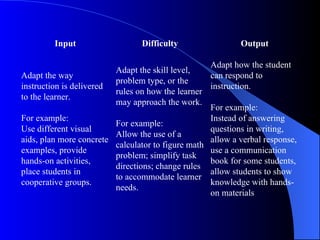
Input Difficulty Output Adapt the way instruction is delivered to the learner. For example: Use different visual aids, plan more concrete examples, provide hands-on activities, place students in cooperative groups. Adapt the skill level, problem type, or the rules on how the learner may approach the work. For example: Allow the use of a calculator to figure math problem; simplify task directions; change rules to accommodate learner needs. Adapt how the student can respond to instruction. For example: Instead of answering questions in writing, allow a verbal response, use a communication book for some students, allow students to show knowledge with hands-on materials
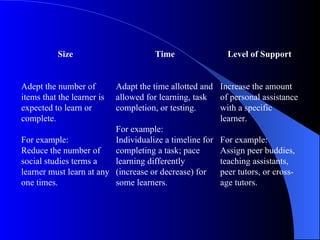
Size Time Level of Support Adept the number of items that the learner is expected to learn or complete. For example:  Reduce the number of social studies terms a learner must learn at any one times. Adapt the time allotted and allowed for learning, task completion, or testing. For example: Individualize a timeline for completing a task; pace learning differently (increase or decrease) for some learners. Increase the amount of personal assistance with a specific learner. For example: Assign peer buddies, teaching assistants, peer tutors, or cross-age tutors.
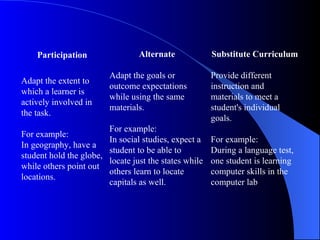
Participation Alternate Substitute Curriculum Adapt the extent to which a learner is actively involved in the task. For example: In geography, have a student hold the globe, while others point out locations. Adapt the goals or outcome expectations while using the same materials. For example: In social studies, expect a student to be able to locate just the states while others learn to locate capitals as well. Provide different instruction and materials to meet a student's individual goals. For example: During a language test, one student is learning computer skills in the computer lab
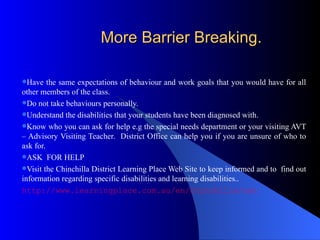
More Barrier Breaking. Have the same expectations of behaviour and work goals that you would have for all other members of the class.  Do not take behaviours personally. Understand the disabilities that your students have been diagnosed with. Know who you can ask for help e.g the special needs department or your visiting AVT – Advisory Visiting Teacher.  District Office can help you if you are unsure of who to ask for. ASK  FOR HELP Visit the Chinchilla District Learning Place Web Site to keep informed and to  find out information regarding specific disabilities and learning disabilities.. http://www.learningplace.com.au/en/chinchilla/ssn
Become Involved You are these students teacher and you need to assume responsibility for their  educational needs. Ask to see and read the students - IEP Individual Educational Plan. Talk to the other members of the students management team.  Spend time with the student outside your classroom e.g volunteer to do a duty in the special needs area
Remember "A bonus associated with learning to make modifications is that you can then use these to help all learners. Not only will this help you reinforce the idea that all people learn differently, but it will also help you teach that everyone needs e xtra help once in awhile."  -- Golomb & Hammeken. (January/February 1996).

Who is in my classroom

  • 1.
    Who is inmy classroom
  • 2.
    Have you noticed?Students Who are: Unprepared and seem lazy about completing tasks asked of them Having trouble with group work Not being able to concentrate after or just before lunch Clumsy and have untidy handwriting Talkative about topics which are completely off task Appearing to ignore you if you ask them a question. Needing anger management as they easily fly off the handle at small changes in routine
  • 3.
    You may also have been handed a large mysterious folder of information with only one students name on the outside!!
  • 4.
    Which may havecaused you to ask What the!!!…………..
  • 5.
    Who are thesestudents These students are those which are categorised as having a special need in their ability to access the curriculum Every student in every classroom learns with a different learning style. They display a multiple of strengths and weaknesses and have good and bad days Students who have a low incidence disability or have a learning difficulty are are students with different styles of learning, the have strengths and weakness and have good and bad days.
  • 6.
    Dssu and thepeo rang to ask if the stld and the hose had completed the asc1 for the vi5/sli 6 and an iep so he could report back to mes or the ppo about possibility of putting out an eoi for an s1
  • 7.
    Lets unjumble thejargon What is a learning disability? Students with learning difficulties (LD) are those whose access the curriculum is limited because of short-term or persistent problems in one or more areas of literacy, numeracy and learning how to learn: Students with learning difficulties can have a long term neurological disorder e.g. ADD or ADHD but do not suffer from an intellectual impairment Level of support is attained through the internal process of appraisement . What is a low incidence disability? Low incidence disabilities effect no more than 10% of the general population although this is on the increase. Low incidence disabilities under the management of Education Queensland include: ASD – Autistic Spectrum Disorder II – Intellectual Impairment PI – Physical Impairment SLI – Speech Language Impairment VI – Visual Impairment Level of Support is gained through the external process of ascertainment
  • 8.
    Learning Disabilities –Teaching Strategies Students who have LD usually have trouble processing information. Set specific instructions keep them short and give no more than 2 instructions at a time. Keep a copy of any notes form the board to give to the LD students. Break down assessment tasks into achievement levels. The greatest enemy of a LD student is a lack of self esteem and belief in there own ability. Provide the students with goals for the lesson. Get to know your STLD- Support Teacher Learning Difficulties. They have a wealth of knowledge on supporting students with LD and will welcome your input into management of each of the students
  • 9.
    Low Incidence Disability– How can I teach these students? I am not Special Ed trained. Teachers do not need to have been trained in Special Education to be able to teach inclusively.
  • 10.
    Teaching Strategies for Breaking down the barriers to learning
  • 11.
    Input Difficulty OutputAdapt the way instruction is delivered to the learner. For example: Use different visual aids, plan more concrete examples, provide hands-on activities, place students in cooperative groups. Adapt the skill level, problem type, or the rules on how the learner may approach the work. For example: Allow the use of a calculator to figure math problem; simplify task directions; change rules to accommodate learner needs. Adapt how the student can respond to instruction. For example: Instead of answering questions in writing, allow a verbal response, use a communication book for some students, allow students to show knowledge with hands-on materials
  • 12.
    Size Time Levelof Support Adept the number of items that the learner is expected to learn or complete. For example: Reduce the number of social studies terms a learner must learn at any one times. Adapt the time allotted and allowed for learning, task completion, or testing. For example: Individualize a timeline for completing a task; pace learning differently (increase or decrease) for some learners. Increase the amount of personal assistance with a specific learner. For example: Assign peer buddies, teaching assistants, peer tutors, or cross-age tutors.
  • 13.
    Participation Alternate SubstituteCurriculum Adapt the extent to which a learner is actively involved in the task. For example: In geography, have a student hold the globe, while others point out locations. Adapt the goals or outcome expectations while using the same materials. For example: In social studies, expect a student to be able to locate just the states while others learn to locate capitals as well. Provide different instruction and materials to meet a student's individual goals. For example: During a language test, one student is learning computer skills in the computer lab
  • 14.
    More Barrier Breaking.Have the same expectations of behaviour and work goals that you would have for all other members of the class. Do not take behaviours personally. Understand the disabilities that your students have been diagnosed with. Know who you can ask for help e.g the special needs department or your visiting AVT – Advisory Visiting Teacher. District Office can help you if you are unsure of who to ask for. ASK FOR HELP Visit the Chinchilla District Learning Place Web Site to keep informed and to find out information regarding specific disabilities and learning disabilities.. http://www.learningplace.com.au/en/chinchilla/ssn
  • 15.
    Become Involved Youare these students teacher and you need to assume responsibility for their educational needs. Ask to see and read the students - IEP Individual Educational Plan. Talk to the other members of the students management team. Spend time with the student outside your classroom e.g volunteer to do a duty in the special needs area
  • 16.
    Remember "A bonusassociated with learning to make modifications is that you can then use these to help all learners. Not only will this help you reinforce the idea that all people learn differently, but it will also help you teach that everyone needs e xtra help once in awhile." -- Golomb & Hammeken. (January/February 1996).

Editor's Notes

  • #7 For about one third of your mainstream class comprehending verbal instruction, completing large chunks of handwritten materials and cognitively processing quickly everything that is going on around while trying to pick out your voice from the background noise is as annoying as the sound of the this slide or if I asked you to write an essay on the above paragraph without asking any questions. Then also imagine on top of this frustration that you partner has just left you, or you just realise you have never had a real friend the whole time you have been at school or the job that you dreamed of doing does not cater to those with your disability. Would you still have turned up for work this morning?? Would you have stayed at home? Would you have asked for time to sort out your life before continuing, Students who have a learning disability or low incidence disability cope with this sort of stress everyday of there lives but it can be confusing knowing how to deal with students who just don’t engage or display behaviours which are different to those of the rest of the class.
  • #8 3.4% of the district has Low Incidence disability 91 students
  • #9 Students who have LD usually have trouble processing information to accommodate this allow greater time to answer questions in class and always check for understanding Set specific instructions keep them short and give no more than 2 instructions at a time. Keep a copy of any notes form the board to give to the LD students. This allows them to highlight points and removes the frustration of falling behind when copying information. In primary school reduce the amount you want them to write. Break down assessment tasks into achievement levels this way a student can focus on there areas of proficiency and not spend too much time on the areas which are too hard for them. Adapting how a student can respond to a task The greatest enemy of a LD student is a lack of self esteem and belief in there own ability. Use praise and positive reinforcement as often as possible to ensure students can see the value in what they are doing. Provide the students with goals for the lesson. Giving them a purpose will provide them with a focus and enable them to remain on task. It also gives a reference point to refer the student too when needed. Get to know your STLD- Support Teacher Learning Difficulties. They have a wealth of knowledge on supporting students with LD and will welcome your input into management of each of the students
  • #10 Not the teacher aide or the special education teachers job to program for mainstream classess.