Top Ten Differentiation Strategies
NUMBER 10 Preassessment  –  Not the least important because it is 10.  No differentiation unless you use it.  Formal or informal Use data for designing lesson or unit.
NUMBER 9 Curriculum Compacting Essential for covering required material. Appropriate pace. Used to fill “gaps.” Used to cover material that will be easily mastered.
NUMBER 8 5 Most Difficult First Like compacting for a day Skill based subjects – math If students shows mastery, move onto independent work. Give credit for assignment.
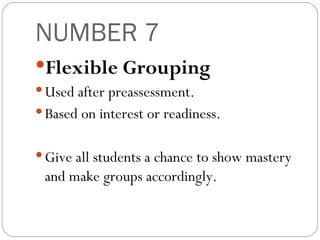
NUMBER 7 Flexible Grouping Used after preassessment. Based on interest or readiness. Give all students a chance to show mastery and make groups accordingly.
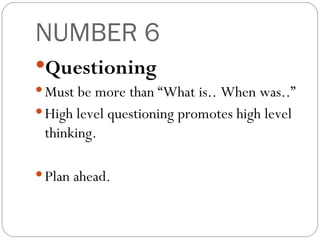
NUMBER 6 Questioning Must be more than “What is.. When was..” High level questioning promotes high level thinking. Plan ahead.
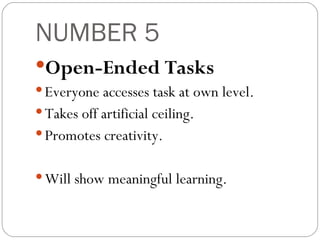
NUMBER 5 Open-Ended Tasks Everyone accesses task at own level. Takes off artificial ceiling. Promotes creativity. Will show meaningful learning.
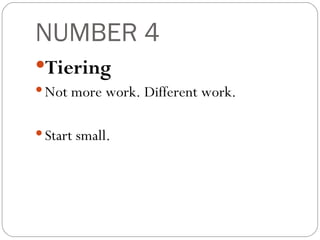
NUMBER 4 Tiering Not more work. Different work. Start small.
NUMBER 3 Learning Contracts Commitment to task Accountability Can be done in many ways.
NUMBER 2 Choice Boards Independent work with teacher direction. When mastery is demonstrated or as a class project. Be happy with all of the options.
NUMBER 1 Independent Projects Ultimate in autonomous learning. Huge student buy in. Even the unexpected will help you and the student learn something. Fun and Learning!! Nothing beats that.

Top ten differentiation strategies

  • 1.
  • 2.
    NUMBER 10 Preassessment – Not the least important because it is 10. No differentiation unless you use it. Formal or informal Use data for designing lesson or unit.
  • 3.
    NUMBER 9 CurriculumCompacting Essential for covering required material. Appropriate pace. Used to fill “gaps.” Used to cover material that will be easily mastered.
  • 4.
    NUMBER 8 5Most Difficult First Like compacting for a day Skill based subjects – math If students shows mastery, move onto independent work. Give credit for assignment.
  • 5.
    NUMBER 7 FlexibleGrouping Used after preassessment. Based on interest or readiness. Give all students a chance to show mastery and make groups accordingly.
  • 6.
    NUMBER 6 QuestioningMust be more than “What is.. When was..” High level questioning promotes high level thinking. Plan ahead.
  • 7.
    NUMBER 5 Open-EndedTasks Everyone accesses task at own level. Takes off artificial ceiling. Promotes creativity. Will show meaningful learning.
  • 8.
    NUMBER 4 TieringNot more work. Different work. Start small.
  • 9.
    NUMBER 3 LearningContracts Commitment to task Accountability Can be done in many ways.
  • 10.
    NUMBER 2 ChoiceBoards Independent work with teacher direction. When mastery is demonstrated or as a class project. Be happy with all of the options.
  • 11.
    NUMBER 1 IndependentProjects Ultimate in autonomous learning. Huge student buy in. Even the unexpected will help you and the student learn something. Fun and Learning!! Nothing beats that.