Prepared By
D . Mahendra
Dept of PA&QA
A group of techniques in which a physical property is measured as a
function of temperature.
The sample is subjected to a predefined heating or
cooling program.
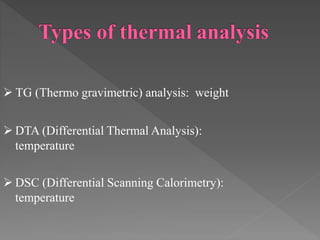
 TG (Thermo gravimetric) analysis: weight
 DTA (Differential Thermal Analysis):
temperature
 DSC (Differential Scanning Calorimetry):
temperature
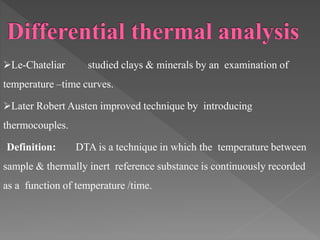
Le-Chateliar studied clays & minerals by an examination of
temperature –time curves.
Later Robert Austen improved technique by introducing
thermocouples.
Definition: DTA is a technique in which the temperature between
sample & thermally inert reference substance is continuously recorded
as a function of temperature /time.
In DTA both test sample & an inert reference material
(alumina) – controlled heating or cooling programming.
If zero temperature difference b/w sample & reference
material
– sample does not undergo any chemical or physical change.
If any reaction takes place temperature difference (∆T)
will occur b/w sample & reference material .
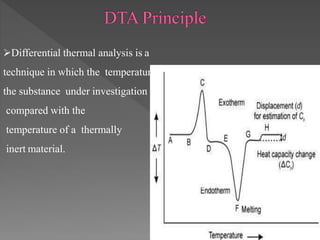
Differential thermal analysis is a
technique in which the temperature of
the substance under investigation is
compared with the
temperature of a thermally
inert material.
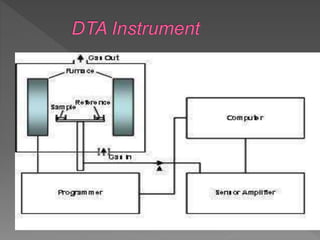
sample holder
sample and reference cells (Al)
sensors
one for thePt/Rh or chromel/alumel thermocouples
sample and one for the reference joined to
differential temperature controller
furnace
alumina block containing sample and reference cells
temperature controller
controls for temperature program and furnace
atmosphere
Recording system
advantages:
instruments can be used at very high temperatures
instruments are highly sensitive
flexibility in crucible volume/form
characteristic transition or reaction temperatures can be
accurately determined
disadvantages:
uncertainty of heats of fusion, transition, or reaction
estimations is 20-50%
Qualitative and Quantitative Identification of Minerals: detection of
any minerals in a sample
Polymeric Materials: DTA useful for the characterization of
polymeric materials in the light of identification of thermo physical ,
thermo chemical, thermo mechanical and thermo elastic changes or
transitions.
Measurement of Crystalline: measurement of the mass fraction
of crystalline material in semi crystalline polymers.
Analysis of Biological Materials: DTA curves are used to date bone
remains or to study archaeological materials.
this technique is developed by E.S.Watson and
M.J.O’Neill in 1962.
introduced commercially at the Pittsburgh Conference on analytical
Chemistry and Applied Spectroscopy.
First Adiabatic differential scanning calorimeter that could be used in
Biochemistry was developed by
P.L.Privalov in 1964.
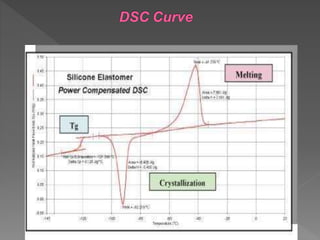
In DSC the heat flow is measured and plotted against temperature of
furnace or time to get a thermogram. This is the basis of Differential
Scanning Calorimetry (DSC).
The deviation observed above the base (zero) line is called exothermic
transition and below is called endothermic transition.
The area under the peak is directly proportional to the heat evolved or
absorbed by the reaction, and the height of the curve is directly
proportional to the rate of reaction.
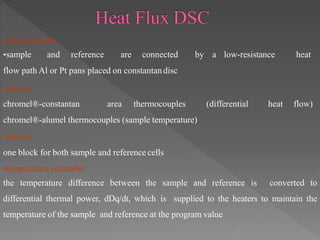
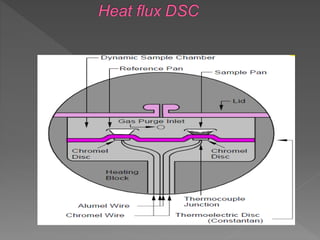
•sample holder
•sample and reference are connected by a low-resistance heat
flow path Al or Pt pans placed on constantandisc
•sensors
chromel®-constantan area thermocouples (differential heat flow)
chromel®-alumel thermocouples (sample temperature)
•furnace
one block for both sample and reference cells
•temperature controller
the temperature difference between the sample and reference is converted to
differential thermal power, dDq/dt, which is supplied to the heaters to maintain the
temperature of the sample and reference at the program value
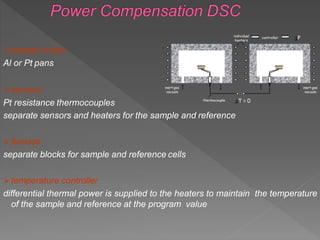
sample holder
Al or Pt pans
sensors
Pt resistance thermocouples
separate sensors and heaters for the sample and reference
furnace
separate blocks for sample and reference cells
temperature controller
differential thermal power is supplied to the heaters to maintain the temperature
of the sample and reference at the program value
sample
pan
T = 0
inertgas
vacuum
inertgas
vacuum
individual
heaters
controller P
reference
pan
thermocouple
Protien Stability and Folding
Liquid Biopharmaceutical Formulations
Process Development
Protien Engineering
Rank order Binding
Antibody Domain Studies
Characterisation of Membranes,lipids,nucleiec acids & micellar systems
Assesment of the effects of structural change on a molecules stabiity
Measurement of Ultra-light molecular interactions
Assesment of biocomparability during manufracturing.
composition of polymers is determined.
Melting point and lass transition temp can be determined
This can show the polymer degradation by lowering the melting
point(Tm).Molecular weight(low grade –low melting point) can be
determained.
Percentage Crytallinity
Thermal degradation and impurities
Liquid crystals
Oxidative Stability: stability & optimum storage conditions
Drug analysis: widely used in Pharmaceutical industry(defining
processing parameters) and polymer industry(curing process.).
General Chemical analysis: Freezing point depression can be
used as a purity analysis tool.
Functional Applications:
Binding Studies
DIFFERENTIAL THERMAL ANALYSIS AND DIFFERENTIAL SCANING COLORIMETRY

DIFFERENTIAL THERMAL ANALYSIS AND DIFFERENTIAL SCANING COLORIMETRY

  • 1.
    Prepared By D .Mahendra Dept of PA&QA
  • 2.
    A group oftechniques in which a physical property is measured as a function of temperature. The sample is subjected to a predefined heating or cooling program.
  • 3.
     TG (Thermogravimetric) analysis: weight  DTA (Differential Thermal Analysis): temperature  DSC (Differential Scanning Calorimetry): temperature
  • 4.
    Le-Chateliar studied clays& minerals by an examination of temperature –time curves. Later Robert Austen improved technique by introducing thermocouples. Definition: DTA is a technique in which the temperature between sample & thermally inert reference substance is continuously recorded as a function of temperature /time.
  • 5.
    In DTA bothtest sample & an inert reference material (alumina) – controlled heating or cooling programming. If zero temperature difference b/w sample & reference material – sample does not undergo any chemical or physical change. If any reaction takes place temperature difference (∆T) will occur b/w sample & reference material .
  • 6.
    Differential thermal analysisis a technique in which the temperature of the substance under investigation is compared with the temperature of a thermally inert material.
  • 7.
    sample holder sample andreference cells (Al) sensors one for thePt/Rh or chromel/alumel thermocouples sample and one for the reference joined to differential temperature controller furnace alumina block containing sample and reference cells temperature controller controls for temperature program and furnace atmosphere Recording system
  • 9.
    advantages: instruments can beused at very high temperatures instruments are highly sensitive flexibility in crucible volume/form characteristic transition or reaction temperatures can be accurately determined disadvantages: uncertainty of heats of fusion, transition, or reaction estimations is 20-50%
  • 10.
    Qualitative and QuantitativeIdentification of Minerals: detection of any minerals in a sample Polymeric Materials: DTA useful for the characterization of polymeric materials in the light of identification of thermo physical , thermo chemical, thermo mechanical and thermo elastic changes or transitions. Measurement of Crystalline: measurement of the mass fraction of crystalline material in semi crystalline polymers. Analysis of Biological Materials: DTA curves are used to date bone remains or to study archaeological materials.
  • 11.
    this technique isdeveloped by E.S.Watson and M.J.O’Neill in 1962. introduced commercially at the Pittsburgh Conference on analytical Chemistry and Applied Spectroscopy. First Adiabatic differential scanning calorimeter that could be used in Biochemistry was developed by P.L.Privalov in 1964.
  • 12.
    In DSC theheat flow is measured and plotted against temperature of furnace or time to get a thermogram. This is the basis of Differential Scanning Calorimetry (DSC). The deviation observed above the base (zero) line is called exothermic transition and below is called endothermic transition. The area under the peak is directly proportional to the heat evolved or absorbed by the reaction, and the height of the curve is directly proportional to the rate of reaction.
  • 14.
    •sample holder •sample andreference are connected by a low-resistance heat flow path Al or Pt pans placed on constantandisc •sensors chromel®-constantan area thermocouples (differential heat flow) chromel®-alumel thermocouples (sample temperature) •furnace one block for both sample and reference cells •temperature controller the temperature difference between the sample and reference is converted to differential thermal power, dDq/dt, which is supplied to the heaters to maintain the temperature of the sample and reference at the program value
  • 16.
    sample holder Al orPt pans sensors Pt resistance thermocouples separate sensors and heaters for the sample and reference furnace separate blocks for sample and reference cells temperature controller differential thermal power is supplied to the heaters to maintain the temperature of the sample and reference at the program value sample pan T = 0 inertgas vacuum inertgas vacuum individual heaters controller P reference pan thermocouple
  • 17.
    Protien Stability andFolding Liquid Biopharmaceutical Formulations Process Development Protien Engineering Rank order Binding Antibody Domain Studies Characterisation of Membranes,lipids,nucleiec acids & micellar systems Assesment of the effects of structural change on a molecules stabiity Measurement of Ultra-light molecular interactions Assesment of biocomparability during manufracturing.
  • 18.
    composition of polymersis determined. Melting point and lass transition temp can be determined This can show the polymer degradation by lowering the melting point(Tm).Molecular weight(low grade –low melting point) can be determained. Percentage Crytallinity Thermal degradation and impurities
  • 19.
    Liquid crystals Oxidative Stability:stability & optimum storage conditions Drug analysis: widely used in Pharmaceutical industry(defining processing parameters) and polymer industry(curing process.). General Chemical analysis: Freezing point depression can be used as a purity analysis tool. Functional Applications: Binding Studies