S.N.PATEL INSTITUTE OF TECHNOLOGY
AND RESEARCH CENTRE,UMRAKH
THERMAL ANALYSIS (DTA) AND
THEIR APPLICATION
Subject : P& IC(2140501)
Guided by:
Contents
Thermal analysis
 Classification of thermal analysis
 Differential thermal analysis(DTA)
 Principle
 Instrumentation
Advantage and Disadvantage
 Application
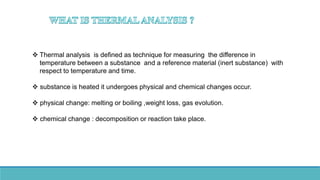
 Thermal analysis is defined as technique for measuring the difference in
temperature between a substance and a reference material (inert substance) with
respect to temperature and time.
 substance is heated it undergoes physical and chemical changes occur.
 physical change: melting or boiling ,weight loss, gas evolution.
 chemical change : decomposition or reaction take place.
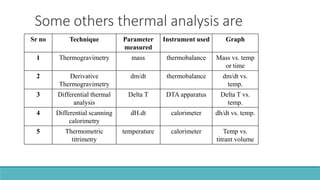
Sr no Technique Parameter
measured
Instrument used Graph
1 Thermogravimetry mass thermobalance Mass vs. temp
or time
2 Derivative
Thermogravimetry
dm/dt thermobalance dm/dt vs.
temp.
3 Differential thermal
analysis
Delta T DTA apparatus Delta T vs.
temp.
4 Differential scanning
calorimetry
dH.dt calorimeter dh/dt vs. temp.
5 Thermometric
titrimetry
temperature calorimeter Temp vs.
titrant volume
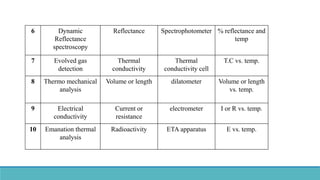
6 Dynamic
Reflectance
spectroscopy
Reflectance Spectrophotometer % reflectance and
temp
7 Evolved gas
detection
Thermal
conductivity
Thermal
conductivity cell
T.C vs. temp.
8 Thermo mechanical
analysis
Volume or length dilatometer Volume or length
vs. temp.
9 Electrical
conductivity
Current or
resistance
electrometer I or R vs. temp.
10 Emanation thermal
analysis
Radioactivity ETA apparatus E vs. temp.
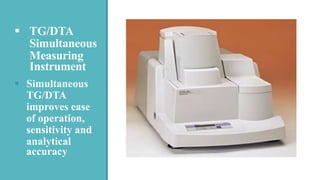
 TG/DTA
Simultaneous
Measuring
Instrument
 Simultaneous
TG/DTA
improves ease
of operation,
sensitivity and
analytical
accuracy
Principle :
The principle of (DTA) analysis is that sample and
reference (inert substance) materials is heating
or cooling at desirable rate simultaneously and they under
go chemical and physical change which is measured by
recorder.
Differential thermal analysis
Instrumental detail
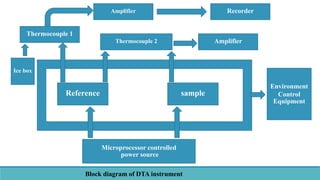
• This instrument comprises a sample holder with thermocouple assembly ,furnaces, flow
rate control assembly ,amplifier, detector ,recorder and furnace temperature controller
as mentioned in fig
• Briefly sample and references are kept in small crucible called sample holder which it
connected with thermocouple each.
• This crucible made of refractory materials like silica Pyrex nickel or platinum .
depending upon the nature of the of the test involved the thermocouple is direct contact
with the sample and reference to avoid contamination and degradation .
• The function of thermo couple is to ensure that heating or cooling is equally distributed
in the sample and reference
• These holders are kept in furnace in which heating is carried out for continuous and
desirable heating or cooling furnace .
• Temperature Control is attached with furnace with furnace now thermocouple is
attached with amplifier detector and recorder which is measures the
• Chemical and physical on heating or cooling the sample and reference .
• Now the sample which is to be analyzed and reference are kept in sample holder and
heating or cooling is started at desirable flow rate the chemical and physical change
during temperature difference with respect to time is measured and recorded which is
represented as thermogram the thermogram of calcium acetate is illustrated below
Microprocessor controlled
power source
Reference sample
Environment
Control
Equipment
Thermocouple 1
Amplifier
Thermocouple 2 Amplifier
Recorder
Ice box
Block diagram of DTA instrument
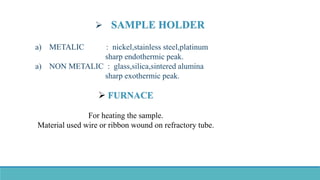
 SAMPLE HOLDER
a) METALIC : nickel,stainless steel,platinum
sharp endothermic peak.
a) NON METALIC : glass,silica,sintered alumina
sharp exothermic peak.
 FURNACE
For heating the sample.
Material used wire or ribbon wound on refractory tube.
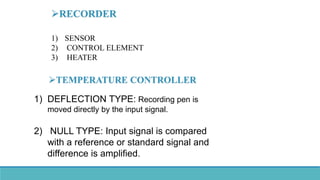
TEMPERATURE CONTROLLER
1) SENSOR
2) CONTROL ELEMENT
3) HEATER
RECORDER
1) DEFLECTION TYPE: Recording pen is
moved directly by the input signal.
2) NULL TYPE: Input signal is compared
with a reference or standard signal and
difference is amplified.
ADVANTAGE
High resolution and a robust easy to
use.
DISADVANTAGE
Less satisfactory with regard to
resolution of thermal traces and
quantitative data.
 Unable to measure the energy
associated with each event.
Application
1. DTA techniques are useful for providing many basic
transformations,dehydration,decomposition,oxidation,reduction,heat of reaction,
specific heat, thermal diffusivity , etc.
2. Melting point and boiling point of any organic compound are easily determined
using this techniques .
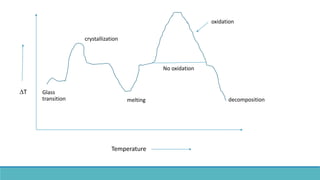
3. DTA techniques is widely used for characterization of polymer one of the
thermogram of polymer as mentioned .
decompositionmelting
oxidation
Glass
transition
crystallization
Temperature
T
No oxidation
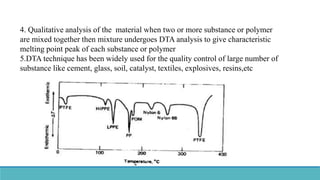
4. Qualitative analysis of the material when two or more substance or polymer
are mixed together then mixture undergoes DTA analysis to give characteristic
melting point peak of each substance or polymer
5.DTA technique has been widely used for the quality control of large number of
substance like cement, glass, soil, catalyst, textiles, explosives, resins,etc
6.It is also utilized for analyze the thermal stability of large no of
inorganic compounds and complexes.
7. It is widely used for purity determination and also evaluation of
kinetic parameters of polymer, explosives ,pharmaceuticals oils fat
and other organic materials.
Thermal analysis and their application

Thermal analysis and their application

  • 1.
    S.N.PATEL INSTITUTE OFTECHNOLOGY AND RESEARCH CENTRE,UMRAKH THERMAL ANALYSIS (DTA) AND THEIR APPLICATION Subject : P& IC(2140501) Guided by:
  • 2.
    Contents Thermal analysis  Classificationof thermal analysis  Differential thermal analysis(DTA)  Principle  Instrumentation Advantage and Disadvantage  Application
  • 3.
     Thermal analysisis defined as technique for measuring the difference in temperature between a substance and a reference material (inert substance) with respect to temperature and time.  substance is heated it undergoes physical and chemical changes occur.  physical change: melting or boiling ,weight loss, gas evolution.  chemical change : decomposition or reaction take place.
  • 4.
    Sr no TechniqueParameter measured Instrument used Graph 1 Thermogravimetry mass thermobalance Mass vs. temp or time 2 Derivative Thermogravimetry dm/dt thermobalance dm/dt vs. temp. 3 Differential thermal analysis Delta T DTA apparatus Delta T vs. temp. 4 Differential scanning calorimetry dH.dt calorimeter dh/dt vs. temp. 5 Thermometric titrimetry temperature calorimeter Temp vs. titrant volume
  • 5.
    6 Dynamic Reflectance spectroscopy Reflectance Spectrophotometer% reflectance and temp 7 Evolved gas detection Thermal conductivity Thermal conductivity cell T.C vs. temp. 8 Thermo mechanical analysis Volume or length dilatometer Volume or length vs. temp. 9 Electrical conductivity Current or resistance electrometer I or R vs. temp. 10 Emanation thermal analysis Radioactivity ETA apparatus E vs. temp.
  • 6.
     TG/DTA Simultaneous Measuring Instrument  Simultaneous TG/DTA improvesease of operation, sensitivity and analytical accuracy
  • 7.
    Principle : The principleof (DTA) analysis is that sample and reference (inert substance) materials is heating or cooling at desirable rate simultaneously and they under go chemical and physical change which is measured by recorder. Differential thermal analysis
  • 8.
    Instrumental detail • Thisinstrument comprises a sample holder with thermocouple assembly ,furnaces, flow rate control assembly ,amplifier, detector ,recorder and furnace temperature controller as mentioned in fig • Briefly sample and references are kept in small crucible called sample holder which it connected with thermocouple each. • This crucible made of refractory materials like silica Pyrex nickel or platinum . depending upon the nature of the of the test involved the thermocouple is direct contact with the sample and reference to avoid contamination and degradation . • The function of thermo couple is to ensure that heating or cooling is equally distributed in the sample and reference
  • 9.
    • These holdersare kept in furnace in which heating is carried out for continuous and desirable heating or cooling furnace . • Temperature Control is attached with furnace with furnace now thermocouple is attached with amplifier detector and recorder which is measures the • Chemical and physical on heating or cooling the sample and reference . • Now the sample which is to be analyzed and reference are kept in sample holder and heating or cooling is started at desirable flow rate the chemical and physical change during temperature difference with respect to time is measured and recorded which is represented as thermogram the thermogram of calcium acetate is illustrated below
  • 10.
    Microprocessor controlled power source Referencesample Environment Control Equipment Thermocouple 1 Amplifier Thermocouple 2 Amplifier Recorder Ice box Block diagram of DTA instrument
  • 11.
     SAMPLE HOLDER a)METALIC : nickel,stainless steel,platinum sharp endothermic peak. a) NON METALIC : glass,silica,sintered alumina sharp exothermic peak.  FURNACE For heating the sample. Material used wire or ribbon wound on refractory tube.
  • 12.
    TEMPERATURE CONTROLLER 1) SENSOR 2)CONTROL ELEMENT 3) HEATER RECORDER 1) DEFLECTION TYPE: Recording pen is moved directly by the input signal. 2) NULL TYPE: Input signal is compared with a reference or standard signal and difference is amplified.
  • 13.
    ADVANTAGE High resolution anda robust easy to use. DISADVANTAGE Less satisfactory with regard to resolution of thermal traces and quantitative data.  Unable to measure the energy associated with each event.
  • 14.
    Application 1. DTA techniquesare useful for providing many basic transformations,dehydration,decomposition,oxidation,reduction,heat of reaction, specific heat, thermal diffusivity , etc. 2. Melting point and boiling point of any organic compound are easily determined using this techniques . 3. DTA techniques is widely used for characterization of polymer one of the thermogram of polymer as mentioned .
  • 15.
  • 16.
    4. Qualitative analysisof the material when two or more substance or polymer are mixed together then mixture undergoes DTA analysis to give characteristic melting point peak of each substance or polymer 5.DTA technique has been widely used for the quality control of large number of substance like cement, glass, soil, catalyst, textiles, explosives, resins,etc
  • 17.
    6.It is alsoutilized for analyze the thermal stability of large no of inorganic compounds and complexes. 7. It is widely used for purity determination and also evaluation of kinetic parameters of polymer, explosives ,pharmaceuticals oils fat and other organic materials.