UNIT V
OTHER
TESTING
TYPES OF MATERIALS
TESTING
 Mechancial testing & Non destructive
testing
 Testing for physical& chemical properties
 Testing for thermal properties
 Testing for electrical properties
 Testing for resistance to corrosion,
Radiation and Biological deterioration.
THERMAL PROPERTIES
 Thermal analysis is a form of analytical
technique most commonly used in the
branch of materials science where changes
in the properties of materials are examined
with respect to temperature.
 It is a group of techniques in which
changes of physical or chemical properties
of the sample are monitored against time
or temperature, while the temperature of
the sample is programmed.
THERMALTESTING
 Thermal testing involves testing a
product at the extremes of its intended use
thermal environment for heating rate,
temperature and airflow or gaseous
atmosphere or vacuum with measuring
case temperatures on individual
components to determine the effect on
product performance and long- term
reliability.
THERMOGRAVIMETRIC
ANALYSIS(TGA)
 The Thermogravimetric analysis(TGA) is a
type of thermo analytical testing performed
on materials to determine changes in weight
in relation to changes in temperature.
 The TGA relies on a high degree of precision
in three measurements: weight, temperature,
and temperature changes.
DIFFERENTIAL SCANNING
CALORIMETRY
 DSC measures the energy absorbed or
released from a sample as a function of
time or temperature profile.
 DSC is useful to make the measurements
for melting points, heats of reaction,
glass transition, and heat capacity.
PRINCIPLE
 Differential scanning calorimetry (DSC) is
based on the principle; sample and reference
and maintained at the same temperature,
even during a thermal event (in the sample).
The energy required maintaining zero
temperature different between the sample
and the reference is measured.
 By calibrating the standard
material(reference materials), the unknown
sample quantitative measurement is
achievable.
TYPES
 There are four different types of DSC
instrument
 Heat flux DSC
 Power compensated DSC
 Modulated DSC
 Hyper DSC
 Pressure DSC
 The most common methods are Heat flux
DSC and Power compensated DSC.
POWER COMPENSATION DSC
 A technique in which difference of
thermal energy that is applied to the
sample and the preference materials
separately per unit of times is measured as
a function of the temperature.
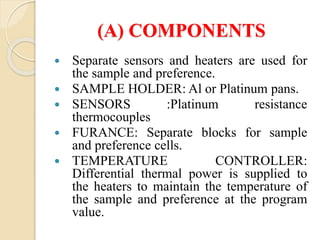
(A) COMPONENTS
 Separate sensors and heaters are used for
the sample and preference.
 SAMPLE HOLDER: Al or Platinum pans.
 SENSORS :Platinum resistance
thermocouples
 FURANCE: Separate blocks for sample
and preference cells.
 TEMPERATURE CONTROLLER:
Differential thermal power is supplied to
the heaters to maintain the temperature of
the sample and preference at the program
value.
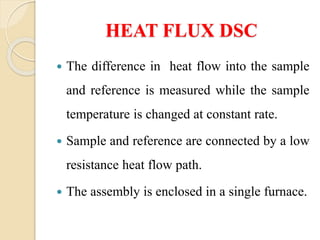
HEAT FLUX DSC
 The difference in heat flow into the sample
and reference is measured while the sample
temperature is changed at constant rate.
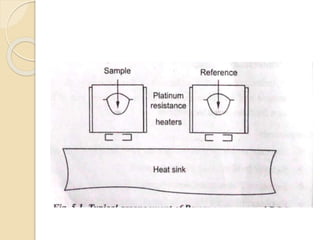
 Sample and reference are connected by a low
resistance heat flow path.
 The assembly is enclosed in a single furnace.
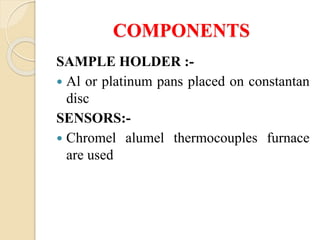
COMPONENTS
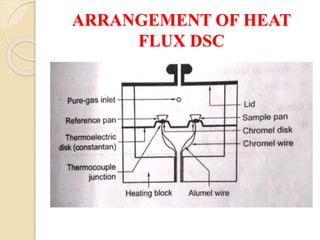
SAMPLE HOLDER :-
 Al or platinum pans placed on constantan
disc
SENSORS:-
 Chromel alumel thermocouples furnace
are used
ARRANGEMENT OF HEAT
FLUX DSC
WORKING
 The main assembly of the DSC cell is
enclosed in a cylindrical, silver heating
black, which dissipates heat to the
specimens via I constantan disc which is
attached to the silver block.
 The disc has two raised platforms on
which the sample and reference pans are
placed.
WORKING
 A chromel disk and connecting wire are
attached to the underside of each platform
and the resulting chromel constantan
thermocouples are used to determine the
differential temperatures of interest.
 Alumel wires attached to the chrome disc
provide the chromel-alumel junctions for
independently measuring the sample and
reference temperature.
DSC MEASURES
 Glass transistion
 Melting and boiling points
 Crystallization time and temperature
 Present crystallinity
 Heats of fusion and reactions
 Specific heat capacity
 Purity
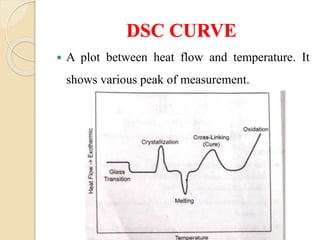
DSC CURVE
 A plot between heat flow and temperature. It
shows various peak of measurement.
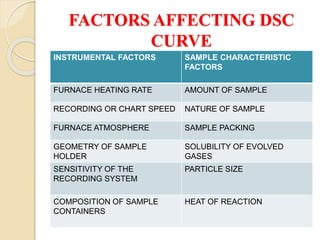
FACTORS AFFECTING DSC
CURVE
INSTRUMENTAL FACTORS SAMPLE CHARACTERISTIC
FACTORS
FURNACE HEATING RATE AMOUNT OF SAMPLE
RECORDING OR CHART SPEED NATURE OF SAMPLE
FURNACE ATMOSPHERE SAMPLE PACKING
GEOMETRY OF SAMPLE
HOLDER
SOLUBILITY OF EVOLVED
GASES
SENSITIVITY OF THE
RECORDING SYSTEM
PARTICLE SIZE
COMPOSITION OF SAMPLE
CONTAINERS
HEAT OF REACTION
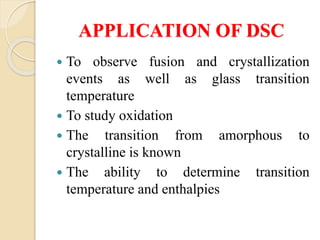
APPLICATION OF DSC
 To observe fusion and crystallization
events as well as glass transition
temperature
 To study oxidation
 The transition from amorphous to
crystalline is known
 The ability to determine transition
temperature and enthalpies
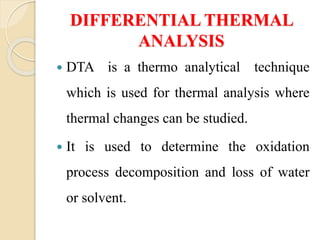
DIFFERENTIAL THERMAL
ANALYSIS
 DTA is a thermo analytical technique
which is used for thermal analysis where
thermal changes can be studied.
 It is used to determine the oxidation
process decomposition and loss of water
or solvent.
PRINCIPLE
 The sample material and reference
material are made to undergo identical
thermal cycles, while recording any
temperature difference between sample
and reference.
 Changes in the sample, either exothermic
or endothermic can be detected relative to
the inert reference.
COMPONENTS
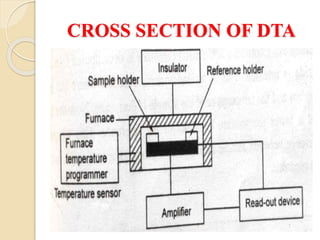
 FURNACE – used for heating the sample
(Nickel and Chromium alloy furnace)
 SAMPLE HOLDER – contain the sample
and reference material
 DC AMPLIFIER- low level DC amplifier
 DIFFERENTIAL TEMPERATURE
DETCETOR- to measure differential
temperature
 FURNACE TEMPERATURE
PROGRAMME- increase the temperature
of the furnace at steady rate
 RECORDER- to record DTA curve
 CONTROL EQUIPMENT- maintain
suitable atmosphere of the furnace and
sample holder.
CROSS SECTION OF DTA
WORKING
 The sample under investigation is loaded
into the container.
 This container is then placed into the
sample pan and it is marked as S
 Same quantity of reference sample is
placed in another container which is then
placed onto the reference pan and it is
marked as R.
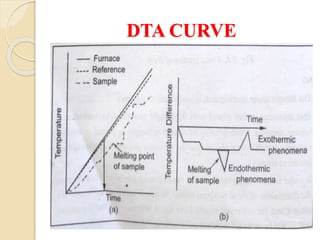
DTA CURVE
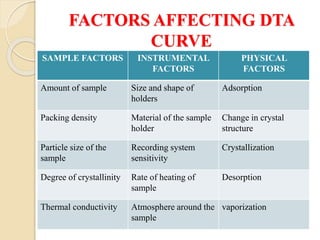
FACTORS AFFECTING DTA
CURVE
SAMPLE FACTORS INSTRUMENTAL
FACTORS
PHYSICAL
FACTORS
Amount of sample Size and shape of
holders
Adsorption
Packing density Material of the sample
holder
Change in crystal
structure
Particle size of the
sample
Recording system
sensitivity
Crystallization
Degree of crystallinity Rate of heating of
sample
Desorption
Thermal conductivity Atmosphere around the
sample
vaporization
APPLICATIONS
 Used to identify minerals both
qualitatively and quantitatively.
 Polymers characterization is easily
characterized
 Degree of crystallinity is assessed
 Melting point, boiling point and
temperatures of decomposition of organic
compounds can be determined.
THERMO MECHANICAL
ANALYSIS
 A technique in which deformation of the
sample under non-oscillating stress is
monitored against time or temperature while
the temperature of the sample in a specified
atmosphere is programmed.
 TMA easily measures sample displacement
as a function of temperature.
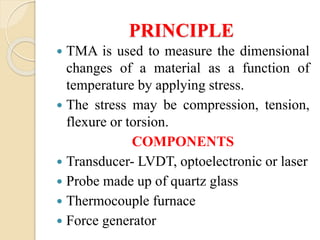
PRINCIPLE
 TMA is used to measure the dimensional
changes of a material as a function of
temperature by applying stress.
 The stress may be compression, tension,
flexure or torsion.
COMPONENTS
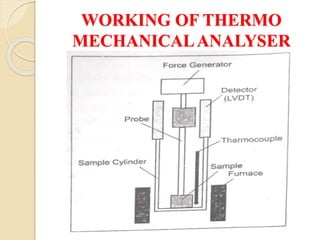
 Transducer- LVDT, optoelectronic or laser
 Probe made up of quartz glass
 Thermocouple furnace
 Force generator
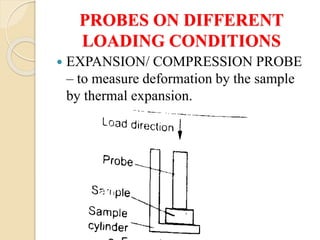
PROBES ON DIFFERENT
LOADING CONDITIONS
 EXPANSION/ COMPRESSION PROBE
– to measure deformation by the sample
by thermal expansion.
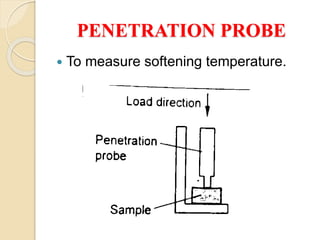
PENETRATION PROBE
 To measure softening temperature.
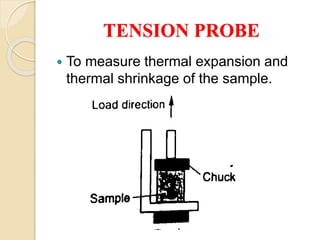
TENSION PROBE
 To measure thermal expansion and
thermal shrinkage of the sample.
CONSTRUCTIONA ND
WORKING
 The sample is inserted into the furnace
and is touched by the probe which is
connected with the length detector and
force generator.
 The construction of push rod and sample
holder depends on the mode of
measurements.
 The thermocouple for temperature
measurement is located near the sample.
WORKING OF THERMO
MECHANICALANALYSER
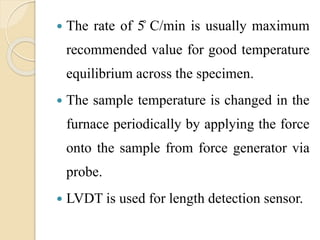
 The rate of 5̊ C/min is usually maximum
recommended value for good temperature
equilibrium across the specimen.
 The sample temperature is changed in the
furnace periodically by applying the force
onto the sample from force generator via
probe.
 LVDT is used for length detection sensor.
APPLICATION
 Measurement of dimensional change
 Coefficient of linear thermal expansion
 Determination of material anistropy
 Softening temperatures and glass
transition
 Linear thermal expansion
ADVANTAGES
 Compactness and lightness
 Low operation voltage
 Measure large deformation
 Large actuation force
DISADVANTAGES
 Used for only solid samples
 Creep occurring concurrently
 Usage of proper probe
 Low operational speed
THERMO MECHANICAL
DYNAMIC ANALYSIS
 It is also known as DMA (DYNAMIC
MECHANICALANALYSIS)

UNIT 5 PPT.pptx

  • 1.
  • 2.
    TYPES OF MATERIALS TESTING Mechancial testing & Non destructive testing  Testing for physical& chemical properties  Testing for thermal properties  Testing for electrical properties  Testing for resistance to corrosion, Radiation and Biological deterioration.
  • 3.
    THERMAL PROPERTIES  Thermalanalysis is a form of analytical technique most commonly used in the branch of materials science where changes in the properties of materials are examined with respect to temperature.  It is a group of techniques in which changes of physical or chemical properties of the sample are monitored against time or temperature, while the temperature of the sample is programmed.
  • 4.
    THERMALTESTING  Thermal testinginvolves testing a product at the extremes of its intended use thermal environment for heating rate, temperature and airflow or gaseous atmosphere or vacuum with measuring case temperatures on individual components to determine the effect on product performance and long- term reliability.
  • 5.
    THERMOGRAVIMETRIC ANALYSIS(TGA)  The Thermogravimetricanalysis(TGA) is a type of thermo analytical testing performed on materials to determine changes in weight in relation to changes in temperature.  The TGA relies on a high degree of precision in three measurements: weight, temperature, and temperature changes.
  • 6.
    DIFFERENTIAL SCANNING CALORIMETRY  DSCmeasures the energy absorbed or released from a sample as a function of time or temperature profile.  DSC is useful to make the measurements for melting points, heats of reaction, glass transition, and heat capacity.
  • 7.
    PRINCIPLE  Differential scanningcalorimetry (DSC) is based on the principle; sample and reference and maintained at the same temperature, even during a thermal event (in the sample). The energy required maintaining zero temperature different between the sample and the reference is measured.  By calibrating the standard material(reference materials), the unknown sample quantitative measurement is achievable.
  • 8.
    TYPES  There arefour different types of DSC instrument  Heat flux DSC  Power compensated DSC  Modulated DSC  Hyper DSC  Pressure DSC  The most common methods are Heat flux DSC and Power compensated DSC.
  • 9.
    POWER COMPENSATION DSC A technique in which difference of thermal energy that is applied to the sample and the preference materials separately per unit of times is measured as a function of the temperature.
  • 10.
    (A) COMPONENTS  Separatesensors and heaters are used for the sample and preference.  SAMPLE HOLDER: Al or Platinum pans.  SENSORS :Platinum resistance thermocouples  FURANCE: Separate blocks for sample and preference cells.  TEMPERATURE CONTROLLER: Differential thermal power is supplied to the heaters to maintain the temperature of the sample and preference at the program value.
  • 11.
    HEAT FLUX DSC The difference in heat flow into the sample and reference is measured while the sample temperature is changed at constant rate.  Sample and reference are connected by a low resistance heat flow path.  The assembly is enclosed in a single furnace.
  • 13.
    COMPONENTS SAMPLE HOLDER :- Al or platinum pans placed on constantan disc SENSORS:-  Chromel alumel thermocouples furnace are used
  • 14.
  • 15.
    WORKING  The mainassembly of the DSC cell is enclosed in a cylindrical, silver heating black, which dissipates heat to the specimens via I constantan disc which is attached to the silver block.  The disc has two raised platforms on which the sample and reference pans are placed.
  • 16.
    WORKING  A chromeldisk and connecting wire are attached to the underside of each platform and the resulting chromel constantan thermocouples are used to determine the differential temperatures of interest.  Alumel wires attached to the chrome disc provide the chromel-alumel junctions for independently measuring the sample and reference temperature.
  • 17.
    DSC MEASURES  Glasstransistion  Melting and boiling points  Crystallization time and temperature  Present crystallinity  Heats of fusion and reactions  Specific heat capacity  Purity
  • 18.
    DSC CURVE  Aplot between heat flow and temperature. It shows various peak of measurement.
  • 19.
    FACTORS AFFECTING DSC CURVE INSTRUMENTALFACTORS SAMPLE CHARACTERISTIC FACTORS FURNACE HEATING RATE AMOUNT OF SAMPLE RECORDING OR CHART SPEED NATURE OF SAMPLE FURNACE ATMOSPHERE SAMPLE PACKING GEOMETRY OF SAMPLE HOLDER SOLUBILITY OF EVOLVED GASES SENSITIVITY OF THE RECORDING SYSTEM PARTICLE SIZE COMPOSITION OF SAMPLE CONTAINERS HEAT OF REACTION
  • 20.
    APPLICATION OF DSC To observe fusion and crystallization events as well as glass transition temperature  To study oxidation  The transition from amorphous to crystalline is known  The ability to determine transition temperature and enthalpies
  • 21.
    DIFFERENTIAL THERMAL ANALYSIS  DTAis a thermo analytical technique which is used for thermal analysis where thermal changes can be studied.  It is used to determine the oxidation process decomposition and loss of water or solvent.
  • 22.
    PRINCIPLE  The samplematerial and reference material are made to undergo identical thermal cycles, while recording any temperature difference between sample and reference.  Changes in the sample, either exothermic or endothermic can be detected relative to the inert reference.
  • 23.
    COMPONENTS  FURNACE –used for heating the sample (Nickel and Chromium alloy furnace)  SAMPLE HOLDER – contain the sample and reference material  DC AMPLIFIER- low level DC amplifier  DIFFERENTIAL TEMPERATURE DETCETOR- to measure differential temperature
  • 24.
     FURNACE TEMPERATURE PROGRAMME-increase the temperature of the furnace at steady rate  RECORDER- to record DTA curve  CONTROL EQUIPMENT- maintain suitable atmosphere of the furnace and sample holder.
  • 25.
  • 26.
    WORKING  The sampleunder investigation is loaded into the container.  This container is then placed into the sample pan and it is marked as S  Same quantity of reference sample is placed in another container which is then placed onto the reference pan and it is marked as R.
  • 27.
  • 28.
    FACTORS AFFECTING DTA CURVE SAMPLEFACTORS INSTRUMENTAL FACTORS PHYSICAL FACTORS Amount of sample Size and shape of holders Adsorption Packing density Material of the sample holder Change in crystal structure Particle size of the sample Recording system sensitivity Crystallization Degree of crystallinity Rate of heating of sample Desorption Thermal conductivity Atmosphere around the sample vaporization
  • 29.
    APPLICATIONS  Used toidentify minerals both qualitatively and quantitatively.  Polymers characterization is easily characterized  Degree of crystallinity is assessed  Melting point, boiling point and temperatures of decomposition of organic compounds can be determined.
  • 30.
    THERMO MECHANICAL ANALYSIS  Atechnique in which deformation of the sample under non-oscillating stress is monitored against time or temperature while the temperature of the sample in a specified atmosphere is programmed.  TMA easily measures sample displacement as a function of temperature.
  • 31.
    PRINCIPLE  TMA isused to measure the dimensional changes of a material as a function of temperature by applying stress.  The stress may be compression, tension, flexure or torsion. COMPONENTS  Transducer- LVDT, optoelectronic or laser  Probe made up of quartz glass  Thermocouple furnace  Force generator
  • 32.
    PROBES ON DIFFERENT LOADINGCONDITIONS  EXPANSION/ COMPRESSION PROBE – to measure deformation by the sample by thermal expansion.
  • 33.
    PENETRATION PROBE  Tomeasure softening temperature.
  • 34.
    TENSION PROBE  Tomeasure thermal expansion and thermal shrinkage of the sample.
  • 35.
    CONSTRUCTIONA ND WORKING  Thesample is inserted into the furnace and is touched by the probe which is connected with the length detector and force generator.  The construction of push rod and sample holder depends on the mode of measurements.  The thermocouple for temperature measurement is located near the sample.
  • 36.
  • 37.
     The rateof 5̊ C/min is usually maximum recommended value for good temperature equilibrium across the specimen.  The sample temperature is changed in the furnace periodically by applying the force onto the sample from force generator via probe.  LVDT is used for length detection sensor.
  • 38.
    APPLICATION  Measurement ofdimensional change  Coefficient of linear thermal expansion  Determination of material anistropy  Softening temperatures and glass transition  Linear thermal expansion
  • 39.
    ADVANTAGES  Compactness andlightness  Low operation voltage  Measure large deformation  Large actuation force DISADVANTAGES  Used for only solid samples  Creep occurring concurrently  Usage of proper probe  Low operational speed
  • 40.
    THERMO MECHANICAL DYNAMIC ANALYSIS It is also known as DMA (DYNAMIC MECHANICALANALYSIS)