Thermal analysis
Introduction
Thermal analysis refers to a group of
techniques that study the properties of
materials as they change with
temperature.
Thermal analysis is performed to abtain
properties such as enthalpy, thermal
capacity, mass changes, and the
coefficient of heat expansion.
Differences
between
thermal
analysis
methods
Technique Abbrevi
ation
Property Uses
Differential thermal
analysis
DTA Temperature
difference
Phase changes,
reactions
Differential scanning
calorimetry
DSC Power
difference or
heat flow or
enthalpy
Heat capacity,
phase changes,
reactions
Thermogravimetry TG/TGA Mass Decompositions
,oxidations
Thermomechanical
analysis
TMA Deformations Mechanical
changes,
expansion
Dynamic mechanical
analysis
DMA Moduli Phase changes,
glass
transitions,
polymer
composition
Evolved gas analysis EGA Gas
decomposition
Evolved gas
amount
Dielectric analysis DEA Deformation Electrical
changes.
Instrument
Detection Unit: Furnace, sample and reference
holder, and sensor, heat and cool the sample in the
furnace, and detects the sample temperature and
property.
Temperature Control Unit: Controls the furnace
temperature.
Data Recording Unit: Records the signals of sensor
and sample temperature and analyzes them.
Differential Thermal Analysis (DTA)
 Differential thermal analysis (DTA), in analytical chemistry, is a
technique for identifying and quantitatively analyzing the chemical
composition of substances by observing the thermal behavior of a
sample as it is heated.
 The technique is based on the fact that as a substance is heated, it
undergoes reactions and phase changes that involve absorption or
emission of heat.
Principle
A technique in which the temperature difference between a
substance and reference is measured as a function of
temperature, while the substance and reference are subjected
to a controlled temperature programme.
The difference in temperature is called as Differential Temp is
plotted against temperature or a function of time.
Physical changes result in endothermic peak, whereas chemical
reactions those of an oxidative nature are exothermic.
Endothermic reaction (absorption of energy) includes
vaporization, sublimation, and absorption and gives downward
peak.
Exothermic reaction (liberation of energy) includes oxidation,
polymerization, and catalytic reactions and gives upward peak.
Instrumentation
 Furnace:
 In DTA apparatus, one always prefers tubular furnace.
 This is constructed with an appropriate material (wire or ribbon)
wound on a refractory tube.
 These are inexpensive. Generally, the choice of the resistance
material as well that of refractory is decided from the internal
maximum temperature of operation and gaseous environments.
 Sample holders:
 Both metallic as well as nonmetallic are employed for the fabrication
of the sample holders.
 Metallic materials generally include nickel, stainless steel, platinum
and its alloys.
 Nonmetallic materials include glass, vitreous silica or sintered
alumina. Metallic holders give rise to sharp exotherms and flat
endotherms. On the other hand, nonmetallic holders yield relatively
sharp endotherms and exotherms.
Instrumentation
 DC amplifier:
 It is used for amplifications of signals obtained from temperature.
 It is a gain or low noise circuit.
 Differential temperature detector:
In order to control, the three basic elements are required. These are:
Sensors, control element and heater.
 ON-OFF CONTROL: In this device, if the sensor-signal indicates the
temperature has become greater than the set point, the heater is
immediately cut off. Not used in DTA.
 PROPORTIONAL CONTROL: In on-off controllers there occurs
fluctuations of temperature around the set value. These can be
minimized if the heat input to the system is progressively reduced as
the temperature approaches the desired value.
 Such a controller that anticipates the approach to the set value is
known as proportional controller
Instrumentation
 DC amplifier:
It provides smooth heating or cooling at a linear rate by changing the
voltage through heating component. Modern DTA instruments
incorporate electronic temperature controller in which the signal from
thermocouple in furnace is compared electrically against ref potential
which can be programmed to correspond to a variety of heating modes
and heating rate.
 Recorder:
 In thermo-analytical studies, the signal obtainted from the sensors
can be recorded in witch the signal trace is produced on paper or
film, heating stylus, electrical writing or optical beam.
 There are two types of recording devices:
 Deflection type
 Null—point type
Instrumentation
 Control equipment:
For some type of samples, the atmosphere must be controlled to
suppress undesirable reaction such as oxidation by flowing an inert gas.
Working of DTA
 The sample and reference standard are placed in the furnace on flat,
highly thermally conductive pans and the thermocouples are
physically attached to the pans directly under the sample.
 This procedure avoids or reduces any thermal lag resulting from the
time required for the heat to transfer to the sample and reference
materials then to thermocouples.
 The thermocouples are connected in opposition.
 In a similar manner any change in state that involves a latent heat of
transition will cause the temperature of the sample to lag or lead that
of the reference standard and identify the change of state and the
temperature at which it occurred.
Thermogram or DTA curve
 A differential thermogram consists of a record of the difference in
sample and reference temperature plotted as a function of time,
sample temperature, reference temperature or furnace temperature.
 In most of the cases physical changes give rise to endothermic curves
whereas chemical reaction gives rise to exothermic.
 Sharp endothermic: change in crystallinity or fusion
 Broad endothermic: dehydration
 Exothermic: mostly oxidation reaction
Factors affecting the DTA curve
 Environmental factor.
 Instrumental factors:
 Sample holder.
 Differential temperature sensing device.
 Furnace characteristics.
 Temperature programmer controller.
 Thermal regime.
 Recorder.
 Sample factors:
 Physical.
 Chemical.
Advantages and Limitations
 Advantages:
 Instruments can be used at very high temperatures.
 Instruments are highly sensitive.
 Characteristic transitions or reaction temperatures can be accurately determined.
 Limitations:
 ΔΤ determined by DTA is not so accurate (2-3°C).
 Small change in ΔΤ can not be determined and quantified.
 Due to heat variation between sample and reference makes, it less sensitive.
Applications
 Qualitative and quantitative identification of minerals: detection of
any minerals in a sample.
 Polymeric minerals: DTA useful for the characterization of polymeric
materials in the light of identification of thermo-physical, thermo-
chemical, thermo-mechanical, thermo-elastic changes or transitions.
 Measurement of crystalline: measurement of the mass fraction of
crystalline material.
 Analysis of biological materials: DTA curves are used to date bones
remains or to study archaeological materials.
Derivative differential thermal analysis
 A method based on the use of the two temperatures of the inflection
determined on a single derivative differential thermal analysis (DDTA)
curve and of the temperature of the extremum determined on the
differential thermal analysis (DTA) curve is proposed for computing
the activation energy and the order of reaction of a chemical process.
 The obtained formulae do not content the heat rate. If the conversion
degree corresponding to the three temperatures required by the
formulae is known, the third kinetic parameter, may be also
computed. The formulae is fitted to the reaction order model.
Derivative differential thermal analysis
References
 Giscard Doungmo et al. (2016). Intercalation of oxalate ions in the
interlayer space of a layered. DOI: 10.14419/ijbas.v5i2.5672
 Skoog et al. Principles of instrumental analysis, 5th edition New York
2001.
 Instrumental methods of chemical analysis Gurdeep R. Chatwal.
Differential Scanning Calorimetry (DSC)
The DSC has been developed by E.S Watson and M.J O’Neil in 1960 and
introduced commercially at the Pittsburgh Conference on Analytical
Chemistry and Applied Spectroscopy in 1963.
 A calorimeter measures the heat into or out of a sample.
 A differential calorimeter measures the heat of sample relative to a
reference.
 A differential scanning calorimeter does all the above and heats the
sample with a linear temperature.
Principle
 The sample and reference are maintained at the
same temperature, even during a thermal event
in the sample.
 The energy required to maintain zero
temperature difference between the sample
and reference is measured.
 During a thermal event in the sample, the
system will transfer heat to or from the sample
pan to maintain the same temperature in
reference and sample pans.
Instruments
Two basic types of DSC instruments :
 Power compensation DSC
 Sample holder: Aluminum or Platinum pans.
 Sensors : Platinum resistance, thermocouples, separate sensors and heaters for
the sample and reference.
 Furnace: Separate blocks for the sample and reference cells.
 Temperature controller: Supply the differential thermal power to the heaters to
maintain the temperature of the sample and reference at the program value.
Instruments
 Heat flux DSC
 Sample and reference holder: Al and Pt are placed on constantan disc sample and
reference holders are connected by a low-resistance heat flow path.
 Sensors :
• Chromel (an alloy made of 90% nickel and 10% chromium) constantan area
thermocouples (differential heat flow) .
• Chromel-alumel (an alloy consisting of approximately 95% nickel, 2% manganese,
2% aluminum and 1% silicon) Thermocouples (sample temperature).
Thermocouple is a junction between two different metals that produces a voltage due
to a temperature difference.
 Furnace: One block for the sample and reference cells.
 Temperature controller: The temperature difference between the sample and
reference is converted to differential thermal power, which is supplied to the
heaters to maintain the temperature of sample and reference at the program
value.
Procedure
 There are two pans, in sample pan, material is added, while in
the other, reference or standard substance is added.
 Each pan sits on top of heaters which are controlled by a
computer.
 The computer turns on heaters, and let them heat the two
pans at a specific rate, usually 10°C/min.
 The computer makes sure that the heating rate stays the same
throughout the experiment.
Applications
The DSC measures:
 Glass transitions.
 Melting and boiling point.
 Crystallization time and temperature.
 Percent crystallinity.
 Heats of fusion and reactions.
 Specific heat capacity.
 Oxidative/thermal capacity.
 Reactions kinetics.
 Purity.
Thermogram or DSC curve
 The result of a DSC experiment is a curve of heat flux versus
temperature or time.
 This curve can be used to calculate enthalpies of transition,
which is done by integrating the peak corresponding to a
given transition. The enthalpy of transition can be expressed
using equation below:
Where ΔH is the enthalpy of transition, K is the calorimetry
constant and A the area.
ΔH=KA
Factors affecting DSC curve
 Instrumental factors:
 Furnace heating rate.
 Recording or chart speed.
 Furnace atmosphere.
 Geometry of sample holder/location of sensors.
 Sensitivity of the recording system.
 Composition of sample containers.
 Sample characteristics:
 Amount of sample.
 Nature of sample.
 Sample packing.
 Solubility of evolved gases in the sample.
 Particle size.
 Heat of reaction.
 Thermal conductivity.
Determination of heat capacity
 DSC plot can be used to determine heat capacity:
 The heat flow is heat (q) supplied per unit time (t). Whereas,
 The heating rate of temperature increase (ΔT) per unit time
(t) .
Heat flow=
ℎ𝑒𝑎𝑡
𝑡𝑖𝑚𝑒
=
𝑞
𝑡
Heating rate=
𝑡𝑒𝑚𝑝 𝑖𝑛𝑐𝑟𝑒𝑎𝑠𝑒
𝑡𝑖𝑚𝑒
=
Δ𝑇
𝑡
 By dividing heat flow by the heating rate. It ends
up with heat supplied divided by the temperature
increase, which is called heat capacity.
𝑞
𝑡
Δ𝑇
𝑡
=
𝑞
Δ𝑇
=Cp=heat capacity
Glass transition temp and
Crystallization
 Glass transition temperature:
On heating the material to a certain temperature, plot will shift
suddenly downward (see the curve part).
 Crystallization:
After glass transition, the materials have a lot of mobility. They
wiggle and squirm, and never stays immobilized for very long time.
But when they rich the right temperature, they give off enough
energy to move into ordered arrangements, which is called crystals.
The temperature at the highest point in the peak is the polymer’s
crystallization temperature Tc (see the curve part).
Melting or fusion
If we heat, our material pasts its Tc, eventually
we will reach go towards another transition,
called melting. When we attain the material’s
melting temperature Tm, the material crystals
start to fall apart, that is they melt. It comes out
of their ordered arrangements and begin to move
around freely that can be spotted on a DSC plot.
This means that the little heater under the
sample pan must put a lot of heat into the
material in order to both melt the crystals and
keep the temperature rising at the same rate as
that of the reference pan. This extra heat flow
during melting shows up as big as dip on DSC plot
see the curve part.
Advantages and Limitations
 Advantages:
 Instruments can be used at very high temperatures.
 Instruments are highly sensitive.
 Flexibility in sample volume/form.
 Characteristic transition or reaction temperatures can be determined.
 High resolution obtained.
 High sensitivity.
 Stability of the material.
 Limitations:
 DSC generally unsuitable for two phases mixtures
 Difficulties in test cell preparation in avoiding evaporation of volatiles
solvents.
 DSC is generally used only for thermal screening of isolated
intermediates or products.
 Does not detect gas generation.
 Uncertainty of heats of fusion and transition temperatures.
References
 https://www.mff.cuni.cz/en/kfm/experimental-facilities/differential-
scanning-calorimetry-dsc.
 https://www.surfacesciencewestern.com/analytical-
services/differential-scanning-calorimetry-dsc/.
 https://www.semanticscholar.org/paper/DIFFERENTIAL-SCANNING-
CALORIMETRY-%28DSC%29-AN-AND-IN-Patra-
Acharya/84f6df23d8789c884c13790c9e339fc72e7eb61d/figure/3.
 https://textilefocus.com/determination-thermal-behaviour-pet-
bottle-using-differential-scanning-calorimetry-dsc/.
 https://www.researchgate.net/publication/266469730_Solutions_to_
Blistering_Modification_of_a_Polyurea-co-
_urethane_Coating_Applied_to_Concrete_Surfaces/figures?lo=1.
Thermogravimetry analysis (TGA/TG)
Thermogravimetry or thermal gravimetric analysis (TGA) is a
method thermal analysis in which the sample’s mass is measured
over time as the temperature changes.
This measurement provides information about physical
phenomena, such as phase transitions, absorption or desorption as
well as chemical phenomena including chemisorption, thermal
decomposition, and solid-gas reactions (oxidation or reduction as
example).
 In thermo-gravimetric analysis, the sample is
heated in each environment (air, N2, CO2, He, Ar
etc.) at controlled rate. The change in the weight
of the substance is recorded as a function of
temperature or time.
 The temperature is increased at a constant rate
for a known initial weight of the substance and
the changes in weights are recorded as function
of temperature at different time interval.
 This plot of weight change against temperature is
called thermo-gravimetric curve or thermo-gram.
Principle
 Isothermal or static thermogravimetry: In this
technique, the sample weight is recorded as
function of time at constant temperature.
 Quasistatic thermogravimetry: In this one, the
substance is heated to constant weight at each of
series of increasing temperatures.
 Dynamic thermogravimetry: Here, the analyte is
heated in an environment whose temperature is
changing in a predetermined manner generally
at linear rate. This type is the most used.
TGA topology
 Recording balance:
A microbalance is used to record a change in mass of sample. An ideal
microbalance must possess following features:
• It should accurately and reproducibly record the change in mass of
sample in ideal ranges of atmosphere conditions and temperatures.
• It should provide electronic signals to record the change in mass using a
recorder.
• The electronic signals should provide rapid response in mass change.
• It should be stable at high ranges, mechanically and electrically.
• Its operation should be user friendly.
After the sample has been placed on microbalance, it is left for 10-15mn to
stabilize. Recorder balances are two types:
• Deflection-type instrument.
• Null-type instrument.
 Deflection-type balance: There are beam type, helical type, Cantilevered
beam and Torsion wire.
Instrumentation and Procedure
 Null point balances: It consist of a sensor which detects the deviation
from the null point and restores the balance to its null points by means of
restoring force.
Instrumentation and Procedure
 Sample holder:
 The substance to be studied is placed in sample holder or crucible. It is
attached to the weighing arm of microbalance.
 There are different varieties of crucibles used. Some differ in shape and
size while some differ in materials used.
 They are made from platinum, aluminum, quartz, or alumina and some
other materials like graphite, stainless steel, glass etc.
Crucibles should have temperature at least 100K greater than temperature
range of experiment and must transfer heat uniformly to sample. Therefore
the shape, thermal conductivity and thermal mass of crucibles are important
which depends on the weight and nature of sample and temperature range.
There are different types of crucibles which are:
• Shallow pan used (used for volatiles substances).
• Deep crucibles (industrial scale calcination).
• Loosely covered crucibles (self generated atmosphere studies).
• Retort cups (Boiling point studies).
Instrumentation and Procedure
 Furnace:
 The furnace should be designed in such way that it produces a linear
heating range.
 It should have a hot zone which can hold sample and crucible and its
temperature corresponds to the temperature of furnace.
 There are different combinations of microbalance and furnace available.
The furnace heating coil should be wound in such a way that there is no
magnetic interaction between coil and sample or there can cause
apparent mass change.
 Temperature programmer/controller:
 Temperature measurement is done in no of ways thermocouple is the most common
technique.
Instrumentation and Procedure
 The position of the temperature measurement device relative to the
sample is very important.
 The major types are:
• The thermocouple is placed near the sample container and it has no
contact with the sample container. This is not a good arrangement where
low-pressure are employed.
• The thermocouple is kept inside the sample holder but not in contact with
it. This arrangement is better than the first one because it responds to
small temperature changes.
• The thermocouple is placed either in contact with sample or with the
sample container. This is the best arrangement of sample temperature
detection.
Instrumentation and Procedure
 Recorder: The recording systems are mainly of 2 types:
 Time-base potentiometric strip chart recorder.
 X-Y recorder.
• In some instruments, light beam galvanometer, photographic paper
recorders or one recorder with two or more pens are also used.
• In the X-Y recorder, we get curves having plot of weights directly against
temperatures.
• However, the percentage mass change against temperature or time would
be more useful.
TGA curve
 The instrument used for thermo-gravimetry is a programmed precision
balance for rise in temperature known as thermo-balance.
 Results are displayed by a plot of mass change versus temperature or
time and are known as thermogravimetric curves or TGA curves.
 TGA curves are normally plotted with the mass change (Dm) in
percentage on the y-axis and temperature (T) or Time (t) on the x-axis.
 There are two temperatures in the reaction, Ti(procedural decomposition
temp.) and Tf (final temp.) representing the lowest temperature at which
the onset of a mass change is seen and the lowest temperature at which
the process has been completed, respectively.
 The reaction temperature and interval (Tf-Ti) depend on the experimental
condition; therefore, they do not have any fixed value.
Factors affecting TGA
 Instrumental factors:
 Furnace heating rate: The temperature at which the compound
decompose depends upon the heating rate. When the heating rate is
high, the decomposition temperature is also high. A heating rate of
3.5°C/mn is recommended for reliable and reproducible TGA.
 Furnace atmosphere: The atmosphere inside the furnace surrounding the
sample has a profound effect on the decomposition temperature of the
sample. A pure N2 gas from a cylinder passed through the furnace which
provides an inert atmosphere.
 Sample characteristics:
 Weight of the sample: A small weight of the sample is recommended using
a small weight eliminates the existence of temperature gradient
throughout the sample.
 Particle size of the sample: The particle size of the sample should be small
and uniform. The use of large particle or crystal may result in apparent,
very rapid weight loss during heating.
 Other factors.
 Sample holder
 Heat of reaction
 Sample compactness
 Sample previous history.
Applications
 From TGA, we can determine the purity and thermal stability of
both primary and secondary standard.
 Determination of complex mixture composition and complex
systems composition complex OR decomposition.
 For studying the sublimation behavior of various substances.
 TGA is used to study the kinetics of the reaction rate constant.
 Applied in the study of catalyst: the change in the chemical states
of the catalyst may be studied by TGA.
 Analysis of the dosage form.
 Product lifetime estimation.
 Materials oxidative stability investigation.
 TGA is often used to measure residual solvents and moisture but
can be also be used to determine solubility of pharmaceutical
materials in solvent.
 The effect of reactive or corrosive atmosphere on materials.
 Moisture and volatiles contents on materials.
Advantages and Limitations
 Advantages:
 A relatively small set of data is to be treated.
 Continuous recording of weight loss as a function of
temperature ensures equal weightage to examination over
the whole range of study.
 As a single sample is analyzed over the whole range of
temperature, the variation in the value of the kinetic
parameters, if any, will be indicated.
 Limitations:
 The chemical or physical changes which are not
accompanied by the change in mass on heating are not
indicated in TGA.
 During TGA, Pure fusion reaction, crystalline transition,
glass transition, crystallization and solid-state reaction with
no volatile product would not be indicated because they
provide no change in mass of the specimen.
Reference
 Sravanthi Loganathan et al. (2002), Thermogravimetry
Analysis for Characterization of Nanomaterials.
 https://www.researchgate.net/publication/344124333_En
gineering_mixed_surfactant_systems_to_template_hierarc
hical_nanoporous_materials/figures?lo=1.
 https://www.researchgate.net/publication/265102984_Th
ermoanalytical_Instrumentation_and_Applications/figures
?lo=1.
 Skoog et al. Principles of instrumental analysis, 5th edition
New York 2001.
 Instrumental methods of chemical analysis Gurdeep R.
Chatwal.
TGA with EVOLVED gas analysis TGA-EGA
It is well known that the evolution of gaseous compounds take place when the
sample undergoes decomposition under a controlled temperature program.
When TGA is coupled to Fourier Transform Infrared spectroscopy (FTIR) or gas
chromatography-mass spectrometry instruments, it is possible to analyze the
functional composition of gaseous compounds released from sample subjected
to controlled temperature program.
Several techniques are now available for analysis of gaseous products from TG
analysis and the approach is termed as “evolved gas analysis” (EGA). The EGA
approach involves a subset of hyphenated techniques in which two or more
instruments are integrated. The TGA-EGA techniques followed currently are
discussed as follows:
Principle
Evolved gas analysis (EGA) is a technique in which
the nature and/or the amount of gas or vapors
evolved from the sample is monitored against time
or temperature while the temperature of the
sample in a specified atmosphere is programmed.
Instrumentatıon
There are many ways in which the evolved gases may be detected and identified.
 For general thermal decomposition work, a large sample of several grams may be
heated in a furnace in a following gas stream, using a controlled temperature
program.
 The products can be collected by passing the gas through an absorber, a coal trap or
a series of a specific gas detectors.
 The products are differentiated as the non-volatile residue, remaining in the oven,
the high boilers, like waxes and less volatiles oils, condensing on the walls, and the
volatiles, passing onto the traps for condensation at lower temperatures.
 In the apparatus, it is an advantage to control the conditions by using a thermal
analysis technique to provide the heating.
 Thermogravimetry has been widely used for this, and the gases evolved from the
thermobalance are conducted away into other analytical devices.
Procedures
We may classify the methods used for detection and/or identification under three
headings:
• Physical methods: conductivity and density.
• Chemical methods: reaction, color indication, electrochemical.
• Spectroscopic methods: mass spectrometry, Infrared.
 Physical method:
• The sensitive detectors of gases used for gas chromatography are often added to
thermal analysis units to detect evolved gases.
• The DSC instrument could be fitted with a thermal conductivity detector to show
changes in the gas streams.
• Flame-ionization detectors (FID) have been used to detect gases evolved directly
from heated plastic materials as well as gases separated by GC.
However, theses detectors are unable to detect water vapors of carbon dioxide.
• Theses gas evolved may be absorbed into a suitable solvent.
• The change can be followed by monitoring the electrical conductance or the
capacitance of the solution or the solution may be analyzed by chromatography.
• In the moisture evolution analyzer (MEA), the moisture evolved from the heater is
transferred by nitrogen carrier gas into the electrolytic cell detector where it is
absorbed by phosphorous pentoxide coated onto platinum electrodes.
• The water is electrolyzed to hydrogen and oxygen which are carried away by the gas
stream.
• The electrolysis current is integrated and gives the amount of water directly.
 Chemical method:
• The chemical reaction of gases with reagents or detectors specific to their chemical
nature is a simple method for detecting gases.
• The evolution of acidic gases can be detected and quantified by absorbing the
evolved gas in a solvent and measuring the change in pH, or color of an indicator or
by eventual titration.
TGA-FTIR Method
 Principle:
• A sample will release volatile components when burnt in TGA. Theses gases are
transferred to the IR cell which detects the components to be identified depending
upon various absorption bands.
• The absorption bands are further tallied with digital library to identify the evolved
gases.
 Advantages:
• Affordable gas analysis.
• No separate transfer line.
• No need for liquid nitrogen (DTGS detector)
• Optimal for tests with an automatic sample changer.
 Limitations:
• Nonpolar molecules can not be determined.
• Moisture sensitive.
 TGA-FTIR apparatus:
TGA-GC/MS method
 Principle:
• Like TGA-FTIR, evolved gas is sent into a capillary column, that separate the gases.
• The difference in the chemical properties between different molecules in a mixture
and their relive affinity for the stationary phase of the column will promote
separation of the molecules as the sample travels the length of the column.
• The molecules are retained by the column and then elute from the column at
different times, and this allows the mass spectrometer downstream to capture,
ionize, accelerate, deflect, and detect the ionized molecules separately.
 Advantages:
• Can be carried out for release of symmetrical molecules.
• Higher sensitivity.
• Shows fragmentation of molecules.
• Higher transfer time.
 Limitations:
• Does not show isomerism.
• No functional groups.
• Higher price and more time consuming.
 TGA-FTIR apparatus:
TGA-MS method
 Principle:
• Another type of integrated instrument used for EGA is TGA-mass spectrometry (MS)
which is useful for detection of very low level of impurities in real time. Like TGA-
FTIR, gases released during heating of sample are passed to MS where the
compounds can be detected. TGA-MS serves as a powerful tool for EGA because of
its ability to identify even minute level of components present in the evolved gas.
Hence, this technique finds great potential for identification of components in quality
control, safety as well as product development departments.
 Advantages:
It is only able to detect extremely small amounts of substances. This technique is ideal
for the online characterization of all types of volatiles compounds.
 Apparatus:
TGA-EGA applications
 Pharmaceuticals:
• Stability
• Residual solvent
• Formulation
 Polymers:
• Composition
• Hazard evaluation
• Identification
 Catalysts:
• Product/byproduct analysis
• Conversion efficiency
 Natural products:
• Contamination in soil
• Raw material selection
 Inorganics:
• Reaction elucidation
• Stoichiometry
• Pyrotechnics
 Extra-Terrestrial planet geological and
atmosphere analysis
Thermomechanical analysis (TMA)
 The mechanical properties of materials provide an essential
information about their suitability for usage and can indicate how the
material has been treated before testing.
 The molecular nature of the material will be most important in
determining their mechanical properties.
 For example, the behavior of plastics will be very greatly influenced
by their chemical structure, their blending and the way in which they
have been fabricated.
 The mechanical methods are divided into two classes, depending on
whether the forces applied are constant or varied.
 Very often, the parameters and properties which are measured are
specific to the method but can still be extremely useful in comparing
materials.
Principle
• This is a technique in which the deformation of the
sample under non-oscillating stress is monitored
against time or temperature, while the
temperature of the sample, in a specified
atmosphere, is programmed.
• The stress may be compression, tension, flexure or
torsion, and if the stress is too low to cause
deformation, TMA monitors the dimensions of the
sample, and this role can be called thermo-
dilatometry.
• If the stress is oscillating, the technique is called
dynamic-load thermomechanical analysis (DLTMA).
Mechanical
Moduli
• If any sample is subjected to a force, it may behave in a variety of
ways.
• A large force, suddenly applied, will often break the material, but a
small force will deform it.
• Liquid will flow when a force is applied, depending on their
viscosity.
• Some solid may deform elastically, returning exactly to their former
shape and size when the force is withdrawn.
• Others may behave visco-elastically, showing behavior which
incorporates both flow and elastic deformation.
• With many materials, there is an elastic limit above which the
material undergoes plastic deformation which is irreversible.
• Further increase in load eventually causes fracture.
• The parameters, symbols and terminology that will be used for
studying mechanical properties must be established.
• The stress is the force applied per unit area.
• So, we have normal tensile stress, tangential sharing stress and
pressure change.
• This stress will cause a deformation measured by the strain, which is
the deformation per unit dimension. We have three types:
 Tensile strain or elongation: ε=Δl/l
 Shear strain: δ=ΔX/Y
Mechanical
Moduli
 Volume or bulk strain: ϴ=ΔV/V with no unit.
• For an elastic material, HOOK’s law applies, and strain is
proportional to stress, the constant being the modulus.
• Modulus=stress/strain. We have 3 types:
 Tensile, or Young’s modulus: E=σ/ε
 Shear Modulus: G=τ/δ
 Bulk or compression modulus: K=ΔP/ϴ
NB: σ, τ, P all expresses by F/A with F=Force and A=area
Instrumentation
 Prove: This is the most important part of the instrument. A predetermined
load is applied to the sample via probe. There are three main types of the probe
for TMA:
• Expansion/Compression prove: It is used for the measurement of the
deformation by the thermal expansion and the transition of the sample under
the compressed force is applied.
• Penetration probe: It is used to measure the softening temperature.
• Tension probe: It is used for the measurement of the thermal expansion and
the thermal shrinkage of the sample such as the film and the fiber.
The materials of probes are quartz glass, alumina, and metals.
The choice is dependent on the temperature range and/or the measurement
purpose.
 Linear Variable Displacement Transducer: LVDT
is a type of electrical transformer used for measuring linear displacement
(position). LVDTs are inherently frictionless, they have a virtually infinite cycle life
when properly used. They have been widely used in applications such as power
turbines, nuclear reactors, aircraft and many others. These transducers have low
hysteresis and excellent repeatability. LVDT operation does not require an
electrical contact between the moving part and coil assembly, but instead relies
on the electromagnetic coupling.
Instrumentation
Current is
driven
through the
primary coil
at A, causing
an induction
current to be
generated
through the
secondary
coils at B.
Procedure
 The instrument is warmed up before putting the sample.
 The sample is prepared by according to the modes used.
 For example, the sample should be flat for compression
modes to make sure the sample is in a good contact with the
probe.
 The sample is put into the furnace and the probe touched the
sample.
 The probe is integrated into an inductive position sensor.
 For temperature measurement of the sample, the
thermocouple is placed near the sample.
 The system is heated at a slow rate.
 If the specimen expands or contacts, the probe will be
moved.
 By applying the force on the sample from the force generator
by the probe, the sample temperature is changed in the
furnace.
 The sample deformation such as thermal expansion and
softening with changing temperature is measured as the
probe displacement by the length detector.
 LVDT is used for length detector sensor.
 The measurement consists then of a record of force and
length versus temperature.
Curve
and
Applications
 Coefficient of thermal expansion.
 Glass transition Temperature.
 Solvent swelling of polymers.
 Films and Fibbers.
 Phase transition.
 Sintering.
 Polymers cure.
Dynamic mechanical Analysis (DMA)
 Mechanical test, the response of a material to periodic stress is measured.
 DMA provides information about yhe visco-elastic nature of a polymer.
 It is a sensitive test for studying glass transitions and secondary transitions in
polymer.
 Considering the response of elastic and viscous to imposed sinusoidal strains.
 Viscosity: resistance to flow (damping).
 Elasticity: ability to revert to original shape.
 Viscoelasticity: ability to be both elastic and viscous.
 Glass transition temperature: Transition from bond stretching to long range
molecular motion.
 Flow temperature: Point at which heat vibration is enough to break bonds in
crystal lattice.
Principle
 DMA measures visco-elastic materials as a function of temperature of frequency.
When the materials are deformed under the action of a periodic force or displacement.
 Modulus as a function of time or temperature is measured.
 Provides information on phase transitions.
 Exothermic reaction (liberation of energy) includes oxidation, polymerization, and catalytic
reactions and gives upward peak.
Types of dynamic experiments
 Temperature sweep.
• Frequency and amplitude of oscillating stress is held constant.
• Temperature is increasing.
• Results are display as function of temperature.
 Scan time.
• Temperature held constant
• Properties measured as a function of time
• Used when studying curing of thermosets.
 Frequency scan
• Tests range of frequency at constant temperature.
• Analyze the effects of frequency on temperature.
• Run on fluids or polymers melts.
• Result display as modulus and viscosity as function of
frequency.
Instrumentation
 Motor and driveshaft used to apply
dynamic stress.
 LVDT used to measure linear
displacement.
 The carriage contains the sample
and is typically enveloped by a
furnace and heat sink.
 Different fixtures can be used to hold
the samples.
 And should be choosing according to
the type of sample.
Working and Curve
 Working
• The sample is clamped into a frame and is heated by the furnace.
• The sample in the furnace is applied the stress from the force generator via probe.
• To make the strain amplitude constant, the stress is applied as the sinusoidal force.
• The deformation amount generated by the sinusoidal force is detected.
• Viscoelastic values such as elasticity and viscosity is calculated from the applied
stress and the strain and plotted as a function of temperature or time.
• As the free volume of the chain segment increases, its ability to move in various
directions also increases.
• This increased mobility in either side chains or small groups of adjacent backbone
atoms results in a greater compliance (lower modulus) of the molecule.
• Theses movements have been classified by their type of motion.
 Curve
• As the temp increases, the material goes through a number of minor transitions
due to expansion. At theses transitions, the modulus also undergoes changes.
• The glass transition Tg occurs with the rapid change of physical properties at some
temp.
Working and Curve
• The storage (elastic) modulus of the polymer drops dramatically at Tg.
• As the temperature is rises above the glass transition point, the material loses its
structure and becomes rubbery before finally melting.
Applications, Advantages and Limits
 Applications
• Measurement of the glass transition temp of polymer.
• Varying the composition monomers.
• Evaluate effectively the miscibility of polymers
• Characterize the glass transition temperature of material.
• Describe quality defects, processing flaws and other parameters.
 Advantages
• DMA is an essential technique for determining the polymer viscoelastic properties.
• Due to its use of oscillating stress, this method can quickly scan and calculate the modulus
for a range of temperatures.
• Fast analysis time (typically 30s).
• Easy sample preparation.
 Limitations
• The modulus value is very dependent on sample dimensions.
• Large inaccuracies are introduced if dimensional measurements of samples are slighltly
inaccurate.
• Oscillating stress converts mechanical energy to heat and changes the temperature of the
sample.
References
 Yang Liu. (2016). PhD thesis “Novel Parylene Filters for Biomedical
Applications”.
 K. Dyamenahalli, A. Famili, R. Shandas, (2015). ”Characterization of
shape-memory polymers for biomedical applications’’.
http://dx.doi.org/10.1016/B978-0-85709-698-2.00003-9.
 Yi-Yang Peng, Diana Diaz Dussan, Ravin Narain, (2020). Thermal,
mechanical, and electrical properties. https://doi.org/10.1016/B978-
0-12-816806-6.00009-1.
 W.E. Morton et al. Physical properties of textile fibers wodhead
publishing in textiles.
 Hevin P. Menard. Dynamic mechanical analysis / a practical
introduction second edition, CRS press.
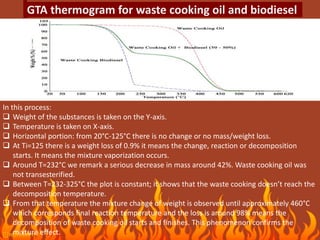
GTA thermogram for waste cooking oil and biodiesel
In this process:
 Weight of the substances is taken on the Y-axis.
 Temperature is taken on X-axis.
 Horizontal portion: from 20°C-125°C there is no change or no mass/weight loss.
 At Ti=125 there is a weight loss of 0.9% it means the change, reaction or decomposition
starts. It means the mixture vaporization occurs.
 Around T=232°C we remark a serious decrease in mass around 42%. Waste cooking oil was
not transesterified.
 Between T=232-325°C the plot is constant; it shows that the waste cooking doesn’t reach the
decomposition temperature.
 From that temperature the mixture change of weight is observed until approximately 460°C
which corresponds final reaction temperature and the loss is around 98% means the
decomposition of waste cooking oil starts and finishes. This phenomenon confirms the
mixture effect.
Prafulla D. Patil, Veera Gnaneswar Gude, Harvind K. Reddy, Tapaswy Muppaneni, Shuguang
Deng, (2011). Biodiesel Production from Waste Cooking Oil Using Sulfuric Acid and Microwave
Irradiation Processes. http://dx.doi.org/10.4236/jep.2012.31013.
Reference

Thermal analysis.pptx

  • 1.
  • 2.
    Introduction Thermal analysis refersto a group of techniques that study the properties of materials as they change with temperature. Thermal analysis is performed to abtain properties such as enthalpy, thermal capacity, mass changes, and the coefficient of heat expansion.
  • 3.
    Differences between thermal analysis methods Technique Abbrevi ation Property Uses Differentialthermal analysis DTA Temperature difference Phase changes, reactions Differential scanning calorimetry DSC Power difference or heat flow or enthalpy Heat capacity, phase changes, reactions Thermogravimetry TG/TGA Mass Decompositions ,oxidations Thermomechanical analysis TMA Deformations Mechanical changes, expansion Dynamic mechanical analysis DMA Moduli Phase changes, glass transitions, polymer composition Evolved gas analysis EGA Gas decomposition Evolved gas amount Dielectric analysis DEA Deformation Electrical changes.
  • 4.
    Instrument Detection Unit: Furnace,sample and reference holder, and sensor, heat and cool the sample in the furnace, and detects the sample temperature and property. Temperature Control Unit: Controls the furnace temperature. Data Recording Unit: Records the signals of sensor and sample temperature and analyzes them.
  • 5.
    Differential Thermal Analysis(DTA)  Differential thermal analysis (DTA), in analytical chemistry, is a technique for identifying and quantitatively analyzing the chemical composition of substances by observing the thermal behavior of a sample as it is heated.  The technique is based on the fact that as a substance is heated, it undergoes reactions and phase changes that involve absorption or emission of heat.
  • 6.
    Principle A technique inwhich the temperature difference between a substance and reference is measured as a function of temperature, while the substance and reference are subjected to a controlled temperature programme. The difference in temperature is called as Differential Temp is plotted against temperature or a function of time. Physical changes result in endothermic peak, whereas chemical reactions those of an oxidative nature are exothermic. Endothermic reaction (absorption of energy) includes vaporization, sublimation, and absorption and gives downward peak. Exothermic reaction (liberation of energy) includes oxidation, polymerization, and catalytic reactions and gives upward peak.
  • 7.
    Instrumentation  Furnace:  InDTA apparatus, one always prefers tubular furnace.  This is constructed with an appropriate material (wire or ribbon) wound on a refractory tube.  These are inexpensive. Generally, the choice of the resistance material as well that of refractory is decided from the internal maximum temperature of operation and gaseous environments.  Sample holders:  Both metallic as well as nonmetallic are employed for the fabrication of the sample holders.  Metallic materials generally include nickel, stainless steel, platinum and its alloys.  Nonmetallic materials include glass, vitreous silica or sintered alumina. Metallic holders give rise to sharp exotherms and flat endotherms. On the other hand, nonmetallic holders yield relatively sharp endotherms and exotherms.
  • 8.
    Instrumentation  DC amplifier: It is used for amplifications of signals obtained from temperature.  It is a gain or low noise circuit.  Differential temperature detector: In order to control, the three basic elements are required. These are: Sensors, control element and heater.  ON-OFF CONTROL: In this device, if the sensor-signal indicates the temperature has become greater than the set point, the heater is immediately cut off. Not used in DTA.  PROPORTIONAL CONTROL: In on-off controllers there occurs fluctuations of temperature around the set value. These can be minimized if the heat input to the system is progressively reduced as the temperature approaches the desired value.  Such a controller that anticipates the approach to the set value is known as proportional controller
  • 9.
    Instrumentation  DC amplifier: Itprovides smooth heating or cooling at a linear rate by changing the voltage through heating component. Modern DTA instruments incorporate electronic temperature controller in which the signal from thermocouple in furnace is compared electrically against ref potential which can be programmed to correspond to a variety of heating modes and heating rate.  Recorder:  In thermo-analytical studies, the signal obtainted from the sensors can be recorded in witch the signal trace is produced on paper or film, heating stylus, electrical writing or optical beam.  There are two types of recording devices:  Deflection type  Null—point type
  • 10.
    Instrumentation  Control equipment: Forsome type of samples, the atmosphere must be controlled to suppress undesirable reaction such as oxidation by flowing an inert gas.
  • 11.
    Working of DTA The sample and reference standard are placed in the furnace on flat, highly thermally conductive pans and the thermocouples are physically attached to the pans directly under the sample.  This procedure avoids or reduces any thermal lag resulting from the time required for the heat to transfer to the sample and reference materials then to thermocouples.  The thermocouples are connected in opposition.  In a similar manner any change in state that involves a latent heat of transition will cause the temperature of the sample to lag or lead that of the reference standard and identify the change of state and the temperature at which it occurred.
  • 12.
    Thermogram or DTAcurve  A differential thermogram consists of a record of the difference in sample and reference temperature plotted as a function of time, sample temperature, reference temperature or furnace temperature.  In most of the cases physical changes give rise to endothermic curves whereas chemical reaction gives rise to exothermic.  Sharp endothermic: change in crystallinity or fusion  Broad endothermic: dehydration  Exothermic: mostly oxidation reaction
  • 13.
    Factors affecting theDTA curve  Environmental factor.  Instrumental factors:  Sample holder.  Differential temperature sensing device.  Furnace characteristics.  Temperature programmer controller.  Thermal regime.  Recorder.  Sample factors:  Physical.  Chemical.
  • 14.
    Advantages and Limitations Advantages:  Instruments can be used at very high temperatures.  Instruments are highly sensitive.  Characteristic transitions or reaction temperatures can be accurately determined.  Limitations:  ΔΤ determined by DTA is not so accurate (2-3°C).  Small change in ΔΤ can not be determined and quantified.  Due to heat variation between sample and reference makes, it less sensitive.
  • 15.
    Applications  Qualitative andquantitative identification of minerals: detection of any minerals in a sample.  Polymeric minerals: DTA useful for the characterization of polymeric materials in the light of identification of thermo-physical, thermo- chemical, thermo-mechanical, thermo-elastic changes or transitions.  Measurement of crystalline: measurement of the mass fraction of crystalline material.  Analysis of biological materials: DTA curves are used to date bones remains or to study archaeological materials.
  • 16.
    Derivative differential thermalanalysis  A method based on the use of the two temperatures of the inflection determined on a single derivative differential thermal analysis (DDTA) curve and of the temperature of the extremum determined on the differential thermal analysis (DTA) curve is proposed for computing the activation energy and the order of reaction of a chemical process.  The obtained formulae do not content the heat rate. If the conversion degree corresponding to the three temperatures required by the formulae is known, the third kinetic parameter, may be also computed. The formulae is fitted to the reaction order model.
  • 17.
  • 18.
    References  Giscard Doungmoet al. (2016). Intercalation of oxalate ions in the interlayer space of a layered. DOI: 10.14419/ijbas.v5i2.5672  Skoog et al. Principles of instrumental analysis, 5th edition New York 2001.  Instrumental methods of chemical analysis Gurdeep R. Chatwal.
  • 19.
    Differential Scanning Calorimetry(DSC) The DSC has been developed by E.S Watson and M.J O’Neil in 1960 and introduced commercially at the Pittsburgh Conference on Analytical Chemistry and Applied Spectroscopy in 1963.  A calorimeter measures the heat into or out of a sample.  A differential calorimeter measures the heat of sample relative to a reference.  A differential scanning calorimeter does all the above and heats the sample with a linear temperature.
  • 20.
    Principle  The sampleand reference are maintained at the same temperature, even during a thermal event in the sample.  The energy required to maintain zero temperature difference between the sample and reference is measured.  During a thermal event in the sample, the system will transfer heat to or from the sample pan to maintain the same temperature in reference and sample pans.
  • 21.
    Instruments Two basic typesof DSC instruments :  Power compensation DSC  Sample holder: Aluminum or Platinum pans.  Sensors : Platinum resistance, thermocouples, separate sensors and heaters for the sample and reference.  Furnace: Separate blocks for the sample and reference cells.  Temperature controller: Supply the differential thermal power to the heaters to maintain the temperature of the sample and reference at the program value.
  • 22.
    Instruments  Heat fluxDSC  Sample and reference holder: Al and Pt are placed on constantan disc sample and reference holders are connected by a low-resistance heat flow path.  Sensors : • Chromel (an alloy made of 90% nickel and 10% chromium) constantan area thermocouples (differential heat flow) . • Chromel-alumel (an alloy consisting of approximately 95% nickel, 2% manganese, 2% aluminum and 1% silicon) Thermocouples (sample temperature). Thermocouple is a junction between two different metals that produces a voltage due to a temperature difference.  Furnace: One block for the sample and reference cells.  Temperature controller: The temperature difference between the sample and reference is converted to differential thermal power, which is supplied to the heaters to maintain the temperature of sample and reference at the program value.
  • 23.
    Procedure  There aretwo pans, in sample pan, material is added, while in the other, reference or standard substance is added.  Each pan sits on top of heaters which are controlled by a computer.  The computer turns on heaters, and let them heat the two pans at a specific rate, usually 10°C/min.  The computer makes sure that the heating rate stays the same throughout the experiment.
  • 24.
    Applications The DSC measures: Glass transitions.  Melting and boiling point.  Crystallization time and temperature.  Percent crystallinity.  Heats of fusion and reactions.  Specific heat capacity.  Oxidative/thermal capacity.  Reactions kinetics.  Purity.
  • 25.
    Thermogram or DSCcurve  The result of a DSC experiment is a curve of heat flux versus temperature or time.  This curve can be used to calculate enthalpies of transition, which is done by integrating the peak corresponding to a given transition. The enthalpy of transition can be expressed using equation below: Where ΔH is the enthalpy of transition, K is the calorimetry constant and A the area. ΔH=KA
  • 26.
    Factors affecting DSCcurve  Instrumental factors:  Furnace heating rate.  Recording or chart speed.  Furnace atmosphere.  Geometry of sample holder/location of sensors.  Sensitivity of the recording system.  Composition of sample containers.  Sample characteristics:  Amount of sample.  Nature of sample.  Sample packing.  Solubility of evolved gases in the sample.  Particle size.  Heat of reaction.  Thermal conductivity.
  • 27.
    Determination of heatcapacity  DSC plot can be used to determine heat capacity:  The heat flow is heat (q) supplied per unit time (t). Whereas,  The heating rate of temperature increase (ΔT) per unit time (t) . Heat flow= ℎ𝑒𝑎𝑡 𝑡𝑖𝑚𝑒 = 𝑞 𝑡 Heating rate= 𝑡𝑒𝑚𝑝 𝑖𝑛𝑐𝑟𝑒𝑎𝑠𝑒 𝑡𝑖𝑚𝑒 = Δ𝑇 𝑡  By dividing heat flow by the heating rate. It ends up with heat supplied divided by the temperature increase, which is called heat capacity. 𝑞 𝑡 Δ𝑇 𝑡 = 𝑞 Δ𝑇 =Cp=heat capacity
  • 28.
    Glass transition tempand Crystallization  Glass transition temperature: On heating the material to a certain temperature, plot will shift suddenly downward (see the curve part).  Crystallization: After glass transition, the materials have a lot of mobility. They wiggle and squirm, and never stays immobilized for very long time. But when they rich the right temperature, they give off enough energy to move into ordered arrangements, which is called crystals. The temperature at the highest point in the peak is the polymer’s crystallization temperature Tc (see the curve part).
  • 29.
    Melting or fusion Ifwe heat, our material pasts its Tc, eventually we will reach go towards another transition, called melting. When we attain the material’s melting temperature Tm, the material crystals start to fall apart, that is they melt. It comes out of their ordered arrangements and begin to move around freely that can be spotted on a DSC plot. This means that the little heater under the sample pan must put a lot of heat into the material in order to both melt the crystals and keep the temperature rising at the same rate as that of the reference pan. This extra heat flow during melting shows up as big as dip on DSC plot see the curve part.
  • 30.
    Advantages and Limitations Advantages:  Instruments can be used at very high temperatures.  Instruments are highly sensitive.  Flexibility in sample volume/form.  Characteristic transition or reaction temperatures can be determined.  High resolution obtained.  High sensitivity.  Stability of the material.  Limitations:  DSC generally unsuitable for two phases mixtures  Difficulties in test cell preparation in avoiding evaporation of volatiles solvents.  DSC is generally used only for thermal screening of isolated intermediates or products.  Does not detect gas generation.  Uncertainty of heats of fusion and transition temperatures.
  • 31.
    References  https://www.mff.cuni.cz/en/kfm/experimental-facilities/differential- scanning-calorimetry-dsc.  https://www.surfacesciencewestern.com/analytical- services/differential-scanning-calorimetry-dsc/. https://www.semanticscholar.org/paper/DIFFERENTIAL-SCANNING- CALORIMETRY-%28DSC%29-AN-AND-IN-Patra- Acharya/84f6df23d8789c884c13790c9e339fc72e7eb61d/figure/3.  https://textilefocus.com/determination-thermal-behaviour-pet- bottle-using-differential-scanning-calorimetry-dsc/.  https://www.researchgate.net/publication/266469730_Solutions_to_ Blistering_Modification_of_a_Polyurea-co- _urethane_Coating_Applied_to_Concrete_Surfaces/figures?lo=1.
  • 32.
    Thermogravimetry analysis (TGA/TG) Thermogravimetryor thermal gravimetric analysis (TGA) is a method thermal analysis in which the sample’s mass is measured over time as the temperature changes. This measurement provides information about physical phenomena, such as phase transitions, absorption or desorption as well as chemical phenomena including chemisorption, thermal decomposition, and solid-gas reactions (oxidation or reduction as example).
  • 33.
     In thermo-gravimetricanalysis, the sample is heated in each environment (air, N2, CO2, He, Ar etc.) at controlled rate. The change in the weight of the substance is recorded as a function of temperature or time.  The temperature is increased at a constant rate for a known initial weight of the substance and the changes in weights are recorded as function of temperature at different time interval.  This plot of weight change against temperature is called thermo-gravimetric curve or thermo-gram. Principle
  • 34.
     Isothermal orstatic thermogravimetry: In this technique, the sample weight is recorded as function of time at constant temperature.  Quasistatic thermogravimetry: In this one, the substance is heated to constant weight at each of series of increasing temperatures.  Dynamic thermogravimetry: Here, the analyte is heated in an environment whose temperature is changing in a predetermined manner generally at linear rate. This type is the most used. TGA topology
  • 35.
     Recording balance: Amicrobalance is used to record a change in mass of sample. An ideal microbalance must possess following features: • It should accurately and reproducibly record the change in mass of sample in ideal ranges of atmosphere conditions and temperatures. • It should provide electronic signals to record the change in mass using a recorder. • The electronic signals should provide rapid response in mass change. • It should be stable at high ranges, mechanically and electrically. • Its operation should be user friendly. After the sample has been placed on microbalance, it is left for 10-15mn to stabilize. Recorder balances are two types: • Deflection-type instrument. • Null-type instrument.  Deflection-type balance: There are beam type, helical type, Cantilevered beam and Torsion wire. Instrumentation and Procedure
  • 36.
     Null pointbalances: It consist of a sensor which detects the deviation from the null point and restores the balance to its null points by means of restoring force. Instrumentation and Procedure  Sample holder:  The substance to be studied is placed in sample holder or crucible. It is attached to the weighing arm of microbalance.  There are different varieties of crucibles used. Some differ in shape and size while some differ in materials used.  They are made from platinum, aluminum, quartz, or alumina and some other materials like graphite, stainless steel, glass etc. Crucibles should have temperature at least 100K greater than temperature range of experiment and must transfer heat uniformly to sample. Therefore the shape, thermal conductivity and thermal mass of crucibles are important which depends on the weight and nature of sample and temperature range. There are different types of crucibles which are: • Shallow pan used (used for volatiles substances). • Deep crucibles (industrial scale calcination).
  • 37.
    • Loosely coveredcrucibles (self generated atmosphere studies). • Retort cups (Boiling point studies). Instrumentation and Procedure  Furnace:  The furnace should be designed in such way that it produces a linear heating range.  It should have a hot zone which can hold sample and crucible and its temperature corresponds to the temperature of furnace.  There are different combinations of microbalance and furnace available. The furnace heating coil should be wound in such a way that there is no magnetic interaction between coil and sample or there can cause apparent mass change.  Temperature programmer/controller:  Temperature measurement is done in no of ways thermocouple is the most common technique.
  • 38.
    Instrumentation and Procedure The position of the temperature measurement device relative to the sample is very important.  The major types are: • The thermocouple is placed near the sample container and it has no contact with the sample container. This is not a good arrangement where low-pressure are employed. • The thermocouple is kept inside the sample holder but not in contact with it. This arrangement is better than the first one because it responds to small temperature changes. • The thermocouple is placed either in contact with sample or with the sample container. This is the best arrangement of sample temperature detection.
  • 39.
    Instrumentation and Procedure Recorder: The recording systems are mainly of 2 types:  Time-base potentiometric strip chart recorder.  X-Y recorder. • In some instruments, light beam galvanometer, photographic paper recorders or one recorder with two or more pens are also used. • In the X-Y recorder, we get curves having plot of weights directly against temperatures. • However, the percentage mass change against temperature or time would be more useful.
  • 40.
    TGA curve  Theinstrument used for thermo-gravimetry is a programmed precision balance for rise in temperature known as thermo-balance.  Results are displayed by a plot of mass change versus temperature or time and are known as thermogravimetric curves or TGA curves.  TGA curves are normally plotted with the mass change (Dm) in percentage on the y-axis and temperature (T) or Time (t) on the x-axis.  There are two temperatures in the reaction, Ti(procedural decomposition temp.) and Tf (final temp.) representing the lowest temperature at which the onset of a mass change is seen and the lowest temperature at which the process has been completed, respectively.  The reaction temperature and interval (Tf-Ti) depend on the experimental condition; therefore, they do not have any fixed value.
  • 41.
    Factors affecting TGA Instrumental factors:  Furnace heating rate: The temperature at which the compound decompose depends upon the heating rate. When the heating rate is high, the decomposition temperature is also high. A heating rate of 3.5°C/mn is recommended for reliable and reproducible TGA.  Furnace atmosphere: The atmosphere inside the furnace surrounding the sample has a profound effect on the decomposition temperature of the sample. A pure N2 gas from a cylinder passed through the furnace which provides an inert atmosphere.  Sample characteristics:  Weight of the sample: A small weight of the sample is recommended using a small weight eliminates the existence of temperature gradient throughout the sample.  Particle size of the sample: The particle size of the sample should be small and uniform. The use of large particle or crystal may result in apparent, very rapid weight loss during heating.  Other factors.  Sample holder  Heat of reaction  Sample compactness  Sample previous history.
  • 42.
    Applications  From TGA,we can determine the purity and thermal stability of both primary and secondary standard.  Determination of complex mixture composition and complex systems composition complex OR decomposition.  For studying the sublimation behavior of various substances.  TGA is used to study the kinetics of the reaction rate constant.  Applied in the study of catalyst: the change in the chemical states of the catalyst may be studied by TGA.  Analysis of the dosage form.  Product lifetime estimation.  Materials oxidative stability investigation.  TGA is often used to measure residual solvents and moisture but can be also be used to determine solubility of pharmaceutical materials in solvent.  The effect of reactive or corrosive atmosphere on materials.  Moisture and volatiles contents on materials.
  • 43.
    Advantages and Limitations Advantages:  A relatively small set of data is to be treated.  Continuous recording of weight loss as a function of temperature ensures equal weightage to examination over the whole range of study.  As a single sample is analyzed over the whole range of temperature, the variation in the value of the kinetic parameters, if any, will be indicated.  Limitations:  The chemical or physical changes which are not accompanied by the change in mass on heating are not indicated in TGA.  During TGA, Pure fusion reaction, crystalline transition, glass transition, crystallization and solid-state reaction with no volatile product would not be indicated because they provide no change in mass of the specimen.
  • 44.
    Reference  Sravanthi Loganathanet al. (2002), Thermogravimetry Analysis for Characterization of Nanomaterials.  https://www.researchgate.net/publication/344124333_En gineering_mixed_surfactant_systems_to_template_hierarc hical_nanoporous_materials/figures?lo=1.  https://www.researchgate.net/publication/265102984_Th ermoanalytical_Instrumentation_and_Applications/figures ?lo=1.  Skoog et al. Principles of instrumental analysis, 5th edition New York 2001.  Instrumental methods of chemical analysis Gurdeep R. Chatwal.
  • 45.
    TGA with EVOLVEDgas analysis TGA-EGA It is well known that the evolution of gaseous compounds take place when the sample undergoes decomposition under a controlled temperature program. When TGA is coupled to Fourier Transform Infrared spectroscopy (FTIR) or gas chromatography-mass spectrometry instruments, it is possible to analyze the functional composition of gaseous compounds released from sample subjected to controlled temperature program. Several techniques are now available for analysis of gaseous products from TG analysis and the approach is termed as “evolved gas analysis” (EGA). The EGA approach involves a subset of hyphenated techniques in which two or more instruments are integrated. The TGA-EGA techniques followed currently are discussed as follows:
  • 46.
    Principle Evolved gas analysis(EGA) is a technique in which the nature and/or the amount of gas or vapors evolved from the sample is monitored against time or temperature while the temperature of the sample in a specified atmosphere is programmed.
  • 47.
    Instrumentatıon There are manyways in which the evolved gases may be detected and identified.  For general thermal decomposition work, a large sample of several grams may be heated in a furnace in a following gas stream, using a controlled temperature program.  The products can be collected by passing the gas through an absorber, a coal trap or a series of a specific gas detectors.  The products are differentiated as the non-volatile residue, remaining in the oven, the high boilers, like waxes and less volatiles oils, condensing on the walls, and the volatiles, passing onto the traps for condensation at lower temperatures.  In the apparatus, it is an advantage to control the conditions by using a thermal analysis technique to provide the heating.  Thermogravimetry has been widely used for this, and the gases evolved from the thermobalance are conducted away into other analytical devices.
  • 48.
    Procedures We may classifythe methods used for detection and/or identification under three headings: • Physical methods: conductivity and density. • Chemical methods: reaction, color indication, electrochemical. • Spectroscopic methods: mass spectrometry, Infrared.  Physical method: • The sensitive detectors of gases used for gas chromatography are often added to thermal analysis units to detect evolved gases. • The DSC instrument could be fitted with a thermal conductivity detector to show changes in the gas streams. • Flame-ionization detectors (FID) have been used to detect gases evolved directly from heated plastic materials as well as gases separated by GC. However, theses detectors are unable to detect water vapors of carbon dioxide. • Theses gas evolved may be absorbed into a suitable solvent. • The change can be followed by monitoring the electrical conductance or the capacitance of the solution or the solution may be analyzed by chromatography. • In the moisture evolution analyzer (MEA), the moisture evolved from the heater is transferred by nitrogen carrier gas into the electrolytic cell detector where it is absorbed by phosphorous pentoxide coated onto platinum electrodes. • The water is electrolyzed to hydrogen and oxygen which are carried away by the gas stream. • The electrolysis current is integrated and gives the amount of water directly.  Chemical method: • The chemical reaction of gases with reagents or detectors specific to their chemical nature is a simple method for detecting gases. • The evolution of acidic gases can be detected and quantified by absorbing the evolved gas in a solvent and measuring the change in pH, or color of an indicator or by eventual titration.
  • 49.
    TGA-FTIR Method  Principle: •A sample will release volatile components when burnt in TGA. Theses gases are transferred to the IR cell which detects the components to be identified depending upon various absorption bands. • The absorption bands are further tallied with digital library to identify the evolved gases.  Advantages: • Affordable gas analysis. • No separate transfer line. • No need for liquid nitrogen (DTGS detector) • Optimal for tests with an automatic sample changer.  Limitations: • Nonpolar molecules can not be determined. • Moisture sensitive.  TGA-FTIR apparatus:
  • 50.
    TGA-GC/MS method  Principle: •Like TGA-FTIR, evolved gas is sent into a capillary column, that separate the gases. • The difference in the chemical properties between different molecules in a mixture and their relive affinity for the stationary phase of the column will promote separation of the molecules as the sample travels the length of the column. • The molecules are retained by the column and then elute from the column at different times, and this allows the mass spectrometer downstream to capture, ionize, accelerate, deflect, and detect the ionized molecules separately.  Advantages: • Can be carried out for release of symmetrical molecules. • Higher sensitivity. • Shows fragmentation of molecules. • Higher transfer time.  Limitations: • Does not show isomerism. • No functional groups. • Higher price and more time consuming.  TGA-FTIR apparatus:
  • 51.
    TGA-MS method  Principle: •Another type of integrated instrument used for EGA is TGA-mass spectrometry (MS) which is useful for detection of very low level of impurities in real time. Like TGA- FTIR, gases released during heating of sample are passed to MS where the compounds can be detected. TGA-MS serves as a powerful tool for EGA because of its ability to identify even minute level of components present in the evolved gas. Hence, this technique finds great potential for identification of components in quality control, safety as well as product development departments.  Advantages: It is only able to detect extremely small amounts of substances. This technique is ideal for the online characterization of all types of volatiles compounds.  Apparatus:
  • 52.
    TGA-EGA applications  Pharmaceuticals: •Stability • Residual solvent • Formulation  Polymers: • Composition • Hazard evaluation • Identification  Catalysts: • Product/byproduct analysis • Conversion efficiency  Natural products: • Contamination in soil • Raw material selection  Inorganics: • Reaction elucidation • Stoichiometry • Pyrotechnics  Extra-Terrestrial planet geological and atmosphere analysis
  • 53.
    Thermomechanical analysis (TMA) The mechanical properties of materials provide an essential information about their suitability for usage and can indicate how the material has been treated before testing.  The molecular nature of the material will be most important in determining their mechanical properties.  For example, the behavior of plastics will be very greatly influenced by their chemical structure, their blending and the way in which they have been fabricated.  The mechanical methods are divided into two classes, depending on whether the forces applied are constant or varied.  Very often, the parameters and properties which are measured are specific to the method but can still be extremely useful in comparing materials.
  • 54.
    Principle • This isa technique in which the deformation of the sample under non-oscillating stress is monitored against time or temperature, while the temperature of the sample, in a specified atmosphere, is programmed. • The stress may be compression, tension, flexure or torsion, and if the stress is too low to cause deformation, TMA monitors the dimensions of the sample, and this role can be called thermo- dilatometry. • If the stress is oscillating, the technique is called dynamic-load thermomechanical analysis (DLTMA).
  • 55.
    Mechanical Moduli • If anysample is subjected to a force, it may behave in a variety of ways. • A large force, suddenly applied, will often break the material, but a small force will deform it. • Liquid will flow when a force is applied, depending on their viscosity. • Some solid may deform elastically, returning exactly to their former shape and size when the force is withdrawn. • Others may behave visco-elastically, showing behavior which incorporates both flow and elastic deformation. • With many materials, there is an elastic limit above which the material undergoes plastic deformation which is irreversible. • Further increase in load eventually causes fracture. • The parameters, symbols and terminology that will be used for studying mechanical properties must be established. • The stress is the force applied per unit area. • So, we have normal tensile stress, tangential sharing stress and pressure change. • This stress will cause a deformation measured by the strain, which is the deformation per unit dimension. We have three types:  Tensile strain or elongation: ε=Δl/l  Shear strain: δ=ΔX/Y
  • 56.
    Mechanical Moduli  Volume orbulk strain: ϴ=ΔV/V with no unit. • For an elastic material, HOOK’s law applies, and strain is proportional to stress, the constant being the modulus. • Modulus=stress/strain. We have 3 types:  Tensile, or Young’s modulus: E=σ/ε  Shear Modulus: G=τ/δ  Bulk or compression modulus: K=ΔP/ϴ NB: σ, τ, P all expresses by F/A with F=Force and A=area
  • 57.
    Instrumentation  Prove: Thisis the most important part of the instrument. A predetermined load is applied to the sample via probe. There are three main types of the probe for TMA: • Expansion/Compression prove: It is used for the measurement of the deformation by the thermal expansion and the transition of the sample under the compressed force is applied. • Penetration probe: It is used to measure the softening temperature. • Tension probe: It is used for the measurement of the thermal expansion and the thermal shrinkage of the sample such as the film and the fiber. The materials of probes are quartz glass, alumina, and metals. The choice is dependent on the temperature range and/or the measurement purpose.  Linear Variable Displacement Transducer: LVDT is a type of electrical transformer used for measuring linear displacement (position). LVDTs are inherently frictionless, they have a virtually infinite cycle life when properly used. They have been widely used in applications such as power turbines, nuclear reactors, aircraft and many others. These transducers have low hysteresis and excellent repeatability. LVDT operation does not require an electrical contact between the moving part and coil assembly, but instead relies on the electromagnetic coupling.
  • 58.
    Instrumentation Current is driven through the primarycoil at A, causing an induction current to be generated through the secondary coils at B.
  • 59.
    Procedure  The instrumentis warmed up before putting the sample.  The sample is prepared by according to the modes used.  For example, the sample should be flat for compression modes to make sure the sample is in a good contact with the probe.  The sample is put into the furnace and the probe touched the sample.  The probe is integrated into an inductive position sensor.  For temperature measurement of the sample, the thermocouple is placed near the sample.  The system is heated at a slow rate.  If the specimen expands or contacts, the probe will be moved.  By applying the force on the sample from the force generator by the probe, the sample temperature is changed in the furnace.  The sample deformation such as thermal expansion and softening with changing temperature is measured as the probe displacement by the length detector.  LVDT is used for length detector sensor.  The measurement consists then of a record of force and length versus temperature.
  • 60.
    Curve and Applications  Coefficient ofthermal expansion.  Glass transition Temperature.  Solvent swelling of polymers.  Films and Fibbers.  Phase transition.  Sintering.  Polymers cure.
  • 61.
    Dynamic mechanical Analysis(DMA)  Mechanical test, the response of a material to periodic stress is measured.  DMA provides information about yhe visco-elastic nature of a polymer.  It is a sensitive test for studying glass transitions and secondary transitions in polymer.  Considering the response of elastic and viscous to imposed sinusoidal strains.  Viscosity: resistance to flow (damping).  Elasticity: ability to revert to original shape.  Viscoelasticity: ability to be both elastic and viscous.  Glass transition temperature: Transition from bond stretching to long range molecular motion.  Flow temperature: Point at which heat vibration is enough to break bonds in crystal lattice.
  • 62.
    Principle  DMA measuresvisco-elastic materials as a function of temperature of frequency. When the materials are deformed under the action of a periodic force or displacement.  Modulus as a function of time or temperature is measured.  Provides information on phase transitions.  Exothermic reaction (liberation of energy) includes oxidation, polymerization, and catalytic reactions and gives upward peak.
  • 63.
    Types of dynamicexperiments  Temperature sweep. • Frequency and amplitude of oscillating stress is held constant. • Temperature is increasing. • Results are display as function of temperature.  Scan time. • Temperature held constant • Properties measured as a function of time • Used when studying curing of thermosets.  Frequency scan • Tests range of frequency at constant temperature. • Analyze the effects of frequency on temperature. • Run on fluids or polymers melts. • Result display as modulus and viscosity as function of frequency.
  • 64.
    Instrumentation  Motor anddriveshaft used to apply dynamic stress.  LVDT used to measure linear displacement.  The carriage contains the sample and is typically enveloped by a furnace and heat sink.  Different fixtures can be used to hold the samples.  And should be choosing according to the type of sample.
  • 65.
    Working and Curve Working • The sample is clamped into a frame and is heated by the furnace. • The sample in the furnace is applied the stress from the force generator via probe. • To make the strain amplitude constant, the stress is applied as the sinusoidal force. • The deformation amount generated by the sinusoidal force is detected. • Viscoelastic values such as elasticity and viscosity is calculated from the applied stress and the strain and plotted as a function of temperature or time. • As the free volume of the chain segment increases, its ability to move in various directions also increases. • This increased mobility in either side chains or small groups of adjacent backbone atoms results in a greater compliance (lower modulus) of the molecule. • Theses movements have been classified by their type of motion.  Curve • As the temp increases, the material goes through a number of minor transitions due to expansion. At theses transitions, the modulus also undergoes changes. • The glass transition Tg occurs with the rapid change of physical properties at some temp.
  • 66.
    Working and Curve •The storage (elastic) modulus of the polymer drops dramatically at Tg. • As the temperature is rises above the glass transition point, the material loses its structure and becomes rubbery before finally melting.
  • 67.
    Applications, Advantages andLimits  Applications • Measurement of the glass transition temp of polymer. • Varying the composition monomers. • Evaluate effectively the miscibility of polymers • Characterize the glass transition temperature of material. • Describe quality defects, processing flaws and other parameters.  Advantages • DMA is an essential technique for determining the polymer viscoelastic properties. • Due to its use of oscillating stress, this method can quickly scan and calculate the modulus for a range of temperatures. • Fast analysis time (typically 30s). • Easy sample preparation.  Limitations • The modulus value is very dependent on sample dimensions. • Large inaccuracies are introduced if dimensional measurements of samples are slighltly inaccurate. • Oscillating stress converts mechanical energy to heat and changes the temperature of the sample.
  • 68.
    References  Yang Liu.(2016). PhD thesis “Novel Parylene Filters for Biomedical Applications”.  K. Dyamenahalli, A. Famili, R. Shandas, (2015). ”Characterization of shape-memory polymers for biomedical applications’’. http://dx.doi.org/10.1016/B978-0-85709-698-2.00003-9.  Yi-Yang Peng, Diana Diaz Dussan, Ravin Narain, (2020). Thermal, mechanical, and electrical properties. https://doi.org/10.1016/B978- 0-12-816806-6.00009-1.  W.E. Morton et al. Physical properties of textile fibers wodhead publishing in textiles.  Hevin P. Menard. Dynamic mechanical analysis / a practical introduction second edition, CRS press.
  • 69.
    GTA thermogram forwaste cooking oil and biodiesel In this process:  Weight of the substances is taken on the Y-axis.  Temperature is taken on X-axis.  Horizontal portion: from 20°C-125°C there is no change or no mass/weight loss.  At Ti=125 there is a weight loss of 0.9% it means the change, reaction or decomposition starts. It means the mixture vaporization occurs.  Around T=232°C we remark a serious decrease in mass around 42%. Waste cooking oil was not transesterified.  Between T=232-325°C the plot is constant; it shows that the waste cooking doesn’t reach the decomposition temperature.  From that temperature the mixture change of weight is observed until approximately 460°C which corresponds final reaction temperature and the loss is around 98% means the decomposition of waste cooking oil starts and finishes. This phenomenon confirms the mixture effect.
  • 70.
    Prafulla D. Patil,Veera Gnaneswar Gude, Harvind K. Reddy, Tapaswy Muppaneni, Shuguang Deng, (2011). Biodiesel Production from Waste Cooking Oil Using Sulfuric Acid and Microwave Irradiation Processes. http://dx.doi.org/10.4236/jep.2012.31013. Reference

Editor's Notes

  • #3 Heat expansion coeff: coefficient de dilatation
  • #7 Endothermic or downward peak: melting. Exothermic or upward peak: crystallization/solidification/condensation
  • #8 Stainless steel: acier inoxydable. Alloys: alliages. Vitreous silica: silice vitreuse. Sintered alumina: alumine frittée ou cuite
  • #12 Thermocouple is a junction between two different metals that produces a voltage due to a temperature difference. Lag: retard ou decalage. Lead: avance. Latent heat: enthalpie de changement d'état
  • #13 Endothermic peak release heat and exothermic one needs or absorbs heat.
  • #15 Accurate: précis
  • #17 Compute:calculate. Heat rate: Taux de chaleur. Fitted: ajustée
  • #20 Scanning: balayage
  • #26 Concave: concave. Convex: convexe
  • #27 Chart:graphique
  • #28 Plot:tracé
  • #29 To shift:se déplacer. Wiggle/squirm: trotiller. Give off/evolve: dégager
  • #30 Fall apart: desagréger. Spot: repérer. Dip: creux
  • #31 Screening: criblage/dépistage
  • #36 Beam: faisceau. Spring: resort
  • #38 Coil: bobine, Crucible: Creuset. Retort cups: tasses de cornue. Range: plage, portée, intervalle, gamme
  • #41 Display: afficher. Onset: début. Therefore: par consequent
  • #42 Reliable:fiable. Surrounding: entourant
  • #44 Set:ensemble. Weightage:ponderation. Range: plage
  • #46 Subset:sous-ensemble
  • #48 Trap: piège. Oven: Four. PID: photo-ionization detector or Piping and instrumentation diagram
  • #49 Headings: rubriques
  • #50 Tailled:compté
  • #51 Downstream: en aval. Deflect: dévier
  • #54 Suitability:aptitude
  • #56 Withdraw:retirer. Tensile strain:contrainte de traction. Shear strain: contrainte de cisaillement: Stress : deformation. Strain: contrainte
  • #58 Prove: sonde. Softening temp: temp de ramollissement. Shrinkage: rétrécissement
  • #64 Sweep: balayage. Curing: durcissement
  • #66 Clamp: Serrer. Frame: cadre