IR Sampling Technique
1
Content
 Solids run in solution
 Mull technique
 Pressed pellet technique
 Sampling for gases
 Sampling for liquids
2
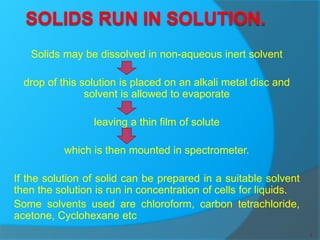
Solids may be dissolved in non-aqueous inert solvent
drop of this solution is placed on an alkali metal disc and
solvent is allowed to evaporate
leaving a thin film of solute
which is then mounted in spectrometer.
If the solution of solid can be prepared in a suitable solvent
then the solution is run in concentration of cells for liquids.
Some solvents used are chloroform, carbon tetrachloride,
acetone, Cyclohexane etc
3
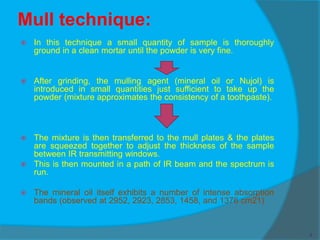
Mull technique:
 In this technique a small quantity of sample is thoroughly
ground in a clean mortar until the powder is very fine.
 After grinding, the mulling agent (mineral oil or Nujol) is
introduced in small quantities just sufficient to take up the
powder (mixture approximates the consistency of a toothpaste).
 The mixture is then transferred to the mull plates & the plates
are squeezed together to adjust the thickness of the sample
between IR transmitting windows.
 This is then mounted in a path of IR beam and the spectrum is
run.
 The mineral oil itself exhibits a number of intense absorption
bands (observed at 2952, 2923, 2853, 1458, and 1376 cm21)
4
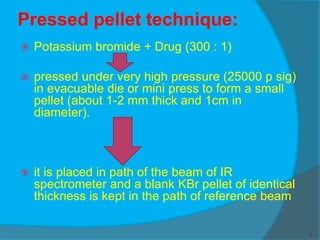
Pressed pellet technique:
 Potassium bromide + Drug (300 : 1)
 pressed under very high pressure (25000 p sig)
in evacuable die or mini press to form a small
pellet (about 1-2 mm thick and 1cm in
diameter).
 it is placed in path of the beam of IR
spectrometer and a blank KBr pellet of identical
thickness is kept in the path of reference beam
5
Sampling for gases:
 Small size particles hence the cells are
large.
 •10 cm to 1m long
 •Multiple reflections can be used to
make the effective path length as long
as 40 cm
 •Lacks sensitivity
6
Sampling for liquids:
 Liquid samples taken.
 •Put it into rectangular cells of KBr, NaCl etc.
 •I R spectra obtained.
 •Sample thickness … such that transmittance
lies between 15 – 20 % i.e., 0.015 – 0.05 mm
in thickness.
 •For double beam, matched cells are generally
employed
 •One cell contains sample while other has
solvent used in sample.
 •Matched cells should be of same thickness,
protect from moisture.
7
8

IR Sampling technique_ Lalit

  • 1.
  • 2.
    Content  Solids runin solution  Mull technique  Pressed pellet technique  Sampling for gases  Sampling for liquids 2
  • 3.
    Solids may bedissolved in non-aqueous inert solvent drop of this solution is placed on an alkali metal disc and solvent is allowed to evaporate leaving a thin film of solute which is then mounted in spectrometer. If the solution of solid can be prepared in a suitable solvent then the solution is run in concentration of cells for liquids. Some solvents used are chloroform, carbon tetrachloride, acetone, Cyclohexane etc 3
  • 4.
    Mull technique:  Inthis technique a small quantity of sample is thoroughly ground in a clean mortar until the powder is very fine.  After grinding, the mulling agent (mineral oil or Nujol) is introduced in small quantities just sufficient to take up the powder (mixture approximates the consistency of a toothpaste).  The mixture is then transferred to the mull plates & the plates are squeezed together to adjust the thickness of the sample between IR transmitting windows.  This is then mounted in a path of IR beam and the spectrum is run.  The mineral oil itself exhibits a number of intense absorption bands (observed at 2952, 2923, 2853, 1458, and 1376 cm21) 4
  • 5.
    Pressed pellet technique: Potassium bromide + Drug (300 : 1)  pressed under very high pressure (25000 p sig) in evacuable die or mini press to form a small pellet (about 1-2 mm thick and 1cm in diameter).  it is placed in path of the beam of IR spectrometer and a blank KBr pellet of identical thickness is kept in the path of reference beam 5
  • 6.
    Sampling for gases: Small size particles hence the cells are large.  •10 cm to 1m long  •Multiple reflections can be used to make the effective path length as long as 40 cm  •Lacks sensitivity 6
  • 7.
    Sampling for liquids: Liquid samples taken.  •Put it into rectangular cells of KBr, NaCl etc.  •I R spectra obtained.  •Sample thickness … such that transmittance lies between 15 – 20 % i.e., 0.015 – 0.05 mm in thickness.  •For double beam, matched cells are generally employed  •One cell contains sample while other has solvent used in sample.  •Matched cells should be of same thickness, protect from moisture. 7
  • 8.