SUBMITTED BY:
HARSHALA DHENDE
FIRST YEAR M.PHARM
SEM-I
(DEPT. OF PHARMACEUTICS)
Guided By:
Mr. Mukesh T. Mohite
DR. D.Y.PATIL COLLEGE OF PHARMACY, AKURDI, PUNE
1
Outline…..
 What is Thermal Analysis?
 Types of thermal analysis techniques
 DTA(DIFFERENTIAL THERMAL ANALYSIS)
 Principle involved
 Instrumentation
 Advantages and disadvantages
 Applications
2
What is Thermal analysis?
Definition of Thermal Analysis (TA):
Thermal Analysis (TA)is a
group of techniques that study the
properties of materials as they change
with temperature.
3
 When a material is heated its structural and chemical
composition can undergo changes such as fusion,
melting, crystallization, oxidation, transition,
decomposition, expansion and sintering.
 Using Thermal Analysis such changes can be monitored
in every atmosphere of interest. The obtained information
is very useful in both quality control and problem solving.
 In practice thermal analysis gives properties like; enthalpy,
thermal capacity, mass changes and the coefficient of
heat expansion.
4
 Thermal analysis includes different methods. These
are distinguished from one another by the property which is
measured;
1. ƒThermo gravimetric analysis (TGA): mass
2. ƒ Differential thermal analysis (DTA): temperature
difference
3. ƒDifferential scanning calorimetric (DSC): heat difference
4. ƒPressurized TGA (PTGA): mass changes as function of
pressure.
5. s
6. ƒThermo mechanical analysis (TMA): deformations and
dimension 5
7. ƒDilatometer (DIL): volume ƒ
8. Evolved gas analysis (EGA): gaseous decomposition
products
Often different properties may be measured at the same
time: TGA-DTA, TGA-EGA
6
7
INTRODUCTION…
 Differential thermal analysis(DTA) is a thermo
analytical technique similar to differential scanning
calorimetric.
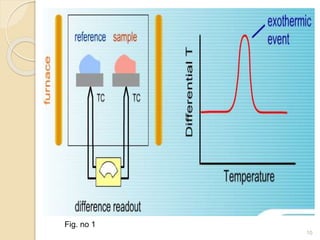
 In DTA ,the material under study and an inert
reference are made to undergo identical thermal
cycles ,while recording any temperature difference
between sample and reference.
 This differential temperature is then plotted again
time or, or against temperature.
 The curve plotted is called as DTA curve or thermo
gram. 8
 Changes in the sample either endothermic or
exothermic,can be detected relative to the inert
reference.
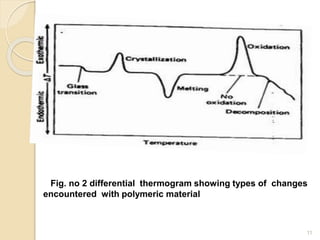
 Thus a DTA curve provides data on the
transformation that have occurred such as glass
transition, crystallization, melting and sublimation.
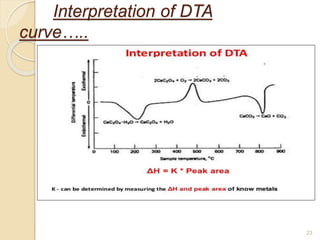
 The area under DTA peak is the enthalpy change
and is not affected by the heat capacity of the
sample.
9
10
Fig. no 1
Fig. no 2 differential thermogram showing types of changes
encountered with polymeric material
11
 In DTA both the test sample and inert
reference material (alumina) controlled
heating or cooling programming.
 If zero temperature difference b/t
sample and reference material – then
sample doe not undergo any chemical and
physical changes.
If any reaction takes place temperature
difference will occur between sample and
reference material. 12
Principle of DTA….
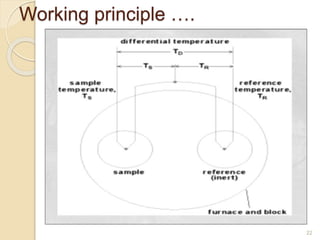
 A technique in which the temperature
difference between a substance and
reference material is measured as function of
temperature, while the substance and
reference are subjected to controlled
temperature programmed.
 The difference in the temp is called as
differential temperature and is plotted against
temp or function of time.
 Physical changes usually result in
endothermic peaks, whereas chemical
reaction those of an oxidative nature show
exothermic peak. 13
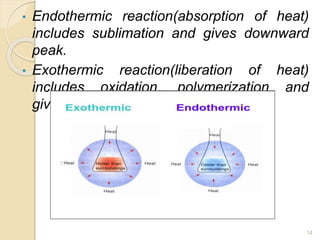
• Endothermic reaction(absorption of heat)
includes sublimation and gives downward
peak.
• Exothermic reaction(liberation of heat)
includes oxidation, polymerization and
gives upward peak.
14
Factors causing change in
heat/temperature:
Physical:
 Adsorption(exothermic)
 Desorption(endothermic)
 A change in crystal structure (endo –or exothermic)
 Crystallization (exothermic)
 Melting(endothermic)
 Vaporization (endothermic)
15
Chemical :-
 Oxidation (exothermic)
 Reduction (endothermic)
 Break down reactions (endo or exothermic)
 Chemisorptions (exothermic)
 Solid state reactions (endo –or exothermic)
16
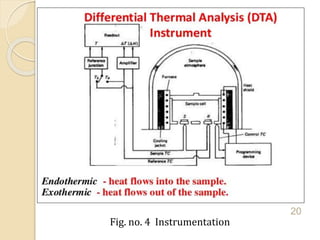
INSTRUMENTATION………
 A DTA consists of a ,
1. sample holder
2. thermocouples
3. a furnace;
4. a temperature programmer
5. and a recording system.
 The key feature is the existence of two
thermocouples connected to a voltmeter.
 One thermocouple is placed in an inert material such
as aluminum oxide, while the other is placed in a
sample of the material under study.
17
1. Sample holder:
The sample holder and reference cells are made
up of aluminum.
2. Sensors/thermocouples:
Platinum or chromyl thermocouples one for
sample and one for reference material is joined to
differential temperature controller.
3. Furnace:
alumina block containing sample and reference
cells.
18
4. Temperature controller:
controls temperature program and
furnace atmosphere
5. Recording system:
It is a system where the change in
the temperature i.e. differential temperature is
recorded and the enthalpy is recorded
19
20
Fig. no. 4 Instrumentation
Working…
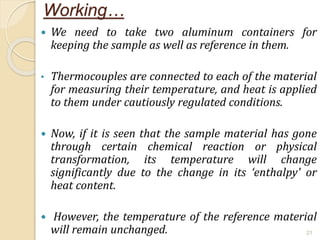
 We need to take two aluminum containers for
keeping the sample as well as reference in them.
• Thermocouples are connected to each of the material
for measuring their temperature, and heat is applied
to them under cautiously regulated conditions.
 Now, if it is seen that the sample material has gone
through certain chemical reaction or physical
transformation, its temperature will change
significantly due to the change in its ‘enthalpy' or
heat content.
 However, the temperature of the reference material
will remain unchanged. 21
Working principle ….
22
Interpretation of DTA
curve…..
23
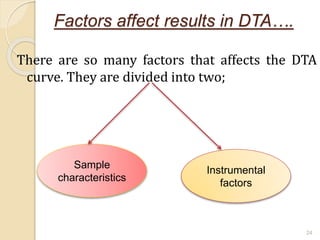
Factors affect results in DTA….
There are so many factors that affects the DTA
curve. They are divided into two;
24
Sample
characteristics
Instrumental
factors
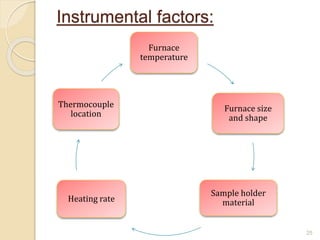
Instrumental factors:
Furnace
temperature
Furnace size
and shape
Sample holder
materialHeating rate
Thermocouple
location
25
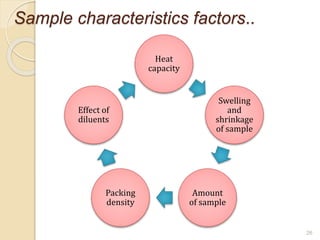
Sample characteristics factors..
Heat
capacity
Swelling
and
shrinkage
of sample
Amount
of sample
Packing
density
Effect of
diluents
26
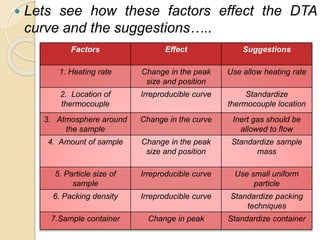
 Lets see how these factors effect the DTA
curve and the suggestions…..
Factors Effect Suggestions
1. Heating rate Change in the peak
size and position
Use allow heating rate
2. Location of
thermocouple
Irreproducible curve Standardize
thermocouple location
3. Atmosphere around
the sample
Change in the curve Inert gas should be
allowed to flow
4. Amount of sample Change in the peak
size and position
Standardize sample
mass
5. Particle size of
sample
Irreproducible curve Use small uniform
particle
6. Packing density Irreproducible curve Standardize packing
techniques
7.Sample container Change in peak Standardize container
Advantages:
1. Instruments can be used at a very high
temperature
2. Instruments are highly sensitive
3. Flexibility in crucible volume/form
4. Characteristic transition or reaction temperature
can be accurately determined
Disadvantages:
1. Reaction or transition estimations is only 20% to
50% DTA
2. Uncertainty in heats of fusion
28
Applications of differential
thermal analysis……
 Qualitative and Quantitative identification of
Minerals:
Detection of any minerals in sample.
 Polymeric materials:
DTA is useful for characterization of polymeric
materials in the light of identification of thermo-
physical, thermo-chemical ,thermo-mechanical,
and thermo-elastic changes or transition.
 Measurement of crystalline:
Measurement of the mass fraction of
crystalline material in semi- crystalline polymer.
29
 Producing phase diagrams and identifying phase
conversions
 Finding the change in enthalpy (∆H) in the entire procedure
 Fingerprinting certain materials
 Verifying decomposition temperatures of various organic
composites
 Exemplifying inorganic compounds
 Analyzing a physical mixture of commercial polymers
qualitatively
30
 Quantitative identification and purity assessment of
material are accomplished by comparing the DTA curve of
sample to that of a reference curve
 Impurities may be detected by depression of the M.P.
 DTA is widely used in the pharmaceutical] and food
industries.
 DTA may be used in cement chemistry mineralogical
research and in environmental studies.
 DTA curves may also be used to date bone remains or to
study archaeological materials Using DTA one can obtain
liquids & solidus lines of phase diagrams.
31
References……..
 Differential thermal analysis (DTA) and differential scanning
calorimetric (DSC) as a method of material investigation,
Greg Klančnik1, *, Josef Medved1 , Primo Mrvar1 1 ,
University of Ljubljana, Faculty of natural science and engineering,
Department of materials and metallurgy, Aškerčeva 12, SI-1000
Ljubljana, Slovenia.
 Introduction to thermal Analysis Techniques and Applications,
Edited by Michael E. Brown Chemistry Department, Rhodes University,
Grahamstown, South Africa KLUWER ACADEMIC PUBLISHERS NEW YORK,
BOSTON, DORDRECHT, LONDON, MOSCOW page no.55-80
 Handbook of differential thermal analysis and colorimetric,
volume 1,
by Patrick K.Gallaghaer, page no.52
32
• Principle of instrumental analysis, By Douglas A. Skoog
and F. James Holler,
6th edition page no.62
33
34

Dta presentation

  • 1.
    SUBMITTED BY: HARSHALA DHENDE FIRSTYEAR M.PHARM SEM-I (DEPT. OF PHARMACEUTICS) Guided By: Mr. Mukesh T. Mohite DR. D.Y.PATIL COLLEGE OF PHARMACY, AKURDI, PUNE 1
  • 2.
    Outline…..  What isThermal Analysis?  Types of thermal analysis techniques  DTA(DIFFERENTIAL THERMAL ANALYSIS)  Principle involved  Instrumentation  Advantages and disadvantages  Applications 2
  • 3.
    What is Thermalanalysis? Definition of Thermal Analysis (TA): Thermal Analysis (TA)is a group of techniques that study the properties of materials as they change with temperature. 3
  • 4.
     When amaterial is heated its structural and chemical composition can undergo changes such as fusion, melting, crystallization, oxidation, transition, decomposition, expansion and sintering.  Using Thermal Analysis such changes can be monitored in every atmosphere of interest. The obtained information is very useful in both quality control and problem solving.  In practice thermal analysis gives properties like; enthalpy, thermal capacity, mass changes and the coefficient of heat expansion. 4
  • 5.
     Thermal analysisincludes different methods. These are distinguished from one another by the property which is measured; 1. ƒThermo gravimetric analysis (TGA): mass 2. ƒ Differential thermal analysis (DTA): temperature difference 3. ƒDifferential scanning calorimetric (DSC): heat difference 4. ƒPressurized TGA (PTGA): mass changes as function of pressure. 5. s 6. ƒThermo mechanical analysis (TMA): deformations and dimension 5
  • 6.
    7. ƒDilatometer (DIL):volume ƒ 8. Evolved gas analysis (EGA): gaseous decomposition products Often different properties may be measured at the same time: TGA-DTA, TGA-EGA 6
  • 7.
  • 8.
    INTRODUCTION…  Differential thermalanalysis(DTA) is a thermo analytical technique similar to differential scanning calorimetric.  In DTA ,the material under study and an inert reference are made to undergo identical thermal cycles ,while recording any temperature difference between sample and reference.  This differential temperature is then plotted again time or, or against temperature.  The curve plotted is called as DTA curve or thermo gram. 8
  • 9.
     Changes inthe sample either endothermic or exothermic,can be detected relative to the inert reference.  Thus a DTA curve provides data on the transformation that have occurred such as glass transition, crystallization, melting and sublimation.  The area under DTA peak is the enthalpy change and is not affected by the heat capacity of the sample. 9
  • 10.
  • 11.
    Fig. no 2differential thermogram showing types of changes encountered with polymeric material 11
  • 12.
     In DTAboth the test sample and inert reference material (alumina) controlled heating or cooling programming.  If zero temperature difference b/t sample and reference material – then sample doe not undergo any chemical and physical changes. If any reaction takes place temperature difference will occur between sample and reference material. 12
  • 13.
    Principle of DTA…. A technique in which the temperature difference between a substance and reference material is measured as function of temperature, while the substance and reference are subjected to controlled temperature programmed.  The difference in the temp is called as differential temperature and is plotted against temp or function of time.  Physical changes usually result in endothermic peaks, whereas chemical reaction those of an oxidative nature show exothermic peak. 13
  • 14.
    • Endothermic reaction(absorptionof heat) includes sublimation and gives downward peak. • Exothermic reaction(liberation of heat) includes oxidation, polymerization and gives upward peak. 14
  • 15.
    Factors causing changein heat/temperature: Physical:  Adsorption(exothermic)  Desorption(endothermic)  A change in crystal structure (endo –or exothermic)  Crystallization (exothermic)  Melting(endothermic)  Vaporization (endothermic) 15
  • 16.
    Chemical :-  Oxidation(exothermic)  Reduction (endothermic)  Break down reactions (endo or exothermic)  Chemisorptions (exothermic)  Solid state reactions (endo –or exothermic) 16
  • 17.
    INSTRUMENTATION………  A DTAconsists of a , 1. sample holder 2. thermocouples 3. a furnace; 4. a temperature programmer 5. and a recording system.  The key feature is the existence of two thermocouples connected to a voltmeter.  One thermocouple is placed in an inert material such as aluminum oxide, while the other is placed in a sample of the material under study. 17
  • 18.
    1. Sample holder: Thesample holder and reference cells are made up of aluminum. 2. Sensors/thermocouples: Platinum or chromyl thermocouples one for sample and one for reference material is joined to differential temperature controller. 3. Furnace: alumina block containing sample and reference cells. 18
  • 19.
    4. Temperature controller: controlstemperature program and furnace atmosphere 5. Recording system: It is a system where the change in the temperature i.e. differential temperature is recorded and the enthalpy is recorded 19
  • 20.
    20 Fig. no. 4Instrumentation
  • 21.
    Working…  We needto take two aluminum containers for keeping the sample as well as reference in them. • Thermocouples are connected to each of the material for measuring their temperature, and heat is applied to them under cautiously regulated conditions.  Now, if it is seen that the sample material has gone through certain chemical reaction or physical transformation, its temperature will change significantly due to the change in its ‘enthalpy' or heat content.  However, the temperature of the reference material will remain unchanged. 21
  • 22.
  • 23.
  • 24.
    Factors affect resultsin DTA…. There are so many factors that affects the DTA curve. They are divided into two; 24 Sample characteristics Instrumental factors
  • 25.
    Instrumental factors: Furnace temperature Furnace size andshape Sample holder materialHeating rate Thermocouple location 25
  • 26.
    Sample characteristics factors.. Heat capacity Swelling and shrinkage ofsample Amount of sample Packing density Effect of diluents 26
  • 27.
     Lets seehow these factors effect the DTA curve and the suggestions….. Factors Effect Suggestions 1. Heating rate Change in the peak size and position Use allow heating rate 2. Location of thermocouple Irreproducible curve Standardize thermocouple location 3. Atmosphere around the sample Change in the curve Inert gas should be allowed to flow 4. Amount of sample Change in the peak size and position Standardize sample mass 5. Particle size of sample Irreproducible curve Use small uniform particle 6. Packing density Irreproducible curve Standardize packing techniques 7.Sample container Change in peak Standardize container
  • 28.
    Advantages: 1. Instruments canbe used at a very high temperature 2. Instruments are highly sensitive 3. Flexibility in crucible volume/form 4. Characteristic transition or reaction temperature can be accurately determined Disadvantages: 1. Reaction or transition estimations is only 20% to 50% DTA 2. Uncertainty in heats of fusion 28
  • 29.
    Applications of differential thermalanalysis……  Qualitative and Quantitative identification of Minerals: Detection of any minerals in sample.  Polymeric materials: DTA is useful for characterization of polymeric materials in the light of identification of thermo- physical, thermo-chemical ,thermo-mechanical, and thermo-elastic changes or transition.  Measurement of crystalline: Measurement of the mass fraction of crystalline material in semi- crystalline polymer. 29
  • 30.
     Producing phasediagrams and identifying phase conversions  Finding the change in enthalpy (∆H) in the entire procedure  Fingerprinting certain materials  Verifying decomposition temperatures of various organic composites  Exemplifying inorganic compounds  Analyzing a physical mixture of commercial polymers qualitatively 30
  • 31.
     Quantitative identificationand purity assessment of material are accomplished by comparing the DTA curve of sample to that of a reference curve  Impurities may be detected by depression of the M.P.  DTA is widely used in the pharmaceutical] and food industries.  DTA may be used in cement chemistry mineralogical research and in environmental studies.  DTA curves may also be used to date bone remains or to study archaeological materials Using DTA one can obtain liquids & solidus lines of phase diagrams. 31
  • 32.
    References……..  Differential thermalanalysis (DTA) and differential scanning calorimetric (DSC) as a method of material investigation, Greg Klančnik1, *, Josef Medved1 , Primo Mrvar1 1 , University of Ljubljana, Faculty of natural science and engineering, Department of materials and metallurgy, Aškerčeva 12, SI-1000 Ljubljana, Slovenia.  Introduction to thermal Analysis Techniques and Applications, Edited by Michael E. Brown Chemistry Department, Rhodes University, Grahamstown, South Africa KLUWER ACADEMIC PUBLISHERS NEW YORK, BOSTON, DORDRECHT, LONDON, MOSCOW page no.55-80  Handbook of differential thermal analysis and colorimetric, volume 1, by Patrick K.Gallaghaer, page no.52 32
  • 33.
    • Principle ofinstrumental analysis, By Douglas A. Skoog and F. James Holler, 6th edition page no.62 33
  • 34.