USMAN ALI 1
PRESENETED BY
USMAN ALI &
UMAR RAFIQUE
TO
Sir. AJMAL BHATTI Sb
Government College Gujranwala
2USMAN ALI
Differential
Thermal
Analysis
(DTA)
• Principle
• Characteristics
of DTA Curve
• Instrumentation
• Factors
Affecting DTA
Curve
• Interpretation of
DTA Curve
• Application
3USMAN ALI
Limitations Of TGA
 The Chemical or physical changes which are
not accompanied by the change in mass on
heating are not indicated in
thermogravimetric analysis
 During TG, Pure fusion reaction, crystalline
transition, glass transition, crystallization
and solid state reation with no volatile
product would not be indicated because they
provide no change in mass of the specimen.
4USMAN ALI
1.Principle
Differential Thermal analysis is a technique in
which the temperature of the substance
under investigation is compared with the
temperature of a thermally inert material
such as a-alumina, and is recorded with
furnace temperature as the substance is
heated or cooled at a predetermined uniform
rate.
The principle of method consists in measuring
the change in temperature associated with
physical or chemical changes during the
gradual heating of the substance.
5USMAN ALI
Phenomena causing changes in
Temperature
Physical:
 Adsorption (exothermic)
 Desorption (endothermic)
 A change in crystal structure
(endo – or exothermic)
 Crystallization (exothermic)
 Melting (endothermic)
 Vaporization (endothermic)
 Sublimation (endothermic)
6USMAN ALI
Chemical:
 Oxidation (exothermic)
 Reduction (endothermic)
 Break down reactions
(endo – or exothermic)
 Chemisorption (exothermic)
 Solid state reactions
(endo – or exothermic)
 Generally speaking, phase transitions,
dehydration, reduction and some decomposition
reactions produce endothermic effects whereas
crystallization, oxidation and some
decomposition reaction produce exothermic
effects.
7USMAN ALI
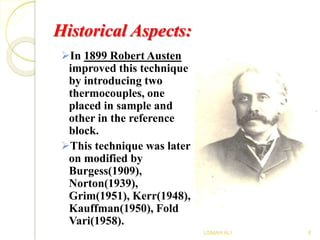
Historical Aspects:
In 1899 Robert Austen
improved this technique
by introducing two
thermocouples, one
placed in sample and
other in the reference
block.
This technique was later
on modified by
Burgess(1909),
Norton(1939),
Grim(1951), Kerr(1948),
Kauffman(1950), Fold
Vari(1958).
8USMAN ALI
Characteristics Of DTA Curves
9USMAN ALI
Characteristics Of DTA Curves
Temperature of the sample is greater
for an exothermic reaction, than that of
reference, for endothermic the sample
temperature lags behind that of
reference
The peak temperature corresponds to
the maximum rate of heat of evolution.
It does not represent the maximum rate
of reaction nor the completion of the
exothermic process.
10USMAN ALI
Characteristics Of DTA Curves
 DTA curves are not only help in the
identification of materials but their peak
areas provide quantitative information
regarding mass of sample, heat of reactions
(Enthalpy change) and factors such as sample
geometry and thermal conductivity.
 If latter two factors are expressed by a factor
“K” called calibration factor, then peak area
can be expressed as:
Peak Area (A) = ±∆ H m K
11USMAN ALI
Instrumentation:
12USMAN ALI
Instrumentation:
1. Source of Uniform Heating:
 Nichrome (up to 1300 0C )
 Platinum and its alloys (up to 1750 0C )
 Molybdenum (up to 2000 0C )
2. Temperature Regulating System:
 Electronic Temperature Regulators
3. Specimen Holder:
 Pt, Ni, stainless steel, Ag and alloy such as Pt-
Rh
 Ceramic material: sintered alumina, silica
13USMAN ALI
Instrumentation:
4. Measurement of Temperature:
 Rare metal alloys Pt - Rh (Pt 10% - Rh 13%)
used as thermocouple
 W - Mo also used as thermocouple
5. Temperature Recording System:
Galvanometric Observation ( For few
samples)
Automatic pen
Ink electronic Recorder
14USMAN ALI
Factors Affecting DTA Curves:
DTA is a dynamic temperature technique.
Therefore, a large number of factors can affect.
These factors can be divided into the two
groups:
i) Instrumental factors
ii) Sample factors
15USMAN ALI
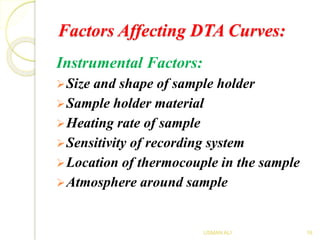
Factors Affecting DTA Curves:
Instrumental Factors:
Size and shape of sample holder
Sample holder material
Heating rate of sample
Sensitivity of recording system
Location of thermocouple in the sample
Atmosphere around sample
16USMAN ALI
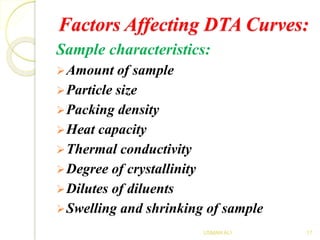
Factors Affecting DTA Curves:
Sample characteristics:
Amount of sample
Particle size
Packing density
Heat capacity
Thermal conductivity
Degree of crystallinity
Dilutes of diluents
Swelling and shrinking of sample
17USMAN ALI
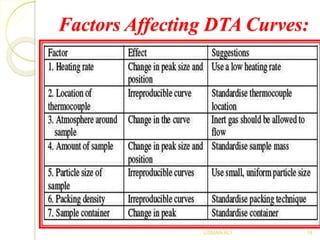
Factors Affecting DTA Curves:
18USMAN ALI
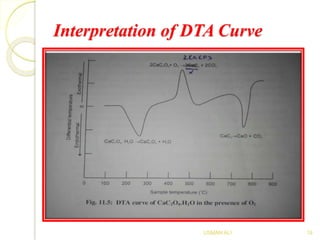
Interpretation of DTA Curve
19USMAN ALI
Applications
The important applications of DTA are:
Rapid identification of the composition
of mixed clays
Studying the thermal stabilities of
inorganic compounds
Critically examining in a specific
reaction whether a new compound is
actually formed or the product is
nothing but an unreacted original
substance 20USMAN ALI
Applications
DTA offers a wide spectrum of useful
investigations related to reaction
kinetics, polymerization, solvent -
retention, phase-transformations, solid-
phase reactions and curing or drying
properties of a product
21USMAN ALI
Thank
You !
USMAN ALI 22

Differential Thermal Analysis

  • 1.
  • 2.
    PRESENETED BY USMAN ALI& UMAR RAFIQUE TO Sir. AJMAL BHATTI Sb Government College Gujranwala 2USMAN ALI
  • 3.
    Differential Thermal Analysis (DTA) • Principle • Characteristics ofDTA Curve • Instrumentation • Factors Affecting DTA Curve • Interpretation of DTA Curve • Application 3USMAN ALI
  • 4.
    Limitations Of TGA The Chemical or physical changes which are not accompanied by the change in mass on heating are not indicated in thermogravimetric analysis  During TG, Pure fusion reaction, crystalline transition, glass transition, crystallization and solid state reation with no volatile product would not be indicated because they provide no change in mass of the specimen. 4USMAN ALI
  • 5.
    1.Principle Differential Thermal analysisis a technique in which the temperature of the substance under investigation is compared with the temperature of a thermally inert material such as a-alumina, and is recorded with furnace temperature as the substance is heated or cooled at a predetermined uniform rate. The principle of method consists in measuring the change in temperature associated with physical or chemical changes during the gradual heating of the substance. 5USMAN ALI
  • 6.
    Phenomena causing changesin Temperature Physical:  Adsorption (exothermic)  Desorption (endothermic)  A change in crystal structure (endo – or exothermic)  Crystallization (exothermic)  Melting (endothermic)  Vaporization (endothermic)  Sublimation (endothermic) 6USMAN ALI
  • 7.
    Chemical:  Oxidation (exothermic) Reduction (endothermic)  Break down reactions (endo – or exothermic)  Chemisorption (exothermic)  Solid state reactions (endo – or exothermic)  Generally speaking, phase transitions, dehydration, reduction and some decomposition reactions produce endothermic effects whereas crystallization, oxidation and some decomposition reaction produce exothermic effects. 7USMAN ALI
  • 8.
    Historical Aspects: In 1899Robert Austen improved this technique by introducing two thermocouples, one placed in sample and other in the reference block. This technique was later on modified by Burgess(1909), Norton(1939), Grim(1951), Kerr(1948), Kauffman(1950), Fold Vari(1958). 8USMAN ALI
  • 9.
    Characteristics Of DTACurves 9USMAN ALI
  • 10.
    Characteristics Of DTACurves Temperature of the sample is greater for an exothermic reaction, than that of reference, for endothermic the sample temperature lags behind that of reference The peak temperature corresponds to the maximum rate of heat of evolution. It does not represent the maximum rate of reaction nor the completion of the exothermic process. 10USMAN ALI
  • 11.
    Characteristics Of DTACurves  DTA curves are not only help in the identification of materials but their peak areas provide quantitative information regarding mass of sample, heat of reactions (Enthalpy change) and factors such as sample geometry and thermal conductivity.  If latter two factors are expressed by a factor “K” called calibration factor, then peak area can be expressed as: Peak Area (A) = ±∆ H m K 11USMAN ALI
  • 12.
  • 13.
    Instrumentation: 1. Source ofUniform Heating:  Nichrome (up to 1300 0C )  Platinum and its alloys (up to 1750 0C )  Molybdenum (up to 2000 0C ) 2. Temperature Regulating System:  Electronic Temperature Regulators 3. Specimen Holder:  Pt, Ni, stainless steel, Ag and alloy such as Pt- Rh  Ceramic material: sintered alumina, silica 13USMAN ALI
  • 14.
    Instrumentation: 4. Measurement ofTemperature:  Rare metal alloys Pt - Rh (Pt 10% - Rh 13%) used as thermocouple  W - Mo also used as thermocouple 5. Temperature Recording System: Galvanometric Observation ( For few samples) Automatic pen Ink electronic Recorder 14USMAN ALI
  • 15.
    Factors Affecting DTACurves: DTA is a dynamic temperature technique. Therefore, a large number of factors can affect. These factors can be divided into the two groups: i) Instrumental factors ii) Sample factors 15USMAN ALI
  • 16.
    Factors Affecting DTACurves: Instrumental Factors: Size and shape of sample holder Sample holder material Heating rate of sample Sensitivity of recording system Location of thermocouple in the sample Atmosphere around sample 16USMAN ALI
  • 17.
    Factors Affecting DTACurves: Sample characteristics: Amount of sample Particle size Packing density Heat capacity Thermal conductivity Degree of crystallinity Dilutes of diluents Swelling and shrinking of sample 17USMAN ALI
  • 18.
    Factors Affecting DTACurves: 18USMAN ALI
  • 19.
    Interpretation of DTACurve 19USMAN ALI
  • 20.
    Applications The important applicationsof DTA are: Rapid identification of the composition of mixed clays Studying the thermal stabilities of inorganic compounds Critically examining in a specific reaction whether a new compound is actually formed or the product is nothing but an unreacted original substance 20USMAN ALI
  • 21.
    Applications DTA offers awide spectrum of useful investigations related to reaction kinetics, polymerization, solvent - retention, phase-transformations, solid- phase reactions and curing or drying properties of a product 21USMAN ALI
  • 22.