DIFFERENTIAL THERMAL
ANALYSIS
Sarode shweta
M. Pharm (QA)
MPAT
Content -
 Introduction
 Principle
 Reference material used in DTA
 Instrumentation
 Factor affecting the DTA curve
 Application
 Reference
DIFFERNTIAL THERMALANALYSIS
(DTA)
 Le - Chateliar studied clays & minerals by an
examination of temperature –time curves.
Later Robert Austen improved technique by
introducing thermocouples.
Definition:-
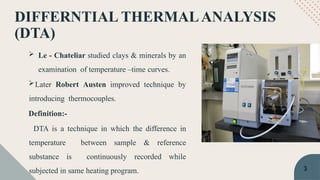
DTA is a technique in which the difference in
temperature between sample & reference
substance is continuously recorded while
subjected in same heating program. 3
Continue ….
• It measures thermophysical thermochemical effect
• Contains : thermocouple for measuring change in T
• Thermocouple used to measure the temperature difference
• Example :- Calcium oxalate monohydrate ( CaC2O4.H2O)
4
PRINCIPLE
• Differential thermal analysis is a technique in
which the temperature of the substance under
investigation is compared with the temperature
of a inert material.
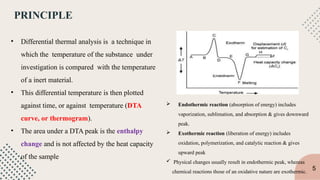
• This differential temperature is then plotted
against time, or against temperature (DTA
curve, or thermogram).
• The area under a DTA peak is the enthalpy
change and is not affected by the heat capacity
of the sample
 Endothermic reaction (absorption of energy) includes
vaporization, sublimation, and absorption & gives downward
peak.
 Exothermic reaction (liberation of energy) includes
oxidation, polymerization, and catalytic reaction & gives
upward peak
 Physical changes usually result in endothermic peak, whereas
chemical reactions those of an oxidative nature are exothermic.
5
Reference material used in DTA
There are two types of the reference material
• Organic reference material :-
In which the organic reference material such as polymer
for example- octyl phthalate, silicone oil.
• Inorganic reference material :-
In which the inorganic reference material such as inert metal like
aluminium or silicon carbide, glass beads.
Both reference and sample material used in powder form
6
CONTINUE….
 Characteristics of reference material
• Reference material should be inert
• Reference material can bear the temperature range
• Reference material should not react with sample
• Electrical conductivity and thermal conductivity should be same as sample
material
7
Instrumentation
8
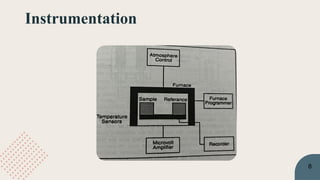
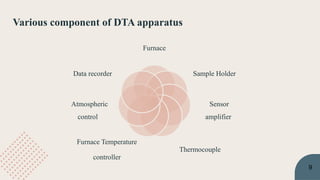
Various component of DTA apparatus
Furnace
Sample Holder
Sensor
amplifier
Thermocouple
Furnace Temperature
controller
Atmospheric
control
Data recorder
9
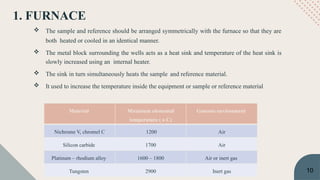
1. FURNACE
 The sample and reference should be arranged symmetrically with the furnace so that they are
both heated or cooled in an identical manner.
 The metal block surrounding the wells acts as a heat sink and temperature of the heat sink is
slowly increased using an internal heater.
 The sink in turn simultaneously heats the sample and reference material.
 It used to increase the temperature inside the equipment or sample or reference material
Material Maximum elemental
temperature ( o C)
Gaseous environment
Nichrome V, chromel C 1200 Air
Silicon carbide 1700 Air
Platinum – rhodium alloy 1600 – 1800 Air or inert gas
Tungsten 2900 Inert gas 10
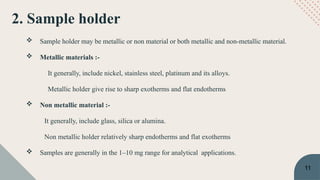
2. Sample holder
 Sample holder may be metallic or non material or both metallic and non-metallic material.
 Metallic materials :-
It generally, include nickel, stainless steel, platinum and its alloys.
Metallic holder give rise to sharp exotherms and flat endotherms
 Non metallic material :-
It generally, include glass, silica or alumina.
Non metallic holder relatively sharp endotherms and flat exotherms
 Samples are generally in the 1–10 mg range for analytical applications.
11
4. Thermocouple
 Thermocouple placed between the sample and reference material
 Thermocouple used to measure the difference of temperature between
sample and reference material
3. Sensor amplifier
 It is used for amplification of signals obtained from temperature
 It is gain and low noise circuit
12
6. Furnace Temperature controller
 Temperature of furnace is controlled by the computer
5. Atmospheric control
 Atmospheric control inside the box control and also it control the atmosphere of
furnace
 It contain atmosphere like air or inert gas mostly used nitrogen
13
7. Recorder
 In thermo- analytical studies, the signal obtained from the sensors can be
recorded in which the signal trace is produced on paper or film, heating
stylus, electric writing or optical beam.
 There are two types of recording devices similar to the TG -
A. Deflection type
B. Null-point type
14
Factors affecting the DTA curve
1) Environmental factors:
This technique is very sensitive to the gaseous environment around the sample. The reaction of gaseous environment
with the sample can produce extra peaks in the curve.
For example- Oxygen in air can cause an oxidation reaction and give rise to an exothermic peak
2) Instrumental factors
Sample holder: The size, shape and the material used for fabrication affect the DTA curve.
For good resolution, the size of sample holders and the amount of sample should be as small as possible
3) Sample characteristics:
Sample characteristics - The weight of sample, degree of crystallinity , particle size affect the nature of DTA curve
15
APPLICATION
 Study of characteristics of polymers.
 Study of decomposition temperature, crystallization point and melting point phase
transition temperature and thermal stability of material.
 Quality control of material like ceramic glass, resins etc.
 Study of metal amine complexes, oxalates, oxides etc.
 Melting point determined by DTA can be used to check purity of sample.
 Quantitative analysis of sample is possible by using DTA curve
16
REFERNCE -
INSTRUMENTAL METHODS OF CHEMICAL ANALYSIS BY GURDEEP R. CHA
TWAL, SHAM K.ANAND PAGE NO .2.719 – 2.735
https://www.sciencedirect.com/topics/chemistry/thermoanalysis
https://www.slideshare.net/bknanjwade/thermal-analysis-42770949
17
CREDITS: This presentation template was created by Slidesgo, including icons
by Flaticon, infographics & images by Freepik
Thank
YOU !
18

Differential thermal analysis M .PHARM MPAT

  • 1.
  • 2.
    Content -  Introduction Principle  Reference material used in DTA  Instrumentation  Factor affecting the DTA curve  Application  Reference
  • 3.
    DIFFERNTIAL THERMALANALYSIS (DTA)  Le- Chateliar studied clays & minerals by an examination of temperature –time curves. Later Robert Austen improved technique by introducing thermocouples. Definition:- DTA is a technique in which the difference in temperature between sample & reference substance is continuously recorded while subjected in same heating program. 3
  • 4.
    Continue …. • Itmeasures thermophysical thermochemical effect • Contains : thermocouple for measuring change in T • Thermocouple used to measure the temperature difference • Example :- Calcium oxalate monohydrate ( CaC2O4.H2O) 4
  • 5.
    PRINCIPLE • Differential thermalanalysis is a technique in which the temperature of the substance under investigation is compared with the temperature of a inert material. • This differential temperature is then plotted against time, or against temperature (DTA curve, or thermogram). • The area under a DTA peak is the enthalpy change and is not affected by the heat capacity of the sample  Endothermic reaction (absorption of energy) includes vaporization, sublimation, and absorption & gives downward peak.  Exothermic reaction (liberation of energy) includes oxidation, polymerization, and catalytic reaction & gives upward peak  Physical changes usually result in endothermic peak, whereas chemical reactions those of an oxidative nature are exothermic. 5
  • 6.
    Reference material usedin DTA There are two types of the reference material • Organic reference material :- In which the organic reference material such as polymer for example- octyl phthalate, silicone oil. • Inorganic reference material :- In which the inorganic reference material such as inert metal like aluminium or silicon carbide, glass beads. Both reference and sample material used in powder form 6
  • 7.
    CONTINUE….  Characteristics ofreference material • Reference material should be inert • Reference material can bear the temperature range • Reference material should not react with sample • Electrical conductivity and thermal conductivity should be same as sample material 7
  • 8.
  • 9.
    Various component ofDTA apparatus Furnace Sample Holder Sensor amplifier Thermocouple Furnace Temperature controller Atmospheric control Data recorder 9
  • 10.
    1. FURNACE  Thesample and reference should be arranged symmetrically with the furnace so that they are both heated or cooled in an identical manner.  The metal block surrounding the wells acts as a heat sink and temperature of the heat sink is slowly increased using an internal heater.  The sink in turn simultaneously heats the sample and reference material.  It used to increase the temperature inside the equipment or sample or reference material Material Maximum elemental temperature ( o C) Gaseous environment Nichrome V, chromel C 1200 Air Silicon carbide 1700 Air Platinum – rhodium alloy 1600 – 1800 Air or inert gas Tungsten 2900 Inert gas 10
  • 11.
    2. Sample holder Sample holder may be metallic or non material or both metallic and non-metallic material.  Metallic materials :- It generally, include nickel, stainless steel, platinum and its alloys. Metallic holder give rise to sharp exotherms and flat endotherms  Non metallic material :- It generally, include glass, silica or alumina. Non metallic holder relatively sharp endotherms and flat exotherms  Samples are generally in the 1–10 mg range for analytical applications. 11
  • 12.
    4. Thermocouple  Thermocoupleplaced between the sample and reference material  Thermocouple used to measure the difference of temperature between sample and reference material 3. Sensor amplifier  It is used for amplification of signals obtained from temperature  It is gain and low noise circuit 12
  • 13.
    6. Furnace Temperaturecontroller  Temperature of furnace is controlled by the computer 5. Atmospheric control  Atmospheric control inside the box control and also it control the atmosphere of furnace  It contain atmosphere like air or inert gas mostly used nitrogen 13
  • 14.
    7. Recorder  Inthermo- analytical studies, the signal obtained from the sensors can be recorded in which the signal trace is produced on paper or film, heating stylus, electric writing or optical beam.  There are two types of recording devices similar to the TG - A. Deflection type B. Null-point type 14
  • 15.
    Factors affecting theDTA curve 1) Environmental factors: This technique is very sensitive to the gaseous environment around the sample. The reaction of gaseous environment with the sample can produce extra peaks in the curve. For example- Oxygen in air can cause an oxidation reaction and give rise to an exothermic peak 2) Instrumental factors Sample holder: The size, shape and the material used for fabrication affect the DTA curve. For good resolution, the size of sample holders and the amount of sample should be as small as possible 3) Sample characteristics: Sample characteristics - The weight of sample, degree of crystallinity , particle size affect the nature of DTA curve 15
  • 16.
    APPLICATION  Study ofcharacteristics of polymers.  Study of decomposition temperature, crystallization point and melting point phase transition temperature and thermal stability of material.  Quality control of material like ceramic glass, resins etc.  Study of metal amine complexes, oxalates, oxides etc.  Melting point determined by DTA can be used to check purity of sample.  Quantitative analysis of sample is possible by using DTA curve 16
  • 17.
    REFERNCE - INSTRUMENTAL METHODSOF CHEMICAL ANALYSIS BY GURDEEP R. CHA TWAL, SHAM K.ANAND PAGE NO .2.719 – 2.735 https://www.sciencedirect.com/topics/chemistry/thermoanalysis https://www.slideshare.net/bknanjwade/thermal-analysis-42770949 17
  • 18.
    CREDITS: This presentationtemplate was created by Slidesgo, including icons by Flaticon, infographics & images by Freepik Thank YOU ! 18