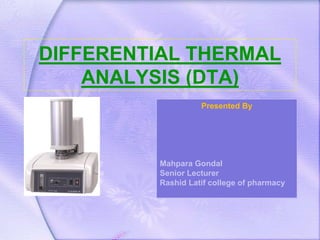
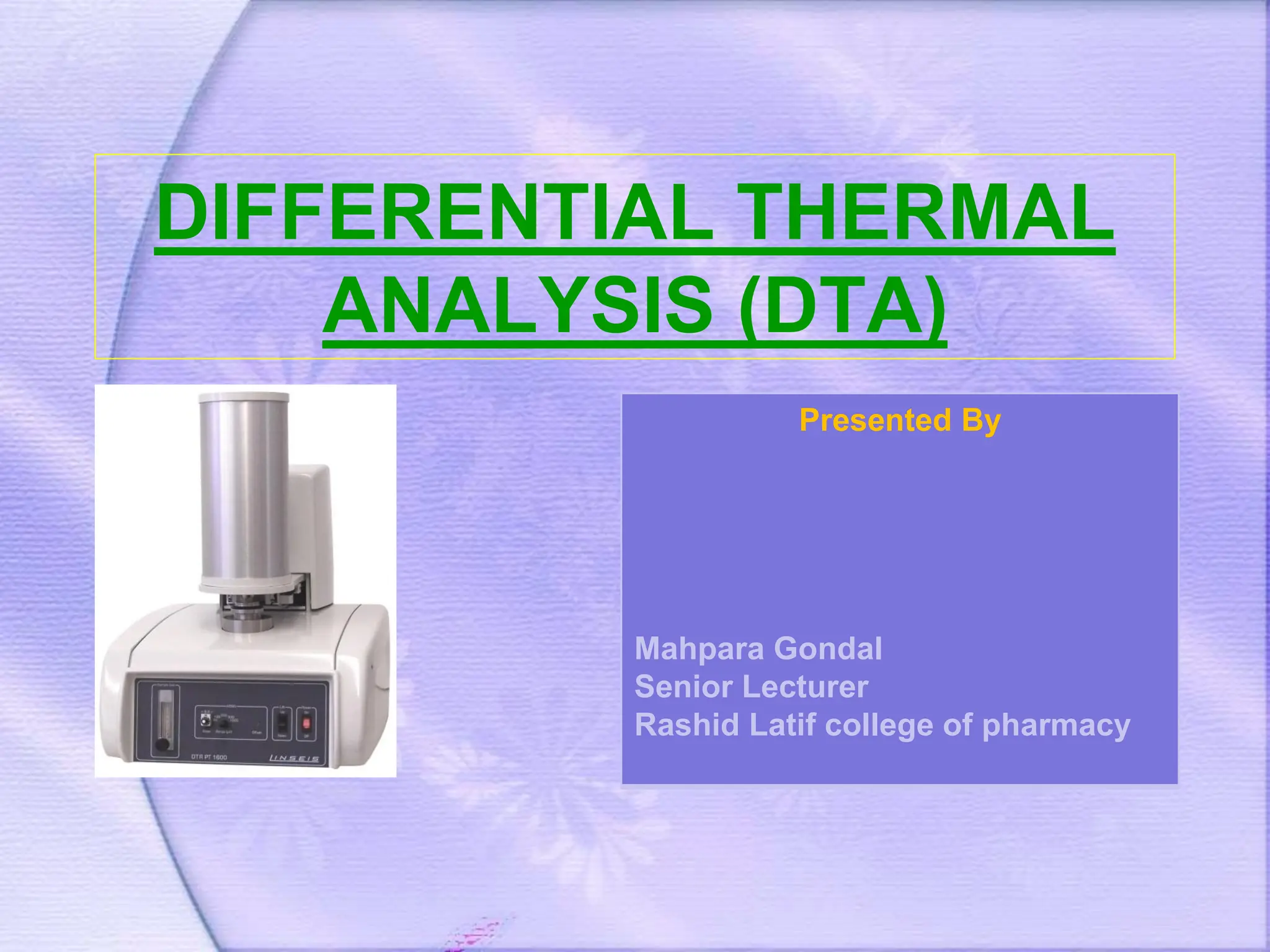
DIFFERENTIAL THERMAL
ANALYSIS (DTA)
Presented By
Mahpara Gondal
Senior Lecturer
Rashid Latif college of pharmacy
Thermal Analysis Techniques
• When a material is heated its structural and
chemical composition can undergo changes
such as fusion, melting, crystallization,
oxidation, decomposition, transition,
expansion and sintering.
• Using Thermal Analysis such changes can be
monitored in every atmosphere of interest. The
obtained information is very useful in both
quality control and problem solving.
Types of thermal analysis
• TG (Thermogravimetric) analysis:
weight
• DTA (Differential Thermal Analysis):
temperature
• DSC (Differential ScanningCalorimetry):
temperature
• In Differential Thermal Analysis, the
temperature difference that develops
between a sample and an inert reference
material is measured, when both are subjected
to identical heat - treatments.
• The related technique of Differential Scanning
Calorimetry relies on differences in energy
required to maintain the sample and reference
at an identical temperature.
Thermogravimetry (TG)
• Thermogravimetry is the measurement of the
mass of a sample as the temperature increases.
This method is useful for determining sample
purity and water, carbonate, and organic
content; and for studying decomposition
reactions.
INTRODUCTION
• This is a comparison method
• Analytical method for recording the
difference in temperature (∆T) b/w a
substance and an inert reference material as
a function of temperature or time
• Any transformation – change in specific heat
or an enthaply of transition can be detected
by DTA
• In DTA both test sample & an inert reference
material (alumina) – controlled heating or
cooling programming
• If zero temperature difference b/w sample &
reference material – sample does not
undergo any chemical or physical change.
• If any reaction takes place temperature
difference (∆T) will occur b/w sample &
reference material
• A DTA curve can be used as a finger print for
identification purposes, for example,
• in the study of clays where the structural
similarity of different forms renders diffraction
experiments difficult to interpret.
PRINCIPLE
• The principle of DTA is based on the fact that
the thermal effects associated with the physical
and chemical changes are measured by a
differential method in which the sample
temperature is continuously compared against
the temperature of the thermally inert reference
material. this difference in temperature, called
differential temperature T, is recorded as
a function of reference material temperature or
furnace temperature.
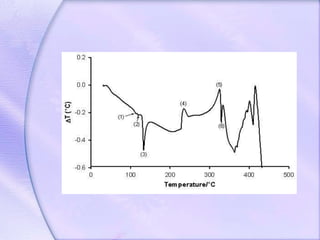
DTA CURVE/ THERMOGRAM
• The differential temperature is then plotted
against time or against temperature.
• DTA curve provides data on the transformations
that have occurred, such as glass transitions,
crystallization, melting and sublimation. The area
under a DTA peak is the enthalpy change and is
not affected by the heat capacity of the sample.
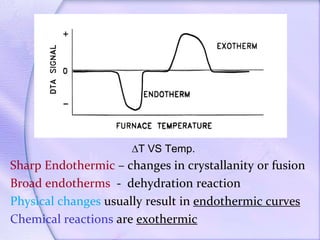
∆T VS Temp.
Sharp Endothermic – changes in crystallanity or fusion
Broad endotherms - dehydration reaction
Physical changes usually result in endothermic curves
Chemical reactions are exothermic
Cont..
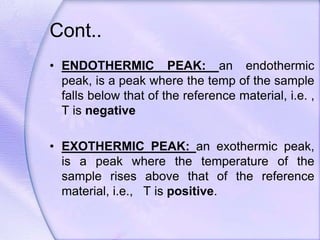
• ENDOTHERMIC PEAK: an endothermic
peak, is a peak where the temp of the sample
falls below that of the reference material, i.e. ,
T is negative
• EXOTHERMIC PEAK: an exothermic peak,
is a peak where the temperature of the
sample rises above that of the reference
material, i.e., T is positive.
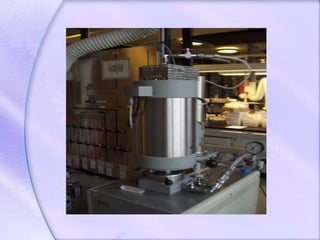
Apparatus
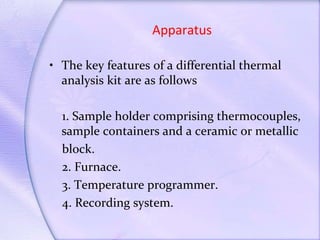
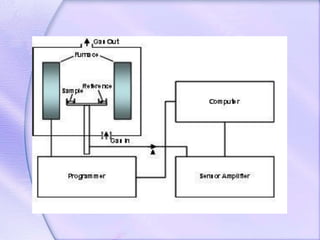
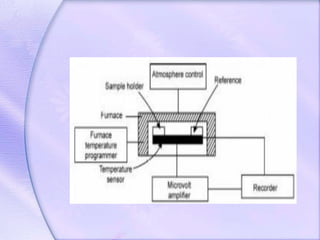
• The key features of a differential thermal
analysis kit are as follows
1. Sample holder comprising thermocouples,
sample containers and a ceramic or metallic
block.
2. Furnace.
3. Temperature programmer.
4. Recording system.
CONTAINERS:
• Various containers have been used to contain sample and reference
material. They are usually made of alumina, borosilicate, fused
quartz, stainless steel, nickel, platinum graphite etc. The choice of
material depends on the sample and temperature range to be studied.
There should be no reaction between sample and container during
pyrolysis.
• THERMOCOUPLE: The most commonly used temperature detecting
device is the thermocouple which is constructed from Chromel vs
alumel, Copper vs platinum, 10-15% rhodium and others.
• The choice of thermocouple depends on the maximum temperature
desired, chemical reactivity of sample and sensitivity of d.c amplifier.
• For temp up to 1500 C, a platinum couple is satisfactory, for fairly low temp
(up to 300 C) copper couple is recommended and for temp up to 1100 C
chromel-alumel is suitable
….
• FURNACE: The choice of furnace geometry also depends on
the temperature rang to be studied. The furnace which covers
the range of 190 C to 2800 C have been in use.
• The temperature rise of the furnace is usually controlled by
either increasing the voltage through the heater element by a
motor driven transformer. The most commonly used rate is 100
to 15o per min.
• AMPLIFIER: A good low noise-level d.c amplifiers are used as
differential temp detectors.
• RECORDER: Strip chart recorders or galvanometric recorders
or an X-Y recorders are used to record amplified T signals as a
function of time or temp
WORKING
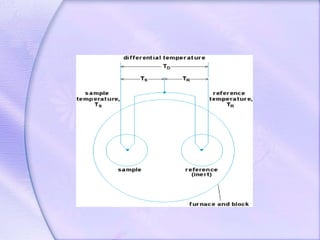
• A furnace is used which contains a sample holder or sample
block, the latter of which has two identification and symmetrically
located chambers.
• The sample is loaded into a crucible, which is then inserted into
the sample well (S). A reference sample is made by placing a
similar quantity of inert material in second crucible marked as R.
The weight of S and R equal.
• One set of thermocouple is inserted into the inert material, such as
aluminium oxide and the other set of thermocouple junction is
placed in other chamber containing sample. Some other
temperature detecting devices are also employed.
• The metal block surrounding the wells acts as a heat sink. The
temp of the sink is slowly increased using an internal heater. The
sink in turn simultaneously heats the sample and reference
material.
Cont..
• The output of differential thermocouple, Ts- Tr is amplified and
send to data acquisition system. As the temperature is
increased, there will be a brief deflection of the voltmeter if the
sample is undergoing a phase transition .
• If there is no difference in temp, no signal is generated, even
though the actual temp of both sample and reference are both
increasing
• The sample and block temperature are then increased at linear
rate, and the temperature between sample and reference
materials is continuously measured or recorded against the
furnace or reference material temperature.
• Heart of the analysis – heating block
(Summary)
• Identical pair of cavities for the sample, ref.
material
• Whole unit is set in an oven- control pressure
• Thermocouple is place directly in contact with
the sample and another in contact with the
reference
• Temp.of the block is raised, the temperature of
the sample & reference follow
• Zero temp. difference – no physical or chemical
change
• If any reaction – difference in ∆T
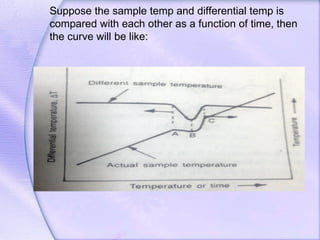
Suppose the sample temp and differential temp is
compared with each other as a function of time, then
the curve will be like:
Cont..
• At point A, it has been assumed that sample undergoes
some type of endothermic reaction. It is also seen that
the sample temp is no longer linear w.r.t. time but lacks
the furnace temp as a result of absorption of heat.
• The reaction will complete at B, and sample temp
increases and after sometime it becomes equal to
furnace temp again at C. during actual transition when
begins at A the sample and reference temp differs ideally
in case of peak ABC, with a maximum at B. beyond A,
curve returns to baseline T= 0 due to equalization of
sample and reference temp.
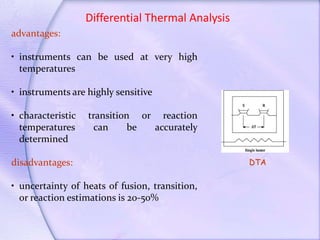
Differential Thermal Analysis
advantages:
• instruments can be used at very high
temperatures
• instruments are highly sensitive
• characteristic transition or reaction
temperatures can be accurately
determined
disadvantages:
• uncertainty of heats of fusion, transition,
or reaction estimations is 20-50%
DTA
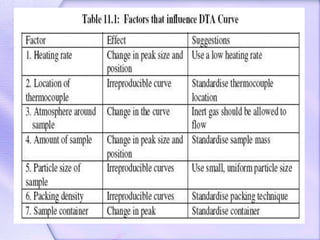
Factors affect results in DTA
• Sample weight
• Particle size
• Heating rate
• Atmospheric conditions
• Conditions of sample packing into dishes
Applications
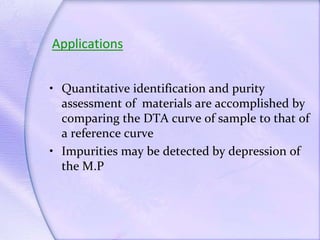
• Quantitative identification and purity
assessment of materials are accomplished by
comparing the DTA curve of sample to that of
a reference curve
• Impurities may be detected by depression of
the M.P
Cont…
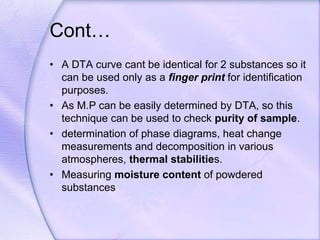
• A DTA curve cant be identical for 2 substances so it
can be used only as a finger print for identification
purposes.
• As M.P can be easily determined by DTA, so this
technique can be used to check purity of sample.
• determination of phase diagrams, heat change
measurements and decomposition in various
atmospheres, thermal stabilities.
• Measuring moisture content of powdered
substances
Cont..
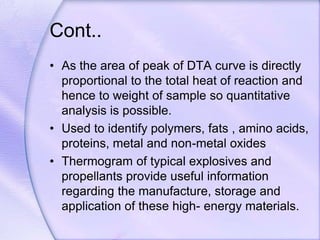
• As the area of peak of DTA curve is directly
proportional to the total heat of reaction and
hence to weight of sample so quantitative
analysis is possible.
• Used to identify polymers, fats , amino acids,
proteins, metal and non-metal oxides
• Thermogram of typical explosives and
propellants provide useful information
regarding the manufacture, storage and
application of these high- energy materials.
differential thermal analysis explained.pdf

differential thermal analysis explained.pdf

  • 1.
    DIFFERENTIAL THERMAL ANALYSIS (DTA) PresentedBy Mahpara Gondal Senior Lecturer Rashid Latif college of pharmacy
  • 2.
    Thermal Analysis Techniques •When a material is heated its structural and chemical composition can undergo changes such as fusion, melting, crystallization, oxidation, decomposition, transition, expansion and sintering. • Using Thermal Analysis such changes can be monitored in every atmosphere of interest. The obtained information is very useful in both quality control and problem solving.
  • 3.
    Types of thermalanalysis • TG (Thermogravimetric) analysis: weight • DTA (Differential Thermal Analysis): temperature • DSC (Differential ScanningCalorimetry): temperature
  • 4.
    • In DifferentialThermal Analysis, the temperature difference that develops between a sample and an inert reference material is measured, when both are subjected to identical heat - treatments. • The related technique of Differential Scanning Calorimetry relies on differences in energy required to maintain the sample and reference at an identical temperature.
  • 5.
    Thermogravimetry (TG) • Thermogravimetryis the measurement of the mass of a sample as the temperature increases. This method is useful for determining sample purity and water, carbonate, and organic content; and for studying decomposition reactions.
  • 6.
    INTRODUCTION • This isa comparison method • Analytical method for recording the difference in temperature (∆T) b/w a substance and an inert reference material as a function of temperature or time • Any transformation – change in specific heat or an enthaply of transition can be detected by DTA
  • 7.
    • In DTAboth test sample & an inert reference material (alumina) – controlled heating or cooling programming • If zero temperature difference b/w sample & reference material – sample does not undergo any chemical or physical change. • If any reaction takes place temperature difference (∆T) will occur b/w sample & reference material
  • 8.
    • A DTAcurve can be used as a finger print for identification purposes, for example, • in the study of clays where the structural similarity of different forms renders diffraction experiments difficult to interpret.
  • 9.
    PRINCIPLE • The principleof DTA is based on the fact that the thermal effects associated with the physical and chemical changes are measured by a differential method in which the sample temperature is continuously compared against the temperature of the thermally inert reference material. this difference in temperature, called differential temperature T, is recorded as a function of reference material temperature or furnace temperature.
  • 10.
    DTA CURVE/ THERMOGRAM •The differential temperature is then plotted against time or against temperature. • DTA curve provides data on the transformations that have occurred, such as glass transitions, crystallization, melting and sublimation. The area under a DTA peak is the enthalpy change and is not affected by the heat capacity of the sample.
  • 11.
    ∆T VS Temp. SharpEndothermic – changes in crystallanity or fusion Broad endotherms - dehydration reaction Physical changes usually result in endothermic curves Chemical reactions are exothermic
  • 12.
    Cont.. • ENDOTHERMIC PEAK:an endothermic peak, is a peak where the temp of the sample falls below that of the reference material, i.e. , T is negative • EXOTHERMIC PEAK: an exothermic peak, is a peak where the temperature of the sample rises above that of the reference material, i.e., T is positive.
  • 13.
    Apparatus • The keyfeatures of a differential thermal analysis kit are as follows 1. Sample holder comprising thermocouples, sample containers and a ceramic or metallic block. 2. Furnace. 3. Temperature programmer. 4. Recording system.
  • 17.
    CONTAINERS: • Various containershave been used to contain sample and reference material. They are usually made of alumina, borosilicate, fused quartz, stainless steel, nickel, platinum graphite etc. The choice of material depends on the sample and temperature range to be studied. There should be no reaction between sample and container during pyrolysis. • THERMOCOUPLE: The most commonly used temperature detecting device is the thermocouple which is constructed from Chromel vs alumel, Copper vs platinum, 10-15% rhodium and others. • The choice of thermocouple depends on the maximum temperature desired, chemical reactivity of sample and sensitivity of d.c amplifier. • For temp up to 1500 C, a platinum couple is satisfactory, for fairly low temp (up to 300 C) copper couple is recommended and for temp up to 1100 C chromel-alumel is suitable
  • 18.
    …. • FURNACE: Thechoice of furnace geometry also depends on the temperature rang to be studied. The furnace which covers the range of 190 C to 2800 C have been in use. • The temperature rise of the furnace is usually controlled by either increasing the voltage through the heater element by a motor driven transformer. The most commonly used rate is 100 to 15o per min. • AMPLIFIER: A good low noise-level d.c amplifiers are used as differential temp detectors. • RECORDER: Strip chart recorders or galvanometric recorders or an X-Y recorders are used to record amplified T signals as a function of time or temp
  • 19.
    WORKING • A furnaceis used which contains a sample holder or sample block, the latter of which has two identification and symmetrically located chambers. • The sample is loaded into a crucible, which is then inserted into the sample well (S). A reference sample is made by placing a similar quantity of inert material in second crucible marked as R. The weight of S and R equal. • One set of thermocouple is inserted into the inert material, such as aluminium oxide and the other set of thermocouple junction is placed in other chamber containing sample. Some other temperature detecting devices are also employed. • The metal block surrounding the wells acts as a heat sink. The temp of the sink is slowly increased using an internal heater. The sink in turn simultaneously heats the sample and reference material.
  • 20.
    Cont.. • The outputof differential thermocouple, Ts- Tr is amplified and send to data acquisition system. As the temperature is increased, there will be a brief deflection of the voltmeter if the sample is undergoing a phase transition . • If there is no difference in temp, no signal is generated, even though the actual temp of both sample and reference are both increasing • The sample and block temperature are then increased at linear rate, and the temperature between sample and reference materials is continuously measured or recorded against the furnace or reference material temperature.
  • 21.
    • Heart ofthe analysis – heating block (Summary) • Identical pair of cavities for the sample, ref. material • Whole unit is set in an oven- control pressure • Thermocouple is place directly in contact with the sample and another in contact with the reference • Temp.of the block is raised, the temperature of the sample & reference follow • Zero temp. difference – no physical or chemical change • If any reaction – difference in ∆T
  • 22.
    Suppose the sampletemp and differential temp is compared with each other as a function of time, then the curve will be like:
  • 23.
    Cont.. • At pointA, it has been assumed that sample undergoes some type of endothermic reaction. It is also seen that the sample temp is no longer linear w.r.t. time but lacks the furnace temp as a result of absorption of heat. • The reaction will complete at B, and sample temp increases and after sometime it becomes equal to furnace temp again at C. during actual transition when begins at A the sample and reference temp differs ideally in case of peak ABC, with a maximum at B. beyond A, curve returns to baseline T= 0 due to equalization of sample and reference temp.
  • 26.
    Differential Thermal Analysis advantages: •instruments can be used at very high temperatures • instruments are highly sensitive • characteristic transition or reaction temperatures can be accurately determined disadvantages: • uncertainty of heats of fusion, transition, or reaction estimations is 20-50% DTA
  • 27.
    Factors affect resultsin DTA • Sample weight • Particle size • Heating rate • Atmospheric conditions • Conditions of sample packing into dishes
  • 29.
    Applications • Quantitative identificationand purity assessment of materials are accomplished by comparing the DTA curve of sample to that of a reference curve • Impurities may be detected by depression of the M.P
  • 30.
    Cont… • A DTAcurve cant be identical for 2 substances so it can be used only as a finger print for identification purposes. • As M.P can be easily determined by DTA, so this technique can be used to check purity of sample. • determination of phase diagrams, heat change measurements and decomposition in various atmospheres, thermal stabilities. • Measuring moisture content of powdered substances
  • 31.
    Cont.. • As thearea of peak of DTA curve is directly proportional to the total heat of reaction and hence to weight of sample so quantitative analysis is possible. • Used to identify polymers, fats , amino acids, proteins, metal and non-metal oxides • Thermogram of typical explosives and propellants provide useful information regarding the manufacture, storage and application of these high- energy materials.