Differential Thermal Analysis
(DTA)
Mr. Sarang R. Bhagwat
Department of Chemistry
K.B.P. College Vashi Navi Mumbai
SRB, Dept of Chem, KBP College Vashi
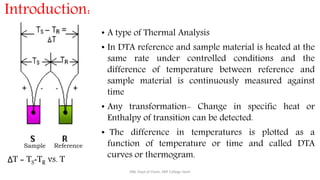
• A type of Thermal Analysis
• In DTA reference and sample material is heated at the
same rate under controlled conditions and the
difference of temperature between reference and
sample material is continuously measured against
time
• Any transformation- Change in specific heat or
Enthalpy of transition can be detected.
• The difference in temperatures is plotted as a
function of temperature or time and called DTA
curves or thermogram.
Sample Reference
SRB, Dept of Chem, KBP College Vashi
Introduction:
ΔT = TS‐TR vs. T
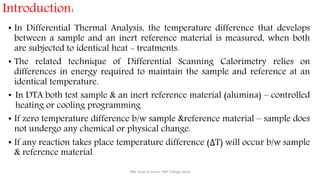
• In Differential Thermal Analysis, the temperature difference that develops
between a sample and an inert reference material is measured, when both
are subjected to identical heat - treatments.
• The related technique of Differential Scanning Calorimetry relies on
differences in energy required to maintain the sample and reference at an
identical temperature.
• In DTA both test sample & an inert reference material (alumina) – controlled
heating or cooling programming
• If zero temperature difference b/w sample &reference material – sample does
not undergo any chemical or physical change.
• If any reaction takes place temperature difference (ΔT) will occur b/w sample
& reference material
SRB, Dept of Chem, KBP College Vashi
Introduction:
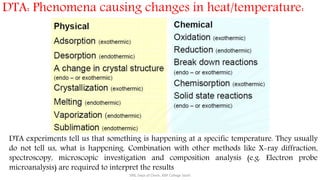
DTA: Phenomena causing changes in heat/temperature:
SRB, Dept of Chem, KBP College Vashi
DTA experiments tell us that something is happening at a specific temperature. They usually
do not tell us, what is happening. Combination with other methods like X-ray diffraction,
spectroscopy, microscopic investigation and composition analysis (e.g. Electron probe
microanalysis) are required to interpret the results
SRB, Dept of Chem, KBP College Vashi
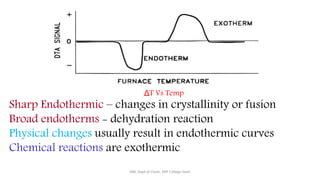
Sharp Endothermic – changes in crystallinity or fusion
Broad endotherms - dehydration reaction
Physical changes usually result in endothermic curves
Chemical reactions are exothermic
ΔT Vs Temp
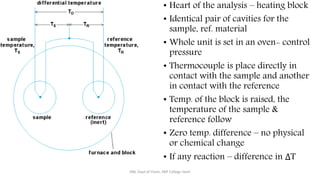
• Heart of the analysis – heating block
• Identical pair of cavities for the
sample, ref. material
• Whole unit is set in an oven- control
pressure
• Thermocouple is place directly in
contact with the sample and another
in contact with the reference
• Temp. of the block is raised, the
temperature of the sample &
reference follow
• Zero temp. difference – no physical
or chemical change
• If any reaction – difference in ΔT
SRB, Dept of Chem, KBP College Vashi
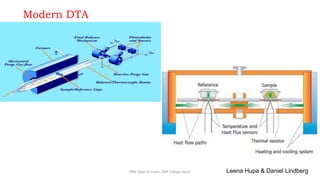
Leena Hupa & Daniel Lindberg
Modern DTA
SRB, Dept of Chem, KBP College Vashi
Types of DTA
On the basis of temperature sensing system DTA
are of two types:
1. Heat flux DTA: In case of heat flux DTA thermocouple is placed
outside the sample and reference material.
2. Classic DTA: In case of classic DTA thermocouple is immersed into
the sample and reference material.
Some Experimental factors:
- Powder decomposition reaction is affected by the specimen environment, size,
surface to volume ratio and composition.
- To avoid this, the sample can be diluted with inert materials.
- The weight of the sample and the rate of heating do not affect the shape of peaks
in DTA
SRB, Dept of Chem, KBP College Vashi
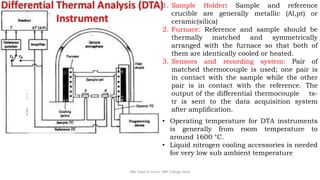
1. Sample Holder: Sample and reference
crucible are generally metallic (Al,pt) or
ceramic(silica)
2. Furnace: Reference and sample should be
thermally matched and symmetrically
arranged with the furnace so that both of
them are identically cooled or heated.
3. Sensors and recording system: Pair of
matched thermocouple is used; one pair is
in contact with the sample while the other
pair is in contact with the reference. The
output of the differential thermocouple ts-
tr is sent to the data acquisition system
after amplification.
• Operating temperature for DTA instruments
is generally from room temperature to
around 1600 °C.
• Liquid nitrogen cooling accessories is needed
for very low sub ambient temperature
SRB, Dept of Chem, KBP College Vashi
Interpretation and Presentation of Data
• A typical DTA plot consists of several linear portions displaced from abscissa due to:
1. The differences in the heat capacity and thermal conductivity of the reference and test sample
2. Physical or chemical changes taking place in the samples result in either absorption or evolution of
heat.
• The enthalpy change is related to the peak area A, or the area enclosed between the peak and
interpolated baseline.
• If differential thermocouple is in thermal contact and not in physical with the reference and test material
then A can be found using
A= mq/gK
• m is mass of sample, q is enthalpy change per unit mass, g is shape factor and K is thermal conductivity
of the test specimen.
• To calibrate the DTA apparatus for enthalpy measurements, area under the peaks of the standard
samples is measured over the specified temperature range using minimum two samples.
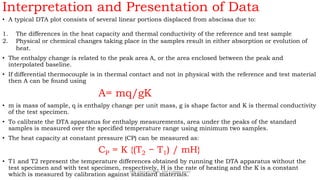
• The heat capacity at constant pressure (CP) can be measured as:
CP = K {(T2 − T1) / mH}
• T1 and T2 represent the temperature differences obtained by running the DTA apparatus without the
test specimen and with test specimen, respectively, H is the rate of heating and the K is a constant
which is measured by calibration against standard materials.
SRB, Dept of Chem, KBP College Vashi
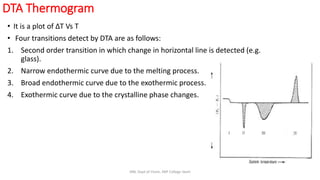
DTA Thermogram
• It is a plot of ∆T Vs T
• Four transitions detect by DTA are as follows:
1. Second order transition in which change in horizontal line is detected (e.g.
glass).
2. Narrow endothermic curve due to the melting process.
3. Broad endothermic curve due to the exothermic process.
4. Exothermic curve due to the crystalline phase changes.
SRB, Dept of Chem, KBP College Vashi
Factors affecting DTA curves:
•If the DTA curve is used for quantitative purposes, the
shape, position, the area enclosed by the curve is to be
studied and has importance.
•For specific heat measurements the baseline deviations
become important and such conditions as particle size,
system symmetry, sample packing has to study keenly
for obtaining better results.
SRB, Dept of Chem, KBP College Vashi
Factors affecting DTA curves cont.…
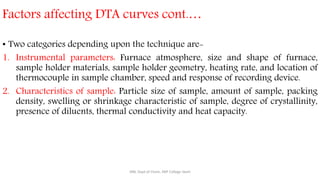
• Two categories depending upon the technique are-
1. Instrumental parameters: Furnace atmosphere, size and shape of furnace,
sample holder materials, sample holder geometry, heating rate, and location of
thermocouple in sample chamber, speed and response of recording device.
2. Characteristics of sample: Particle size of sample, amount of sample, packing
density, swelling or shrinkage characteristic of sample, degree of crystallinity,
presence of diluents, thermal conductivity and heat capacity.
SRB, Dept of Chem, KBP College Vashi
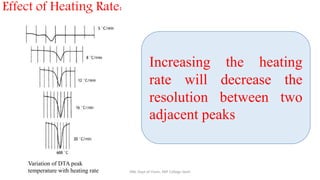
Increasing the heating
rate will decrease the
resolution between two
adjacent peaks
Effect of Heating Rate:
SRB, Dept of Chem, KBP College Vashi
Variation of DTA peak
temperature with heating rate
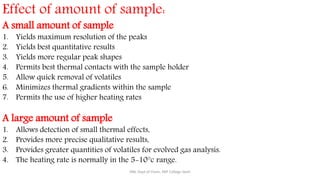
Effect of amount of sample:
A small amount of sample
1. Yields maximum resolution of the peaks
2. Yields best quantitative results
3. Yields more regular peak shapes
4. Permits best thermal contacts with the sample holder
5. Allow quick removal of volatiles
6. Minimizes thermal gradients within the sample
7. Permits the use of higher heating rates
A large amount of sample
1. Allows detection of small thermal effects,
2. Provides more precise qualitative results,
3. Provides greater quantities of volatiles for evolved gas analysis.
4. The heating rate is normally in the 5-10°c range.
SRB, Dept of Chem, KBP College Vashi
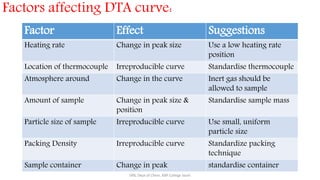
Factors affecting DTA curve:
Factor Effect Suggestions
Heating rate Change in peak size Use a low heating rate
position
Location of thermocouple Irreproducible curve Standardise thermocouple
Atmosphere around Change in the curve Inert gas should be
allowed to sample
Amount of sample Change in peak size &
position
Standardise sample mass
Particle size of sample Irreproducible curve Use small, uniform
particle size
Packing Density Irreproducible curve Standardize packing
technique
Sample container Change in peak standardise container
SRB, Dept of Chem, KBP College Vashi
Applications of DTA (Differential Thermal
Analysis)
1. Analysis of characteristic decomposition patterns.
2. Studies of degradation mechanisms and reaction kinetics.
3. Determination of organic content and inorganic content in a
sample.
4. Study of materials, chemical analysis.
5. Any change which is associated with enthalpy change.
6. Quantitative identification and purity.
7. assessment of materials are accomplished by comparing the
DTA curve of sample to that of a reference curve.
8. Impurities may be detected by depression of the M.P
SRB, Dept of Chem, KBP College Vashi

DTA

  • 1.
    Differential Thermal Analysis (DTA) Mr.Sarang R. Bhagwat Department of Chemistry K.B.P. College Vashi Navi Mumbai SRB, Dept of Chem, KBP College Vashi
  • 2.
    • A typeof Thermal Analysis • In DTA reference and sample material is heated at the same rate under controlled conditions and the difference of temperature between reference and sample material is continuously measured against time • Any transformation- Change in specific heat or Enthalpy of transition can be detected. • The difference in temperatures is plotted as a function of temperature or time and called DTA curves or thermogram. Sample Reference SRB, Dept of Chem, KBP College Vashi Introduction: ΔT = TS‐TR vs. T
  • 3.
    • In DifferentialThermal Analysis, the temperature difference that develops between a sample and an inert reference material is measured, when both are subjected to identical heat - treatments. • The related technique of Differential Scanning Calorimetry relies on differences in energy required to maintain the sample and reference at an identical temperature. • In DTA both test sample & an inert reference material (alumina) – controlled heating or cooling programming • If zero temperature difference b/w sample &reference material – sample does not undergo any chemical or physical change. • If any reaction takes place temperature difference (ΔT) will occur b/w sample & reference material SRB, Dept of Chem, KBP College Vashi Introduction:
  • 4.
    DTA: Phenomena causingchanges in heat/temperature: SRB, Dept of Chem, KBP College Vashi DTA experiments tell us that something is happening at a specific temperature. They usually do not tell us, what is happening. Combination with other methods like X-ray diffraction, spectroscopy, microscopic investigation and composition analysis (e.g. Electron probe microanalysis) are required to interpret the results
  • 5.
    SRB, Dept ofChem, KBP College Vashi Sharp Endothermic – changes in crystallinity or fusion Broad endotherms - dehydration reaction Physical changes usually result in endothermic curves Chemical reactions are exothermic ΔT Vs Temp
  • 6.
    • Heart ofthe analysis – heating block • Identical pair of cavities for the sample, ref. material • Whole unit is set in an oven- control pressure • Thermocouple is place directly in contact with the sample and another in contact with the reference • Temp. of the block is raised, the temperature of the sample & reference follow • Zero temp. difference – no physical or chemical change • If any reaction – difference in ΔT SRB, Dept of Chem, KBP College Vashi
  • 7.
    Leena Hupa &Daniel Lindberg Modern DTA SRB, Dept of Chem, KBP College Vashi
  • 8.
    Types of DTA Onthe basis of temperature sensing system DTA are of two types: 1. Heat flux DTA: In case of heat flux DTA thermocouple is placed outside the sample and reference material. 2. Classic DTA: In case of classic DTA thermocouple is immersed into the sample and reference material. Some Experimental factors: - Powder decomposition reaction is affected by the specimen environment, size, surface to volume ratio and composition. - To avoid this, the sample can be diluted with inert materials. - The weight of the sample and the rate of heating do not affect the shape of peaks in DTA SRB, Dept of Chem, KBP College Vashi
  • 9.
    1. Sample Holder:Sample and reference crucible are generally metallic (Al,pt) or ceramic(silica) 2. Furnace: Reference and sample should be thermally matched and symmetrically arranged with the furnace so that both of them are identically cooled or heated. 3. Sensors and recording system: Pair of matched thermocouple is used; one pair is in contact with the sample while the other pair is in contact with the reference. The output of the differential thermocouple ts- tr is sent to the data acquisition system after amplification. • Operating temperature for DTA instruments is generally from room temperature to around 1600 °C. • Liquid nitrogen cooling accessories is needed for very low sub ambient temperature SRB, Dept of Chem, KBP College Vashi
  • 10.
    Interpretation and Presentationof Data • A typical DTA plot consists of several linear portions displaced from abscissa due to: 1. The differences in the heat capacity and thermal conductivity of the reference and test sample 2. Physical or chemical changes taking place in the samples result in either absorption or evolution of heat. • The enthalpy change is related to the peak area A, or the area enclosed between the peak and interpolated baseline. • If differential thermocouple is in thermal contact and not in physical with the reference and test material then A can be found using A= mq/gK • m is mass of sample, q is enthalpy change per unit mass, g is shape factor and K is thermal conductivity of the test specimen. • To calibrate the DTA apparatus for enthalpy measurements, area under the peaks of the standard samples is measured over the specified temperature range using minimum two samples. • The heat capacity at constant pressure (CP) can be measured as: CP = K {(T2 − T1) / mH} • T1 and T2 represent the temperature differences obtained by running the DTA apparatus without the test specimen and with test specimen, respectively, H is the rate of heating and the K is a constant which is measured by calibration against standard materials. SRB, Dept of Chem, KBP College Vashi
  • 11.
    DTA Thermogram • Itis a plot of ∆T Vs T • Four transitions detect by DTA are as follows: 1. Second order transition in which change in horizontal line is detected (e.g. glass). 2. Narrow endothermic curve due to the melting process. 3. Broad endothermic curve due to the exothermic process. 4. Exothermic curve due to the crystalline phase changes. SRB, Dept of Chem, KBP College Vashi
  • 12.
    Factors affecting DTAcurves: •If the DTA curve is used for quantitative purposes, the shape, position, the area enclosed by the curve is to be studied and has importance. •For specific heat measurements the baseline deviations become important and such conditions as particle size, system symmetry, sample packing has to study keenly for obtaining better results. SRB, Dept of Chem, KBP College Vashi
  • 13.
    Factors affecting DTAcurves cont.… • Two categories depending upon the technique are- 1. Instrumental parameters: Furnace atmosphere, size and shape of furnace, sample holder materials, sample holder geometry, heating rate, and location of thermocouple in sample chamber, speed and response of recording device. 2. Characteristics of sample: Particle size of sample, amount of sample, packing density, swelling or shrinkage characteristic of sample, degree of crystallinity, presence of diluents, thermal conductivity and heat capacity. SRB, Dept of Chem, KBP College Vashi
  • 14.
    Increasing the heating ratewill decrease the resolution between two adjacent peaks Effect of Heating Rate: SRB, Dept of Chem, KBP College Vashi Variation of DTA peak temperature with heating rate
  • 15.
    Effect of amountof sample: A small amount of sample 1. Yields maximum resolution of the peaks 2. Yields best quantitative results 3. Yields more regular peak shapes 4. Permits best thermal contacts with the sample holder 5. Allow quick removal of volatiles 6. Minimizes thermal gradients within the sample 7. Permits the use of higher heating rates A large amount of sample 1. Allows detection of small thermal effects, 2. Provides more precise qualitative results, 3. Provides greater quantities of volatiles for evolved gas analysis. 4. The heating rate is normally in the 5-10°c range. SRB, Dept of Chem, KBP College Vashi
  • 16.
    Factors affecting DTAcurve: Factor Effect Suggestions Heating rate Change in peak size Use a low heating rate position Location of thermocouple Irreproducible curve Standardise thermocouple Atmosphere around Change in the curve Inert gas should be allowed to sample Amount of sample Change in peak size & position Standardise sample mass Particle size of sample Irreproducible curve Use small, uniform particle size Packing Density Irreproducible curve Standardize packing technique Sample container Change in peak standardise container SRB, Dept of Chem, KBP College Vashi
  • 17.
    Applications of DTA(Differential Thermal Analysis) 1. Analysis of characteristic decomposition patterns. 2. Studies of degradation mechanisms and reaction kinetics. 3. Determination of organic content and inorganic content in a sample. 4. Study of materials, chemical analysis. 5. Any change which is associated with enthalpy change. 6. Quantitative identification and purity. 7. assessment of materials are accomplished by comparing the DTA curve of sample to that of a reference curve. 8. Impurities may be detected by depression of the M.P SRB, Dept of Chem, KBP College Vashi
  • 18.
    SRB, Dept ofChem, KBP College Vashi