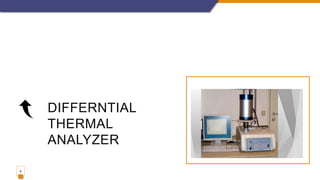
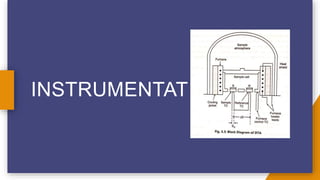
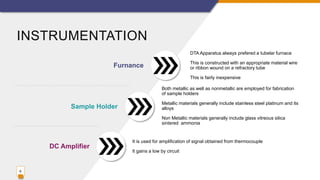
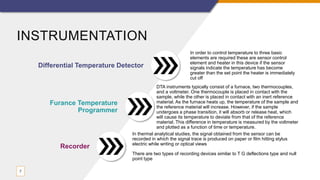
Differential thermal analysis (DTA) measures the difference in temperature between a sample and an inert reference material as they are heated at the same rate. DTA can detect phase transitions like melting or chemical reactions in a sample by observing temperature differences - endothermic events cause the sample temperature to lag behind the reference, while exothermic events cause it to rise faster, appearing as peaks on the DTA curve. The instrument consists of a furnace containing the sample and reference along with thermocouples to measure their temperatures, allowing qualitative and quantitative analysis of thermal events in materials.


![THERMOGRAVIMETRY ANALYSIS [TGA] AS PER PCI[M.PHARM]](https://cdn.slidesharecdn.com/ss_thumbnails/49-191219085241-thumbnail.jpg?width=640&height=640&fit=bounds)


![DIFFERENTIAL THERMAL ANALYSIS [DTA]](https://cdn.slidesharecdn.com/ss_thumbnails/dtapresentation11-191116170632-thumbnail.jpg?width=640&height=640&fit=bounds)


