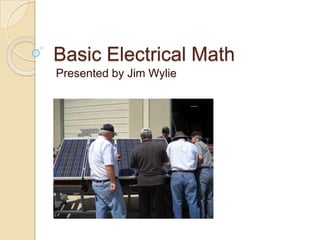
Basic Electrical MathPresented by Jim Wylie
This pre-class is to help you to prepare for the Solar Technician Course. The goal is to be able to understand the technical lessons of the main course, not become frustrated or fall behind the other students. Jim Wylie, your instructor, has posted regular office hours to help you to successfully complete the Solar Technician Course.  If you need times not posted, contact Jim by email or Blackboard  and make other arrangements.
Introduction PV Installers must be able to calculate simple electrical formula problems.
 PV Installers must be able to do simple geometric and trigonometric problems
 The instructor assumes that students are capable of simple addition, subtraction, multiplication and divisions.
 The instructor realizes that students may not remember or have a good foundation in algebra. Training OutlineLesson 1: Voltage, Amperes and ResistanceLesson 2: Series Electric CircuitsLesson 3: Parallel Electric CircuitsLesson 4: Electric SourcesLesson 5:  Sun angle  and Solar Panel Orientation
Ohms Law is possibly the most important concept to learn in electrical technology. It is used by every electrician and equally used by solar installers.  The formula E=IR explains the relationship of current, resistance to the voltage of all electric circuits. In this lesson we will use the Ohms formula to explain the relationship of volts, amps and ohms.Learn this lesson well before you continue to Lesson Two.  If you feel that you are not learning the lesson, contact the instructor during his office hours for some help.Ohms Law      V=IR
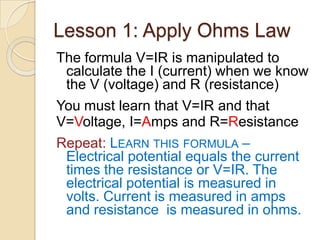
Lesson 1: Apply Ohms LawThe formula V=IR is manipulated to calculate the I (current) when we know the V (voltage) and R (resistance)You must learn that V=IR and thatV=Voltage, I=Amps and R=ResistanceRepeat: Learn this formula – Electrical potential equals the current times the resistance or V=IR. The electrical potential is measured in volts. Current is measured in amps and resistance is measured in ohms.
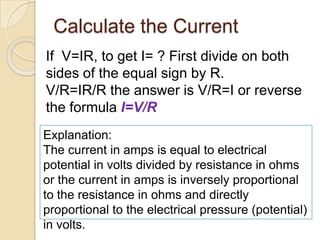
Calculate the CurrentIf  V=IR, to get I= ? First divide on both sides of the equal sign by R.V/R=IR/R the answer is V/R=I or reverse the formula I=V/RExplanation:The current in amps is equal to electrical potential in volts divided by resistance in ohms  or the current in amps is inversely proportional to the resistance in ohms and directly proportional to the electrical pressure (potential) in volts.
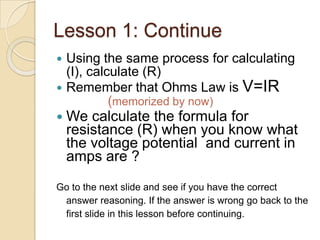
Lesson 1: ContinueUsing the same process for calculating (I), calculate (R)Remember that Ohms Law is V=IR       (memorized by now)We calculate the formula for resistance (R) when you know what the voltage potential  and current in amps are ?Go to the next slide and see if you have the correct answer reasoning. If the answer is wrong go back to the first slide in this lesson before continuing.
Answer: Find R, If  V=IRV=IR by dividing both sides of the equal sign by I. V/I=IR/I  The results is V/I=R or R=V/IQUIZ: Describe the process and results in math terms? Stand on your head for the answerYou can say that the resistance in ohms is equal to electrical potential in volts divided by current in amps or you can say that resistance in ohms is inversely proportional to the current in amps and directly proportional to the electrical pressure (potential) in volts.
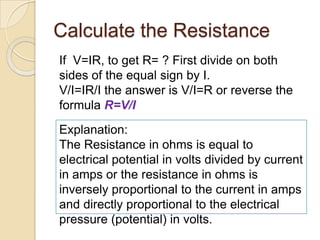
Calculate the ResistanceIf  V=IR, to get R= ? First divide on both sides of the equal sign by I.V/I=IR/I the answer is V/I=R or reverse the formula R=V/IExplanation:The Resistance in ohms is equal to electrical potential in volts divided by current in amps or the resistance in ohms is inversely proportional to the current in amps and directly proportional to the electrical pressure (potential) in volts.
 Instructor’s Tips:About now you may be asking – What in the World are we doing? If so here is a few tips. If you do not understand the lesson slide then reread it until it makes sense or try memorizing it and continue on to the next slide.Repeat this same procedure for each slide until you finish the lesson.  The review slide will contain all variations of Ohms Law – memorize the variations if you cannot calculate them.The last slide in the lesson will be using real numbers instead of letters. This might make more sense to you. Lastly, review the complete lesson and if all else fails call the instructor for help.
Lesson 1 Review Memorize the three variations of Ohms Law:
 V=IR
 I=V/R
 R=V/I
 Explain each of the Ohm’s Law variation with mathematical terms –
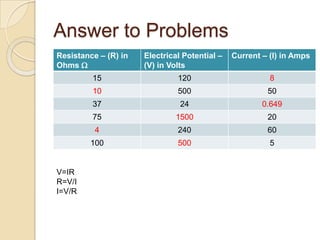
Using numbers is usually easier than letter in a formula. Go to the self-test next slide and see if you know how to use Ohm’s Law. Lesson 1 – Practice Problems Solve for the unknown in red
Answer to ProblemsV=IRR=V/II=V/R
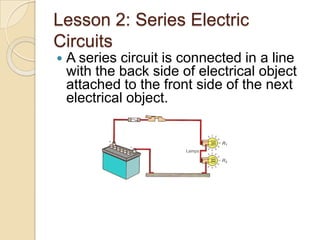
Lesson 2: Series Electric CircuitsA series circuit is connected in a line with the back side of electrical object attached to the front side of the next electrical object.
Lesson 2: How It WorksSERIES CIRCUITSA Series Circuit has only one path to ground, so electrons must go through each component to get back to ground. All loads are placed in series.1. An open in the circuit will disable the entire circuit. 2. The voltage divides (shared) between the loads.3. The current flow is the same throughout the circuit.4. The resistance of each load can be different
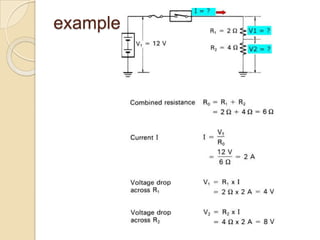
Lesson 2: Voltage DropVOLTAGE DROP CALCULATIONWhen current flows in a circuit, the presence of a resistance in that circuit will cause the voltage to fall or drop as it passes through the resistance. The resultant difference in the voltage on each side of the resistance is called a voltage drop. When current (I) flows in the following circuit, voltage drops V1 and V2 across resistances R1 and R2 can be determined as follows from Ohm's law. (The value of current I is the same for both R1 and R2 since they are connected in series.)
Series Voltage Drop Calculation
example:
Series Circuit SummaryRemember these points and understand how the voltage drop calculations are doneThere is only one path to the groundCurrent remains the same throughout the circuitThe presence of a resistance in the circuit will cause the voltage to drop
Lesson 3: Parallel CircuitsA parallel circuit is like a ladder with the steps being the resistance between the sides representing the positive and negative wires. Voltage and current flows independently through each resistant step.
Lesson 3: How It WorksPARALLEL CIRCUITA parallel circuit has more than one path for current flow. The same voltage is applied across each branch. If the load resistance in each branch is the same, the current in each branch will be the same. If the load resistance in each branch is different, the current in each branch will be different. If one branch is broken, current will continue flowing to the other branches.
Lesson 3: calculationsResistance in a parallel circuit is calculated with the formula: Current is calculated by the formula:
Parallel Circuit SummaryRemember these points and understand how the resistance and current calculations are doneA parallel circuit will have more than one path to the groundThe same voltage will appear across each branchDifferent current will result from different resistance of the branchesIf a branch is opened current will continue through the other branches
Lesson 3: Power SourcesWe will use our knowledge of Ohms Law, Series and Parallel electric circuits to understand how power sources like batteries and solar panels work.

Basic electrical math

  • 1.
  • 2.
    This pre-class isto help you to prepare for the Solar Technician Course. The goal is to be able to understand the technical lessons of the main course, not become frustrated or fall behind the other students. Jim Wylie, your instructor, has posted regular office hours to help you to successfully complete the Solar Technician Course. If you need times not posted, contact Jim by email or Blackboard and make other arrangements.
  • 3.
    Introduction PV Installersmust be able to calculate simple electrical formula problems.
  • 4.
    PV Installersmust be able to do simple geometric and trigonometric problems
  • 5.
    The instructorassumes that students are capable of simple addition, subtraction, multiplication and divisions.
  • 6.
    The instructorrealizes that students may not remember or have a good foundation in algebra. Training OutlineLesson 1: Voltage, Amperes and ResistanceLesson 2: Series Electric CircuitsLesson 3: Parallel Electric CircuitsLesson 4: Electric SourcesLesson 5: Sun angle and Solar Panel Orientation
  • 7.
    Ohms Law ispossibly the most important concept to learn in electrical technology. It is used by every electrician and equally used by solar installers. The formula E=IR explains the relationship of current, resistance to the voltage of all electric circuits. In this lesson we will use the Ohms formula to explain the relationship of volts, amps and ohms.Learn this lesson well before you continue to Lesson Two. If you feel that you are not learning the lesson, contact the instructor during his office hours for some help.Ohms Law V=IR
  • 8.
    Lesson 1: ApplyOhms LawThe formula V=IR is manipulated to calculate the I (current) when we know the V (voltage) and R (resistance)You must learn that V=IR and thatV=Voltage, I=Amps and R=ResistanceRepeat: Learn this formula – Electrical potential equals the current times the resistance or V=IR. The electrical potential is measured in volts. Current is measured in amps and resistance is measured in ohms.
  • 9.
    Calculate the CurrentIf V=IR, to get I= ? First divide on both sides of the equal sign by R.V/R=IR/R the answer is V/R=I or reverse the formula I=V/RExplanation:The current in amps is equal to electrical potential in volts divided by resistance in ohms or the current in amps is inversely proportional to the resistance in ohms and directly proportional to the electrical pressure (potential) in volts.
  • 10.
    Lesson 1: ContinueUsingthe same process for calculating (I), calculate (R)Remember that Ohms Law is V=IR (memorized by now)We calculate the formula for resistance (R) when you know what the voltage potential and current in amps are ?Go to the next slide and see if you have the correct answer reasoning. If the answer is wrong go back to the first slide in this lesson before continuing.
  • 11.
    Answer: Find R,If V=IRV=IR by dividing both sides of the equal sign by I. V/I=IR/I The results is V/I=R or R=V/IQUIZ: Describe the process and results in math terms? Stand on your head for the answerYou can say that the resistance in ohms is equal to electrical potential in volts divided by current in amps or you can say that resistance in ohms is inversely proportional to the current in amps and directly proportional to the electrical pressure (potential) in volts.
  • 12.
    Calculate the ResistanceIf V=IR, to get R= ? First divide on both sides of the equal sign by I.V/I=IR/I the answer is V/I=R or reverse the formula R=V/IExplanation:The Resistance in ohms is equal to electrical potential in volts divided by current in amps or the resistance in ohms is inversely proportional to the current in amps and directly proportional to the electrical pressure (potential) in volts.
  • 13.
    Instructor’s Tips:Aboutnow you may be asking – What in the World are we doing? If so here is a few tips. If you do not understand the lesson slide then reread it until it makes sense or try memorizing it and continue on to the next slide.Repeat this same procedure for each slide until you finish the lesson. The review slide will contain all variations of Ohms Law – memorize the variations if you cannot calculate them.The last slide in the lesson will be using real numbers instead of letters. This might make more sense to you. Lastly, review the complete lesson and if all else fails call the instructor for help.
  • 14.
    Lesson 1 ReviewMemorize the three variations of Ohms Law:
  • 15.
  • 16.
  • 17.
  • 18.
    Explain eachof the Ohm’s Law variation with mathematical terms –
  • 19.
    Using numbers isusually easier than letter in a formula. Go to the self-test next slide and see if you know how to use Ohm’s Law. Lesson 1 – Practice Problems Solve for the unknown in red
  • 20.
  • 21.
    Lesson 2: SeriesElectric CircuitsA series circuit is connected in a line with the back side of electrical object attached to the front side of the next electrical object.
  • 22.
    Lesson 2: HowIt WorksSERIES CIRCUITSA Series Circuit has only one path to ground, so electrons must go through each component to get back to ground. All loads are placed in series.1. An open in the circuit will disable the entire circuit. 2. The voltage divides (shared) between the loads.3. The current flow is the same throughout the circuit.4. The resistance of each load can be different
  • 23.
    Lesson 2: VoltageDropVOLTAGE DROP CALCULATIONWhen current flows in a circuit, the presence of a resistance in that circuit will cause the voltage to fall or drop as it passes through the resistance. The resultant difference in the voltage on each side of the resistance is called a voltage drop. When current (I) flows in the following circuit, voltage drops V1 and V2 across resistances R1 and R2 can be determined as follows from Ohm's law. (The value of current I is the same for both R1 and R2 since they are connected in series.)
  • 24.
  • 25.
  • 26.
    Series Circuit SummaryRememberthese points and understand how the voltage drop calculations are doneThere is only one path to the groundCurrent remains the same throughout the circuitThe presence of a resistance in the circuit will cause the voltage to drop
  • 27.
    Lesson 3: ParallelCircuitsA parallel circuit is like a ladder with the steps being the resistance between the sides representing the positive and negative wires. Voltage and current flows independently through each resistant step.
  • 28.
    Lesson 3: HowIt WorksPARALLEL CIRCUITA parallel circuit has more than one path for current flow. The same voltage is applied across each branch. If the load resistance in each branch is the same, the current in each branch will be the same. If the load resistance in each branch is different, the current in each branch will be different. If one branch is broken, current will continue flowing to the other branches.
  • 29.
    Lesson 3: calculationsResistancein a parallel circuit is calculated with the formula: Current is calculated by the formula:
  • 30.
    Parallel Circuit SummaryRememberthese points and understand how the resistance and current calculations are doneA parallel circuit will have more than one path to the groundThe same voltage will appear across each branchDifferent current will result from different resistance of the branchesIf a branch is opened current will continue through the other branches
  • 31.
    Lesson 3: PowerSourcesWe will use our knowledge of Ohms Law, Series and Parallel electric circuits to understand how power sources like batteries and solar panels work.

Editor's Notes

  • #4 Tip: Add your own speaker notes here.
  • #7 Tip: Add your own speaker notes here.
  • #16 Tip: Add your own speaker notes here.
  • #22 Tip: Add your own speaker notes here.
  • #26 Tip: Add your own speaker notes here.
  • #31 Tip: Add your own speaker notes here.