Veterinary Teaching Hospital
Airlangga University

Small Animal Practice

Differential
Diagnose
Diarrhea
• Diarrhea is define simply as passage of feces that
contain an excess amount of water. This results in an
abnormal increase in stool liquidity and weight. In
some patients there may simply be an increase in
frequency of defecation.
• Diarrhea has also been described in broad, simple
terms as “the too rapid evacuation of too loose
stools.”
• Definitions notwithstanding, however, it is most
important that the clinician carefully determine
exactly what the owner means when the term
diarrhea is used.
triakoso 2014
Diarrhea
• Small intestine diarrhea
• Large intestine diarrhea

triakoso 2014
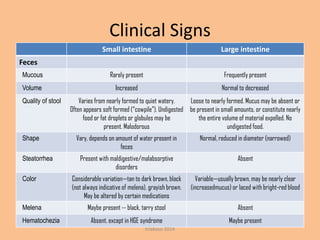
Clinical Signs
Small intestine

Large intestine

Mucous

Rarely present

Frequently present

Volume

Increased

Normal to decreased

Feces

Quality of stool

Shape
Steatorrhea
Color

Melena
Hematochezia

Varies from nearly formed to quiet watery.
Loose to nearly formed. Mucus may be absent or
Often appears soft formed (“cowpile”). Undigested be present in small amounts, or constitute nearly
food or fat droplets or globules may be
the entire volume of material expelled. No
present. Malodorous
undigested food.
Vary, depends on amount of water present in
feces

Normal, reduced in diameter (narrowed)

Present with maldigestive/malabsorptive
disorders

Absent

Considerable variation—tan to dark brown, black
(not always indicative of melena), grayish brown.
May be altered by certain medications

Variable—usually brown, may be nearly clear
(increasedmucus) or laced with bright-red blood

Maybe present -- black, tarry stool

Absent

Absent, except in HGE syndrome

Maybe present

triakoso 2014
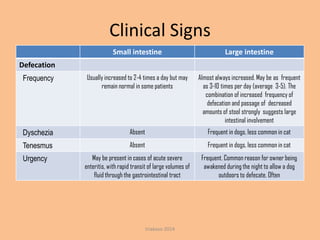
Clinical Signs
Small intestine

Large intestine

Frequency

Usually increased to 2-4 times a day but may
remain normal in some patients

Almost always increased. May be as frequent
as 3-10 times per day (average 3-5). The
combination of increased frequency of
defecation and passage of decreased
amounts of stool strongly suggests large
intestinal involvement

Dyschezia

Absent

Frequent in dogs, less common in cat

Tenesmus

Absent

Frequent in dogs, less common in cat

May be present in cases of acute severe
enteritis, with rapid transit of large volumes of
fluid through the gastrointestinal tract

Frequent. Common reason for owner being
awakened during the night to allow a dog
outdoors to defecate. Often

Defecation

Urgency

triakoso 2014
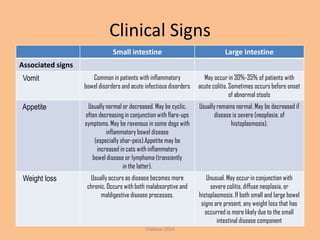
Clinical Signs
Small intestine

Large intestine

Vomit

Common in patients with inflammatory
bowel disorders and acute infectious disorders

May occur in 30%-35% of patients with
acute colitis. Sometimes occurs before onset
of abnormal stools

Appetite

Usually normal or decreased. May be cyclic,
often decreasing in conjunction with flare-ups
symptoms. May be ravenous in some dogs with
inflammatory bowel disease
(especially shar-peis).Appetite may be
increased in cats with inflammatory
bowel disease or lymphoma (transiently
in the latter).

Usually remains normal. May be decreased if
disease is severe (neoplasia, of
histoplasmosis).

Usually occurs as disease becomes more
chronic. Occurs with both malabsorptive and
maldigestive disease processes.

Unusual. May occur in conjunction with
severe colitis, diffuse neoplasia, or
histoplasmosis. If both small and large bowel
signs are present, any weight loss that has
occurred is more likely due to the small
intestinal disease component

Associated signs

Weight loss

triakoso 2014
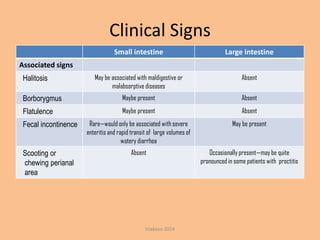
Clinical Signs
Small intestine

Large intestine

May be associated with maldigestive or
malabsorptive diseases

Absent

Borborygmus

Maybe present

Absent

Flatulence

Maybe present

Absent

Fecal incontinence

Rare—would only be associated with severe
enteritis and rapid transit of large volumes of
watery diarrhea

May be present

Scooting or
chewing perianal
area

Absent

Occasionally present—may be quite
pronounced in some patients with proctitis

Associated signs
Halitosis

triakoso 2014
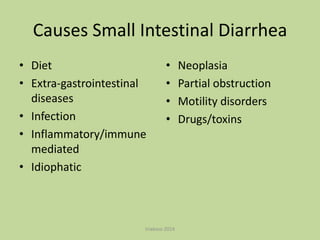
Causes Small Intestinal Diarrhea
• Diet
• Extra-gastrointestinal
diseases
• Infection
• Inflammatory/immune
mediated
• Idiophatic

•
•
•
•

triakoso 2014

Neoplasia
Partial obstruction
Motility disorders
Drugs/toxins
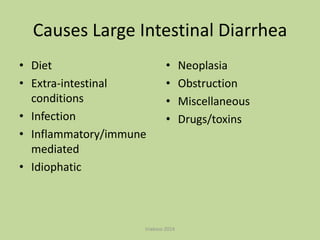
Causes Large Intestinal Diarrhea
• Diet
• Extra-intestinal
conditions
• Infection
• Inflammatory/immune
mediated
• Idiophatic

•
•
•
•

triakoso 2014

Neoplasia
Obstruction
Miscellaneous
Drugs/toxins
Small Intestinal Diarrhea
• Diet
– Dietary intolerance [Food hypersensitivity; Food
intolerance; Gluten-sensitive enteropathy]

• Extra-gastrointestinal diseases
– EPI
– Hepatic disease
– Hyperthiroidism
– Hypoadrenocorticism
triakoso 2014
Small Intestinal Diarrhea
• Infection
– Bacterial [Campyovacter spp; Clostridium spp;
Salmonella spp; E coli; Staphylococcus, SIBO]
– Fungal
– Helminth [Hookworm; Roundworm; Tapeworm;
Whipworm]
– Protozoal [Cryptosporidiosis; Giardia spp]
– Rickettsial
– Viral [Corona virus; Parvovirus; Feline
panleukopenia]
triakoso 2014
Small Intestinal Diarrhea
• Inflammatory/immune mediated
–
–
–
–

Basenji enteropathy
Duodenal ulceration
Hemorrhagic gastroenteritis
Inflammatory bowel disease [Eosinophilic;
Granulomatous; Lymphoplasmacytic]
– Protein-losing enteropathy and nephropathy of the
Soft-Coated Weaten Terrier

• Idiophatic
– Lymphangiectasia
triakoso 2014
Large Intestinal Diarrhea
• Diet*
– Dietary hypersensitivity
– Dietary indiscretion

• Extra-intestinal conditions
–
–
–
–
–

Metastatic neoplasia
Neurological disease leading to ulcerative colitis
Pancreatitis
Toxaemia
Uraemia

• Infection
– Bacterial*, e.g. [Campylobacter spp; Clostridium difficile;
Clostridium perfringens; E. coli; Salmonella spp; Yersinia
enterocolitica]
triakoso 2014
Large Intestinal Diarrhea
• Infection
– Viral* [Coronavirus; Feline immunodeficiency virus
(C); Feline infectious peritonitis (C); Feline leukaemia
virus (C); Parvovirus]
– Fungal, e.g. [ Histoplasmosis; Protothecosis]
– Parasitic*, e.g. [Amoebiasis; Ancylostoma spp;
Balantidium coli; Cryptosporidiosis; Giardia spp;
Heterobilharzia americana; Roundworm; Tapeworm;
Tritrichomonas foetus(C); Uncinaria spp; Whipworm]
– Protozoal, e.g. [Toxoplasmosis]
triakoso 2014
Large Intestinal Diarrhea
• Immune-mediated/inflammatory disease
– Histiocytic ulcerative colitis of Boxers (D)
– Inflammatory bowel disease*

• Idiopathic conditions
– Fibre-responsive large-bowel diarrhoea
– Irritable bowel syndrome

• Neoplasia*
– Benign, e.g. [Adenomatous polyps; Leiomyoma]
– Malignant, e.g. [Adenocarcinoma; Lymphoma]
triakoso 2014
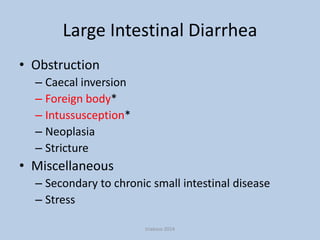
Large Intestinal Diarrhea
• Obstruction
– Caecal inversion
– Foreign body*
– Intussusception*
– Neoplasia
– Stricture

• Miscellaneous
– Secondary to chronic small intestinal disease
– Stress
triakoso 2014
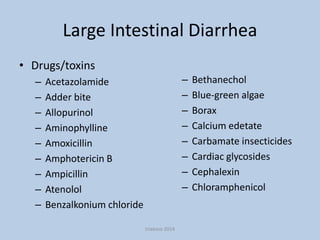
Large Intestinal Diarrhea
• Drugs/toxins
–
–
–
–
–
–
–
–
–

–
–
–
–
–
–
–
–

Acetazolamide
Adder bite
Allopurinol
Aminophylline
Amoxicillin
Amphotericin B
Ampicillin
Atenolol
Benzalkonium chloride
triakoso 2014

Bethanechol
Blue-green algae
Borax
Calcium edetate
Carbamate insecticides
Cardiac glycosides
Cephalexin
Chloramphenicol
Large Intestinal Diarrhea
• Drugs/toxins
–
–
–
–
–
–
–
–
–

–
–
–
–
–
–
–
–
–

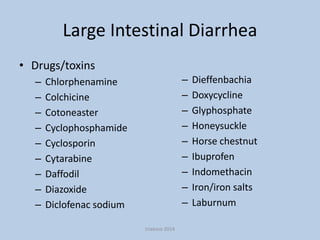
Chlorphenamine
Colchicine
Cotoneaster
Cyclophosphamide
Cyclosporin
Cytarabine
Daffodil
Diazoxide
Diclofenac sodium
triakoso 2014

Dieffenbachia
Doxycycline
Glyphosphate
Honeysuckle
Horse chestnut
Ibuprofen
Indomethacin
Iron/iron salts
Laburnum
Large Intestinal Diarrhea
• Drugs/toxins
–
–
–
–
–
–
–
–

–
–
–
–
–
–
–
–

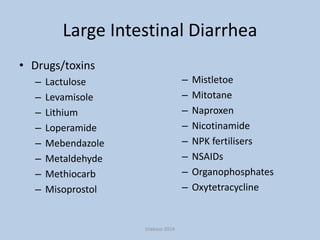
Lactulose
Levamisole
Lithium
Loperamide
Mebendazole
Metaldehyde
Methiocarb
Misoprostol

triakoso 2014

Mistletoe
Mitotane
Naproxen
Nicotinamide
NPK fertilisers
NSAIDs
Organophosphates
Oxytetracycline
Large Intestinal Diarrhea
• Drugs/toxins
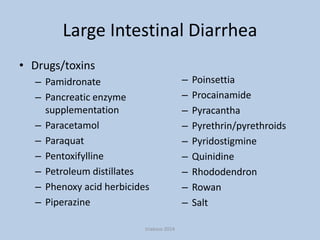
– Pamidronate
– Pancreatic enzyme
supplementation
– Paracetamol
– Paraquat
– Pentoxifylline
– Petroleum distillates
– Phenoxy acid herbicides
– Piperazine
triakoso 2014

–
–
–
–
–
–
–
–
–

Poinsettia
Procainamide
Pyracantha
Pyrethrin/pyrethroids
Pyridostigmine
Quinidine
Rhododendron
Rowan
Salt
Large Intestinal Diarrhea
• Drugs/toxins
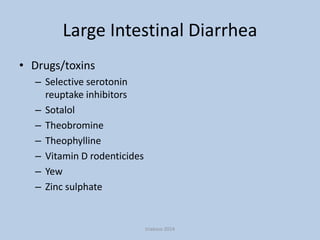
– Selective serotonin
reuptake inhibitors
– Sotalol
– Theobromine
– Theophylline
– Vitamin D rodenticides
– Yew
– Zinc sulphate

triakoso 2014
Thank you…..
triakoso 2014

Differential Diarrhea - Small Animal Medicine

  • 1.
    Veterinary Teaching Hospital AirlanggaUniversity Small Animal Practice Differential Diagnose
  • 2.
    Diarrhea • Diarrhea isdefine simply as passage of feces that contain an excess amount of water. This results in an abnormal increase in stool liquidity and weight. In some patients there may simply be an increase in frequency of defecation. • Diarrhea has also been described in broad, simple terms as “the too rapid evacuation of too loose stools.” • Definitions notwithstanding, however, it is most important that the clinician carefully determine exactly what the owner means when the term diarrhea is used. triakoso 2014
  • 3.
    Diarrhea • Small intestinediarrhea • Large intestine diarrhea triakoso 2014
  • 4.
    Clinical Signs Small intestine Largeintestine Mucous Rarely present Frequently present Volume Increased Normal to decreased Feces Quality of stool Shape Steatorrhea Color Melena Hematochezia Varies from nearly formed to quiet watery. Loose to nearly formed. Mucus may be absent or Often appears soft formed (“cowpile”). Undigested be present in small amounts, or constitute nearly food or fat droplets or globules may be the entire volume of material expelled. No present. Malodorous undigested food. Vary, depends on amount of water present in feces Normal, reduced in diameter (narrowed) Present with maldigestive/malabsorptive disorders Absent Considerable variation—tan to dark brown, black (not always indicative of melena), grayish brown. May be altered by certain medications Variable—usually brown, may be nearly clear (increasedmucus) or laced with bright-red blood Maybe present -- black, tarry stool Absent Absent, except in HGE syndrome Maybe present triakoso 2014
  • 5.
    Clinical Signs Small intestine Largeintestine Frequency Usually increased to 2-4 times a day but may remain normal in some patients Almost always increased. May be as frequent as 3-10 times per day (average 3-5). The combination of increased frequency of defecation and passage of decreased amounts of stool strongly suggests large intestinal involvement Dyschezia Absent Frequent in dogs, less common in cat Tenesmus Absent Frequent in dogs, less common in cat May be present in cases of acute severe enteritis, with rapid transit of large volumes of fluid through the gastrointestinal tract Frequent. Common reason for owner being awakened during the night to allow a dog outdoors to defecate. Often Defecation Urgency triakoso 2014
  • 6.
    Clinical Signs Small intestine Largeintestine Vomit Common in patients with inflammatory bowel disorders and acute infectious disorders May occur in 30%-35% of patients with acute colitis. Sometimes occurs before onset of abnormal stools Appetite Usually normal or decreased. May be cyclic, often decreasing in conjunction with flare-ups symptoms. May be ravenous in some dogs with inflammatory bowel disease (especially shar-peis).Appetite may be increased in cats with inflammatory bowel disease or lymphoma (transiently in the latter). Usually remains normal. May be decreased if disease is severe (neoplasia, of histoplasmosis). Usually occurs as disease becomes more chronic. Occurs with both malabsorptive and maldigestive disease processes. Unusual. May occur in conjunction with severe colitis, diffuse neoplasia, or histoplasmosis. If both small and large bowel signs are present, any weight loss that has occurred is more likely due to the small intestinal disease component Associated signs Weight loss triakoso 2014
  • 7.
    Clinical Signs Small intestine Largeintestine May be associated with maldigestive or malabsorptive diseases Absent Borborygmus Maybe present Absent Flatulence Maybe present Absent Fecal incontinence Rare—would only be associated with severe enteritis and rapid transit of large volumes of watery diarrhea May be present Scooting or chewing perianal area Absent Occasionally present—may be quite pronounced in some patients with proctitis Associated signs Halitosis triakoso 2014
  • 8.
    Causes Small IntestinalDiarrhea • Diet • Extra-gastrointestinal diseases • Infection • Inflammatory/immune mediated • Idiophatic • • • • triakoso 2014 Neoplasia Partial obstruction Motility disorders Drugs/toxins
  • 9.
    Causes Large IntestinalDiarrhea • Diet • Extra-intestinal conditions • Infection • Inflammatory/immune mediated • Idiophatic • • • • triakoso 2014 Neoplasia Obstruction Miscellaneous Drugs/toxins
  • 10.
    Small Intestinal Diarrhea •Diet – Dietary intolerance [Food hypersensitivity; Food intolerance; Gluten-sensitive enteropathy] • Extra-gastrointestinal diseases – EPI – Hepatic disease – Hyperthiroidism – Hypoadrenocorticism triakoso 2014
  • 11.
    Small Intestinal Diarrhea •Infection – Bacterial [Campyovacter spp; Clostridium spp; Salmonella spp; E coli; Staphylococcus, SIBO] – Fungal – Helminth [Hookworm; Roundworm; Tapeworm; Whipworm] – Protozoal [Cryptosporidiosis; Giardia spp] – Rickettsial – Viral [Corona virus; Parvovirus; Feline panleukopenia] triakoso 2014
  • 12.
    Small Intestinal Diarrhea •Inflammatory/immune mediated – – – – Basenji enteropathy Duodenal ulceration Hemorrhagic gastroenteritis Inflammatory bowel disease [Eosinophilic; Granulomatous; Lymphoplasmacytic] – Protein-losing enteropathy and nephropathy of the Soft-Coated Weaten Terrier • Idiophatic – Lymphangiectasia triakoso 2014
  • 13.
    Large Intestinal Diarrhea •Diet* – Dietary hypersensitivity – Dietary indiscretion • Extra-intestinal conditions – – – – – Metastatic neoplasia Neurological disease leading to ulcerative colitis Pancreatitis Toxaemia Uraemia • Infection – Bacterial*, e.g. [Campylobacter spp; Clostridium difficile; Clostridium perfringens; E. coli; Salmonella spp; Yersinia enterocolitica] triakoso 2014
  • 14.
    Large Intestinal Diarrhea •Infection – Viral* [Coronavirus; Feline immunodeficiency virus (C); Feline infectious peritonitis (C); Feline leukaemia virus (C); Parvovirus] – Fungal, e.g. [ Histoplasmosis; Protothecosis] – Parasitic*, e.g. [Amoebiasis; Ancylostoma spp; Balantidium coli; Cryptosporidiosis; Giardia spp; Heterobilharzia americana; Roundworm; Tapeworm; Tritrichomonas foetus(C); Uncinaria spp; Whipworm] – Protozoal, e.g. [Toxoplasmosis] triakoso 2014
  • 15.
    Large Intestinal Diarrhea •Immune-mediated/inflammatory disease – Histiocytic ulcerative colitis of Boxers (D) – Inflammatory bowel disease* • Idiopathic conditions – Fibre-responsive large-bowel diarrhoea – Irritable bowel syndrome • Neoplasia* – Benign, e.g. [Adenomatous polyps; Leiomyoma] – Malignant, e.g. [Adenocarcinoma; Lymphoma] triakoso 2014
  • 16.
    Large Intestinal Diarrhea •Obstruction – Caecal inversion – Foreign body* – Intussusception* – Neoplasia – Stricture • Miscellaneous – Secondary to chronic small intestinal disease – Stress triakoso 2014
  • 17.
    Large Intestinal Diarrhea •Drugs/toxins – – – – – – – – – – – – – – – – – Acetazolamide Adder bite Allopurinol Aminophylline Amoxicillin Amphotericin B Ampicillin Atenolol Benzalkonium chloride triakoso 2014 Bethanechol Blue-green algae Borax Calcium edetate Carbamate insecticides Cardiac glycosides Cephalexin Chloramphenicol
  • 18.
    Large Intestinal Diarrhea •Drugs/toxins – – – – – – – – – – – – – – – – – – Chlorphenamine Colchicine Cotoneaster Cyclophosphamide Cyclosporin Cytarabine Daffodil Diazoxide Diclofenac sodium triakoso 2014 Dieffenbachia Doxycycline Glyphosphate Honeysuckle Horse chestnut Ibuprofen Indomethacin Iron/iron salts Laburnum
  • 19.
    Large Intestinal Diarrhea •Drugs/toxins – – – – – – – – – – – – – – – – Lactulose Levamisole Lithium Loperamide Mebendazole Metaldehyde Methiocarb Misoprostol triakoso 2014 Mistletoe Mitotane Naproxen Nicotinamide NPK fertilisers NSAIDs Organophosphates Oxytetracycline
  • 20.
    Large Intestinal Diarrhea •Drugs/toxins – Pamidronate – Pancreatic enzyme supplementation – Paracetamol – Paraquat – Pentoxifylline – Petroleum distillates – Phenoxy acid herbicides – Piperazine triakoso 2014 – – – – – – – – – Poinsettia Procainamide Pyracantha Pyrethrin/pyrethroids Pyridostigmine Quinidine Rhododendron Rowan Salt
  • 21.
    Large Intestinal Diarrhea •Drugs/toxins – Selective serotonin reuptake inhibitors – Sotalol – Theobromine – Theophylline – Vitamin D rodenticides – Yew – Zinc sulphate triakoso 2014
  • 22.