Rift Valley Fever   Symptoms Texas A&M University  University of Pretoria College of Veterinary Medicine  Department of  Veterinary Tropical Diseases  Jeffrey Musser, DVM, PhD  Professor J.A.W. Coetzer Suzanne Burnham, DVM
Special thanks for materials  borrowed with permission  from presentations by: Dr Linda Logan, “Rift Valley Fever” CSU Foreign Animal Disease Training Course,  College of Veterinary Medicine and Biomedical Sciences, August 1-5, 2005.  Professor JAW Coetzer,  Department of Veterinary Tropical Diseases, Faculty of Veterinary Science, University of Pretoria, “Rift Valley Fever” presented at the FEAD course in Knoxville, Tenn. 2005.
Rift Valley Fever In this presentation the authors especially drew from the first hand experience of their colleagues in South Africa.  Personal interviews as well as standard research sources provide the insights we bring you for the recognition of this exotic disease. JAW Coetzer Jeffrey Musser  Suzanne Burnham
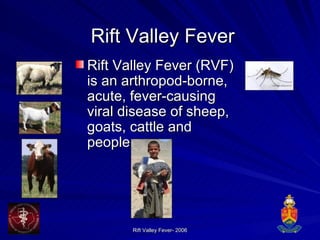
Rift Valley Fever Rift Valley Fever (RVF) is an arthropod-borne, acute, fever-causing viral disease of sheep, goats, cattle and people.
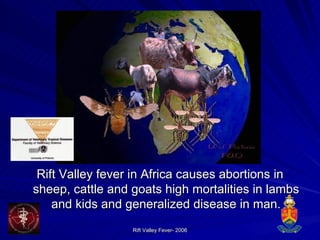
Rift Valley fever in Africa causes abortions in sheep, cattle and goats high mortalities in lambs and kids and generalized disease in man.
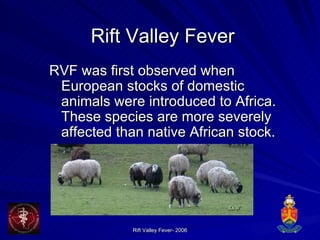
Rift Valley Fever RVF was first observed when European stocks of domestic animals were introduced to Africa. These species are more severely affected than native African stock.
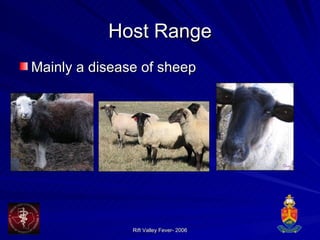
Host Range Mainly a disease of sheep
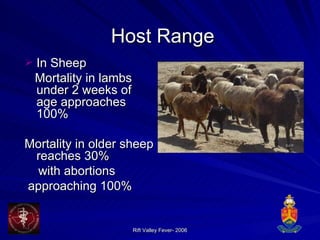
Host Range In Sheep Mortality in lambs under 2 weeks of age approaches 100% Mortality in older sheep reaches 30%  with abortions  approaching 100%
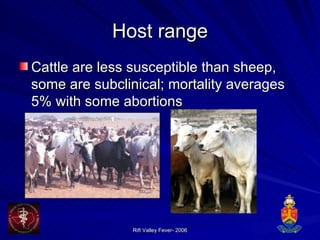
Host range Cattle are less susceptible than sheep, some are subclinical; mortality averages 5% with some abortions
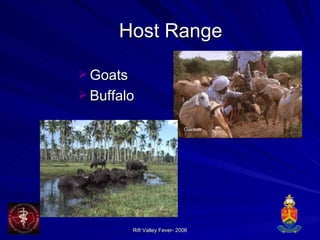
Host Range Goats Buffalo
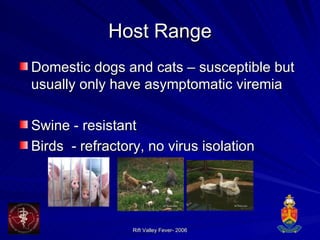
Host Range Domestic dogs and cats – susceptible but usually only have asymptomatic viremia Swine - resistant Birds  - refractory, no virus isolation
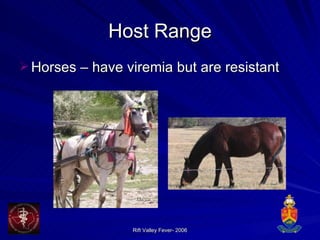
Host Range Horses – have viremia but are resistant
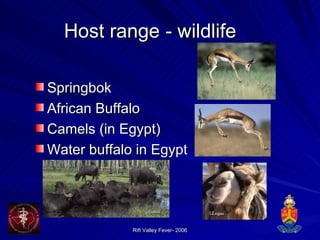
Host range  - wildlife Springbok African Buffalo  Camels (in Egypt)  Water buffalo in Egypt
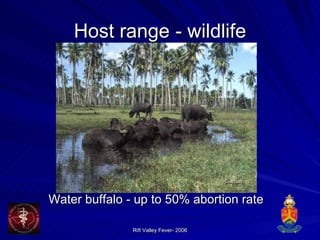
Host range  - wildlife Water buffalo - up to 50% abortion rate
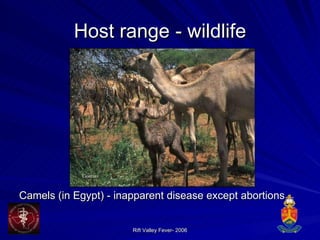
Host range  - wildlife Camels (in Egypt) - inapparent disease except abortions
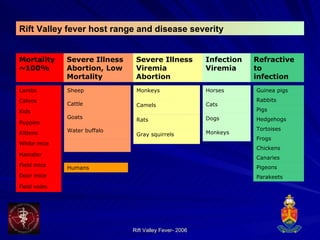
Humans Refractive to infection  Infection Viremia Severe Illness Viremia Abortion Severe Illness Abortion, Low Mortality Mortality ~100% Rift Valley fever host range and disease severity   Field voles Door mice Field mice Hamster White mice  Kittens Puppies Kids Calves Lambs      Water buffalo Goats Cattle Sheep Gray squirrels Rats Camels Monkeys Monkeys Dogs Cats Horses Parakeets Pigeons Canaries Chickens Frogs Tortoises Hedgehogs Pigs Rabbits Guinea pigs
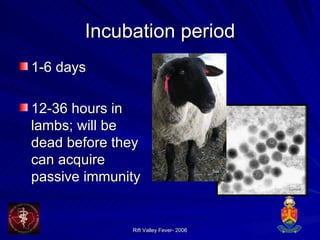
Incubation period 1-6 days 12-36 hours in lambs; will be dead before they can acquire passive immunity
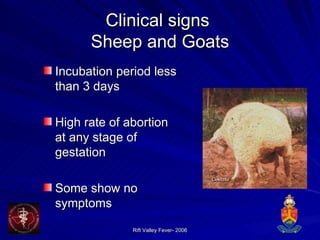
Clinical signs  Sheep and Goats Incubation period less than 3 days High rate of abortion at any stage of gestation Some show no symptoms
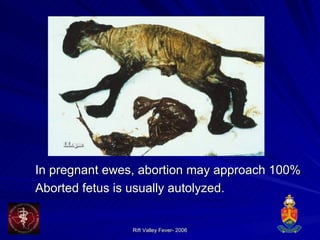
In pregnant ewes, abortion may approach 100% Aborted fetus is usually autolyzed.
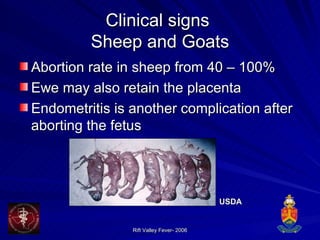
Clinical signs  Sheep and Goats Abortion rate in sheep from 40 – 100% Ewe may also retain the placenta Endometritis is another complication after aborting the fetus USDA
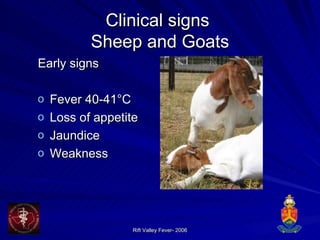
Clinical signs  Sheep and Goats Early signs Fever 40-41°C Loss of appetite  Jaundice Weakness
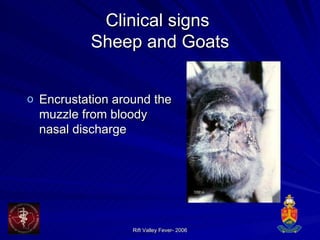
Clinical signs  Sheep and Goats Encrustation around the muzzle from bloody nasal discharge
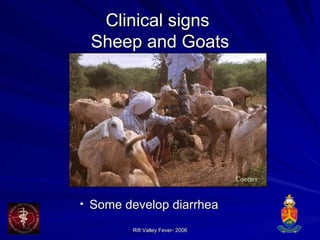
Clinical signs  Sheep and Goats Some develop diarrhea
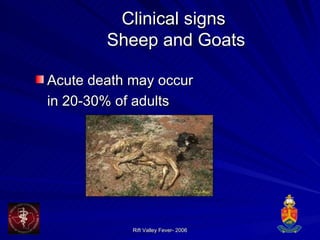
Clinical signs  Sheep and Goats Acute death may occur  in 20-30% of adults
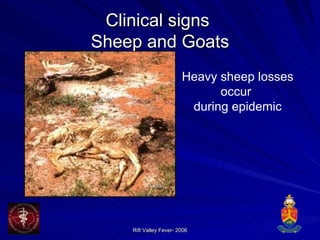
Clinical signs  Sheep and Goats Heavy sheep losses occur  during epidemic
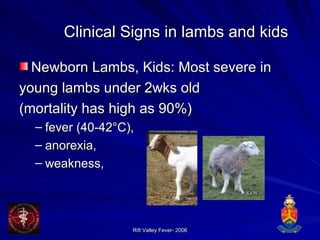
Clinical Signs in lambs and kids Newborn Lambs, Kids: Most severe in  young lambs under 2wks old (mortality has high as 90%) fever (40-42°C),  anorexia,  weakness,
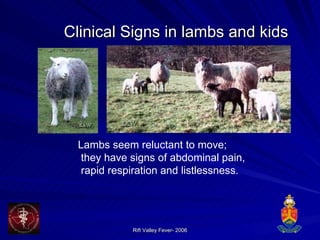
Clinical Signs in lambs and kids Lambs seem reluctant to move; they have signs of abdominal pain, rapid respiration and listlessness.
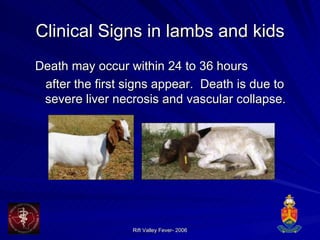
Clinical Signs in lambs and kids Death may occur within 24 to 36 hours  after the first signs appear.  Death is due to severe liver necrosis and vascular collapse.
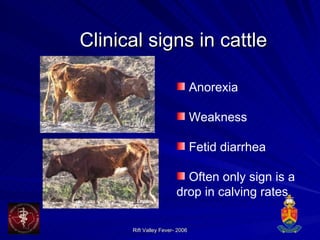
Clinical signs in cattle Anorexia Weakness Fetid diarrhea Often only sign is a drop in calving rates Add images
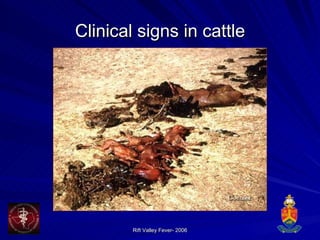
Clinical signs in cattle Calves: fever (40-41°C), depression. Mortality rate: 10-70% Death occurs about 2-8 days after the first signs appear.  Adults: fever (40-41°C), excessive salivation, anorexia, weakness, fetid diarrhea, fall in milk yield. Abortion may reach 85% in the herd. Mortality rate is usually less than 10%
Clinical signs in cattle
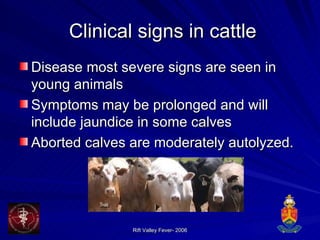
Clinical signs in cattle Disease most severe signs are seen in young animals Symptoms may be prolonged and will include jaundice in some calves Aborted calves are moderately autolyzed.
Clinical signs Dogs: Abortions may occur in adult dogs; severe disease and death usually only in puppies Cats: Death in kittens
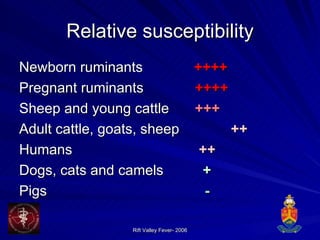
Relative susceptibility Newborn ruminants  ++++ Pregnant ruminants  ++++ Sheep and young cattle    +++ Adult cattle, goats, sheep   ++ Humans   ++ Dogs, cats and camels   + Pigs  -
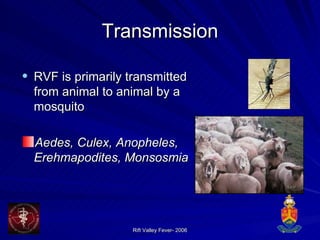
Transmission RVF is primarily transmitted from animal to animal by a mosquito  Aedes, Culex, Anopheles, Erehmapodites, Monsosmia
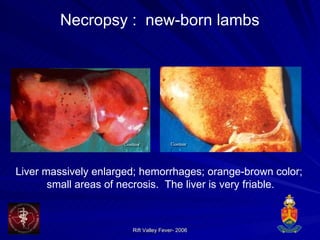
Necropsy findings Massive hepatitis: hemorrhages, necrotic foci, marked enlargement, orange-brown, friable, edematous liver tissue  (“If you open a newborn lamb, the liver jumps into your face” Coetzer) Chocolate-brown digested blood in abomasum, hemorrhages in intestinal mucosa, free blood in lumen
Pathology Summary Focal or generalized hepatic necrosis  Congestion, enlargement, and discoloration of liver with subcapsular hemorrhages  Brown-yellowish color of liver in aborted fetuses  Hemorrhagic enteritis  Icterus (low percentage)  Widespread cutaneous hemorrhages, petechial to ecchymotic hemorrhages on parietal and visceral serosal membranes  Enlargement, edema, hemorrhages and necrosis of lymph nodes  Congestion and cortical hemorrhages of kidneys and gallbladder
Necropsy :  new-born lambs Liver massively enlarged; hemorrhages; orange-brown color;  small areas of necrosis.  The liver is very friable.
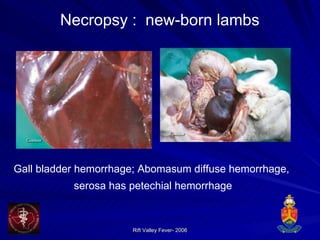
Necropsy :  new-born lambs Gall bladder hemorrhage; Abomasum diffuse hemorrhage,  serosa has petechial hemorrhage
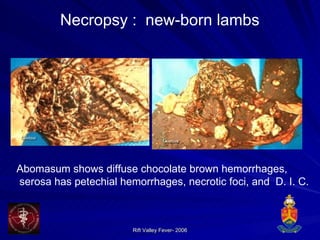
Necropsy :  new-born lambs Abomasum shows diffuse chocolate brown hemorrhages, serosa has petechial hemorrhages, necrotic foci, and  D. I. C.
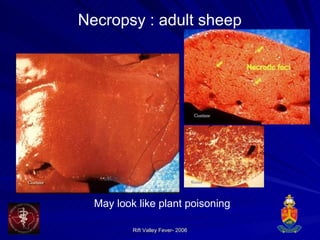
Necropsy : adult sheep May look like plant poisoning
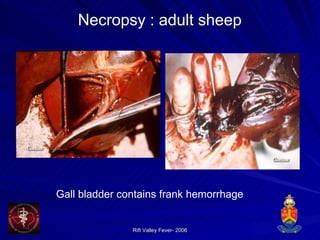
Necropsy : adult sheep Gall bladder contains frank hemorrhage
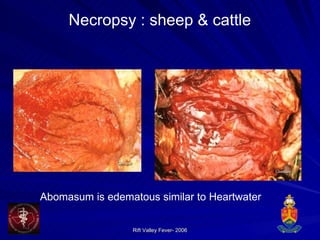
Necropsy : sheep & cattle Abomasum is edematous similar to Heartwater
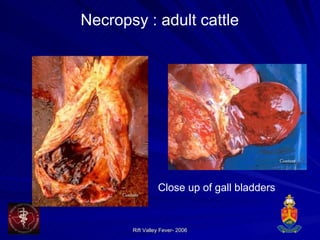
Necropsy : adult cattle Close up of gall bladders
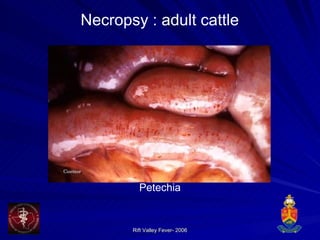
Necropsy : adult cattle Petechia
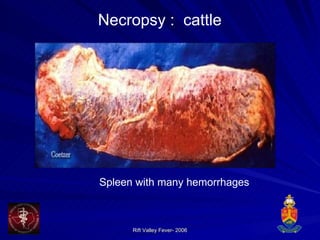
Necropsy :  cattle Spleen with many hemorrhages
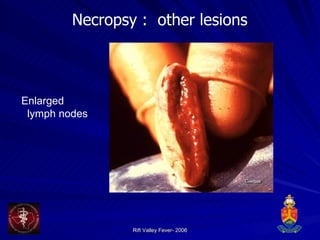
Necropsy :  other lesions Enlarged lymph nodes
Differential Diagnosis Abortifacient agents Agents causing hepatitis Agents that cause hemorrhages
Differential Diagnosis Bluetongue  Wesselsbron disease  Enterotoxemia of sheep  Ephemeral fever  Brucellosis  Vibriosis  Trichomonosis
Differential Diagnosis Nairobi sheep disease  Heartwater  Ovine enzootic abortion  Toxic plants  Bacterial septicemias (Pasteurella, Salmonella, Anthrax) Rinderpest and Peste des petits ruminants
Suspect Rift Valley Fever if: High mortalities in lambs, kids and calves following increase in mosquito populations Disease is milder in adults than in newborns Abortions in sheep, goats and cattle Extensive necrotic liver changes Influenza symptoms in people working with sick animals or handling infected carcasses
Rift Valley Fever   - Bibliography Linda L Logan, DVM PhD, USDA APHIS Attach é, North Africa, East Africa, Middle East, “Rift Valley Fever” CSU Foreign Animal Disease Training Course, Aug 1-5, 2005. Professor  J A W Coetzer, Department of Veterinary Tropical Diseases, Faculty of Veterinary Science, University of Pretoria, “Rift Valley Fever”  USAHA,  Foreign Animal Diseases , 1992 Edition, p.311-317 W.A. Geering, A.J. Foreman and M.J. Nunn,  Exotic Diseases of Animals , 1995 Australian Govt Publishing Service, Canberra; p.218- 224.
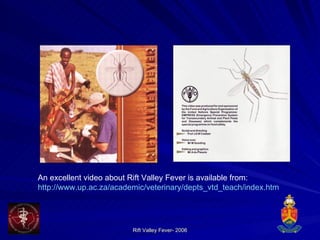
An excellent video about Rift Valley Fever is available from: http://www.up.ac.za/academic/veterinary/depts_vtd_teach/index.htm
Image Watermark  “ KAW” images by Dr. Ken A. Waldrup “ Coetzer” images used with permission by Dr. Koos Coetzer “ LLogan” images by Dr. Linda Logan “ Suz” images by Dr Suzanne Burnham “ MFitilodze” images by Dr.  M. W. (Bill) Mfitilodze Bunda College of Agriculture, University of Malawi
Acknowledgements Special thanks to  Professor JAW Coetzer  Linda Logan, DVM PhD,  USDA Ken Waldrup, DVM, PhD Robin Sewell, DVM  Kelsey Pohler- Research Assistant

Rift valleyfeversymptoms.ppt

  • 1.
    Rift Valley Fever Symptoms Texas A&M University University of Pretoria College of Veterinary Medicine Department of Veterinary Tropical Diseases Jeffrey Musser, DVM, PhD Professor J.A.W. Coetzer Suzanne Burnham, DVM
  • 2.
    Special thanks formaterials borrowed with permission from presentations by: Dr Linda Logan, “Rift Valley Fever” CSU Foreign Animal Disease Training Course, College of Veterinary Medicine and Biomedical Sciences, August 1-5, 2005. Professor JAW Coetzer, Department of Veterinary Tropical Diseases, Faculty of Veterinary Science, University of Pretoria, “Rift Valley Fever” presented at the FEAD course in Knoxville, Tenn. 2005.
  • 3.
    Rift Valley FeverIn this presentation the authors especially drew from the first hand experience of their colleagues in South Africa. Personal interviews as well as standard research sources provide the insights we bring you for the recognition of this exotic disease. JAW Coetzer Jeffrey Musser Suzanne Burnham
  • 4.
    Rift Valley FeverRift Valley Fever (RVF) is an arthropod-borne, acute, fever-causing viral disease of sheep, goats, cattle and people.
  • 5.
    Rift Valley feverin Africa causes abortions in sheep, cattle and goats high mortalities in lambs and kids and generalized disease in man.
  • 6.
    Rift Valley FeverRVF was first observed when European stocks of domestic animals were introduced to Africa. These species are more severely affected than native African stock.
  • 7.
    Host Range Mainlya disease of sheep
  • 8.
    Host Range InSheep Mortality in lambs under 2 weeks of age approaches 100% Mortality in older sheep reaches 30% with abortions approaching 100%
  • 9.
    Host range Cattleare less susceptible than sheep, some are subclinical; mortality averages 5% with some abortions
  • 10.
  • 11.
    Host Range Domesticdogs and cats – susceptible but usually only have asymptomatic viremia Swine - resistant Birds - refractory, no virus isolation
  • 12.
    Host Range Horses– have viremia but are resistant
  • 13.
    Host range - wildlife Springbok African Buffalo Camels (in Egypt) Water buffalo in Egypt
  • 14.
    Host range - wildlife Water buffalo - up to 50% abortion rate
  • 15.
    Host range - wildlife Camels (in Egypt) - inapparent disease except abortions
  • 16.
    Humans Refractive toinfection Infection Viremia Severe Illness Viremia Abortion Severe Illness Abortion, Low Mortality Mortality ~100% Rift Valley fever host range and disease severity Field voles Door mice Field mice Hamster White mice Kittens Puppies Kids Calves Lambs     Water buffalo Goats Cattle Sheep Gray squirrels Rats Camels Monkeys Monkeys Dogs Cats Horses Parakeets Pigeons Canaries Chickens Frogs Tortoises Hedgehogs Pigs Rabbits Guinea pigs
  • 17.
    Incubation period 1-6days 12-36 hours in lambs; will be dead before they can acquire passive immunity
  • 18.
    Clinical signs Sheep and Goats Incubation period less than 3 days High rate of abortion at any stage of gestation Some show no symptoms
  • 19.
    In pregnant ewes,abortion may approach 100% Aborted fetus is usually autolyzed.
  • 20.
    Clinical signs Sheep and Goats Abortion rate in sheep from 40 – 100% Ewe may also retain the placenta Endometritis is another complication after aborting the fetus USDA
  • 21.
    Clinical signs Sheep and Goats Early signs Fever 40-41°C Loss of appetite Jaundice Weakness
  • 22.
    Clinical signs Sheep and Goats Encrustation around the muzzle from bloody nasal discharge
  • 23.
    Clinical signs Sheep and Goats Some develop diarrhea
  • 24.
    Clinical signs Sheep and Goats Acute death may occur in 20-30% of adults
  • 25.
    Clinical signs Sheep and Goats Heavy sheep losses occur during epidemic
  • 26.
    Clinical Signs inlambs and kids Newborn Lambs, Kids: Most severe in young lambs under 2wks old (mortality has high as 90%) fever (40-42°C), anorexia, weakness,
  • 27.
    Clinical Signs inlambs and kids Lambs seem reluctant to move; they have signs of abdominal pain, rapid respiration and listlessness.
  • 28.
    Clinical Signs inlambs and kids Death may occur within 24 to 36 hours after the first signs appear. Death is due to severe liver necrosis and vascular collapse.
  • 29.
    Clinical signs incattle Anorexia Weakness Fetid diarrhea Often only sign is a drop in calving rates Add images
  • 30.
    Clinical signs incattle Calves: fever (40-41°C), depression. Mortality rate: 10-70% Death occurs about 2-8 days after the first signs appear. Adults: fever (40-41°C), excessive salivation, anorexia, weakness, fetid diarrhea, fall in milk yield. Abortion may reach 85% in the herd. Mortality rate is usually less than 10%
  • 31.
  • 32.
    Clinical signs incattle Disease most severe signs are seen in young animals Symptoms may be prolonged and will include jaundice in some calves Aborted calves are moderately autolyzed.
  • 33.
    Clinical signs Dogs:Abortions may occur in adult dogs; severe disease and death usually only in puppies Cats: Death in kittens
  • 34.
    Relative susceptibility Newbornruminants ++++ Pregnant ruminants ++++ Sheep and young cattle +++ Adult cattle, goats, sheep ++ Humans ++ Dogs, cats and camels + Pigs -
  • 35.
    Transmission RVF isprimarily transmitted from animal to animal by a mosquito Aedes, Culex, Anopheles, Erehmapodites, Monsosmia
  • 36.
    Necropsy findings Massivehepatitis: hemorrhages, necrotic foci, marked enlargement, orange-brown, friable, edematous liver tissue (“If you open a newborn lamb, the liver jumps into your face” Coetzer) Chocolate-brown digested blood in abomasum, hemorrhages in intestinal mucosa, free blood in lumen
  • 37.
    Pathology Summary Focalor generalized hepatic necrosis Congestion, enlargement, and discoloration of liver with subcapsular hemorrhages Brown-yellowish color of liver in aborted fetuses Hemorrhagic enteritis Icterus (low percentage) Widespread cutaneous hemorrhages, petechial to ecchymotic hemorrhages on parietal and visceral serosal membranes Enlargement, edema, hemorrhages and necrosis of lymph nodes Congestion and cortical hemorrhages of kidneys and gallbladder
  • 38.
    Necropsy : new-born lambs Liver massively enlarged; hemorrhages; orange-brown color; small areas of necrosis. The liver is very friable.
  • 39.
    Necropsy : new-born lambs Gall bladder hemorrhage; Abomasum diffuse hemorrhage, serosa has petechial hemorrhage
  • 40.
    Necropsy : new-born lambs Abomasum shows diffuse chocolate brown hemorrhages, serosa has petechial hemorrhages, necrotic foci, and D. I. C.
  • 41.
    Necropsy : adultsheep May look like plant poisoning
  • 42.
    Necropsy : adultsheep Gall bladder contains frank hemorrhage
  • 43.
    Necropsy : sheep& cattle Abomasum is edematous similar to Heartwater
  • 44.
    Necropsy : adultcattle Close up of gall bladders
  • 45.
    Necropsy : adultcattle Petechia
  • 46.
    Necropsy : cattle Spleen with many hemorrhages
  • 47.
    Necropsy : other lesions Enlarged lymph nodes
  • 48.
    Differential Diagnosis Abortifacientagents Agents causing hepatitis Agents that cause hemorrhages
  • 49.
    Differential Diagnosis Bluetongue Wesselsbron disease Enterotoxemia of sheep Ephemeral fever Brucellosis Vibriosis Trichomonosis
  • 50.
    Differential Diagnosis Nairobisheep disease Heartwater Ovine enzootic abortion Toxic plants Bacterial septicemias (Pasteurella, Salmonella, Anthrax) Rinderpest and Peste des petits ruminants
  • 51.
    Suspect Rift ValleyFever if: High mortalities in lambs, kids and calves following increase in mosquito populations Disease is milder in adults than in newborns Abortions in sheep, goats and cattle Extensive necrotic liver changes Influenza symptoms in people working with sick animals or handling infected carcasses
  • 52.
    Rift Valley Fever - Bibliography Linda L Logan, DVM PhD, USDA APHIS Attach é, North Africa, East Africa, Middle East, “Rift Valley Fever” CSU Foreign Animal Disease Training Course, Aug 1-5, 2005. Professor J A W Coetzer, Department of Veterinary Tropical Diseases, Faculty of Veterinary Science, University of Pretoria, “Rift Valley Fever” USAHA, Foreign Animal Diseases , 1992 Edition, p.311-317 W.A. Geering, A.J. Foreman and M.J. Nunn, Exotic Diseases of Animals , 1995 Australian Govt Publishing Service, Canberra; p.218- 224.
  • 53.
    An excellent videoabout Rift Valley Fever is available from: http://www.up.ac.za/academic/veterinary/depts_vtd_teach/index.htm
  • 54.
    Image Watermark “ KAW” images by Dr. Ken A. Waldrup “ Coetzer” images used with permission by Dr. Koos Coetzer “ LLogan” images by Dr. Linda Logan “ Suz” images by Dr Suzanne Burnham “ MFitilodze” images by Dr. M. W. (Bill) Mfitilodze Bunda College of Agriculture, University of Malawi
  • 55.
    Acknowledgements Special thanksto Professor JAW Coetzer Linda Logan, DVM PhD, USDA Ken Waldrup, DVM, PhD Robin Sewell, DVM Kelsey Pohler- Research Assistant

Editor's Notes

  • #5 Burnham
  • #9 Waldrup Image
  • #12 Logan
  • #14 Logan Springboks: www.namibian.org (top Image) www.stock-photography.co.za (lower image)
  • #15 Image coetz
  • #16 Camels in Egypt - Coetzer
  • #19 Coetzer
  • #20 Logan
  • #21 vein.library.usyd.edu.au/.../exoimages/rd329.jpg Image contributed by US Department of Agriculture
  • #26 Coezter
  • #27 Coezter image
  • #28 Coetzer
  • #30 logan
  • #33 Usda?
  • #35 From Logan
  • #36 http://news.bbc.co.uk/olmedia/930000/images/_934032_mosq150.jpg Sheep: KAW
  • #39 Liver massively enlarged; hemorrhages; orange-brown color; small areas of necrosis. Gall bladder hemorrhage; Abomasum diffuse chocolate brown hemorrhage, serosa has petechial hemorrhage - Coetzer
  • #40 Liver massively enlarged; hemorrhages; orange-brown color; small areas of necrosis. Gall bladder hemorrhage; Abomasum diffuse chocolate brown hemorrhage, serosa has petechial hemorrhage - Coetzer
  • #41 Abomasum diffuse chocolate brown hemorrhage, serosa has petechial hemorrhage; Necrotic Foci, D. I. C. – Coetzer
  • #42 May look like plant poisoning
  • #43 Gall bladder contains frank hemorrhage Coetzer images
  • #44 Coetzer images Abomasum is edematous similar to Heartwater
  • #45 Close up of gall bladders- Coetzer images
  • #46 Petechiation Coetzer images
  • #47 Spleen with many hemorrhages - Coetzer
  • #48 Enlarged lymph nodes
  • #52 Logan