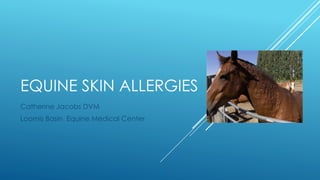
EQUINE SKIN ALLERGIES
Catherine Jacobs DVM
Loomis Basin Equine Medical Center
AN ITCHY HORSE CAN BE AN
UNHAPPY HORSE
Two Main Causes of Skin Allergies in Horses
1. Environmental Allergens
2. Insect Bite Hypersensitvity
EQUINE SKIN ALLERGIES
Environmental Allergens
 Atopic Dermatitis
 Hives (Urticaria)
 May or may not be pruritic (itchy)
 May note some lethargy
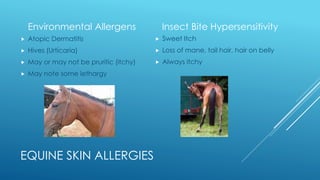
Insect Bite Hypersensitivity
 Sweet Itch
 Loss of mane, tail hair, hair on belly
 Always itchy
HIVES - APPEARANCE
 Flat topped wheal
 Doughnut shape
 Neck and Trunk most common
 May or may not ooze serum
 May or may not itch
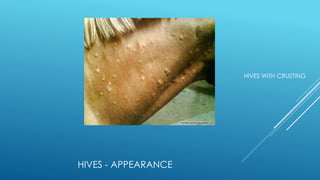
HIVES - APPEARANCE
FLAT TOPPED
COALESCING
WHEALS
HIVES - APPEARANCE
DOUGNUT SHAPED HIVES
HIVES - APPEARANCE
HIVES WITH CRUSTING
HIVES - CAUSES
 Usually due to inhaled allergens in the environment
 Can also be due to, but less commonly:
 1. Food allergy
 2. Contact allergy (shavings, fly spray, laundry detergent)
 3. Drug reactions
 4. Infections
 5. Non immunologic causes (stress, pressure, exercise)
HIVES - DIAGNOSIS
Evaluate if any new bedding,
topicals, medications, or feed
introduced recently
Skin Allergy Testing – must
withdraw meds 14-28 days
prior – more sensitive for
allergen specific IgE levels
Serum Allergy testing – no
medication withdrawl
needed – not as sensitive
SERUM ALLERGY TESTING – PULL
BLOOD SAMPLE
 Idexx laboratory
 Regional 2 panel CA
 1. Food – Barley, Beetpulp, Yeast, Corn, Oats, Flaxseed, etc.
 2. Farm and Stable – Alfalfa, Orchard Grass, Grain Mill Dust, Cat
Dander, red clover, Candida Albicans, etc.
 3. Insects – Flea, cockroach, biting midge, culicoides, caddis fly,
storage mite, house fly, stable fly, mosquito, horsefly, mayfly, etc,
 4. Molds, grasses, weeds and Trees common in our area
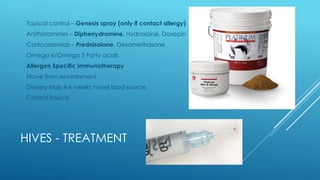
HIVES - TREATMENT
Topical control – Genesis spray (only if contact allergy)
Anithistamines – Diphenydramine, Hydroxizine, Doxepin
Corticosteroids – Prednisolone, Dexamethasone
Omega 6/Omega 3 Fatty acids
Allergen Specific Immunotherapy
Move from environment
Dietary trials 4-6 weeks novel food source
Control insects
ALLERGEN SPECIFIC IMMUNOTHERAPY
Consider if treating hives more than 4 months out of the year
Lack of satisfactory response to management changes
Concerns about adverse drug affects with corticosteroids (laminitis)
Concerns about competing – Cannot show on Hydroxizine
ALLERGEN SPECIFIC IMMUNOTHERAPY
Allergy Testing (serum or skin) used to determine specific environmental
reactants
These reactants are incorporated into allergen specific immunotherapy
Small volume injections initially a few days apart
Effects as soon as 2 months after starting injections but can take 12
months
60-70% of these horses affected by inhaled environemtnal allergens
improve with Allergen Specific Immunotherapy
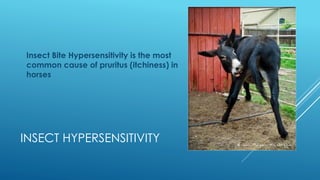
INSECT HYPERSENSITIVITY
Insect Bite Hypersensitivity is the most
common cause of pruritus (itchiness) in
horses
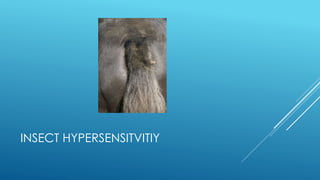
INSECT HYPERSENSITVITIY
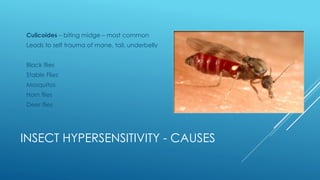
INSECT HYPERSENSITIVITY - CAUSES
Culicoides – biting midge – most common
Leads to self trauma of mane, tail, underbelly
Black flies
Stable Flies
Mosquitos
Horn flies
Deer flies
INSECT HYPERSENSITIVITY - CAUSES
Causes of Pruritus from insect bites
1. The bite itself
2. Immediate reaction to salivary antigens of the insect
3. Delayed reaction to insect proteins
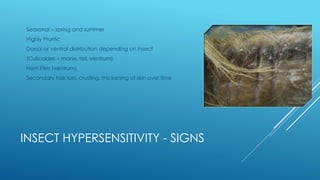
INSECT HYPERSENSITIVITY - SIGNS
Seasonal – spring and summer
Highly Pruritic
Dorsal or ventral distribution depending on insect
(Culicoides – mane, tail, ventrum)
Horn Flies (ventrum)
Secondary hair loss, crusting, thickening of skin over time
INSECT HYPERSENSITVITY - DIAGNOSIS
Seasonality
Distribution patterns
Ruling out ectoparasite, bacterial, fungal causes
Intradermal Skin allergy testing of insect allergen
proteins – use to confirm diagnosis and to select
extracts to use for therapy
INSECT HYPERSENSITIVITY - TREATMENT
AVOIDANCE – reduce insect contact as
much as possible
Keep in at dawn and dusk
Fly control in the barn with automated spray
2%Permethrin Flyspray
Fipronil (Frontline)spray on trouble areas
Fans
Fly sheets/masks
Feed through fly control
INSECT HYPERSENSITIVITY - TREATMENT
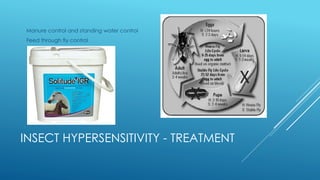
Manure control and standing water control
Feed through fly control
INSECT HYPERSENSITIVITY - TREATMENT
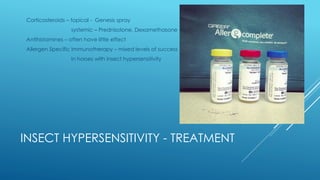
Corticosteroids – topical - Genesis spray
systemic – Prednisolone, Dexamethasone
Antihistamines – often have little effect
Allergen Specific Immunotherapy – mixed levels of success
In horses with insect hypersensitivity
QUESTIONS?

Equine skin allergies

  • 1.
    EQUINE SKIN ALLERGIES CatherineJacobs DVM Loomis Basin Equine Medical Center
  • 2.
    AN ITCHY HORSECAN BE AN UNHAPPY HORSE Two Main Causes of Skin Allergies in Horses 1. Environmental Allergens 2. Insect Bite Hypersensitvity
  • 3.
    EQUINE SKIN ALLERGIES EnvironmentalAllergens  Atopic Dermatitis  Hives (Urticaria)  May or may not be pruritic (itchy)  May note some lethargy Insect Bite Hypersensitivity  Sweet Itch  Loss of mane, tail hair, hair on belly  Always itchy
  • 4.
    HIVES - APPEARANCE Flat topped wheal  Doughnut shape  Neck and Trunk most common  May or may not ooze serum  May or may not itch
  • 5.
    HIVES - APPEARANCE FLATTOPPED COALESCING WHEALS
  • 6.
  • 7.
  • 8.
    HIVES - CAUSES Usually due to inhaled allergens in the environment  Can also be due to, but less commonly:  1. Food allergy  2. Contact allergy (shavings, fly spray, laundry detergent)  3. Drug reactions  4. Infections  5. Non immunologic causes (stress, pressure, exercise)
  • 9.
    HIVES - DIAGNOSIS Evaluateif any new bedding, topicals, medications, or feed introduced recently Skin Allergy Testing – must withdraw meds 14-28 days prior – more sensitive for allergen specific IgE levels Serum Allergy testing – no medication withdrawl needed – not as sensitive
  • 10.
    SERUM ALLERGY TESTING– PULL BLOOD SAMPLE  Idexx laboratory  Regional 2 panel CA  1. Food – Barley, Beetpulp, Yeast, Corn, Oats, Flaxseed, etc.  2. Farm and Stable – Alfalfa, Orchard Grass, Grain Mill Dust, Cat Dander, red clover, Candida Albicans, etc.  3. Insects – Flea, cockroach, biting midge, culicoides, caddis fly, storage mite, house fly, stable fly, mosquito, horsefly, mayfly, etc,  4. Molds, grasses, weeds and Trees common in our area
  • 11.
    HIVES - TREATMENT Topicalcontrol – Genesis spray (only if contact allergy) Anithistamines – Diphenydramine, Hydroxizine, Doxepin Corticosteroids – Prednisolone, Dexamethasone Omega 6/Omega 3 Fatty acids Allergen Specific Immunotherapy Move from environment Dietary trials 4-6 weeks novel food source Control insects
  • 12.
    ALLERGEN SPECIFIC IMMUNOTHERAPY Considerif treating hives more than 4 months out of the year Lack of satisfactory response to management changes Concerns about adverse drug affects with corticosteroids (laminitis) Concerns about competing – Cannot show on Hydroxizine
  • 13.
    ALLERGEN SPECIFIC IMMUNOTHERAPY AllergyTesting (serum or skin) used to determine specific environmental reactants These reactants are incorporated into allergen specific immunotherapy Small volume injections initially a few days apart Effects as soon as 2 months after starting injections but can take 12 months 60-70% of these horses affected by inhaled environemtnal allergens improve with Allergen Specific Immunotherapy
  • 14.
    INSECT HYPERSENSITIVITY Insect BiteHypersensitivity is the most common cause of pruritus (itchiness) in horses
  • 15.
  • 16.
    INSECT HYPERSENSITIVITY -CAUSES Culicoides – biting midge – most common Leads to self trauma of mane, tail, underbelly Black flies Stable Flies Mosquitos Horn flies Deer flies
  • 17.
    INSECT HYPERSENSITIVITY -CAUSES Causes of Pruritus from insect bites 1. The bite itself 2. Immediate reaction to salivary antigens of the insect 3. Delayed reaction to insect proteins
  • 18.
    INSECT HYPERSENSITIVITY -SIGNS Seasonal – spring and summer Highly Pruritic Dorsal or ventral distribution depending on insect (Culicoides – mane, tail, ventrum) Horn Flies (ventrum) Secondary hair loss, crusting, thickening of skin over time
  • 19.
    INSECT HYPERSENSITVITY -DIAGNOSIS Seasonality Distribution patterns Ruling out ectoparasite, bacterial, fungal causes Intradermal Skin allergy testing of insect allergen proteins – use to confirm diagnosis and to select extracts to use for therapy
  • 20.
    INSECT HYPERSENSITIVITY -TREATMENT AVOIDANCE – reduce insect contact as much as possible Keep in at dawn and dusk Fly control in the barn with automated spray 2%Permethrin Flyspray Fipronil (Frontline)spray on trouble areas Fans Fly sheets/masks Feed through fly control
  • 21.
    INSECT HYPERSENSITIVITY -TREATMENT Manure control and standing water control Feed through fly control
  • 22.
    INSECT HYPERSENSITIVITY -TREATMENT Corticosteroids – topical - Genesis spray systemic – Prednisolone, Dexamethasone Antihistamines – often have little effect Allergen Specific Immunotherapy – mixed levels of success In horses with insect hypersensitivity
  • 23.