Dr. Bikal Lamichhane
1st Year Internal Medicine resident
NAMS
Evaluation and management of
Acute Diarrhea
DEFINITIONS
 Diarrhea is defined as the passage of loose or watery stools, typically at
least three times in a 24-hour period .
 It reflects increased water content of the stool, whether due to impaired
water absorption and/or active water secretion by the bowel.
 The following definitions have been suggested according to the duration
of symptoms:
 ●Acute – 14 days or fewer in duration
 ●Persistent diarrhea – more than 14 but fewer than 30 days in duration
 ●Chronic – more than 30 days in duration
 Invasive diarrhea, or dysentery, is defined as diarrhea with visible
blood or mucus, in contrast to watery diarrhea. Dysentery is commonly
associated with fever and abdominal pain.
ETIOLOGY
 Most cases of acute diarrhea are due to infections and are self-limited.
 The major causes of acute infectious diarrhea include
 viruses (norovirus, rotavirus, adenoviruses, astrovirus, and others),
 bacteria (Salmonella, Campylobacter, Shigella, enterotoxigenic Escherichia
coli, Clostridioides [formerly Clostridium] difficile, and others), and
 protozoa (Cryptosporidium, Giardia, Cyclospora, Entamoeba, and others)
 Taken together, most cases of acute infectious diarrhea are likely viral, as indicated by
the observation that stool cultures are positive in only 1.5 to 5.6 percent of cases in most
studies
 Among those with severe diarrhea, however, bacterial causes are responsible for most
cases. As an example, in a study of 173 healthy adults with severe acute community-
acquired diarrhea (defined in this study as ≥4 fluid stools per day for more than three
days), a bacterial pathogen was identified in 87 percent of cases .
 Protozoa are less commonly identified as the etiologic agents of acute gastrointestinal
illness.
 Noninfectious etiologies become more common as the course of the diarrhea persists
and becomes chronic.
Etiology:-
 Resource rich vs Resource limited setting.
 Traveller diarrhoea
 Food poisoining
 Epidemic Diarrhoea
Copyrights apply
Copyrights apply
Watery diarrhoea contd..
Inflammatory diarrhoea
Epidemic diarrhea —
 S. dysenteriae and V. cholerae are the most
common organisms associated with epidemic
diarrhea.
 Epidemic refers to an increase, often sudden, in
the number of cases of a disease above what is
normally expected in that population in that area.
 Outbreak carries the same definition as
epidemic, but it is often used for a more limited
geographic area.
 Four species of Shigella cause bloody diarrhea; they are
distinguished serologically as S. dysenteriae, Shigella
flexneri, Shigella boydii, and Shigella sonnei .
 Of those, S. dysenteriae serotype 1 (Sd1) is uniquely responsible for
epidemic dysentery.
 Four important features account for the association between Sd1 and
large, regional epidemics of dysentery :-
•It produces a potent cytotoxin (Shiga toxin) that causes patchy
destruction of the colonic epithelium.
•The low infective dose (10 to 100 organisms) facilitates person-to-
person spread of infection.
•Illness due to Sd1 is more severe and more prolonged than illness due
to other species of Shigella.
•Resistance to antimicrobials is more common than in other species
of Shigella.
Cholera:-
 Cholera is a secretory diarrheal disease caused
by enterotoxin-producing strains of V. cholerae.
 More than 200 serogroups of V. cholerae have
been identified to date, but historically, the O1
serogroup has caused the vast majority of
disease.
 The O139 serogroup emerged as a cause of
disease in 1992 , but has remained limited to a
few countries in Asia.
Copyrights apply
PATHOGENESIS
Copyrights apply
Copyrights apply
INOCULOM SIZE
PATHOGEN INOCULUM SIZE
Rotavirus <10 viral copies
Norovirus <100 viral copies
Cryptosporidium parvum 1-103
Entamoeba histolytica 10-102
Giardia lamblia 10-102
Shigella 10-102
Campylobacter jejuni 102-106
Salmonella 105
Escherichia coli 108
Vibrio cholerae 108
Gut Physiology
Intestinal physiologyAbsorption and secretion regulated by ion transporters
• 1. Sodium/hydrogen exchangers
(NHEs)
• 2. Sodium/glucose cotransporter
(SGLT1, SLC5A1)
• 3. Down-regulated in adenoma
(DRA [SLC26A3)
• 4. Epithelial sodium channel (ENaC)
• 5. Ca-activated chloride channels
• 6. Sodium/potassium/chloride
cotransporter 1 (NKCC1,
[SLC12A2])
• 7. Cystic fibrosis transmembrane
conductance regulator (CFTR)
• 8. Na,K ATPase:
Pathophysiology of Infective Diarrhoea
• Osmotic/Malabsorptive (various mechanisms)
• Secretory (toxin mediated)
• Intestinal tight junction dysruption(leak-flux)
• Inflammatory (Mucosal invasion)
• Intestinal Motility (through the enteric nervous
system)
Osomotic/Malabsorptive
• Mainly Small Intestinal
• Mechanism
– Enterotoxin –ion channelmediated
– Adherence
– Superficial invasion
• Features
– Large volume watery
– No fecal WBC
– Minimal/NO lactoferrin
• Rotavirus - results of villous
epithelial cell destruction with
resulting brush border enzyme
deficiency and complex sugar
malabsorption
• Rotaviirus also inhibit SGLT ion
transporter
• Giardia tropozoites strongly
adhere to the epithelial surface of
the intestine via a ventral
adhesive disc. Giardia causes a
loss of the absorptive surface
similar to EPEC. It decreases
NaCl and glucose absorption
owing to this loss of absorptive
surface area
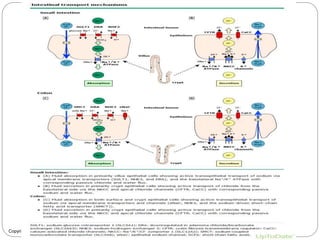
Malabsorption -Ion Channel Mediated
Sodium/hydrogen exchangers
(NHEs) Sodium/glucose
cotransporter (SGLT1) Down-
regulated in adenoma (DRA)
Epithelial sodium channel ENaC)
Das et al Cellular and Molecular Gastroenterology and Hepatology Vol. 6,
No. 1
Figure 1. Localization of absorptive ion transporters (discussed in text) in the small intestine and colon, and their regulation by pathogens
or their
secreted toxins. The red bars indicate inhibitory effects. CT, cholera toxin; DRA, down-regulated in adenoma; ENaC, epithelial sodium
channel; EPEC, enteropathogenic E. coli; KCC1, potassium chloride cotransporter-1; NHE, sodium hydrogen exchanger; NSP4, Rotavirus
non-structural protein 4; SGLT1, sodium glucose cotransporter-1; ST, heat-stable toxin of E. coli; LT, heatlabile toxin of E. coli; TcdB, C.
difficile toxin B.
Das et al Cellular and Molecular Gastroenterology and Hepatology Vol. 6,
Secretory Diarrhoea
• Movement of water and ions into the bowel lumen resulting in watery
diarrhoea.
• Secretory diarrhea
– continues despite fasting,
– is associated with stool volumes >1 liter/day,
– occurs day and night in contrast to osmotic diarrhea in which these
characteristics are uncommon.
• The osmotic gap is determined by subtracting the sum of the sodium and
potassium concentration in stool multiplied by a factor of 2 from 290
mOsm/kg to account for unmeasured anions (ie, 290 - 2 ({Na+} + {K+})).
• An osmotic gap of >125 mOsm/kg suggests an osmotic diarrhea while a gap of
<50 mOsm/kg suggests a secretory diarrhea.
Lundgren O et al Science.
2000;287(5452):491.
Secretory Diarrhoea - Toxin
• Enterotoxin mediated
– Heat Stable – activate
cGMP - activate enterocyte
cyclic GMP, increases
chloride secretion and
inhibits of sodium chloride
absorption
– Heat labile (similar to
cholera toxin)- activate
cAMP – increases chloride
secretion
– Cholera Toxin - CFTR
mediated –
increases chloride secreation
Das et al Cellular and Molecular Gastroenterology and Hepatology Vol. 6,
No. 1
Secretory Diarrhoea
Das et al Cellular and Molecular Gastroenterology and Hepatology Vol. 6,
No. 1
Intestinal Barrier/Leak-flux
• Many inflammatory
cytokines also impact tight
junction integrity and
permeability
• Eg Rotavirus, EPEC
Ramig R JOURNAL OF VIROLOGY,
Oct. 2004,
Intestinal Motility
• Increased intestinal motility results
in reduced time to absorb
electrolytes and nutrients, leading
to excessive unabsorbed
substrates in the intestine and
reduced fluid absorption, leading
to diarrhea.
• Stimulation of the
enteric neurosystem
• Eg Rotavirus
Ramig R JOURNAL OF VIROLOGY,
Oct. 2004,
Inflammatory Diarrhoea
• Causes destruction or impairment of epithelial cells resulting in loss of surface area and
transports resulting impaired nutrient absorption and increased osmotic load in the
intestinal lumen
• Inflammatory cytokines/chemokines can influence cell proliferation and the census of ion
transporters varies in less vs more differentiated epithelial cells, with a predominance of
secretory transporters in the former cells.
• Many inflammatory cytokines also impact tight junction integrity, which indirectly alters ion
transport.
• the inflammatory process also can lead to the breakdown in intestinal barrier function
resulting in exudation of mucus, protein, and blood into the gut lumen (eg protein-losing
enteropathy).
• Features:
– Mainly affects the terminal ileum or colon
– Faecal WBC +
– Faecal lactoferrin+
Inflammatory Diarrhoea
• Involves invasion of the
mucosa
History —
 History with respect to the duration of symptoms,
the frequency and characteristics of the stool, and
associated symptoms should be asked.
 Additionally, there should be an attempt to elicit
evidence of extracellular volume depletion (eg,
dark yellow or scant urine, decreased skin turgor,
orthostatic hypotension).
 Questioning about potential exposures, such as
food history, residence, occupational exposure,
recent and remote travel, pets, and hobbies, can
also provide further diagnostic clues.
Character of symptoms –
 Details on the frequency and nature of the stool can suggest whether the
diarrhea is originating in the small or the large bowel, and thus can
suggest certain pathogens .
 Diarrhea of small bowel origin is typically watery, of large volume, and
associated with abdominal cramping, bloating, and gas .
 Weight loss can occur if diarrhea becomes persistent.
 Fever is rarely a significant symptom and occult blood or inflammatory cells
in the stool are rarely identified.
 In contrast, diarrhea of large intestinal origin often presents with frequent,
regular, small volume, and often painful bowel movements.
 Fever and bloody or mucoid stools are common, and red blood cells and
inflammatory cells can be seen routinely on stool microscopy.
Copyrights apply
 Visibly bloody acute diarrhea is relatively uncommon and
raises the possibility of Shiga toxin-producing E.
coli (STEC) (eg, E. coli O157:H7) infection.
 Other bacterial causes of visibly bloody diarrhea
are Shigella, Campylobacter, and Salmonella species.
 Bloody diarrhea can also reflect noninfectious etiologies
such as inflammatory bowel disease or ischemic colitis.
 Syndromes that begin with diarrhea but progress to fever
and systemic complaints, such as headache and muscle
aches, should raise the possibility of other etiologies,
including a typhoidal illness (particularly in travelers from
resource-limited settings) or infection
with Listeria monocytogenes (particularly if a stiff neck is
also present or the patient is a pregnant woman).
Food history –
 Consumption of unpasteurized dairy products, raw or
undercooked meat or fish, or organic vitamin preparations may
suggest certain pathogens.
 the timing of symptom onset following exposure to the suspected
offending food can be an important clue to the diagnosis :-
•Within six hours – suggests ingestion of a preformed toxin
of Staphylococcus aureus or Bacillus cereus, particularly if
nausea and vomiting were the initial symptoms.
•At 8 to 16 hours – suggests infection with Clostridium perfringens.
•At more than 16 hours – suggests either viral or other bacterial
infection (eg, contamination of food with enterotoxigenic or STEC
or other pathogens)
Other exposures
 •Exposure to animals (poultry, turtles, petting zoos)
has been associated with Salmonella infection.
 •Travel to a resource-limited setting increases the risk
of bacterial diarrhea and also informs the risk of
certain parasitic infections.
 •Occupation in daycare centers has been associated
with infections with Shigella, Cryptosporidium,
and Giardia.
 Rotavirus is a potential consideration, but in countries
that routinely immunize infants against rotavirus,
infection due to rotavirus has decreased substantially.
Medical history –
 Recent antibiotic use (as a clue to the presence of C. difficile infection),
 other medications (such as proton pump inhibitors, which can increase
the risk of infectious diarrhea), and
 past medical history (eg, to identify an immunocompromised host or the
possibility of nosocomial infection).
 As examples of medical history informing the likelihood of various
pathogens,
 pregnancy increases the risk of listeriosis following consumption of
contaminated meat products or unpasteurized dairy products
approximately 20-fold,
 cirrhosis has been associated with Vibrio infection, and
 hemochromatosis has been associated with Yersinia infection.
Physical examination —
 The examination focuses on evaluating volume status and identifying
complications.
 Volume depletion can be suggested by
 dry mucous membranes,
 diminished skin turgor, postural or
 frank reductions in blood pressure, and altered sensorium.
 These signs can be mild or absent with early hypovolemia.
 The abdominal examination should evaluate for findings that can
suggest ileus or peritonitis, including
 abdominal distension,
 pain with gentle percussion,
 abdominal rigidity, or r
 ebound tenderness.
Copyrights apply
DIAGNOSTIC TESTING
General laboratory tests —
• Laboratory tests are not routinely warranted for most patients with acute
diarrhea.
• If substantial volume depletion is present (suggested by signs or symptoms such as
dark and concentrated urine), a basic metabolic panel should be performed to
screen for hypokalemia or renal dysfunction.
• The complete blood count does not reliably distinguish bacterial etiologies of
diarrhea from others but may be helpful in suggesting severe disease or potential
complications.
• A low platelet count may prompt concern for the development of the hemolytic-
uremic syndrome, and
• A leukemoid reaction is consistent with the diagnosis of C. difficile infection.
• Blood cultures should be obtained in patients with high fevers or who appear
systemically ill.
Indications For Further Testing
●Severe illness
-Profuse watery diarrhea with signs of hypovolemia
-Passage of >6 unformed stools per 24 hours
-Severe abdominal pain
-Need for hospitalization
●Other signs or symptoms concerning for inflammatory diarrhea
-Bloody diarrhea
-Passage of many small volume stools containing blood andmucus
-Temperature ≥38.5ºC (101.3ºF)
●High-risk host features
-Age ≥70 years
-Comorbidities(e.g. IHD), which may be exacerbated by hypovolemia or rapid infusion of fluid
-Immunocompromising condition (including advanced HIV infection)
-Inflammatory bowel disease
-Pregnancy
-Symptoms persisting for more than oneweek
-Public health concerns
Stool Diagnostic Tests
• Stool diagnostic studies may be used if available in cases of dysentery,
moderate- to-severe disease, and symptoms lasting >7 days
• Stool Ova cysts parasites – microscopic evaluation, poor sensitivity
• Stool culture - Poor 30% sensitivity
• Toxin identification -Shiga toxin (EIA, RT-PCR), C. Diff Toxin (GDH, Toxin EIA,
RT-PCR)
• Immunological Detection Methods (EIA)
• Molecular Detection Methods - >70% sensitivity, false positives
Multipathogen molecular panels —
 Molecular tests for a panel of many different pathogens
(bacterial, viral, and parasitic) can be performed
simultaneously on diarrheal stool samples and, in some
cases, rectal swabs.
 High degree of clinical correlation is necessary when
interpreting results of molecular testing since these assays
detect genetic material, which does not always indicate
infection with a viable organism, and identification of more
than one pathogen is not uncommon .
 Any specimens that test positive for a bacterial pathogen
on a multiplex molecular panel (or other culture-
independent test) should be submitted for confirmatory
culture .
 If the original specimen was a rectal swab, an additional
stool specimen may be warranted to perform confirmatory
Molecular Diagnostic Testing
Additional testing in specific
circumstances :-Bloody diarrhea —
 For patients with bloody diarrhea, at least two
potential pathogens,
 STEC and
 Entamoeba, warrant additional testing.
 In addition to culture,
 Bloody stools for Shiga toxin and, if available, fecal
leukocytes or lactoferrin;
 If the fecal leukocyte/lactoferrin test is negative, we test
for amebiasis.
 The possibility of noninfectious etiologies may also
warrant further evaluation
 Noninfectious etiologies, in particular ischemic
colitis and inflammatory bowel disease, can also
present acutely with abdominal pain and bloody
diarrhea.
 In patients who have risk factors for colonic
ischemia, imaging with computed tomography
and potentially endoscopy may be warranted.
 Endoscopy can be useful to evaluate patients
with bloody diarrhea for inflammatory bowel
disease if their symptoms do not resolve.
Persistent diarrhea —
 Work-up and management for patients with persistent diarrhea or diarrhea
that does not respond to empiric treatment includes testing for parasitic
organisms and other evaluation for noninfectious processes.
 Testing for parasitic organisms is reasonable in patients with persistent
diarrhea, among whom parasites become more likely pathogens .
 The spectrum of parasites associated with persistent diarrhea can vary
based on exposures or populations.
 In general, Giardia, Cryptosporidium, and E. histolytica are the most
common parasitic pathogens in patients with persistent diarrhea.
 Persistent diarrhea following travel to certain locations, such as Russia,
Nepal, or mountainous regions, is associated with Giardia, Cryptosporidium,
or Cyclospora.
 Persistent diarrhea with exposure to infants in daycare centers has been
associated with Giardia and Cryptosporidium. Microsporidium should be a
consideration in immunocompromised patients with persistent diarrhea.
 Most of these pathogens can be diagnosed by microscopy
for ova and parasites.
 Three specimens should be sent on consecutive days (or
each specimen separated by at least 24 hours) for ova and
parasite examination since parasite excretion may be
intermittent.
 Routine microscopy does not detect cryptosporidia spores;
if suspected, the laboratory should be alerted to the
potential diagnosis, and specific stains (eg, modified acid
fast or trichrome stains) for the organisms should be
requested.
 Giardia, Cryptosporidium, and Entamoeba can also be
detected by antigen or molecular testing
 Antibiotic or health care exposures —
 For patients who are currently taking antibiotics,
who have taken antibiotics within the past three
months, or who have been hospitalized within the
past three months prior to presentation with
diarrhea, C. difficile colitis is a primary concern
Immunocompromised patients —
 Although the typical gastrointestinal pathogens are common causative
organisms in immunocompromised patients with acute diarrhea, such
patients have a higher risk of infections with less common
gastrointestinal pathogens, in particular parasites and CMV.
 For patients with acute diarrhea who have advanced HIV infection (CD4
cell count <200 cells/microL or other AIDS-defining condition) or other
immunocompromising conditions, stool should be sent for culture as
well as parasitic testing .
 For patients who have concern for possible CMV infection (eg, HIV
patients with CD4 cell count <50 cells/microL, transplant recipients),
endoscopy with biopsy is the best diagnostic approach.
 Neutropenic enterocolitis in patients with severe neutropenia (absolute
neutrophil count <500 cells/microL) can present with diarrhea in addition
to fever and abdominal pain. Imaging with computed tomography is
warranted in such settings. (Se
Indications for imaging —
 Abdominal imaging is not typically warranted in
patients with acute diarrhea and rarely changes the
clinical management .
 However, for patients who have significant peritoneal
signs or ileus, abdominal imaging (most typically
computed tomography) can be important to identify
potential complications, such as bowel perforation,
abscess, fulminant colitis, toxic megacolon, or
intestinal obstruction.
 Radiographic findings of colonic wall thickening are
characteristic of C. difficile infection but can also be
seen with other causes of infectious (and non-
infectious) colitis
MANAGEMENT
Managemen
t
• Fluid Replacement
• Anti-diarrhoeals
• Antibiotics
• Probiotics/Prebiotics/Synbioti
cs
MANAGEMENT:-
 The management of patients with acute diarrhea
begins with general measures such as fluid
repletion and nutrition maintenance, with
adjustments in diet if necessary.
 Patients who have bothersome symptoms may
benefit from symptomatic pharmacologic therapy.
 Antibiotic therapy is not indicated in most cases
since the illness is usually self-limited.
ASSESSMENT FOR DEHYDRATION
• Fluid repletion — The most critical therapy in diarrheal
illness is rehydration, preferably by the oral route, with
solutions that contain water, salt, and sugar .
• Diluted fruit juices and flavored soft drinks along with
saltine crackers and broths or soups may meet the fluid
and salt needs in patients with mild illness.
• (ORS), including standard World Health Organization
ORS or commercial ORS, such as Rehydralyte and
Ceralyte, may be more appropriate in patients with
more severe diarrheal disease.
• Altered gut resorption with diarrhoea can result in substantial fluid loss;
for example, 10–20 L of fluid may be lost in 24 hours in cholera.
• The fluid lost in diarrhoea is isotonic, so both water and electrolytes need
to be replaced.
• Absorption of electrolytes from the gut is an active process requiring
energy. Infected mucosa is capable of very rapid fluid and electrolyte
transport if carbohydrate is available as an energy source.
• Oral rehydration solutions (ORS) therefore contain sugars, as well as water
and electrolytes .
• ORS can be just as effective as intravenous replacement fluid, even in the
management of cholera.
ORAL REHYDRATION SOLUTIONS
Basis of ORT
• ORT drives water reabsorption in diseases such as
cholera by taking advantage of the fact that although
the electroneutral NaCl absorptive process is impaired
by the disease, the function of SGLT1 is intact and can
mediate sodium ion and fluid absorption if glucose is
provided.
• This addresses acute water loss caused by diarrhea,
even if it does not combat the root cause of the
diarrheal episode
Starch Based ORT
• Starch-based ORT drives Na absorption
by providing short-chain fatty acids in the
colon and has been shown to be more
effective than conventional ORT.
Replacement of established deficit.
 After 48 hours of moderate diarrhoea (6–10 stools per
24 hrs), the average adult will be 2–4 L depleted from
diarrhoea alone.
 Associated vomiting will compound this.
 Adults with this symptomatology should therefore be
given rapid
replacement of 1–1.5 L, either orally (ORS) or by
intravenous infusion (normal saline), within the first 2–
4 hours of presentation.
Longer symptomatology or more persistent/severe
diarrhoea rapidly produces fluid losses comparable to
diabetic ketoacidosis and is a metabolic emergency
requiring active intervention.
 Replacement of ongoing losses.
 The average adult’s diarrhoeal stool accounts for a loss of
200 mL of isotonic fluid.
 Stool losses should be carefully charted and an estimate of
ongoing replacement fluid calculated.
 Commercially available rehydration sachets are
conveniently produced to provide 200 mL of ORS; one
sachet per diarrhoea stool is an appropriate estimate of
supplementary replacement requirements.
 Replacement of normal daily requirement.
 The average adult has a daily requirement of 1–1.5 L of
fluid in addition
to the calculations above. This will be increased
substantially in fever or a hot environment.
Copyrights apply
 Symptomatic therapy —
 For patients who want symptomatic therapy, the antimotility
agent lOPERAMIDE(Imodium) can be used cautiously in patients in
whom fever is absent or low grade and the stools are not bloody.
 The dose of loperamide is two tablets (4 mg) initially, then 2 mg after
each unformed stool for ≤2 days, with a maximum of 16 mg/day.
 Avoid antimotility agents in patients with clinical features suggestive
of dysentery (fever, bloody or mucoid stools) unless antibiotics are
also given because of concerns that antimotility agents can prolong
disease in such infections or lead to more severe illness.
 In such patients, bismuth salicylate (Pepto-Bismol, 30 mL or two
tablets every 30 minutes for eight doses) is an acceptable
alternative, although it is somewhat less effective and there is the
potential for salicylate toxicity .
 Another antisecretory agent, racecadotril, is an effective option
for symptomatic therapy, if available
Anti-Motility Agents
·Loperamide also allows
greater absorption through a
secondary effect - inhibition
of calmodulin leading to
reduced mucosal secretion.
LOPERAMIDE
• In patients receiving antibiotics for TD, adjunctive loperamide
therapy can be administered to decrease duration of diarrhea and
increase chance for a cure.
• The recommended dose of loperamide for therapy for adults
with diarrhea is 4 mg initially
• followed by 2 mg after subsequently passed watery stools not to
exceed 8 mg per day.
• Loperamide is not given for more than 48 hrs.
Riddle M Am J Gastroenterol 2016; 111:602–
622
BISMUTH SALICYLATES
Riddle M Am J Gastroenterol 2016; 111:602–
622
The recommended dose of BSS for therapy of acute diarrhea is 30 ml (525 mg)
of liquid formulation or two tablets (263 mg per tablet) chewed well each 30–60
min not to exceed eight doses in 24 h.
Empiric antibiotic therapy —
 Given the lack of rapid diagnostic testing methods for enteric
pathogens, most decisions on antibiotic therapy are often
made empirically at the time of presentation.
 Empiric antibiotics are used in the following circumstances:-
●Severe disease (fever, more than six stools per day, volume
depletion warranting hospitalization).
●Features suggestive of invasive bacterial infection, such as
bloody or mucoid stools (except in cases of nonsevere
disease when fever is low or absent).
●Host factors that increase the risk for complications, including
age >70 years old and comorbidities such as cardiac disease
and immunocompromising conditions
Choice of agent —
 Azithromycin or a fluoroquinolone.
 In particular, azithromycin is preferred for patients with fever
or dysentery (bloody or mucoid diarrhea) and in other patients
suspected to be at risk for a fluoroquinolone-resistant
pathogen (eg, in patients with diarrhea after travel to
Southeast Asia, or during outbreaks of resistant pathogens) .
 Azithromycin can be given as a single 1 g dose (for patients
without dysentery) or as 500 mg once daily for three days.
 Appropriate fluoroquinolones include
 Ciprofloxacin (a single 750 mg dose or 500 mg twice daily for
three to five days) and
 Levofloxacin (500 mg as a single dose or given once daily for
three to five days).
 Specific circumstances may warrant empiric treatment for
particular pathogens. These include the following:-
●For patients with severe diarrhea in the setting of prior antibiotic
therapy, empiric treatment for C. difficile is reasonable if the
clinical suspicion is high.
●For pregnant women with diarrhea accompanied by fever or
systemic illness who had potential exposure
to Listeria monocytogenes, empiric therapy often includes
antibiotics with activity against this organism.
●For patients with profuse watery diarrhea and potential
exposure to cholera (eg, travel to an endemic or epidemic
setting), empiric antibiotic coverage of Vibrio cholerae is
reasonable given the potential for very severe disease.
Specific antibiotic therapy — Even if a bacterial pathogen is
identified, not all patients warrant antimicrobial therapy, and
Shiga toxin-producing E. coli (STEC) specifically
Empiric Antibiotic therapy
Riddle M Am J Gastroenterol 2016; 111:602–622
Anti-Microbial Therapy For
Persistent Infectious Diarrhoea
Copyrights apply
Probiotics
• Several meta-analyses and clinical studies in
developed countries suggest that probiotics
prevent or reduce the duration of diarrhoea in
children.
• However, the use of probiotics or prebiotics for
treatment of acute diarrhea in adults is currently
not recommended, except in cases of
postantibiotic-associated illness.
• Lactobacillus GG has been shown to decrease
duration of childhood infectious diarrhea and
difficile
infection.
Riddle M Am J Gastroenterol 2016; 111:602–
622
Future Targetted Therapies
Das et al Cellular and Molecular Gastroenterology and Hepatology Vol. 6,
No. 1
PREVENTION
 Acute diarrheal diseases can be prevented with a variety of measures
focused on preventing the spread of organisms from person to person and
within the community .
 These include:-
 ●Hand washing with soap
 ●Ensuring the availability of safe drinking water
 ●Appropriate disposal of human waste
 ●Breastfeeding of infants and young children
 ●Safe handling and processing of food
 ●Control of flies (particularly for Sd1)
 Two killed whole-cell oral cholera vaccines are internationally licensed and
prequalified by the World Health Organization (WHO).
 A WHO global cholera vaccine stockpile of the lower cost bivalent vaccine
was created in 2013 and has led to increasing use of killed oral cholera
vaccines globally; the monovalent vaccine has been used primarily in
Diarrhea

Diarrhea

  • 1.
    Dr. Bikal Lamichhane 1stYear Internal Medicine resident NAMS Evaluation and management of Acute Diarrhea
  • 2.
    DEFINITIONS  Diarrhea isdefined as the passage of loose or watery stools, typically at least three times in a 24-hour period .  It reflects increased water content of the stool, whether due to impaired water absorption and/or active water secretion by the bowel.  The following definitions have been suggested according to the duration of symptoms:  ●Acute – 14 days or fewer in duration  ●Persistent diarrhea – more than 14 but fewer than 30 days in duration  ●Chronic – more than 30 days in duration  Invasive diarrhea, or dysentery, is defined as diarrhea with visible blood or mucus, in contrast to watery diarrhea. Dysentery is commonly associated with fever and abdominal pain.
  • 3.
    ETIOLOGY  Most casesof acute diarrhea are due to infections and are self-limited.  The major causes of acute infectious diarrhea include  viruses (norovirus, rotavirus, adenoviruses, astrovirus, and others),  bacteria (Salmonella, Campylobacter, Shigella, enterotoxigenic Escherichia coli, Clostridioides [formerly Clostridium] difficile, and others), and  protozoa (Cryptosporidium, Giardia, Cyclospora, Entamoeba, and others)  Taken together, most cases of acute infectious diarrhea are likely viral, as indicated by the observation that stool cultures are positive in only 1.5 to 5.6 percent of cases in most studies  Among those with severe diarrhea, however, bacterial causes are responsible for most cases. As an example, in a study of 173 healthy adults with severe acute community- acquired diarrhea (defined in this study as ≥4 fluid stools per day for more than three days), a bacterial pathogen was identified in 87 percent of cases .  Protozoa are less commonly identified as the etiologic agents of acute gastrointestinal illness.  Noninfectious etiologies become more common as the course of the diarrhea persists and becomes chronic.
  • 6.
    Etiology:-  Resource richvs Resource limited setting.  Traveller diarrhoea  Food poisoining  Epidemic Diarrhoea
  • 7.
  • 9.
  • 11.
  • 12.
  • 13.
    Epidemic diarrhea — S. dysenteriae and V. cholerae are the most common organisms associated with epidemic diarrhea.  Epidemic refers to an increase, often sudden, in the number of cases of a disease above what is normally expected in that population in that area.  Outbreak carries the same definition as epidemic, but it is often used for a more limited geographic area.
  • 14.
     Four speciesof Shigella cause bloody diarrhea; they are distinguished serologically as S. dysenteriae, Shigella flexneri, Shigella boydii, and Shigella sonnei .  Of those, S. dysenteriae serotype 1 (Sd1) is uniquely responsible for epidemic dysentery.  Four important features account for the association between Sd1 and large, regional epidemics of dysentery :- •It produces a potent cytotoxin (Shiga toxin) that causes patchy destruction of the colonic epithelium. •The low infective dose (10 to 100 organisms) facilitates person-to- person spread of infection. •Illness due to Sd1 is more severe and more prolonged than illness due to other species of Shigella. •Resistance to antimicrobials is more common than in other species of Shigella.
  • 15.
    Cholera:-  Cholera isa secretory diarrheal disease caused by enterotoxin-producing strains of V. cholerae.  More than 200 serogroups of V. cholerae have been identified to date, but historically, the O1 serogroup has caused the vast majority of disease.  The O139 serogroup emerged as a cause of disease in 1992 , but has remained limited to a few countries in Asia.
  • 16.
  • 18.
  • 19.
  • 20.
  • 21.
    INOCULOM SIZE PATHOGEN INOCULUMSIZE Rotavirus <10 viral copies Norovirus <100 viral copies Cryptosporidium parvum 1-103 Entamoeba histolytica 10-102 Giardia lamblia 10-102 Shigella 10-102 Campylobacter jejuni 102-106 Salmonella 105 Escherichia coli 108 Vibrio cholerae 108
  • 22.
    Gut Physiology Intestinal physiologyAbsorptionand secretion regulated by ion transporters • 1. Sodium/hydrogen exchangers (NHEs) • 2. Sodium/glucose cotransporter (SGLT1, SLC5A1) • 3. Down-regulated in adenoma (DRA [SLC26A3) • 4. Epithelial sodium channel (ENaC) • 5. Ca-activated chloride channels • 6. Sodium/potassium/chloride cotransporter 1 (NKCC1, [SLC12A2]) • 7. Cystic fibrosis transmembrane conductance regulator (CFTR) • 8. Na,K ATPase:
  • 23.
    Pathophysiology of InfectiveDiarrhoea • Osmotic/Malabsorptive (various mechanisms) • Secretory (toxin mediated) • Intestinal tight junction dysruption(leak-flux) • Inflammatory (Mucosal invasion) • Intestinal Motility (through the enteric nervous system)
  • 24.
    Osomotic/Malabsorptive • Mainly SmallIntestinal • Mechanism – Enterotoxin –ion channelmediated – Adherence – Superficial invasion • Features – Large volume watery – No fecal WBC – Minimal/NO lactoferrin • Rotavirus - results of villous epithelial cell destruction with resulting brush border enzyme deficiency and complex sugar malabsorption • Rotaviirus also inhibit SGLT ion transporter • Giardia tropozoites strongly adhere to the epithelial surface of the intestine via a ventral adhesive disc. Giardia causes a loss of the absorptive surface similar to EPEC. It decreases NaCl and glucose absorption owing to this loss of absorptive surface area
  • 25.
    Malabsorption -Ion ChannelMediated Sodium/hydrogen exchangers (NHEs) Sodium/glucose cotransporter (SGLT1) Down- regulated in adenoma (DRA) Epithelial sodium channel ENaC) Das et al Cellular and Molecular Gastroenterology and Hepatology Vol. 6, No. 1
  • 26.
    Figure 1. Localizationof absorptive ion transporters (discussed in text) in the small intestine and colon, and their regulation by pathogens or their secreted toxins. The red bars indicate inhibitory effects. CT, cholera toxin; DRA, down-regulated in adenoma; ENaC, epithelial sodium channel; EPEC, enteropathogenic E. coli; KCC1, potassium chloride cotransporter-1; NHE, sodium hydrogen exchanger; NSP4, Rotavirus non-structural protein 4; SGLT1, sodium glucose cotransporter-1; ST, heat-stable toxin of E. coli; LT, heatlabile toxin of E. coli; TcdB, C. difficile toxin B. Das et al Cellular and Molecular Gastroenterology and Hepatology Vol. 6,
  • 27.
    Secretory Diarrhoea • Movementof water and ions into the bowel lumen resulting in watery diarrhoea. • Secretory diarrhea – continues despite fasting, – is associated with stool volumes >1 liter/day, – occurs day and night in contrast to osmotic diarrhea in which these characteristics are uncommon. • The osmotic gap is determined by subtracting the sum of the sodium and potassium concentration in stool multiplied by a factor of 2 from 290 mOsm/kg to account for unmeasured anions (ie, 290 - 2 ({Na+} + {K+})). • An osmotic gap of >125 mOsm/kg suggests an osmotic diarrhea while a gap of <50 mOsm/kg suggests a secretory diarrhea. Lundgren O et al Science. 2000;287(5452):491.
  • 28.
    Secretory Diarrhoea -Toxin • Enterotoxin mediated – Heat Stable – activate cGMP - activate enterocyte cyclic GMP, increases chloride secretion and inhibits of sodium chloride absorption – Heat labile (similar to cholera toxin)- activate cAMP – increases chloride secretion – Cholera Toxin - CFTR mediated – increases chloride secreation Das et al Cellular and Molecular Gastroenterology and Hepatology Vol. 6, No. 1
  • 29.
    Secretory Diarrhoea Das etal Cellular and Molecular Gastroenterology and Hepatology Vol. 6, No. 1
  • 30.
    Intestinal Barrier/Leak-flux • Manyinflammatory cytokines also impact tight junction integrity and permeability • Eg Rotavirus, EPEC Ramig R JOURNAL OF VIROLOGY, Oct. 2004,
  • 31.
    Intestinal Motility • Increasedintestinal motility results in reduced time to absorb electrolytes and nutrients, leading to excessive unabsorbed substrates in the intestine and reduced fluid absorption, leading to diarrhea. • Stimulation of the enteric neurosystem • Eg Rotavirus Ramig R JOURNAL OF VIROLOGY, Oct. 2004,
  • 32.
    Inflammatory Diarrhoea • Causesdestruction or impairment of epithelial cells resulting in loss of surface area and transports resulting impaired nutrient absorption and increased osmotic load in the intestinal lumen • Inflammatory cytokines/chemokines can influence cell proliferation and the census of ion transporters varies in less vs more differentiated epithelial cells, with a predominance of secretory transporters in the former cells. • Many inflammatory cytokines also impact tight junction integrity, which indirectly alters ion transport. • the inflammatory process also can lead to the breakdown in intestinal barrier function resulting in exudation of mucus, protein, and blood into the gut lumen (eg protein-losing enteropathy). • Features: – Mainly affects the terminal ileum or colon – Faecal WBC + – Faecal lactoferrin+
  • 33.
  • 34.
    History —  Historywith respect to the duration of symptoms, the frequency and characteristics of the stool, and associated symptoms should be asked.  Additionally, there should be an attempt to elicit evidence of extracellular volume depletion (eg, dark yellow or scant urine, decreased skin turgor, orthostatic hypotension).  Questioning about potential exposures, such as food history, residence, occupational exposure, recent and remote travel, pets, and hobbies, can also provide further diagnostic clues.
  • 35.
    Character of symptoms–  Details on the frequency and nature of the stool can suggest whether the diarrhea is originating in the small or the large bowel, and thus can suggest certain pathogens .  Diarrhea of small bowel origin is typically watery, of large volume, and associated with abdominal cramping, bloating, and gas .  Weight loss can occur if diarrhea becomes persistent.  Fever is rarely a significant symptom and occult blood or inflammatory cells in the stool are rarely identified.  In contrast, diarrhea of large intestinal origin often presents with frequent, regular, small volume, and often painful bowel movements.  Fever and bloody or mucoid stools are common, and red blood cells and inflammatory cells can be seen routinely on stool microscopy.
  • 36.
  • 37.
     Visibly bloodyacute diarrhea is relatively uncommon and raises the possibility of Shiga toxin-producing E. coli (STEC) (eg, E. coli O157:H7) infection.  Other bacterial causes of visibly bloody diarrhea are Shigella, Campylobacter, and Salmonella species.  Bloody diarrhea can also reflect noninfectious etiologies such as inflammatory bowel disease or ischemic colitis.  Syndromes that begin with diarrhea but progress to fever and systemic complaints, such as headache and muscle aches, should raise the possibility of other etiologies, including a typhoidal illness (particularly in travelers from resource-limited settings) or infection with Listeria monocytogenes (particularly if a stiff neck is also present or the patient is a pregnant woman).
  • 38.
    Food history – Consumption of unpasteurized dairy products, raw or undercooked meat or fish, or organic vitamin preparations may suggest certain pathogens.  the timing of symptom onset following exposure to the suspected offending food can be an important clue to the diagnosis :- •Within six hours – suggests ingestion of a preformed toxin of Staphylococcus aureus or Bacillus cereus, particularly if nausea and vomiting were the initial symptoms. •At 8 to 16 hours – suggests infection with Clostridium perfringens. •At more than 16 hours – suggests either viral or other bacterial infection (eg, contamination of food with enterotoxigenic or STEC or other pathogens)
  • 39.
    Other exposures  •Exposureto animals (poultry, turtles, petting zoos) has been associated with Salmonella infection.  •Travel to a resource-limited setting increases the risk of bacterial diarrhea and also informs the risk of certain parasitic infections.  •Occupation in daycare centers has been associated with infections with Shigella, Cryptosporidium, and Giardia.  Rotavirus is a potential consideration, but in countries that routinely immunize infants against rotavirus, infection due to rotavirus has decreased substantially.
  • 41.
    Medical history – Recent antibiotic use (as a clue to the presence of C. difficile infection),  other medications (such as proton pump inhibitors, which can increase the risk of infectious diarrhea), and  past medical history (eg, to identify an immunocompromised host or the possibility of nosocomial infection).  As examples of medical history informing the likelihood of various pathogens,  pregnancy increases the risk of listeriosis following consumption of contaminated meat products or unpasteurized dairy products approximately 20-fold,  cirrhosis has been associated with Vibrio infection, and  hemochromatosis has been associated with Yersinia infection.
  • 42.
    Physical examination — The examination focuses on evaluating volume status and identifying complications.  Volume depletion can be suggested by  dry mucous membranes,  diminished skin turgor, postural or  frank reductions in blood pressure, and altered sensorium.  These signs can be mild or absent with early hypovolemia.  The abdominal examination should evaluate for findings that can suggest ileus or peritonitis, including  abdominal distension,  pain with gentle percussion,  abdominal rigidity, or r  ebound tenderness.
  • 43.
  • 44.
  • 45.
    General laboratory tests— • Laboratory tests are not routinely warranted for most patients with acute diarrhea. • If substantial volume depletion is present (suggested by signs or symptoms such as dark and concentrated urine), a basic metabolic panel should be performed to screen for hypokalemia or renal dysfunction. • The complete blood count does not reliably distinguish bacterial etiologies of diarrhea from others but may be helpful in suggesting severe disease or potential complications. • A low platelet count may prompt concern for the development of the hemolytic- uremic syndrome, and • A leukemoid reaction is consistent with the diagnosis of C. difficile infection. • Blood cultures should be obtained in patients with high fevers or who appear systemically ill.
  • 46.
    Indications For FurtherTesting ●Severe illness -Profuse watery diarrhea with signs of hypovolemia -Passage of >6 unformed stools per 24 hours -Severe abdominal pain -Need for hospitalization ●Other signs or symptoms concerning for inflammatory diarrhea -Bloody diarrhea -Passage of many small volume stools containing blood andmucus -Temperature ≥38.5ºC (101.3ºF) ●High-risk host features -Age ≥70 years -Comorbidities(e.g. IHD), which may be exacerbated by hypovolemia or rapid infusion of fluid -Immunocompromising condition (including advanced HIV infection) -Inflammatory bowel disease -Pregnancy -Symptoms persisting for more than oneweek -Public health concerns
  • 47.
    Stool Diagnostic Tests •Stool diagnostic studies may be used if available in cases of dysentery, moderate- to-severe disease, and symptoms lasting >7 days • Stool Ova cysts parasites – microscopic evaluation, poor sensitivity • Stool culture - Poor 30% sensitivity • Toxin identification -Shiga toxin (EIA, RT-PCR), C. Diff Toxin (GDH, Toxin EIA, RT-PCR) • Immunological Detection Methods (EIA) • Molecular Detection Methods - >70% sensitivity, false positives
  • 48.
    Multipathogen molecular panels—  Molecular tests for a panel of many different pathogens (bacterial, viral, and parasitic) can be performed simultaneously on diarrheal stool samples and, in some cases, rectal swabs.  High degree of clinical correlation is necessary when interpreting results of molecular testing since these assays detect genetic material, which does not always indicate infection with a viable organism, and identification of more than one pathogen is not uncommon .  Any specimens that test positive for a bacterial pathogen on a multiplex molecular panel (or other culture- independent test) should be submitted for confirmatory culture .  If the original specimen was a rectal swab, an additional stool specimen may be warranted to perform confirmatory
  • 49.
  • 50.
    Additional testing inspecific circumstances :-Bloody diarrhea —  For patients with bloody diarrhea, at least two potential pathogens,  STEC and  Entamoeba, warrant additional testing.  In addition to culture,  Bloody stools for Shiga toxin and, if available, fecal leukocytes or lactoferrin;  If the fecal leukocyte/lactoferrin test is negative, we test for amebiasis.  The possibility of noninfectious etiologies may also warrant further evaluation
  • 51.
     Noninfectious etiologies,in particular ischemic colitis and inflammatory bowel disease, can also present acutely with abdominal pain and bloody diarrhea.  In patients who have risk factors for colonic ischemia, imaging with computed tomography and potentially endoscopy may be warranted.  Endoscopy can be useful to evaluate patients with bloody diarrhea for inflammatory bowel disease if their symptoms do not resolve.
  • 52.
    Persistent diarrhea — Work-up and management for patients with persistent diarrhea or diarrhea that does not respond to empiric treatment includes testing for parasitic organisms and other evaluation for noninfectious processes.  Testing for parasitic organisms is reasonable in patients with persistent diarrhea, among whom parasites become more likely pathogens .  The spectrum of parasites associated with persistent diarrhea can vary based on exposures or populations.  In general, Giardia, Cryptosporidium, and E. histolytica are the most common parasitic pathogens in patients with persistent diarrhea.  Persistent diarrhea following travel to certain locations, such as Russia, Nepal, or mountainous regions, is associated with Giardia, Cryptosporidium, or Cyclospora.  Persistent diarrhea with exposure to infants in daycare centers has been associated with Giardia and Cryptosporidium. Microsporidium should be a consideration in immunocompromised patients with persistent diarrhea.
  • 53.
     Most ofthese pathogens can be diagnosed by microscopy for ova and parasites.  Three specimens should be sent on consecutive days (or each specimen separated by at least 24 hours) for ova and parasite examination since parasite excretion may be intermittent.  Routine microscopy does not detect cryptosporidia spores; if suspected, the laboratory should be alerted to the potential diagnosis, and specific stains (eg, modified acid fast or trichrome stains) for the organisms should be requested.  Giardia, Cryptosporidium, and Entamoeba can also be detected by antigen or molecular testing
  • 54.
     Antibiotic orhealth care exposures —  For patients who are currently taking antibiotics, who have taken antibiotics within the past three months, or who have been hospitalized within the past three months prior to presentation with diarrhea, C. difficile colitis is a primary concern
  • 55.
    Immunocompromised patients — Although the typical gastrointestinal pathogens are common causative organisms in immunocompromised patients with acute diarrhea, such patients have a higher risk of infections with less common gastrointestinal pathogens, in particular parasites and CMV.  For patients with acute diarrhea who have advanced HIV infection (CD4 cell count <200 cells/microL or other AIDS-defining condition) or other immunocompromising conditions, stool should be sent for culture as well as parasitic testing .  For patients who have concern for possible CMV infection (eg, HIV patients with CD4 cell count <50 cells/microL, transplant recipients), endoscopy with biopsy is the best diagnostic approach.  Neutropenic enterocolitis in patients with severe neutropenia (absolute neutrophil count <500 cells/microL) can present with diarrhea in addition to fever and abdominal pain. Imaging with computed tomography is warranted in such settings. (Se
  • 56.
    Indications for imaging—  Abdominal imaging is not typically warranted in patients with acute diarrhea and rarely changes the clinical management .  However, for patients who have significant peritoneal signs or ileus, abdominal imaging (most typically computed tomography) can be important to identify potential complications, such as bowel perforation, abscess, fulminant colitis, toxic megacolon, or intestinal obstruction.  Radiographic findings of colonic wall thickening are characteristic of C. difficile infection but can also be seen with other causes of infectious (and non- infectious) colitis
  • 57.
  • 58.
    Managemen t • Fluid Replacement •Anti-diarrhoeals • Antibiotics • Probiotics/Prebiotics/Synbioti cs
  • 59.
    MANAGEMENT:-  The managementof patients with acute diarrhea begins with general measures such as fluid repletion and nutrition maintenance, with adjustments in diet if necessary.  Patients who have bothersome symptoms may benefit from symptomatic pharmacologic therapy.  Antibiotic therapy is not indicated in most cases since the illness is usually self-limited.
  • 62.
  • 63.
    • Fluid repletion— The most critical therapy in diarrheal illness is rehydration, preferably by the oral route, with solutions that contain water, salt, and sugar . • Diluted fruit juices and flavored soft drinks along with saltine crackers and broths or soups may meet the fluid and salt needs in patients with mild illness. • (ORS), including standard World Health Organization ORS or commercial ORS, such as Rehydralyte and Ceralyte, may be more appropriate in patients with more severe diarrheal disease.
  • 64.
    • Altered gutresorption with diarrhoea can result in substantial fluid loss; for example, 10–20 L of fluid may be lost in 24 hours in cholera. • The fluid lost in diarrhoea is isotonic, so both water and electrolytes need to be replaced. • Absorption of electrolytes from the gut is an active process requiring energy. Infected mucosa is capable of very rapid fluid and electrolyte transport if carbohydrate is available as an energy source. • Oral rehydration solutions (ORS) therefore contain sugars, as well as water and electrolytes . • ORS can be just as effective as intravenous replacement fluid, even in the management of cholera.
  • 65.
  • 66.
    Basis of ORT •ORT drives water reabsorption in diseases such as cholera by taking advantage of the fact that although the electroneutral NaCl absorptive process is impaired by the disease, the function of SGLT1 is intact and can mediate sodium ion and fluid absorption if glucose is provided. • This addresses acute water loss caused by diarrhea, even if it does not combat the root cause of the diarrheal episode
  • 67.
    Starch Based ORT •Starch-based ORT drives Na absorption by providing short-chain fatty acids in the colon and has been shown to be more effective than conventional ORT.
  • 68.
    Replacement of establisheddeficit.  After 48 hours of moderate diarrhoea (6–10 stools per 24 hrs), the average adult will be 2–4 L depleted from diarrhoea alone.  Associated vomiting will compound this.  Adults with this symptomatology should therefore be given rapid replacement of 1–1.5 L, either orally (ORS) or by intravenous infusion (normal saline), within the first 2– 4 hours of presentation. Longer symptomatology or more persistent/severe diarrhoea rapidly produces fluid losses comparable to diabetic ketoacidosis and is a metabolic emergency requiring active intervention.
  • 69.
     Replacement ofongoing losses.  The average adult’s diarrhoeal stool accounts for a loss of 200 mL of isotonic fluid.  Stool losses should be carefully charted and an estimate of ongoing replacement fluid calculated.  Commercially available rehydration sachets are conveniently produced to provide 200 mL of ORS; one sachet per diarrhoea stool is an appropriate estimate of supplementary replacement requirements.  Replacement of normal daily requirement.  The average adult has a daily requirement of 1–1.5 L of fluid in addition to the calculations above. This will be increased substantially in fever or a hot environment.
  • 70.
  • 71.
     Symptomatic therapy—  For patients who want symptomatic therapy, the antimotility agent lOPERAMIDE(Imodium) can be used cautiously in patients in whom fever is absent or low grade and the stools are not bloody.  The dose of loperamide is two tablets (4 mg) initially, then 2 mg after each unformed stool for ≤2 days, with a maximum of 16 mg/day.  Avoid antimotility agents in patients with clinical features suggestive of dysentery (fever, bloody or mucoid stools) unless antibiotics are also given because of concerns that antimotility agents can prolong disease in such infections or lead to more severe illness.  In such patients, bismuth salicylate (Pepto-Bismol, 30 mL or two tablets every 30 minutes for eight doses) is an acceptable alternative, although it is somewhat less effective and there is the potential for salicylate toxicity .  Another antisecretory agent, racecadotril, is an effective option for symptomatic therapy, if available
  • 72.
    Anti-Motility Agents ·Loperamide alsoallows greater absorption through a secondary effect - inhibition of calmodulin leading to reduced mucosal secretion.
  • 73.
    LOPERAMIDE • In patientsreceiving antibiotics for TD, adjunctive loperamide therapy can be administered to decrease duration of diarrhea and increase chance for a cure. • The recommended dose of loperamide for therapy for adults with diarrhea is 4 mg initially • followed by 2 mg after subsequently passed watery stools not to exceed 8 mg per day. • Loperamide is not given for more than 48 hrs. Riddle M Am J Gastroenterol 2016; 111:602– 622
  • 74.
    BISMUTH SALICYLATES Riddle MAm J Gastroenterol 2016; 111:602– 622 The recommended dose of BSS for therapy of acute diarrhea is 30 ml (525 mg) of liquid formulation or two tablets (263 mg per tablet) chewed well each 30–60 min not to exceed eight doses in 24 h.
  • 75.
    Empiric antibiotic therapy—  Given the lack of rapid diagnostic testing methods for enteric pathogens, most decisions on antibiotic therapy are often made empirically at the time of presentation.  Empiric antibiotics are used in the following circumstances:- ●Severe disease (fever, more than six stools per day, volume depletion warranting hospitalization). ●Features suggestive of invasive bacterial infection, such as bloody or mucoid stools (except in cases of nonsevere disease when fever is low or absent). ●Host factors that increase the risk for complications, including age >70 years old and comorbidities such as cardiac disease and immunocompromising conditions
  • 76.
    Choice of agent—  Azithromycin or a fluoroquinolone.  In particular, azithromycin is preferred for patients with fever or dysentery (bloody or mucoid diarrhea) and in other patients suspected to be at risk for a fluoroquinolone-resistant pathogen (eg, in patients with diarrhea after travel to Southeast Asia, or during outbreaks of resistant pathogens) .  Azithromycin can be given as a single 1 g dose (for patients without dysentery) or as 500 mg once daily for three days.  Appropriate fluoroquinolones include  Ciprofloxacin (a single 750 mg dose or 500 mg twice daily for three to five days) and  Levofloxacin (500 mg as a single dose or given once daily for three to five days).
  • 77.
     Specific circumstancesmay warrant empiric treatment for particular pathogens. These include the following:- ●For patients with severe diarrhea in the setting of prior antibiotic therapy, empiric treatment for C. difficile is reasonable if the clinical suspicion is high. ●For pregnant women with diarrhea accompanied by fever or systemic illness who had potential exposure to Listeria monocytogenes, empiric therapy often includes antibiotics with activity against this organism. ●For patients with profuse watery diarrhea and potential exposure to cholera (eg, travel to an endemic or epidemic setting), empiric antibiotic coverage of Vibrio cholerae is reasonable given the potential for very severe disease. Specific antibiotic therapy — Even if a bacterial pathogen is identified, not all patients warrant antimicrobial therapy, and Shiga toxin-producing E. coli (STEC) specifically
  • 78.
    Empiric Antibiotic therapy RiddleM Am J Gastroenterol 2016; 111:602–622
  • 79.
  • 80.
  • 81.
    Probiotics • Several meta-analysesand clinical studies in developed countries suggest that probiotics prevent or reduce the duration of diarrhoea in children. • However, the use of probiotics or prebiotics for treatment of acute diarrhea in adults is currently not recommended, except in cases of postantibiotic-associated illness. • Lactobacillus GG has been shown to decrease duration of childhood infectious diarrhea and difficile infection. Riddle M Am J Gastroenterol 2016; 111:602– 622
  • 82.
    Future Targetted Therapies Daset al Cellular and Molecular Gastroenterology and Hepatology Vol. 6, No. 1
  • 83.
    PREVENTION  Acute diarrhealdiseases can be prevented with a variety of measures focused on preventing the spread of organisms from person to person and within the community .  These include:-  ●Hand washing with soap  ●Ensuring the availability of safe drinking water  ●Appropriate disposal of human waste  ●Breastfeeding of infants and young children  ●Safe handling and processing of food  ●Control of flies (particularly for Sd1)  Two killed whole-cell oral cholera vaccines are internationally licensed and prequalified by the World Health Organization (WHO).  A WHO global cholera vaccine stockpile of the lower cost bivalent vaccine was created in 2013 and has led to increasing use of killed oral cholera vaccines globally; the monovalent vaccine has been used primarily in