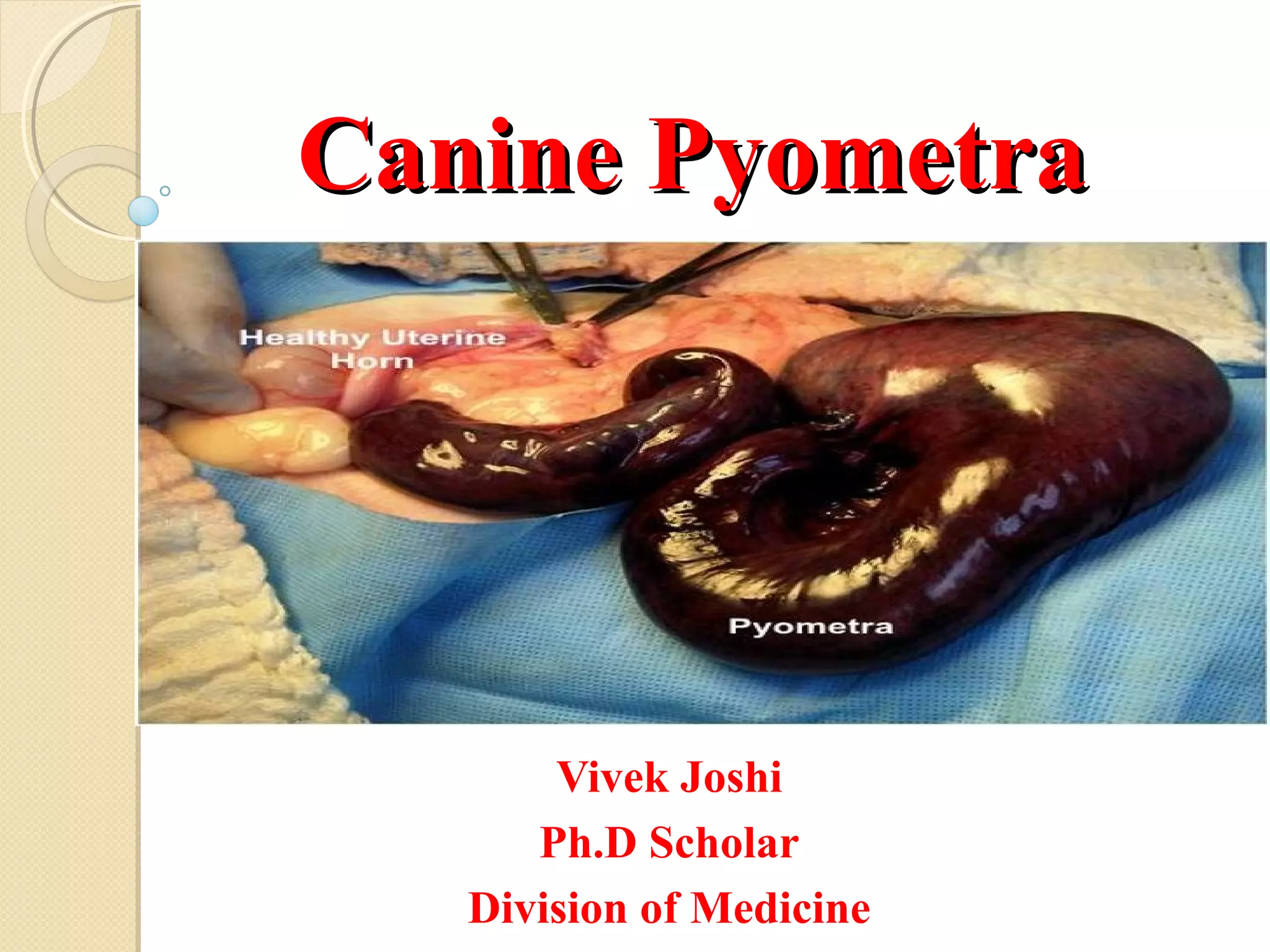
Canine PyometraCanine Pyometra
Vivek Joshi
Ph.D Scholar
Division of Medicine
OverviewOverview
1. Introduction
2. Types
3. Predisposing Factors
4. Aetio-pathogenesis
5. Clinical signs
6. Diagnosis
7. Differential diagnosis
8. Treatment
9. Control
10. Conclusion
IntroductionIntroduction
 Canine pyometra → intact bitches → uterine bacterial
infection → systemic illness
 Etiology: Escherichia coli clones from normal flora
 Early diagnosis & intervention to avoid disastrous
consequences
 Closed-cervix pyometra : medical emergency
PyometraPyometra
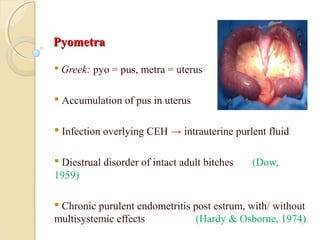
 Greek: pyo = pus, metra = uterus
 Accumulation of pus in uterus
 Infection overlying CEH → intrauterine purlent fluid
 Diestrual disorder of intact adult bitches (Dow,
1959)
 Chronic purulent endometritis post estrum, with/ without
multisystemic effects (Hardy & Osborne, 1974)
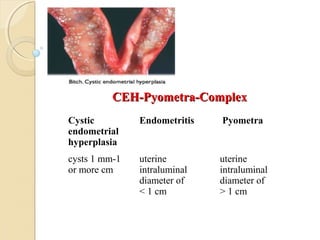
CEH-Pyometra-ComplexCEH-Pyometra-Complex
Cystic
endometrial
hyperplasia
Endometritis Pyometra
cysts 1 mm-1
or more cm
uterine
intraluminal
diameter of
< 1 cm
uterine
intraluminal
diameter of
> 1 cm
CEH-Pyometra-ComplexCEH-Pyometra-Complex
 CEH precedes pyometra
 CEH & pyometra → two separate entities → clinical
manifestations & morphohistological differences
(De Bosschere et al, 2001)
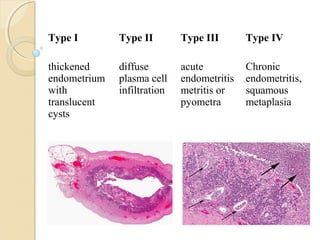
 Four gradations of CEH-Pyometra complex
(Dow, 1959)
Type I Type II Type III Type IV
thickened
endometrium
with
translucent
cysts
diffuse
plasma cell
infiltration
acute
endometritis
metritis or
pyometra
Chronic
endometritis,
squamous
metaplasia
““Open” or “Closed” cervixOpen” or “Closed” cervix
1. Closed pyometra
2. Open pyometra
3. Stump pyometra
 inflammation/ bacterial infection→uterine body
remnant
 Severity of signs : cervix patency
INCIDENCEINCIDENCE
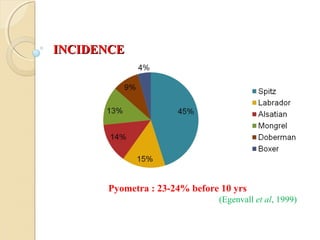
Pyometra : 23-24% before 10 yrs
(Egenvall et al, 1999)
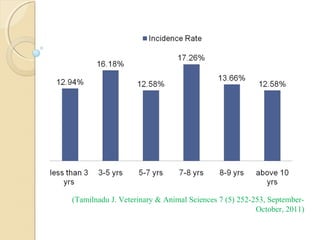
(Tamilnadu J. Veterinary & Animal Sciences 7 (5) 252-253, September-
October, 2011)
Predisposing FactorsPredisposing Factors
Age
 middle-aged or old bitches (> 4 years)
 8.2 years (Dow, 1959)
 2.4 years (Kersey, 2004)
Parity
 nulliparous, intact bitches
Oestrous characteristics
 long diestrus
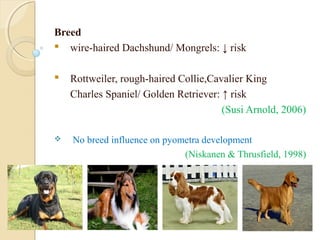
Breed
 wire-haired Dachshund/ Mongrels: ↓ risk
 Rottweiler, rough-haired Collie,Cavalier King
Charles Spaniel/ Golden Retriever: ↑ risk
(Susi Arnold, 2006)
 No breed influence on pyometra development
(Niskanen & Thrusfield, 1998)
PathogenesisPathogenesis
1) Hormonal influence on uterus
2) Virulence of infecting bacteria
3) Ability of bitch to combat infection
4) Individual sensitivity
 Growth factors & their receptors (growth factors
receptors, GFs)
(Gama et al. 2009)
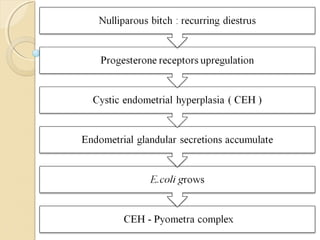
Hormonal influence on uterusHormonal influence on uterus
 Progesterone in aetiology of canine pyometra & its
potentiation by estrogen
Teunissen (1952)
 Prolonged stimulation of uterus by progesterone from cystic
corpora lutea
Hardy & Osborne (1974)
 Steroid hormones influence conc. & distribution of steriod
receptors in uterus & cause pyometra
Dhaliwal et al (1999)
Virulence of infecting bacteriaVirulence of infecting bacteria
 Bacterial infection- not primary cause
 Predominant bacteria (in 82–100% of clinical cases):
Escherichia coli
 E. coli isolates → O serogroups (O4, O6)
(Wadas et al, 1996)
 Uropathogenic virulence factors (UVFs) for extra-intestinal
infection
(Yuri et al, 1999)
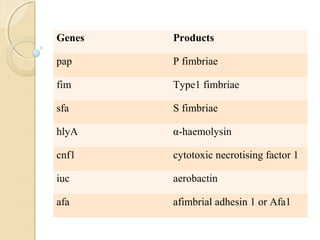
Genes Products
pap P fimbriae
fim Type1 fimbriae
sfa S fimbriae
hlyA α-haemolysin
cnf1 cytotoxic necrotising factor 1
iuc aerobactin
afa afimbrial adhesin 1 or Afa1
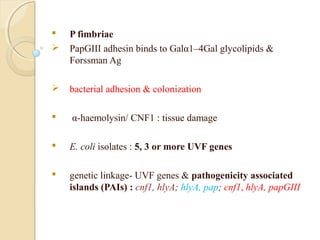
 P fimbriae
 PapGIII adhesin binds to Galα1–4Gal glycolipids &
Forssman Ag
 bacterial adhesion & colonization
 α-haemolysin/ CNF1 : tissue damage
 E. coli isolates : 5, 3 or more UVF genes
 genetic linkage- UVF genes & pathogenicity associated
islands (PAIs) : cnf1, hlyA; hlyA, pap; cnf1, hlyA, papGIII
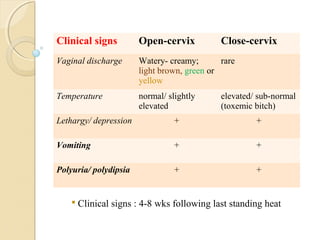
Clinical signs Open-cervix Close-cervix
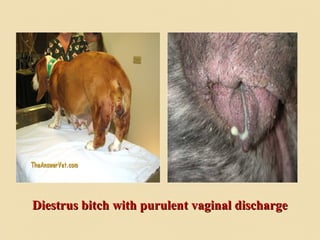
Vaginal discharge Watery- creamy;
light brown, green or
yellow
rare
Temperature normal/ slightly
elevated
elevated/ sub-normal
(toxemic bitch)
Lethargy/ depression + +
Vomiting + +
Polyuria/ polydipsia + +
 Clinical signs : 4-8 wks following last standing heat
Diestrus bitch with purulent vaginal dischargeDiestrus bitch with purulent vaginal discharge
Mechanism of PolyuriaMechanism of Polyuria
 Multifactorial
 Reduced permeability for water in DCT of kidney
(Asheim, 1964)
 Deposition of immune complexes in glomeruli causes
membranoproliferative glomerulonephropathy
(Sandholm et al, 1975)
 Renal tubular insensitivity to ADH due to tubular
damage by E.coli endotoxins
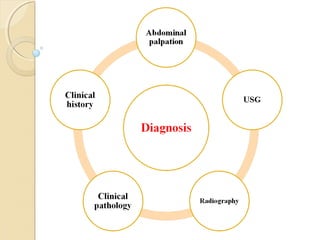
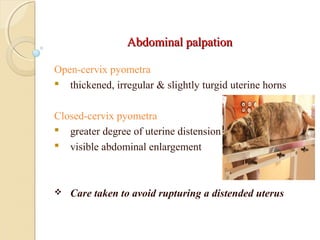
Abdominal palpationAbdominal palpation
Open-cervix pyometra
 thickened, irregular & slightly turgid uterine horns
Closed-cervix pyometra
 greater degree of uterine distension
 visible abdominal enlargement
 Care taken to avoid rupturing a distended uterus
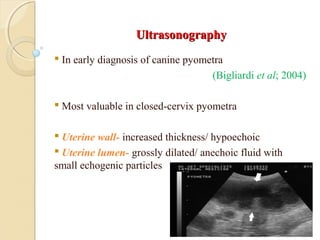
UltrasonographyUltrasonography
 In early diagnosis of canine pyometra
(Bigliardi et al; 2004)
 Most valuable in closed-cervix pyometra
 Uterine wall- increased thickness/ hypoechoic
 Uterine lumen- grossly dilated/ anechoic fluid with
small echogenic particles
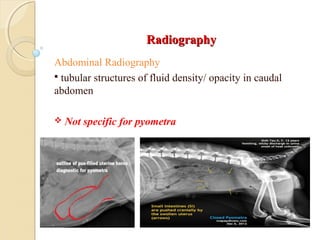
RadiographyRadiography
Abdominal Radiography
 tubular structures of fluid density/ opacity in caudal
abdomen
 Not specific for pyometra
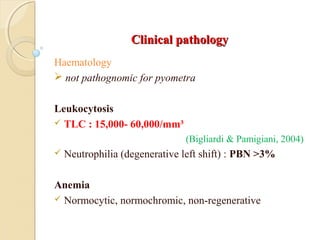
Clinical pathologyClinical pathology
Haematology
 not pathognomic for pyometra
Leukocytosis
 TLC : 15,000- 60,000/mm³
(Bigliardi & Pamigiani, 2004)
 Neutrophilia (degenerative left shift) : PBN >3%
Anemia
 Normocytic, normochromic, non-regenerative
 Hyperglobulinemia
 Hypoalbuminemia
 ↑ ALP, BUN
 ↑ PG-metabolite (SIRS); cTnI / CRP (myocardial
injury→ endotoxemia, septicemia, DIC, secondary uremia)
(Hagman et al, 2007)
Urinalysis
 Hyposthenuria (sp. gravity < 1.030)
TreatmentTreatment
Surgical
 Ovariohysterectomy is treatment of choice
 severely ill bitches : aggressive fluid therapy & broad
spectrum antibiotics
Transcervical Endoscopic Catheterisation (TECT)
(Verstegen et al., 2008)
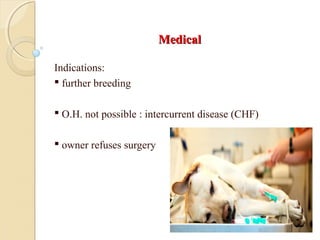
MedicalMedical
Indications:
 further breeding
 O.H. not possible : intercurrent disease (CHF)
 owner refuses surgery
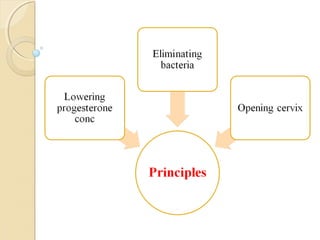
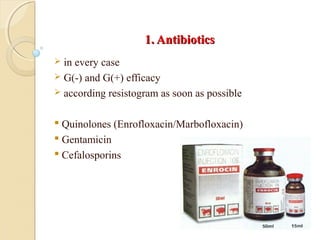
1. Antibiotics1. Antibiotics
 in every case
 G(-) and G(+) efficacy
 according resistogram as soon as possible
 Quinolones (Enrofloxacin/Marbofloxacin)
 Gentamicin
 Cefalosporins
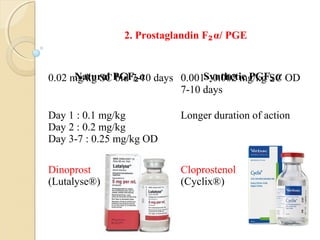
Natural PGF₂α Synthetic PGF₂α0.02 mg/kg SC bid 7-10 days 0.001– 0.002 mg/kg SC OD
7-10 days
Day 1 : 0.1 mg/kg
Day 2 : 0.2 mg/kg
Day 3-7 : 0.25 mg/kg OD
Longer duration of action
Dinoprost
(Lutalyse®)
Cloprostenol
(Cyclix®)
2. Prostaglandin F₂α/ PGE
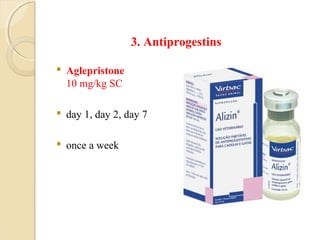
 Aglepristone
10 mg/kg SC
 day 1, day 2, day 7
 once a week
3. Antiprogestins
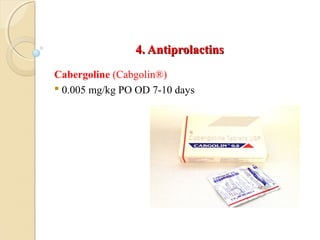
4. Antiprolactins4. Antiprolactins
Cabergoline (Cabgolin®)
 0.005 mg/kg PO OD 7-10 days
5. Supportive therapy5. Supportive therapy
 IV fluids (Lactated Ringer’s sol. /Glucose 5%)
 H₂ blocker : Metoclopramide
(vomiting / nausea)
 NSAIDs
 Antihistaminics
 Anticholinergics (excess salivation)
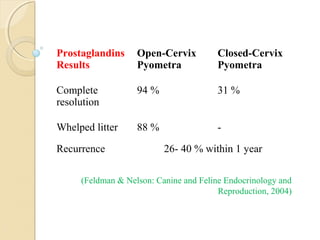
Prostaglandins
Results
Open-Cervix
Pyometra
Closed-Cervix
Pyometra
Complete
resolution
94 % 31 %
Whelped litter 88 % -
Recurrence 26- 40 % within 1 year
(Feldman & Nelson: Canine and Feline Endocrinology and
Reproduction, 2004)
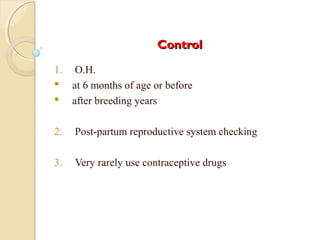
ControlControl
1. O.H.
 at 6 months of age or before
 after breeding years
2. Post-partum reproductive system checking
3. Very rarely use contraceptive drugs
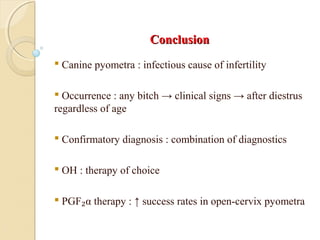
ConclusionConclusion
 Canine pyometra : infectious cause of infertility
 Occurrence : any bitch → clinical signs → after diestrus
regardless of age
 Confirmatory diagnosis : combination of diagnostics
 OH : therapy of choice
 PGF₂α therapy : ↑ success rates in open-cervix pyometra
Canine pyometra

Canine pyometra

  • 1.
    Canine PyometraCanine Pyometra VivekJoshi Ph.D Scholar Division of Medicine
  • 2.
    OverviewOverview 1. Introduction 2. Types 3.Predisposing Factors 4. Aetio-pathogenesis 5. Clinical signs 6. Diagnosis 7. Differential diagnosis 8. Treatment 9. Control 10. Conclusion
  • 3.
    IntroductionIntroduction  Canine pyometra→ intact bitches → uterine bacterial infection → systemic illness  Etiology: Escherichia coli clones from normal flora  Early diagnosis & intervention to avoid disastrous consequences  Closed-cervix pyometra : medical emergency
  • 4.
    PyometraPyometra  Greek: pyo= pus, metra = uterus  Accumulation of pus in uterus  Infection overlying CEH → intrauterine purlent fluid  Diestrual disorder of intact adult bitches (Dow, 1959)  Chronic purulent endometritis post estrum, with/ without multisystemic effects (Hardy & Osborne, 1974)
  • 5.
    CEH-Pyometra-ComplexCEH-Pyometra-Complex Cystic endometrial hyperplasia Endometritis Pyometra cysts 1mm-1 or more cm uterine intraluminal diameter of < 1 cm uterine intraluminal diameter of > 1 cm
  • 6.
    CEH-Pyometra-ComplexCEH-Pyometra-Complex  CEH precedespyometra  CEH & pyometra → two separate entities → clinical manifestations & morphohistological differences (De Bosschere et al, 2001)  Four gradations of CEH-Pyometra complex (Dow, 1959)
  • 7.
    Type I TypeII Type III Type IV thickened endometrium with translucent cysts diffuse plasma cell infiltration acute endometritis metritis or pyometra Chronic endometritis, squamous metaplasia
  • 8.
    ““Open” or “Closed”cervixOpen” or “Closed” cervix 1. Closed pyometra 2. Open pyometra 3. Stump pyometra  inflammation/ bacterial infection→uterine body remnant  Severity of signs : cervix patency
  • 9.
    INCIDENCEINCIDENCE Pyometra : 23-24%before 10 yrs (Egenvall et al, 1999)
  • 10.
    (Tamilnadu J. Veterinary& Animal Sciences 7 (5) 252-253, September- October, 2011)
  • 11.
    Predisposing FactorsPredisposing Factors Age middle-aged or old bitches (> 4 years)  8.2 years (Dow, 1959)  2.4 years (Kersey, 2004) Parity  nulliparous, intact bitches Oestrous characteristics  long diestrus
  • 12.
    Breed  wire-haired Dachshund/Mongrels: ↓ risk  Rottweiler, rough-haired Collie,Cavalier King Charles Spaniel/ Golden Retriever: ↑ risk (Susi Arnold, 2006)  No breed influence on pyometra development (Niskanen & Thrusfield, 1998)
  • 13.
    PathogenesisPathogenesis 1) Hormonal influenceon uterus 2) Virulence of infecting bacteria 3) Ability of bitch to combat infection 4) Individual sensitivity  Growth factors & their receptors (growth factors receptors, GFs) (Gama et al. 2009)
  • 14.
    Hormonal influence onuterusHormonal influence on uterus  Progesterone in aetiology of canine pyometra & its potentiation by estrogen Teunissen (1952)  Prolonged stimulation of uterus by progesterone from cystic corpora lutea Hardy & Osborne (1974)  Steroid hormones influence conc. & distribution of steriod receptors in uterus & cause pyometra Dhaliwal et al (1999)
  • 16.
    Virulence of infectingbacteriaVirulence of infecting bacteria  Bacterial infection- not primary cause  Predominant bacteria (in 82–100% of clinical cases): Escherichia coli  E. coli isolates → O serogroups (O4, O6) (Wadas et al, 1996)  Uropathogenic virulence factors (UVFs) for extra-intestinal infection (Yuri et al, 1999)
  • 17.
    Genes Products pap Pfimbriae fim Type1 fimbriae sfa S fimbriae hlyA α-haemolysin cnf1 cytotoxic necrotising factor 1 iuc aerobactin afa afimbrial adhesin 1 or Afa1
  • 18.
     P fimbriae PapGIII adhesin binds to Galα1–4Gal glycolipids & Forssman Ag  bacterial adhesion & colonization  α-haemolysin/ CNF1 : tissue damage  E. coli isolates : 5, 3 or more UVF genes  genetic linkage- UVF genes & pathogenicity associated islands (PAIs) : cnf1, hlyA; hlyA, pap; cnf1, hlyA, papGIII
  • 19.
    Clinical signs Open-cervixClose-cervix Vaginal discharge Watery- creamy; light brown, green or yellow rare Temperature normal/ slightly elevated elevated/ sub-normal (toxemic bitch) Lethargy/ depression + + Vomiting + + Polyuria/ polydipsia + +  Clinical signs : 4-8 wks following last standing heat
  • 20.
    Diestrus bitch withpurulent vaginal dischargeDiestrus bitch with purulent vaginal discharge
  • 21.
    Mechanism of PolyuriaMechanismof Polyuria  Multifactorial  Reduced permeability for water in DCT of kidney (Asheim, 1964)  Deposition of immune complexes in glomeruli causes membranoproliferative glomerulonephropathy (Sandholm et al, 1975)  Renal tubular insensitivity to ADH due to tubular damage by E.coli endotoxins
  • 23.
    Abdominal palpationAbdominal palpation Open-cervixpyometra  thickened, irregular & slightly turgid uterine horns Closed-cervix pyometra  greater degree of uterine distension  visible abdominal enlargement  Care taken to avoid rupturing a distended uterus
  • 24.
    UltrasonographyUltrasonography  In earlydiagnosis of canine pyometra (Bigliardi et al; 2004)  Most valuable in closed-cervix pyometra  Uterine wall- increased thickness/ hypoechoic  Uterine lumen- grossly dilated/ anechoic fluid with small echogenic particles
  • 25.
    RadiographyRadiography Abdominal Radiography  tubularstructures of fluid density/ opacity in caudal abdomen  Not specific for pyometra
  • 26.
    Clinical pathologyClinical pathology Haematology not pathognomic for pyometra Leukocytosis  TLC : 15,000- 60,000/mm³ (Bigliardi & Pamigiani, 2004)  Neutrophilia (degenerative left shift) : PBN >3% Anemia  Normocytic, normochromic, non-regenerative
  • 27.
     Hyperglobulinemia  Hypoalbuminemia ↑ ALP, BUN  ↑ PG-metabolite (SIRS); cTnI / CRP (myocardial injury→ endotoxemia, septicemia, DIC, secondary uremia) (Hagman et al, 2007) Urinalysis  Hyposthenuria (sp. gravity < 1.030)
  • 28.
    TreatmentTreatment Surgical  Ovariohysterectomy istreatment of choice  severely ill bitches : aggressive fluid therapy & broad spectrum antibiotics Transcervical Endoscopic Catheterisation (TECT) (Verstegen et al., 2008)
  • 29.
    MedicalMedical Indications:  further breeding O.H. not possible : intercurrent disease (CHF)  owner refuses surgery
  • 31.
    1. Antibiotics1. Antibiotics in every case  G(-) and G(+) efficacy  according resistogram as soon as possible  Quinolones (Enrofloxacin/Marbofloxacin)  Gentamicin  Cefalosporins
  • 32.
    Natural PGF₂α SyntheticPGF₂α0.02 mg/kg SC bid 7-10 days 0.001– 0.002 mg/kg SC OD 7-10 days Day 1 : 0.1 mg/kg Day 2 : 0.2 mg/kg Day 3-7 : 0.25 mg/kg OD Longer duration of action Dinoprost (Lutalyse®) Cloprostenol (Cyclix®) 2. Prostaglandin F₂α/ PGE
  • 33.
     Aglepristone 10 mg/kgSC  day 1, day 2, day 7  once a week 3. Antiprogestins
  • 34.
    4. Antiprolactins4. Antiprolactins Cabergoline(Cabgolin®)  0.005 mg/kg PO OD 7-10 days
  • 35.
    5. Supportive therapy5.Supportive therapy  IV fluids (Lactated Ringer’s sol. /Glucose 5%)  H₂ blocker : Metoclopramide (vomiting / nausea)  NSAIDs  Antihistaminics  Anticholinergics (excess salivation)
  • 36.
    Prostaglandins Results Open-Cervix Pyometra Closed-Cervix Pyometra Complete resolution 94 % 31% Whelped litter 88 % - Recurrence 26- 40 % within 1 year (Feldman & Nelson: Canine and Feline Endocrinology and Reproduction, 2004)
  • 37.
    ControlControl 1. O.H.  at6 months of age or before  after breeding years 2. Post-partum reproductive system checking 3. Very rarely use contraceptive drugs
  • 38.
    ConclusionConclusion  Canine pyometra: infectious cause of infertility  Occurrence : any bitch → clinical signs → after diestrus regardless of age  Confirmatory diagnosis : combination of diagnostics  OH : therapy of choice  PGF₂α therapy : ↑ success rates in open-cervix pyometra