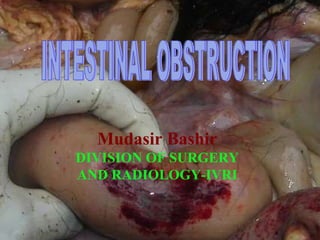
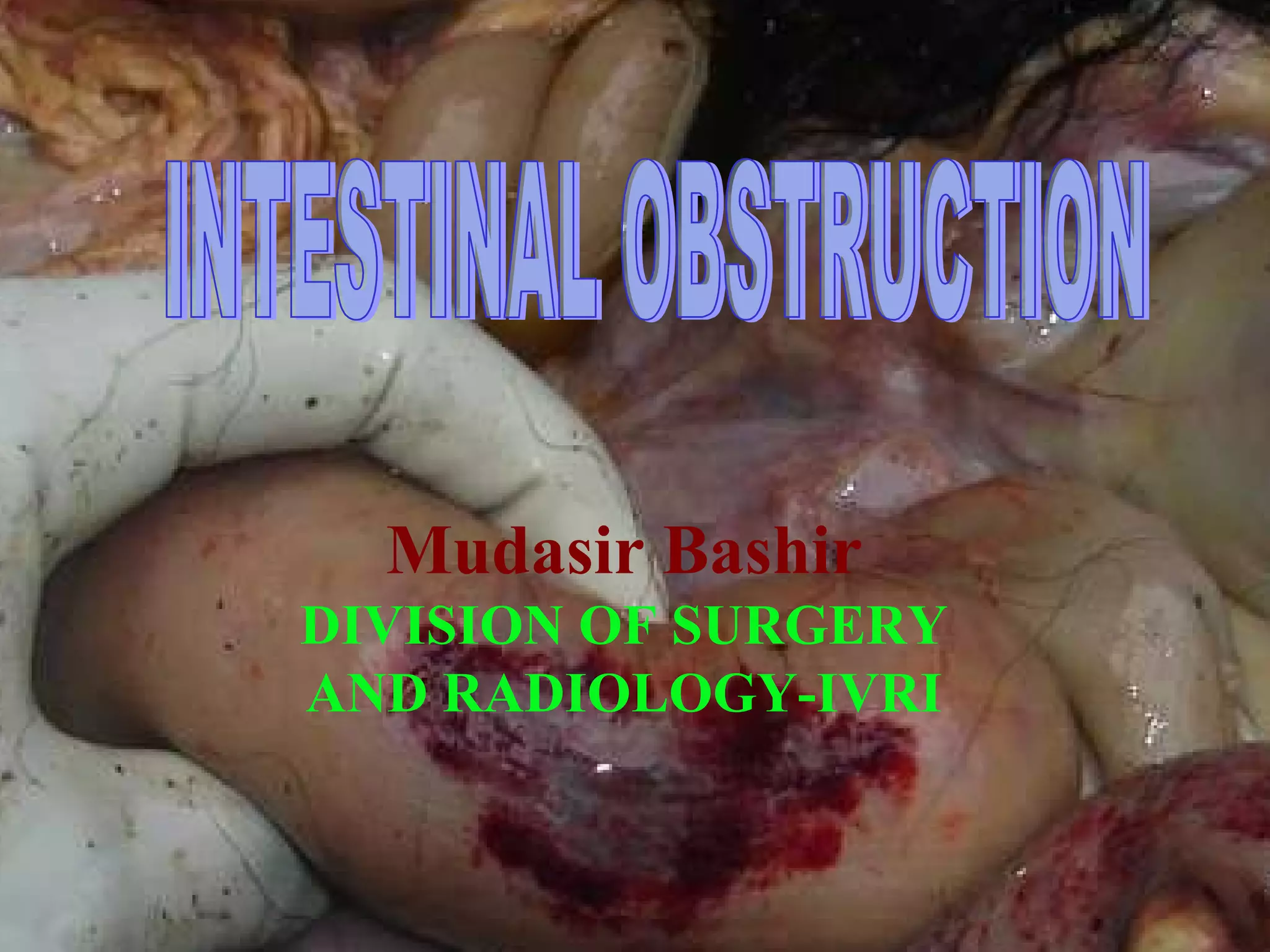
INTESTINAL OBSTRUCTION Mudasir Bashir DIVISION OF SURGERY AND RADIOLOGY-IVRI
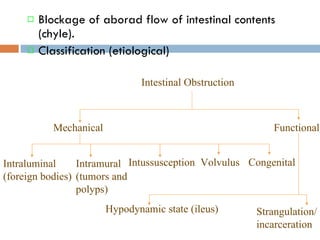
Blockage of aborad flow of intestinal contents (chyle). Classification (etiological) Intestinal Obstruction Mechanical Functional Intraluminal (foreign bodies) Intramural (tumors and  polyps)  Intussusception  Volvulus  Hypodynamic state (ileus) Strangulation/  incarceration Congenital
Clinical Signs Depend upon :- Location   More orad –more acute signs (secretion- absorption) More aborad – mild, non specific and chronic signs Animals with more orad obstruction respond better to fluid and electrolyte therapy.
Obstruction in duodenum and proximal jejeunum-   * Acute vomition especially post-prandial. * Praying posture Obstruction in mid and caudal jejeunum –   *mild, non specific and chronic signs. *Letharginess, anorexia, oligodipsia and  scanty stool Intussusception  – Bloody, fetid smelling feces
Severity   Complete – significant and early signs Partial – few or no signs  (in later stages) Duration  Long standing obstruction – severe signs Early obstruction – few non specific signs.
General signs Depression Lack of responsiveness Halitosis Dehydration with dry mucosa Moaning Painful abdomen (treading and stretching out, kicking at belly, lying on ground) Retching  Bilateral lower abdominal distention at later stages
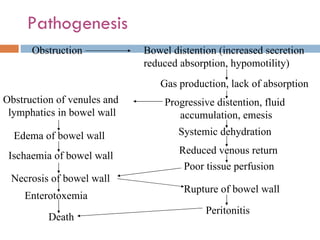
Pathogenesis   Obstruction Bowel distention (increased secretion reduced absorption, hypomotility) Gas production, lack of absorption Progressive distention, fluid  accumulation, emesis Systemic dehydration Reduced venous return Poor tissue perfusion Obstruction of venules and  lymphatics in bowel wall Edema of bowel wall Ischaemia of bowel wall Necrosis of bowel wall Enterotoxemia  Death  Rupture of bowel wall Peritonitis
Sepsis and septic shock sepsis with septic shock occurs as a result of host response to bacterial signal molecules-endotoxin of gram negative,exotoxins of peptidoglycan,lipotechoic acid,etc. Toll-like receptors –essential in innate recognition of microbial signal molecules in triggering acquired immunity. Ten types of TLRs have been found.TLR-4 is essential for lps signelling. Biological effects of LPS-induced host immunolgical responses are- Increased vascular permeability
Extensive microvascular thrombosis disseminated intravascular coagulation. Vasodilatation. Decreased myocardial contractility. Fever. No organ is left by sepsis-multiple organ dysfunction   syndrome. Following are the effects of sepsis and septic shock on different organs:-
Lung -increased alveolar permeability---increased pulmonary fluid----decreased oxygen exchange. GIT -haemorrhagic necrosis of mucosa due to ischaemia. Kidney -acute tubular necrosis---acute renal failure. Liver -stasis of bile,focal necrosis and jaundice. Endocrine and metabolic effects- increased levels of cortisol,catecholamines and glucagon—increased proteolysis,lipolysis and gluconeogenesis. Heart -decreased myocardial function--increased
Systolic and diastolic ventricular volume with a decreased ejection fraction . strangulation obstruction Strangulation—intestinal wall integrity disturbance—ischaemia/haemorrhagic intestinal wall infarction—anoxia and necrosis of bowell wall—bacterial growth and multiplication{bacteroids,clostridium,coliforms}—penetration of bacterial products into peritonium—through portal lymphatic—blood stream—septic shock.
Diagnosis History Clinical findings Physical examination – abdominal palpation Imaging  Radiography Ultrasonography Laparoscopy Measurement of diameters Laboratory examination
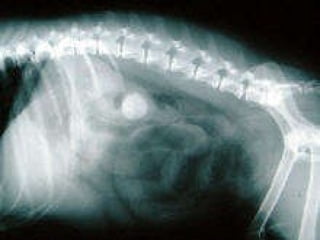
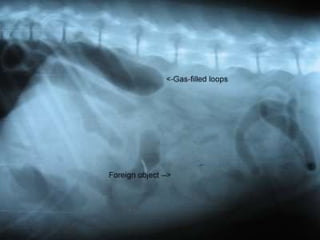
Radiography  Plain  Dilated and gas filled loops of bowel Identifiable foreign body Clumping of bowel + intestinal gas pattern resembling rows of tear drops shaped lucencies arranged in palisades = linear foreign body
Contrast radiography   May take 6-24 hrs Barium  (insoluble contrast agent) Adv. - more details - soothing effect on irritated bowel  Disadv. – very irritating to peritoneum if spilled out  Diatrizoate meglumine (soluble contrast agent)   Adv. – less likely to cause peritonitis Disadv. – poorer details - increases dehydration (hypertonic).
 
 
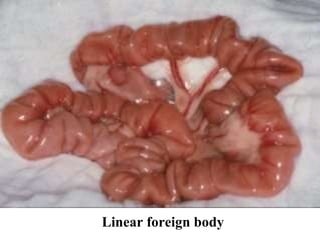
Linear foreign body
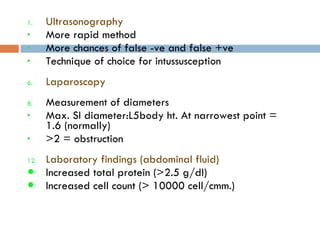
Ultrasonography More rapid method More chances of false -ve and false +ve Technique of choice for intussusception Laparoscopy Measurement of diameters Max. SI diameter:L5body ht. At narrowest point = 1.6 (normally)  >2 = obstruction Laboratory findings (abdominal fluid) Increased total protein (>2.5 g/dl) Increased cell count (> 10000 cell/cmm.)
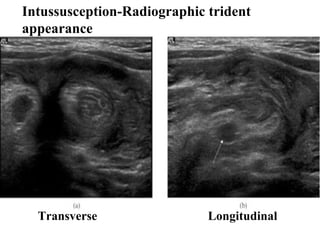
Intussusception-Radiographic trident appearance   Transverse   Longitudinal
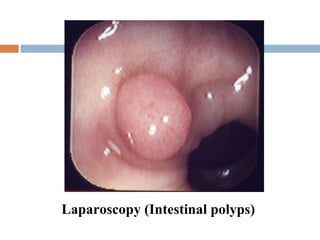
Laparoscopy (Intestinal polyps)
Foreign bodies Most common cause of intestinal obstruction in animals. Space occupying   Round smooth Complete obstruction Trail of distended bowel (aborad propulsion) Pressure necrosis Sharp edged Partial obstruction Perforates bowel wall
Linear foreign body Thread, nylon stockings, rope, string, carpet etc. Most frequent in cats  One end  – tongue base, pharynx, pylorus Other end  – carried to intestine through peristalsis Mesenteric side  – perforations Oral examination  – most important Abdominal examination  – pain, pleating and clumping of intestine Radiography Rx  - surgical emergency - enterotomy (multiple or single)
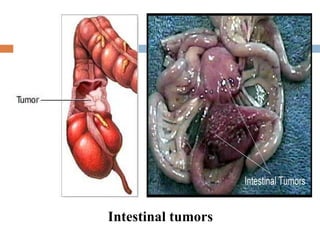
Tumors  Mostly malignant (thoracic radiography and hepatic ultrasonography). Adenocarcinoma  bowel stricture Most common – distal jejunum and ileum Treatment unrewarding Leiomyoma/ Leiomyosarcoma Impinge on bowel lumen Leiomyoma- good prognosis Leiomyosarcoma- grave prognosis
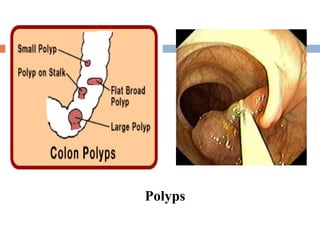
Lymphosarcoma Protein losing enteropathy – most common Chemotherapy is treatment of choice Adenoma  Also known as polyps Partial obstruction Irritation - intussussception
Polyps
Intestinal tumors
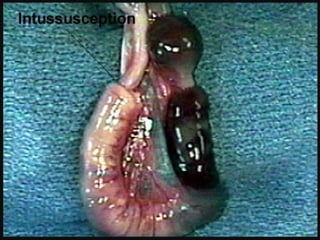
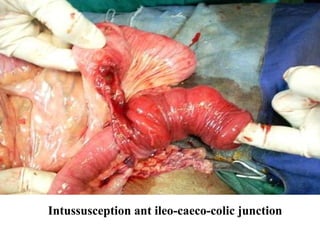
Intussusception  Invagination or telescopy of intestines Intussusceptum – intussuscipiens Hypermotility (irritataed bowel) Partial obstruction – complete obstruction Ileo-caeco-colic junction – most common site Common in young pups Rx Laparotomy – release of invagination with or without intestinal resection and anastomosis.
 
Intussusception ant ileo-caeco-colic junction
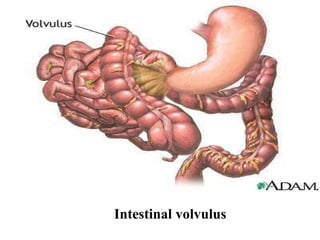
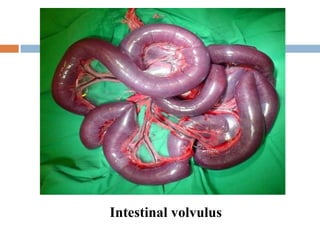
Volvulus  Twisting of intestine on its mesenteric axis Susceptibility –  GSD – dogs with GSD blood – other breeds. Radiograph – massive dilation of multiple loops of bowel in stellate pattern originating from a central focus. Prognosis – very grave.
Intestinal volvulus
Intestinal volvulus
Congenital defects Atresia of intestinal segments Signs visible in neonatal life Intestinal resection and anastomosis - only cure.
 
Ileus / Pseudo- obstruction Def.  – ineffective aborad intestinal propulsion Occurs  – (a) after surgery (b) secondary to diseases (uremia, peritonitis, pancreatitis)  Mainly due to electrolyte disturbances Usually transient Rx  – (a) prokinetic drugs (b) correction of electrolyte disturbance (c) correction of underlying disease
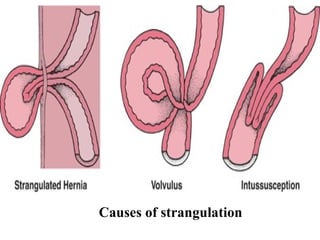
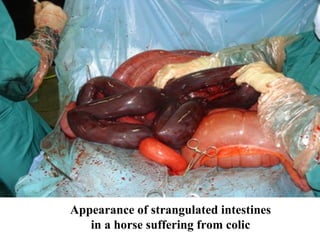
Strangulation / Incarceration Entrapment of intestines in traumatic wall hernia, omental tears, congenital hernia, mesenteric rents, volvulus and intussusception. Compression of intestinal veins – inhibition of arterial flow – mucosal degeneration – endotoxemic shock and peritonitis (perforation)  Stabilize the animal – enterotomy / anastomosis Prognosis - grave
Causes of strangulation
Appearance of strangulated intestines in a horse suffering from colic
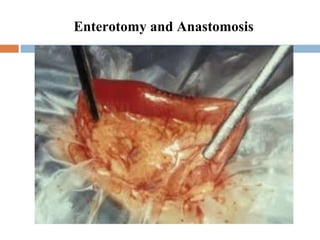
Intestinal Surgery GENERAL PRINCIPLES Maintenance of fluid and electrolyte imbalance (hypokalemia, hypochloremia, hyponatremia and metabolic acidosis) Antibiotic prophylaxis (contaminated or clean contaminated surgery) Assessment of intestinal viability Choice of suture material  Monofilament synthetic absorbable (polydioxanone, polyglyconate)
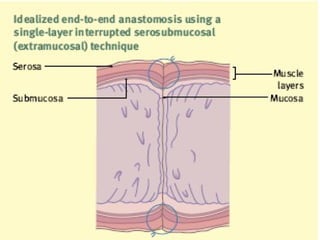
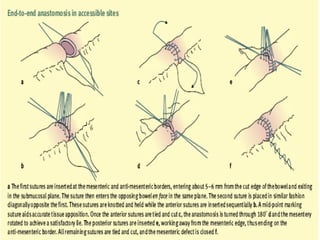
Choice of suture pattern Submucosa (incorporation) * Single layer – preferred * Double layered – Avascular necrosis of inverted cuff of tissues  - Narrowing of lumen. inadequate submucosal apposition.  .
* Apposition – preferred method * Eversion  - adhesions * Inversion – reduced intestinal lumen Interrupted single layered serosubmucosal suture pattern – gold standard Suture line enforcement Prevention of leakage Revascularization  Omental wrapping Serosal patching (surgical parachute)
 
Enterotomy and Anastomosis
 
THANK YOU

Intestinal Obstruction, MUDASIR BASHIR

  • 1.
    INTESTINAL OBSTRUCTION MudasirBashir DIVISION OF SURGERY AND RADIOLOGY-IVRI
  • 2.
    Blockage of aboradflow of intestinal contents (chyle). Classification (etiological) Intestinal Obstruction Mechanical Functional Intraluminal (foreign bodies) Intramural (tumors and polyps) Intussusception Volvulus Hypodynamic state (ileus) Strangulation/ incarceration Congenital
  • 3.
    Clinical Signs Dependupon :- Location More orad –more acute signs (secretion- absorption) More aborad – mild, non specific and chronic signs Animals with more orad obstruction respond better to fluid and electrolyte therapy.
  • 4.
    Obstruction in duodenumand proximal jejeunum- * Acute vomition especially post-prandial. * Praying posture Obstruction in mid and caudal jejeunum – *mild, non specific and chronic signs. *Letharginess, anorexia, oligodipsia and scanty stool Intussusception – Bloody, fetid smelling feces
  • 5.
    Severity Complete – significant and early signs Partial – few or no signs (in later stages) Duration Long standing obstruction – severe signs Early obstruction – few non specific signs.
  • 6.
    General signs DepressionLack of responsiveness Halitosis Dehydration with dry mucosa Moaning Painful abdomen (treading and stretching out, kicking at belly, lying on ground) Retching Bilateral lower abdominal distention at later stages
  • 7.
    Pathogenesis Obstruction Bowel distention (increased secretion reduced absorption, hypomotility) Gas production, lack of absorption Progressive distention, fluid accumulation, emesis Systemic dehydration Reduced venous return Poor tissue perfusion Obstruction of venules and lymphatics in bowel wall Edema of bowel wall Ischaemia of bowel wall Necrosis of bowel wall Enterotoxemia Death Rupture of bowel wall Peritonitis
  • 8.
    Sepsis and septicshock sepsis with septic shock occurs as a result of host response to bacterial signal molecules-endotoxin of gram negative,exotoxins of peptidoglycan,lipotechoic acid,etc. Toll-like receptors –essential in innate recognition of microbial signal molecules in triggering acquired immunity. Ten types of TLRs have been found.TLR-4 is essential for lps signelling. Biological effects of LPS-induced host immunolgical responses are- Increased vascular permeability
  • 9.
    Extensive microvascular thrombosisdisseminated intravascular coagulation. Vasodilatation. Decreased myocardial contractility. Fever. No organ is left by sepsis-multiple organ dysfunction syndrome. Following are the effects of sepsis and septic shock on different organs:-
  • 10.
    Lung -increased alveolarpermeability---increased pulmonary fluid----decreased oxygen exchange. GIT -haemorrhagic necrosis of mucosa due to ischaemia. Kidney -acute tubular necrosis---acute renal failure. Liver -stasis of bile,focal necrosis and jaundice. Endocrine and metabolic effects- increased levels of cortisol,catecholamines and glucagon—increased proteolysis,lipolysis and gluconeogenesis. Heart -decreased myocardial function--increased
  • 11.
    Systolic and diastolicventricular volume with a decreased ejection fraction . strangulation obstruction Strangulation—intestinal wall integrity disturbance—ischaemia/haemorrhagic intestinal wall infarction—anoxia and necrosis of bowell wall—bacterial growth and multiplication{bacteroids,clostridium,coliforms}—penetration of bacterial products into peritonium—through portal lymphatic—blood stream—septic shock.
  • 12.
    Diagnosis History Clinicalfindings Physical examination – abdominal palpation Imaging Radiography Ultrasonography Laparoscopy Measurement of diameters Laboratory examination
  • 13.
    Radiography Plain Dilated and gas filled loops of bowel Identifiable foreign body Clumping of bowel + intestinal gas pattern resembling rows of tear drops shaped lucencies arranged in palisades = linear foreign body
  • 14.
    Contrast radiography May take 6-24 hrs Barium (insoluble contrast agent) Adv. - more details - soothing effect on irritated bowel Disadv. – very irritating to peritoneum if spilled out Diatrizoate meglumine (soluble contrast agent) Adv. – less likely to cause peritonitis Disadv. – poorer details - increases dehydration (hypertonic).
  • 15.
  • 16.
  • 17.
  • 18.
    Ultrasonography More rapidmethod More chances of false -ve and false +ve Technique of choice for intussusception Laparoscopy Measurement of diameters Max. SI diameter:L5body ht. At narrowest point = 1.6 (normally) >2 = obstruction Laboratory findings (abdominal fluid) Increased total protein (>2.5 g/dl) Increased cell count (> 10000 cell/cmm.)
  • 19.
  • 20.
  • 21.
    Foreign bodies Mostcommon cause of intestinal obstruction in animals. Space occupying Round smooth Complete obstruction Trail of distended bowel (aborad propulsion) Pressure necrosis Sharp edged Partial obstruction Perforates bowel wall
  • 22.
    Linear foreign bodyThread, nylon stockings, rope, string, carpet etc. Most frequent in cats One end – tongue base, pharynx, pylorus Other end – carried to intestine through peristalsis Mesenteric side – perforations Oral examination – most important Abdominal examination – pain, pleating and clumping of intestine Radiography Rx - surgical emergency - enterotomy (multiple or single)
  • 23.
    Tumors Mostlymalignant (thoracic radiography and hepatic ultrasonography). Adenocarcinoma bowel stricture Most common – distal jejunum and ileum Treatment unrewarding Leiomyoma/ Leiomyosarcoma Impinge on bowel lumen Leiomyoma- good prognosis Leiomyosarcoma- grave prognosis
  • 24.
    Lymphosarcoma Protein losingenteropathy – most common Chemotherapy is treatment of choice Adenoma Also known as polyps Partial obstruction Irritation - intussussception
  • 25.
  • 26.
  • 27.
    Intussusception Invaginationor telescopy of intestines Intussusceptum – intussuscipiens Hypermotility (irritataed bowel) Partial obstruction – complete obstruction Ileo-caeco-colic junction – most common site Common in young pups Rx Laparotomy – release of invagination with or without intestinal resection and anastomosis.
  • 28.
  • 29.
  • 30.
    Volvulus Twistingof intestine on its mesenteric axis Susceptibility – GSD – dogs with GSD blood – other breeds. Radiograph – massive dilation of multiple loops of bowel in stellate pattern originating from a central focus. Prognosis – very grave.
  • 31.
  • 32.
  • 33.
    Congenital defects Atresiaof intestinal segments Signs visible in neonatal life Intestinal resection and anastomosis - only cure.
  • 34.
  • 35.
    Ileus / Pseudo-obstruction Def. – ineffective aborad intestinal propulsion Occurs – (a) after surgery (b) secondary to diseases (uremia, peritonitis, pancreatitis) Mainly due to electrolyte disturbances Usually transient Rx – (a) prokinetic drugs (b) correction of electrolyte disturbance (c) correction of underlying disease
  • 36.
    Strangulation / IncarcerationEntrapment of intestines in traumatic wall hernia, omental tears, congenital hernia, mesenteric rents, volvulus and intussusception. Compression of intestinal veins – inhibition of arterial flow – mucosal degeneration – endotoxemic shock and peritonitis (perforation) Stabilize the animal – enterotomy / anastomosis Prognosis - grave
  • 37.
  • 38.
    Appearance of strangulatedintestines in a horse suffering from colic
  • 39.
    Intestinal Surgery GENERALPRINCIPLES Maintenance of fluid and electrolyte imbalance (hypokalemia, hypochloremia, hyponatremia and metabolic acidosis) Antibiotic prophylaxis (contaminated or clean contaminated surgery) Assessment of intestinal viability Choice of suture material Monofilament synthetic absorbable (polydioxanone, polyglyconate)
  • 40.
    Choice of suturepattern Submucosa (incorporation) * Single layer – preferred * Double layered – Avascular necrosis of inverted cuff of tissues - Narrowing of lumen. inadequate submucosal apposition. .
  • 41.
    * Apposition –preferred method * Eversion - adhesions * Inversion – reduced intestinal lumen Interrupted single layered serosubmucosal suture pattern – gold standard Suture line enforcement Prevention of leakage Revascularization Omental wrapping Serosal patching (surgical parachute)
  • 42.
  • 43.
  • 44.
  • 45.