1
2
Azoturia
 Paralytic myoglobinuria,
 Lumbago,
 Monday morning disease,
 Tying-up syndrome,
 Exertional rhabdomyolysis
3
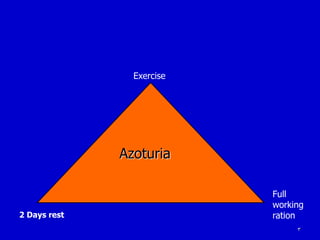
Azoturia
Exercise
2 Days rest
Full
working
ration
4
Definition:
 It is multifactorial myopathy affecting mainly
draft horses and less frequently the race
horses.
 The disease is a metabolic muscular disorder
of horses characterized clinically by
 stiffness in gait,
 lameness and swelling and
 hardening of massive muscles
 Biochemically: the presence of myoglobin pigments in
urine (myoglobinuria).
5
Incidence, occurrence and
predisposing factor:
 1- The disease affects mostly draft
(draught) horses but race horses are
sporadically affected.
 2- the disease occurs during exercise after
a period of at least 2 days of complete
rest on a full working ration.
6
Etiology and pathogenesis
 1-Carbohydrate Overloading
 The major cause is feeding the draught horse on full
working ration during resting at weekend and when the
horse returns to work several days later it suffers an attack
of the disease.
 The muscle glycogen accumulates during the rest period
and when used during exercise, it produces excessive lactic
acid in a rate higher than removal by blood vessels leading
to lactic acid accumulation.
 This causes local tissue damage (myopathy) and constriction of the
blood vessels, resulting in decreased blood flow to the tissues and
further reduction in lactic acid removal.
 Accumulation of sarcolactic acid in muscles produces swelling and
hardening of muscle (hard board-like).
7
 2-Local Hypoxia
 Certain types of muscle fibers are larger,
have greater glycogen stores and fewer
surrounding blood vessels than others.
 Local hypoxia (lack of oxygen supplied by
the blood) may increase the lactic acid
production in these fibers.
8
 3-Thiamine Deficiency
 Thiamine (one of the Vitamin B complex)
involved in the metabolism of waste
products from muscle activity.
 Therefore, a deficiency could lead to a
build up of these waste products and
hence, lactic acidosis.
9
 4-Vitamin E and Selenium Deficiency
 This theory is based on reports of success at
preventing further episodes following
supplementation (antioxidant).
 5-Hormonal Disturbances
 Reproductive hormones, thyroid hormones
and cortisol have all been implicated in equine
rhabdomyolosis.
 6-Electrolyte Imbalances
 Chronic sodium and/or potassium deficiencies
may be involved in chronic equine
rhabdomyolosis.
10
Pathogenesis
 1- During exercise the large store of
glycogen formed during the period of rest
in the muscles metabolized to sarcolactic
acid.
 2- Accumulation of lactic acid leads to:
 a- Degeneration of the muscles and liberation of
myoglobin (muscle haemoglobin)
 b- Swelling of muscle because lactic acid is
hydrophilic.
11
Clinical signs
Signs develop 15 -60 min after beginning of exercise. Clinical
signs vary according to the amount of exercise and extend
of muscle damage:
A- In very mild cases that receive little amount of exercise,
only poor performance is observed.
B- In mild cases, stiffness in gait are observed.
C- In severe cases, which receive excessive exercise:
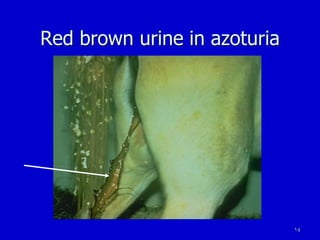
 Profuse sweating, stiffness in gait and reluctance to move.
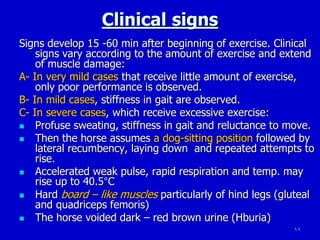
 Then the horse assumes a dog-sitting position followed by
lateral recumbency, laying down and repeated attempts to
rise.
 Accelerated weak pulse, rapid respiration and temp. may
rise up to 40.5°C
 Hard board – like muscles particularly of hind legs (gluteal
and quadriceps femoris)
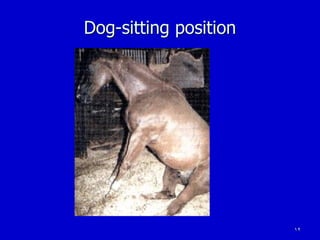
 The horse voided dark – red brown urine (Hburia)
12
Dog-sitting position
13
Dog sitting position (lumbago)
14
Red brown urine in azoturia
15
Profuse sweating
Clinical sign of lactation tetany
16
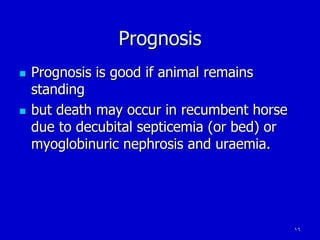
Prognosis
 Prognosis is good if animal remains
standing
 but death may occur in recumbent horse
due to decubital septicemia (or bed) or
myoglobinuric nephrosis and uraemia.
17
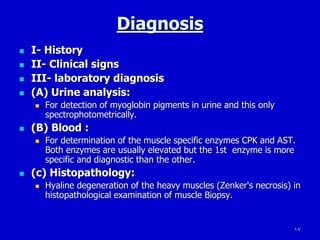
Diagnosis
 I- History
 II- Clinical signs
 III- laboratory diagnosis
 (A) Urine analysis:
 For detection of myoglobin pigments in urine and this only
spectrophotometrically.
 (B) Blood :
 For determination of the muscle specific enzymes CPK and AST.
Both enzymes are usually elevated but the 1st enzyme is more
specific and diagnostic than the other.
 (c) Histopathology:
 Hyaline degeneration of the heavy muscles (Zenker's necrosis) in
histopathological examination of muscle Biopsy.
18
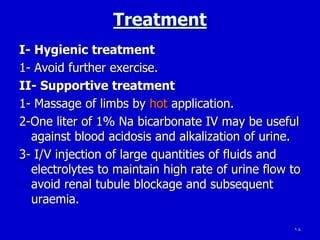
Treatment
I- Hygienic treatment
1- Avoid further exercise.
II- Supportive treatment
1- Massage of limbs by hot application.
2-One liter of 1% Na bicarbonate IV may be useful
against blood acidosis and alkalization of urine.
3- I/V injection of large quantities of fluids and
electrolytes to maintain high rate of urine flow to
avoid renal tubule blockage and subsequent
uraemia.
19
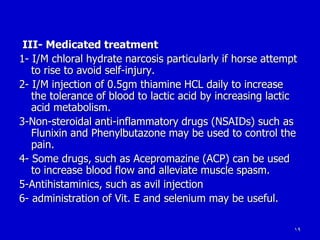
III- Medicated treatment
1- I/M chloral hydrate narcosis particularly if horse attempt
to rise to avoid self-injury.
2- I/M injection of 0.5gm thiamine HCL daily to increase
the tolerance of blood to lactic acid by increasing lactic
acid metabolism.
3-Non-steroidal anti-inflammatory drugs (NSAIDs) such as
Flunixin and Phenylbutazone may be used to control the
pain.
4- Some drugs, such as Acepromazine (ACP) can be used
to increase blood flow and alleviate muscle spasm.
5-Antihistaminics, such as avil injection
6- administration of Vit. E and selenium may be useful.
20
Control (prevention)
1 -Reduce the working ration (particularly
grains) to 0. 5, the amount during the
period of rest.
2-Exercise should start light then gradually
increased.
21
Thank You

Azoturia- Paralytic myoglobinuria-

  • 1.
  • 2.
    2 Azoturia  Paralytic myoglobinuria, Lumbago,  Monday morning disease,  Tying-up syndrome,  Exertional rhabdomyolysis
  • 3.
  • 4.
    4 Definition:  It ismultifactorial myopathy affecting mainly draft horses and less frequently the race horses.  The disease is a metabolic muscular disorder of horses characterized clinically by  stiffness in gait,  lameness and swelling and  hardening of massive muscles  Biochemically: the presence of myoglobin pigments in urine (myoglobinuria).
  • 5.
    5 Incidence, occurrence and predisposingfactor:  1- The disease affects mostly draft (draught) horses but race horses are sporadically affected.  2- the disease occurs during exercise after a period of at least 2 days of complete rest on a full working ration.
  • 6.
    6 Etiology and pathogenesis 1-Carbohydrate Overloading  The major cause is feeding the draught horse on full working ration during resting at weekend and when the horse returns to work several days later it suffers an attack of the disease.  The muscle glycogen accumulates during the rest period and when used during exercise, it produces excessive lactic acid in a rate higher than removal by blood vessels leading to lactic acid accumulation.  This causes local tissue damage (myopathy) and constriction of the blood vessels, resulting in decreased blood flow to the tissues and further reduction in lactic acid removal.  Accumulation of sarcolactic acid in muscles produces swelling and hardening of muscle (hard board-like).
  • 7.
    7  2-Local Hypoxia Certain types of muscle fibers are larger, have greater glycogen stores and fewer surrounding blood vessels than others.  Local hypoxia (lack of oxygen supplied by the blood) may increase the lactic acid production in these fibers.
  • 8.
    8  3-Thiamine Deficiency Thiamine (one of the Vitamin B complex) involved in the metabolism of waste products from muscle activity.  Therefore, a deficiency could lead to a build up of these waste products and hence, lactic acidosis.
  • 9.
    9  4-Vitamin Eand Selenium Deficiency  This theory is based on reports of success at preventing further episodes following supplementation (antioxidant).  5-Hormonal Disturbances  Reproductive hormones, thyroid hormones and cortisol have all been implicated in equine rhabdomyolosis.  6-Electrolyte Imbalances  Chronic sodium and/or potassium deficiencies may be involved in chronic equine rhabdomyolosis.
  • 10.
    10 Pathogenesis  1- Duringexercise the large store of glycogen formed during the period of rest in the muscles metabolized to sarcolactic acid.  2- Accumulation of lactic acid leads to:  a- Degeneration of the muscles and liberation of myoglobin (muscle haemoglobin)  b- Swelling of muscle because lactic acid is hydrophilic.
  • 11.
    11 Clinical signs Signs develop15 -60 min after beginning of exercise. Clinical signs vary according to the amount of exercise and extend of muscle damage: A- In very mild cases that receive little amount of exercise, only poor performance is observed. B- In mild cases, stiffness in gait are observed. C- In severe cases, which receive excessive exercise:  Profuse sweating, stiffness in gait and reluctance to move.  Then the horse assumes a dog-sitting position followed by lateral recumbency, laying down and repeated attempts to rise.  Accelerated weak pulse, rapid respiration and temp. may rise up to 40.5°C  Hard board – like muscles particularly of hind legs (gluteal and quadriceps femoris)  The horse voided dark – red brown urine (Hburia)
  • 12.
  • 13.
  • 14.
    14 Red brown urinein azoturia
  • 15.
  • 16.
    16 Prognosis  Prognosis isgood if animal remains standing  but death may occur in recumbent horse due to decubital septicemia (or bed) or myoglobinuric nephrosis and uraemia.
  • 17.
    17 Diagnosis  I- History II- Clinical signs  III- laboratory diagnosis  (A) Urine analysis:  For detection of myoglobin pigments in urine and this only spectrophotometrically.  (B) Blood :  For determination of the muscle specific enzymes CPK and AST. Both enzymes are usually elevated but the 1st enzyme is more specific and diagnostic than the other.  (c) Histopathology:  Hyaline degeneration of the heavy muscles (Zenker's necrosis) in histopathological examination of muscle Biopsy.
  • 18.
    18 Treatment I- Hygienic treatment 1-Avoid further exercise. II- Supportive treatment 1- Massage of limbs by hot application. 2-One liter of 1% Na bicarbonate IV may be useful against blood acidosis and alkalization of urine. 3- I/V injection of large quantities of fluids and electrolytes to maintain high rate of urine flow to avoid renal tubule blockage and subsequent uraemia.
  • 19.
    19 III- Medicated treatment 1-I/M chloral hydrate narcosis particularly if horse attempt to rise to avoid self-injury. 2- I/M injection of 0.5gm thiamine HCL daily to increase the tolerance of blood to lactic acid by increasing lactic acid metabolism. 3-Non-steroidal anti-inflammatory drugs (NSAIDs) such as Flunixin and Phenylbutazone may be used to control the pain. 4- Some drugs, such as Acepromazine (ACP) can be used to increase blood flow and alleviate muscle spasm. 5-Antihistaminics, such as avil injection 6- administration of Vit. E and selenium may be useful.
  • 20.
    20 Control (prevention) 1 -Reducethe working ration (particularly grains) to 0. 5, the amount during the period of rest. 2-Exercise should start light then gradually increased.
  • 21.